The McMartin prosecution, The Order, the murder of Mulugeta Seraw, and two killings described in court as occult-motivated do not form a simple contest between imaginary and real groups. Read carefully, the records show something more useful: investigators succeed when identity, agreement, conduct, and causation are proved independently of the label placed on a case.
Group Violence: A Proof-First Taxonomy
The hardest question in an alleged group crime is not whether a group can be named. It is whether the evidence shows that a criminal group existed, who belonged to it, what its members agreed to do, and which acts can be attributed to which people. That distinction sounds elementary. The cases considered here show how quickly it can disappear when an allegation carries exceptional emotional or political force.
The McMartin Preschool case began with an allegation of child sexual abuse and expanded into claims involving many children, multiple adults, ritual acts, pornography, animals, and underground spaces. Seven people were charged at one stage, but no one was convicted. It is therefore inaccurate to classify McMartin as a proven form of “group-motivated crime.” It is better understood as an alleged group-crime case in which the reliability and independence of the principal evidence became the central dispute.
The Order presents the opposite evidentiary problem. It was a real white supremacist organization whose members planned crimes, stole money, moved proceeds, kept weapons and documents, and killed people. The Ninth Circuit’s account describes an association formed in 1983 to pursue violent “direct action,” followed by bank and armored-car robberies, counterfeiting, two killings, fugitive assistance, and the distribution of stolen funds. Those facts did not depend on an investigator deciding that a symbol looked sinister. They were established through participant testimony, physical and documentary evidence, searches, financial proof, and relationships among completed crimes. The appellate decision is the soundest starting point for the case.
The murder of Mulugeta Seraw falls into a third category. Three local racist skinheads were criminally convicted. A later civil jury found that leaders of White Aryan Resistance, or WAR, had substantially assisted or encouraged the Oregon defendants through agents, participated in a conspiracy that led to Seraw’s death, and recklessly selected or retained agents to organize East Side White Pride. That chain was not inferred merely from shared racist beliefs; it was litigated through testimony, correspondence, and evidence of organizing. The Oregon Court of Appeals preserved the jury’s findings.
Finally, the murders of Teresa Simmons in Georgia and Steven Newberry in Missouri involved small groups of offenders. Courts recorded testimony that the offenders used satanic language or understood the killings in ritual terms. But those cases were solved and proved through ordinary evidence: admissions, accomplice testimony, the recovery of bodies and objects, and physical details that corroborated parts of the accounts. They show that a professed occult motive may be relevant without becoming a substitute for proof of the homicide itself.
These are not two kinds of “group”: tangible organizations and intangible conspiracies. They are four different evidentiary situations. A defensible taxonomy distinguishes a proven enterprise, a civilly established organizational connection, a small co-offender group, and an allegation cascade in which the claimed organization was never proved.
McMartin: From One Report to a Community-Wide Inquiry
The McMartin Preschool investigation began in Manhattan Beach, California, in August 1983, when Judy Johnson reported that her two-and-a-half-year-old son had been sexually abused by Raymond Buckey, a teacher at the family-run preschool.
Later accounts sometimes dismiss the report by saying the first examination found no evidence. The contemporary record is more complicated. Reports described physicians who interpreted findings as consistent with abuse, while a defense expert later testified that the first examination showed no sign even consistent with sodomy and that a later examination supplied evidence of some form of sexual abuse. Other prosecution physicians interpreted scarring in several children as evidence of penetration; the defense disputed the reliability and meaning of those findings.
The accurate formulation is not “there was no medical evidence.” It is that the medical evidence was contested and did not identify an offender or corroborate the extraordinary ritual allegations. Contemporary reporting reflects that dispute.
Johnson later made increasingly extraordinary claims. Contemporary reports described allegations that Buckey could fly, that children had been made to drink blood, and that ritual activity had occurred elsewhere. Johnson was later reported to have been diagnosed with paranoid schizophrenia.
That history is relevant to the reliability of her later statements, but it should not be used as a shortcut for deciding the truth of every allegation. A person’s diagnosis does not prove that a reported event did or did not occur. The proper response was to test each claim for independent corroboration. A later case history reports the diagnosis; contemporary coverage documents the dispute over Johnson’s mental condition and the prosecution’s handling of related records.
On September 8, 1983, Manhattan Beach Police Chief Harry Kuhlmeyer sent a letter to roughly 200 current and former McMartin families. The letter named Raymond Buckey, described suspected sexual acts, and asked parents to question their children about whether they had witnessed or experienced crimes. The text of the letter matters because it shows that families were not approached through a neutral, blind inquiry. They were told the suspect’s identity and the suspected conduct before many children were interviewed professionally.
That did not make every later statement false. It did, however, create a serious source-monitoring problem. Investigators needed to know whether a detail originated with a child, a parent, another family, a news report, or an interviewer. Once parents had questioned children and families had spoken with one another, repetition could no longer be treated automatically as independent corroboration. The number of people repeating an allegation and the number of independent sources for it were not the same thing.
The district attorney’s office referred families to Children’s Institute International, where Kee MacFarlane and other interviewers used puppets, anatomically detailed dolls, drawings, peer information, repeated questions, and invitations to speculate. It is sometimes claimed that every technique and quotation came from MacFarlane personally. That is not supported. The surviving record concerns a CII team, and some of the best-known exchanges were conducted by another interviewer, Shawn Connerly.
MacFarlane later testified that she personally interviewed about 80 McMartin children; CII as a whole interviewed about 400. Contemporary Los Angeles Times reporting said approximately 350 were judged by the center to have been abused, although the criminal case ultimately involved a much smaller set of complainants. The Times’ account of MacFarlane’s testimony is more precise than saying the number of “victims” simply rose above 360.
The Interview Record and Its Limits
Later empirical work identified techniques in the McMartin interviews that researchers considered problematic: suggestive questions, references to what other children supposedly said, praise or criticism, repeated questions, invitations to pretend or guess, and the introduction of stereotypes.
A 2006 case study of the transcripts described interviewers telling children that other children knew “secrets” and asking them to help solve the puzzle. Experimental work using techniques identified in the interviews showed that social influence and reinforcement could produce false allegations more often than suggestive questions alone.
Those findings support a careful criticism: the methods increased the risk that some answers were shaped by the interview process. They do not license the categorical claim that interviewers knowingly “manufactured” every allegation. The transcript-based study makes a narrower and stronger case.
The problem is visible in contemporaneous reporting. One CII interviewer told a child that 183 other children had already disclosed “yucky secrets,” described teachers as “sick in the head,” and encouraged the child to act as a detective. Other exchanges asked children to guess where touching might have occurred and praised an answer only after the child supplied the body part the interviewer was seeking.
These examples were drawn from recorded sessions and later shown to jurors. The first jury’s foreperson told the Los Angeles Times that the interview tapes were decisive for him. The lesson is not that children are inherently unreliable. It is that children’s evidence, like adult evidence, must be collected in a way that preserves rather than obscures its origin.
Modern guidance reflects that concern. The U.S. Office of Juvenile Justice and Delinquency Prevention recommends open-ended prompts, allowing silence, recording interviews electronically, and moving to focused questions cautiously because pressure to please an interviewer can encourage erroneous responses. It also recognizes that disclosure is affected by age, family circumstances, fear, culture, and the interviewer’s conduct.
In other words, avoiding suggestion and taking abuse reports seriously are complementary duties, not opposing camps. OJJDP’s best-practices bulletin expressly treats both accuracy and child sensitivity as essential.
The McMartin evidence also cannot honestly be summarized as “no physical evidence ever existed.” Prosecutors presented medical testimony that they said supported abuse, and defense experts challenged it. Searches did not find pornography involving the McMartin children. Early official searches did not find the secret rooms or tunnels described in some accounts.
In 1990, after the first trial, a privately funded excavation led a former FBI official and an archaeologist to claim that soil disturbances and debris showed possible buried passages. Prosecutors said the excavation was unrelated to the remaining counts, and the claims were never adjudicated as proof of the charged offenses.
A careful article should say that no tunnel evidence was accepted in the criminal trials as corroboration of the ritual accounts, not that the subject has never been disputed. The Los Angeles Times reported both the private claim and the prosecution’s position.
The case’s legal outcome is clearer than the historical question of what, if anything, happened to any individual child. Seven defendants were originally charged. In 1986, the district attorney dropped the cases against five, calling the evidence against them extremely weak. Raymond Buckey and his mother, Peggy McMartin Buckey, went to trial.
In January 1990, the jury acquitted both defendants on 52 counts and deadlocked on 13 counts against Raymond Buckey. A second jury later deadlocked on eight remaining counts; prosecutors declined a third trial, and the charges were dismissed. No McMartin defendant was convicted.
Some jurors said they believed some children might have been abused but did not believe the prosecution had proved who was responsible beyond a reasonable doubt. Acquittal, therefore, must not be rewritten as a judicial finding that every allegation was fabricated, just as the filing of charges must not be treated as proof that abuse occurred.
The prosecution ran for nearly seven years and was widely described at the time as the longest and costliest criminal case in the country. Cost estimates varied depending on the cutoff date and which proceedings were counted: Los Angeles County figures exceeded $13 million before the case ended; press estimates commonly used $15 million; and a later UPI report placed the cost above $17 million.
“More than $13 million, widely reported as about $15 million” is more defensible than presenting one figure as uncontested. The final mistrial report supports the duration, the contemporary characterization, and the absence of a conviction.
Moral Panic, Expertise, and the Media
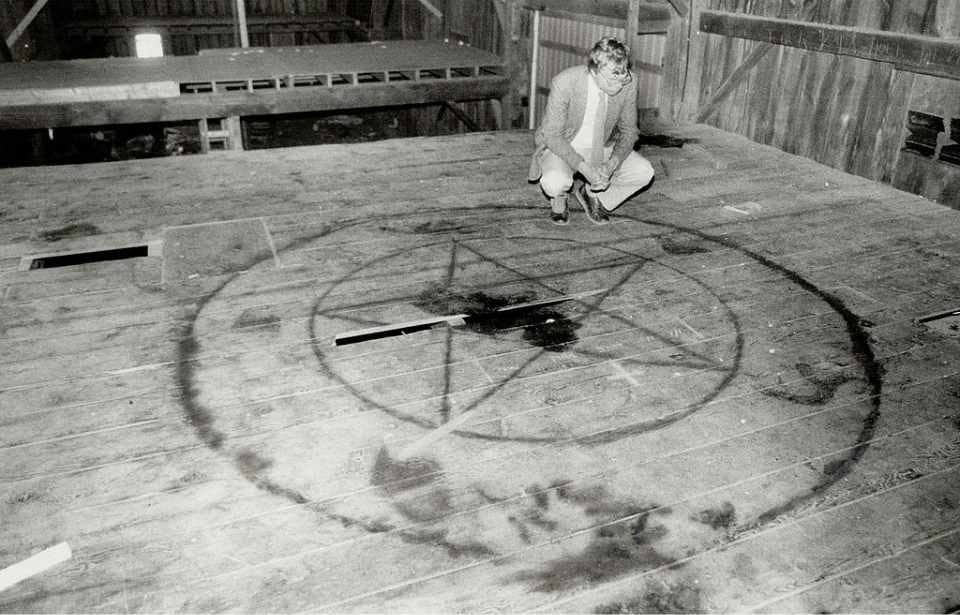
The wider Satanic Panic had no single cause. Scholars have connected it to increased recognition of real child sexual abuse, changes in childcare and family life, religious and political campaigns about social decline, therapeutic claims about recovered memory, law-enforcement training on supposed occult crime, and sensational media.
Those are interpretive arguments. It is too deterministic to say that dual-income households, evangelical Christianity, or the New Right “produced” the panic.
The 1980 book Michelle Remembers, written by psychiatrist Lawrence Pazder and his patient Michelle Smith, whom he later married, was influential in giving satanic ritual-abuse claims a therapeutic vocabulary. Its central story was never independently corroborated, and later historical work has treated it as a foundational text of the panic.

Pazder consulted with people connected to McMartin and trained or advised law enforcement and mental health audiences. The often-repeated figure that he was involved in more than 1,000 cases came from Pazder’s own claim; it is not a verified caseload.
By 1992, FBI behavioral-science specialist Kenneth Lanning wrote that years of investigation had produced little or no evidence for allegations of large-scale baby breeding, human sacrifice, or organized satanic conspiracies. Crucially, Lanning did not tell the police to dismiss the abuse allegations. He advised an aggressive investigation accompanied by an equally serious search for alternative explanations and corroboration.
His formulation remains useful: the more severe the consequences of state action, the more evidence is required. Lanning’s investigator’s guide is a primary source for understanding the change in law enforcement thinking.
The media’s role at McMartin is well documented, but “the media created the case” remains too simplistic. A Los Angeles Times retrospective acknowledged that early coverage often assumed the prosecution’s account, repeated unproved claims, and failed to examine how the evidence had been developed.
Law-enforcement officials also promoted the story, some defense lawyers initially declined to speak, and news organizations later became more skeptical. The supported conclusion is that early reporting amplified allegations and public pressure before their reliability had been tested. The Times’ self-critical media analysis is unusually candid on that point.
Claims about Dale Griffis and the West Memphis Three also need restraint. Griffis testified in a 1994 Arkansas murder trial, outside this article’s 1980s scope. His advanced degrees came from Columbia Pacific University, which was not nationally accredited and was later ordered closed by California authorities.
But saying his credentials were simply “fraudulent” goes beyond what the appellate record shows. The Arkansas Supreme Court noted the school’s lack of national accreditation, reviewed Griffis’s law-enforcement experience and claimed study of occult groups, and held that the trial judge had not abused his discretion in qualifying him.
The stronger criticism is that his testimony illustrates how courts can admit experience-based expertise even when its academic foundation and methodology are contested. The Arkansas Supreme Court opinion should replace unsourced shorthand.
When Offenders Themselves Invoke the Occult
Two 1980s homicide cases show why investigators should neither presume an occult conspiracy nor erase an offender’s own stated belief.
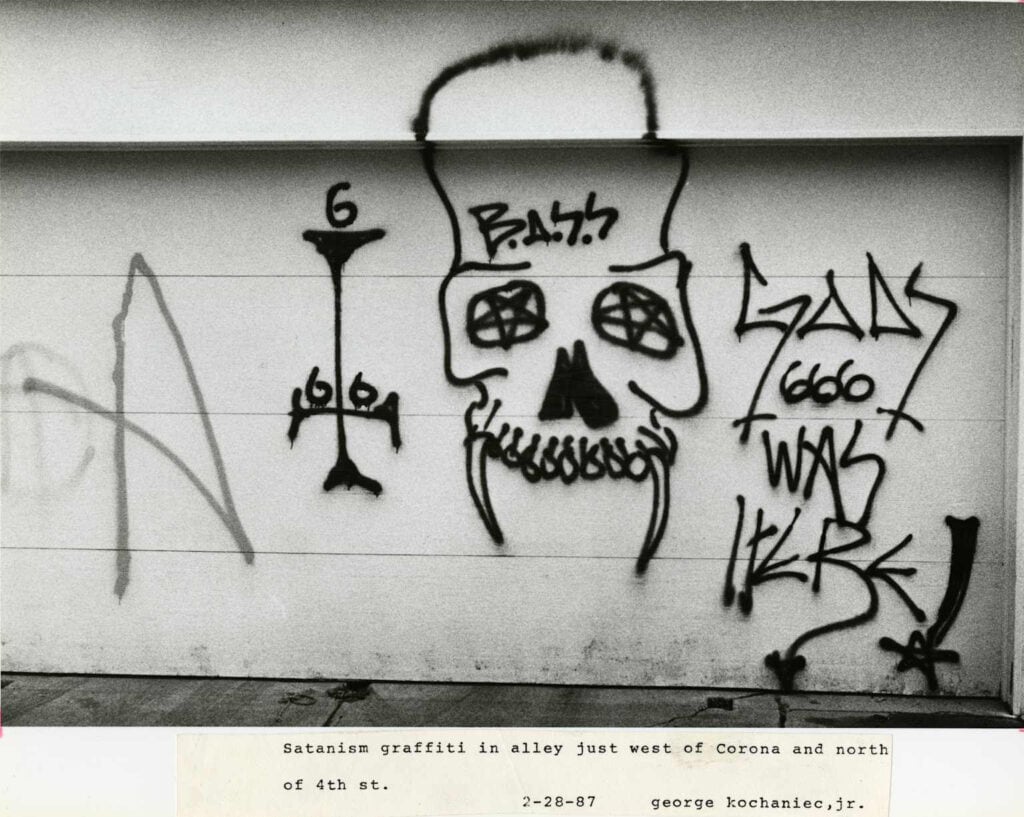
In Douglas County, Georgia, seventeen-year-old Malisa Earnest and fifteen-year-old Teresa Simmons ran away from a group home in January 1988. They met Terry Belcher and later Robert McIntyre. According to the Georgia Supreme Court’s summary, Belcher testified that he called himself the high priest of an eleven-member satanic cult; neither girl was a member.
Simmons rejected McIntyre’s sexual advances. The court said the three defendants planned her killing, strangled her on January 17, and buried her in a shallow grave. Belcher testified that he and McIntyre performed a satanic ritual over her body.
Some accounts incorrectly say the case was broken after Earnest was arrested in Louisiana for unrelated crimes and confessed to a cellmate. The Eleventh Circuit record says police stopped a missing van occupied by the three youths. McIntyre and Belcher were detained overnight; Earnest stayed voluntarily because she had nowhere else to go.
A nearby detainee reported hearing the three discuss the killing. Georgia investigators then searched near the house, recovered Simmons’s body, and found physical evidence including rope matching the rope at the house, a bootlace around her neck, and boots with one lace missing. Earnest later gave the police a detailed taped statement.
Each defendant was convicted of malice murder in a separate trial and sentenced to life imprisonment. The occult evidence was admitted as possible motive evidence, but the convictions rested on far more than a ritual label. Earnest v. State and McIntyre v. Williams provide the controlling factual summaries.
In Carl Junction, Missouri, nineteen-year-old Steven Newberry was killed by three seventeen-year-old classmates on December 6, 1987. The Missouri appellate record says James Hardy, Theron “Pete” Roland, and Ronald Clements took Newberry to an isolated area, killed a cat, then beat Newberry with baseball bats and placed his body in a cistern.
Courts recorded evidence that Hardy had decided the three should sacrifice Newberry to Satan and that Roland believed the act might bring supernatural power or possession. That was trial evidence about the offenders’ understanding and the prosecution’s theory, not proof of a wider occult network.
The original table says only one perpetrator received a life sentence. That is wrong. Hardy pleaded guilty to first-degree murder and received life without parole. Roland was convicted of first-degree murder and received the same sentence.
Clements was convicted and sentenced to life without parole; his first conviction was reversed because an expert improperly opined on the ultimate issue of deliberation, but he was convicted again at retrial. The historically accurate formulation is that all three were convicted and originally sentenced to life without parole. Their later custody status cannot be inferred from the original judgments. State v. Roland and the second Clements appeal document the convictions and original sentences.
These cases do not prove that “Satanism” is a coherent criminological category. They show that offenders sometimes borrow religious, occult, political, or popular-cultural language to explain, justify, dramatize, or organize violence.
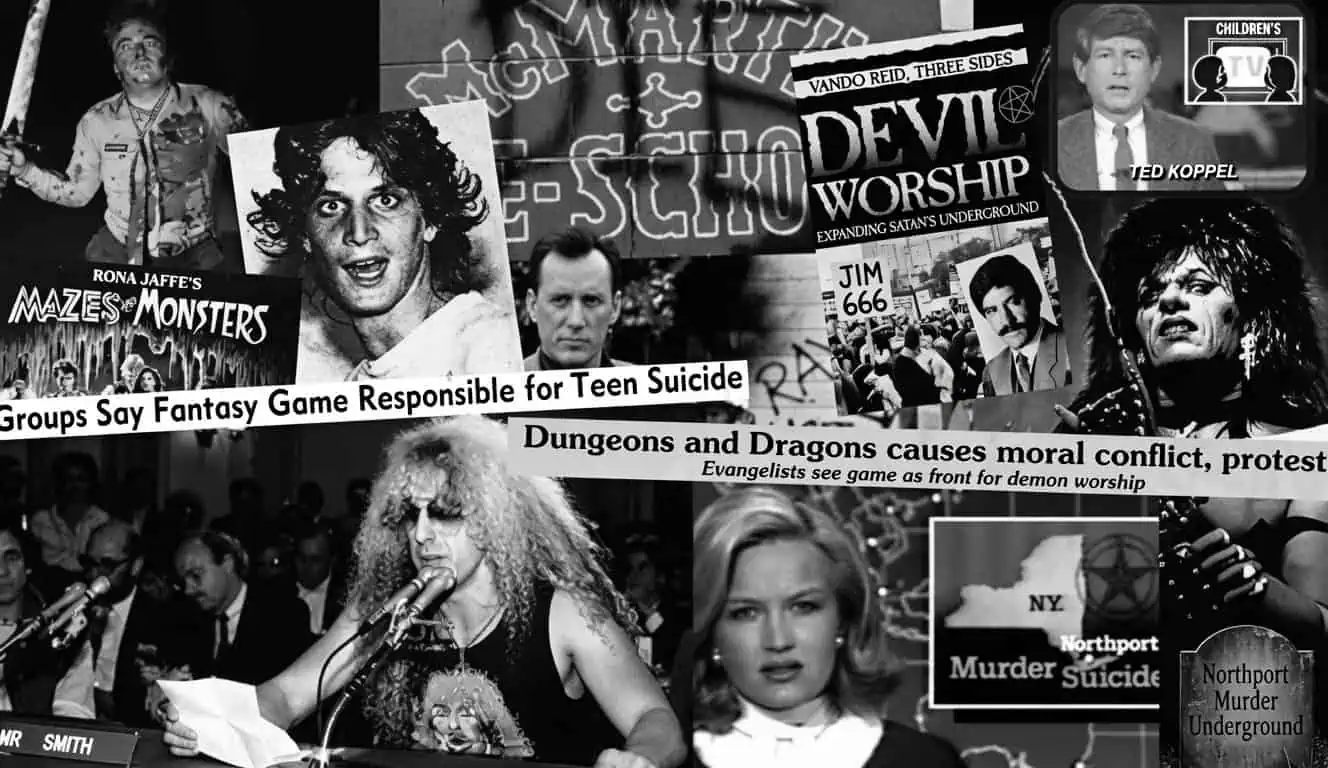
The evidentiary task is to determine what that language proves. A statement made before a crime may show planning or motive. A post-arrest account may contain self-serving invention. A symbol may be common, ambiguous, or irrelevant. None of it identifies a killer unless it connects to conduct through admissible and corroborated evidence.
The Order: An Enterprise Proved Through Conduct
Robert Jay Mathews formed The Order in 1983 from people associated with white-supremacist organizations and Christian Identity beliefs. The group sought the violent overthrow of the federal government, which its members portrayed through an antisemitic conspiracy theory as being controlled by Jews. It also pursued the creation of a white separatist territory in the Pacific Northwest.
William Luther Pierce’s 1978 racist novel The Turner Diaries influenced Mathews and supplied a fictional model of revolutionary violence. That influence is well documented, but it overreaches to state, without attribution, that the Order’s operational goal was the extermination of Jews, Black Americans, and every perceived enemy.
The record safely supports a program of violent white supremacy, antisemitism, separatism, and overthrow. More specific genocidal objectives should be tied to a quoted document or witness.
The Order’s conduct escalated rapidly. The Ninth Circuit recorded an armed robbery of an adult bookstore in Spokane on October 28, 1983; bank robberies; counterfeiting; two Seattle armored-car robberies in March and April 1984; and the July 19, 1984 robbery of a Brink’s armored-car run near Ukiah, California, which yielded about $3.6 million.
The court said most of the Ukiah proceeds went into the organization’s coffers, and some were distributed to other far-right groups. The claim that the first robbery produced $369.10 is unsupported by the appellate record; the court simply said it yielded little.
Members also killed Walter Edward West in May 1984 after suspecting he was a security risk. The Ninth Circuit’s factual summary calls him “Richard West,” while contemporaneous reporting and historical accounts identify him as Walter West.
On June 18, 1984, Alan Berg, a Jewish Denver radio host known for confronting racist and antisemitic callers and organizations, was shot outside his home. The Ninth Circuit described Berg’s murder as an Order act and identified Bruce Pierce as the shooter.
A later Tenth Circuit decision affirmed the federal civil-rights convictions of Pierce and David Lane, finding sufficient proof that Berg had been targeted because he was Jewish and because of his employment as a radio host. Richard Scutari and Jean Craig were acquitted in that separate case. The Tenth Circuit opinion matters because it prevents the Berg verdict from being blurred into the earlier RICO prosecution.
The investigation used cooperating members, searches, weapons evidence, stolen-money evidence, counterfeit currency, organizational documents, and the connections among crimes in several states.
Thomas Martinez, an Order associate arrested for passing counterfeit bills, became an informant and helped investigators locate Mathews. It is fair to call his cooperation important. It is speculation to state flatly that he cooperated “to avoid prosecution” unless that motive is attributed to Martinez or a source. Cooperators may act from fear, remorse, self-interest, bargaining, or several motives at once; their information gains reliability through corroboration, not through a journalist’s preferred explanation.
Mathews escaped a November 1984 confrontation at a Portland motel after a gunfight in which an FBI agent was wounded. Agents traced him to Whidbey Island, Washington. The FBI describes a 35-hour standoff ending on December 8, when the house caught fire during gunfire, and Mathews died.
In April 1985, a federal grand jury indicted 23 defendants. Twelve pleaded guilty before trial. Ten defendants tried together were convicted of substantive RICO and RICO conspiracy counts, and many were convicted of additional offenses. The appellate court upheld the convictions.
Overall, sentences from the Seattle prosecution ranged from 40 to 100 years, not 30 to 150. Pierce and Lane later each received an additional 150 years in the separate Berg civil-rights case. The FBI’s Seattle history summarizes the investigation, while the appellate opinions supply the necessary legal precision.
What RICO Did, and Did Not Do
RICO was enacted in 1970 as part of the Organized Crime Control Act. It allows prosecution of specified conduct connected to an “enterprise” through a “pattern of racketeering activity.”
The statute says a pattern requires at least two predicate acts within the statutory period, but two acts alone do not automatically establish a pattern; Supreme Court doctrine also requires relationship and continuity. Describing RICO as committing “at least two of 35 specified crimes” is both oversimplified and vulnerable to becoming outdated as Congress amends the predicate list. The current statutory text and the Supreme Court’s H.J. Inc. decision are more reliable than that formula.
RICO was effective against The Order because prosecutors could present the association and its related crimes as an enterprise conducted through racketeering. It did not “prosecute the ideological conspiracy itself.” The Ninth Circuit rejected a First Amendment challenge precisely because RICO punishes conduct, not status or belief.
Nor is it correct to suggest that, without RICO, leaders who planned but did not personally carry out crimes could not be reached; ordinary conspiracy and accomplice-liability doctrines can also impose liability. RICO’s practical value was aggregation: it allowed the government to show how robberies, the movement of stolen money, counterfeiting, killings, weapons offences, and assistance to fugitives served the same enterprise.
That distinction protects both security and liberty. Political and religious beliefs, including hateful ones, are not interchangeable with criminal acts. The state must prove the defendant’s knowing relationship to the enterprise and the legally required conduct.
In the Order case, ideology helped explain the purpose and the relationship among acts, but bank records, weapons, stolen cash, documents, participant testimony, and completed crimes supplied the proof.
Mulugeta Seraw and the Reach of Civil Liability
Mulugeta Seraw was born in Ethiopia in 1960 and came to Oregon in 1980 to pursue an education. He took business and engineering classes at Portland Community College and worked a succession of jobs. By the fall of 1988, he was driving an airport bus and living in southeast Portland.
Describing him only as a “student” freezes his life in a single role. He was an immigrant, worker, former student, son, father, nephew, and member of Portland’s Ethiopian community. The Oregon Encyclopedia biography restores some of that life to the case.
In the early hours of November 13, 1988, Seraw and Ethiopian friends encountered Kenneth Mieske, Kyle Brewster, and Steven Strasser near Seraw’s apartment. The confrontation became a racist assault. Mieske wielded a baseball bat; it is sometimes incorrectly said that all three beat Seraw with the bat.
Seraw, who had turned 28 weeks earlier, died from his injuries. Mieske later pleaded guilty to murder and admitted that he killed Seraw because of his race. Brewster and Strasser pleaded guilty to manslaughter and received prison sentences.
The criminal cases established the attackers’ responsibility. The later civil suit asked a different question: whether Tom Metzger, John Metzger, and White Aryan Resistance were legally responsible for organizing and encouraging the local group through an agent.
The evidence included a letter introducing WAR recruiter Dave Mazzella to East Side White Pride, as well as Mazzella’s testimony about his mission and activities in Portland. The civil jury found that one or more California defendants, through agents, substantially assisted or encouraged conduct that caused Seraw’s death; participated in a conspiracy with the Oregon defendants; and caused the death by recklessly selecting or retaining agents to organize East Side White Pride.
In October 1990, the jury awarded Seraw’s estate $12.5 million in compensatory and punitive damages against the defendants, with liability allocated among the individual attackers, the Metzgers, and WAR. The Oregon Court of Appeals affirmed the judgment in 1993, and further review was denied.
Collection efforts forced the sale of the Metzger family home, but the claim that it was sold to a “Latinx family” is not established by the court record.
Calling the result merely “vicarious liability” understates the verdict and risks doctrinal error. The jury found intentional assistance or encouragement, conspiracy, and reckless selection or retention of agents. Nor did the verdict make Metzger criminally guilty of murder; the Metzgers were not criminally charged in Seraw’s death.
The civil case imposed monetary liability under civil causes of action, with different remedies and procedures than those in a criminal prosecution. Its force came from proving an operational connection between national organizers and local violence, not from punishing racist speech in the abstract.
An Evidence Hierarchy Without Shortcuts
One common framing puts confessions and insider testimony at the top of an “evidence hierarchy,” while statements from vulnerable witnesses occupy the bottom. That is too rigid.
Confessions can be false. Accomplices and informants can bargain, minimize their own conduct, or accuse others. Children can give accurate accounts, and delayed or incomplete disclosure does not, by itself, make an account false. Reliability depends on how evidence was obtained, what incentives or pressures existed, whether the account contains nonpublic facts, whether those facts are independently verified, and whether later statements remain consistent on material points.
The cases illustrate the difference. In the Simmons case, a nearby detainee’s report was not the end of the inquiry. Investigators recovered a body and physical items, heard admissions, obtained Earnest’s taped statement, and presented medical evidence of strangulation.
In the Newberry case, statements led investigators to a body, bats, and a crime scene. In the Order case, cooperator testimony was tested against money, weapons, documents, searches, and crimes that had already been independently reported.
In McMartin, by contrast, the prior spread of allegations through parents, interviewers, and media made it difficult to determine which details were truly independent; the most extraordinary claims lacked comparable corroboration.
Jailhouse informants warrant special caution, but Thomas Martinez was not one. He was a participant who became a cooperating source. A 2024 National Registry of Exonerations report found jailhouse-informant testimony in seven percent of all Registry exonerations recorded and in a higher share of death-sentenced murder exonerations.
The defensible point is that incentivized testimony is a documented risk of wrongful conviction and requires disclosure, careful vetting, and corroboration. It is not accurate, without a defined dataset, to call it simply “a leading cause” of all wrongful convictions.
The Durable Investigative Rule
The most useful lesson from these cases is methodological, not supernatural. Begin with the alleged acts and the legal elements. Preserve the first account. Separate witnesses before information can circulate. Record interviews. Use open prompts before focused ones. Track the source of each detail. Search for evidence that could disprove as well as confirm the working theory.
For an alleged organization, map membership, communications, money, authority, logistics, and completed acts. For ideological material, ask whether it proves identity, intent, agreement, or nothing more than taste and association.
Modern threat-assessment practice is consistent with that behavior-based approach. The FBI describes multidisciplinary teams that include law enforcement, analysts, mental-health practitioners, educators, and community partners. Their purpose is to assess concerning behavior and manage a path toward violence, not to treat unconventional beliefs as a diagnosis or a crime. The FBI’s Behavioral Analysis Program emphasizes targeted-violence prevention through information sharing and multidisciplinary assessment.
There are reasonable comparisons between the 1980s ritual-abuse panic and later conspiracy movements such as Pizzagate and QAnon: both feature hidden elites, endangered children, and secret sexual crimes, often with satanic themes.
But the analogy is analysis, not identity. Digital platforms accelerate repetition and collapse the distance between rumor, audience, and action; the institutions and political settings are different. A peer-reviewed social-media study traces the movement from Pizzagate to QAnon and the reuse of satanic-paedophilia claims.
McMartin, The Order, Seraw’s murder, and the Simmons and Newberry cases all warn against the same error from different directions. A frightening allegation must not be dismissed because it sounds strange. A frightening ideology must not be treated as proof that its adherent committed a particular crime.
The work begins after the label is applied: identify the act, preserve the account, test the links, corroborate the witness, and state honestly what the evidence cannot establish. In serious investigations, theory is necessary. It is never a substitute for proof.
Frequently Asked Questions
Was anyone convicted in the McMartin Preschool case?
No. Five defendants had their charges dropped in 1986. Raymond Buckey and Peggy McMartin Buckey were acquitted on 52 counts in 1990; jurors deadlocked on the remaining counts against Raymond Buckey, and the last charges were later dismissed.
Did investigators find no physical evidence in McMartin?
That wording is too broad. Prosecutors presented disputed medical findings that they said supported abuse, while defense experts challenged their meaning. No physical evidence tied a defendant to the extraordinary ritual allegations, no alleged child pornography was found, and no tunnel evidence was accepted in the criminal trials as corroboration.
Were the McMartin children proven to have lied?
No blanket finding established that. Recorded interviews contained methods later shown to risk suggestion and social pressure, and those methods impaired the ability to identify independent recall. The criminal trials produced no convictions.
What crimes did The Order commit?
Court records describe bank and armored-car robberies, counterfeiting, movement of stolen money, weapons offenses, fugitive assistance, and killings, including the murder of Alan Berg. Members were convicted of RICO offenses and other federal crimes.
Did RICO criminalize The Order’s beliefs?
No. The Ninth Circuit said RICO punished conduct rather than association or belief. Ideology helped explain the enterprise’s purpose, but prosecutors still had to prove the existence of the enterprise, the defendants’ participation, and the predicate crimes.
Who was convicted of killing Mulugeta Seraw?
Kenneth Mieske pleaded guilty to murder; Kyle Brewster and Steven Strasser pleaded guilty to manslaughter. A later civil jury imposed liability on additional defendants, including Tom and John Metzger and White Aryan Resistance, but that civil verdict was not a criminal murder conviction.
Were the Simmons and Newberry killings really “satanic” crimes?
Courts recorded testimony that offenders used satanic language and understood ritual belief as part of their motive or planning. The homicides were nevertheless proved through admissions, accomplice evidence, recovered bodies, physical evidence, and other conventional investigative work.
Sources
- United States v. Yarbrough, 852 F.2d 1522 (9th Cir. 1988)
- United States v. Lane and United States v. Pierce, 883 F.2d 1484 (10th Cir. 1989)
- Berhanu v. Metzger, 119 Or. App. 175 (1993)
- Earnest v. State, 262 Ga. 494 (1992)
- McIntyre v. Williams, 216 F.3d 1254 (11th Cir. 2000)
- State v. Roland, 808 S.W.2d 855 (Mo. Ct. App. 1991)
- State v. Clements, 849 S.W.2d 640 (Mo. Ct. App. 1993)
- Arkansas Supreme Court opinion in Echols v. State
- 18 U.S.C. § 1961, RICO definitions
- H.J. Inc. v. Northwestern Bell Telephone Co., 492 U.S. 229 (1989)
- Kenneth Lanning, Investigator’s Guide to Allegations of “Ritual” Child Abuse
- OJJDP, Child Forensic Interviewing: Best Practices
- National Registry of Exonerations, Jailhouse Informant Testimony and Exonerations
- FBI Seattle field-office history: The Order investigation
- FBI Behavioral Analysis and threat-assessment program
- Manhattan Beach Police letter to McMartin parents
- Nadja Schreiber Compo et al., “Suggestive Interviewing in the McMartin Preschool and Kelly Michaels Daycare Abuse Cases”
- Paul Bleakley, “Panic, Pizza and Mainstreaming the Alt-Right”
- Los Angeles Times, “Judge Grants New Delay in McMartin School Trial”
- Los Angeles Times, “Interviewer’s Methods Seen as Key Issue in Preschool Case”
- Los Angeles Times, “Doctor ‘Can’t Tell’ if Nine McMartin Pupils Molested”
- Los Angeles Times, “Evidence of Tunnels at McMartin Site Reported”
- Los Angeles Times, “McMartin Jury Deadlocks; Buckey Won’t Be Retried”
- Los Angeles Times, “Where Was Skepticism in Media?”
- Oregon Encyclopedia, “Mulugeta Seraw (1960–1988)”
Discover more from The Dark Side of Humanity
Subscribe to get the latest posts sent to your email.