FILE NO. 0154Case status Unsolved
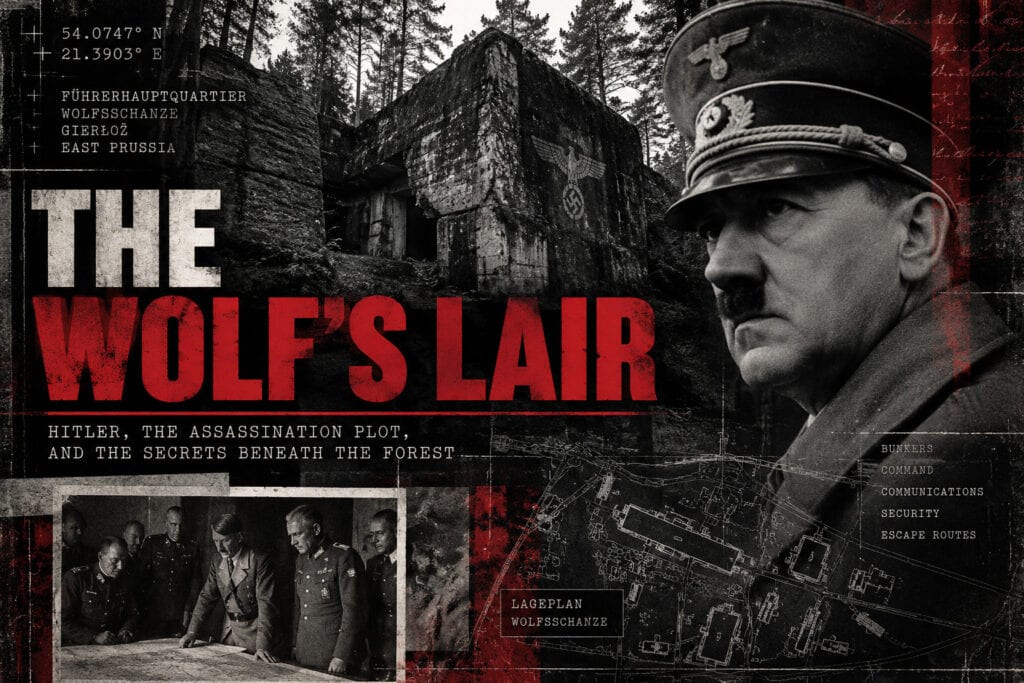
Wolf’s Lair Skeletons: In February 2024, researchers uncovered human skeletal remains inside the ruins of Hermann Göring’s former residence at the Wolf’s Lair in Poland. Forensic examinations identified at least four individuals, but severe degradation prevented authorities from determining their cause of death or identities, leading authorities to close the criminal investigation.
The circumstances surrounding the burial remain unresolved, including its exact timeframe, which could span from the operational Nazi era to postwar abandonment. While missing extremities sparked speculation of occult rites or mutilation, no public evidence connects Göring to the burial or confirms a ritual sacrifice.
Wolf’s Lair Skeletons
In 2024, human remains were uncovered inside the ruins of Hermann Göring’s residence at Hitler’s Wolfsschanze. The discovery was real. The identities, cause of death, burial date, and meaning remain unresolved.
The most dramatic version of this story, a Nazi occult sacrifice beneath Göring’s house, is not established by the surviving evidence. The dossier separates the archaeological discovery, the prosecutor’s later forensic summary, and the theories that accumulated around them.

What Was Found?
Direct answer before theory.
The verified core
On February 24, 2024, members of Fundacja Latebra uncovered human skeletal remains in the ruins of Hermann Göring’s former residence at the Wolf’s Lair in northeastern Poland. Early archaeological accounts described five individuals and emphasized the absence of hands, feet, clothing, and personal effects. A later forensic summary from Polish prosecutors described the remains of at least four people, three likely middle-aged men and one child, and concluded that decomposition prevented identification of a cause of death. The investigation was discontinued because homicide could not be proved from the surviving bones, not because the burial was explained.
Record Boundary
What is established, disputed, and unknown.
The 2024 Discovery
A shallow burial inside a place already saturated with history.
Ten Centimetres Down
The Latebra team was not looking for bodies. It was investigating the remains of flooring and utilities inside the ruined residence. According to the group’s account, the first skull fragment appeared only about ten centimetres below the surface. Police were notified immediately before excavation continued.
The location matters. This was not a remote forest grave discovered somewhere on the former headquarters grounds. The bones were inside the footprint of a residence used by one of the most powerful men in Nazi Germany.
Why the Find Became Sensational
The combination was irresistible to headline writers: Göring, an infamous Nazi site, multiple bodies, missing extremities, no clothing, and no immediate explanation. But the emotional force of those facts does not tell us when the burial occurred or who placed the bodies there.
The first responsibility is therefore chronological: determine what belongs to the operational Nazi headquarters, what belongs to its destruction in 1945, and what may have happened after the site was abandoned.
Forensic Conflict
The public record does not contain one clean demographic answer.
| Source layer | Reported count | Reported demographic | Weight |
|---|---|---|---|
| Fundacja Latebra / early excavation accounts | 5 | Three adults, one teenager, one newborn/baby | Field account |
| Polish prosecutor / forensic medical summary | At least 4 | Three likely middle-aged men; one child of undetermined sex | Formal forensic summary |
| Cause of death | Undetermined | Advanced decomposition prevented a reliable conclusion | Forensic limit |
| Legal status | Investigation discontinued | No evidence sufficient to prove manslaughter/homicide | Procedural outcome |
The Missing Hands and Feet
Suspicious feature, not self-proving mutilation.
The Deliberate-Removal Hypothesis
If hands and feet were intentionally removed, possible explanations would include identification suppression, postmortem mutilation, trophy-taking, punishment, or concealment. But none of those motives is established by the public record.
The Decomposition Problem
Hands and feet contain many small bones that disarticulate readily. Shallow burial, soil movement, animal activity, later demolition disturbance, and decades of exposure can separate or remove them. Absence alone cannot establish intentional amputation.
The Wolfsschanze
The command complex makes the burial more mysterious, not automatically more Nazi.
A Fortress in the Masurian Forest
The Wolf’s Lair was Hitler’s main Eastern Front headquarters from 1941 to 1944. The modern historical site describes roughly 200 structures and notes that Hitler spent about 800 days there. It was the setting for the July 20, 1944 Stauffenberg assassination attempt.
Its isolation, restricted zones, guard units, mines, internal roads and staff infrastructure made it a controlled administrative enclave rather than an open military camp.
The Security Paradox
That security cuts both ways. If the burial occurred while the headquarters functioned normally, placing multiple bodies beneath or inside Göring’s residence would have required extraordinary access or complicity. If the burial occurred during evacuation, demolition, Soviet occupation, or postwar lawlessness, the same location becomes much easier to explain.
Why Göring’s Name Changes the Story
Historical guilt is real. Specific responsibility for this grave is unproved.
A Central Nazi Perpetrator
Hermann Göring was not a peripheral figure. He helped build the Nazi police state, directed major economic and military programs, and in July 1941 instructed Reinhard Heydrich to prepare a plan for the “Final Solution.” He was convicted at Nuremberg of conspiracy, crimes against peace, war crimes and crimes against humanity.
But This Grave Is Not His Conviction
The moral and legal enormity of Göring’s documented crimes does not supply evidence for an unrelated burial. The remains were found in his residence; that fact establishes location. It does not establish that he ordered the deaths, knew about the burial, or was present when it occurred.
The Occult-Sacrifice Claim
Why the most cinematic theory is the weakest evidentiary fit.
The “Thunderstone” Problem
The ritual theory rests partly on claims that “thunderstones” or belemnite fossils were found around the remains. But this detail is absent from the archaeologists’ public accounts, the prosecutor’s reporting and major international coverage. Without independent provenance, the objects should not be treated as scene evidence.
Nazi Occultism Is Not One Thing
Popular culture often compresses the Third Reich into a single occult mythology. That obscures distinctions between documented ideological mysticism around figures such as Heinrich Himmler and the actual evidence in a particular grave. For a broader evidentiary framework, see ritual murder claims and the difference between symbols, folklore and proof.
Chronology
The timeline defines what could, and could not, have happened.
Construction
The Wolfsschanze is built in East Prussia as Hitler’s Eastern Front headquarters.
Operational Headquarters
Hitler and senior Nazi leadership use the complex for command, planning and administration of the eastern war.
Stauffenberg Bomb Plot
Claus von Stauffenberg’s bomb explodes during a briefing at the Wolf’s Lair; Hitler survives.
Hitler Leaves
Hitler departs the complex for the last time as the Eastern Front collapses toward East Prussia.
German Demolition
Retreating German forces attempt to destroy the Wolf’s Lair with explosives before Soviet arrival.
Soviet Occupation
The Red Army enters the abandoned complex. The site’s controlled security environment is over.
Human Remains Found
Fundacja Latebra uncovers skeletal remains during archaeological work in Göring’s former residence.
Prosecutor Closes Inquiry
The forensic examination cannot determine cause of death; the criminal inquiry is discontinued for lack of evidence establishing a crime.
Competing Theories
Plausibility is not proof.
| Theory | What supports it | What weakens it | Assessment |
|---|---|---|---|
| Occult / human sacrifice | Location; sensational claims of ritual objects; popular Nazi-occult mythology | No established ritual evidence; no proven connection to Göring; building chronology undercuts “foundation sacrifice” framing | Very weak |
| Wartime execution or murder | Nazi regime’s documented violence; access to detainees, forced laborers and security prisoners | Operational security makes an unrecorded burial inside a senior leader’s residence difficult to explain | Possible |
| Late-war killing during evacuation | Security collapse, demolition, retreat, possible extrajudicial violence | No identified victims, perpetrator or direct dating evidence | Plausible |
| Postwar clandestine burial | Abandoned ruins, population displacement, revenge, robbery and lawlessness after 1945 | No direct evidence proving a postwar date | Plausible |
| Non-homicidal burial | Cause of death could not be determined | Multiple naked bodies in a hidden shallow grave remain highly irregular | Cannot exclude |
What Would Actually Solve It?
Questions that matter more than the folklore.
Dating
Radiocarbon dating, burial-stratigraphy publication, or clearer archaeological documentation could narrow whether the grave predates demolition, belongs to the retreat, or is postwar.
Identity
Recoverable DNA, isotope analysis, dental comparison, archival missing-person records, or genealogical work could potentially identify one or more individuals.
Trauma
A detailed osteological publication could clarify whether extremities were cut, detached after death, or lost through decomposition and disturbance.
Provenance
The case needs a publicly accessible synthesis that reconciles the excavation team’s “five people” account with the prosecutor’s “at least four” forensic conclusion.
Archival Geography
The place matters, but context images are not crime-scene evidence.


Myth vs. Record
What the headline version gets wrong.
Myth: “Five members of a murdered family.”
Record: that description comes from the excavation team’s early interpretation. The formal forensic summary later described at least four people, including three likely middle-aged men and one child. The family narrative is therefore not settled.
Myth: “Their hands and feet were cut off.”
Record: hands and feet were reportedly absent, but public reporting does not establish whether they were deliberately amputated or lost through taphonomic processes.
Myth: “Göring’s occult sacrifice.”
Record: the grave is in his former residence. No public evidence connects him personally to the burial or establishes a ritual motive.
Myth: “Prosecutors ruled out murder.”
Record: prosecutors discontinued the criminal investigation because the remains were too degraded to establish cause of death. That is an evidentiary limit, not a historical explanation.
Frequently Asked Questions
Short answers for the most common claims.
How many skeletons were found?
The excavation team reported five. The prosecutor’s later forensic summary described at least four individuals. The discrepancy remains unresolved in the public record.
Were they murdered?
Possibly, but not forensically proven. The remains were too degraded for the medical expert to determine cause of death.
Were their hands and feet deliberately removed?
The extremities were reportedly absent. Public evidence does not establish whether that reflects mutilation, decomposition, disturbance, or some combination.
Did Hermann Göring kill them?
No evidence currently establishes Göring as the killer, order-giver or even someone who knew the burial existed.
Was this a Nazi human sacrifice?
No credible public evidence proves a ritual sacrifice. The claim depends on speculation and weakly sourced details rather than forensic findings.
Why did prosecutors close the case?
Because the forensic examination could not establish a cause of death or evidence sufficient to prove manslaughter. The closure reflects legal insufficiency, not a solved mystery.
Source Ledger
Primary, institutional and high-quality reporting used to anchor the dossier.
Associated Press
Used for the prosecutor’s final forensic summary: at least four individuals, likely three middle-aged men and one child, with cause of death undetermined.
Wolfsschanze Historical Site
Used for site chronology, scale, the 1944 assassination attempt and the headquarters’ operational history.
USHMM: Hermann Göring
Used for Göring’s documented role in Nazi government, persecution and the development of the “Final Solution,” separating established historical culpability from speculation about this grave.
Bundesarchiv / Wikimedia Commons
Used for the July 20, 1944 aftermath image showing Göring at the Wolf’s Lair.
Wikimedia Commons: Göring Residence
Used for modern context photography of the ruins where the remains were discovered.
Evidence Before Folklore
Where archaeology, media coverage and forensic reporting conflict, this dossier privileges the strongest available source layer and labels uncertainty instead of forcing a cinematic answer.
Open question: a publicly accessible full osteological or archaeological report could materially change the interpretation of count, age, trauma, burial sequence or dating. Until then, the central mystery remains unresolved.
Browse every case in the Case File Index
Discover more from The Dark Side of Humanity
Subscribe to get the latest posts sent to your email.