FILE NO. 0101Case status Mixed Outcomes
Comparative Cult Crime Dossier / Evidence First / Archived
Beyond Brainwashing: How Famous Cults Became Deadly
Jonestown, the Manson Family, Waco, Aum Shinrikyo, Heaven’s Gate and other notorious groups are often explained with one word: brainwashing. The record is more demanding. Violence emerged through different mixtures of concentrated authority, isolation, dependency, ideology, personal agency, organizational capacity and failed oversight.
Deadly cult violence is not explained by a single scientifically proven switch called brainwashing. Across major cases, the recurring mechanisms are more concrete: leaders accumulate unchecked authority, members become dependent on the group, dissent and exit become costly, ideology redefines harm as duty, smaller abuses normalize larger ones, and outside institutions sometimes miss warnings or respond badly. Those mechanisms can constrain choice without erasing individual agency, which is why courts still distinguish leaders, perpetrators, coerced participants, victims and survivors.
Evidence Index
What Is a Cult?
The word cult feels precise in popular crime writing, but it is not a universally accepted clinical or legal category. Scholars of religion often prefer terms such as new religious movement, especially when they are describing belief, history or institutional development rather than proven harm. That caution matters because an unconventional theology, communal lifestyle or charismatic founder does not by itself establish abuse, criminality or incapacity.
For an evidence-led crime dossier, conduct is the better starting point. Investigators and reporters can ask whether leaders controlled money, movement, work, sex, marriage, medical care, access to children, identification documents, housing or communication. They can document whether questions were punished, whether leaving carried threats or material ruin, whether violence was directed or concealed, and whether leaders used fraud or coercion to obtain labor, sex or property. Those are observable behaviors, not labels imposed on belief.
Belief Is Not the Risk Test
New or eccentric beliefs can coexist with peaceful conduct, while established institutions can conceal exploitation. The useful question is not whether outsiders find a theology strange. It is whether power is concentrated in ways that destroy meaningful consent, accountability and exit.
Use Legal Language Where It Exists
When a court has found racketeering, homicide, sexual assault, forced labor or fraud, name the offense. “Cult” may describe the social setting, but it should never replace the legal finding or make every member responsible for a leader’s crimes.
This distinction protects two different groups at once. It prevents peaceful minority religions from being treated as criminal simply because they are unfamiliar, and it prevents abusive leaders from hiding behind abstract debates about religion when the record contains concrete coercion, assault, fraud or homicide.
Brainwashing, Coercion and the Science Problem
The classic brainwashing story proposes something close to psychological override: a leader uses extraordinary techniques that replace a person’s prior identity with a controlled one. That model remains controversial. Reviews of the research on new religious movements have repeatedly argued that recruitment, commitment and obedience are better explained through recognizable social processes such as persuasion, group identity, dependency, conformity, authority and escalating commitment than through a scientifically established mechanism that eliminates volition.
That does not make coercion unreal. Isolation can remove corrective relationships. Sleep deprivation can degrade judgment. Financial dependency can make leaving practically impossible. Surveillance, humiliation, sexual exploitation, threats, confession rituals, punishment and control of information can narrow a person’s available choices. A person can be heavily constrained without becoming a puppet in the literal sense.
The distinction becomes crucial in criminal cases. Courts still ask who ordered a crime, who planned it, who carried it out, what the person understood, whether legal duress applies, and whether mental disorder altered criminal responsibility. Influence can be powerful while agency remains legally relevant. The Manson cases make that tension visible, but so do Aum Shinrikyo, NXIVM and other organizations where followers occupied different roles and possessed different levels of knowledge.
Research posture: the dossier treats “brainwashing” as a contested umbrella term. It uses documented mechanisms such as coercion, socialization, dependency, isolation, threats, surveillance, exploitation and escalating commitment whenever the evidence supports them.
Ten-Case Master Register
These cases are frequently grouped under the same cultural label, but they produced radically different crimes and legal outcomes. The register below makes the comparison explicit. It includes mass homicide, terrorism, coordinated suicide, prolonged physical abuse, sex trafficking, child sexual assault and unresolved mass death because the central question is how closed authority systems interact with violence and exploitation, not whether every group followed the same script.
| Group / leader | Period | Location | Documented conduct | Outcome | Evidence posture |
|---|---|---|---|---|---|
| Manson Family / Charles Manson | 1969 | California, U.S. | Conspiracy, ordered killings, Tate-LaBianca murders and related homicides. | Convictions | Extensive trial and appellate record. |
| Peoples Temple / Jim Jones | 1978 | Guyana | Port Kaituma murders followed by mass murder-suicide at Jonestown and deaths in Georgetown. | Leader died | Strong documentary record, incomplete forensic record. |
| Branch Davidians / David Koresh | 1993 | Texas, U.S. | Armed confrontation, prolonged siege, coercive leadership, child-abuse allegations, catastrophic final fire. | Mixed / disputed | Large official record with contested tactical details. |
| Order of the Solar Temple | 1994-1997 | Switzerland, Canada, France | Coordinated deaths involving both suicide and homicide. | Historical | Multiple national investigations; mixed manners of death. |
| Aum Shinrikyo / Shoko Asahara | 1989-1995 | Japan | Assassinations, chemical-weapons program, Matsumoto sarin attack and Tokyo subway sarin attack. | Convictions | Extensive criminal and governmental record. |
| Heaven’s Gate / Marshall Applewhite | 1997 | California, U.S. | Coordinated adult suicides after years of communal isolation and shared theology. | 39 suicides | Medical examiner findings plus extensive group material. |
| Ant Hill Kids / Roch Thériault | 1977-1989 | Quebec and Ontario, Canada | Isolation, forced labor, physical abuse, medical mutilation, aggravated assault and homicide. | Convicted | Survivor testimony and criminal convictions. |
| Movement for the Restoration of the Ten Commandments of God | 2000 | Uganda | Mass deaths by fire plus bodies discovered at multiple properties. | Unresolved | Poor forensic conditions and incomplete public accounting. |
| NXIVM / Keith Raniere | 2000s-2018 | United States / Mexico | Racketeering, sex trafficking, attempted sex trafficking, forced-labor conspiracy and fraud. | Convicted | Federal trial record and sentencing judgment. |
| FLDS / Warren Jeffs | 2000s | Utah / Arizona / Texas, U.S. | Sexual assault of children within a system of leader-controlled plural marriages. | Convicted | Criminal conviction and appellate record. |
SOURCE CHECK Page-level status is comparative and mixed. Individual cases must retain their own legal posture; membership in any group is not itself proof of criminal knowledge or participation.
Why Do People Join Cults or High-Control Groups?
There is no reliable portrait of the person who joins a high-control group. Recruits in the cases covered here included teenagers, parents, older adults, racial-justice activists, people seeking spiritual purpose, engineers, doctors, lawyers and people already connected through family or friendship. Education does not make a person immune, but vulnerability is also not a universal trait that can be read backward from membership.
Groups often recruit through ordinary human needs before harmful controls become visible. Belonging, purpose, political commitment, romantic attachment, employment, recovery from a crisis, housing, spiritual certainty and a desire for community can all create legitimate reasons to enter a social world. The danger is not that the initial need was foolish. The danger appears when access to that need becomes conditional on obedience to a leader or system that progressively controls more of life.
Peoples Temple illustrates the problem vividly. Its early commitments to racial integration and social assistance were not inherently pathological. They were among the reasons people joined. The later concentration of authority around Jim Jones exploited those commitments by making the Temple itself the gatekeeper of housing, work, medicine, political identity and eventually physical exit.
Aum Shinrikyo demonstrates a different route. Skilled professionals did not lose their technical knowledge when they entered the organization. Instead, some used that knowledge inside a moral universe that recoded criminal acts as necessary religious or apocalyptic work. The lesson is not that intelligence fails. It is that expertise can be placed in service of destructive goals when accountability collapses.
Signs of a Dangerous High-Control System
A checklist cannot diagnose a “cult,” and no single item proves that a group will become violent. It can, however, identify conditions that deserve closer scrutiny. The strongest warning signs involve the structure of power and the consequences of disagreement, not unusual clothing, unfamiliar worship or intense belief.
Authority Without Correction
A leader becomes the final interpreter of doctrine, ethics, relationships and facts. Internal grievance systems do not function independently, and criticism is reframed as betrayal, spiritual failure or proof that an enemy has influenced the dissenter.
Exit Becomes Materially Dangerous
Leaving may mean losing housing, money, children, work, immigration documents, medical access, family contact or physical safety. When the cost of departure is engineered by the group, “voluntary membership” becomes a much more complicated claim.
Control Expands Across Domains
The system reaches beyond belief into sleep, diet, sex, marriage, labor, health care, finances, movement and communication. The more domains one authority controls, the harder it becomes for a member to test the leader’s claims against outside reality.
Small Violations Normalize Larger Ones
Humiliation, forced confession, punitive labor, minor assaults or staged “tests” can create a ladder of escalating commitment. Aum’s development is especially instructive because internal crimes and weapons work preceded the Tokyo subway attack rather than appearing from nowhere on March 20, 1995.
The practical question is therefore not “Does this group look like a cult?” It is “What happens when someone says no?” That question exposes the real architecture of control faster than aesthetics ever will.
1969: Manson, Orders and Criminal Agency
The Tate-LaBianca murders are often narrated as a demonstration that Charles Manson could turn followers into automatons. The court record supports a more exact conclusion. Manson created an apocalyptic belief system, demanded loyalty, used communal isolation and drugs, and issued orders, while individual followers also made legally consequential choices about driving, restraining, stabbing, shooting and pursuing victims.
On August 8 and 9, 1969, the victims at 10050 Cielo Drive were Sharon Tate, Jay Sebring, Abigail Folger, Wojciech Frykowski and Steven Parent. The following night, Leno and Rosemary LaBianca were killed. The California Court of Appeal identified Charles “Tex” Watson, Susan Atkins, Patricia Krenwinkel and Linda Kasabian as the group sent to Cielo Drive under Manson’s direction, while Watson, Krenwinkel and Leslie Van Houten participated in the LaBianca attack after Manson entered the house and bound the couple.
The murders also resist a familiar simplification about random targets. The appellate record noted that Manson already knew the Cielo Drive property. On the second night he drove with followers while considering possible victims, making the geography of the two attacks different even though both became part of the prosecution’s larger Helter Skelter theory.
The legal importance of the case lies in the coexistence of domination and responsibility. Manson did not need to inflict every fatal wound to bear criminal liability, and followers did not cease to be actors merely because his authority was powerful. That distinction remains useful whenever a defense of influence is stretched into a claim that a participant had no agency at all.
Leslie Van Houten’s later history makes the same point from another direction. Her 2023 parole release followed decades of incarceration, treatment and evidence of rehabilitation, but it did not vacate the murder conviction or transform the LaBianca deaths into acts for which only Manson mattered. A mature account can recognize coercive influence, personal culpability and later change without collapsing them into one moral category.
RECORD LINK Read the site’s full Charles Manson case file for the Tate-LaBianca evidence, trial record and later myth formation.
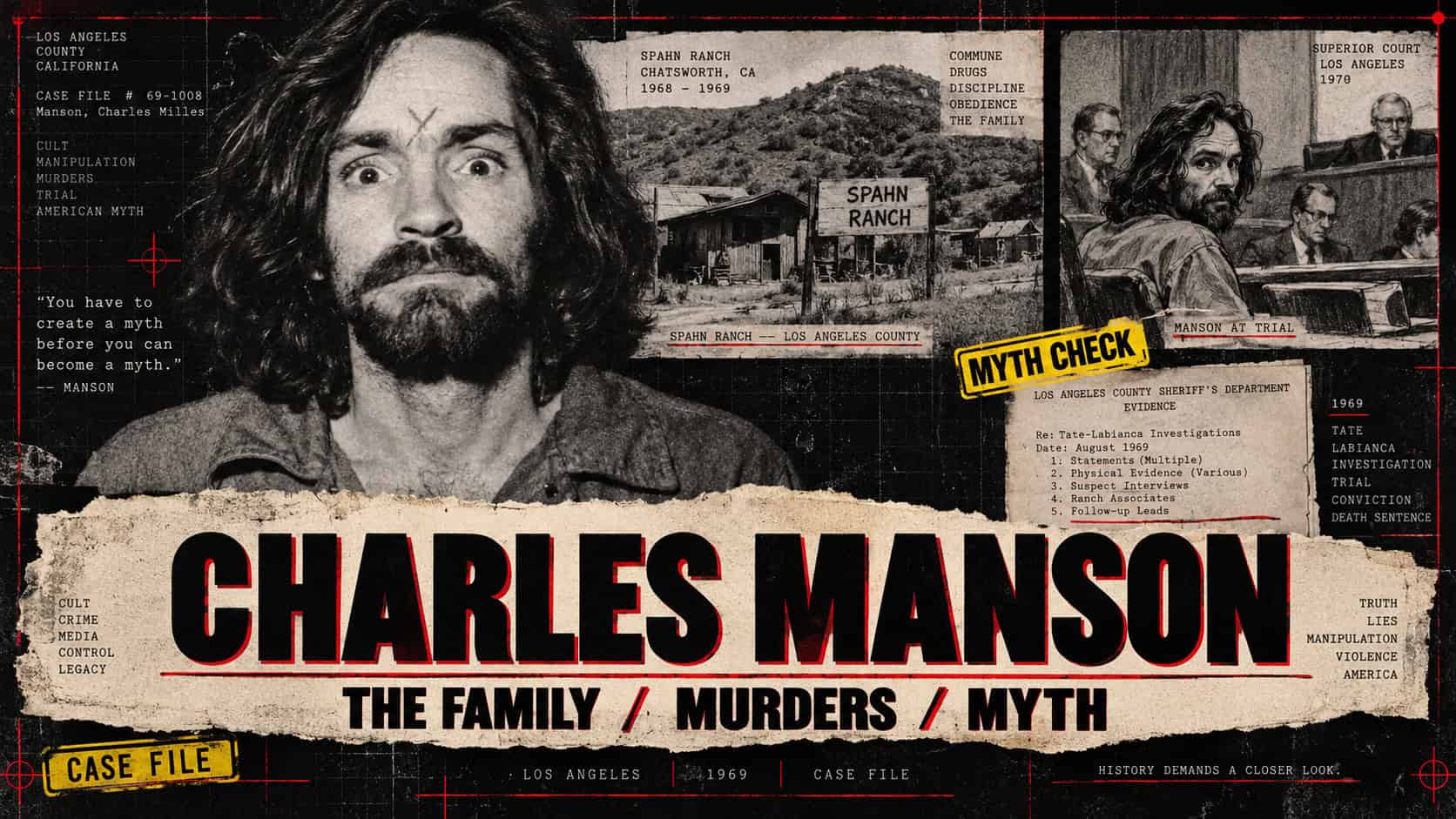
Case-file imagery from the site’s Charles Manson dossier. It is presented as editorial context, not as primary evidence of the murders.
Source: The Dark Side of Humanity archive1978: Jonestown Beyond the Poisoned-Drink Cliché
Peoples Temple did not begin with a public promise of mass death. It drew members through interracial worship, political activism, social services and a community that presented itself as an answer to racism and inequality. Those commitments help explain recruitment, but the historical record also shows how Jones accumulated control over money, housing, labor, medicine, communication and movement as the organization became more isolated.
The move to Guyana intensified dependence. Jonestown’s remoteness made leadership the practical gatekeeper for food, transportation, medical care and access to relatives, while former members described surveillance, punishment and fear of retaliation. Deborah Layton’s June 1978 affidavit warned U.S. officials that residents could not speak freely to visitors and described a rehearsal for collective death months before the final catastrophe.
Representative Leo Ryan traveled to Guyana with staff, journalists and concerned relatives after receiving allegations from former members and families. During the visit, some residents asked to leave. On November 18, 1978, Temple gunmen attacked Ryan’s departing party at Port Kaituma, killing Ryan, journalists Don Harris, Bob Brown and Greg Robinson, and Temple member Patricia Parks, while wounding others including Ryan aide Jackie Speier.
Hours later, death unfolded at Jonestown itself. The total across Jonestown, the Port Kaituma airstrip and a Temple property in Georgetown was 918 people, with 909 dead at the agricultural settlement. The Jonestown memorial accounting identifies 304 people under eighteen among the dead, a fact that immediately defeats any description of the event as a purely voluntary mass suicide.
The surviving final recording is also more complicated than a unanimous vote. Christine Miller argued for another course, Jones rejected resistance, children can be heard crying, and the process was already organized around the administration of poison. Some adults advocated death or assisted the procedure, yet children could not consent and armed security, physical isolation and prior rehearsals materially narrowed the choices available to others.
Forensics cannot reconstruct every adult death with confidence. Only seven complete autopsies were performed after delays and decomposition compromised the bodies, and a later forensic critique described the response as badly mishandled. Reports of injections and forced poisoning are therefore important, but the incomplete autopsy record makes victim-by-victim certainty impossible.
The phrase “drink the Kool-Aid” erases those distinctions. Flavor Aid was present, but the brand trivia is minor compared with the moral distortion. Turning Jonestown into a joke about gullibility makes coercion disappear and reduces murdered children and constrained adults to a metaphor for foolish conformity.
FORENSIC LIMIT The body count and broad sequence are well established; the precise manner of death for every adult is not. See the full Jonestown dossier for a deeper reconstruction.
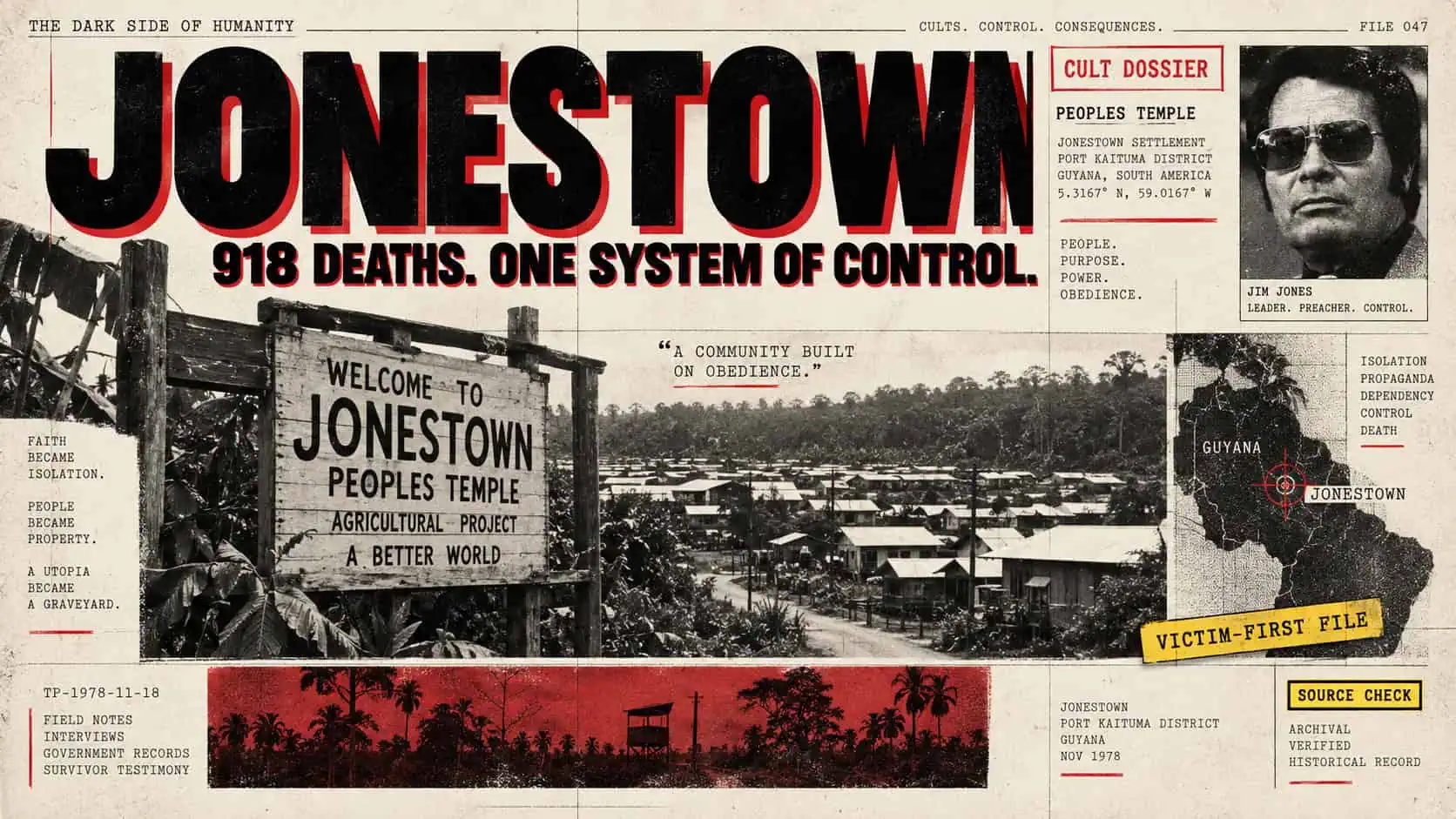
Context image from the site’s Jonestown case file. The dossier distinguishes archival context from forensic evidence collected at the settlement.
Source: The Jonestown Massacre dossier1993: Waco and the Collision of Two Power Systems
Waco is often forced into one of two stories: a dangerous cult that chose destruction, or innocent believers destroyed by the federal government. The surviving record supports neither clean narrative. David Koresh exercised coercive authority within the Branch Davidian community, while federal agencies also made serious operational, tactical and transparency failures that increased the danger of an already volatile confrontation.
Koresh claimed unique authority to interpret the Book of Revelation and reorganized intimate relationships around that authority. Former members reported physical punishment and sexual relationships with minors, and Rachel Jones married Koresh at fourteen. Those allegations and records matter, but the Justice Department later stated that officials did not have direct evidence of physical or sexual abuse of children occurring during the 51-day standoff itself, so claims that immediate tactical action was necessary to stop ongoing abuse should be stated carefully.
The confrontation began on February 28, 1993, when Bureau of Alcohol, Tobacco and Firearms agents attempted to execute arrest and search warrants at Mount Carmel. Four ATF agents and several Davidians died in the gun battle. The Justice Department said agents came under immediate fire, while surviving Davidians disputed who fired first, leaving an enduring factual dispute around the opening seconds without erasing the existence of lawful warrants or the deaths on both sides.
The FBI then managed a 51-day siege in which negotiation and tactical pressure often worked against each other. Negotiators secured the departure of children and adults, while loud noise, power cutoffs, armored movement and repeated tactical escalation hardened the environment. Later Justice Department and congressional reviews criticized coordination, planning and the decision process that led to April 19.
On that final day, the FBI used armored vehicles to deliver CS tear gas. Fires later appeared in multiple parts of the building, and official arson investigations concluded that people inside deliberately ignited them with accelerants. Later inquiries also concluded that federal agents did not start the main fire or direct gunfire at the compound, although the delayed disclosure that a small number of pyrotechnic tear-gas rounds had been used against a concrete structure hours earlier damaged official credibility.
Seventy-five sets of remains were recovered, and nine people escaped the fire. Some people died from gunshot wounds or other trauma rather than heat and smoke, but official reviews could not determine in every instance whether a gunshot represented suicide, killing by another Davidian or an attempt to prevent escape. That uncertainty is part of the case, not an invitation to fill the gaps with whichever political story a reader already prefers.
Waco therefore belongs in a dossier about high-control groups only if state power remains visible in the frame. Koresh’s authority, weapons, sexual control and apocalyptic interpretation were real. So were agency mistakes, damaged trust and tactical decisions that deserve scrutiny on their own terms.
DISPUTED The first shots on February 28 remain contested. Official findings on the April 19 fire are much stronger, but operational criticism of federal agencies remains part of the documented record.
1995: Aum Shinrikyo Turns Expertise Into a Weapons Program
Aum Shinrikyo shows why charisma alone is a poor explanation for mass violence. Shoko Asahara created an apocalyptic religious hierarchy, but the organization also built laboratories, acquired equipment, recruited technically trained members, assigned specialized roles and committed earlier crimes that normalized the idea that enemies could be eliminated. The sarin attacks were organizational achievements in the most destructive sense of that word.
By 1989, Aum members had murdered anti-cult lawyer Tsutsumi Sakamoto, his wife Satoko and their infant son Tatsuhiko. The group later experimented with chemical and biological weapons, with many biological attempts failing. A U.S. Senate staff investigation described a substantial science operation and warned against assuming that every ordinary Aum member knew about the criminal inner circle.
On June 27, 1994, Aum released sarin in Matsumoto, killing eight people and injuring more than 140. The attack was tied to judges handling a property dispute involving the group and proved that Aum could manufacture and disperse a nerve agent. Calling it only a “test run” for Tokyo makes the earlier victims seem like a technical rehearsal and assigns a single motive more confidently than the public record warrants.
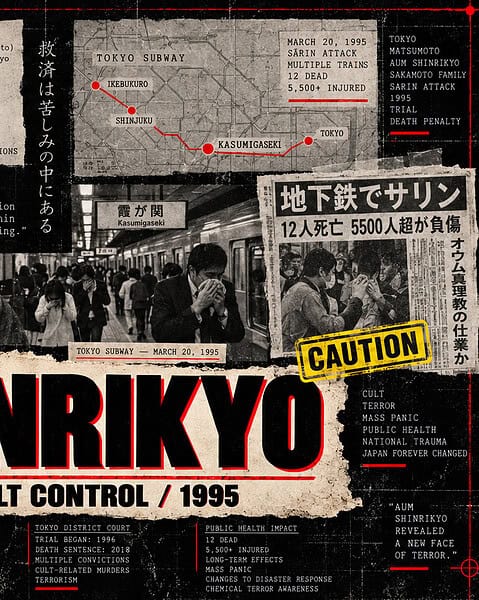
On March 20, 1995, five Aum members carried liquid sarin onto Tokyo subway trains converging on the government district during the morning rush. They punctured bags with sharpened umbrella tips and left the trains, exposing commuters and station staff to an invisible nerve agent. The death toll is now counted as fourteen after Sachiko Asakawa, who lived for 25 years with severe injuries from the exposure, died in 2020; more than 6,000 people were sickened or injured.
The attack demanded a chain of human decisions: procurement, synthesis, concealment, transport, deployment and post-crime secrecy. That chain is analytically more useful than saying followers were brainwashed, because it reveals points at which capability, hierarchy and obedience interacted. It also preserves the difference between rank-and-file religious participation and direct involvement in homicide or terrorism.
Asahara and twelve followers were executed in 2018 after convictions connected to Aum’s crimes. Successor organizations have continued to attract official scrutiny in Japan, but membership in a successor movement does not retroactively establish involvement in the 1990s crimes. Legal accountability must remain tied to conduct and proof.
RECORD LINK The site’s Aum Shinrikyo case file follows the murders, weapons development, Matsumoto attack and Tokyo subway operation in detail.
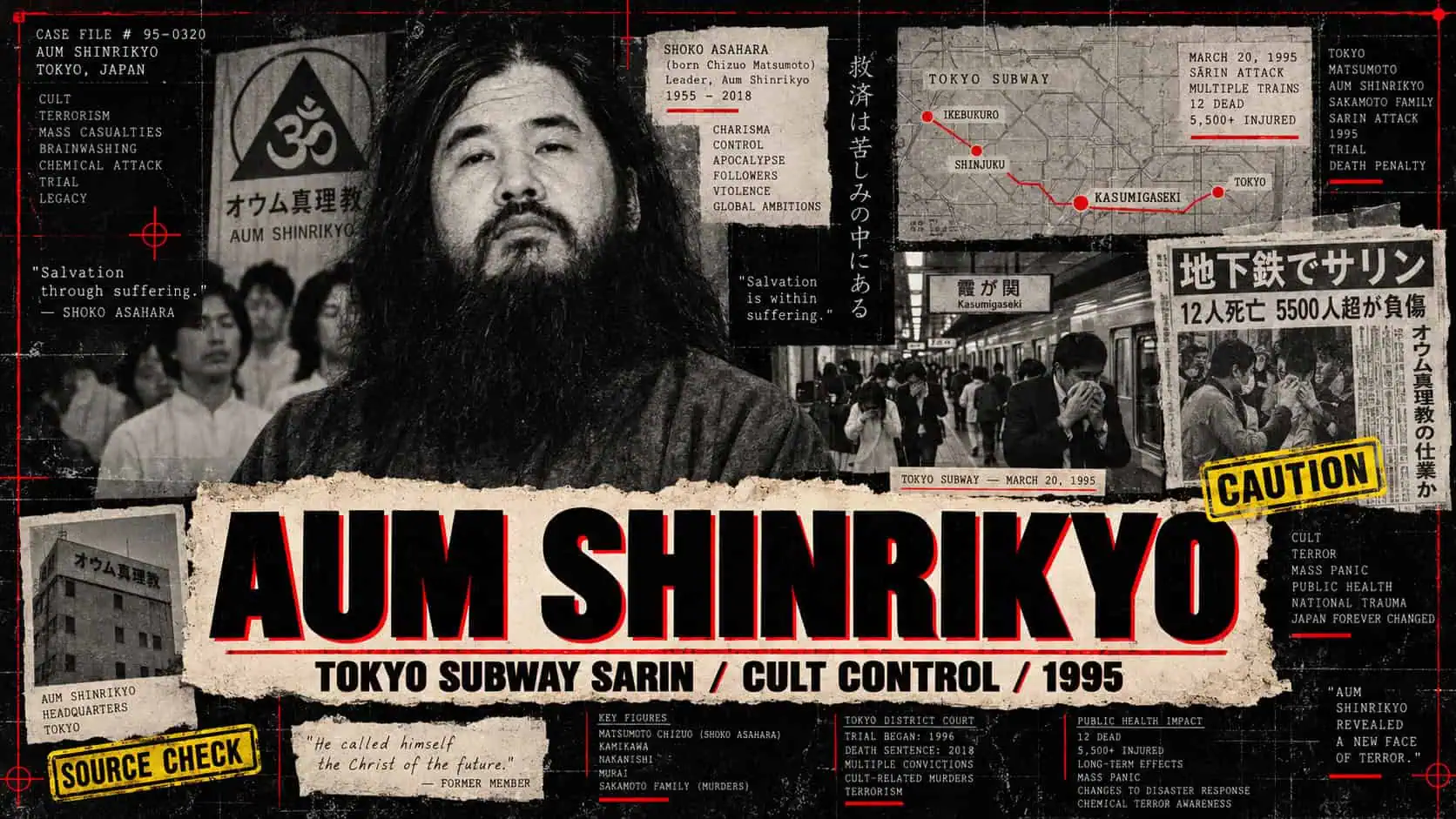
Editorial context from the site’s Aum Shinrikyo case file. The criminal record is grounded separately in court, parliamentary and investigative material.
Source: Aum Shinrikyo case file1997: Heaven’s Gate and the Problem of Voluntary Death
Heaven’s Gate cannot be treated as Jonestown with different costumes. Marshall Applewhite and Bonnie Nettles developed a belief system that combined Christian millennial ideas with extraterrestrial transformation, and adherents gradually organized communal life around strict routines, celibacy and the idea that the human body was only a temporary vehicle. The medical and investigative record does not show an airstrip massacre, murdered children or an armed enforcement apparatus comparable to Peoples Temple.
After Nettles died in 1985, the group’s theology changed in ways that made bodily death compatible with reaching the promised next level. By 1997, members interpreted comet Hale-Bopp as a sign that the moment to leave Earth had arrived. Their farewell videos are primary evidence of what they chose to say within the group’s final environment, but the calm tone of a recording cannot measure the degree of social pressure, doubt or dependency that existed behind it.
Authorities found 39 bodies in a rented Rancho Santa Fe mansion on March 26, 1997. The dead were 21 women and 18 men, including Applewhite. The San Diego County medical examiner ruled the deaths suicides involving phenobarbital, alcohol and, in most cases, probable asphyxia from plastic bags, while the staged sequence showed that members who remained alive removed bags and arranged bodies before later dying themselves.
The evidence therefore supports coordinated suicide under a shared doctrine. It does not prove a scientifically established mind-control mechanism that mechanically overrode every adult’s survival instinct. The more difficult interpretation is that intentional choice can exist inside a social world that has spent years reshaping relationships, information, identity and the meaning assigned to death.
That distinction prevents false equivalence. Jonestown includes child homicide, armed violence and evidence of forced poisoning; Heaven’s Gate was classified by the medical examiner as 39 suicides. Both involve closed belief systems and powerful leaders, but their mechanisms and legal evidence are not interchangeable.
Beyond the Famous Five: Cases That Break the Formula
The value of comparison is not to produce a list of the “deadliest cults.” It is to test whether a proposed explanation survives contact with cases that end differently. The Ant Hill Kids, Order of the Solar Temple, Uganda’s Movement for the Restoration of the Ten Commandments of God, NXIVM and the FLDS prosecutions each expose a different relationship between authority, exploitation and criminal law.
The Ant Hill Kids: Slow Violence Instead of Mass Death
Roch Thériault’s Canadian communes did not culminate in a single mass-casualty event. Control accumulated through isolation, forced labor, violence, humiliation and increasingly extreme pseudo-medical procedures, with survivor Gabrielle Lavallée’s escape in 1989 becoming a critical route to police intervention. Thériault later pleaded guilty to aggravated assault and second-degree murder and received a life sentence.
The case matters because it shows that destructive control can be chronic rather than spectacular. A fixation on dramatic finales can cause investigators and journalists to miss the long period in which injuries, dependency and leader impunity are already severe. The absence of a mass suicide does not make the system less relevant to coercive-control analysis.
CASE LINK See The Ant Hill Kids: Roch Thériault and the Cult Behind the Burnt River Crimes.
The Order of the Solar Temple: One Event, Mixed Manners of Death
Seventy-four people died in Switzerland, Canada and France between 1994 and 1997 in events associated with the Order of the Solar Temple. Investigations found a mixture of homicide and suicide, including people who had been drugged or shot. The case is a direct warning against allowing the phrase “mass suicide” to swallow victim-by-victim distinctions that the forensic evidence can actually make.
Uganda: A Catastrophe With an Incomplete Public Record
The 2000 fire associated with the Movement for the Restoration of the Ten Commandments of God was first described in some reports as collective suicide. Subsequent discoveries of bodies at other properties shifted official suspicion toward mass murder. Weak forensic capacity, inconsistent counts, missing leaders and the absence of a definitive public accounting leave central questions unresolved, so motive theories must remain visibly provisional.
NXIVM and FLDS: Criminal Law Does Not Need the Word Cult
Keith Raniere was convicted in federal court of racketeering, sex trafficking, attempted sex trafficking, sex-trafficking conspiracy, forced-labor conspiracy and wire-fraud conspiracy, then sentenced to 120 years. Warren Jeffs was convicted in Texas of aggravated sexual assault of a child and sexual assault of a child. Those judgments demonstrate the analytical advantage of naming proven conduct first.
Calling a group a cult may be culturally meaningful, but the label is not what establishes coercion, trafficking or sexual assault. Statutes, testimony, records and jury findings do that work. This conduct-first approach also protects uninvolved members from being treated as criminals solely because they belonged to an organization with a notorious leader.
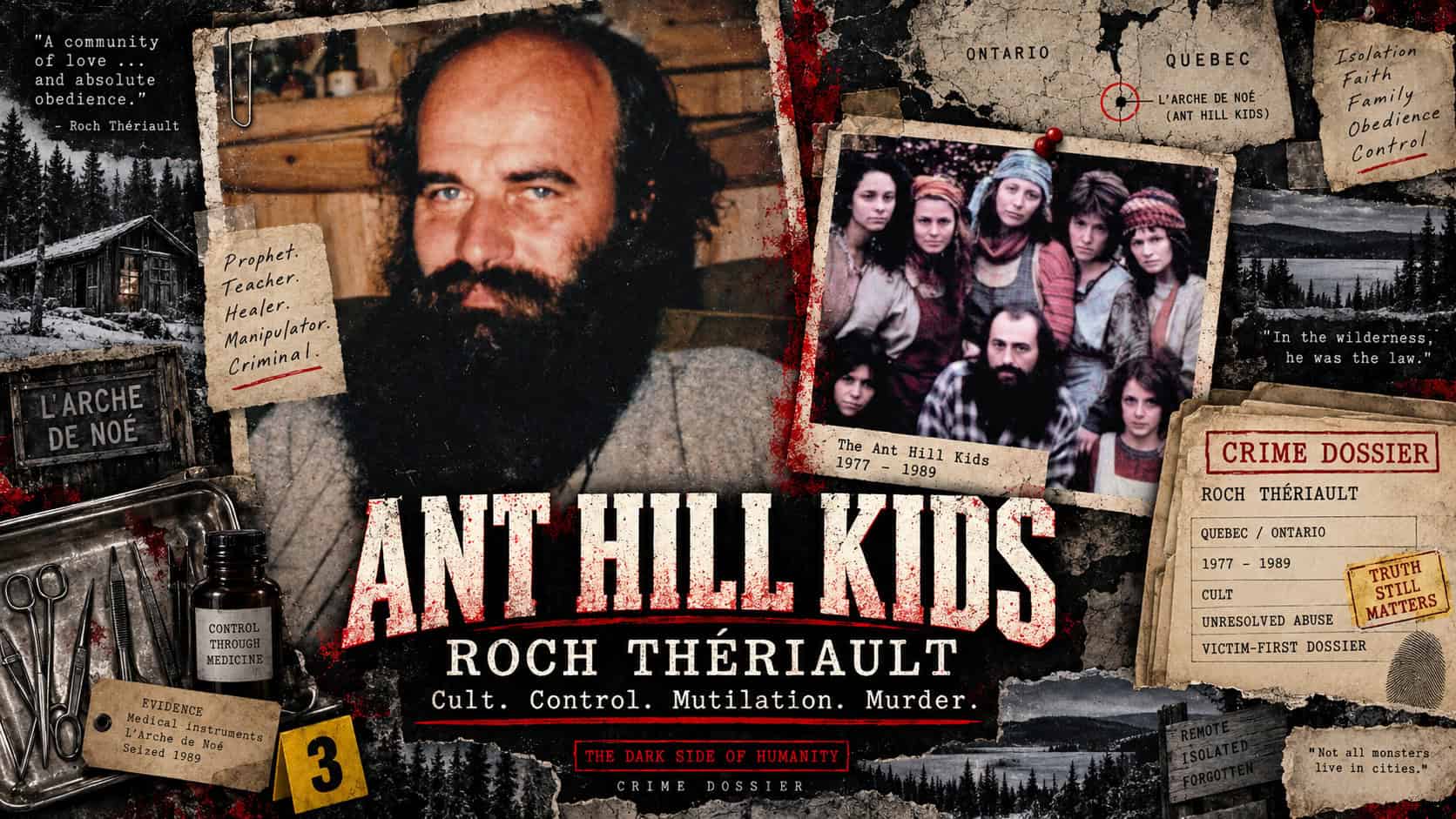
Ant Hill Kids case-file collage. The case is included because slow, chronic coercive violence challenges the assumption that a destructive group must end in one mass-casualty event.
Source: Ant Hill Kids dossierThe Family International (formerly The Children of God): Sex, Lies, and Propaganda Tapes
Founded: 1968, United States
Leader: David Berg (aka “Moses David”, “King David”, “Mo”)
Body Count: Difficult to determine, but allegations of child abuse and neglect are rampant
Modus Operandi: Free Love, Flirty Fishing, and Exploitation
Founded by David Berg, a former evangelist with a penchant for apocalyptic pronouncements and questionable sexual practices, the Children of God (COG) gained notoriety for their unorthodox recruitment techniques and disturbing beliefs.
Criminal Highlights:
- Flirty Fishing: COG members, often young women, were encouraged to engage in “Flirty Fishing,” using sex to convert new members and secure financial support for the group.
- Child Abuse Allegations: The cult faced widespread accusations of child abuse, including sexual abuse, physical abuse, and neglect. Berg’s teachings, often distributed through bizarre illustrated pamphlets, condoned and even encouraged sexual activity with minors.
What Makes Them So Dangerous?: The Family International (as they later rebranded themselves) demonstrates the insidious nature of cults that exploit sexuality and target vulnerable individuals, including children. Their legacy continues to be shrouded in controversy and allegations of abuse, leaving a trail of trauma and shattered lives in its wake.
Leader Power Is a System, Not a Personality Type
Popular culture often reduces a destructive group to one magnetic leader with a pathological personality. Charisma can matter, but personality labels explain little unless they are connected to a structure that converts preferences into consequences. A leader becomes dangerous when followers, money, information, housing, doctrine, weapons, labor or intimate relationships can be mobilized without meaningful correction.
Jim Jones had institutional control over a remote settlement. Manson’s authority operated inside a smaller commune organized around drugs, loyalty and prophecy. Asahara presided over an organization capable of technical research and secret weapons production, while Koresh claimed authority over doctrine, marriage and sexuality in an armed community. The differences matter because the machinery available to a leader shapes what kind of harm can be attempted.
This is why remote diagnosis adds less than it appears to add. Calling a leader narcissistic, psychopathic or sociopathic may sound explanatory, but it can encourage circular reasoning: the person caused harm because they were a psychopath, and we know they were a psychopath because they caused harm. Records of orders, punishments, finances, surveillance, sexual access, weapons acquisition and blocked exit are far more useful.
The same principle applies to followers. Group membership is not a diagnosis, and obedience is not an all-purpose defense. Evidence should identify who knew what, who could leave, who issued orders, who carried them out, who resisted, who benefited and what sanctions existed for refusal.
How Harm Escalates: The Architecture of a Closed System
Mass violence usually looks sudden from outside because outsiders encounter the final act rather than the years of preparation. Inside a closed system, escalation can occur through ordinary organizational mechanisms: leaders become harder to challenge, members become more dependent, prior violations create shared secrets, and enemies are described in language that makes retaliation seem defensive or sacred.
This sequence is a reporting framework, not a predictive formula. Many groups display one or more of these features and never become homicidal. Its value is in forcing the investigation to ask how power moved from idea to infrastructure rather than assuming that extreme belief alone produced the outcome.
Failed Prophecy Does Not Have One Outcome
A failed prophecy is often presented as a mechanical trigger for cult violence. The historical literature is more complicated. Groups can reinterpret a failed prediction, shift the date, spiritualize the event, blame insufficient faith, fragment into factions or simply dissolve, which means failure alone cannot explain why one organization becomes violent while another survives peacefully.
The important variable is what the organization has already built around the prophecy. If leadership is absolute, dissent is punished, weapons are available, outsiders are demonized and prior crimes are concealed, a public failure can threaten not just theology but the leader’s power and the group’s survival. Under those conditions, reinterpretation may take a more dangerous form because the system has more to lose.
Uganda’s Movement for the Restoration of the Ten Commandments of God is frequently summarized as a failed-prophecy massacre. That may be part of the explanation, but the incomplete public investigation and missing leaders make a single-motive story too confident. The case is a reminder that a compelling theory is not the same thing as a completed evidentiary chain.
Control Works Through Domains of Ordinary Life
The strongest evidence of coercive control is often mundane. Who holds identification documents? Who owns the home? Who decides whether a member can see a doctor, call a parent, marry, work outside the group or keep wages? These questions reveal leverage that a general discussion of charisma can miss.
Money and Labor
Financial surrender can transform ideological loyalty into material dependency. Unpaid or controlled labor also gives leadership both economic value and another mechanism for rewarding compliance or punishing dissent.
Family and Children
When a leader controls marriage, parenting or access to children, departure can threaten the member’s most important relationships. Children are especially vulnerable because their dependency is structural, not chosen.
Sex and Intimacy
Sexual access may be justified as doctrine, healing, initiation or special privilege. Legal analysis must still separate adult consent, coercion, age of consent, trafficking and assault rather than treating all unconventional relationships as identical.
Information and Movement
Surveillance, restricted communication and control of transportation can make outside correction practically inaccessible. In remote settings, the ability to leave may depend on the same authority a member is trying to escape.
These domains also explain why outsiders can misread apparent compliance. A person may continue working, smiling, proselytizing or defending the group while facing costs that are invisible to someone who sees only the public performance. Conduct-based reporting makes those costs visible without pretending to know a person’s private mental state.
Institutional Failure Can Magnify Cult Violence
High-control systems are not sealed off from the outside world as completely as later mythology suggests. Former members speak, families complain, courts issue orders, journalists investigate, police receive allegations and regulators encounter financial or weapons violations. The central institutional question is not whether a warning existed, but whether separate pieces of information were recognized as belonging to the same risk system.
Jonestown had defectors, concerned relatives and Deborah Layton’s sworn warning before November 1978. Waco involved law-enforcement planning failures before the first raid and serious disagreement between negotiators and tactical personnel during the siege. Aum committed earlier crimes and a prior sarin attack before the Tokyo subway operation. In each case, the final catastrophe was preceded by opportunities for authorities or institutions to learn more.
This does not mean intervention is easy. Religious liberty, privacy, evidentiary standards, jurisdictional limits and the risk of making a situation more dangerous constrain state action for good reasons. The goal is not to create a license for government surveillance of unpopular religions, but to improve response to concrete allegations such as violence, fraud, trafficking, illegal weapons, child abuse or credible threats.
Waco is the clearest warning about intervention itself becoming part of the hazard. A flawed initial operation can validate a leader’s persecution narrative, while secrecy or delayed disclosure can make later accurate findings harder to trust. Effective prevention therefore requires lawful evidence gathering, operational restraint, coordination and transparency, not merely stronger force.
Not All Deadly Cult Cases Are the Same Crime
A list of notorious groups can create the false impression that all cases share one endpoint. They do not. The record ranges from directed homicide to mass murder-suicide, coordinated adult suicide, terrorism, chronic interpersonal violence, trafficking and unresolved mass death, each of which requires a different evidentiary and legal framework.
| Case | Primary violence pattern | Why classification matters | Key evidence limit |
|---|---|---|---|
| Manson Family | Directed and conspiratorial homicide. | Leader influence and follower liability can coexist. | Popular retellings often simplify motive and target selection. |
| Peoples Temple / Jonestown | Mass murder-suicide, child homicide and armed attack. | A blanket “mass suicide” label erases children and coercion. | Only seven complete autopsies were performed. |
| Branch Davidians / Waco | Armed confrontation, fire and disputed individual manners of death. | State tactics and internal control must both remain visible. | Opening gunfire and some individual death circumstances remain contested. |
| Aum Shinrikyo | Assassination and organized chemical terrorism. | Technical capacity and operational roles are central. | Ordinary membership did not establish knowledge of the criminal inner circle. |
| Heaven’s Gate | Coordinated adult suicide. | It should not be collapsed into Jonestown. | The record cannot quantify subjective freedom or private doubt. |
| Ant Hill Kids | Chronic physical abuse, mutilation, aggravated assault and homicide. | Destructive control may escalate over years without a mass-casualty finale. | Survivor experience should not be generalized to every member. |
Timeline: From Directed Murder to Modern Trafficking Prosecutions
Leaving a High-Control Group Is Not a Single Recovery Script
Departure is often described as a moment of awakening followed by deprogramming and recovery. Former members report a much wider range of experiences. Some leave because a leader’s abuse becomes undeniable, some are expelled, some retain portions of the group’s theology, and some face grief because departure also means losing family, housing, employment and an entire social world.
A qualitative study of former members in Sweden described experiences of being “in between” the group and wider society, with recurring needs around identity, trust, relationships and mental health care. Small and self-selected samples limit generalization, but the study supports an important clinical principle: support should be individualized rather than built around the assumption that every former member has the same diagnosis.
Historical forced deprogramming also complicates the idea that coercion can be cured through more coercion. Detaining an adult, restricting movement or imposing a new ideology reproduces some of the autonomy problems critics claim to oppose. Contemporary help should prioritize immediate safety, practical resources, qualified legal or medical assistance and respect for the adult’s decision-making capacity.
Journalists have a parallel responsibility. Survivor testimony should be quoted for what it actually establishes, not turned into a universal map of how every member thought or felt. When a diagnosis or treatment history is relevant, it belongs to that person and that evidence, not to an entire religious or political community.
How the Word Cult Can Hide the Crime
The word “cult” is powerful because it appears to explain an entire case before the evidence is examined. Once a group receives the label, strange doctrine can be mistaken for proof of dangerousness, ordinary members can be treated as equally culpable, and state failures can disappear behind the assumption that irrational believers were destined for catastrophe. The label can therefore make a story easier to tell while making it less accurate.
Conduct-first language is harder but more useful. “The leader controlled access to passports” establishes a verifiable mechanism. “Members were brainwashed” imports a disputed theory. “A federal jury convicted Raniere of sex trafficking” tells the reader what was proved, while “NXIVM was a sex cult” compresses an entire criminal case into a category whose boundaries change from writer to writer.
The same discipline protects religious freedom. New religious movements, minority faiths, communes and intense political organizations should not be treated as presumptively criminal because their practices appear unfamiliar. A system becomes a public-safety concern when evidence shows coercion, exploitation, violence, trafficking, illegal weapons, fraud, child abuse, obstruction or credible threats.

Illustrative context for the language of brainwashing and persuasion. The image is not evidence that a single psychological technique explains any case in this dossier.
Source: The Dark Side of Humanity archiveMyth vs. Record
Myth: Brainwashing Is a Proven Mental Switch
The classic total-control model is scientifically disputed. Coercion, dependency, social influence and punishment are well documented, but they should be described as specific mechanisms rather than evidence of a magical override of agency.
Myth: Only Gullible People Join
Recruit backgrounds vary widely and include professionals, activists, parents, older adults and people seeking community or purpose. Membership alone does not reveal intelligence, diagnosis or a universal vulnerability profile.
Myth: Jonestown Was Simply a Mass Suicide
The 918 deaths include murdered people at Port Kaituma and 304 people under eighteen at Jonestown. The FBI uses the term mass murder-suicide, and incomplete autopsies leave uncertainty about the precise manner of death for some adults.
Myth: Everyone at Waco Was Killed by Federal Agents
Official inquiries concluded that people inside started the fires and did not find evidence of federal gunfire directed at the compound on April 19. Those findings can coexist with serious documented criticism of federal planning, tactics and delayed disclosure.
Myth: Heaven’s Gate Was Another Jonestown
The medical examiner classified all 39 Heaven’s Gate deaths as suicides. The case lacks the child homicide, airstrip killings and equivalent evidence of armed coercion that make Jonestown a mass murder-suicide.
Myth: Aum Was Just One Charismatic Guru
Aum’s violence required laboratories, technical expertise, money, procurement, operational planning and a hierarchy capable of assigning criminal tasks. Shoko Asahara mattered, but organizational capacity made mass-casualty terrorism possible.
Myth: A Failed Prophecy Automatically Produces Violence
Groups respond to failed predictions in many ways, including reinterpretation, fragmentation and dissolution. Violence depends on additional conditions such as authority, prior crime, enemy construction, capability and perceived existential threat.
Myth: A Cult Label Proves a Crime
Criminal cases are established through statutes and evidence, not a sociological nickname. NXIVM and Warren Jeffs illustrate why trafficking, forced labor and sexual assault should be named directly rather than outsourced to the word cult.
What the Evidence Can Prove, and What It Cannot
Usually Provable
- Who issued or carried out documented orders when testimony or records establish the chain.
- What courts found, which charges were proved and which were not.
- Whether weapons, financial records, communications, autopsies or survivor accounts corroborate specific conduct.
- Whether a person could physically leave, control money or communicate with outsiders in a given setting.
Often Not Provable
- The exact amount of private doubt an individual felt while outwardly complying.
- A universal personality profile for recruits or leaders.
- A single psychological mechanism that caused every participant to act.
- Victim-by-victim manner of death when forensic examination was incomplete, as at Jonestown.
This boundary is not an excuse for vagueness. It is the difference between a dossier that explains what records establish and one that replaces missing evidence with a dramatic theory. Uncertainty should be located precisely so that strong findings remain strong.
Frequently Asked Questions
What is a cult?
There is no universally accepted clinical or legal definition. For crime reporting, it is more reliable to examine conduct such as coercion, deception, exploitation, punishment of dissent, blocked exit and violence than to classify a group by unusual belief alone.
What are the strongest signs of a dangerous cult?
The strongest warning signs involve unaccountable authority, punishment for dissent, control of multiple life domains and engineered barriers to leaving. None of those signs alone proves that a group will become violent, but together they justify closer scrutiny of concrete conduct.
Why do people join cults?
People join for varied reasons, including community, spiritual purpose, political ideals, friendship, romance, employment or support during a crisis. Harm often becomes visible only after the group has gained more control over relationships, money, information or daily life.
Do cults really brainwash people?
The classic idea of brainwashing as a scientifically proven technique that removes all agency is disputed. Isolation, dependency, threats, sleep disruption, surveillance and social punishment can still constrain choice and make resistance more difficult.
Was Jonestown a mass suicide or mass murder?
Both terms are necessary, which is why the FBI describes Jonestown as mass murder-suicide. Children could not consent, some adults resisted, and evidence supports coercion or forced poisoning in some deaths, while other adults advocated or participated in the plan.
How many people died at Jonestown?
There were 918 deaths across Jonestown, the Port Kaituma airstrip and a Temple property in Georgetown. Of those, 909 died at Jonestown, including 304 people under eighteen.
Did the FBI start the Waco fire?
Multiple official and independent inquiries concluded that people inside Mount Carmel deliberately set the fires and did not find that federal agents ignited the main complex. Separate reviews still criticized federal planning, tactics and disclosure, so the official fire finding does not erase government failure.
How many people died in the Tokyo subway sarin attack?
Fourteen people are now counted as having died from the attack after a severely injured survivor died in 2020. More than 6,000 people were sickened or injured by the sarin exposure.
Were the Heaven’s Gate deaths voluntary?
The medical examiner ruled all 39 deaths suicides, and the surviving record shows planning and shared belief. The evidence cannot quantify how years of communal life and restricted social context shaped each adult’s sense of available choices.
Are cult leaders all psychopaths?
No reliable universal diagnosis applies to cult leaders, and remote diagnosis can become circular. A better analysis documents authority, exploitation, deception, orders, punishment, financial control and violence without pretending a label explains every case.
Can educated people join high-control groups?
Yes. Aum Shinrikyo included doctors, scientists, lawyers and engineers, demonstrating that education is not immunity to social influence or ideology. Expertise can also increase a group’s capacity when technical skills are redirected toward criminal goals.
Can people recover after leaving a high-control group?
Yes, but recovery varies greatly. Some former members need help with trauma, housing, finances, identity, relationships or legal problems, while others do not require clinical treatment and should not be assigned a diagnosis simply because they left a stigmatized group.
Source Ledger
This dossier prioritizes court decisions, government reviews, investigative archives and scholarly work over retrospective personality theories. Source categories are separated so readers can distinguish a legal finding from historical interpretation or later reporting.
Jonestown and Peoples Temple
Manson and Van Houten
Mount Carmel Reviews
Aum, NXIVM and FLDS
Coercion, Conversion and Recovery
Jonestown, Aum and Heaven’s Gate
Internal Case Network
For deeper case-specific records, continue to the Jonestown dossier, Aum Shinrikyo case file, Charles Manson case file and Ant Hill Kids dossier. The broader Cults & Extremism archive provides the surrounding context.
Editorial standard: allegations remain allegations, legal findings remain tied to their jurisdiction and evidentiary gaps are stated rather than repaired with speculation.
Browse every case in the Case File Index
Discover more from The Dark Side of Humanity
Subscribe to get the latest posts sent to your email.