Thierry Bissonnier
The 1994 killing of a man in his own flat in eastern Paris, the one crime for which Nicolas Claux was convicted, and the record behind the nickname that has overshadowed him.
Sentence served · released 2002 · record checked 5:35 p.m. ET, Friday, October 2, 2026
In its own voice this file states only what a court decided: Nicolas Claux was convicted of one premeditated murder, that of Thierry Bissonnier, sentenced to 12 years and released in 2002. Everything else is attributed. Three points remain open: the year of the trial, the time he served, and whether any of Claux’s own accounts of graves and mortuaries were proved.
- Date of killing
- Oct. 4, 1994, according to Crime Library6
- Investigating magistrate
- Gilbert Thiel, juge d’instruction2
- Arrest
- Nov. 15, 1994, according to Crime Library6
- Other counts
- Armed robbery; cheque fraud; licence falsification; attempted fraud, according to Crime Library6
- Not convicted of
- Grave robbery; theft of blood, according to Crime Library6
- Judgment
- Not located by TDSH16
- Case
- Paris · 1994
- Victim
- T. Bissonnier
Items in the cited record
- Victim’s cheque, used in an attempted purchase6
- Victim’s driving licence, photo replaced6
- Shop photocopy of the licence, per Claux7
- Minitel contact with the victim2
- .22 Long Rifle firearm, per Le Parisien1
SRC: Crime Library; Le Parisien; Le Nouveau Détective; Claux (2020)
Sentence served; released in 2002. Status as of 5:35 p.m. ET, Friday, October 2, 2026.
Nicolas Claux was convicted of the premeditated murder of Thierry Bissonnier, sentenced to 12 years and released in 2002.1245 He is living; the most recent report reviewed, from March 2025, gives his age as 52.
Convicted of one premeditated murder · 12 years · released 2002 · status as of 5:35 p.m. ET, Friday, October 2, 2026.
This file concerns the killing of a man in his home and discusses claims, made by the man convicted of killing him, about the mutilation of human remains, the theft of blood and the eating of human tissue. Those claims are reported only as claims, without graphic detail. French quotations are exact and are followed by TDSH’s translation. The victim’s family is not named, and no photograph of the victim or of Claux is used.
What happened to Thierry Bissonnier?
A man in the 11th arrondissement · direct answer first
What happened to Thierry Bissonnier, and what was Nicolas Claux convicted of?
Thierry Bissonnier was killed in his flat in the 11th arrondissement of Paris in 1994. Le Parisien reported that he was shot several times with a .22 Long Rifle firearm. Nicolas Claux was convicted of his assassinat, the French legal term for murder committed with premeditation, and sentenced to 12 years in prison. He was released in 2002. That conviction, with the robbery and fraud counts that Crime Library lists alongside it, is the whole of what a court has found against him in the sources TDSH reviewed.12345
A name that the case swallowed
Most of what has been published about this case is not about Thierry Bissonnier. It is about the man who killed him, and about a nickname, the “Vampire of Paris,” that grew up around that man’s own descriptions of himself. Crime Library itself spells his surname two ways. This file starts with him because the record starts with him: the only crime for which a French court convicted Nicolas Claux is the killing of Thierry Bissonnier.126
What can be said about him with confidence is short, and this file does not stretch it. He was a man living in eastern Paris in the autumn of 1994. He had been in contact with his killer through Minitel, France’s national videotex network, which by 1997 had some 25 million users and carried popular chat services. He was killed in his own home. Crime Library, the only source that gives his age, put it at 34.2613
One killing, one sentence
Claux was tried before a French criminal court and convicted of assassinat, which the penal code then in force defined in one line: « Le meurtre commis avec préméditation constitue un assassinat » (“Murder committed with premeditation constitutes an assassinat”). The maximum penalty was life imprisonment. He received 12 years. Three French publications, Le Parisien, Le Nouveau Détective and Le Télégramme, report the 12-year term, and L’Express reported it in 2006.123410
He was released in 2002, a date reported by L’Express in 2006 and by Le Parisien in 2012. The sources disagree on how much of the term he actually served, and on the year of the trial itself; this file explains both gaps rather than choosing a number.4567
What this file will and will not say
Almost everything that made this case notorious comes from Claux himself: his accounts of working in hospital mortuaries, of entering graves, of taking blood and human tissue. A retired investigating magistrate has since said that part of that account checked out. A crime writer who cited the case documents wrote that they mention none of it. According to Crime Library, he was never convicted of any of it.267
So this file keeps two registers apart. In its own voice it states only what a court decided. Everything else is attributed to the person who said it, with the date and the publication, so a reader can weigh each claim by where it came from.
Who was Thierry Bissonnier?
The victim · what the record holds, and what it leaves out
Thierry Bissonnier
A home in the 11th
Two French publications name him and place the killing in a flat in the 11th arrondissement, in eastern Paris. Both date it to 1994. Le Nouveau Détective adds that his killer had been in contact with him through Minitel before that day.12
That is the verified core. It is not much, and the thinness is itself part of the story. Even Crime Library, the fullest English-language account, conceded that “reports on the life Thierry led are rather sketchy.” No reporting from the time of the killing or the trial surfaced in the archives TDSH searched, and nothing the family may have said publicly was found. The rest of what is known about him comes from a single English-language feature, which this file credits each time it is used.616
What Crime Library adds
According to Crime Library, Thierry Bissonnier was 34, worked as a restaurateur and played classical music part time. Crime Library also reports that his body lay in the flat for about three days before his parents found him. No other source TDSH could verify gives those details, so they are credited to Crime Library each time they appear here.6
This file does not go looking for more. It does not publish a photograph of him, and it does not repeat details of his private life that appear only in the killer’s narration.6
“Homophobic,” in two papers’ words
Le Parisien called the killing « un assassinat homophobe » (“a homophobic assassinat”) in March 2025, and Le Nouveau Détective, writing two days later, called it « un meurtre homophobe ». Those are the papers’ characterizations. TDSH has not seen the judgment and cannot say whether the court made any finding about motive. Claux, for his part, has denied it: “I’m not homophobic,” he told an interviewer in 2020.127
This matters for how Thierry Bissonnier is remembered. Minitel’s chat services were a common way for strangers in France to meet in the 1990s, and it was through Minitel that his killer reached him. Whatever Claux later said about his reasons, and he has said several contradictory things, nothing in any source suggests that Thierry Bissonnier did anything other than agree to meet someone he had been talking to.2613
Le meurtre commis avec préméditation constitue un assassinat.Code pénal, Article 221-3, in the text in force from March 1, 1994. “Murder committed with premeditation constitutes an assassinat.” The definition of the crime of which Claux was convicted.
Where does the case stand today?
Status · as of 5:35 p.m. ET, Friday, October 2, 2026
A sentence served
The criminal case is closed. Claux was convicted, sentenced, imprisoned and released; the sources reviewed for this file do not mention an appeal. He is living. Reporting from March 2025 describes him as 52 and free.245
Nothing in the public record TDSH examined suggests that any other charge is pending against him, and this file connects him to no other death. He was convicted of one killing.12
The missing judgment
No copy of the judgment was located. TDSH searched the Le Monde archive for the defendant’s and the victim’s names across the years of the case and found no report of the trial. Without the judgment or a report written at the time, two basic facts remain unsettled in print: the year of the trial and the length of time served.16
This file states neither. Section 10 sets out what each source says, so a reader can see the disagreement for themselves.
What is established, and what rests on Claux’s word?
Four layers of evidence · read the source before the claim
What a court decided
One conviction for assassinat. A 12-year sentence. Release in 2002. These are the facts reported consistently by French publications across two decades, and they are the only facts this file states in its own voice about what Nicolas Claux did.12345
Crime Library, which says it drew on the case documents, adds the other counts in the verdict: armed robbery, fraudulent use of a cheque, falsification of a driving-licence photo and an attempt to defraud a retailer. Those are credited to Crime Library because no French source TDSH could open lists them.6
What the magistrate remembers
Gilbert Thiel, the juge d’instruction who ran the investigation, spoke about the case in 2025, years after his retirement. As quoted by Le Nouveau Détective from his interview with Le Parisien, he said that he had at first doubted Claux’s accounts, then found that at least part of them was true. That is a first-hand recollection from the investigator, given three decades later. It is evidence; it is not a judgment.214
What Claux has said about himself
The childhood, the hospital mortuaries, the graves, the blood, the tissue he says he ate, the motive: all of it comes from Claux’s own narrations, written for Crime Library, and from interviews he gave later. These are statements by a convicted man about himself, they have changed over time, sometimes within a single account. This file reports them only as his words.67
What the press has called him
French headlines have described Claux with words that no court applied to him. Those labels are quoted here, inside quotation marks and with the publication named, because readers will meet them elsewhere. Quoting a label is not endorsing it. Section 13 explains where the “Vampire of Paris” name comes from and why it is not a finding of fact.123
Who are the key people?
Named only where the name is official or consistently reported
Thierry Bissonnier
Nicolas Claux

Gilbert Thiel
David Lohr
Who is not named here, and why
The case involved other people: members of the victim’s family, defence counsel, police officers, a presiding judge, people Claux says he knew. Some of their names circulate in English-language retellings. This file names a person only when the name is official or reported consistently by at least two reputable sources, and none of those other names cleared that bar. Family members are not named in any case.
The same rule applies to places. This file does not give the victim’s street, the hospitals where Claux has said he worked, or the cemeteries he has named. Those details come from his own narration and add nothing a reader needs.
Who was Nicolas Claux before October 1994?
Background · almost entirely in his own words
Born abroad, raised on the move
According to Crime Library, Nicolas Claux was born in 1972 in Cameroon, the son of a French bank employee whose work took the family abroad for long stretches. Crime Library says the family moved to London when he was about five and to the southern part of Paris when he was seven. Le Nouveau Détective gave his age as 52 in March 2025, which fits a birth in 1972.62
Beyond those outlines, the story of his early life is his own. It reaches readers through two channels: the written narrations he supplied for Crime Library’s feature, which its author says were edited and arranged for flow, and interviews he gave much later. Neither is independent of him.67
The account he gives of his childhood
Claux has said that he was a solitary child who grew up with “a fascination for death and the occult.” In a 2020 interview he said that when he was about 10, his grandfather died suddenly while playing badminton with him, and that the funeral home left a deep impression on him. He has said that at about 12 he looked through a magazine, kept by an uncle, that printed photographs from the case of Issei Sagawa, which Claux described as “a big case” in France, and that the pictures fascinated him.7
He has said that the family then spent four years in Portugal, where he began spending time in cemeteries, and that after returning to France he skipped school to visit cemeteries. He told Crime Library that his parents were kind but distant, and that he “grew emotionally cold.”67
None of this has been checked against any independent record, and TDSH has not tried to fill the gaps. It is reported here because it is the version of his life that Claux himself has put into circulation, and because the later sections of this file show how that version shifts.
The army, the mortuaries and what he says he did there
Claux has said that he joined the army at about 18 and, on returning, decided on a career in the funeral trade. He has said that he worked in “a couple of morgues” in Paris hospitals when he was about 20. In the same 2020 interview he said that during that period he cut tissue from bodies in an autopsy room and ate it, and that while also working for a blood bank he took bags of blood home. “All these activities took place within a year,” he said.7
Those are his statements. Le Nouveau Détective reported in March 2025, in the conditional, that while working in a hospital mortuary Claux « aurait récidivé en prélevant des « tissus humains » pour les manger » (“allegedly did it again, taking ‘human tissue’ to eat it”), and wrote that those acts earned him the « Vampire de Paris » name. No source TDSH reviewed reports a conviction for any act in this card; Crime Library says he was never convicted of grave robbery or of stealing blood.26
What happened in the flat in the 11th arrondissement?
The killing · what is verified, and whose account fills the rest
A killing in his home
Thierry Bissonnier was killed in his flat in the 11th arrondissement in 1994. Le Parisien reported that Claux shot him several times with a .22 Long Rifle firearm. According to Crime Library, the date was October 4, 1994.126
This file does not reconstruct the killing beyond those facts. The only detailed description of what happened inside the flat comes from the man convicted of it. It is not independent, it is not needed to understand the case, and repeating it would give his voice the last word over the victim’s death.
How a Minitel contact worked
Minitel was a small terminal with a screen and keyboard, connected over the telephone network, that France rolled out nationally in 1982. By 1997, the BBC reported, there were 9 million terminals and about 25 million users, with 26,000 services, among them the « Minitel rose » chat lines. Its chat services let strangers exchange messages and arrange to meet. France switched the network off in June 2012, 30 years after its launch.13
Le Nouveau Détective reported that Claux had been in contact with Thierry Bissonnier by Minitel. Claux has said the same, and has said he chose that route because it let him reach a stranger.27
What makes a killing an assassinat
The penal code that came into force in France on March 1, 1994, distinguishes two kinds of intentional killing. Meurtre, « le fait de donner volontairement la mort à autrui » (“intentionally causing the death of another”), carried up to 30 years of imprisonment. Assassinat is meurtre committed with préméditation, and carried life imprisonment. The code defines premeditation as « le dessein formé avant l’action de commettre un crime ou un délit déterminé » (“the intention, formed before the act, to commit a specific crime or offence”).1011
A conviction for assassinat therefore means the court found that the decision to kill was made before the act. It says nothing, in itself, about the reason. The motives Claux has offered over the years are set out in Section 12, and they do not agree with one another.10
The versions he has given of that day
Claux has given more than one account of the killing itself. In his narration for Crime Library, he said that during a reconstitution ordered by the investigating magistrate he claimed the first shot had been accidental, and that he “stuck to this version until the trial.” In the same narration he described the killing as deliberate. In 2020 he called it “an experiment” to test a firearm.67
According to his own narration, he left the flat with the victim’s chequebook, a credit card, a wallet, his driving licence and other belongings. Crime Library reports that the verdict included armed robbery.6
How was the killing traced to Claux?
A cheque, a licence and a photograph · Oct. to Nov. 1994
The cheque and the licence
According to Crime Library, in mid-October 1994 Claux tried to pay for an electronics purchase with one of Thierry Bissonnier’s cheques. Asked for identification, he produced the victim’s driving licence, into which he had inserted his own photograph. The clerk compared the signatures and noticed the fraud, and Claux left before police arrived. Crime Library reports that the verdict included fraudulent use of a cheque, falsification of the licence photograph and an attempt to defraud the retailer.6
Claux’s own later account adds one detail: that the shop had photocopied the licence, and that police enlarged the small photograph on it and circulated it to police stations across Paris.7
The arrest
According to Crime Library, officers of the Paris Brigade criminelle arrested Claux on November 15, 1994, outside the Moulin Rouge cabaret. Claux has described the arrest the same way, saying police had been looking for him for about a month and a half and recognized him from the photograph. In his Crime Library narration he said he confessed in custody when shown the ballistic evidence.67
The interval fits: from early October to mid-November is about six weeks. That is TDSH’s arithmetic, not a finding in any record.

Who ran the investigation
In France, an investigation into a crime as serious as murder is led by a juge d’instruction, an investigating magistrate. The government’s legal guide explains that such an investigation is mandatory for crimes, that the judge investigates « à charge et à décharge » (gathering evidence both for and against the suspect), can order psychiatric assessments and a reconstitution of the events, and ends by deciding whether to send the case to the cour d’assises for trial.12
The juge d’instruction in this case was Gilbert Thiel, who had become a judge in Paris in August 1994. In July 1995 he joined the anti-terrorism section of the Paris court, where he remained until his retirement on July 1, 2014. Crime Library reports that he chose to keep the Claux investigation after that move. Crime Library calls him a Brigade criminelle investigator; that is wrong. He was a magistrate, not a police officer.261415
What did investigators find?
The magistrate’s memory against the writer’s reading of the file
« Mais ce qu’il avait dit était vrai »
Gilbert Thiel described the interrogations in 2025. As quoted by Le Nouveau Détective from his interview with Le Parisien, he said: « Quand il a commencé à raconter ça, je surveillais ma greffière qui était sur le point de tourner de l’œil (…) Au début, je ne le croyais pas trop, je pensais qu’il faisait ça pour se faire passer pour un fou. Mais ce qu’il avait dit était vrai. On a trouvé des mausolées fracturés et il manquait des morceaux de cadavre. »2
In English: “When he started telling that, I was watching my clerk, who was about to faint (…) At first I didn’t really believe him; I thought he was doing it to pass himself off as mad. But what he had said was true. We found mausoleums that had been broken open, and pieces of bodies were missing.”
This is the strongest corroboration of any part of Claux’s account, and it comes from the man who ran the investigation. It is also a recollection given about three decades after the events, quoted second-hand, and it does not say what charges, if any, followed.2
“No mention” in the documents
David Lohr, who wrote Crime Library’s feature with access to Claux’s narrations and, he says, to documents in the case, reached a different conclusion. “In the actual documents of the case,” he wrote, there is “no mention of any grave robbing, necrophilia, vampirism or cannibalism.” He added: “I’m tempted to view these sensational accounts as either hallucinations or outright fabrications.”6
Lohr also wrote that, “contrary to Claux’s version of events, he was never convicted of grave robbery or the theft of bags containing blood.”6
How the two accounts fit, and where they do not
The two statements are not as far apart as they first look. Thiel says investigators found damaged tombs and missing remains. Lohr says the case documents he saw do not mention grave robbing, and that Claux was not convicted of it. Both could be true: an investigation can establish a fact that never becomes a count in the verdict.
Where they pull apart is on whether any of it is documented in the case file. TDSH has seen neither the file nor the judgment and cannot settle the point. What is certain is the limit both men agree on: the conviction was for the killing of Thierry Bissonnier and the crimes connected to it.26
Claux himself has written that the search of his flat turned up a .22 handgun and human remains. That is his narration; this file does not repeat its detail.6
What was he convicted of, and what was he not?
Status matrix · conviction, credited counts, and what no court found
| Matter | Status | Basis |
|---|---|---|
| Assassinat (premeditated murder) of Thierry Bissonnier | CONVICTED | Le Parisien; Le Nouveau Détective; Crime Library126 |
| Sentence | 12 YEARS | Le Parisien; Le Nouveau Détective; Le Télégramme; L’Express1234 |
| Armed robbery | CONVICTED · CL | According to Crime Library6 |
| Fraudulent use of a cheque | CONVICTED · CL | According to Crime Library6 |
| Falsifying the photograph on a driving licence | CONVICTED · CL | According to Crime Library6 |
| Attempted fraud of a retailer | CONVICTED · CL | According to Crime Library6 |
| Violation of graves | ACCUSED · NOT CONVICTED | Crime Library: “never convicted of grave robbery.” L’Express (2006) wrote « accusé de profanations » (accused of desecration); whether any charge was brought is not shown by the sources reviewed64 |
| Theft of blood | HIS CLAIM · NOT CONVICTED | Crime Library: never convicted of “the theft of bags containing blood”6 |
| Eating human remains | HIS CLAIM ONLY | No source reports a charge or conviction; the claims are Claux’s own and a conditional press report27 |
| Any other death | NO CHARGE FOUND | No source TDSH relied on reports a charge or conviction for any other death126 |
| Diminished responsibility | UNCONFIRMED | Claux says he was granted it; Crime Library says the case documents do not confirm this67 |
The offence he was not convicted of
French law has its own offence for interfering with graves. The 1994 penal code, Article 225-17, punished « la violation ou la profanation » (“violation or desecration”) of tombs and graves with one year’s imprisonment, raised to two years where it was accompanied by an attack on the integrity of a body. Had such a charge been brought and proved, it would appear in the verdict as its own count. Crime Library, which lists the counts, says it does not.106
What is known about the trial?
The court, the psychiatric evidence and a year this file does not state
The year of the trial
Published sources disagree on the year in which Claux was tried and sentenced. TDSH searched for the judgment and for reporting published at the time of the trial and found neither, so this file does not state a year.16
The disagreement is not a small one. French publications writing between 2006 and 2025 mention one year in passing, in sentences about other things. A French crime weekly’s summary line gives a different year. Crime Library’s chronology of the investigation, if accurate, rules out the year the French papers give. None of these sources was written at the time of the trial, and none cites the judgment. Until the judgment or a contemporaneous report is found, any single year would be a guess presented as a fact.123456
A crime, so a cour d’assises
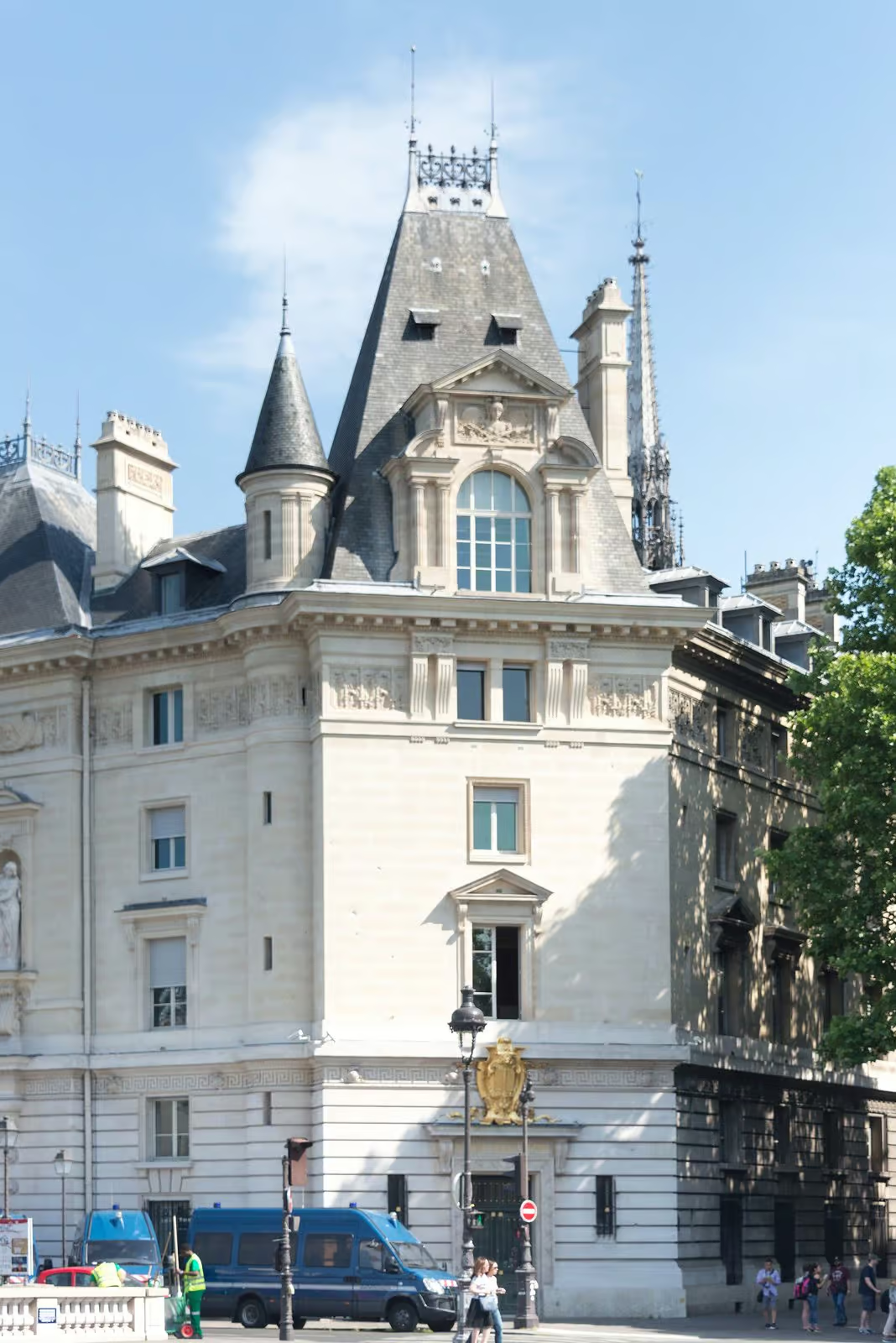
Assassinat is a crime in the French sense, the most serious category of offence, and crimes are tried by the cour d’assises once the investigating magistrate sends the case there.12
Claux has claimed that the press and the public were kept out of the courtroom. TDSH could not confirm that. What is certain is that TDSH found no trace of the trial in the archives it could search.616
What the experts found, according to whom
Crime Library reports that, according to Claux, a court-appointed team of psychiatrists and psychologists examined him and found a “borderline psychotic personality disorder.” The feature then adds that the experts “did not detect any psychic or neuropsychic disorders, which could have interfered with his discernment or control of his actions.”6
Claux has told a different story about the same evidence. In his narration of the trial he said that “psychosis was established,” and that he “could benefit from Rule 242, concerning diminished responsibility.” In 2020 he said his sentence was the result of “psychology,” and that he was, “according to them,” not able to fully understand what he was doing. Crime Library’s answer is direct: “the documents in the case do not confirm this.”67
There is no “Rule 242”
The penal code in force in 1994 numbers its articles by book, title and chapter, in the form 122-1 or 221-3. Its rule on reduced responsibility is Article 122-1, second paragraph: a person whose discernment was « altéré » (impaired) by a psychiatric or neuropsychiatric disorder at the time of the act « demeure punissable ; toutefois, la juridiction tient compte de cette circonstance lorsqu’elle détermine la peine » (“remains punishable; however, the court takes this circumstance into account when it sets the sentence”). The first paragraph provides that a person whose discernment was « aboli » (abolished) is not criminally responsible at all.10
TDSH found no provision numbered 242 that deals with responsibility. Whatever Claux meant, the provision on reduced responsibility in force at the time was Article 122-1, and the sources do not show whether the court applied it.106
Why 12 years?
Assassinat carried a maximum of life imprisonment. Claux received 12 years. No source TDSH could verify explains how the court arrived at that figure. Claux attributes it to a finding of reduced responsibility; Crime Library says the documents do not confirm one. This file leaves the question open rather than repeat either explanation as fact.1067
How long did he serve?
Remand, prison and release · 1994 to 2002
Two prisons
According to Crime Library, Claux was held after his arrest at Fleury-Mérogis, a remand prison south of Paris, and remained there until February 1999, when he was transferred to the Maison centrale de Poissy, a maximum-security prison northwest of Paris.6

Released in 2002
Claux was released in 2002. L’Express reported it in 2006, in a sentence that also gives the 12-year term, and Le Parisien reported it in 2012.45
The sources disagree on exactly how long he spent in custody before that release. Crime Library and Claux’s own 2020 account give figures that differ by several months, and neither cites a release order. This file gives the year only.67
After 2002
This file ends where the sentence ends. What Claux has done or said in public since his release is not part of the criminal record, and it is not covered here.
How has Claux’s story changed?
One killing, several explanations · all in his words
| Topic | What Claux has said | Where |
|---|---|---|
| Motive, first version | “The first motive I gave him was robbery,” he wrote, referring to the investigating magistrate. | Crime Library narration6 |
| Motive, second version | That he later told the magistrate of an argument in a cemetery over “territory,” a story he says he gave because he “could benefit from a diminished responsibility plea.” | Crime Library narration6 |
| Motive, third version | That there was no sexual component and that he “was just looking for death.” | Crime Library narration6 |
| Motive, fourth version | That the killing was “an experiment” to test a firearm. | Forenseek interview, 20207 |
| Homophobia | “I’m not homophobic.” Le Parisien and Le Nouveau Détective both call the killing homophobic. | Forenseek, 2020; press712 |
| The first shot | That at the reconstitution he called it accidental and “stuck to this version until the trial.” | Crime Library narration6 |
| The sentence | That it reflected a finding about his psychology. Crime Library: “the documents in the case do not confirm this.” | Crime Library; Forenseek67 |
| Time in custody | A total that differs from Crime Library’s figure by several months. | Forenseek, 2020; Crime Library67 |
| Mortuaries and graves | Detailed accounts of taking blood and tissue and entering graves. Lohr: possibly “hallucinations or outright fabrications.” Thiel: part of it “was true.” | Crime Library; Forenseek; Le Nouveau Détective672 |
A narrator with reasons to shape the story
By his own account, Claux adjusted his explanation of the killing at least once to improve his position in court. He told Crime Library that he gave the cemetery story because he could benefit from a plea of diminished responsibility. A narrator who says he once invented a motive for tactical reasons cannot be taken at his word on motive afterwards, and this file does not.6
The same caution applies to the more lurid parts of his account, in both directions. They may be partly true, as the magistrate’s recollection suggests. They may be partly invented, as Crime Library’s author suspected. What they are not is part of the judgment. The only motive a court is known to have found is the one built into the word assassinat: the decision to kill came before the act.2610
Why “Vampire of Paris,” and who was the other Paris “vampire”?
A nickname, its sources, and an 1849 case it is often confused with
A press name, not a finding
In English the name is best known as the title of Crime Library’s feature, “Vampire of Paris: The Story of Nico Claux.” In French, Le Nouveau Détective wrote in March 2025 that the mortuary claims « lui vaudront le surnom de « Vampire de Paris » » (“would earn him the nickname ‘Vampire of Paris’”). TDSH has not established who first used it.62
The French press has also attached harder labels. Le Télégramme described him in 2025 as « nécrophile et cannibale surnommé « le vampire de Paris » », and Le Parisien as « auteur d’actes de cannibalisme ». Those are the newspapers’ words. They describe what Claux has claimed and what has been alleged; no source TDSH reviewed reports a conviction for any such act. This file quotes them so readers can recognize them, and does not repeat them as its own.316
“Vampire” is not a diagnosis either. As TDSH’s explainer on criminal vampirism sets out, the term is not a recognized psychiatric or legal category.
François Bertrand, the « vampire de Montparnasse »
Claux is not the first man in Paris to be known as a vampire, and he is sometimes confused with the earlier one. In 1848 and 1849, graves in Paris cemeteries were repeatedly dug up and the bodies mutilated. A trap set at the Montparnasse cemetery fired on an intruder on the night of March 15 to 16, 1849. Soon afterwards a young army sergeant, François Bertrand, came to the Val-de-Grâce military hospital with gunshot wounds he could not explain, and confessed. Because he was a soldier, he was tried by a court-martial, in July 1849, charged only with violation de sépulture, and sentenced to one year in prison. He became known as the « vampire de Montparnasse ».89
The two cases are 145 years apart and share nothing but the word “vampire.” Bertrand was tried for desecrating graves and was not charged with killing anyone. Claux was convicted of killing Thierry Bissonnier and, according to Crime Library, of no offence involving graves. TDSH’s file on necrosadism and homicidal necrophilia discusses the Bertrand case in its historical setting.896
How did it unfold, date by date?
Timeline · dates credited where they rest on one source
Born in Cameroon
Nicolas Claux is born in Cameroon, according to Crime Library.6
A new penal code
France’s new penal code comes into force, with its definitions of meurtre and assassinat and its Article 122-1 on responsibility.10
Found by his parents
According to Crime Library, his parents go to the flat after failing to reach him, and find him.6
The cheque and the licence
According to Crime Library, Claux tries to make a purchase with one of the victim’s cheques, using the victim’s licence with his own photo inserted. The clerk notices; Claux leaves.6
Transfer to Poissy
According to Crime Library, Claux is moved from Fleury-Mérogis to the Maison centrale de Poissy.6
The judge retires
Gilbert Thiel retires from the bench.14
TDSH record check
TDSH searches for the judgment and for contemporaneous trial coverage and finds neither. Status checked 5:35 p.m. ET.16
What does the record say, word for word?
Exhibits CF-1 to CF-6 · exact text, with translations
The killing and the sentence
« (…) en 1994, l’année où Nicolas Claux a abattu de plusieurs tirs de 22 long rifle Thierry Bissonnier dans un appartement du XIe arrondissement de Paris. Un assassinat homophobe pour lequel il a été condamné à douze ans de prison. »1
Translation: “(…) in 1994, the year in which Nicolas Claux shot Thierry Bissonnier dead with several .22 Long Rifle rounds in a flat in the 11th arrondissement of Paris. A homophobic assassinat for which he was sentenced to 12 years in prison.”
The magistrate remembers
« Au début, je ne le croyais pas trop, je pensais qu’il faisait ça pour se faire passer pour un fou. Mais ce qu’il avait dit était vrai. On a trouvé des mausolées fracturés et il manquait des morceaux de cadavre. »2
Translation: “At first I didn’t really believe him; I thought he was doing it to pass himself off as mad. But what he had said was true. We found mausoleums that had been broken open, and pieces of bodies were missing.”
Sentence, release, and an accusation
« Condamné à douze ans de prison (…) pour meurtre et libéré en 2002, accusé de profanations de sépultures suivies de mutilations et d’actes de cannibalisme (…) »4
Translation: “Sentenced to 12 years in prison (…) for murder and released in 2002, accused of desecrating graves followed by mutilation and acts of cannibalism (…)”. Note the verb: accusé, accused. The magazine does not say he was convicted of those acts. The elision removes a year this file does not state.
What the verdict did not include
The conditional
« Alors qu’il travaille au service mortuaire d’un hôpital (…), Nicolas Claux aurait récidivé en prélevant des « tissus humains » pour les manger. Ces faits lui vaudront le surnom de « Vampire de Paris ». »2
Translation: “While working in a hospital mortuary (…), Nicolas Claux allegedly did it again, taking ‘human tissue’ to eat it. These acts would earn him the nickname ‘Vampire of Paris’.” The verb aurait is the French conditional, the form used for an unproven allegation. The elision removes the hospital’s location.
The definition
« Article 221-3 : Le meurtre commis avec préméditation constitue un assassinat. Il est puni de la réclusion criminelle à perpétuité. »10
Translation: “Article 221-3: Murder committed with premeditation constitutes an assassinat. It is punishable by life imprisonment.” The article’s further paragraphs on the minimum term are not reproduced. The current version, amended in 2011, adds lying in wait (guet-apens) as an alternative to premeditation.1011
What is established, and what is still disputed?
Record check · yellow = disputed, unresolved or unknown
| Claim | Status | Basis |
|---|---|---|
| Thierry Bissonnier was killed in his flat in the 11th arrondissement in 1994. | ESTABLISHED | Le Parisien; Le Nouveau Détective12 |
| Nicolas Claux was convicted of his assassinat and sentenced to 12 years. | ESTABLISHED | Le Parisien; Le Nouveau Détective; Le Télégramme; L’Express1234 |
| Claux was released in 2002. | ESTABLISHED | L’Express 2006; Le Parisien 201245 |
| Gilbert Thiel was the juge d’instruction. | ESTABLISHED | Le Nouveau Détective; Crime Library (which mislabels his role)26 |
| Claux and the victim were in contact through Minitel. | ESTABLISHED | Le Nouveau Détective; Claux’s own account27 |
| The killing took place on Oct. 4, 1994. | CREDITED | Crime Library only6 |
| The victim was 34, a restaurateur and part-time musician. | CREDITED | Crime Library only6 |
| Claux was arrested on Nov. 15, 1994, outside the Moulin Rouge. | CREDITED | Crime Library; location also in Claux’s account67 |
| The verdict included robbery and fraud counts. | CREDITED | Crime Library only6 |
| The year of the trial. | DISPUTED | Sources conflict; no judgment or contemporaneous report found12616 |
| How long Claux served before release. | DISPUTED | Crime Library and Claux’s 2020 account differ67 |
| Whether the court found reduced responsibility. | DISPUTED | Claux says yes; Crime Library says the documents do not confirm it67 |
| Whether graves were broken into, as Claux described. | DISPUTED | Thiel: partly true. Lohr: not in the documents. No conviction, according to Crime Library26 |
| Whether Claux ate human tissue. | UNPROVEN | His own claim; reported in the conditional; no conviction27 |
| The motive. | UNKNOWN | Claux has given at least four versions; the press calls the killing homophobic; the judgment was not located1267 |
Contrary to Claux’s version of events, he was never convicted of grave robbery or the theft of bags containing blood.David Lohr, “Vampire of Paris: The Story of Nico Claux,” Crime Library.
What do people get wrong about the case?
Myth against record
| What gets repeated | What the record shows | Basis |
|---|---|---|
| Bissonnier was killed in Claux’s flat. | No. He was killed in his own flat in the 11th arrondissement. This file does not print either man’s street address. | 16 |
| Claux stayed in the flat with the body for days. | No source says so. In his own account he left the flat after the killing; according to Crime Library, the victim’s parents found him about three days later. | 6 |
| Claux was convicted of eating human remains. | No. He was convicted of one assassinat and, according to Crime Library, related robbery and fraud counts. The eating claims are his own, and the French press reports them in the conditional. | 126 |
| He was convicted of robbing graves. | No, according to Crime Library: he “was never convicted of grave robbery.” L’Express (2006) used the word « accusé » (accused). | 64 |
| He killed more than one person. | He was convicted of one killing, that of Thierry Bissonnier. No source TDSH relied on reports a charge for any other death. | 126 |
| He was sentenced to life. | No. He received 12 years, although assassinat carried a maximum of life. | 110 |
| He got 12 years because he was found to have diminished responsibility. | That is Claux’s account. Crime Library says the case documents do not confirm it. | 67 |
| The trial was in a known, documented year. | Published sources disagree, and TDSH found no judgment or contemporaneous report. | 1616 |
| He is the 19th-century “vampire de Montparnasse.” | No. That was François Bertrand, an army sergeant court-martialled in 1849 for violating graves. | 89 |
| The case was run by a police detective named Thiel. | Gilbert Thiel was the juge d’instruction, an investigating magistrate, not a police officer. | 214 |
| “Vampirism” was his diagnosis. | It is a press nickname. TDSH’s criminal vampirism explainer notes that the term is not a recognized psychiatric or legal diagnosis. | 26 |
What do readers ask most?
Short answers, sourced
Who was Thierry Bissonnier?
Thierry Bissonnier was a man living in the 11th arrondissement of Paris who was killed in his flat in 1994. According to Crime Library, he was 34 and worked as a restaurateur and part-time classical musician. Nicolas Claux was convicted of his premeditated murder.126
What was Nicolas Claux convicted of?
Assassinat, the French offence of murder committed with premeditation, for the killing of Thierry Bissonnier. According to Crime Library, the verdict also covered armed robbery, fraudulent use of a cheque, falsification of a driving-licence photo and attempted fraud of a retailer. He was sentenced to 12 years.126
Was Claux convicted of eating human remains or robbing graves?
No. According to Crime Library he was never convicted of grave robbery or of stealing blood, and no source reports a conviction for eating human remains. Those claims come from Claux himself. The investigating magistrate has said part of his account was true.267
When was he released?
In 2002. Sources disagree on exactly how long he had served by then.4567
What year was he convicted?
Published sources disagree on the year of the trial, and TDSH could not find the judgment or a report from the time. This file does not state a year.16
Why is he called the “Vampire of Paris”?
It is a press nickname, used as the title of Crime Library’s feature and linked by Le Nouveau Détective to the mortuary claims. It is not a legal finding or a diagnosis.62
Is he the same person as the Montparnasse “vampire”?
No. The « vampire de Montparnasse » was François Bertrand, an army sergeant tried by court-martial in 1849 for violating graves and sentenced to one year. The cases are 145 years apart.89
Is Nicolas Claux still alive?
Yes. Reporting from March 2025 gives his age as 52 and describes him as released.2
Who investigated the case?
Gilbert Thiel, a Paris juge d’instruction who joined the anti-terrorism section of the Paris court in July 1995, kept this case, and retired in 2014.21415
Where do these facts come from?
Source ledger · numbered notes
Le Parisien, March 1, 2025 (partly paywalled)
The killing in a flat in the 11th arrondissement in 1994; the .22 Long Rifle weapon; the conviction for assassinat and the 12-year sentence; the paper’s own labels.
Notes 1
Open source ↗Virginie Paillard, Le Nouveau Détective, March 3, 2025
The killing in the 11th arrondissement; conviction and 12-year sentence; the investigating magistrate’s name and role; his recollection, quoted from Le Parisien; the mortuary claim in the conditional; contact through Minitel.
Notes 2
Open source ↗Claire Steinlen, Le Télégramme, March 22, 2025
One line: the 12-year sentence for murder, and the paper’s own labels for Claux.
Notes 3
Open source ↗L’Express, April 21, 2006, via info-sectes.org
The 12-year sentence and the 2002 release; the wording “accusé de profanations” (accused of desecration), not convicted.
Notes 4
Open source ↗Le Parisien, Feb. 5, 2012
The 2002 release, in a passing reference.
Notes 5
Open source ↗David Lohr, Crime Library
The date of the killing, the victim’s age and occupation, the discovery of the body, the cheque and licence, the arrest date, the counts in the verdict, the places of detention, and the statements that Claux was never convicted of grave robbery or blood theft and that the case documents do not confirm a diminished-responsibility finding. Every Claux quotation in it is his own account.
Notes 6
Open source ↗Forenseek / Books, Bullets and Bad Omens, Oct. 11, 2020
What Claux said in 2020 about his childhood, his work in hospital mortuaries, the killing and his sentence. Used only for attributed statements.
Notes 7
Open source ↗Pierre Ancery, RetroNews, Nov. 28, 2018
François Bertrand, the 1848 to 1849 Montparnasse cemetery case, the military trial and the one-year sentence.
Notes 8
Open source ↗Thomas Martin, actu.fr, March 13, 2022
Second source for François Bertrand: the trap, the court-martial and the one-year sentence for violation de sépulture.
Notes 9
Open source ↗Code pénal as in force March 1, 1994
The definitions of meurtre and assassinat, their maximum penalties, the impaired-discernment rule (Article 122-1) and the offence of violating graves (Article 225-17).
Notes 10
Open source ↗Légifrance, Code pénal Article 221-3
Assassinat is murder with premeditation and carries life imprisonment.
Notes 11
Open source ↗Service-Public.gouv.fr, “Information judiciaire”
What an investigating magistrate does, and that a judicial investigation is mandatory for a crime.
Notes 12
Open source ↗Hugh Schofield, BBC News, June 28, 2012
Minitel’s national launch in 1982, its reach in the 1990s and its switch-off in 2012.
Notes 13
Open source ↗L’Obs (Le Nouvel Observateur), July 3, 2014
Gilbert Thiel’s career dates: judge in Paris from August 1994, anti-terrorism from July 1995, retirement July 1, 2014.
Notes 14
Open source ↗Laure Mentzel, Le Monde, March 9, 2012
Gilbert Thiel as a Paris investigating magistrate specializing in terrorism cases.
Notes 15
Open source ↗Le Monde archive search, checked Oct. 2, 2026
The absence of any Le Monde report on the case or the trial in the archive’s search results.
Notes 16
Open source ↗Numbered notes
- Le Parisien, « Exposition « Serial Killer » : dédicaces, cartes de visite… Quand un meurtrier en profite pour faire sa promo », March 1, 2025, 4:10 p.m. Paris time. Open portion read Oct. 2, 2026; the rest of the article is behind a paywall. www.leparisien.fr
- Virginie Paillard, Le Nouveau Détective, « Livres, photos dédicacées, cartes de visite…le tueur cannibale Nicolas Claux tire profit de l’exposition « Serial Killer » à Paris », March 3, 2025. Quotes Le Parisien’s interview with the retired investigating magistrate. www.lenouveaudetective.com
- Claire Steinlen, Le Télégramme, « À Paris, cette exposition sur les tueurs en série plaît beaucoup… aux femmes », March 22, 2025. www.letelegramme.fr
- L’Express, « Satanisme : au nom du diable », April 21, 2006, read on the info-sectes.org mirror (the original lexpress.fr address was not located). info-sectes.org
- Le Parisien, « « Détenir une part du croque-mitaine qui me terrorisait enfant » », Feb. 5, 2012 (a passing reference identifies Claux and gives his release year). www.leparisien.fr
- David Lohr, “Vampire of Paris: The Story of Nico Claux,” Crime Library (undated in the copies reviewed), read in the reproduction on murderpedia.org; also mirrored at lesvampires.org. The feature is built on Claux’s written narrations, which Lohr says were “edited, polished, and arranged.” murderpedia.org
- Forenseek, “Interview with real-life cannibal and killer Nico Claux, the ‘Vampire of Paris’,” Oct. 11, 2020 (Books, Bullets and Bad Omens interview). Subject’s own account; not independent. forenseek.app
- Pierre Ancery, RetroNews (Bibliothèque nationale de France press archive), « L’épouvantable postérité du vampire de Montparnasse, profanateur de sépultures », Nov. 28, 2018, updated Nov. 22, 2024. www.retronews.fr
- Thomas Martin, actu.fr, « Qui était le Vampire du Montparnasse à Paris ? », March 13, 2022. actu.fr
- Code pénal, original text in force March 1, 1994: Articles 122-1, 132-72, 221-1, 221-3 and 225-17, as reproduced by ledroitcriminel.fr. ledroitcriminel.fr
- Légifrance, Code pénal, Article 221-3 (version in force since May 19, 2011). www.legifrance.gouv.fr
- Service-Public.gouv.fr (Direction de l’information légale et administrative), « Information judiciaire (instruction préparatoire) », verified Dec. 13, 2024. www.service-public.gouv.fr
- Hugh Schofield, BBC News, “Minitel: The rise and fall of the France-wide web,” June 28, 2012. www.bbc.com
- L’Obs (Le Nouvel Observateur), « “Être juge, c’est mission impossible” », interview with Gilbert Thiel and “Bio express,” July 3, 2014 (byline: Le Nouvel Obs). www.nouvelobs.com
- Laure Mentzel, Le Monde (M le magazine du Monde), « L’emmerdeur du palais de justice », March 9, 2012. www.lemonde.fr
- Le Monde archive search, “Claux” (1994 to 1998) and “Bissonnier” (1994 to 2002), checked Oct. 2, 2026: no report of the case or the trial in the results. www.lemonde.fr
Discover more from The Dark Side of Humanity
Subscribe to get the latest posts sent to your email.