FILE NO. 0131Case status Unsolved
CASE FILE: Hagley Wood / Wych Elm victim (“Bella”).
Jurisdiction: Worcestershire Constabulary (1943) → West Mercia Police (successor) → archival custody, Worcestershire Archive and Archaeology Service.
Status: Murder by person or persons unknown. Victim unidentified. Remains missing. No charge ever brought.
On 18 April 1943, teenage boys found an unidentified woman’s skull inside a hollow wych elm in Hagley Wood, Worcestershire. Police recovered a near-complete skeleton, clothing, shoes and a cheap ring. Professor James M. Webster reconstructed age, height, hair and dental pattern, and estimated she had been dead roughly eighteen months to two years. A coroner’s jury returned a verdict of murder by a person or persons unknown.
The name “Bella” did not come from a birth certificate, a relative, or a positive identification. It came later, from chalk graffiti across the West Midlands asking who had put her in the tree. That slogan, and its later echo on the Wychbury Obelisk, made the case famous. It did not solve it.
What followed was a long accumulation of theory: wartime espionage, witchcraft, a Dutch illegal entrant, a missing sex worker, a local domestic killing. Some of those theories rest on real documents. Most do not rest on proof. Because the original remains left institutional custody and have not been located, modern DNA or isotope analysis cannot presently be attempted. The honest dossier is denser than the folklore and colder than the slogans. This is that dossier.
Related unsolved dossiers: Hinterkaifeck Murders · Villisca Axe Murders
Case Chronology (Record)
| Date / window | What the record supports |
|---|---|
| Est. spring-autumn 1941 (approx.) | Webster’s estimate of death: ~18 months to 2 years before April 1943. Not an exact date. |
| 18 April 1943 | Skull found in hollow wych elm, Hagley Wood (Hagley Hall / Lord Cobham estate area, near Wychbury Hill). Police recover skeleton and associated items. |
| April-May 1943 onward | Forensic reconstruction; clothing description circulated; dental notices; missing-person checks. No identification. |
| Inquest (1943) | Verdict: murder by person or persons unknown. Material in mouth treated as possible cause; not a conclusive medical mechanism in archival summaries. |
| From March 1944 (earliest graffiti window disputed into late 1943 in some press) | Chalk messages: “Luebella” / “Bella” / “Who put Bella down the wych elm… Hagley Wood?” Police investigate writer and name; no conclusive match. |
| 1953 | “Anna of Claverley” (identified in archive research as Una Mossop / Hainsworth) contacts Express & Star (“Quaestor” / Wilfred Byford-Jones); espionage / Dutch-victim allegation. Uncorroborated. |
| From ~1970s | Recurring “Who put Bella…” graffiti on Wychbury Obelisk; later copycat cycles (incl. late 1990s / 1999 press revival). |
| 2005 | West Mercia review: no clear leads; case recommended closed; files toward county archive (WAAS account). Secondary accounts sometimes cite later transfer years. |
| 2016 | WAAS Monthly Mystery summary; Clara Bauerle death registration reported (Berlin, 16 Dec 1942): excludes Bauerle as the tree victim. |
| 2018 | Facial approximation from historic skull photographs (Face Lab / Caroline Wilkinson team), not from recovered bones. West Midlands Police: no exhibits/docs located in force museums/records. |
| 2023 | BBC Sounds The Body in the Tree appeal to locate missing remains (tracked historically to Birmingham police training display / Tally Ho trail, then lost). |
| 2025 FOI (West Mercia) | Force states it holds no case records; transferred to Worcestershire Archive and Archaeology Service (consultable at The Hive). |
A Skull in Hagley Wood
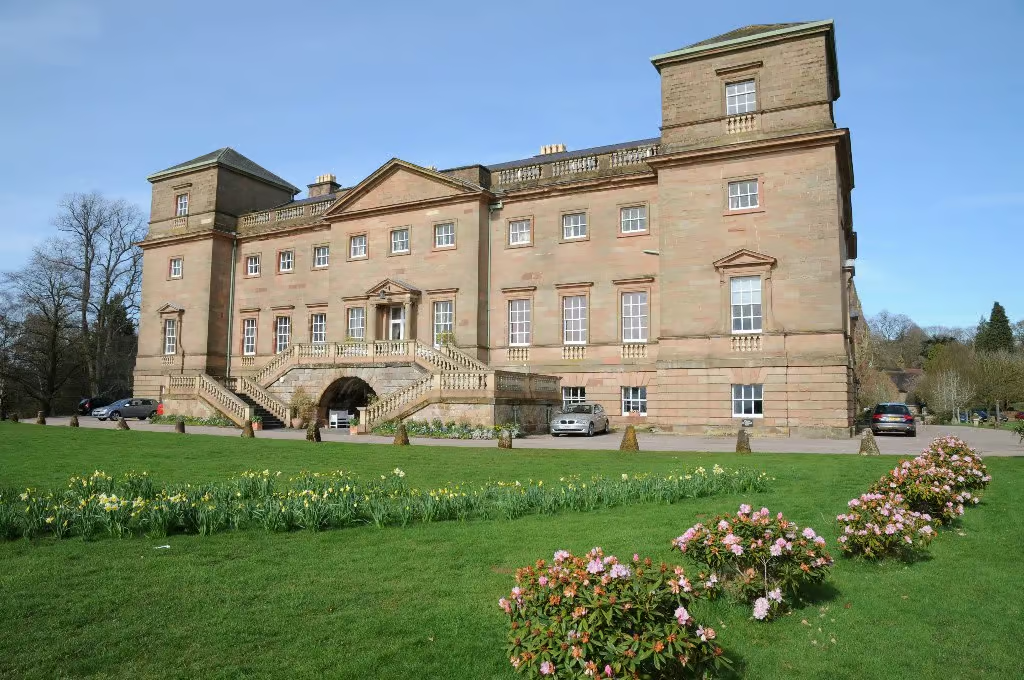
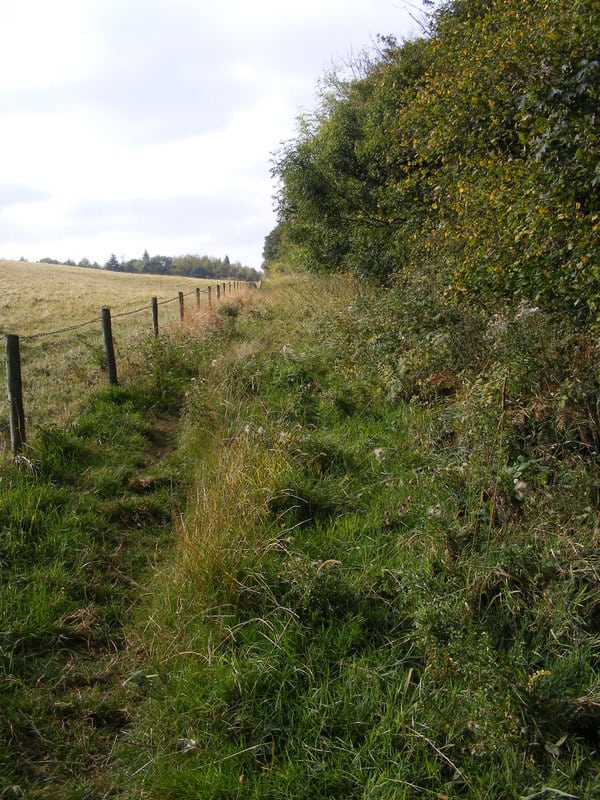
At about midday on Sunday, 18 April 1943, four teenage boys entered Hagley Wood: privately owned woodland on the Hagley Hall estate near Wychbury Hill in Worcestershire. Later retellings call them bird-nesters, poachers, or boys supplementing wartime food. The agreed core is simpler: they were on the land without permission and did not want that fact known.
Surviving name lists commonly give Robert Hart, Thomas (Tommy) Willetts, Bob Farmer and Fred Payne. Attribution is not perfectly uniform across retellings. BBC Hereford & Worcester (2023) quotes Bob Farmer describing the find decades later. Birmingham Live / local reporting likewise places Farmer climbing and seeing the skull, with Tommy Willetts as the boy who told his father. An inquest-linked account used in newspaper-archive summaries names Robert Hart looking into the tree.
According to contemporary reporting preserved via the British Newspaper Archive’s later summary of wartime coverage, one of the boys used a stick to rake the skull out before putting it back. The boys went home. One told his father. The father telephoned the police.
BBC Hereford & Worcester (2023) published Farmer’s later recollection of the scene: the head on the surface, a bone protruding, shoes scattered with rotting fabric. That is a witness memory decades after the fact (useful colour, not a substitute for the 1943 police inventory) but it matches the broad picture of a skeletonised concealment rather than a fresh body.
On that April afternoon there was no “Bella”, not as a police identity. There was an unidentified skull in a tree and, beneath and around it, the remains of a woman whose death had gone unnoticed for many months. Later recollections describe hair still attached to part of the skull and conspicuously irregular front teeth. Those details mattered. Almost everything investigators did next depended on reconstruction: a skeleton, an appearance, clothes, and a possible sequence of events from what decomposition had left.
The setting was extraordinary. The evidentiary problem was ordinary. Investigators had a dead woman, no confirmed name, no known last address, no witness to her final hours, and no person waiting at a station who could prove she was theirs.
What the Tree Contained
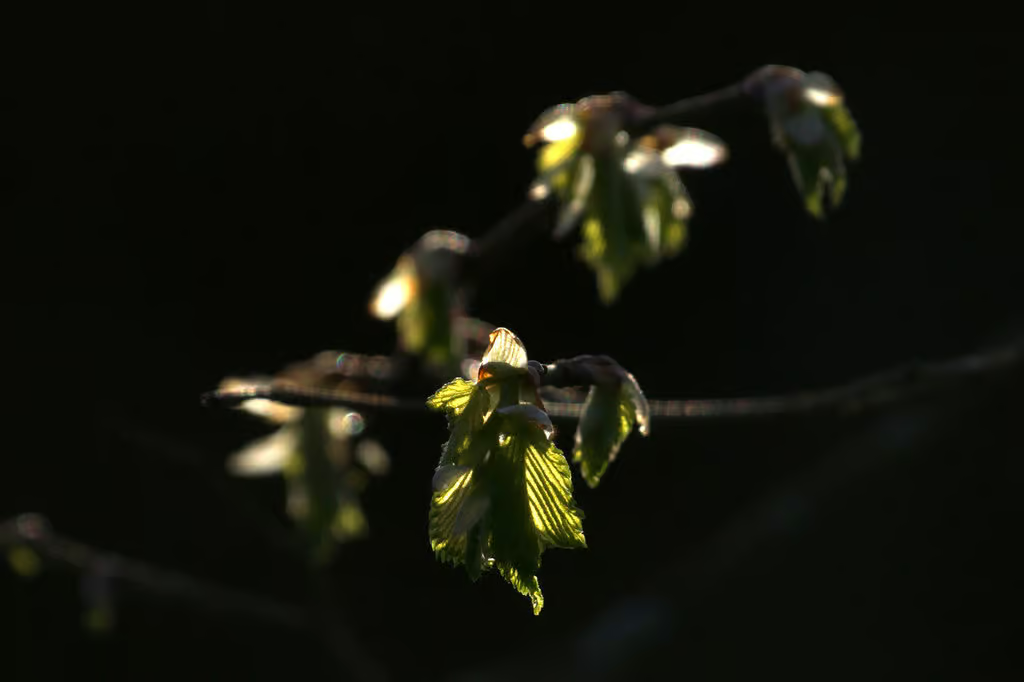
Police and Professor James M. Webster, director of the West Midland Forensic Science Laboratory, examined the tree and recovered a near-complete female skeleton. The trunk was opened so the remains could be removed and reconstructed. The Worcestershire Archive and Archaeology Service (WAAS), which now holds surviving West Mercia Police files on the case (catalogued within West Mercia Police Authority material relating to the “Bella Murder,” including references in the BA14908 / 4857/11 family of records), summarises that officers also recovered a wedding ring, shoes and badly deteriorated clothing. No coat or handbag was found.
The clothing still gave a usable public description. Webster identified a mustard-coloured skirt, a blue-and-yellow striped cardigan, a light-blue belt, a peach-coloured taffeta underskirt and blue shoes with crêpe soles. Contemporary newspaper reporting described the ring as rolled gold: cheap, not a high-value piece. A mannequin was dressed in reproductions of the clothes and fitted with a wig in the hope that someone would recognise the missing woman.
These facts contradict a motif that has entered many modern versions: that a calculating killer removed every trace of identity. The surviving evidence does not support that conclusion. A ring remained. So did clothing, shoes, hair and a distinctive dental pattern. The absence of a handbag or coat may be significant; it does not prove a systematic erasure of identity. Nor does the failure to identify the victim prove she was unloved, transient or without relatives. It proves only that the information available to police never produced a reliable match.
Additional bones were recovered outside the tree, including finger bones from one hand. This, too, became distorted. Later accounts repeatedly claimed a deliberately severed hand, sometimes a ritual burial, sometimes a severed shin, sometimes a precise number of paces from the trunk. The accessible archival summary does not establish that sequence. Later reporting records disagreement over whether the hand was intentionally removed; police considered animal scattering of smaller bones after decomposition. Any claim that the killer amputated and ritually buried a hand goes beyond what the physical evidence can presently prove.
That distinction is not pedantry. Deliberate human amputation invites one set of conclusions; animal dispersal invites another. Because the original remains are now missing and the full forensic file is not freely digitised online, uncertainty must not be converted into spectacle. The correct account: bones were found away from the main skeleton; the reason for separation was not conclusively established.
Webster’s Reconstruction
Webster estimated the woman was approximately 35 years old and about five feet tall. Hair: mousy or light brown. Lower teeth: irregularly aligned. Contemporary reporting placed a broader age range of 25 to 40, with 35 most likely. The examination also suggested she might previously have given birth, although Dr John Lund, who assisted and was interviewed decades later, described that conclusion as less than certain.
Webster believed she had been dead between 18 months and two years. Counting back from April 1943 places death roughly between spring and autumn 1941. It was never an exact clock. “Late 1941” or “October 1941” function as shorthand; the proper formulation is an estimated interval from the condition of the remains. Some later writers have hypothesised earlier placement windows; those are hypotheses, not Webster’s recorded estimate.
The position of the skeleton led Webster to believe the body had been placed into the hollow feet-first, and soon after death, before rigor made the body too inflexible to fit. Later writers compressed that inference into the cinematic phrase “still warm.” It is defensible only when clearly attributed to Webster’s reconstruction. No investigator witnessed the placement. The evidence cannot establish how much force was used or whether limbs were twisted in the manner some secondary accounts invent.
The tree was an effective hide. Its hollowness was not obvious to a casual passer-by. WAAS notes later speculation that whoever selected it may have known the wood, because a stranger would have been unlikely to discover the cavity by chance. That is a reasonable investigative inference, not proof the killer was a resident, estate worker, traveller, or member of any named community.
The Taffeta Problem
The most consequential forensic finding was a piece of material deep inside the mouth. Webster described it as part of a garment and said it might have caused death. Because a peach-coloured taffeta underskirt was among the recovered clothing, the material became widely known as a “taffeta gag.” In retellings, possibility hardened into certainty: gagged and suffocated.
The historical record is less secure. Contemporary inquest-linked accounts say Webster found no evidence of violence on the bones and regarded the material as a possible cause of death. WAAS likewise says he thought she “might have been suffocated.” Neither formulation is a definitive medical cause.
There is a further complication. In later interview material summarised by ABC News (2023), Lund recalled that the boys had described wrapping cloth around a stick and putting it into the mouth area when they returned the skull to the tree. It is not clear from accessible reporting whether that was the same material Webster recovered, whether the boys disturbed material already present, or whether memories conflated across decades. It is enough to prevent treating the cloth as unambiguous proof of suffocation.
Cause of death and manner of death are separate. Soft tissue was largely gone; bones showed no identifiable fatal injury. Circumstances nonetheless persuaded the coroner’s jury of murder. The inquest returned murder by a person or persons unknown. That supports describing the case as a homicide. It does not justify inventing a struggle, a ritual gagging ceremony, or a film-ready sequence of final minutes.
The Search for a Name
Once Webster had age, height, appearance and clothing, Worcestershire Constabulary circulated the information. Notices went into leading dental journals because of the irregular teeth. Police reviewed missing-person reports and followed leads from people searching for absent relatives. The mannequin gave the public a figure rather than a list of measurements.
Nothing produced an identification.
A circulated description preserved in later case-file summaries (and quoted in secondary casefiles drawing on contemporary papers) gave age between 25 and 40 (most probably 35), height 5 ft, light brown hair, dark blue and mustard striped cardigan, mustard skirt, blue crêpe-soled shoes about size 5½, poor-quality garments, and a cheap rolled-gold ring. That level of detail is why the failure to identify her remains so stark: the public was not looking for a blank silhouette.
The failed dental inquiry is often inflated into a search of “national dental records,” as if a modern central database had been queried and returned silence. That is misleading. Investigators publicised an unusual dental pattern through professional channels and asked practitioners to recognise it. Success depended on surviving records, a dentist seeing the notice, remembering the patient, and connecting that patient to a disappearance. Each link could fail.
The investigation unfolded in wartime. Resources and communications were under pressure. Birmingham and its industrial belt had endured bombing. Population movement complicated tracing. Those conditions may help explain failure; they do not identify the woman as refugee, foreign national, itinerant worker, or Blitz casualty. Each of those labels arrived later as theory.
One lead reported in later reviews of police material concerned a sex worker who approached police in 1944. She reportedly said another sex worker known to her as Bella, associated with Birmingham’s Hagley Road, had disappeared about three years earlier. Timing and name attracted interest. There was no confirmed surname, dental match, or other evidence connecting that missing woman to the skeleton. Record it as a failed lead, not as proof the victim was a sex worker.
The same caution applies to “no family ever looked for her.” Investigators followed reports from people seeking missing women; none matched. Until she is identified, nothing reliable can be said about who missed her, what relationships she had, or why a linkable report never surfaced.
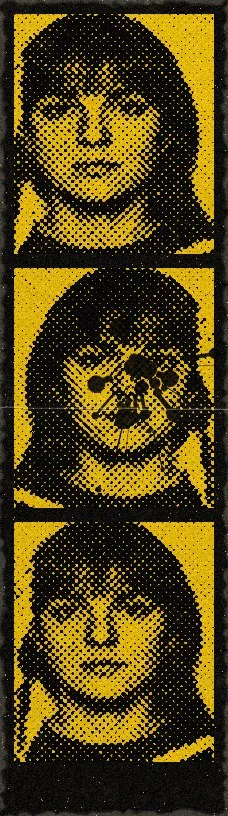
Writing on the Walls, “Who Put Bella in the Wych Elm?”
By March 1944, chalked messages had entered the case. The precise date of the first inscription remains unsettled. WAAS dates the graffiti to 1944. A later Independent account placed an early Old Hill version around Christmas 1943. Contemporary March 1944 reporting referred to more than one message.
An early inscription at Haden / Hayden Hill Road in Old Hill asked, “Who put Luebella down the wych elm?” Another, on empty premises in Upper Dean Street, Birmingham, read, “Who put Bella down the wych elm, Hagley Wood?” The second made the link to the unidentified remains unmistakable. BBC Hereford & Worcester (2023) likewise notes early Birmingham wording including “Hagley Wood Bella” and the full wych-elm question.
Police took the writings seriously. At least one was reported as positioned too high for casual children’s chalk. Investigators appealed for the writer, revisited missing-person records for women named Bella, and tried to trace handwriting. No author was identified. No missing Bella was conclusively connected to the body.
The graffiti gave the woman a name tag, not necessarily her name. “Bella” may have been a real first name, a nickname, an invention, or a word that caught. The earlier “Luebella” form increases uncertainty. The proposition that the writer knew the victim is possible. So are hoax, taunt, or publicity without inside knowledge.
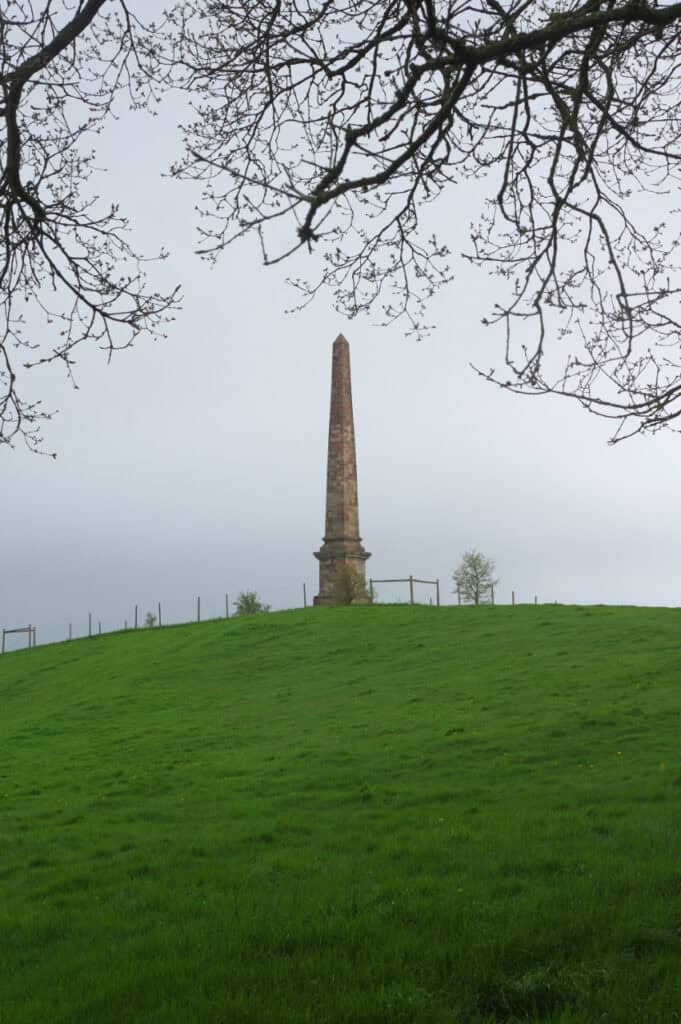
Wychbury Obelisk and the long afterlife of the slogan
Over decades, other hands repeated the question around the West Midlands and, from at least the 1970s, on the Wychbury Obelisk near the wood: the stone that keeps the “Who put Bella” question in public memory. Spellings drift: wych elm (the tree) versus witch elm (folk conflation). The tree name is wych; “witch” is folklore and graffiti mutation, not botanical proof of occult use.
In 1999, BBC News and The Independent covered renewed interest when graffiti on the Hagley / Wychbury monument again put the slogan in the press. A West Mercia representative told The Independent that later graffiti had become a joke without evidentiary meaning. More recent alterations (including a reported change of the famous line on the obelisk in later local coverage) are best read as copycat culture unless evidence shows otherwise. Stourbridge News has noted that the famous sprayed monument wording is itself a later layer, not part of the 1943 investigation, even as it became iconic.
Yet the 1943 to 44 writings remain relevant because they appeared before the case was national folklore. They caused police to investigate the name Bella and left a question still unanswered: whether the earliest writer possessed information that never reached authorities in any other form.
“Anna of Claverley”: Theory, Not Verdict
In 1953, journalist Wilfred Byford-Jones revived the story in the Wolverhampton Express and Star under the pen name “Quaestor.” A woman writing as “Anna of Claverley” responded. She said the person who could answer the mystery was beyond earthly courts, claimed the victim was Dutch, had entered Britain illegally around 1941, and had no connection to witchcraft or ritual.
Police and Byford-Jones eventually met the writer. Researchers examining the police archive identify her as Una Mossop, later Una Hainsworth. Worcestershire CalmView catalogue material lists original investigation letters labelled as Anna letters to Quaestor (1953), with notes identifying Anna as Una Hainsworth previously Mossop. Her account implicated her former husband, Jack Mossop, and a Dutch associate she called Van Ralt / Van Raalte.
Versions of her story are not consistent.
- WAAS summary: she linked the men to a pro-German group collecting information about aircraft and munitions factories in the West Midlands; said her former husband was present when the woman was put in the tree and was haunted by it.
- A police-statement version reported later by ABC News: a woman who passed out during a car journey after drinking with the men; the men placed her in the hollow believing she would wake frightened the next morning.
- Other secondary retellings escalate into intentional strangulation by Van Raalte with Mossop under duress. That dramatic sequence should not be stated as fact. Accessible official archive summaries do not establish it.
Mossop had died in a Stafford mental hospital in 1942, before the remains were discovered. His death and mental deterioration can be treated as biographical facts reported in the case literature; they do not corroborate a confession or place him physically in Hagley Wood with the victim. Van Ralt was not traced. No independent witness established the car journey, Dutch nationality, or an espionage cell’s disposal of the body.
Boundary: the Anna material is genuine investigative history, letters exist in the archive, and is not a solution. It is late, hearsay-based allegation against dead or untraced men. Jack Mossop cannot be called the killer. Van Ralt cannot be presented as a proved participant.
The Spy Who Was Real, and the Woman Who Was Not Bella
Espionage theory gained a second engine when Security Service files entered public view.
Josef Jakobs was real. National Archives material identifies him as a German intelligence agent who parachuted into Huntingdonshire in 1941, broke an ankle on landing, was arrested, tried under the Treachery Act, and executed at the Tower of London (15 August 1941, often cited as the last such execution there). Relevant Security Service case papers sit in the KV series (including KV 2/26 to 27 in National Archives catalogues).
Jakobs carried a photograph of German cabaret performer and actress Clara Bauerle (Hedwig Klara / Clara Bauerle). From MI5 interrogation material as later reported, he described her as his lover and said she had been considered or trained for an intelligence mission to Britain, possibly after he established contact. He was captured before he could do so.
Decades later, the combination of a prospective female agent, the Midlands, an unresolved ~1941 death, and the name Clara Bauerle proved irresistible. Writers suggested “Bauerle” could become “Bella” or “Clarabella” in memory; some claimed she parachuted into the region and vanished. Donald McCormick’s later Murder by Witchcraft (1968) and subsequent press recycled and embroidered Abwehr / “Clarabella” claims that were never hard-proved against the Hagley skeleton.
There was no evidence she reached Britain on such a mission. More decisively, researcher Giselle Jakobs obtained Bauerle’s Berlin death registration. WAAS published an update on 16 December 2016 reporting that Hedwig Klara Bauerle died in a Berlin hospital (Königin-Elisabeth-Hospital, Berlin-Oberschöneweide) on 16 December 1942, with cause recorded including lung infection / pneumonia associated with Veronal (barbital) poisoning. Birth recorded Ulm, 27 August 1905; unmarried.
That record excludes her as the wych elm victim. By April 1943 the Hagley Wood woman had been dead an estimated 18 months to two years. Bauerle was alive in Germany during most or all of that interval and died only months before the discovery. She cannot be “Bella.”
Exclusion does not logically prove the victim had no espionage connection. It removes the only named German woman for whom declassified files offered an apparent parallel. No consulted reputable source provides documentary proof that the unidentified Hagley Wood woman worked for German, Dutch or British intelligence. The Jakobs file explains how the theory arose. It does not solve the murder.
Other named spy-adjacent candidates (including speculative links via Dutch spy Johannes Marinus Dronkers mentioned in WAAS’s overview of theories) remain unproved. They are named speculation, not identifications.
Witchcraft and the Separated Bones: Folklore vs File
The occult theory grew from the unusual hiding place and reports of a hand separated from the skeleton. Anthropologist Margaret Murray associated the case with the folkloric “Hand of Glory.” The 1945 murder of Charles Walton in Lower Quinton, another unresolved Midlands killing later wrapped in witchcraft stories, encouraged journalists to braid the cases.
There is no demonstrated forensic link between Hagley Wood and Walton. More importantly, the premise of intentional ritual mutilation at Hagley is itself uncertain. The archive establishes that finger and other bones were recovered away from the tree; it does not establish ritual amputation and burial. Police considered animal disturbance an ordinary explanation. Sensational local press that still calls the killing “ritualistic” as settled fact is repeating folklore, not the forensic file.
The tree’s name, wych elm, invited wordplay with “witch.” “Wych” is the tree. It is not evidence of occult use. Belladonna / deadly nightshade etymology sometimes gets dragged in via the nickname “Bella”; that is linguistic opportunism, not identification.
Donald McCormick’s Murder by Witchcraft (1968) later braided Hagley Wood with occult and spy motifs in a popular book that subsequent journalists mined. Popularity is not provenance. Where McCormick’s Abwehr / “Clarabella” claims cannot be sourced to primary Security Service files naming the Hagley victim, they stay in the “theory history” column.
By the late 1960s, books and newspaper series had made witchcraft a permanent narrative option. Its endurance says more about an unidentified body in an unusual place than about evidence. No ritual implements, documented coven, reliable confession, or physical finding has been produced to support an occult killing as fact.
Record vs Theory: Hard Boundary
| On the record (supported) | Theory / unverified (do not state as fact) |
|---|---|
| Unidentified adult female skeleton found in hollow wych elm, Hagley Wood, 18 Apr 1943 | Victim’s real name was Bella / Luebella / Clarabella |
| Near-complete skeleton + ring + shoes + clothing fragments; no coat/handbag found | Killer systematically stripped all identifiers |
| Webster age ~35 (range 25 to 40), ~5 ft, light/mousy brown hair, irregular lower teeth | Exact birth date, nationality, occupation, marital status |
| Estimated death ~18 months-2 years before discovery (~1941 window) | Exact day of death; placement years as early as mid-1930s without new forensic proof |
| Material in mouth; possible suffocation considered; inquest: murder by unknown person(s) | Proved gagging ritual; proved “ritualistic” murder |
| Bones (incl. finger bones) found away from tree | Proved deliberate hand severance / Hand of Glory rite |
| 1944 graffiti introduced name Bella / Luebella; writer never identified | Graffiti writer proved to be killer or intimate |
| Anna/Una letters and interviews exist in archive | Mossop / Van Ralt guilt proved; Dutch spy-ring disposal proved |
| Josef Jakobs was a real executed German agent; carried Bauerle photo | Hagley victim was Clara Bauerle (excluded by Berlin death registration) |
| Remains left custody; not located for modern DNA | DNA/isotope already run and failed due to degradation |
| Case unsolved; files with WAAS; West Mercia FOI: force holds no records | Active West Mercia murder squad still working the file day-to-day |
What Can Be Said About the Killer
The inquest concluded murder. Available evidence allows only a narrow description of the person or people responsible.
Someone placed her body feet-first into a concealed hollow in a private wood. If Webster’s reconstruction was correct, this happened before rigor developed. Concealment supports possible prior knowledge of the tree; it does not establish local residence.
Beyond that, theories outrun proof. Domestic or personal killing is possible: no husband, partner or acquaintance has been reliably connected. Sexual or financially motivated killing is possible: no established evidence of sexual assault, robbery or black-market involvement. British or foreign, settled or transient: unknown.
Calling a domestic murder the “most plausible” answer merely substitutes base-rate familiarity for evidence. Most homicides may arise from ordinary relationships rather than spy rings or rituals, but this case contains no confirmed relationship from which to reason. The responsible conclusion is not that an everyday explanation has been proved. It is that the sensational theories have failed, leaving a wide field of unverified possibilities.
The hollow was used to conceal. The surviving ring, clothes and dental features undercut the claim that every identifier was removed. The person responsible may have believed the tree would never be searched. They may not have anticipated how completely decomposition would frustrate identification. The evidence cannot disclose their private calculation.
The Missing Remains
Time did not merely take witnesses. The woman’s remains themselves left institutional custody and have not been located.
Later inquiries found the skeleton had passed into medical or museum collections after Webster’s examination. Dr Lund recalled it had been given to the university, after which whereabouts became unknown. Birmingham Live (2018) reported a trail through a Birmingham forensics lab and the police training base Tally Ho on Pershore Road; West Midlands Police said searches of museums and records found no exhibits or documentation relating to the remains. BBC Hereford & Worcester (2023) similarly reported tracking remains to a Birmingham police training centre display into the late 1960s or early 1970s, after which the force had no further record, and appealed via The Body in the Tree podcast for help locating them (thebodyinthetree@bbc.co.uk as published in 2023 coverage).
This loss changes what modern science can do. Claims that isotope analysis and DNA profiling were already attempted but failed because of degradation are unsupported in reliable consulted sources. The obstacle reported by police and researchers is more fundamental: they do not know where the bones are.
In 2018, a facial approximation was produced from historical photographs of the skull by Professor Caroline Wilkinson and Sarah Shrimpton (Face Lab, Liverpool John Moores University), commissioned in connection with research published by Pete and Alex Merrill / APS Books. Such work can humanise an unidentified person and potentially assist recognition. It is not a genetic identification and cannot establish ancestry, birthplace or family. Because the actual skull was unavailable, the reconstruction depended on the quality and angles of surviving images. Note: some press simultaneously recycled ritual/spy claims around the reveal; those claims are not validated by the existence of a facial approximation.
Until authenticated remains or another biological exhibit is recovered, claims about isotopes, a failed DNA profile, or genetic genealogy should be excluded. The disappearance does not, by itself, establish a conspiracy. Consulted sources document transfers between police, university or museum custody but provide no evidence of deliberate suppression. Whatever the administrative history, the loss deprived the unidentified woman of the scientific route that might otherwise have restored her name.
A Closed File in an Open Archive
The public record contains a small discrepancy about when active review ended. WAAS (2016) says West Mercia Constabulary reviewed the case in 2005, found no clear leads, recommended closure and transferred surviving files. Some later secondary accounts give 2014 (or other nearby years) as final review or transfer. Explore Your Archive material associated with WAAS has also described West Mercia case files arriving in the mid-2010s cataloguing context.
The surviving police files are held by the Worcestershire Archive and Archaeology Service and can be consulted at The Hive, Worcester (see also West Mercia Police FOI 389886, February 2025).
Practical research note: WAAS and CalmView descriptions show the Bella material as a multi-part police file set (reports, photographs, correspondence, cuttings, later review binders). Some images are flagged as potentially distressing. Digital copy notes appear on catalogue records, but researchers should not assume the entire investigation is online; on-site consultation at The Hive remains the route to the underlying papers. Secondary websites that “summarise the whole file” are not substitutes for the archive.
That archive is also a warning about how the story mutates. The surviving investigation spans multiple files; much is not digitised for general online access. Most readers meet the case through layers: 1940s newspaper copy, a 1953 letter, later books, modern articles recycling one another. Repetition across layers is not independent corroboration.
Strongest accessible anchors:
- WAAS / West Mercia archival summaries and catalogue descriptions
- Contemporary inquest and discovery reporting (via reputable newspaper-archive summaries and major press)
- Current official custody statements
- Primary exclusions (Bauerle death registration; National Archives Jakobs existence)
Later interviews can illuminate; memory after many decades has limits. Named theories stay in the dossier only when readers are told where they came from and what, if anything, independently supports them.
Status, precisely: murder remains unsolved; victim unidentified; surviving file is archival, not an actively held West Mercia day-file. No one charged. No suspect proved. Clara Bauerle excluded. Mossop account, sex-worker lead, and occult theory remain uncorroborated.
The graffiti survives as the case’s most famous artifact because it supplies what the investigation never could: a name and a direct question. “Bella” may not have been her name. The first writer may have known nothing more than the public. Later copyists turned the wording into regional folklore, Wychbury Obelisk included, allowing the mystery to eclipse the woman.
What remains after theories are stripped is both smaller and more disturbing. An unidentified woman died in or around 1941. Someone concealed her body in a hollow wych elm in Hagley Wood. Her clothing, ring, hair and teeth were not enough to return her name. Exact cause of death could not be proved, though a jury concluded murder. The original investigation failed to identify her. Later loss of remains frustrated the promise of modern forensic testing.
The question on the walls asks who put Bella in the wych elm. Before that can be answered: who was the woman history decided to call Bella? Until evidence supplies her real name, the most honest account refuses to turn uncertainty into spectacle. She was not a cipher for witchcraft, espionage or wartime intrigue. She was a person whose identity was lost once in death and again in the stories told afterward.
Places, Names, and Spellings (Entity Map)
For clarity, and because spellings vary, the dossier uses these anchors:
- Victim (unidentified): called “Bella” / earlier graffiti “Luebella” after chalk messages; real name unknown.
- Discovery site: hollow wych elm (Ulmus glabra group; “wych” is the tree name) in Hagley Wood, Worcestershire, on land associated with the Hagley Hall estate (Lord Cobham) near Wychbury Hill.
- Memorial / folklore site (not the crime tree): Wychbury Obelisk, later painted with variants of “Who put Bella in the Wych / Witch Elm?”
- Force history: Worcestershire Constabulary (1943 investigation) → successor West Mercia Police (review/closure pathway) → Worcestershire Archive and Archaeology Service at The Hive, Worcester (surviving files).
- Forensic lead (1943): Professor James M. Webster, West Midland Forensic Science Laboratory; assisted in later recollection by Dr John Lund.
- Espionage-adjacent real persons (not proved as Hagley actors): Josef Jakobs (executed German agent, 1941); Clara / Hedwig Klara Bauerle (German performer; died Berlin 16 Dec 1942, excluded as the tree victim).
- Late allegation (1953): “Anna of Claverley” = Una Mossop / Una Hainsworth; named Jack Mossop and Van Ralt / Van Raalte, uncorroborated.
- Folklore figures (no forensic link proved to Hagley): anthropologist Margaret Murray; 1945 Charles Walton murder, Lower Quinton.
Frequently Asked Questions
Who was Bella in the Wych Elm?
An unidentified woman whose skeleton was found inside a hollow wych elm in Hagley Wood, Worcestershire. She has never been identified, and “Bella” is not known to be her name.
When was the body found?
On Sunday, April 18, 1943, when four teenage boys found a skull inside the tree.
How long had she been dead?
Professor James M. Webster estimated she had been dead about 18 months to two years before April 1943. That was an estimated interval from the condition of the remains, not an exact date.
Where did the name Bella come from?
From chalk graffiti that appeared across the West Midlands asking who had put “Bella” in the wych elm. No author was ever identified.
Was anyone charged?
No. The case stands as murder by person or persons unknown, and no charge was ever brought.
Was Clara Bauerle the victim?
No. Records show Bauerle died in a Berlin hospital in December 1942, while the Hagley Wood woman had been dead for well over a year by April 1943.
Where are the remains now?
They are missing. They left institutional custody and have not been traced, which rules out modern DNA testing on them.
What is the Wychbury Obelisk?
A monument near Hagley Wood where the “Who put Bella” slogan has been painted repeatedly. It is a folklore site, not the place where the body was found.
Sources
Citations & Sources
- Worcestershire Archive & Archaeology Service, “Monthly Mystery: Who put ‘Bella’ in the wych elm?” (2 Sep 2016): https://www.explorethepast.co.uk/2016/09/monthly-mystery-who-put-bella-in-the-wych-elm/
- Worcestershire Archive & Archaeology Service, “Update on Clara Bauerle and the Bella in the wych elm story” (16 Dec 2016), https://www.explorethepast.co.uk/2016/12/update-on-clara-bauerle-and-the-bella-in-the-wych-elm-story/
- Explore Your Archive / WAAS, “Crime in Worcestershire Archives and Archaeology Service” (victim-focused summary of Bella file context), https://www.exploreyourarchive.org/crime-in-worcestershire-archives-and-archaeology-service/
- Worcestershire CalmView catalogue, West Mercia Police Authority files relating to the Bella Murder (ref family 4857/11 / BA14908); Anna letters entry identifying Una Hainsworth previously Mossop, e.g. http://e-services.worcestershire.gov.uk/CalmView/Record.aspx?src=CalmView.Catalog&id=4857%2F11 and related child records
- West Mercia Police, FOI 389886: custody of surviving case records (Feb 2025 pathway), https://www.westmercia.police.uk/foi-ai/west-mercia-police/2025/february/foi-389886/
- BBC News (Hereford & Worcester), “Body in the tree murder explored in BBC Sounds podcast” (Nicola Goodwin, 17 Apr 2023), https://www.bbc.co.uk/news/uk-england-hereford-worcester-65262891
- BBC News, “Murder mystery returns to haunt village” (12 Aug 1999), http://news.bbc.co.uk/2/hi/uk_news/418441.stm
- British Newspaper Archive blog, “Who put Bella down the wych elm?” (4 Apr 2019): https://blog.britishnewspaperarchive.co.uk/2019/04/04/who-put-bella-down-the-wych-elm/
- The Independent: “Mystery. Murder. And half a century of suspense” (Richard Askwith, Aug 1999): https://www.independent.co.uk/arts-entertainment/music/features/mystery-murder-and-half-a-century-of-suspense-745330.html
- The Independent: “Is this the Bella in the wych elm? Unravelling the mystery of the skull found in a tree trunk” (Allison Vale, 22 Mar 2013): https://www.independent.co.uk/news/uk/home-news/is-this-the-bella-in-the-wych-elm-unravelling-the-mystery-of-the-skull-found-in-a-tree-trunk-8546497.html
- ABC News, “Unravelling the 80-year-old mystery of the woman found in a wych elm” (2023), https://www.abc.net.au/news/2023-04-07/mystery-over-who-put-bella-down-the-wych-elm-/102171844
- Giselle Jakobs / josefjakobs.info, “Clara Bauerle is Finally Laid to Rest” (27 Sep 2016), https://josefjakobs.info/2016/09/clara-bauerle-is-finally-laid-to-rest.html
- The National Archives, MI5 Official Secrets / Josef Jakobs exhibition & education material; Discovery catalogue for Jakobs Security Service files (KV series), https://www.nationalarchives.gov.uk/whats-on/exhibitions/mi5-official-secrets/ and https://discovery.nationalarchives.gov.uk/details/r/C3539608
- Stourbridge News: “Face of Bella in the Wych Elm revealed for first time…” (Face Lab / Wilkinson & Shrimpton attribution): https://www.stourbridgenews.co.uk/news/16048176.face-bella-wych-elm-revealed-first-time-75-year-hagley-wood-murder-mystery-continues-intrigue/
- Stourbridge News, “Iconic Bella graffiti on Hagley monument mysteriously changed” (Wychbury Obelisk later graffiti layer), https://www.stourbridgenews.co.uk/news/18909712.iconic-bella-graffiti-hagley-monument-mysteriously-changed/
- Birmingham Live, “Revealed after 75 years: The face of Bella in the Wych Elm” (25 Feb 2018), https://www.birminghammail.co.uk/news/midlands-news/revealed-after-75-years-face-14329271
- Undiscovered True Crime, “Wych Elm Bella” casefile overview, https://www.undiscoveredtruecrime.co.uk/casefiles/wych-elm-bella
Discover more from The Dark Side of Humanity
Subscribe to get the latest posts sent to your email.