FILE NO. 0096Case status Archived
Claims of ritual murder, including those attached to occult networks such as the Order of Nine Angles (O9A), often rely on symbolic interpretations that outrun physical evidence. While some homicides involve genuine supernatural beliefs, others use occult imagery for intimidation, theater, or camouflage. Historically, moral panics and investigative errors have frequently conflated religious identity with criminal motive, leading to misinterpretations of complex cases.
Accurate homicide investigation requires prioritizing material facts over mystical theories. High-profile cases demonstrate that supernatural narratives often overlap with financial or social motives. By focusing on corroborated conduct rather than decoding symbols, investigators and journalists can prevent sensationalism and ensure that legal findings reflect evidence rather than folklore.
The Label Before the Evidence
Ritual Murder Claims. The word ritual changes the temperature of a murder story. It suggests an altar behind the act, a doctrine behind the offender, and a hidden community behind the doctrine. Once that word enters public circulation, ordinary evidence can begin to look like a code. Candles become a ceremony. A book becomes proof of allegiance. A pentagram becomes a motive. An offender’s boast becomes theology.
The record is rarely that clean.
There are documented homicides in which perpetrators said they expected supernatural protection, spiritual power, wealth, purification, or obedience to a divine command. There are also homicides in which religious or occult language served as intimidation, theater, post-arrest excuse, coercive control, or camouflage for motives such as money, sex, revenge, or domination. Other cases acquired an occult reputation because investigators, expert witnesses, or news organizations imposed a symbolic narrative on ambiguous facts.
Those are not variations of one phenomenon. They are different evidentiary problems.
Even homicide researchers do not work from a single, settled taxonomy of motive. A 2025 systematic review that developed the Homicide Offender Motive Scale began with the finding that definitions and classifications across homicide research were inconsistent. The authors synthesized 143 described motives into 21 operational themes, illustrating how much precision is lost when disparate conduct is forced under one dramatic label. The category “occult-motivated homicide” is not a universally recognized legal offense, psychiatric diagnosis, or standardized international crime statistic. It is an interpretive description, and it must be earned on a case-by-case basis. The Homicide Offender Motive Scale
That makes “The Church of Blood” a poor factual umbrella. The phrase is vivid, but it implies an institution that doesn’t exist and makes unrelated offenders appear to belong to a coherent class. A South African group formed around religious manipulation, an American defendant who displayed Satanic symbols, a cartel-linked gang seeking magical protection, an offender experiencing psychosis, and a person who removes body parts for sale are not members of the same invisible church. Their acts may share imagery. They do not necessarily share motive, method, mental state, social setting, or legal meaning.
The better starting point is material rather than mystical. Who died? What physical acts occurred? Who performed them? What evidence connects the accused to the crime? What did the offender say before the killing, at the time of it, and after arrest? Was that account corroborated? Did the act serve a religious end, a material end, or both? Was the scene created during the offense, staged afterward, or misunderstood by an observer? Only after those questions are answered can belief be weighed responsibly.
This approach is less cinematic. It is also more faithful to victims, whose deaths should not be converted into supernatural folklore merely because a suspect or commentator supplied a frightening symbol.
What “Ritual” Can Mean
In everyday speech, ritual often refers to a religious ceremony. In behavioral investigation, however, repeated or formalized conduct can arise from many sources. It can be cultural, sexual, psychological, instrumental, spiritual, or a combination of these. An offender may repeat an act because it is part of a belief system, because it produces gratification, because it controls a victim, or because it has worked before.
Kenneth Lanning, then a supervisory special agent in the FBI’s Behavioral Science Unit, made that distinction in his 1992 Investigator’s Guide to Allegations of “Ritual” Child Abuse. His subject was abuse allegations rather than homicide generally, and parts of the guide reflect the period in which it was written. Its central evidentiary warning remains useful: crimes may be ritualistically motivated or may merely contain ritualistic elements. He cautioned that behavior appearing spiritual could be incidental, could be a means of frightening and controlling a victim, or could be deliberately introduced to confuse investigators. He also observed that conduct described as ritual may be sexual or psychological rather than religious. FBI/NIJ Investigator’s Guide
That distinction prevents three common errors.
The first is mistaking an offender’s identity for a motive. A suspect may possess occult literature, belong to a minority religion, wear dark clothing, or display religious objects. None of that proves why a particular person was killed. The United States Supreme Court’s decision in Church of Lukumi Babalu Aye v. City of Hialeah is a reminder that unfamiliar ritual practices can be a sincere exercise of religion and that the government may not target them through laws designed to suppress a disfavoured faith. The case concerned animal sacrifice in Santeria, not homicide, but the principle matters: lawful religious practice and criminal conduct must not be collapsed into one category. Church of Lukumi Babalu Aye v. City of Hialeah
The second error is treating a symbol as self-authenticating. A pentagram may reflect belief, provocation, subculture, performance, misdirection, or someone else’s presence. A candle may be ritual equipment, ordinary household property, a memorial object, or irrelevant. To become evidence of motive, an object needs provenance and context: fingerprints, DNA, purchase history, photographs, communications, witness testimony, or an offender’s corroborated explanation.
The third error is assuming that a stated supernatural purpose excludes worldly purposes. Belief and material advantage can coexist. A leader may teach followers that violence has spiritual power while also using the same violence to obtain money, eliminate rivals, enforce loyalty, or prevent disclosure. The metaphysical story may be sincerely held by some participants and strategically deployed by others. “True believer” and “calculating criminal” are not always opposing types.
This is why a defensible article should describe evidence in layers. “Police alleged” is not the same as “the court found.” “The offender claimed” is not the same as “records corroborated.” “An expert interpreted” is not the same as “the symbol universally means.” “A diagnosis was reported” is not the same as “the illness caused the crime.” Those distinctions are not hedges. They are the architecture of accurate crime writing.
The Panic That Made Symbols Look Like Proof
The Satanic Panic of the 1980s and early 1990s provides the clearest warning about what happens when a theory becomes an investigative lens.
Claims of vast, intergenerational Satanic networks abusing children spread through therapy rooms, police training, churches, talk shows, and courtrooms. The allegations often included secret breeding programs, murder, cannibalism, and conspiracies embedded in respected institutions. The scale of the claims implied physical evidence that should have been difficult to conceal. Yet broad investigations did not substantiate the imagined national network.
The most frequently quoted statistic from this period needs careful wording. A federally funded project led by psychologist Gail Goodman surveyed thousands of mental-health professionals, prosecutors, police departments, and social-service agencies. Contemporary reporting said respondents described 12,264 accusations of ritual abuse. The study did not conclude that every underlying abuse allegation was false. Its more precise finding was that there was no hard evidence for the stereotyped organized, intergenerational Satanic cult said to abuse children and commit murders. It found limited evidence in some cases involving lone perpetrators or pairs using Satanic themes, and stronger evidence for other forms of religion-related abuse, including abusive exorcistic conduct and medical neglect. Goodman and colleagues’ final report: Contemporaneous report on the national survey
That nuance matters for victims. Debunking an organized Satanic conspiracy must not become a reason to dismiss evidence of ordinary sexual or physical abuse. Lanning warned that investigators could become so preoccupied with proving or disproving Satanism that they missed the provable crime. His advice was direct: focus on corroborating acts and conduct, not on decoding signs, symbols, and dates from undocumented occult-crime manuals.
The same discipline applies to homicide. A spectacular theory can consume the inquiry while mundane evidence goes unattended. It can also prejudice jurors by making a defendant’s music, reading, clothing, or private belief appear to be a substitute for proof.
South Africa’s experience demonstrates that moral panic was not confined to the United States. Scholars have traced the formation of the South African Police’s Occult Related Crimes Unit in 1992 to a period in which evangelical Christian ideas, late-apartheid anxieties, and imported Satanic Panic narratives shaped official thinking. One academic history argues that training materials denounced a sweeping range of religious and cultural symbols without adequate consultation and blurred minority beliefs with criminal danger. Study of religion, magic, and the Occult Related Crimes Unit
The lesson is not that spiritually framed violence never occurs. It is that fear is a poor classification system. An investigation fails in two directions when it begins with belief: it may criminalize innocent people who share a symbol, and it may fail to identify the practical structure of a real offense.
Matamoros: A Documented Case and a Legend That Grew Around It
The 1989 Matamoros case is among the strongest documented examples of a criminal group using ritual practice and supernatural claims alongside homicide. It is also an example of how quickly a true case can be enlarged by imprecise retelling.
Mark Kilroy, a 21-year-old University of Texas student, disappeared in Matamoros during spring break in March 1989. The search eventually led Mexican authorities to Rancho Santa Elena, where bodies and ritual objects were found. Arrested members of a drug-smuggling group described killings carried out under the direction of Adolfo de Jesus Constanzo. According to contemporaneous reports quoting suspects and officials, participants believed human sacrifice could provide protection from arrest or physical harm. Contemporaneous Los Angeles Times report
Those facts justify describing ritual belief as part of the case. They do not justify every claim later attached to it.
It is sometimes claimed that Constanzo’s group ritually sacrificed “at least 15 people.” Contemporary reporting drew a more complicated picture. Fifteen bodies were linked to the group in the Matamoros area, but a later Los Angeles Times reconstruction said investigators regarded five deaths as cult sacrifices and the other ten as drug-related killings. Other early reports used changing totals as graves were found and suspects made statements. The responsible formulation is therefore not “15 ritual sacrifices,” but that the group was linked to 15 killings in the area and that authorities identified a smaller subset as alleged sacrifices. Los Angeles Times reconstruction of the Matamoros killings
The religious description also requires care. Constanzo drew on Palo, an Afro-Cuban religious tradition, while constructing his group’s practices. Contemporary officials initially reached for labels such as Satanism and voodoo, and later accounts often treated the group’s crimes as representative of Palo or Santeria. That is misleading. Even the 1989 reconstruction described Constanzo as altering a religious framework to serve his own needs and adding human sacrifice. A later scholarly analysis of Santa Muerte coverage described the saint’s presence in the Matamoros material as marginal and argued that the case nevertheless became a lasting template through which the press connected esoteric religion, spectacular cruelty, and the drug trade. Study of Santa Muerte, the press, church, and state in Mexico
The practical motive was never purely otherworldly. The group trafficked drugs. Some killings were reportedly revenge or enforcement. The protection ritual was tied to avoiding law enforcement and preserving a criminal enterprise. The supernatural claim and the material objective reinforced each other.
Kilroy should remain at the center of this history. He was not an ingredient in a legend or an emblem of “dark religion.” He was a student whose disappearance prompted a cross-border search and whose murder helped expose a violent trafficking group. The case is frightening enough without inflating the victim count, assigning every death the same motive, or making millions of lawful practitioners answer for Constanzo’s criminal inventions.
West Memphis: When an Occult Theory Entered the Courtroom
The murders of eight-year-olds Stevie Branch, Michael Moore, and Christopher Byers in West Memphis, Arkansas, in 1993 became inseparable from a Satanic theory. That theory was not merely a media rumor. It entered the trial record.
Damien Echols, Jason Baldwin, and Jessie Misskelley Jr. were convicted in 1994. In its 1996 opinion affirming the convictions of Echols and Baldwin, the Arkansas Supreme Court recounted the state’s theory that the killings were a Satanic ritual. It discussed testimony from an occult-crime expert, evidence of Echols’s interest in occult subjects, a book about witches found in his room, black coats, and sticks or staffs seen months before the murders. A defense expert testified that the killings were not cult-related. The appellate court concluded that the trial court had not abused its discretion in admitting the challenged occult evidence. Echols v. State (1996)
The opinion establishes what evidence the jury heard and how the appellate court treated admissibility. It does not turn the prosecution’s ritual theory into scientific fact. Nor does later criticism, by itself, erase the legal status of the convictions.
The three men left prison in 2011 after entering Alford pleas, a procedure that allowed them to maintain innocence while accepting convictions and sentences of time served. Saying simply that they were “released” because the Satanic theory was discredited is inaccurate. Their convictions remained. The case continued through post-conviction litigation.
In 2024, the Arkansas Supreme Court held that Echols could seek additional DNA testing even though he was no longer in state custody. The court described the appeal as part of his pursuit of exoneration but did not rule on his innocence or order his exoneration. Echols v. State (2024). In 2025, a circuit judge approved agreed-upon testing, and in June 2026, attorneys said the material was at a Virginia laboratory and that results might be available by the end of July. No reliable public report of those results was located in research through August 6, 2026. June 2026 report on the pending DNA tests
That unresolved status is precisely why categorical true-crime language is dangerous. It is responsible to say that the case became a major example of occult evidence being used at trial and that the reliability and weight of that evidence have been fiercely contested. It is not responsible to declare, without qualification, either that Satanic ritual was proven or that the later plea arrangement judicially established a wrongful conviction.
The three children were murdered. Three teenagers were convicted, later entered Alford pleas, and remain associated with a case under active forensic review. Each part of that sentence matters. The occult narrative should not be allowed to swallow the legal record or the identities of the children whose deaths began it.
Krugersdorp: Religious Manipulation and Material Crime
From 2012 to 2016, members of a group called Electus per Deus, “Chosen by God,” killed 11 people in and around Krugersdorp, South Africa. Here, religious manipulation is supported by an official prosecutorial account, but even this case resists the simple idea of murder performed solely as sacred duty.
In 2019, South Africa’s National Prosecuting Authority announced sentences for Cecilia Steyn, Zak Valentine, and Marcel Steyn. The NPA said the group had emerged after members split from a church focused on deliverance from “satanic bondage.” It described Cecilia Steyn as the mastermind and said the defendants and their associates committed 11 murders, along with robbery and fraud. Cecilia Steyn received 13 life sentences plus 155 years; Valentine received eight life sentences plus 93 years; and Marcel Steyn received seven life sentences plus 144 years. Other participants had already received long sentences. South African NPA sentencing statement
The official account supports several propositions: the group existed, used religious language, formed after a church conflict, committed a series of murders, and also robbed and defrauded victims. It does not support every dramatic explanation repeated in secondary accounts. Some accounts say authorities initially blamed nonexistent Satanists and that the offenders escaped detection because police accepted Steyn’s supernatural stories. That may reflect testimony or later documentary interpretation, but it is not established by the NPA statement cited for the case. Establishing it would require a trial judgment, transcript, or comparably direct record.
More importantly, the offenses evolved. The NPA connected the killings not only to the group’s religious origins but also to fraud and robbery. That does not make the belief system irrelevant. It shows why “divine permission” is too narrow. Religious claims can build obedience, identify enemies, discourage dissent, and give violence a moral vocabulary. Once a group has crossed the threshold into killing, the same structure can be redirected toward money and concealment.
Calling Steyn a prophet or a Satanist without attribution risks accepting the group’s own mythology. The firmer description is that she led a criminal group that used religious claims and manipulation, according to prosecutors and the court process, while committing murders and financial crimes. That phrasing keeps human agency in view. A supernatural story did not kill 11 people. People made plans, recruited others, selected victims, and carried out crimes.
Five Ways the Occult Enters a Case
The same symbol can mean doctrine, intimidation, staging, self-mythology or nothing criminal at all.
Belief-Driven Violence
Doctrine, prophecy or a spiritual system appears to shape planning, victim selection, group control or the meaning assigned to death. The Order of the Solar Temple is the clearest example here because apocalyptic doctrine, hierarchy, staged deaths and written material are part of the historical record.
Instrumental Ritual
Ritual language or practice is used as a tool for intimidation, protection, secrecy, initiation or obedience. The Matamoros case is important because drug trafficking, coercion, homicide and ritual claims operated inside the same criminal system.
Sadistic Theatre
Occult imagery becomes a terror device. Richard Ramirez used Satanic language and iconography to dominate victims and cultivate notoriety, but that does not turn each attack into a formal ritual homicide.
Fabricated Supernatural Cover
An offender may invent demons, possession or supernatural commands to obscure ordinary motives, manipulate investigators or intensify public fear. David Berkowitz’s demon-dog story illustrates why a confession narrative still requires corroboration.
Moral Panic
Fear can become an evidence-making machine. McMartin remains a major warning about suggestive interviewing, escalating allegations and confirmation bias in cases framed through hidden satanic networks.
Symbols Are Clues, Not Verdicts
A pentagram, candle, animal remains, robe, sigil, ritual phrase or occult book should open questions, not close them. Context determines whether the object reflects religion, fantasy, intimidation, pathology, staging or motive.
Symbols Do Not Testify
Some accounts devote long sections to pentagrams, inverted crosses, candles, colors, altars, blood, robes, and body positioning. They repeatedly describe these objects as hallmarks or strong indicators of occult motive. That is the framing most likely to mislead readers and investigators.
Symbols can be evidence. They are not verdicts.
Richard Ramirez is a useful example. The California Supreme Court record verifies that he invoked Satan after arrest, displayed a pentagram and 666 on his palm in court, and drew a pentagram with his blood in his cell. Those facts establish self-presentation and conduct. They do not, without more, prove that every burglary, sexual assault, and murder for which he was convicted was performed as a religious rite. The court opinion lists the offenses and the Satanic displays; it does not announce a unitary supernatural motive. People v. Ramirez
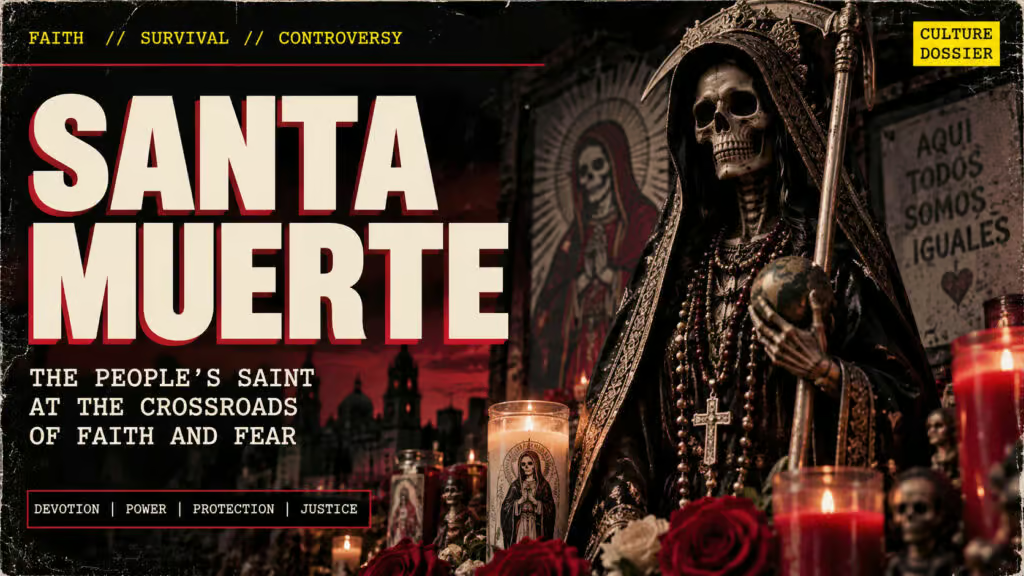
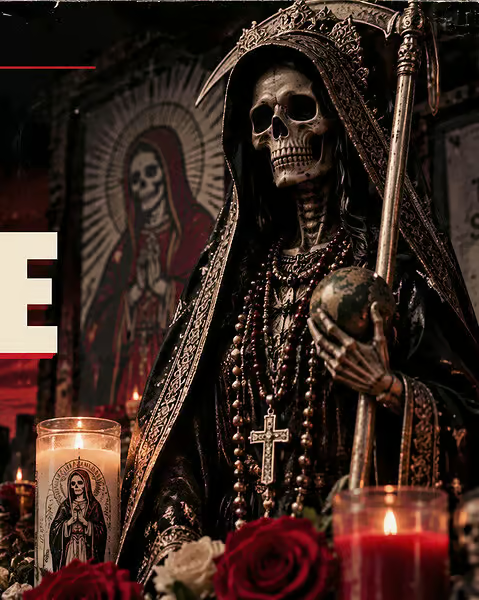
The same caution applies to Santa Muerte. Images of the Mexican folk saint have appeared in criminal contexts, including drug-trafficking cases. But an object found in a home or vehicle does not make its owner a trafficker, and possession itself is not evidence of homicide. An ethnographic study from the University of Miami noted that media portrayals have heavily associated Santa Muerte with violence and criminality, while many devotees are nonviolent practitioners. Santa Muerte as a transnational movement
The evidentiary questions are concrete. Was the object present before the crime? Does it belong to the suspect, the victim, or someone else? Was it moved? Does it contain trace evidence? Do communications show the offender assigning it a role? Did an accomplice describe a ceremony, and is that account corroborated? Is the interpretation offered by a qualified scholar familiar with the particular tradition, or by a generalized “occult expert” working from symbol lists?
Multiple strange elements do not automatically become proof by accumulation. Three ambiguous objects can produce three ambiguous objects, not a confirmed ritual. Their combined significance depends on linkage. A scene staged to look Satanic can be highly relevant, but its relevance may be consciousness of guilt and misdirection rather than worship.
The best investigative rule is simple: document before interpreting. Photograph location and condition. Collect trace evidence under an ordinary forensic protocol. Establish ownership and timing. Consult an expert only after defining the question the evidence must answer. Cultural expertise can prevent error; it should not replace proof.
Mental Illness Is Not a Motive
One common framework divides offenders into ideologically extreme but clinically sane “true believers” and psychotic killers who experience divine commands. It then assigns both groups common traits such as absent empathy, suppressed doubt, and lack of remorse. That framework is too confident and carries a serious stigma.
Psychosis, religious belief, violent ideology, personality traits, and criminal motive are different concepts. A person can hold an extreme belief without psychosis. A person experiencing psychosis can have religiously themed delusions without becoming violent. An offender can make a supernatural claim strategically. A court can find someone legally responsible even when psychiatric symptoms are present, because legal insanity and clinical diagnosis answer different questions.
Research on violence in psychosis is more careful than that. A 2022 systematic review and meta-analysis found an elevated relative risk of violence among people with schizophrenia-spectrum disorders compared with population controls, while emphasizing heterogeneity and the importance of factors such as substance misuse. A 2025 review of first-episode psychosis opens with the point that most true-crime writing should remember: most people with a psychotic illness will never be violent. JAMA Psychiatry systematic review Systematic review of violence risk in first-episode psychosis
The example of David Berkowitz shows the danger of diagnosing motive from a famous story. Berkowitz initially claimed that a demon, associated with a neighbor’s dog, commanded the shootings. In 1979, he said he had made up the possession story. Whatever other beliefs or symptoms he may have had, the demon-dog account cannot be presented as verified evidence that hallucinations caused his crimes. Contemporaneous report of Berkowitz withdrawing the demon story
Responsible reporting therefore avoids phrases such as “a schizophrenic who thinks God commands him to kill” as a generic example. It does not diagnose dead offenders from anecdotes, and it does not infer a lack of empathy from a diagnostic label. Where psychiatric evidence matters, the article should identify its source: a court-ordered evaluation, trial testimony, a medical record introduced in evidence, or a formal finding. It should also state what the finding does and does not establish.
Belief content may help explain an offense when the connection is documented. It should never be used to cast an entire patient population into the shadow of a handful of notorious cases.
More Documented Occult Murder Cases
The “Son of Sam” Cult Connection (1976–1977): A Killer’s Convenient Tale
- Who: David Berkowitz (“Son of Sam”)
- The Claim: Berkowitz initially spun a yarn about taking orders from his neighbor Sam Carr’s demon-possessed Labrador retriever. Yes, a demonic dog allegedly orchestrated a killing spree that left 6 dead and 7 injured in New York City.
- The Reality Check: Spoiler alert: It was bunk. Berkowitz later admitted the whole “demon dog/cult” story was a desperate hoax cooked up to potentially plead insanity and dodge a harsher sentence. More Scooby-Doo villain than Aleister Crowley.
The Kurim Case Torture (Incident ~2007): Twisted Ideology
- Where: Czech Republic
- The Occult Element: This wasn’t Satanism per se, but a bizarre, abusive cult scenario. It involved the extreme torture of children, influenced by a fringe ideology. Reports initially surfaced (though details can be complex and debated) tying elements to twisted ritualistic beliefs held by the abusers.
- The Documentation: The case involved complex manipulation and abuse within a family/group structure, driven by disturbing beliefs. The perpetrators involved were convicted based on the horrific evidence of abuse.
- The McMartin Preschool case, as detailed in a retrospective by LA Weekly, exemplifies the widespread panic and flawed investigative techniques that characterized the Satanic Panic era.
The Chicago Rippers (1981–1982): Gacy’s Carpenter & His Crew
- Who: Robin Gecht, Andrew & Thomas Kokoraleis
- The Occult Practice: This charming quartet (suspected in up to 18 murders, convicted for fewer) engaged in abduction, rape, torture, and murder. The “occult” angle? They mutilated victims, removing breasts as ritualistic “offerings” or souvenirs within their makeshift cult, reportedly led by Gecht.
- The Creepy Connection: Gecht worked as a contractor for notorious killer John Wayne Gacy. Small world, huh? He claimed to channel dark forces, blending sadistic violence with a veneer of Satanic ritual.
Order of the Solar Temple (1994–1997): Apocalyptic Transit
- Where: Switzerland, France, Canada
- The Belief: A sophisticated UFO cult blending New Age ideas with Knights Templar lore. Leaders Luc Jouret and Joseph Di Mambro convinced followers that mass suicide (or “transit”) was necessary to escape Earth’s hypocrisy and reach a new life on a planet orbiting Sirius.
- The Death Toll: A staggering 74 people died across three main events. These weren’t simple suicides; many involved ritualistic arrangements (star formations, ceremonial robes), poison, bullets, and suffocation – including children murdered by their own parents under the cult’s influence. A chilling example of charismatic leaders exploiting spiritual yearning.
- The Order of the Solar Temple’s apocalyptic beliefs, documented by the World Religions and Spirituality Project, culminated in a series of tragic mass suicides and murders.
When Ritual Violence Is Real
Rejecting sensational categories does not require denying documented violence connected to ritual claims or accusations of witchcraft. It requires describing that violence with greater specificity.
The United Nations Human Rights Council did so in 2021 when it adopted a resolution on harmful practices related to accusations of witchcraft and ritual attacks. The resolution recognized killings, mutilation, trafficking, torture, stigma, and forced displacement affecting people in vulnerable situations, including women, children, older people, people with disabilities, and people with albinism. At the same time, it instructed states to distinguish such abuses from the lawful exercise of religion or belief. That two-part principle is essential: confront the violence without criminalizing belief. UN Human Rights Council Resolution 47/8
Amnesty International has documented killings and attacks against people with albinism in Malawi, including crimes in which body parts were sought for purported ritual purposes. Its 2019 report describes criminal gangs and, in some cases, relatives targeting adults and children. This is not a metaphorical “church of blood.” It is a human-rights and criminal-justice problem involving vulnerable victims, discriminatory myths, buyers, intermediaries, weak protection, and impunity. Amnesty International’s Out of the Shadows report
Recent scholarship also complicates the assumption that such killings are driven by pure faith. A 2025 systematic review of empirical literature on ritual child homicide in African settings found only 14 studies that met its criteria. Most reported that material gain or the pursuit of wealth was a primary motive. The review also found that these homicides were generally not recorded as a separate official category, leaving no reliable prevalence indicator in many settings. It warned that missing body parts do not necessarily establish ritual motive; organ trafficking or deliberate staging may offer alternative explanations. Systematic review of ritual child homicide
That evidence directly contradicts an unsupported Zimbabwe statistic that circulates online. The claim that ritual killings accounted for 40 percent of 3,600 murders in 2022 could not be traced to a Zimbabwe National Statistics Agency table. The secondary webpage repeating it acknowledged that the figure might be a typographical error and needed verification. A number that extraordinary cannot be rescued with “if true.” It cannot be relied on until the primary dataset and category definition are produced.
The unsolved London case of the boy known as “Adam” requires similar restraint. His torso was recovered from the Thames in September 2001. In a 2021 anniversary appeal, Metropolitan Police said he was believed to have been five or six years old and from Nigeria, and that his death may have been a ritualistic killing. He has not been identified, and no one has been convicted of his murder. 2021 Metropolitan Police appeal reported by the Evening Standard
Some accounts upgrade that theory into a correct classification and call the case a “Yoruba-style muti” sacrifice. That phrase is inaccurate. Muti or muthi is a southern African term, while Yoruba traditions arise in West Africa; combining them creates an invented cultural category. More fundamentally, the case remains unsolved. Investigators’ ritual theory may be important, but it remains a theory. The verified language is that police have investigated the possibility of ritualistic killing in the unsolved murder of an unidentified child believed to have come from Nigeria.
Real violence does not need mythic inflation. It needs accurate victim counts, careful cultural terms, protection for targeted communities, competent forensics, and evidence capable of surviving court.
Case Studies: Modern Ritualistic Homicide
Let’s move from the abstract to the concrete. These instances highlight the varied, disturbing ways ritualistic violence manifests today.
Elanthoor Human Sacrifice Case (Kerala, India, 2022)
This case exemplifies the horrifying intersection of superstition, greed, and extreme violence.
- The Victims: Roslyn and Padma, women lured by promises of money, allegedly became victims of a plot driven by the belief that human sacrifice would bring prosperity.
- The Accused: Muhammed Shafi is alleged to have orchestrated the killings, preying on the financial desperation of the victims and the superstitious beliefs of his co-accused, Bhagaval Singh (a traditional healer) and his wife, Laila Singh. The trio allegedly believed the sacrifices would alleviate their financial problems.
- Modus Operandi and Ritual Elements: The victims were allegedly tortured, killed, dismembered, and buried. Reports included allegations of cannibalism, potentially linked to beliefs about absorbing the victim’s life force or fulfilling specific ritual requirements dictated by Shafi. The case highlights how occult beliefs, manipulated by a predatory individual, can lead to calculated, brutal homicide disguised as ritual.
Thames Torso Case (“Adam,” London, UK, 2001)
A tragic case underscoring the links between human trafficking, traditional beliefs (specifically Muti or Juju practices), and ritualistic killing.
- The Victim: The torso of a young boy, estimated to be 5-6 years old and later traced back to Nigeria, was discovered in the River Thames. He was given the name “Adam” by investigators.
- Ritualistic Indicators: Forensic analysis indicated a highly specific, ritualistic manner of death and dismemberment, inconsistent with typical homicide patterns. The presence of unusual substances in his system pointed towards possible ritual feeding before death.
- The Trafficking and Muti Connection: The investigation pointed towards Adam being trafficked to the UK specifically for a ritual sacrifice, likely related to Muti – practices where body parts are believed to hold power and bring prosperity or protection when used in rituals. Despite extensive international investigation, identifying Adam and bringing his killers to justice remains an unsolved tragedy, highlighting the difficulties in tackling transnational trafficking networks involved in ritualistic practices.
Okija Shrine Incident (Anambra State, Nigeria, 2004)
This case exposed the abuse of traditional religious authority for criminal purposes, including suspected ritual killings.
- The Discovery: A police raid on the Okija Shrine complex uncovered dozens of decomposing bodies and fresh human skulls in the surrounding forest, referred to as the “evil forest.”
- The Shrine’s Function: The Ogwugwu Akpu shrine served as a traditional adjudicating body, where disputes were settled, and oaths sworn before deities. It was alleged that those deemed guilty by the shrine’s priests, or those who defaulted on oaths, were killed, possibly as sacrifices or punishment dictated by the shrine’s rules, their assets seized by the priests.
- Abuse of Power: Over 30 priests and attendants were arrested. The incident revealed how traditional practices, meant for dispute resolution, could be corrupted into a system of extortion, terror, and murder under the guise of religious authority. It sparked a national debate on regulating traditional religious practices and distinguishing genuine belief from criminal exploitation.
How to Investigate Without Creating a Legend
It is sometimes said that ritual murders are exceptionally difficult to investigate, often more difficult than ordinary homicide. No comparative evidence is offered. Some features described in such accounts can certainly complicate an inquiry: unidentified or incomplete remains, cross-border movement, scene alteration, frightened witnesses, multiple offenders, and disputes over expert interpretation. Those problems are not unique to occult cases, and they should be named directly rather than attributed to a mystical class.
A sound inquiry begins with the homicide, not the cosmology.
First, separate observation from interpretation. “Five red candles were recovered two feet from the body” is an observation. “The candles represented blood and death” is an interpretation requiring a source. “The offender placed the candles during a rite” is a further claim requiring linkage and timing.
Second, preserve alternative hypotheses. A body may be posed as part of a belief, for sexual gratification, to shock a finder, to impede identification, to imitate media, or to redirect suspicion. Investigators should test those possibilities rather than choose the most dramatic one.
Third, vet experts by subject and method. A scholar of one Afro-diasporic religion is not automatically qualified to interpret a different tradition. A therapist is not a crime-scene analyst. A police trainer’s symbol chart is not an empirical validation study. Experts should explain the limits of their opinion and identify the materials on which it rests.
Fourth, distinguish group doctrine from offender invention. The existence of a shrine, saint, scripture, or ritual object does not show that a faith community endorses the offender’s act. Journalists should seek independent scholarship or representatives of the relevant tradition, especially when a criminal claims authority that the tradition itself does not recognize.
Fifth, track material benefit. Follow money, insurance, drugs, property, trafficking routes, communications, and efforts to silence witnesses. The Krugersdorp and Matamoros records show why a spiritual narrative and an economic crime cannot be treated as mutually exclusive.
Finally, report legal status with precision. An allegation is not a finding. An admissibility ruling is not a scientific endorsement. An Alford plea is not exoneration. A police theory in an unsolved case is not a solved motive. A display of Satanic imagery is not proof that Satanism caused a murder.
The most reliable conclusion is narrower than a “Church of Blood.” Some killers and criminal groups have invoked supernatural authority, protection, sacrifice, or divine command. In a few cases, corroborated statements, conduct, and physical evidence establish that belief as a meaningful part of the crime. In others, occult language has been theater, manipulation, stigma, or investigative error.
The work of law enforcement and journalism is not to deny the possibility of ritual motive or to announce it on sight. It is to prove what human beings did, what they intended, and how that conclusion is known. The symbol may be the first thing the public notices. Evidence must have the last word.
Frequently Asked Questions
Is “occult-motivated homicide” an official crime category?
Not universally. It is an interpretive description rather than a standardized international offense or settled psychiatric category. Jurisdictions generally prosecute the underlying homicide and related crimes.
Do pentagrams, candles, or altars prove a ritual murder?
No. Such objects may be relevant, but investigators must establish ownership, timing, placement, and connection to the offense. They can reflect belief, staging, intimidation, or unrelated lawful practice.
Were all 15 Matamoros victims killed as human sacrifices?
Contemporary reporting linked 15 killings to Constanzo’s group but said investigators classified five as alleged cult sacrifices and ten as drug-related killings. The broader claim that there were 15 ritual sacrifices is inaccurate.
Did investigators substantiate the alleged nationwide Satanic abuse conspiracy?
No. A major federally funded survey found no hard evidence for the stereotyped organized, intergenerational Satanic cult. It did find some smaller cases using Satanic themes and stronger evidence of other religion-related abuse.
Were the West Memphis Three exonerated?
No. They entered Alford pleas in 2011 and were released with time-served sentences, but their convictions remained. Additional DNA testing was underway in 2026.
Did David Berkowitz really say a demon commanded him through a dog?
He made that claim after his arrest, but in 1979, he said he had invented the possession story. It should not be presented as verified evidence of a command hallucination.
Are people with psychosis likely to become violent “mission” killers?
Most people with psychotic illness are never violent. Violence risk is heterogeneous and affected by multiple factors; diagnosis or religiously themed symptoms alone do not establish dangerousness or motive.
Are ritual attacks and witchcraft-accusation violence real?
Yes. The United Nations and human-rights organizations have documented killings, mutilation, trafficking, and other abuses. They also stress the need to distinguish those crimes from lawful religion, belief, and traditional medicine.
Sources
- Kenneth V. Lanning, Investigator’s Guide to Allegations of “Ritual” Child Abuse (FBI/NIJ, 1992)
- Gail S. Goodman et al., Characteristics and Sources of Allegations of Ritualistic Child Abuse
- South African National Prosecuting Authority, Electus per Deus sentencing statement
- Echols v. State (Arkansas Supreme Court, 1996)
- Echols v. State (Arkansas Supreme Court, 2024)
- People v. Ramirez (California Supreme Court, 2006)
- Church of Lukumi Babalu Aye v. City of Hialeah (U.S. Supreme Court, 1993)
- UN Human Rights Council Resolution 47/8
- Los Angeles Times, scene and suspect accounts in the Matamoros investigation
- Los Angeles Times, later reconstruction of the Matamoros killings
- The Roanoke Times/New York Times News Service, national ritual-abuse survey
- WMC Action News 5, 2026 West Memphis DNA-testing update
- The Washington Post, Berkowitz’s withdrawal of the demon-possession story
- The Guardian, Beasts of Satan prosecution and investigators’ theory
- Evening Standard, Metropolitan Police appeal in the “Adam” case
- Amnesty International, Out of the Shadows
- Emmanuel Sarpong Owusu, systematic review of ritual child homicide
- JAMA Psychiatry, schizophrenia-spectrum disorders and violence
- Systematic review of violence risk in first-episode psychosis
- University of Miami, Santa Muerte and media sensationalism
- Iztapalapa, Santa Muerte, the press, church, and state
- Journal for the Study of Religion, South Africa’s Occult-Related Crimes Unit
- Finley, Sen-Gupta, and Hanlon, Homicide Offender Motive Scale
- Secondary source reviewed solely to trace the unverified Zimbabwe statistic
Browse every case in the Case File Index
Discover more from The Dark Side of Humanity
Subscribe to get the latest posts sent to your email.