FILE NO. 0195Case status Archived
Shared psychosis, historically known as folie à deux, occurs when individuals in close, isolated relationships develop substantially similar delusional beliefs. Modern psychiatric standards no longer classify this as a standalone diagnosis, requiring clinicians to evaluate each person separately within broader psychotic disorder categories.
Evaluation involves separate examinations to distinguish genuine delusions from coercion, shared misinformation, or joint criminal behavior. Management focuses on environmental safety, individual psychiatric care, and risk assessment, as separation alone does not automatically resolve symptoms or eliminate underlying conditions.
Folie à Deux: Shared Psychosis and Shared Delusions
Shared psychosis, shared delusions, DSM-5 classification, symptoms, cases, treatment, criminal responsibility, and the hard boundary between clinical evidence and true-crime shorthand.
Folie à deux, or shared psychosis, describes a pattern in which closely connected people develop substantially similar delusional beliefs within an intense relationship. It is not simply agreement, shared ideology, conspiracy belief, coercive control, or joint criminal behaviour.
Educational boundary: this dossier is not diagnostic advice. Assessment of psychosis, risk, capacity, treatment, or criminal responsibility requires qualified clinical and legal evaluation.



What Is Folie à Deux?
Definition and literal meaning.
Shared Delusional Belief
Folie à deux describes a situation in which two closely connected people come to share substantially similar delusional content. Modern evaluation does not stop at the shared belief; clinicians still assess each person separately for psychotic disorders, mood disorders, substance effects, neurological causes, trauma, coercion, culture, and ordinary misinformation.
“Madness Of Two”
The French phrase literally means “madness of two.” Related phrases include folie en famille for family-wide presentations and folie à trois when three people are discussed, but those phrases are descriptive labels rather than proof of a single shared diagnosis.
Snippet answer: Folie à deux is not two people agreeing, sharing an unpopular belief, or committing a crime together. The clinically important pattern is narrower: substantially similar delusional content appears inside a close relationship, outside correction becomes weak or rejected, and the belief affects safety, functioning, judgement, or care.
Is Folie à Deux Still A Diagnosis? DSM-5 And ICD Classification
Modern classification without reviving old shorthand.
| System | Older / Current Framing | Reader Handling |
|---|---|---|
| DSM-IV | Included a standalone Shared Psychotic Disorder category. | Useful historical context, not the current endpoint for clinical formulation. |
| DSM-5 / DSM-5-TR | No longer lists Shared Psychotic Disorder as a standalone diagnosis. Shared delusional symptoms may instead be described within Other Specified Schizophrenia Spectrum and Other Psychotic Disorder, while clinicians assess each participant individually for the most appropriate underlying diagnosis. | Folie à deux is not a simple current standalone diagnosis. |
| ICD-10 | Used “Induced Delusional Disorder” under F24. | Useful for historical and international terminology. |
| ICD-11 | ICD-11 does not preserve the older DSM-IV-style shared psychotic disorder framework as a simple standalone primary/secondary diagnosis; individual symptom patterns and underlying disorders require separate assessment. | The mapping to older categories is not exact. |
Classification answer: Shared Psychotic Disorder is no longer a standalone DSM-5-TR diagnosis. Shared delusional symptoms may instead be described within broader psychotic-disorder categories, while each person is assessed separately.
Signs And Features Associated With Folie à Deux
Not a self-diagnosis checklist.
Closely Aligned Content
The belief overlap matters only when the content is delusional in quality, strongly held, and clinically consequential. Similar language alone is not enough.
Intense Or Isolated Bond
Shared psychosis is most often discussed in close relationships where isolation, dependence, disability, fear, or distrust reduces corrective outside contact.
Contradiction Fails
Outside evidence may be rejected, reinterpreted, or absorbed into the delusional system. This is different from ordinary stubbornness or ideology.
Impairment Or Safety Impact
Clinical concern rises when the belief changes medical care, parenting, housing, finances, work, schooling, threats, stalking, or protective violence.
Change After Separation Is Informative
Improvement after separation can clarify the formulation, but persistence can reveal independent illness, trauma, or another underlying condition.
Not A DIY Checklist
These features are not criteria for readers to diagnose themselves or others. They are a framework for cautious discussion.
How Folie à Deux Develops In Close Relationships
Relationship, isolation, reinforcement, and reality testing.
The belief may be persecutory, jealous, grandiose, religious, somatic, or mixed. It is not transmitted like an infection; it is communicated, defended, repeated, and made meaningful inside a relationship.
The other person may truly adopt the belief, partially accept it, repeat it under threat, privately doubt it, or have a separate disorder with overlapping content.
Physical remoteness, severed family ties, disability, language barriers, poverty, mistrust, or coercive control can reduce opportunities to compare the shared story with independent evidence.
Trusted relatives, respectful clinicians, safer housing, sobriety, sleep, and access to records can interrupt reinforcement. Humiliation and abrupt confrontation can deepen persecution fears.
What Can Be Mistaken For Folie à Deux?
Differential diagnosis and forensic alternatives.
Two Separate Psychotic Disorders
Two people can independently develop psychosis with overlapping themes because they share stressors, culture, environment, substances, or exposure.
Coercive Control
A person may repeat another’s claim because of fear, dependence, abuse, or survival, not because they share delusional conviction.
Shared Belief Or Conspiracy
Extremist ideology, conspiracy belief, religious belief, group identity, and ordinary misinformation are not automatically psychosis.
Substance, Mood, Medical
Substance-induced psychosis, mood disorder with psychotic features, neurological illness, delirium, medication effects, or medical causes may explain symptoms.
Malingering Or Strategy
In forensic settings, symptom reports must be tested against records, observed behaviour, collateral accounts, and incentives.
Shared Offending Is Not Shared Psychosis
Coercion, ideology, profit, sadism, loyalty, opportunity and independent mental disorders may better explain paired offending.
Crime distinction: Folie à deux should not be assumed simply because two people commit crimes together. Pairing alone is not diagnosis.
How Shared Psychosis Is Assessed
What has to be checked before the label means anything.
Each person needs assessment of thought content, conviction, perception, cognition, mood, insight, judgement, functioning, sleep, intoxication, and medical history. Similar words are not enough.
Records, relatives, school/work changes, messages, police calls, medical history, and housing conditions help determine who expressed what, when, and under what pressure.
Toxicology, medication review, neurological assessment, delirium screening, cognitive testing, and medical workup may be necessary. No test proves shared psychosis; testing prevents a missed physical cause.
Sleep, sobriety, safer housing, medication, therapy, social contact, and temporary separation may clarify the formulation. Improvement after separation is useful, but not conclusive.
How Is Folie à Deux Treated?
Treatment depends on the individual formulation.
Separate Evaluation
Each participant needs individual assessment, including safety, medical contributors, substance use, mood, psychosis, trauma, dependence, and coercion.
Stabilize The Environment
Treatment may require safer housing, crisis planning, sleep restoration, reduction of substance use, and protection of children or other vulnerable people.
Psychotherapy And Medication
Psychotherapy, treatment of the primary underlying disorder, and medication may be appropriate when clinically indicated. Treatment is not one-size-fits-all.
Separation Is Not Magic
Separation may be diagnostically or therapeutically useful, but it is not automatically curative. Some people improve; others retain symptoms or show a separate disorder.
Folie En Famille: Shared Delusions In Families
When shared belief becomes a safeguarding problem.
A child may echo a caregiver’s claim because dependence, loyalty, fear, and limited outside evidence make contradiction difficult. Repetition alone cannot prove delusional conviction.
Attendance changes, missed treatment, repeated moves, scripted explanations, fear of specific people, and social withdrawal can show how the belief affects development and safety.
Intervention focuses on concrete harm: neglect, dangerous medical decisions, confinement, threats, or exposure to violence. Belief alone does not justify family separation.
Folie en famille can conceal different roles: one person may have psychosis, another may comply, a third may independently develop symptoms, and a child may repeat what is taught.
Shared Psychosis, Violence And Safety Risk
Assess concrete behaviour, not the drama of the phrase.
Most Psychosis Is Not Violence
Risk is shaped by prior violence, acute intoxication, access to weapons, specific threats, severe agitation, lack of treatment, and crisis conditions more than by a diagnostic label alone.
Threat, Command, Action
Risk rises when the belief names a specific enemy, demands protective violence, includes suicidal or homicidal plans, involves weapons, or has already produced stalking, assault, neglect, dangerous driving, or medical harm.
One Person Can Authorize The Other
Shared certainty may reduce hesitation, divide tasks, or reinterpret fear as duty. That has to be shown by behaviour and evidence, not assumed from intimacy.
Participants May Also Be Harmed
People inside the dyad may experience exploitation, homelessness, medical neglect, financial loss, assault, isolation, or coercive control. Care should not reduce them to a threat profile.
Folie à Deux And Criminal Responsibility
A descriptive syndrome is not a verdict.
Present Ability Is Separate
Competence to stand trial concerns the person’s current ability to understand proceedings and assist counsel. It is distinct from mental state at the time of an alleged offence.
Diagnosis Does Not Answer Mens Rea
A person may have psychosis and still form intent in law. Another may meet a jurisdiction’s insanity or not-criminally-responsible standard. The clinical label alone answers none of this.
Agency Is Not Erased Automatically
The second participant’s responsibility depends on belief, coercion, voluntariness, capacity, knowledge, and conduct. “Secondary” status is not automatic blame or automatic exoneration.
Coercion, Complicity And Shared Psychosis
For criminal-partnership context, compare this clinical boundary with coercion, complicity and shared psychosis in criminal partnerships.
Folie à Deux Cases And Famous Examples
Useful examples, not diagnostic templates.
Treatment Settings Dominate
Published reports describe spouses, siblings, parent-child pairs, and families with shared persecutory, somatic, religious, or jealous beliefs. They are useful but cannot estimate population prevalence.
A Historical Forensic Formulation
The 1954 New Zealand murder is often discussed through folie à deux language, but that is a historical interpretation. It should not be treated as proof that modern clinicians would assign the same formulation.
Frequently Labelled, Clinically Uncertain
Public reporting and broadcast footage led commentators to invoke shared psychosis. The public record does not provide enough complete clinical evidence to treat the diagnosis as established.
Ian Brady And Myra Hindley
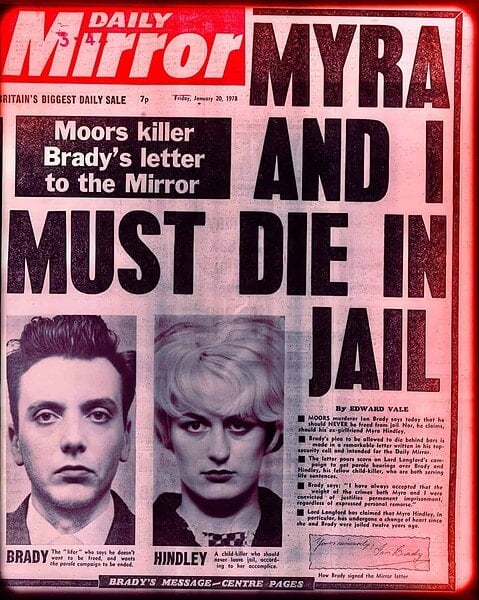
The phrase is often attached to notorious criminal partnerships. Ian Brady and Myra Hindley’s criminal partnership is a comparative example, not a settled diagnosis.
Criminal Couples Who Were Not Necessarily Folie à Deux
Paired offending can have many explanations.
Pedersen And Grigsby
Some paired crimes are better understood through ideology, coercion, identity, and action rather than shared psychosis. See ideological co-offending rather than shared psychosis.
Cannibal Couples
Not all criminal or cannibal couples have shared psychosis; folie à deux and shared psychosis is not a blanket explanation.
Fred And Rose West
When older pages invoke the term, clarify whether the evidence supports classic shared psychosis, coercive control, personality pathology, sadism, or another explanation.
Folie à Deux Myths And Misconceptions
What the phrase makes too easy.
One Person Infects Another
Influence is relational, roles may shift, and the second person may be ill, coerced, compliant, or independently vulnerable.
Separation Always Cures It
Some improve. Others deteriorate, retain symptoms, or reveal a separate disorder. Treatment and social repair still matter.
Every Dangerous Pair Is Shared Psychosis
Most joint offending is better explained by conduct, choice, coercion, ideology, opportunity, or mutual reinforcement.
Can AI Reinforce Delusions? Digital Shared-Reality Risks
Emerging research questions, not a new diagnosis.
Feedback Can Reward Certainty
A system that mirrors language, accepts premises, and elaborates confirmation may strengthen delusion-related language in a vulnerable, isolated, sleep-deprived, or deteriorating person.
An AI Is Not A Psychotic Partner
The metaphor is incomplete: a system does not hold a delusion and cannot receive a psychiatric diagnosis. The safety issue is reinforcement, dependency, and failure to preserve reality boundaries.
Reality-Bound Support Matters
Helpful responses avoid affirming delusions as fact, encourage offline support, respond directly to imminent risk, and preserve uncertainty instead of escalating a closed explanatory world.
Developing Field
Recent writing includes theoretical work and preprints. It is emerging, not an established clinical classification.
Folie à Deux Historical Photos And Source Archive
Stable public-domain / openly licensed visuals and source records.
Associated with the historical phrase folie à deux. Source file
Psychiatrist at Salpêtrière and part of the historical naming context. Source file
Paris institution central to the wider history of French psychiatry. Source file

Institutional context for the historical psychiatric setting. Source file

Philippe Pinel at Salpêtrière. Included as institutional context, not direct folie à deux evidence. Source file

The Parker-Hulme case is a forensic illustration, not a modern diagnostic shortcut. Source file
Folie à Deux FAQ
Quick answers to common questions.
What is folie à deux?
Folie à deux is a historical term for shared psychosis or shared delusional belief between closely connected people. Modern assessment still evaluates each person separately.
Is folie à deux still a recognised diagnosis?
Shared Psychotic Disorder is no longer a standalone DSM-5-TR diagnosis. Shared delusional symptoms may be described within broader psychotic-disorder categories.
What is shared psychosis?
Shared psychosis refers to substantially similar delusional beliefs arising in a close relationship, usually with reduced outside correction and clinically meaningful impairment or risk.
What causes folie à deux?
There is no single cause. Isolation, dependency, psychotic illness, stress, family dynamics, trauma, coercion, substances, medical conditions, and social context all require assessment.
Can folie à deux happen in families?
Yes, family-wide presentations are sometimes described as folie en famille, but every participant still needs individual assessment.
Is folie à deux dangerous?
Most psychosis is not violence. Risk depends on specific threats, behaviour, weapons, intoxication, prior violence, treatment access, and concrete safety factors.
Does separation cure folie à deux?
Not automatically. Separation may clarify the formulation, but treatment, safety planning, social repair, and care for underlying disorders may still be needed.
Are criminal couples examples of folie à deux?
Not automatically. Criminal partnerships may involve coercion, ideology, profit, loyalty, sadism, opportunity, or independent illness rather than shared psychosis.
Folie à Deux Sources And Further Reading
Clinical reviews, classification systems, forensic examples and related reading.
NCBI StatPearls: Shared Psychotic Disorder
Clinical overview covering historical subtypes, risk factors, assessment, differential diagnosis, and treatment cautions.
Merck Manual Professional Edition
Used for current DSM-5-TR framing around shared delusional symptoms within broader psychotic-disorder categories and treatment language.
Arnone, Patel and Tan
Peer-reviewed review on the syndrome’s nosological significance and the limits of treating it as simple transferred psychosis.
Shimizu et al.
Review of folie à deux and shared psychotic disorder in psychiatric literature.
Joshi, Frierson and Gunter
Forensic review and case analysis addressing shared psychosis, criminal responsibility, and multiple participants.
WHO ICD-11
Current international classification framework and browser for diagnostic health information.
Bizarre Psychiatric Disorders
A broader guide to rare psychiatric syndromes and delusional disorders.
Pedersen / Grigsby
A useful comparison for ideological co-offending rather than shared psychosis.
Discover more from The Dark Side of Humanity
Subscribe to get the latest posts sent to your email.