Forensic analysis of criminal dismemberment cases demonstrates that body fragmentation is most commonly a defensive act aimed at concealing remains or facilitating transport. In solved cases, victims are typically known to offenders, and ordinary household tools are predominantly used. Anatomical precision does not reliably indicate an offender’s occupation.
Body fragmentation frequently hinders forensic investigations by destroying crucial evidence needed to establish identity and cause of death. Decapitation can occasionally be the fatal mechanism rather than a post-mortem act. Consequently, modern investigations require multidisciplinary approaches, combining medical imaging, pathology, and trace analysis, rather than relying on behavioral assumptions.

Inside 50 Years of Criminal Dismemberment in Kraków
KEEP GOING
- Crime Dossier: hub
- What Is Necrophilia? Forensic Profile, related case
- Black Dahlia Autopsy, Elizabeth Short, same format
Why are bodies dismembered after homicide? Fifty years of forensic casework, tested against Swedish, Hamburg, and Finnish studies, shows that concealment and transport are common motives, but the act itself does not identify one offender type, profession, diagnosis, or sexual motive.
Why Do Offenders Dismember Bodies?
Concealment, Transport, and Delay
Across several forensic case series, the most frequent classification is defensive or instrumental dismemberment. The offender reduces a body into smaller units so it can be moved, concealed, dispersed, or made harder to identify, often after a homicide that occurred in a residence or another location the offender needs to clean or regain control over.
That pattern is common, but it is not universal. Other cases involve expressive mutilation, anger, sexualized acts, trophy-taking, post-burial interference, or fatal decapitation. The correct inference is therefore behavioral: dismemberment can serve a practical or expressive function, but the physical act alone does not reveal one motive or offender profile.
Does Dismemberment Mean Medical Training?
No. Ordinary knives, axes, and saws dominate several case series, and joint separation has been performed by offenders from unrelated occupations. Toolmarks and anatomical choices can guide questions about familiarity and method, but they cannot identify a surgeon, butcher, hunter, or clinician without independent corroboration.
The phrase “surgical precision” is especially unreliable when it is used as a shortcut for occupation. A forensic opinion must integrate cut direction, false starts, kerf characteristics, joint anatomy, scene logistics, tool recovery, trace evidence, and the offender’s actual history.
Evidence Index
What Is Criminal Dismemberment?
The Narrow Forensic Definition
In forensic literature, criminal dismemberment generally refers to the intentional division or removal of body parts in a criminal context. It is a description of conduct, not a psychiatric diagnosis, and it is not synonymous with serial murder, sexual homicide, necrophilia, cannibalism, or sadism.
The sequence also matters. Dismemberment may occur after death, it may contribute directly to death, or it may involve a body that died from unrelated causes and was later disturbed. A careful report therefore distinguishes postmortem fragmentation from fatal removal such as decapitation and from post-burial interference.
What the Body Can and Cannot Tell You
Cut surfaces can preserve evidence about tool class, direction, repeated attempts, joint use, and sequence. Scene reconstruction can show whether dismemberment occurred where the killing happened, whether fragments were transported, and whether identity-bearing anatomy was targeted or separated.
Those observations do not automatically disclose motive, occupation, diagnosis, or relationship. Those conclusions require independent evidence such as offender statements, digital records, recovered tools, communications, victim history, witness evidence, trace material, and the logistics of the scene.
Why Do Killers Dismember Bodies? The Four-Part Classification
Concealment and Disposal
Dismemberment intended to reduce a body into movable units, delay discovery, complicate identification, separate remains across disposal sites, or remove the body from a location connected to the offender. This is the dominant classification in several modern series.
Expression and Mutilation
Body alteration interpreted as aggression, sexualized treatment, symbolic mutilation, trophy-taking, or another expressive act not required simply to move or hide the remains. The category depends heavily on context because the same cut can serve more than one function.
Dismemberment as the Fatal Act
Removal of a body part causes death rather than occurring after death. In the Kraków series, three cases involved decapitation as the fatal mechanism, making it inaccurate to describe the entire dataset as postmortem dismemberment.
Interference With the Already Dead
Older literature sometimes labels this category “necrophilic,” but that wording can overstate sexual motive. One Kraków example involved exhumation and dismemberment in an insurance-fraud context, so “post-burial” or “corpse-focused” is the safer descriptive label unless sexual motivation is independently established.
What 50 Years of Kraków Cases Found
Criminal dismemberment examinations reviewed over fifty years by the Department of Forensic Medicine in Kraków.
Concealment, transport, disposal, or interference with identification dominated the reported classification.
In ten examinations, destruction or decomposition prevented a definitive conclusion.
Among cases with an identified offender, known-person relationships were overwhelmingly common.
What the 2016 Series Supports
The fifty-year series found that defensive dismemberment was the most frequent motive classification, ordinary knives, axes, and saws predominated, and most identified offenders were relatives, neighbours, or acquaintances of the victim. In solved cases, dismemberment commonly occurred at the homicide scene, frequently an offender’s residence.
The series also shows the forensic cost of fragmentation. Cause of death could be established in only 20 of 30 examinations, while destruction of critical anatomy or decomposition prevented a definitive conclusion in the rest.
Do Not Merge the 2007 and 2016 Kraków Papers
The earlier 2007 paper examined 23 cases from 1968 to 2005. It reported 17 defensive cases, three offensive cases, two fatal decapitations, and one case that was difficult to classify. The later fifty-year review expanded the dataset to 30 examinations covering 1965 to 2015.
These are related studies from the same forensic department, but they are not the same sample. Using the 2007 citation as if it were the source for the later 30-case dataset creates a false source trail, so this dossier keeps the study lineage explicit.
| Study | Period | Cases | Why It Matters |
|---|---|---|---|
| Konopka et al., 2007 | 1968-2005 | 23 | Earlier Kraków series. Useful background, but not the source for the later 30-case fifty-year dataset. |
| Konopka et al., 2016 | 1965-2015 | 30 | Expanded fifty-year series used for the central metrics and classification discussion on this page. |
What Other Forensic Studies Found
| Study | Sample | Key Finding | What It Does Not Prove |
|---|---|---|---|
| Kraków Konopka et al. | 30 examinations, 1965-2015 | Defensive dismemberment dominated; known-person relationships were common in solved cases. | Not a national prevalence study. Motives overlap and the taxonomy is not perfectly exhaustive. |
| Sweden Guggenheimer et al. | 43 mutilation homicides, 1991-2017 | 70% defensive and 30% offensive; cause of death was undetermined in 28%. | National Swedish data cannot be converted into a universal offender profile. |
| Hamburg Wilke-Schalhorst et al. | 51 corpse-dismemberment cases, 1959-2016 | 30 defensive and 21 offensive; ordinary knives were the most common instruments. | Urban disposal logistics and local case mix may influence the pattern. |
| Finland Häkkänen-Nyholm et al. | 13 mutilation homicides among 676 offenders examined, 1995-2004 | Mutilation was rare; developmental and psychiatric problems were more frequent in the small mutilation group. | Mutilation was not significantly associated with psychopathy or substance abuse, and the subsample was very small. |
The comparative record matters because no single city or national series should be treated as universal. The studies repeatedly show that practical disposal motives are common, but the exact proportions vary with definitions, case selection, evidentiary quality, local geography, and the ability to identify an offender. The Swedish study and the Hamburg series are especially useful because they test the Kraków findings against different case environments.
The strongest cross-study conclusion is therefore modest. Dismemberment is often instrumental, but it remains a heterogeneous behavior whose meaning depends on scene context, relationship evidence, timing, disposal strategy, and any independently supported expressive or sexual component.
Does Dismemberment Reveal a Killer’s Profession?
Ordinary Tools Predominated
In the Kraków series, investigators most often encountered kitchen knives, axes, wood saws, and metal saws. Two cases involved angle grinders, and one former medical student used a surgical amputation knife and a spade. Specialized instrumentation was therefore the exception rather than a prerequisite.
Hamburg likewise found ordinary knives to be common. A forensic examiner may be able to narrow a tool class from kerf characteristics and other marks, but tool class is not the same thing as a profession, and a recovered household tool may be more probative than a visually impressive cut.
Joint Separation Is Not a Résumé
Seven Kraków cases involved limb separation through joints, yet those surfaces still showed blade marks, and the people who performed the disarticulation came from unrelated occupations. A joint cut can justify questions about anatomical familiarity, prior experience, or trial-and-error learning, but it cannot name the offender’s trade.
This is why “surgical precision” is a poor forensic conclusion when it stands alone. A valid inference must integrate false starts, cut direction, saw marks, joint anatomy, recovered tools, scene logistics, witness information, and the offender’s documented background.
How Dismemberment Can Obscure Cause of Death
Ten Kraków Examinations Remained Indeterminate
Cause of death was established in 20 of 30 examinations. In the remainder, decomposition or destruction of critical anatomy prevented a defensible conclusion, which shows how fragmentation can function as evidence destruction even when the offender lacks any sophisticated forensic knowledge.
The loss may affect far more than the fatal injury. Fragmentation can separate wounds from their anatomical context, complicate blood-loss interpretation, delay identification, increase commingling risk, and make it harder to reconstruct where one event ends and another begins.
Three Deaths Were Decapitations
The Kraków study included three aggressive-dismemberment cases in which decapitation itself was the fatal act. That distinction prevents the common error of describing every body found in parts as a case of postmortem cutting.
Forensic sequence depends on evidence of vitality, hemorrhage, tissue reaction, surviving anatomy, and the relationship between the severing injury and other trauma. The question is not merely whether the body was divided, but when and how that division occurred relative to death.
How Forensic Investigators Reconstruct Dismembered Remains
Recovery Map
Document where every fragment, package, binding, container, and trace item was recovered. Geography can show movement, disposal staging, commingling, and whether the recovery sites reflect the killing scene or only later transport.
Imaging First
Post-mortem CT can document fractures, foreign material, cut trajectories, and internal relationships before the autopsy changes the remains. Imaging is especially useful when fragments are complex, fragile, decomposed, or potentially commingled.
Reassociation
Pathology, anthropology, radiology, DNA, fingerprints, and dental comparison help determine which fragments belong together and restore identity. Reassociation is a prerequisite for interpreting many injuries in their proper anatomical context.
Sequence and Toolmarks
Investigators document toolmarks before destructive sampling and compare cut surfaces with recovered instruments where appropriate. Vitality, toxicology, histology, and other evidence then help reconstruct when injuries occurred and how the sequence fits the rest of the scene.
Maiese and colleagues proposed an integrated approach combining scene investigation, post-mortem CT, autopsy, toxicology, histology, immunohistochemistry, and genetics. A later systematic review of complex bodies likewise emphasized that fragmented remains demand coordinated methods rather than reliance on a single dramatic sign. Read the Maiese protocol and the 2023 systematic review.
Are Dismemberment Victims Usually Known to the Offender?
Close Relationships Were Common in Solved Kraków Cases
Among the 25 Kraków cases in which an offender was identified, the victim knew the offender in 23. Eighteen involved an immediate family member, and five involved a neighbour or acquaintance. The authors reasoned that someone close to a missing victim may expect scrutiny if the body is discovered, making concealment especially consequential.
This pattern also fits the practical realities of many defensive cases. A homicide inside a shared or familiar residence creates an immediate problem of body removal, blood evidence, witness risk, and future access to the space, so fragmentation can become part of a disposal strategy.
Unsolved Cases Are Missing From That Calculation
The 23-of-25 statistic comes from cases with identified offenders. It cannot prove that an unknown offender must be a spouse, relative, neighbour, or acquaintance because case clearance is not random.
Investigations are often easier to solve when a relational pathway already points police toward a suspect. The proper use of the statistic is to guide hypothesis generation, not to exclude strangers or convert a solved-case pattern into a deterministic profile.
Does Dismemberment Indicate Mental Illness?
The Kraków Record Is Mixed
The fifty-year paper linked six killings to delusions associated with mental illness and recorded other diagnoses using terminology drawn from different periods. Seven offenders had no mental-health information, which itself limits any attempt to construct a complete psychiatric profile from the sample.
Those data can describe individual cases, but they do not establish one psychiatric pathway to dismemberment. A behavior that appears in psychotic, instrumental, sexualized, angry, and concealment-driven cases cannot be used as a diagnosis by itself.
Comparative Findings Do Not Support a Monster Checklist
The Finnish comparison study found developmental and psychiatric problems more often in its very small mutilation group, but mutilation was not significantly associated with psychopathy or substance abuse. The Hamburg series reported that most offenders did not have a primary psychiatric illness.
The responsible conclusion is therefore case-specific. Mental disorder may be central in some cases and peripheral or absent in others, so supported diagnoses are distinct from the observable act of dismemberment.
Dismemberment vs. Necrophilia, Cannibalism, and Sexual Homicide
Necrophilia
Postmortem body treatment does not automatically establish sexual interest in corpses. Dismemberment may serve disposal, transport, anger, trophy-taking, concealment, or another function, so the sexual meaning must be supported separately.
For the clinical and forensic distinction, see the evidence-based necrophilia guide and why postmortem mutilation does not automatically establish necrophilia.
Cannibalism
Dismemberment and consumption can occur in the same case, but they are distinct behaviors. Fragmentation may be necessary for disposal or transport even when there is no evidence of consumption, while some cannibalism cases involve very different handling of remains.
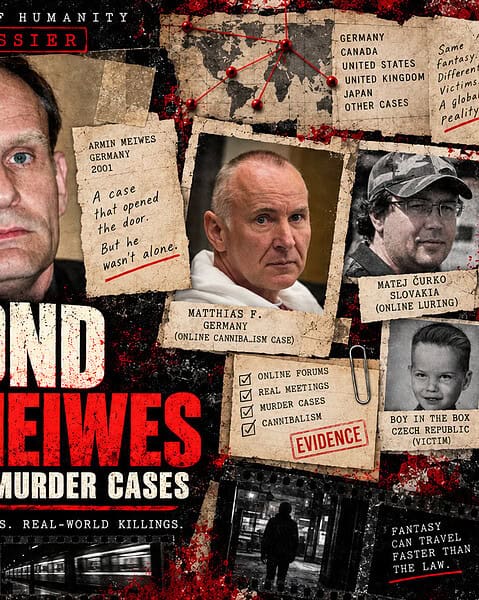
The distinction is especially useful in the European online cannibal murder cases, where the evidence around dismemberment, postmortem mutilation, and actual consumption does not always align. A case can contain one of those behaviors without proving the others.
Sexual Homicide
A dismembered body does not prove sexual sadism or make a homicide sexual. Sexual motive requires evidence from the offense sequence, bodily treatment, offender behavior, communications, fantasy material, or other independent sources.
This is why the phrase “offensive dismemberment” should not be treated as a synonym for sexual homicide. Expressive mutilation can include anger, symbolism, trophy-taking, or other motives that are not sexual.
Real Cases Show Why Context Matters More Than the Cut Pattern
Leslie Mahaffy
In the Paul Bernardo and Karla Homolka case, Leslie Mahaffy’s remains were dismembered and disposed of in concrete blocks. The example is relevant to defensive or instrumental disposal because the body treatment formed part of concealment after homicide.
It should not be used to imply that defensive dismemberment is inherently sexual. The wider case involved sexual violence, but the disposal function must still be analyzed separately from the sexual offenses. See the Bernardo and Homolka dossier.
Benjamin J. Beale Case
A modern New Orleans case involving homicide, dismemberment, and concealed remains in a freezer illustrates how body fragmentation can become part of a practical concealment problem. The investigative value lies in the combination of location, storage, identity, and physical evidence rather than in assigning an offender type from the dismemberment alone.
See the Benjamin J. Beale case file for the case-specific record.
Edmund Kemper
The Edmund Kemper record combines decapitation, dismemberment, postmortem sexual behavior, and dispersal of remains. It demonstrates why one offender can exhibit more than one function of body treatment and why a single category may fail to explain the entire sequence.
Kemper is therefore more useful as a boundary case than as a prototype. The Edmund Kemper evidence dossier separates the physical record from confession-dependent and postmortem behavior.
Myths About Criminal Dismemberment
| Claim | Evidence-Based Correction |
|---|---|
| Myth Dismemberment proves sexual sadism. | No. Defensive disposal is frequently the dominant category. Sexual motive exists in some cases but cannot be inferred from fragmentation alone. |
| Myth Joint disarticulation identifies a surgeon or butcher. | No. The Kraków sample included joint separation by people from multiple unrelated occupations. |
| Myth A dismembered body means the cutting happened after death. | No. Aggressive dismemberment includes fatal decapitation or other removal that causes death. |
| Myth A neat cut proves expertise. | No single cut surface is an occupational fingerprint. Toolmarks, false starts, joint anatomy, scene logistics, and corroborating evidence matter. |
| Myth The killer is probably someone the victim knew. | Known-person relationships were common in solved Kraków cases, but that statistic is vulnerable to clearance bias and cannot identify an unknown offender. |
| Myth Dismemberment indicates severe mental illness. | No. Psychiatric findings are mixed across studies. The behavior cannot diagnose psychosis, psychopathy, or another disorder. |
| Myth Dismemberment and cannibalism are basically the same behavior. | No. They may coexist, but fragmentation, disposal, and consumption require separate evidence and may serve entirely different functions. |
Criminal Dismemberment FAQ
Why do murderers dismember bodies?
The most common reason in several forensic case series is practical concealment: making a body easier to transport, hide, disperse, or separate from a homicide scene. Other cases involve aggression, sexualized behavior, symbolism, trophy-taking, or fatal removal, so no single motive applies to every case.
What is defensive dismemberment?
Defensive dismemberment is a descriptive forensic category in which fragmentation primarily serves concealment, transport, disposal, or identification avoidance. “Defensive” does not mean lawful self-defense; it refers to the offender trying to protect themselves from detection.
What is offensive dismemberment?
Offensive dismemberment refers to body alteration that appears expressive rather than merely practical. It may involve aggression, sexualized treatment, symbolism, or trophy-taking, but the category still requires case context and should not be used as a diagnosis.
What is aggressive dismemberment?
Aggressive dismemberment occurs when the removal itself causes death, such as fatal decapitation. This category is important because a body recovered in parts should not automatically be described as having been dismembered after death.
Does dismemberment always happen after death?
No. Some cases involve postmortem body cutting, but others involve fatal decapitation or another severing injury that contributes directly to death. Forensic pathology must establish sequence rather than assume it from the final condition of the body.
Does dismemberment mean the killer had medical training?
No. The Kraków and Hamburg research shows frequent use of ordinary household tools, and joint separation has been performed by offenders from unrelated occupations. Anatomical familiarity may be one hypothesis, but the cut pattern alone cannot identify a profession.
Can forensic pathologists tell what tool was used?
They can often describe a likely tool class and compare cut or saw marks with candidate instruments, especially when good surfaces survive. Exact individualization may be difficult, and conclusions are strongest when toolmarks are combined with recovered tools, trace evidence, and scene context.
Can dismemberment hide the cause of death?
Yes. Fragmentation can destroy or remove critical anatomy, and decomposition can compound the problem. In the Kraków 30-case series, cause of death was established in 20 examinations and remained indeterminate in ten.
Are dismemberment victims usually known to the killer?
Known-person relationships were very common among solved cases in the Kraków series, where 23 of 25 identified offenders knew the victim. That result should not be treated as a rule for unsolved cases because clearance bias can inflate the proportion of known relationships.
Is dismemberment associated with necrophilia?
It can occur in a case involving necrophilic behavior, but dismemberment alone does not establish sexual interest in corpses. Disposal, concealment, anger, transport, trophy-taking, and other functions must be considered separately.
Is dismemberment a sign of sexual sadism?
No. Some dismemberment occurs in sexual homicide or sadistic violence, but the research shows that practical defensive disposal is common. Sexual motive requires evidence beyond the mere fact that the body was fragmented.
Can investigators identify a body after dismemberment?
Often yes. DNA, fingerprints, dental records, radiology, anthropology, distinctive medical features, and fragment reassociation can restore identity, although fragmentation and decomposition can make the work slower and more complex.
Is dismemberment the same as cannibalism?
No. Dismemberment is body division or removal, while cannibalism involves consumption of human tissue. The two behaviors can occur together, but each requires its own evidence and can serve a different purpose.
What is the strongest forensic lesson from the Kraków study?
Criminal dismemberment is best treated as a behavior that must be reconstructed, not as a psychological fingerprint. Concealment is common, ordinary tools predominate, cause-of-death evidence can be destroyed, and apparent cutting skill cannot reliably identify an offender’s occupation.
The Strongest Conclusion
Criminal Dismemberment Is a Behavior, Not a Psychological Fingerprint
Across the strongest comparative studies, practical disposal is common but not universal, and identified offenders are often known to victims. Ordinary household tools predominate, apparent anatomical skill does not reliably reveal occupation, psychiatric findings are inconsistent, and fragmentation frequently makes cause-of-death and identification work harder.
These findings can structure an investigation by identifying questions about sequence, transport, tool use, scene access, victim relationships, and evidence loss. They cannot replace physical evidence, legal proof, or case-specific reconstruction, and they should not be used to convert a cutting pattern into a diagnosis or a profession.
Source Ledger
Konopka et al., 2016
Thirty criminal dismemberment examinations from the Kraków Department of Forensic Medicine, 1965-2015. Core source for motive classification, tool use, relationship patterns, cause-of-death limits, and scene findings.
Open full studyKonopka et al., 2007
Earlier 23-case regional series covering 1968-2005. It is useful for the research lineage but should not be cited as the source of the later 30-case dataset.
Open PubMed recordGuggenheimer et al., 2021
Nationwide Swedish study of 43 mutilation homicides, finding 70% defensive and 30% offensive classifications and substantial cause-of-death uncertainty.
Open PubMed recordWilke-Schalhorst et al., 2019
Fifty-one corpse-dismemberment cases examined in Hamburg over 57 years, useful for disposal logistics, tool use, and the defensive versus offensive distinction.
Open PubMed recordHäkkänen-Nyholm et al., 2009
Finnish comparison study of homicide offenders with and without mutilation. The small mutilation subsample showed more psychiatric and developmental problems, but no significant association with psychopathy or substance abuse.
Open Helsinki research recordMaiese et al., 2020
Case-series protocol integrating post-mortem CT, autopsy, toxicology, histology, immunohistochemistry, and genetics to reconstruct fragmented remains.
Open PubMed recordBaldino et al., 2023
Systematic review and procedural proposal for complex bodies, supporting multidisciplinary reconstruction rather than reliance on a single sign.
Open full reviewPolish Penal Code
Official consolidated legal text for the jurisdiction represented in the Kraków case series. Legal classification depends on the version of the code in force at the time of the offense.
Open official textNecrosadism vs. Homicidal Necrophilia
Companion forensic explainer showing why postmortem mutilation and dismemberment should not automatically be interpreted as sexually motivated or necrophilic.
Open related dossierWhat Is Necrophilia?
Evidence-based guide separating corpse-focused sexual behavior from disposal, concealment, cannibalism, mutilation, and other postmortem acts.
Open forensic guideKEEP GOING
- Crime Dossier: hub
- What Is Necrophilia? Forensic Profile, related case
- Black Dahlia Autopsy, Elizabeth Short, same format
Discover more from The Dark Side of Humanity
Subscribe to get the latest posts sent to your email.