FILE NO. 0199Case status Unsolved
The Black Dahlia autopsy is frequently distorted by sensationalism and myths. While forensic records confirm Elizabeth Short suffered severe trauma and bisection, they do not identify a specific killer. Evidence suggests the body was moved, indicating the perpetrator had access to a private location and a means of transportation.
Forensic findings regarding anatomical knowledge are often overstated in suspect theories. While the injuries suggest familiarity with anatomy, they do not prove the perpetrator was a medical professional. The autopsy serves as a record of physical evidence rather than a definitive tool for uncovering the killer’s identity or motives.
View the LAPD Autopsy Report.
The Autopsy Beneath the Myth
KEEP GOING
- Crime Dossier: hub
- Ted Bundy Case Study, related case
- David Parker Ray Crime Infographic: same format
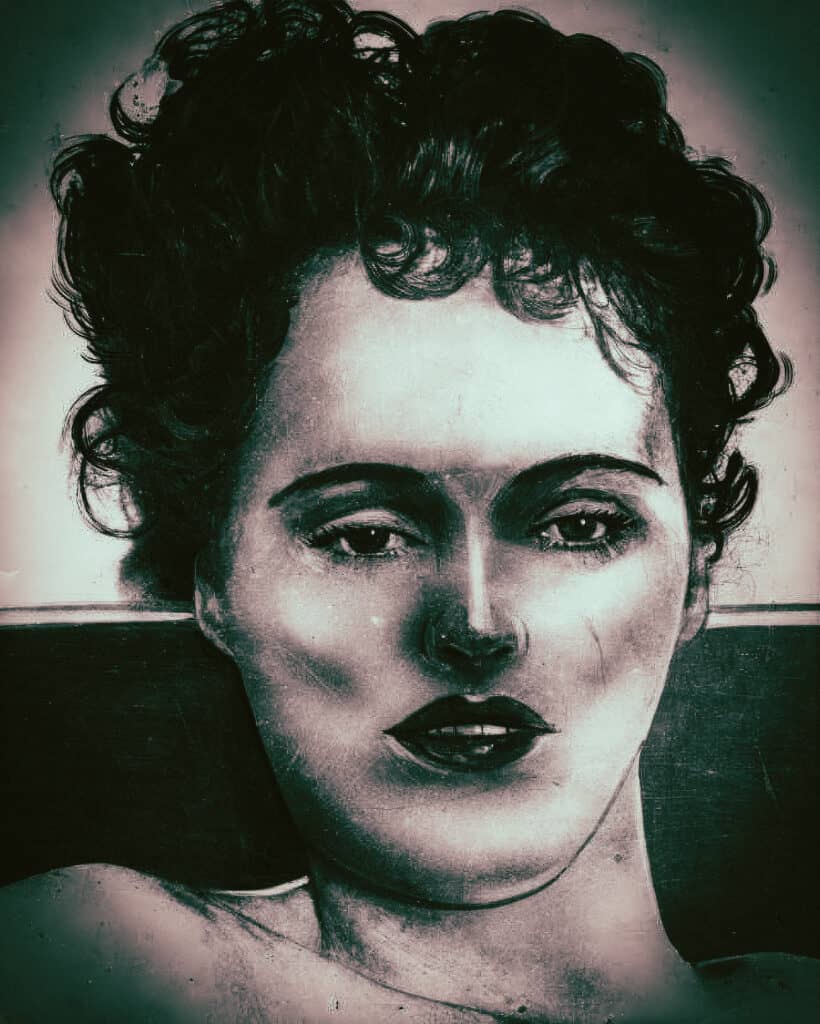
The Black Dahlia autopsy is one of the most searched-for paand most distorted rts of the Elizabeth Short case aThe murder was brutal, but brutality alone has never stopped later writers from adding more. Over the decades, claims about torture, surgical skill, sexual violence, burns, captivity, and staged symbolism have circulated with varying levels of support. Some are grounded in records. Others are extrapolations. Some appear to be pure repetition from sensationalized accounts.
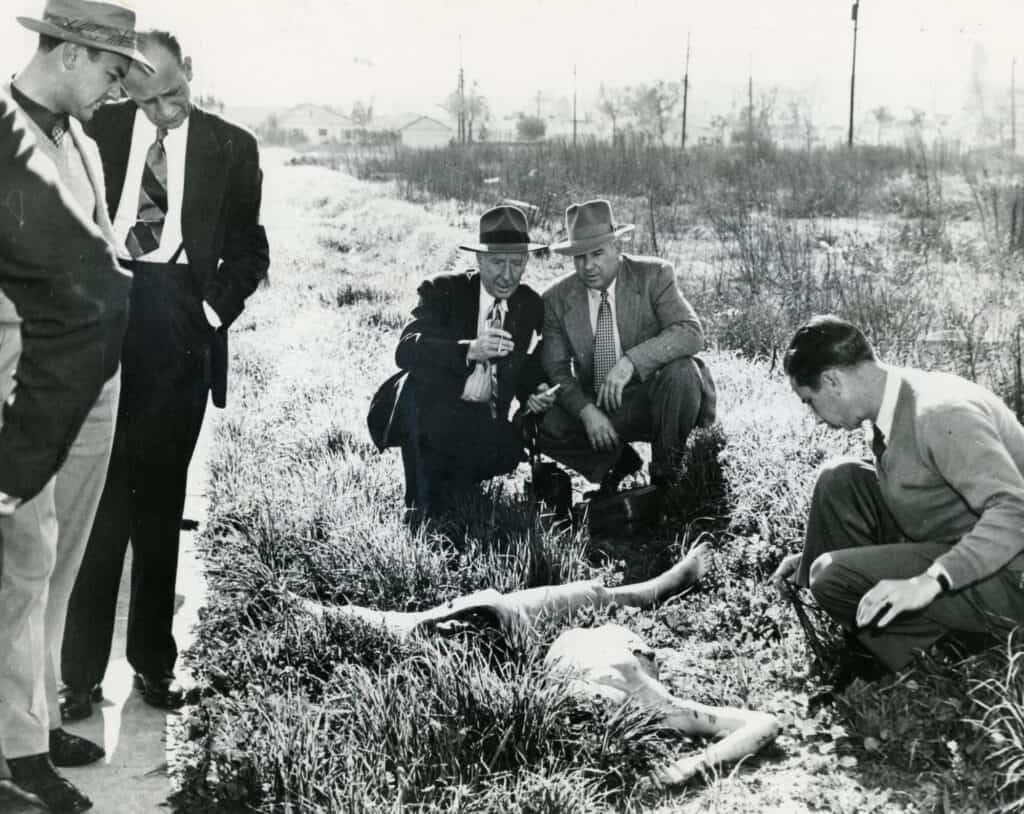
A careful forensic article has to begin with restraint. Elizabeth Short was found dead on January 15, 1947, in a vacant lot near South Norton Avenue in Los Angeles. The FBI’s official case history states that her body was naked, severed at the waist, and found near the sidewalk. The absence of visible blood at the scene suggested she had been killed elsewhere and transported to the location where she was found.
Los Angeles County coroner Dr. Frederick Newbarr performed the autopsy. Public summaries of the autopsy and later case reporting describe severe trauma, including facial lacerations, head injuries, mutilation, and bisection. The death has often been summarized as caused by hemorrhage and shock, with blunt-force trauma also discussed in the case literature. These are serious findings. They do not need decorative horror.
The central question is not whether the Black Dahlia autopsy was disturbing. It was. The question is what it proves.
The Discovery Site Was Probably Not the Murder Scene
The first forensic point is geographic. The vacant lot where Short was found was almost certainly not the full crime scene. The FBI notes that there was no visible blood at the location, which was significant given the condition of the body. If Short had been killed and mutilated there, investigators would have expected a much different physical environment.
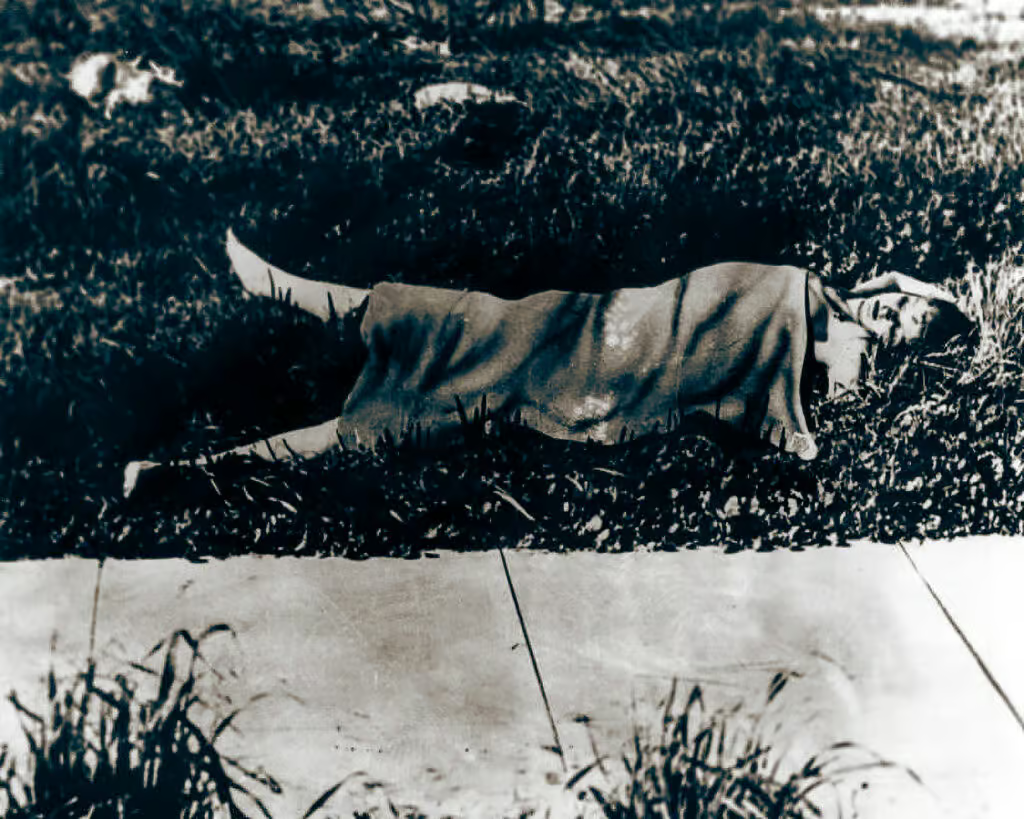
This suggested that Short was killed elsewhere, her body prepared or altered in a separate location, and then moved to the lot. That inference is one of the strongest forensic conclusions in the case. It does not identify the killer, but it narrows the likely behavior. The killer needed access to a private or controlled space, enough time to commit and conceal the violence, and a means of transporting the body to South Norton Avenue.
The lack of a confirmed primary murder scene remains a major reason the case was never solved. A primary scene could have yielded blood patterns, fingerprints, trace evidence, tool marks, vehicle evidence, or witness statements. Instead, detectives had a display site. The killer left the result, not the location where the full crime occurred.
What “Severed at the Waist” Means Investigatively
The bisection of Short’s body became one of the case’s defining facts. It also became the basis for one of the most repeated theories: that the killer had medical knowledge. Investigators did consider that possibility. The FBI’s case history notes that police explored leads involving medical students, and later accounts have often connected the nature of the bisection to anatomical familiarity.
But the inference has limits. A body severed with apparent anatomical knowledge may suggest training, experience, study, or unusual familiarity with human anatomy. It does not prove the killer was a doctor. It does not prove the killer was a surgeon. It does not prove a specific named suspect. The evidentiary distance between “possible anatomical knowledge” and “this person committed murder” is enormous.
This is where many Black Dahlia theories overreach. They take a forensic observation and treat it as a fingerprint. It is not. It is a behavioral and anatomical clue. It may help shape a suspect profile, but it cannot stand alone.
Facial Injuries and Public Misinterpretation
Short’s facial injuries are among the most commonly discussed autopsy details. Public accounts describe deep cuts extending from the corners of the mouth, a mutilation sometimes referred to in later crime writing as a “Glasgow smile.” That phrase may be familiar to readers, but it risks importing later cultural meanings into a 1947 homicide. A clearer description is better: Short suffered severe facial lacerations.
Those injuries mattered because they indicated deliberate disfigurement. They also intensified the public shock when newspapers covered the case. But again, a responsible article has to stop where the record stops. Facial mutilation does not prove a motive. It does not prove symbolic intent. It does not reveal what the killer thought. It shows what the killer did.
True-crime writing often fails at this point by turning bodily injury into imagined psychology. In the Black Dahlia case, that temptation is especially strong because the murder appears staged and theatrical. But “appears” is not proof. The body’s placement and condition demonstrate intentional postmortem handling. They do not allow us to read the killer’s mind.
Cause of Death, Manner of Death, and Mechanism
The Black Dahlia autopsy is often discussed loosely, with cause, manner, and mechanism of death blurred together. These terms should be kept separate.
The manner of death was homicide. The cause of death has been reported in public summaries as hemorrhage and shock associated with her injuries, with head trauma also described. Mechanism refers to the physiological process by which the injuries caused death, such as blood loss or trauma-related shock. The distinction matters because a victim may have many injuries, but not all injuries are fatal and not all were necessarily inflicted before death.
Some injuries to Short’s body were postmortem. That means they occurred after death. Others may have occurred while she was alive. The precise sequencing is an important forensic question, but many public retellings flatten it into a single scene of torture. Where the accessible record does not support exact timing, the article should not pretend certainty.
What the Autopsy Does Not Prove
The autopsy does not prove the killer’s name. It does not prove a motive. It does not prove the killer was a physician. It does not prove every sensational claim repeated online. It does not establish a courtroom case against George Hodel, Robert Manley, Leslie Dillon, Mark Hansen, or any other named suspect.
It also does not prove the elaborate symbolic interpretations sometimes attached to the body. Some writers argue that the positioning or mutilation had ritual, artistic, sexual, or personal meaning. Those interpretations may be discussed as theories if attributed as such, but they should not be presented as established forensic conclusions.
The autopsy proves a violent homicide, postmortem mutilation, probable movement of the body, and the likelihood that the public discovery site was not the primary murder scene. That is already significant. It is also the limit.
The Problem With Online Autopsy Claims
Search interest in the Black Dahlia autopsy is high partly because readers are looking for graphic details. That interest carries editorial risk. A page about it can easily become exploitative if it treats Short’s injuries as a spectacle.
The better approach is myth correction. Readers searching the autopsy should leave with a clearer understanding of what the evidence supports, what remains disputed, and why forensic caution matters. That means explaining the discovery site, bisection, facial injuries, cause and manner of death, and the limits of suspect inference. It also means refusing to reproduce unsupported graphic claims merely because they are popular.
This is not sanitizing the case. It is disciplining it.
Medical Knowledge and Suspect Theories
The medical-knowledge theory has shaped the case for decades. It is one reason doctors and medically adjacent suspects attract attention. George Hodel, a physician, remains the most famous example because later books and media connected him to the murder through circumstantial arguments and family claims. But the autopsy itself cannot convict him or anyone else.
A useful comparison is tool evidence. If a homicide victim is killed with a specialized tool, investigators may look for people with access to that tool. But access is not guilt. Similarly, if Short’s injuries suggest anatomical familiarity, investigators may look at people with medical, mortuary, or butchering experience. But that experience is only one possible lead among many.
The case was never solved because the leads did not become courtroom-proof. The autopsy gave investigators information. It did not give them an identity.
Why the Autopsy Still Matters
The Black Dahlia autopsy remains important because it is one of the few parts of the case grounded in physical evidence rather than rumor. The missing week is uncertain. Many suspect theories are contested. Newspaper coverage was often sensational. But the condition of Short’s body and the circumstances of its discovery are central facts.
Those facts tell us that the killer had access to a private location, moved the body, and left it where it would be found. They tell us the murder involved severe violence and postmortem handling. They tell us the public narrative quickly became more lurid than the forensic record alone required.
They also tell us something about the ethics of writing the case. Elizabeth Short’s body became a media object almost immediately. A modern article should not repeat that harm by treating the autopsy as a catalog of horrors. It should explain the evidence because the evidence matters, and it should stop when explanation becomes voyeurism.
The Responsible Conclusion
The Black Dahlia autopsy does not solve the Black Dahlia murder. It clarifies the boundaries of the unknown. Elizabeth Short was murdered, mutilated, moved, and displayed. The discovery site was probably not where she died. The injuries led investigators to consider anatomical knowledge, but no suspect was ever convicted. Many later claims go beyond what the accessible record can responsibly support.
That is the cold truth beneath decades of distortion. The autopsy is not a key that unlocks the killer’s name. It is a record of what was done to Elizabeth Short and a warning about what happens when evidence becomes legend.
Frequently Asked Questions
Who performed the Black Dahlia autopsy?
Los Angeles County coroner Dr. Frederick Newbarr performed Elizabeth Short’s autopsy.
What did the Black Dahlia autopsy show?
Public summaries describe severe trauma, facial lacerations, bisection, and mutilation. The FBI confirms that Short’s body was found severed at the waist and that the lack of visible blood suggested she was killed elsewhere.
Was Elizabeth Short killed where her body was found?
Investigators believed she was likely killed elsewhere because there was no visible blood at the vacant lot where her body was discovered.
Did the autopsy prove the killer was a doctor?
No. The condition of the body led investigators to consider anatomical or medical knowledge, but the autopsy did not prove the killer was a doctor or identify any specific suspect.
What was Elizabeth Short’s cause of death?
Public summaries commonly describe the cause of death as hemorrhage and shock associated with severe injuries, with head trauma also discussed. The manner of death was homicide.
Are all Black Dahlia autopsy claims online reliable?
No. Some graphic claims repeated online are unsupported, exaggerated, or based on sensationalized retellings rather than clearly documented forensic findings.
Sources
Primary and official sources:
- FBI: Black Dahlia official case history
- FBI Vault: Black Dahlia / Elizabeth Short records, Part 1
- FBI Vault: Black Dahlia / Elizabeth Short records, Part 2
Reporting and context:
- Los Angeles Times: He’s challenging decades of victim-blaming the “Black Dahlia”
- Los Angeles Times: Zodiac killer and Black Dahlia theory debate
KEEP GOING
- Crime Dossier: hub
- Ted Bundy Case Study, related case
- David Parker Ray Crime Infographic: same format
Discover more from The Dark Side of Humanity
Subscribe to get the latest posts sent to your email.