FILE NO. 0119Case status Unsolved
Hinterkaifeck
Six people killed on a remote Bavarian farm, four days before anyone looked, and a century of theories. What the police files, the reported autopsy findings, the 1922 press and the 2007 review support, and where they stop.
Unsolved · file closed 1955
No one was ever charged at trial or convicted. Several people were arrested or held and then released. The last formal proceedings, against Anton Gump, were dropped in 1954.123 So this file has no verdict to report. What survives is the investigation record: police and prosecution papers, many of them lost in the Second World War, autopsy findings known only from secondary documents, the press of the time and later historians.245 Every suspect theory below is a theory and is marked that way. Where the sources disagree, on ages, dates, the weapon or the skulls, this file shows the disagreement.
Never identified
More than 100 people were considered over the decades; none was tried23
House no. 27½, Gemeinde Wangen
About 500 m south-west of Gröbern; today in Waidhofen, Lkr. Neuburg-Schrobenhausen13
- V-01Andreas Gruberage 63–64
- V-02Cäzilia Gruberage 70–72
- V-03Viktoria Gabriel, née Gruberage 35
- V-04Cäzilia Gabrielage 6–9
- V-05Josef Gabriel (also Gruber)age 2
- V-06Maria Baumgartnerage 44–45
- Case
- Hinterkaifeck
- File
- A 169/1922
Items in the surviving record
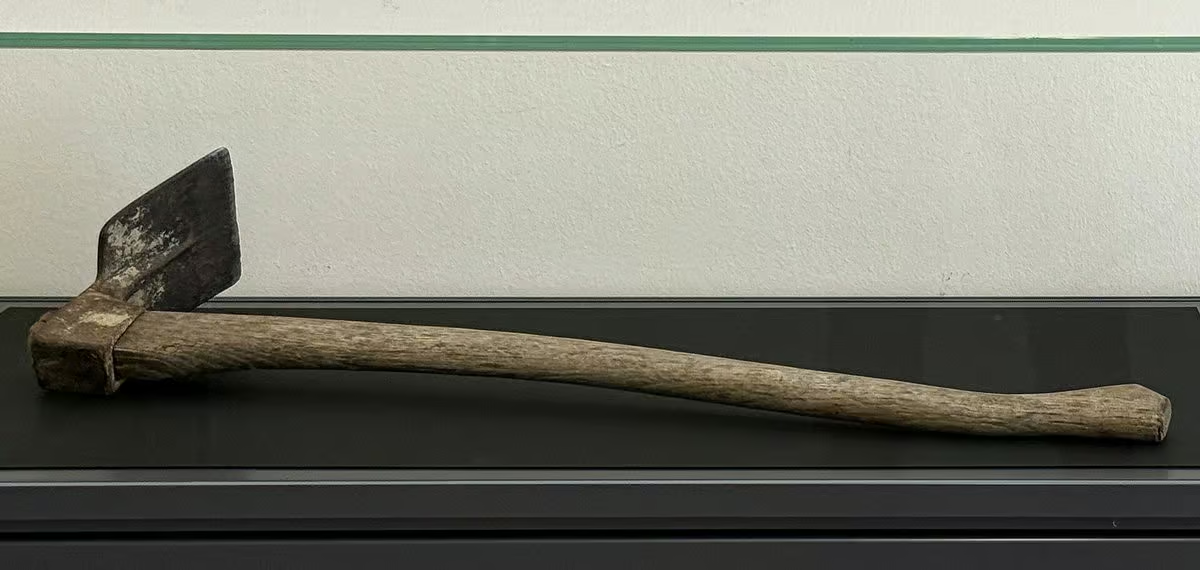
- Reuthaue (grubbing mattock) from the farm’s own tools · found under the attic floor at demolition, 192313
- A “Kreuzhacke” named in the first reports of 19221011
- Roughly 1,800 Goldmark reported found in a cupboard3
- Five scene photographs, 19223
- Schlittenbauer’s statement, 5 Apr. 192212
- No fingerprints taken213
- The victims’ skulls · whereabouts unknown43
SRC: StA Neuburg poster · HLB · press
The Hinterkaifeck murders are unsolved; the investigation was formally closed in 1955.
No one has been charged at trial or convicted. The investigation was formally closed in 1955.24
Physical evidence that could be retested is not known to survive. Many files burned in Augsburg in the Second World War, and the victims’ skulls are lost.24 The Fürstenfeldbruck project leader said in 2012: “Der Tatnachweis ist definitiv nicht mehr zu führen.” (Proof of who did it can definitely no longer be produced.)9
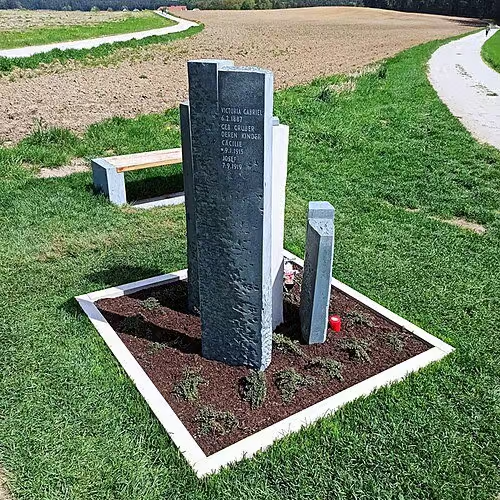
The farm was demolished in 1923. A Marterl stood near the site until 2022, and a new memorial was put up in March 2025.13
No official reopening has been reported in the sources reviewed.
This file describes the killing of six people, two of them small children, with severe head injuries. It summarizes the reported autopsy findings and discusses an incest conviction (1914–15) within the victims’ family. No crime-scene or autopsy photographs are shown. Many details survive only in later statements or transcriptions, and they are labelled that way. German quotations are given in the original with a translation.
What actually happened?
The compressed answer before the mythology takes over
What actually happened?
On the night of 31 March to 1 April 1922, all six people living at Hinterkaifeck, a remote farm about 500 m south-west of Gröbern in Upper Bavaria, were killed with blows to the head.16 Four were found in the barn and two in the house. The killings went unnoticed for four days. Someone fed the animals and ate food in the house during that time.1 Neighbours found the bodies on 4 April. The Munich police, the Neuburg prosecutor and a 100,000-Mark reward produced many suspects but no charge that reached a court, and the file was closed in 1955.62 The murder weapon, a mattock belonging to the farm, turned up under the attic floor when the farm was pulled down in 1923.13 The case is unsolved, and the evidence that might once have solved it is gone.9
Case snapshot
What the record establishes, what it does not, and what should stay separate
Six killed, four days unseen
The 1922 reward poster of the Neuburg prosecutor states the core facts: in the night of 31 March to 1 April 1922 everyone living at the Einödhof Hinterkaifeck, Gemeinde Wangen, Bezirksamt Schrobenhausen, was killed “in bestialischer Weise.”6 The Historisches Lexikon Bayerns adds the four-day gap before discovery, the cared-for livestock and the smoke from the chimney.1
Who, how many, and why
A culprit is not “known”
| Layer | What it covers | Boundary |
|---|---|---|
| Official record | The 1922 prosecutor’s poster, police statements, the memorial card, the archive files cited by historians.6121 | Incomplete. Many files burned in the Second World War and no full autopsy report is known. |
| Reported findings | The autopsy results, known from a telephone note, a prosecutor’s report and statements made in 1953.5 | Second-hand and sometimes contradictory. |
| Press and historians | The 1922 newspapers, the BSB and ÖNB archives, and later journalists and historians.141028 | The 1922 papers got some ages and names wrong. |
| Theory layer | Every suspect, motive and reconstruction. | DISPUTED or unproven. Never stated as fact. |
Who were the key people in the case?
Key-people cards · names and roles from the record
Lorenz Schlittenbauer
- Role
- Farmer and Ortsführer (head) of Gröbern, house no. 20; led the men who found the bodies, 4 Apr. 1922
- Link
- Acknowledged himself as the father of Viktoria Gabriel’s son Josef
- Later
- Named as a suspect for decades (§14, DISPUTED); won slander suits; died 1941
Albert Hofner
- Role
- Mechanic; repaired the motor of the feed-cutter at the farm on 4 Apr. 1922 without seeing anyone
- Why it matters
- His report prompted the search
- Questioned
- First in 1925, by the German Wikipedia account
Michael Pöll · Jakob Sigl
- Role
- Went into the farm with Schlittenbauer on 4 Apr. 1922
Georg Reingruber
- Role
- Kriminaloberinspektor, Munich police; led the investigation from 1922
- Retired
- 28 Feb. 1930; Martin Riedmayer took over in Sept. 1930
Sources 3
Staatsanwaltschaft Neuburg a. D.
- Role
- Ran the case as file A 169/1922; the 1st Staatsanwalt signed the reward poster, 8 Apr. 1922
- Named
- Staatsanwalt Renner reported the autopsy results on 10 Apr. 1922
Dr. Johann Baptist Aumüller
- Role
- Landgerichtsarzt (court physician), Neuburg; performed the autopsies at the farm, 6–7 Apr. 1922
- Record
- No full autopsy report is known to survive
Prof. Hermann Merkel
- Role
- Head of forensic medicine in Munich; informed of the autopsy results; examined the 1922 “Kreuzhacke” and the 1923 Reuthaue
Sources 11
Heinrich Ney
- Role
- Kanzleiassistent present at the autopsies
- Record
- His statements of 1953 are a main source for the autopsy
Sources 5
Peter Leuschner
- Role
- Journalist and author; found the police and justice files in 1977 and wrote three books on the case
- View
- “Es gibt bis heute kein wirkliches Motiv.” (To this day there is no real motive.)
Konrad Müller
- Role
- Retired Kriminalhauptkommissar who investigated privately for decades; gave his files to the Bayerisches Polizeimuseum, Ingolstadt, in 2018
Michaela Forderberg-Zankl
- Role
- Led the 2007 student project at the police college in Fürstenfeldbruck
- Quote
- “Der Tatnachweis ist definitiv nicht mehr zu führen.”
Kurt K. Hieber
- Role
- Made documentaries on the case (from 1991) and a 2009 ZDF docudrama with the Fürstenfeldbruck students
The names of the six victims are on their own cards (§03). No portraits of suspects or witnesses are used. Spellings follow the 1922 documents where they exist; the project leader is spelled Forderberg-Zankl by BR and the Augsburger Allgemeine, Vorderberg-Zankl by German Wikipedia.
The victims
Six people killed in one night: a family of five and a maid who had just arrived
Andreas Gruber
The retired farmer (Austrägler) of the household. He and his daughter Viktoria had been convicted of incest in 1914–15; he served a year in a Zuchthaus.
- Born
- b. 9 Nov. 1858, Greinstetten (memorial card) · 1857 (Marterl)
- Killed
- Night of 31 Mar. – 1 Apr. 1922
- Found
- In the barn (Stadel), with three others, near the door from the stable.
- Outcome
- No one tried
Cäzilia Gruber
Andreas Gruber’s wife. A daughter from her first marriage, Cäzilia Starringer, inherited half the estate in 1922.
- Born
- b. 27 Nov. 1849, Gerolsbach
- Killed
- Night of 31 Mar. – 1 Apr. 1922
- Found
- In the barn, with three others.
- Outcome
- No one tried
Viktoria Gabriel, née Gruber
A widow; her husband Karl Gabriel was killed in France in the First World War. A 1930 report calls her the owner (“Besitzerin”) of the farm.
- Born
- b. 6 Feb. 1887, Gröbern
- Killed
- Night of 31 Mar. – 1 Apr. 1922
- Found
- In the barn, with three others.
- Outcome
- No one tried
Cäzilia Gabriel
Viktoria’s daughter, called Cilli. She was absent from school on 1, 3 and 4 April 1922.
- Born
- b. 1915 (Marterl) · “in her 7th year” (memorial card)
- Killed
- Night of 31 Mar. – 1 Apr. 1922
- Found
- In the barn, with three others. The autopsy is reported to have found that she lived for some time after the blow.
- Outcome
- No one tried
Josef Gabriel (also Gruber)
Viktoria’s son. Schlittenbauer told police he had acknowledged himself as the boy’s father; rumour named Andreas Gruber.
- Born
- b. 1919 (Marterl) · “in his 3rd year” (memorial card)
- Killed
- Night of 31 Mar. – 1 Apr. 1922
- Found
- In the house, in his pram (Stubenwagen) in his mother’s bedroom.
- Outcome
- No one tried
Maria Baumgartner
The new maid (Dienstmagd). Her sister brought her to the farm on the afternoon of 31 March 1922, hours before the killings.
- Born
- b. 1 Oct. 1877, Kühbach
- Killed
- Night of 31 Mar. – 1 Apr. 1922
- Found
- In the house, in the maid’s chamber.
- Outcome
- No one tried
The record behind each card
Each card gives the name and dates the 1922 memorial card gives, what is known of the person’s life, and where the person was found. No victim photographs are used: none with verified rights was found, and each card carries a typographic placeholder. The household’s family history appears in §05 because investigators and later writers made it part of the case, not to explain the killings.
Maria Baumgartner had been at the farm for only a few hours. Any theory has to account for her as well as for the Gruber-Gabriel family.3
The farm and the place
Hinterkaifeck, Gröbern, Wangen, Waidhofen: getting the geography right
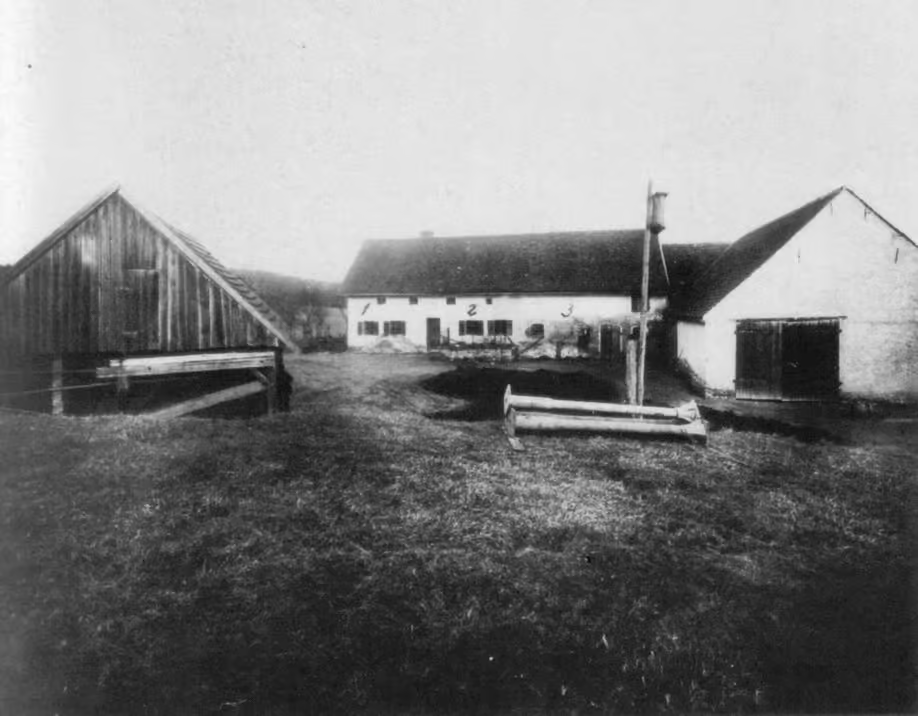
- 1 Maid’s chamber (Magdkammer): Maria Baumgartner found here
- 2 Viktoria Gabriel’s bedroom: Josef found in his pram
- 3 Door from stable to barn: four victims found nearby
- 4 Barn (Stadel)
- 5 Stable (Stall): the animals were fed and milked after the killings
- 6 Attic: hay, hollows, shifted tiles; the mattock under the floor near the chimney (1923)
- 7 Machine house: padlock reported broken before the crime; door open on 1 April
- 8 Bake oven: reported heated in the night after the crime (position approximate)
An Einöde, not a village
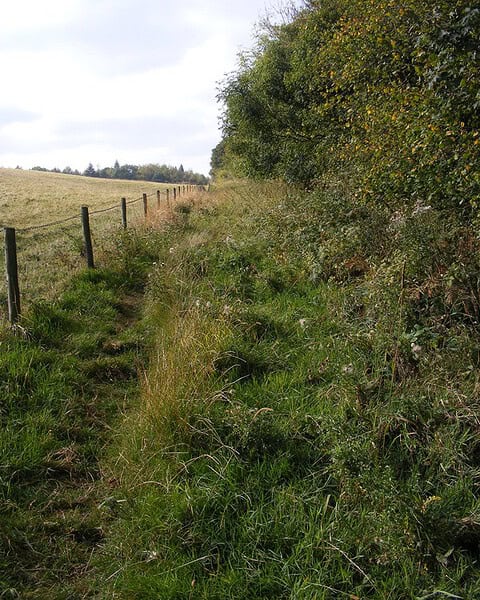
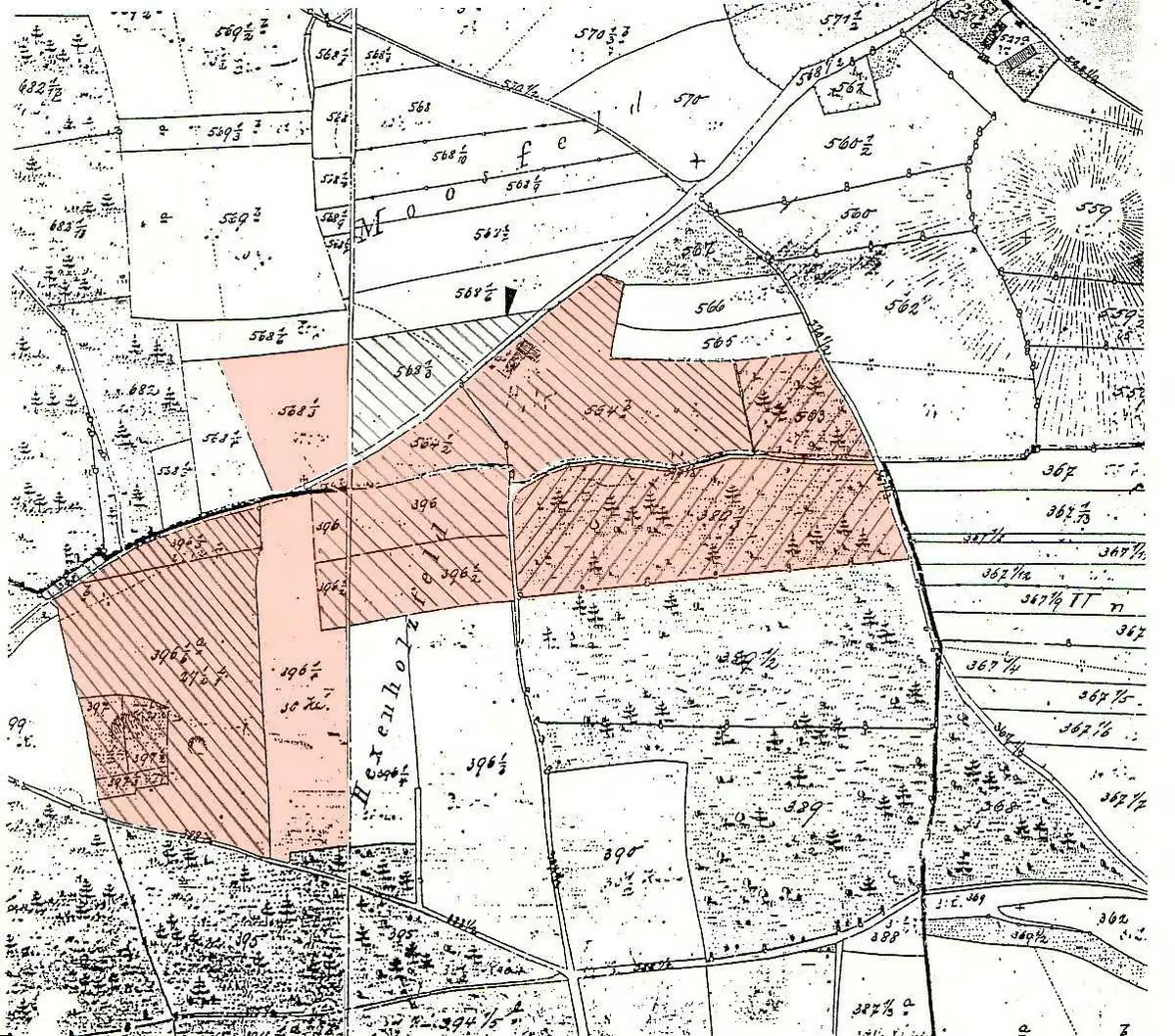
Hinterkaifeck was a single farm on its own (an Einödhof), about 500 m south-west of Gröbern and about 6 km from Schrobenhausen.1 It was officially house no. 27½ of the then Gemeinde Wangen, belonging to Gröbern, and is now in the municipality of Waidhofen, Landkreis Neuburg-Schrobenhausen, Upper Bavaria.3 “Hinterkaifeck” was only a house name. The farm did not belong to the hamlet of Kaifeck, about 1 km to the south.34
House, stable and barn under one roof
The farm was built around 1863. In 1922 it was a long single-storey building with the living quarters and the stable, joined at a right angle by a larger barn, with one high attic running over the whole L.3 The April 1922 photograph below shows the house range and the barn from the south. The farm was pulled down in 1923, and its stones were reused in a neighbouring village.14 The site is now farmland.32
Before the night
Family history, a paternity dispute and the reported warning signs of March 1922
A family history the investigators wrote down
Andreas Gruber and his daughter Viktoria were convicted of incest: he was sentenced to a year in a Zuchthaus and she to a month in prison.93 Viktoria’s husband, Karl Gabriel, was killed as a soldier in France in December 1914.18 After his death Viktoria had a relationship with Lorenz Schlittenbauer, the widowed Ortsführer of Gröbern. He told police on 5 April 1922 that he had acknowledged himself as the father of her two-year-old son.128 The Augsburger Allgemeine reports that Viktoria turned down his proposal of marriage.9
Reported signs before the crime
Later accounts describe a run of strange events in the weeks before the killings. A copy of a Munich newspaper no one nearby subscribed to was found near the farm. Andreas Gruber found footprints in the snow leading to the farm and none leading away. A house key went missing, the padlock on the machine house was broken, and the family heard footsteps in the attic. Gruber is said to have told several people but refused help from neighbours or the police.3 SZ reports that Viktoria and her father said they saw someone watching the farm from the edge of the wood.8
The maid who left
The night of 31 March – 1 April
What the reconstruction supports and where it becomes inference
A new maid arrives
Four people in the barn
The Historisches Lexikon Bayerns summarizes the reconstruction: Andreas and Cäzilia Gruber, Viktoria Gabriel and the girl Cäzilia were probably drawn into the barn one after another and killed there. The killer or killers then went from the barn into the house, where the maid and the little boy were killed.1 The order is a reconstruction from where the bodies lay. One version has Viktoria first, then Cäzilia Gruber, Andreas and the girl.3 Tests later showed that screams from the barn could not be heard in the living quarters.3
A tool from the farm
The killings were done with blows to the head. Later analysis found that the weapon belonged to the farm.133 The victims were covered: the four in the barn under a door, the maid under a bedcover.2 Covering the bodies has been read as a sign that the killer knew them, an interpretation, not a finding (§16).2
Four days unseen
Visitors who saw nothing, a farm that kept running, and what that suggests
Fed animals, eaten bread, smoke
Between the killings and the discovery, the livestock were fed and milked and smoke rose from the chimney. The police later found that the whole stock of bread had been eaten and meat in the larder freshly cut.13 The Historisches Lexikon Bayerns concludes that the killer or killers stayed in the house during those four days.1 German Wikipedia puts it more cautiously: they must have stayed or come back at least once.3
Two figures
Simon Reißländer, a farmer and butcher walking home near Brunnen, later said he saw two strangers at the edge of the wood who turned their faces away.3
The bake oven
Michael Plöckl, a craftsman passing the farm, said he saw the bake oven fired by someone who blinded him with a torch, and that the smoke smelled foul.3
The postman
Josef Mayer, the postman, found the farm apparently deserted.3
Discovery, 4 April 1922
The mechanic, the Ortsführer and a scene disturbed before the police arrived
The search
In Gröbern Hofner told Schlittenbauer’s daughters that the repair was done and that he had seen no one; he also told Georg Greger, the mayor of Wangen.3 Schlittenbauer sent his sons Johann and Josef to look, then went in himself that day with Michael Pöll and Jakob Sigl.13 They found four bodies in the barn and two in the house.8 By his own later account Schlittenbauer went into the house alone and unlocked the front door from inside.3
“Vorgerufen wurde der Lorenz Schlittenbauer”
The police took Schlittenbauer’s statement the next day. The typed record is headed “Kaifeck hinter Gröbern 5.4.22” and “Betreff: Mord an der Bauernfamilie Gabriel hinter Kaifeck bei Gröbern.” In it he says he knew the Grubers and the widow Viktoria Gabriel well, that she had a two-year-old illegitimate child whose father he had acknowledged himself to be, and that on Saturday, 1 April, a coffee seller had come to his farm.12
Gendarmes, then Munich
Gendarmes from the Hohenwart station came first, mainly to keep onlookers away. Munich detectives arrived in the night of 4 April.1 German Wikipedia says Kriminaloberinspektor Georg Reingruber and five officers, two with police dogs, reached Wangen at 1:30 a.m. and went to the farm at 5:30 with the court commission from Schrobenhausen.3
The 1922 investigation
A robbery theory, a reward, a medium and the evidence that was never collected
“Sechsfacher Raubmord”
Four days after the discovery the 1st Staatsanwalt in Neuburg an der Donau put up a poster headed “Sechsfacher Raubmord · 100,000 M. Belohnung!” It offered the reward “für die Ergreifung der Täter oder die sichere Ermöglichung ihrer Ergreifung” (for catching the perpetrators or making their capture certain) and asked for information under file ref. A 169/1922 to the Staatsanwaltschaft Neuburg, the Polizeidirektion München or any Gendarmerie station.6 The Munich press was still calling the case a “Raubmord” weeks later.14
Money left behind
Robbery was the first working motive, so vagrants, hoarders, pedlars and people with criminal records from the area were checked first.1 The theory never fitted well. No one could establish how much money had been on the farm, and a considerable sum was found even though the killers had had time to search.1 German Wikipedia puts it at about 1,800 Goldmark in a cupboard.3 Peter Leuschner: “Die Akten wurden lange unter dem Betreff Raubmord geführt. Aber man weiß, dass es kein Raubmord war, weil nichts geraubt wurde.” (The files were long kept under the heading robbery-murder. But we know it was not one, because nothing was taken.)2
What was not done
Only five photographs were taken at the scene.3 No fingerprints were secured, although that was usual practice in 1922.213 Konrad Müller, the retired detective, said the method had been mature since 1909.9 SZ adds that names were sometimes written down wrongly.8 Some witnesses were not questioned until years later: Hofner in 1925.3
The skulls and a medium
The autopsy findings, as reported
Dr. Aumüller’s examinations, known only from secondary documents
Six autopsies at the farm
All six victims were examined at the farm itself. On Thursday, 6 April, Landgerichtsarzt Dr. Johann Baptist Aumüller of Neuburg examined Cäzilia Gabriel, Cäzilia Gruber and Viktoria Gabriel; on Friday, 7 April, Maria Baumgartner, Josef and Andreas Gruber.5 German Wikipedia says the work was done on a makeshift table in the farmyard.3 No complete autopsy report is known. The findings come from a Munich police telephone note of 7 April, Staatsanwalt Renner’s report of 10 April 1922, and the statements of the court clerk Heinrich Ney in 1953.5
| Victim | Reported findings (summarized) |
|---|---|
| Cäzilia Gabriel | Skull shattered; a neck wound. Aumüller is reported to have said she could have been saved if found in time, and that she died two to three hours after the blow. She had torn out tufts of her own hair.53 |
| Cäzilia Gruber | Several blows to the head, the skull cracked.5 |
| Viktoria Gabriel | Nine star-shaped head wounds; the face smashed. Renner reported that she was not pregnant.5 |
| Andreas Gruber | The right side of the face smashed.5 |
| Maria Baumgartner | Head wounds, including a hole about 4 cm wide at the back of the head.5 |
| Josef | A single blow, through the hood of his pram.5 |
What the documents disagree on
Strangulation marks are reported for one woman, but the documents disagree on which: the telephone note gives them to Cäzilia Gruber, Renner’s report to Viktoria Gabriel. German Wikipedia says the evidence is “nicht eindeutig” (not clear-cut).53 Ney’s 1953 statement speaks of an “11-jährige Viktoria Gabriel,” evidently meaning the girl Cäzilia, which shows how far memory had drifted after 31 years.5
Buried without their heads
The weapon
A pickaxe in 1922, a mattock in 1923, and why the difference matters
The first weapon: a “Kreuzhacke”
The mattock under the attic floor
When the farm was demolished in 1923, the weapon was found hidden in the attic.1 German Wikipedia describes it as a Reuthaue (a grubbing mattock) belonging to Andreas Gruber, hidden under the floorboards near the chimney and found in or after February 1923, when Karl Gabriel senior, the father of Viktoria’s late husband, began pulling the farm down.3 A protruding screw from a makeshift repair is said to match marks in the wounds.3 Merkel examined it in 1923.11 A Reuthaue was shown as the “mutmaßliche Mordwaffe” (presumed murder weapon) at an exhibition in the Bayerisches Hauptstaatsarchiv in March 2026; the Commons record does not say whether it is the original or a reconstruction. The Fürstenfeldbruck students had a replica made.13
A farm tool proves access, not identity
Because the mattock came from the farm, it points to someone who was there and could find it. It doesn’t say who. The hiding place and the screw may have mattered in 1923. Today no one can test it against a person: “Es gibt keine Tatortspuren mehr” (no scene traces remain).9
Timeline
From the farm’s building to the 2026 archive exhibition, dated from the record
Most of the case happened after the murders
The farm is built
An L-shaped house, stable and barn under one attic, on what had been open fields.3
A maid leaves
An earlier maid leaves “fluchtartig,” saying she felt watched.8
Reported warning signs
A stray Munich newspaper, footprints in the snow, a missing key, a broken padlock, footsteps in the attic, by later accounts.3
Discovery
Schlittenbauer, Pöll and Sigl find the bodies; gendarmes and Munich detectives arrive.1
Schlittenbauer’s statement
He describes his ties to the family and the coffee seller’s visit on 1 April.12
Autopsies at the farm
Dr. Aumüller examines the six; the heads are removed.5
Demolition
The farm is pulled down; the mattock is found under the attic floor.1
Karl Gabriel’s death confirmed again
A former NCO of his regiment gives a statement about Gabriel’s death in December 1914.18
Hofner questioned
The mechanic is questioned for the first time, three years on.3
Warrant for Bärtl
The Neuburg prosecutor seeks the escaped asylum patient Josef Bärtl; he is never found.3
Pfleger arrested
Josef Pfleger is held on his daughter’s report and released days later.3
Schlittenbauer dies
He had won several civil suits against people who called him the murderer.3
The Gump proceedings
Anton Gump is held after his sister’s deathbed accusation; the case is dropped in 1954.3
Leuschner finds the files
The journalist Peter Leuschner comes across the police and justice files.2
Last interviews
The last recorded interviews take place.3
New memorial
A new memorial is set up where the Marterl stood.3
Evidence ledger
What each kind of record can establish, and where interpretation starts
| Evidence | What it supports | Limit |
|---|---|---|
| Reward poster, 8 Apr. 1922 | The six victims, the place, the date, the prosecutor’s file reference and the first “Raubmord” framing.6 | Ages were wrong and the motive was assumed. |
| Memorial card, 1922 | Names, birth dates and birthplaces.7 | A devotional print, not a civil register. |
| Schlittenbauer’s statement, 5 Apr. 1922 | His relationship with the family, the paternity, the coffee seller on 1 April.12 | An account by the man who found the bodies and later became a suspect. |
| Autopsy documents | The injuries; the girl’s survival after the blow; the removal of the heads.5 | Second-hand, partly recorded in 1953, and contradictory on strangulation marks. |
| Five scene photographs | How the bodies lay.3 | Not reproduced here. Few, and taken after the scene was disturbed. |
| The Reuthaue | A farm tool used and hidden by someone who knew the attic.13 | Found a year later during demolition; no fingerprints. |
| Witnesses, 1–4 Apr. | Someone was at the farm after the killings.3 | Several statements were taken years later; Hofner’s in 1925. |
| Reported warning signs | Possible entry or watching before the crime.38 | Recounted afterwards; no record made at the time. |
| Money left behind | Weakens a simple robbery motive.1 | How much was on the farm was never established. |
| Brummer statement, 1924 | Karl Gabriel’s death in December 1914.189 | Given ten years later; consistent with other soldiers’ testimony and his grave. |
| Rumour, séances, deathbed claims | Leads that shaped the investigation.13 | Not evidence. None was corroborated. |
| 2007 police-student review | A modern reading of the surviving files.29 | A student project; it names no one and cannot prove anything. |
Suspect theories
Ten theories from the files and the press, all of them unproven
- DISPUTED unproven
- His soldier’s grave in France was found and photographed9
- DISPUTED unproven · contradicted by the record
- A séance is not evidence; sightings never confirmed1
- DISPUTED unproven
- Anton held in custody 1951; proceedings dropped 1954. Adolf died 19443
- No involvement could be shown3
- DISPUTED unproven
- Alibi accepted; the knife was never attributed3
- DISPUTED unproven
- Rieger said Anton knew the farm and the dog never barked at him3
- Followed up; no charge3
- Single-witness suspicion3
- DISPUTED unproven
- Rieger said one questioned her at night about the family and their money3
- No charge3
- Single-witness suspicion3
- DISPUTED unproven
- Josef Betz said Weber spoke of killing the old man for gold, 1919–203
- No charge3
- Second-hand account3
- DISPUTED unproven
A list of suspicions, not a line-up
More than 100 people were considered over the years.3 The ten theories here are those the published sources discuss most. None reached a court, and the investigators of 1922, the prosecutors of the 1950s and the police students of 2007 all stopped short of naming a culprit.12 Popular books and forums often point at one name. That is opinion, and it is presented here as opinion.
The investigation path
Police, prosecutors, courts and reviewers: who handled the case, 1922–2026
- 4 Apr. 1922Gendarmerie HohenwartFirst on the scene; keep onlookers away.1
- 4–5 Apr. 1922Polizeidirektion MünchenReingruber’s team arrives in the night; investigation led from Munich.13
- 6 Apr. 1922Gerichtskommission SchrobenhausenInspection record (Augenscheinprotokoll) of Oberamtsrichter Konrad Wiessner.5
- 6–7 Apr. 1922Landgerichtsarzt, NeuburgDr. Aumüller’s autopsies at the farm.5
- 8 Apr. 1922Staatsanwaltschaft Neuburg a. D.Reward poster, file ref. A 169/1922.6
- 1922 · 1923Forensic medicine, MunichProf. Merkel examines the Kreuzhacke and then the Reuthaue.11
- Aug. 1922ArrestsThe Schreyer brothers are held and released.173
- Jan. 1924Gendarmerie Rottenburg → MunichBrummer’s statement on Karl Gabriel’s death.18
- 1926Staatsanwaltschaft NeuburgArrest warrant for Josef Bärtl.3
- Before 1941Civil courtsSchlittenbauer wins slander suits against people who called him the killer.3
- 1951–1954StaatsanwaltschaftProceedings against Anton Gump; dropped 1954.3
- 1955Investigation closedFormally closed without a charge reaching court.24
- 2007Police college, FürstenfeldbruckStudent case analysis of the surviving files.29
- 2018 · 2026Polizeimuseum · HauptstaatsarchivMüller’s files go to the Ingolstadt police museum; archive exhibition in Munich.36
Why there is no appeal record
Because no one was tried, there is no indictment, verdict or appeal to cite. The legal record consists of the prosecutor’s file, the arrests and releases, and the decision to close the investigation in 1955.62 The only court rulings connected with the case are civil: Schlittenbauer’s slander suits, and the plagiarism suit over the novel Tannöd, which the Landgericht München and the Oberlandesgericht rejected (§20).32
The 2007 Fürstenfeldbruck review
What the police students found, what they declined to say, and why it proves nothing
Fifteen police students and the old files
In 2007 fifteen trainee police officers at the Fachhochschule für öffentliche Verwaltung und Rechtspflege in Bayern, in Fürstenfeldbruck, re-examined the case as a study project, working through the surviving documents again.28 German Wikipedia describes the result as a 188-page report.3 The project was led by Polizeihauptmeisterin Michaela Forderberg-Zankl.2
Sloppy work in 1922, no name in 2007
The students showed how carelessly the case had been investigated: “Nicht einmal Fingerabdrücke wurden genommen, obwohl das 1922 durchaus üblich war.” (Not even fingerprints were taken, although that was quite usual in 1922.)2 Their case analysis concluded that “Auslöser für die Tat war ein persönlicher, emotionaler Konflikt” (the trigger for the crime was a personal, emotional conflict).9 SZ reports their view that with today’s forensic methods the killer or killers would very probably have been caught.8 The report names no murderer. Its June 2007 conclusion, quoted by BR, says that one name “wird immer im Zusammenhang mit diesem mehrfachen Mord von Hinterkaifeck in unseren Köpfen auftauchen” (will always come to mind in connection with this multiple murder).2
“Der Tatnachweis ist definitiv nicht mehr zu führen”
Forderberg-Zankl summed up in 2012: proof of the crime can definitely no longer be produced. “Es gibt keine Tatortspuren mehr. Das ist das Problem.” (There are no scene traces any more. That is the problem.) For the same reason, the Augsburger Allgemeine noted, DNA analysis doesn’t help.9 In 2022 she told BR that the covered bodies suggested the killer knew the victims and wanted to make some kind of amends, an interpretation, not a finding.2
Archives and losses
Which files survive, where the sources place them, and what is gone for good
Staatsarchiv München, Pol. Dir. 8091 b
The Historisches Lexikon Bayerns cites the Hinterkaifeck file as Staatsarchiv München, Polizeidirektion 8091 b, and credits its images of the farm, a police special bulletin and a wanted poster to that file.1 The Augsburger Allgemeine says the files Peter Leuschner used came from the Staatsarchive in Augsburg and Munich and are now online.9 The prosecuting office was the Staatsanwaltschaft Neuburg an der Donau.6
Fire, bombs and missing reports
Copies, a museum and an exhibition
Konrad Müller, a retired Kriminalhauptkommissar who kept investigating on his own, gave his collected files to the Bayerisches Polizeimuseum in Ingolstadt in 2018.3 In 2012 he said it still pained him that his colleagues of 1922 took no fingerprints.9 In March 2026 trainee archivists showed originals at the Bayerisches Hauptstaatsarchiv in Munich, among them the reward poster, the memorial card and the Schlittenbauer and Brummer statements reproduced in §18.671218
Document wall
Archival exhibits: the poster, the memorial card and two police statements
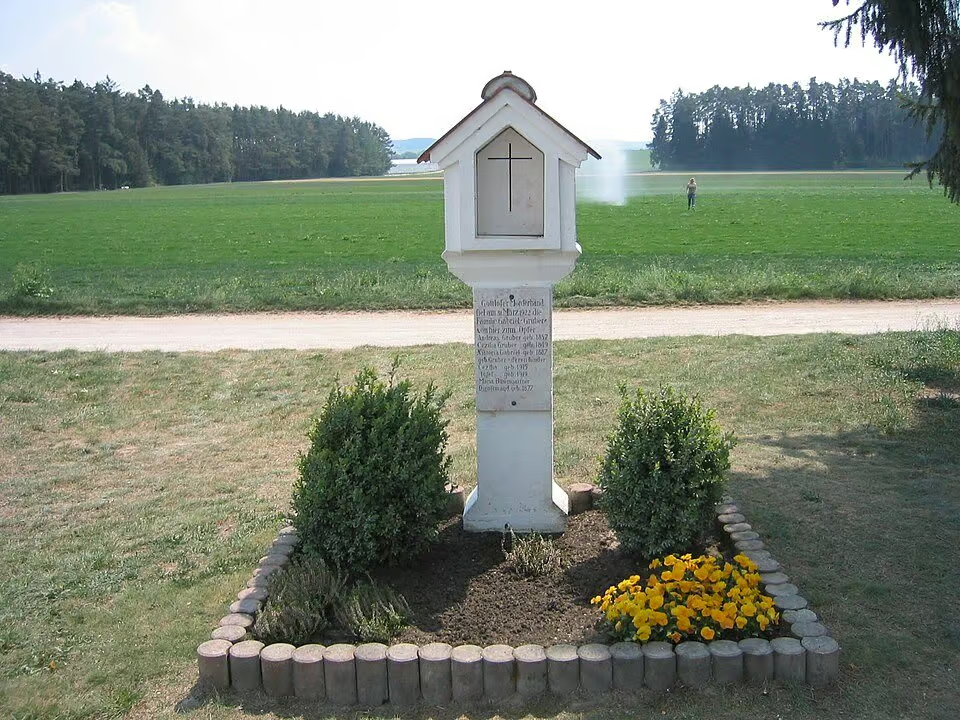
The record, not the spectacle. The pages below are photographs of the 1922–24 originals shown at the Bayerisches Hauptstaatsarchiv in 2026, plus the inscription of the former Marterl. No crime-scene, autopsy or victim photographs are used. Commons also has a 2026 photograph of the exhibited scene photographs, which is deliberately left out.


Myth vs. record
A century of retelling has turned reports into certainties
The killer is known
No. No one was tried, and no court, prosecutor or official review has named a culprit. The 2007 students agreed on an opinion and deliberately withheld it.12
The police secretly solved it
No. The 2007 project was a student study, and its leader said proof “ist definitiv nicht mehr zu führen.”9
Footprints led in and none led out
This is a report attributed to Andreas Gruber by later witnesses, about days before the crime. It isn’t a police finding.3
The killer lived in the attic for days
Unproven. Hollows in the hay and shifted tiles were noted, and have also been read as traces of the incest relationship. Someone was at the farm after the killings, but whether they stayed throughout is unknown.31
It was a robbery-murder
That was the 1922 working theory and the poster’s headline. A considerable sum was found, so most later writers doubt it.612
Karl Gabriel came back from the war
Contradicted. Soldiers testified to his death in December 1914, and his grave in France has been found.189
Modern DNA could solve it
Not without material. The scene traces and the skulls are gone; the AA’s summary is that DNA analysis “hilft nicht weiter.”94
“Tannöd” is a novel
Andrea Maria Schenkel’s 2006 novel transposes the case into fiction. A plagiarism suit by Peter Leuschner was rejected by the Landgericht München and the Oberlandesgericht.2
Memory and afterlife
The Marterl, the memorial, the novel and the tourism
Marterl, grave and a new memorial
A Marterl (wayside shrine) near the site read “Gottloser Mörderhand fiel am 31. März 1922 die Familie Gabriel-Gruber von hier zum Opfer” (by a godless murderer’s hand the Gabriel-Gruber family of this place fell victim on 31 March 1922), followed by the six names.15 It stood until 2022.1 A new memorial was set up at the end of March 2025 where the Marterl had been.3 The victims lie in the cemetery at Waidhofen.4
Novel, films and night walks
The case has been the subject of many books, plays and films: Esther Gronenborn’s film Hinter Kaifeck (2009), Bettina Oberli’s Tannöd (2009), based on Andrea Maria Schenkel’s novel, and Kurt Hieber’s documentaries.1134 SZ noted in 2012 that the crime was being “touristisch ausgeschlachtet” (exploited for tourism), with guided night walks to the site.8 Schlittenbauer’s daughter, Regina Weichselbaumer, told SZ how the suspicion weighed on the family.4
Six people, not a haunted farm
The fame of the case has made the farm a horror brand. The six people killed, among them two children and a woman who had arrived that afternoon, are the reason the case matters. For another unsolved family killing see the Villisca axe murders, and for another European cold case Who put Bella in the Wych Elm?.
Related case files
Other unsolved cases and the site’s case-file series
Hinterkaifeck FAQ
Direct answers, without turning theory into fact
Who killed the Hinterkaifeck family?
No one knows. No one was ever tried or convicted, and no court, prosecutor or official review has named a culprit. More than 100 people were considered as suspects. Every named theory, including those about Lorenz Schlittenbauer, Karl Gabriel, Josef Bärtl and the Gump brothers, remains unproven.12
When did the Hinterkaifeck murders happen?
In the night of 31 March to 1 April 1922. The bodies were found on 4 April 1922.61
Who were the victims?
Andreas Gruber, his wife Cäzilia Gruber, their widowed daughter Viktoria Gabriel, her children Cäzilia and Josef, and the maid Maria Baumgartner, who had arrived that afternoon. The sources give different ages for some of them.67
Where was Hinterkaifeck?
A single farm about 500 metres south-west of Gröbern, house no. 27½ of the then Gemeinde Wangen, near Schrobenhausen in Upper Bavaria. The area is now part of the municipality of Waidhofen, Landkreis Neuburg-Schrobenhausen. The farm was demolished in 1923.13
What was the murder weapon?
A Reuthaue, a grubbing mattock belonging to the farm, found hidden under the attic floor when the farm was demolished in 1923. The first reports in 1922 spoke of a pickaxe.13
Did the killer stay at the farm after the murders?
Someone did. In the four days before the discovery the animals were fed, the bread was eaten and smoke rose from the chimney. Whether one person stayed throughout or someone came back is not known.1
What did the 2007 police review conclude?
Fifteen police students in Fürstenfeldbruck found that the 1922 investigation was badly run and that no fingerprints were taken. They agreed among themselves on a likely culprit but published no name, and their project leader said proof can no longer be produced.29
Can DNA solve the Hinterkaifeck case?
Very unlikely. No scene traces are known to survive and the victims’ skulls are lost, so there is nothing reliable to test.94
Source ledger
Archival originals and the state lexicon first; press and historians second; Wikipedia only as a gateway
“Sechsfacher Raubmord – 100,000 M. Belohnung!”, reward poster of the 1st Staatsanwalt, Neuburg a. D., 8 April 1922, file ref. A 169/1922 (archival original, photographed at the Bayerisches Hauptstaatsarchiv exhibition, 27 March 2026, by Burkhard Mücke, CC BY-SA 4.0)
The Neuburg prosecutor’s reward poster: the victims, the place, the file reference and the reward.
Notes 6
Open source ↗Sterbebild (memorial card) “Gedenket im Gebete der sechs Todesopfer …”, printed by Buchdruckerei Ed. Pollinger, Hohenwart, 1922 (archival original, photographed 27 March 2026 by Burkhard Mücke, CC BY-SA 4.0)
The 1922 memorial card: names, birth dates and birthplaces.
Notes 7
Open source ↗Witness-statement record of Lorenz Schlittenbauer, Ortsführer of Gröbern, headed “Kaifeck hinter Gröbern 5.4.22” (archival original, photographed 27 March 2026 by Burkhard Mücke, CC BY-SA 4.0)
Schlittenbauer’s statement of 5 April 1922.
Notes 12
Open source ↗Statement of Josef Brummer on Karl Gabriel’s death, Gendarmerie-Hauptstation Rottenburg i. Ndb. to the Polizeidirektion München, 25 January 1924 (archival original, photographed 27 March 2026 by Burkhard Mücke, CC BY-SA 4.0)
The 1924 Rottenburg statement on Karl Gabriel’s death.
Notes 18
Open source ↗Christoph Bachmann, “Kriminalfälle (19./20. Jahrhundert)”, Historisches Lexikon Bayerns, published 30 July 2012, section “Hinterkaifeck” (sources: Staatsarchiv München, Polizeidirektion 8091 b)
The Bavarian state historical lexicon: the case summary and the archive signature.
Notes 1
Open source ↗Das Hinterkaifeck-Wiki, “Sachverhalte: Ergebnisse der Obduktion” (transcribed excerpts of the Polizeipräsidium München telephone note of 7 April 1922, Staatsanwalt Renner’s report of 10 April 1922 and Heinrich Ney’s statements of 1953; a volunteer transcription site, not an official archive)
The autopsy findings, as transcribed from the 1922 and 1953 documents.
Notes 5
Open source ↗Das Hinterkaifeck-Wiki, “Ermittler: Merkel Hermann Prof. Dr.” (file references for the 1922 and 1923 weapon examinations)
The weapon examinations of 1922 and 1923.
Notes 11
Open source ↗Münchner Neueste Nachrichten, Abendblatt, 26 April 1922 (“Zum Raubmord in Hinterkaifeck”), digiPress, Bayerische Staatsbibliothek
Munich press, April 1922: still a “Raubmord.”
Notes 14
Open source ↗Münchner Neueste Nachrichten, Morgenblatt, 4 August 1922 (report on the Schreyer arrests), digiPress, Bayerische Staatsbibliothek
Munich press on the August 1922 arrests.
Notes 17
Open source ↗Ingolstädter Anzeiger, Nr. 82, 9 April 1930 (eighth anniversary report), digiPress, Bayerische Staatsbibliothek
The eighth anniversary, 1930.
Notes 16
Open source ↗Salzburger Wacht, 6 April 1922, p. 6, “Sechsfacher Mord” (ANNO, Österreichische Nationalbibliothek; quoted from the German Wikipedia transcription, not re-read for this file)
The first Austrian report, April 1922, as transcribed.
Notes 10
Open source ↗Salzburger Volksblatt, 22 April 1922, p. 6, “Der sechsfache Raubmörder ein Geisteskranker?” (ANNO; quoted from the German Wikipedia transcription, not re-read for this file)
The Bärtl report, April 1922, as transcribed.
Notes 19
Open source ↗Petra Martin, “100 Jahre danach: Der Mordfall von Hinterkaifeck”, BR Heimat (Bayerischer Rundfunk), 28 March 2022
The centenary report: Leuschner, Hieber, the 2007 review.
Notes 2
Open source ↗Manuela Mayr, “Kriminalgeschichte: Hinterkaifeck oder der Reiz des Ungewissen”, Augsburger Allgemeine, 21 March 2012
The 2007 review’s conclusions, Müller and the fingerprints.
Notes 9
Open source ↗Hans Kratzer, “90 Jahre nach der Tat von Hinterkaifeck: Mörderisches Mysterium”, Süddeutsche Zeitung, 30 March 2012
The 90th anniversary: the discovery, the 2007 conclusion, the maid of 1921.
Notes 8
Open source ↗Stefan Mayr, “Mysteriöser Mord 1922: Geheimnis um eine siebte Leiche”, Süddeutsche Zeitung, print 11 March 2009 (online page dated 17 May 2010)
The skulls, the burial and Schlittenbauer’s daughter.
Notes 4
Open source ↗Angelika Kahl, “Der wahre Fall hinter ‘Tannöd’”, Abendzeitung München, 17 November 2009
Hieber’s 2009 docudrama and the Fürstenfeldbruck reconstruction.
Notes 13
Open source ↗Inscription on the former Marterl near Hinterkaifeck, photographed 16 January 2007 by Christian Greller (Wikimedia Commons, CC BY 2.0)
The Marterl inscription with the victims’ birth years.
Notes 15
Open source ↗“Hinterkaifeck”, German-language Wikipedia (consulted 30 September 2026 as a gateway to archive-quoted detail; every use is flagged)
Archive-quoted detail not available elsewhere; every use flagged.
Notes 3
Open source ↗“Wie die Polizei heute im Mordfall Hinterkaifeck ermitteln würde”, idowa, 2022 (paywalled; only the teaser was readable)
The 2022 claim about the project leader’s later view; paywalled, not used as fact.
Notes 20
Open source ↗Numbered notes
- Christoph Bachmann, “Kriminalfälle (19./20. Jahrhundert)”, Historisches Lexikon Bayerns, published 30 July 2012, section “Hinterkaifeck” (sources: Staatsarchiv München, Polizeidirektion 8091 b). www.historisches-lexikon-bayerns.de
- Petra Martin, “100 Jahre danach: Der Mordfall von Hinterkaifeck”, BR Heimat (Bayerischer Rundfunk), 28 March 2022. www.br.de
- “Hinterkaifeck”, German-language Wikipedia (consulted 30 September 2026 as a gateway to archive-quoted detail; every use is flagged). de.wikipedia.org
- Stefan Mayr, “Mysteriöser Mord 1922: Geheimnis um eine siebte Leiche”, Süddeutsche Zeitung, print 11 March 2009 (online page dated 17 May 2010). www.sueddeutsche.de
- Das Hinterkaifeck-Wiki, “Sachverhalte: Ergebnisse der Obduktion” (transcribed excerpts of the Polizeipräsidium München telephone note of 7 April 1922, Staatsanwalt Renner’s report of 10 April 1922 and Heinrich Ney’s statements of 1953; a volunteer transcription site, not an official archive). wiki.hinterkaifeck.net
- “Sechsfacher Raubmord – 100,000 M. Belohnung!”, reward poster of the 1st Staatsanwalt, Neuburg a. D., 8 April 1922, file ref. A 169/1922 (archival original, photographed at the Bayerisches Hauptstaatsarchiv exhibition, 27 March 2026, by Burkhard Mücke, CC BY-SA 4.0). commons.wikimedia.org
- Sterbebild (memorial card) “Gedenket im Gebete der sechs Todesopfer …”, printed by Buchdruckerei Ed. Pollinger, Hohenwart, 1922 (archival original, photographed 27 March 2026 by Burkhard Mücke, CC BY-SA 4.0). commons.wikimedia.org
- Hans Kratzer, “90 Jahre nach der Tat von Hinterkaifeck: Mörderisches Mysterium”, Süddeutsche Zeitung, 30 March 2012. www.sueddeutsche.de
- Manuela Mayr, “Kriminalgeschichte: Hinterkaifeck oder der Reiz des Ungewissen”, Augsburger Allgemeine, 21 March 2012. www.augsburger-allgemeine.de
- Salzburger Wacht, 6 April 1922, p. 6, “Sechsfacher Mord” (ANNO, Österreichische Nationalbibliothek; quoted from the German Wikipedia transcription, not re-read for this file). anno.onb.ac.at
- Das Hinterkaifeck-Wiki, “Ermittler: Merkel Hermann Prof. Dr.” (file references for the 1922 and 1923 weapon examinations). wiki.hinterkaifeck.net
- Witness-statement record of Lorenz Schlittenbauer, Ortsführer of Gröbern, headed “Kaifeck hinter Gröbern 5.4.22” (archival original, photographed 27 March 2026 by Burkhard Mücke, CC BY-SA 4.0). commons.wikimedia.org
- Angelika Kahl, “Der wahre Fall hinter ‘Tannöd’”, Abendzeitung München, 17 November 2009. www.abendzeitung-muenchen.de
- Münchner Neueste Nachrichten, Abendblatt, 26 April 1922 (“Zum Raubmord in Hinterkaifeck”), digiPress, Bayerische Staatsbibliothek. digipress.digitale-sammlungen.de
- Inscription on the former Marterl near Hinterkaifeck, photographed 16 January 2007 by Christian Greller (Wikimedia Commons, CC BY 2.0). commons.wikimedia.org
- Ingolstädter Anzeiger, Nr. 82, 9 April 1930 (eighth anniversary report), digiPress, Bayerische Staatsbibliothek. digipress.digitale-sammlungen.de
- Münchner Neueste Nachrichten, Morgenblatt, 4 August 1922 (report on the Schreyer arrests), digiPress, Bayerische Staatsbibliothek. digipress.digitale-sammlungen.de
- Statement of Josef Brummer on Karl Gabriel’s death, Gendarmerie-Hauptstation Rottenburg i. Ndb. to the Polizeidirektion München, 25 January 1924 (archival original, photographed 27 March 2026 by Burkhard Mücke, CC BY-SA 4.0). commons.wikimedia.org
- Salzburger Volksblatt, 22 April 1922, p. 6, “Der sechsfache Raubmörder ein Geisteskranker?” (ANNO; quoted from the German Wikipedia transcription, not re-read for this file). anno.onb.ac.at
- “Wie die Polizei heute im Mordfall Hinterkaifeck ermitteln würde”, idowa, 2022 (paywalled; only the teaser was readable). www.idowa.de
Browse every case in the Case File Index
Discover more from The Dark Side of Humanity
Subscribe to get the latest posts sent to your email.