The danger of the Order of Nine Angles does not lie in its size alone. By most available accounts, it has never resembled a mass movement, a conventional political party, or a disciplined terrorist command structure. Its threat is stranger than that, and in some ways harder to contain: a body of extremist occult doctrine, a decentralized network of adherents and imitators, and a violent mythos that has travelled through neo-Nazi subcultures, accelerationist spaces, online exploitation networks, and isolated individuals looking for permission to cross moral limits.
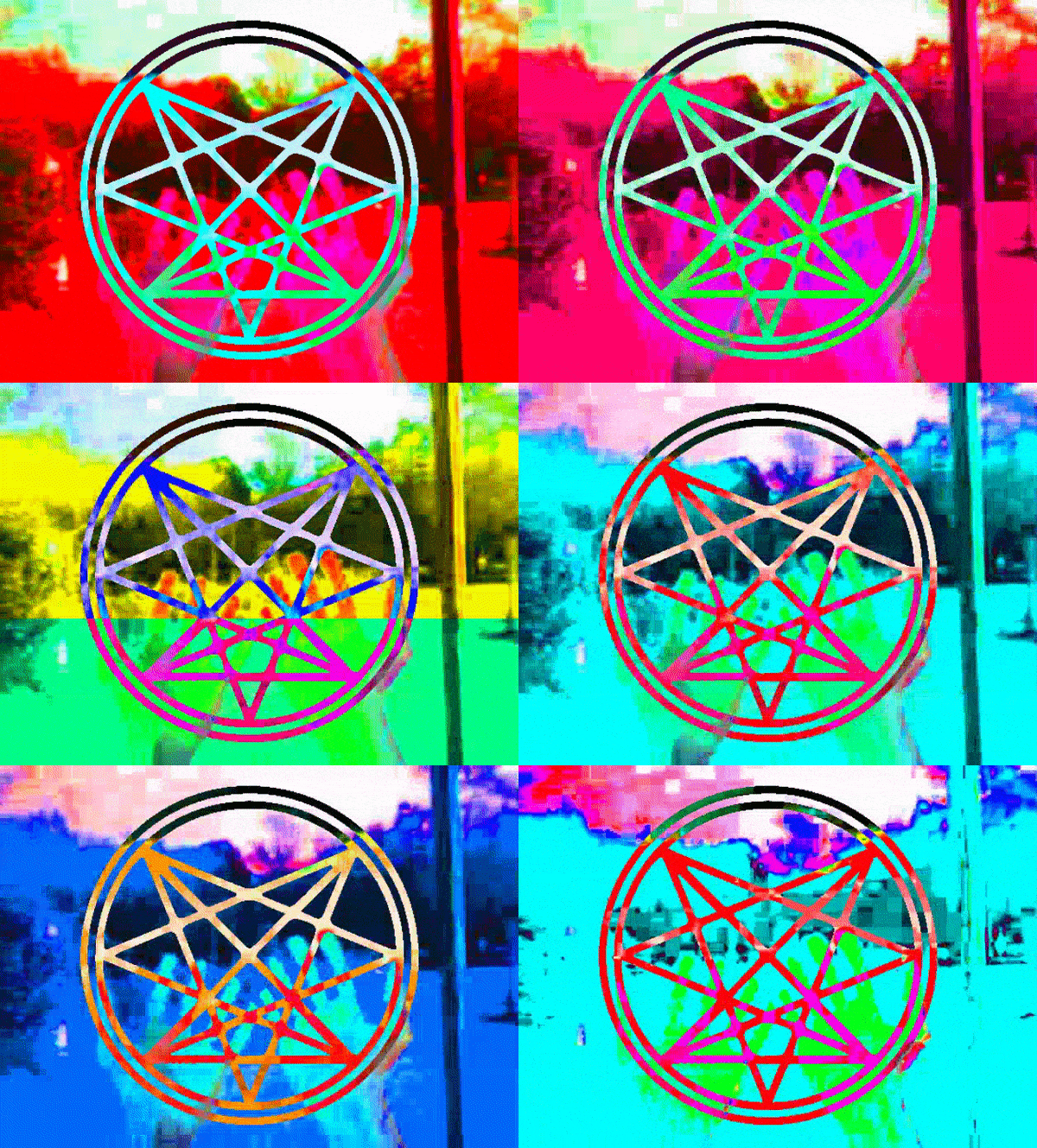
The O9A exists at the intersection of ideology and pathology. Its writings and associated networks have fused Satanic occultism, neo-Nazism, esoteric Hitlerism, social Darwinism, misogyny, antisemitism, nihilism, and an obsession with transgression into a doctrine that treats violence not as a tragic endpoint, but as a form of initiation. That is what makes it more than an obscure occult curiosity. It functions as a radicalization pathway: a way of moving people from alienation, hatred, fantasy, or occult curiosity toward political violence, sexual exploitation, institutional infiltration, and the deliberate pursuit of social collapse.
At a glance, the O9A threat can be understood through several overlapping features:
- It blends neo-Nazi politics with occult and Satanic language.
- It promotes transgression as a method of personal and ideological transformation.
- It encourages deception, infiltration, and boundary-crossing.
- It circulates through decentralized online and offline networks.
- It overlaps with accelerationist extremist spaces.
- It has appeared in terrorism, exploitation, and violent extremist case files.
- It is difficult to disrupt because it functions as both an ideology and a subcultural pathway.
For counter-extremism researchers, the O9A is difficult to classify because it is not simply a single entity. It is not only a Satanist group. It is not only a neo-Nazi tendency. It is not only a cultic milieu, a body of literature, a set of rituals, or a criminal subculture. It is all of these at once, and its ambiguity is part of the problem. The less it looks like a formal organization, the easier it becomes for adherents to deny membership, evade accountability, and present the most extreme elements as fiction, metaphor, provocation, or private religious expression.
That deniability has not made the threat imaginary. The record now links O9A influence, texts, symbolism, or associated ideas to terrorism cases, neo-Nazi networks, online violent extremism, and child exploitation concerns. The group’s own mystique has always depended on secrecy, initiation, and moral inversion. Its modern influence depends on something far more scalable: the internet.
THE ORIGIN STORY WAS DESIGNED TO BE OPAQUE
The Order of Nine Angles emerged from Britain’s occult and far-right fringe in the late 1960s or 1970s, though its exact origins remain contested. The group’s own accounts have described a lineage rooted in secretive pre-Christian traditions in the Welsh Marches, but outside researchers have generally treated that mythology with caution. Like many extremist occult movements, the O9A has used origin stories not merely to explain itself, but to create an aura of antiquity, hidden authority, and inherited power.
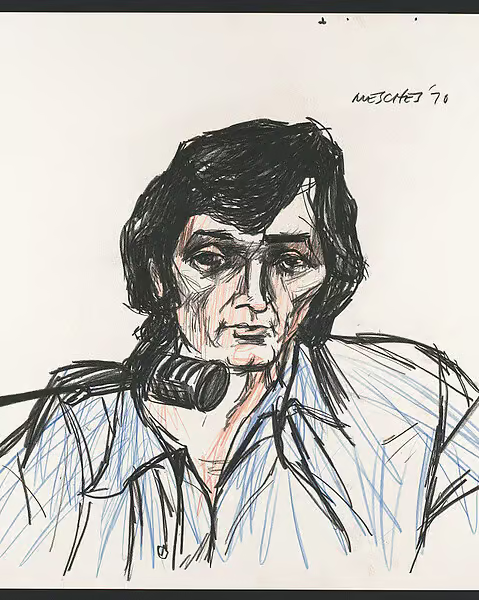
The name most often associated with the O9A is “Anton Long,” a pseudonymous figure credited with shaping much of the group’s doctrine and writings. Many scholars, journalists, and anti-fascist researchers have linked Anton Long to David Myatt, a British extremist with a long history in neo-Nazi politics. Myatt has denied being Anton Long, and the question remains disputed. The uncertainty matters because it reflects a broader pattern: O9A identity has often been less about clear authorship and more about strategic obscurity.
Several points should remain clear when discussing the group’s origins:
- The O9A’s claimed ancient lineage should not be treated as established fact.
- “Anton Long” remains a disputed identity.
- David Myatt is widely discussed in relation to the O9A, but he has denied being Anton Long.
- The uncertainty around authorship has helped preserve the group’s mystique.
- The movement’s ambiguity is not incidental; it is part of how it protects itself.
That obscurity has served the movement well. If Anton Long were a single person, the pseudonym would create distance between the author and the ideology. If the name functioned as a collective mask, it helped make doctrine more durable than any single individual. Either way, the ambiguity became part of the brand. The O9A did not simply preach secrecy; it used secrecy as a structural defence.
This is why attempts to understand the O9A through ordinary organizational categories often fall short. It is not best understood only as a group with members, leaders, and chapters. It is also a mythology, a library, a posture, and a set of behavioural instructions that can be adopted by individuals who may never meet a formal leader. That makes the origins important, but not definitive. The greater threat lies in what the O9A became once its ideas entered the extremist bloodstream.
A DOCTRINE BUILT FROM HATRED, OCCULTISM, AND COLLAPSE
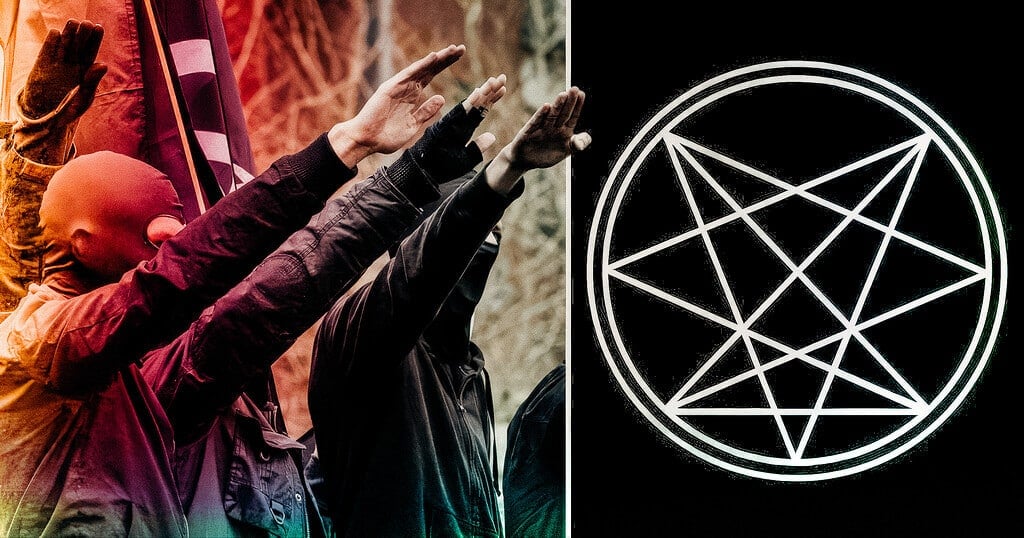
At its core, the O9A presents a toxic synthesis of neo-Nazism, occultism, anti-Christian transgression, racial hierarchy, and contempt for liberal democratic society. Its worldview treats existing moral systems as obstacles to be overcome. Compassion, equality, pluralism, and legal restraint are not merely rejected; they are framed as signs of weakness. Violence becomes a test. Cruelty becomes a method. Domination becomes a form of self-definition.
The group’s ideology draws from several overlapping currents:
- Neo-Nazism: racial hierarchy, antisemitism, authoritarianism, and admiration for Nazi symbolism or mythology.
- Esoteric Hitlerism: the transformation of Nazi ideology into a mystical or quasi-religious worldview.
- Satanic and occult transgression: the rejection of conventional morality as a method of self-transformation.
- Accelerationism: the belief that violence and social destabilization can hasten systemic collapse.
- Social Darwinism: the use of “strength” and “weakness” language to justify domination and cruelty.
- Nihilism: the rejection of ordinary moral limits, often reframed as liberation or initiation.
The group’s ideological universe is heavily shaped by esoteric fascism. Nazism is not treated only as a political programme, but as a mystical or civilizational force. Hitler and the Third Reich are mythologized within a broader fantasy of racial evolution, social purification, and aeonic change. In this framework, history is imagined as a succession of ages, and adherents are encouraged to see themselves as agents of a coming rupture.
That rupture is often described through accelerationist logic. The existing order is not to be reformed; it is to be weakened, destabilized, and pushed toward collapse. The O9A’s “sinister dialectic” frames chaos, violence, and social breakdown as necessary stages in the emergence of a new order. This is where the group intersects with broader neo-Nazi accelerationist milieus, which view terrorism and destabilization as tools to hasten the failure of modern society.
Key ideological concepts include:
- Vindex: an anticipated figure associated with vengeance, rupture, and the destruction of the existing order.
- The sinister dialectic: the idea that conflict, cruelty, and collapse can accelerate historical transformation.
- Insight roles: the practice of entering institutions, movements, or social roles for experience, deception, access, or subversion.
- Culling: the pseudo-spiritual or ideological justification of killing selected victims.
- Transgression: the deliberate violation of moral, social, sexual, legal, or religious boundaries.
- Aeonic change: the belief that civilization moves through vast historical ages that can be shaped through violence and elite action.
The O9A’s emphasis on transgression makes the ideology especially dangerous. Many extremist movements demonize enemies; the O9A goes further by presenting moral violation itself as transformative. Its literature and associated networks have promoted the idea that adherents must cross ethical boundaries to prove themselves. In practical terms, that can mean encouraging violence, abuse, deception, infiltration, or criminality as rites of passage.
This does not make the O9A powerful in a conventional sense. It makes it corrosive. Its ideology is designed to dissolve restraints.
THE NETWORK WITHOUT A CENTRE
The O9A’s structure is often described in terms of “nexions,” small cells or local groupings that operate with significant autonomy. That decentralized model is one of the reasons the movement has proved so difficult for law enforcement and researchers to track. There is no single headquarters to raid, no uniform membership list, no universally recognized leadership council, and no clear line between committed adherent, online propagandist, occult dabbler, ideological borrower, and criminal imitator.
Its structure creates several counter-extremism problems:
- There is no simple chain of command.
- Local cells or “nexions” may operate independently.
- Online adherents may never meet offline members.
- Sympathizers can deny formal membership while spreading the ideology.
- Texts and symbols can circulate without a central publisher.
- O9A ideas can migrate into other extremist networks.
- Law enforcement may struggle to distinguish ideology, affiliation, influence, and operational planning.
This ambiguity benefits the movement. Public-facing sympathizers can deny that the O9A is an organization at all, presenting it instead as a philosophy, tradition, artistic current, or esoteric path. More extreme adherents can meanwhile use the same body of material as justification for violence, exploitation, and subversion. The result is a system in which the public surface and the operational danger do not always look the same.
The concept of “insight roles” is central to this concern. In O9A doctrine, adherents are encouraged to enter institutions, movements, or social roles that may appear contradictory to their beliefs in order to gain experience, access, influence, or tactical advantage. These roles may include involvement in political groups, religious organizations, law enforcement, the military, or other institutions. The point is not honest participation. The point is transformation through deception and, in some interpretations, preparation for subversion.
This doctrine has drawn particular attention because of cases involving military personnel or would-be infiltrators. The danger is not that the O9A commands large numbers of trained operatives. The danger is that its ideology explicitly valorizes infiltration, making it attractive to extremists who already seek weapons training, tactical credibility, or institutional access.
A conventional extremist organization seeks to recruit followers. The O9A model can work differently: it encourages adherents to move outward, embed elsewhere, and carry the ideology into other spaces.
VIOLENCE AS INITIATION
The most disturbing feature of the O9A is its treatment of violence as spiritually or ideologically meaningful. Some O9A texts have promoted the idea of “culling,” a term used to describe the killing of selected victims under a pseudo-spiritual or social Darwinist logic. The concept should be understood plainly: it is an attempt to give murder an ideological and ritual frame.
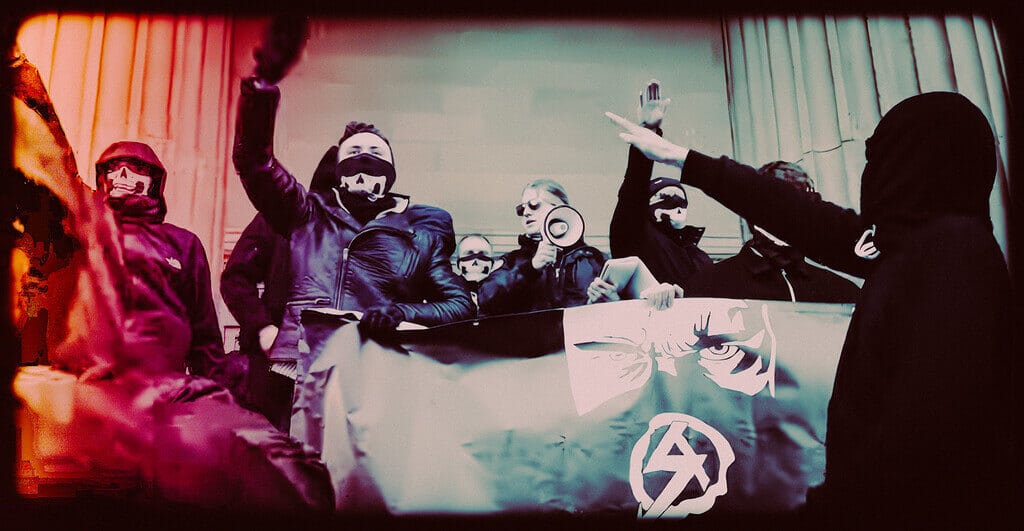
Responsible analysis must be careful here. The existence of violent doctrine does not mean every claimed adherent has committed violence, nor does it prove that every crime associated with O9A material was centrally directed. The movement’s decentralization makes attribution difficult. But the doctrine itself matters because it lowers barriers. It teaches adherents to reinterpret harm as discipline, cruelty as advancement, and the victim as disposable.
The violent elements of O9A doctrine commonly appear around several themes:
- Violence as purification or initiation.
- Murder framed through the language of “culling.”
- Cruelty treated as a test of will.
- Sexual exploitation framed as transgression.
- Deception treated as personal development.
- Terrorism imagined as a catalyst for social collapse.
- Victims dehumanized as weak, disposable, symbolic, or useful.
O9A-linked concern also extends to sexual violence and child exploitation. Counter-extremism and law-enforcement sources have repeatedly noted the presence of sexual abuse advocacy, misogyny, coercion, and child exploitation themes in O9A-adjacent spaces. In recent years, the overlap between extremist ideology and online exploitation networks has become a major concern, especially where minors and vulnerable people are targeted through coercion, blackmail, humiliation, and self-harm demands.
That overlap is not incidental. The O9A’s core ethic of transgression makes it compatible with abusive networks that treat degradation as status. The ideology provides a language for individuals who want to turn harm into identity. In this sense, the O9A does not simply radicalize toward terrorism. It can radicalize toward a broader spectrum of predatory behaviour.
The group’s occult language should not distract from the material danger. Ritual language, Satanic imagery, and esoteric terminology can make the movement appear theatrical or absurd to outsiders. But beneath the theatre is a doctrine that repeatedly points followers toward domination, secrecy, cruelty, and violence.
THE INTERNET MADE THE FRINGE PORTABLE
For years, the O9A remained obscure, circulating through small occult and far-right communities. Its modern relevance depends heavily on digitization. Texts, symbols, memes, manifestos, and references that once required entry into niche subcultures can now be encountered through Telegram channels, encrypted chats, image boards, extremist forums, file-sharing archives, music scenes, and online networks that blend politics, nihilism, occultism, and abuse.
This does not mean the O9A has become a mass movement. It means its material has become portable. A teenager does not need to join a formal lodge to absorb O9A ideas. A neo-Nazi accelerationist does not need to accept the entire occult system to borrow its aesthetics. A violent online network does not need to operate as an O9A cell to adopt its language of transgression, degradation, and elite cruelty.
Common pathways into O9A-adjacent material may include:
- Far-right and neo-Nazi online spaces.
- Accelerationist propaganda channels.
- Extreme occult communities.
- National Socialist black metal and related subcultures.
- Encrypted messaging groups.
- Nihilistic or misanthropic online communities.
- Violent exploitation networks.
- Forums that glorify cruelty, self-harm, or social collapse.
The recruitment pattern is often gradual. Some individuals arrive through occult curiosity. Others come through neo-Nazi politics, black metal subcultures, anti-Christian rebellion, misogynistic forums, accelerationist propaganda, or nihilistic online communities. The O9A’s appeal lies in the way it offers a totalizing explanation for alienation: the world is corrupt, morality is weakness, violence is revelation, and the adherent is part of a hidden elite.
Warning signs of O9A-style radicalization may include:
- Sudden fixation on Nazi-occult imagery.
- Repeated references to “culling,” “Vindex,” “sinister tradition,” or “insight roles.”
- Glorification of cruelty as personal development.
- Obsession with social collapse or accelerationist violence.
- Interest in joining the military or law enforcement for extremist purposes.
- Participation in encrypted extremist or exploitation-focused communities.
- Dehumanizing language toward perceived “weak” people.
- Mixing occult imagery with neo-Nazi or terrorist propaganda.
The O9A does not need to persuade every recruit to follow a coherent doctrine. It only needs to make the next boundary crossing feel meaningful.
FROM IDEOLOGY TO CASE FILES

The O9A’s threat becomes clearest when its ideas appear in criminal and terrorism cases. One of the most significant examples is Ethan Melzer, a former U.S. Army soldier who pleaded guilty to attempting to murder U.S. service members, providing and attempting to provide material support to terrorists, and unlawfully transmitting national defence information. U.S. authorities described him as having sent sensitive military information to members of O9A while plotting an attack against his own unit. In 2023, he was sentenced to 45 years in prison.
The Melzer case illustrates why “insight roles” alarm investigators. It was not merely a matter of extremist belief. It involved institutional access, military information, and an attempt to turn that access against fellow soldiers. The case showed how O9A doctrine could intersect with operational danger, even when the wider network remained decentralized and hard to define.
The case demonstrates several broader risks:
- Extremist ideology can become dangerous when paired with institutional access.
- Military training may be attractive to adherents seeking tactical skills.
- O9A influence can coexist with other extremist propaganda.
- Decentralized networks can still create real-world operational threats.
- The lack of formal hierarchy does not eliminate danger.
The O9A has also appeared in discussions of other violent extremist formations, including neo-Nazi accelerationist groups and online networks that borrow its symbolism or doctrine. The relationship is not always formal. In many cases, influence is diffuse: texts, aesthetics, references, and ideological fragments moving between groups and individuals. That diffusion makes the problem harder to prosecute but easier to spread.
More recently, concern around networks such as 764 has expanded the frame. Researchers and law-enforcement agencies have described violent online communities that target minors and vulnerable people through coercion, exploitation, and self-harm demands. GNET researchers have described 764 as adjacent to the O9A, while the FBI and IC3 have warned about violent online networks that use blackmail and manipulation to coerce victims into sexual exploitation, self-harm, animal cruelty, and suicide-related content.
This is not the old model of extremist recruitment. It is a convergence of ideological radicalization, status-seeking cruelty, online coercion, and predatory abuse. The O9A’s legacy in this environment is not only ideological but also aesthetic and behavioural. It helps create a world in which exploitation is framed as initiation and harm becomes social currency.
THE COUNTER-EXTREMISM PROBLEM
The O9A presents a hard target for law enforcement because it sits across multiple categories. It is religious or quasi-religious in presentation, but political in its fascist commitments. It is ideological, but often criminal in practice. It is decentralized, but still coherent enough to transmit doctrine. It is theatrical, but not harmless. It encourages violence, but often through texts and networks that allow adherents to claim ambiguity.
The main law-enforcement and counter-extremism challenges include:
- Decentralization: no clear command structure or stable membership list.
- Online anonymity: activity often occurs through encrypted or semi-private platforms.
- Plausible deniability: adherents can claim the material is symbolic, fictional, or purely religious.
- Cross-movement contamination: O9A ideas can move into other extremist networks.
- Occult obfuscation: esoteric language can conceal practical violent intent.
- Free expression issues: governments may face legal challenges when responding to extremist belief systems.
- Youth vulnerability: online extremist and exploitation networks can reach minors directly.
- Institutional infiltration concerns: “insite roles” encourage entry into sensitive institutions.
This creates practical challenges. A formal ban may be easier to apply to an organization with leaders, assets, meetings, and membership structures. The O9A is more elusive. Its influence can persist even if a specific cell disappears. Its texts can circulate after websites vanish. Its adherents can deny belonging while continuing to promote its worldview. Its ideas can reappear inside other groups under different names.
Different jurisdictions have responded in different ways. New Zealand designated the Order of Nine Angles as a terrorist entity in December 2025. In the United Kingdom, political and counter-extremism calls to proscribe the O9A have circulated for years, though the official proscription list has instead included other extremist organizations, including related or adjacent violent networks. This uneven legal treatment reflects the difficulty of defining exactly what the O9A is in operational terms.
Effective responses require more than banning a name. They require attention to the pathway itself:
- Identify when O9A material is being used to justify violence or exploitation.
- Treat online coercion and radicalization as overlapping risks.
- Avoid amplifying the group’s mystique.
- Distinguish curiosity from mobilization toward harm.
- Track cross-pollination between occult extremism, neo-Nazism, and accelerationism.
- Support parents, educators, and frontline workers in recognizing warning signs.
- Focus on victim protection, especially where minors are targeted.
Countering it requires more than banning names. It requires understanding pathways. The most important question is often not whether a person holds a membership card, but whether O9A material is functioning as a permission structure for violence, abuse, infiltration, or coercion. Investigators, educators, parents, platform moderators, and frontline practitioners need to recognize the signs without amplifying the mystique.
That is a delicate balance. Overstating the O9A’s power risks making it more attractive to the very people drawn to forbidden identities. Understating it risks missing the way small extremist milieus can produce severe harm. The correct frame is neither panic nor dismissal. The O9A should be treated as a high-risk radicalization ecosystem: small in visible numbers, outsized in influence, and particularly dangerous where it overlaps with violent accelerationism, youth exploitation, and institutional access.
THE REAL THREAT IS THE PATHWAY
The Order of Nine Angles is best understood not only as a group, but as a pathway. It takes existing grievances, fascist fantasies, occult curiosity, misogyny, alienation, and online nihilism, then organizes them around transgression. It tells adherents that the collapse of empathy is enlightenment. It tells them that violence is proof. It tells them that cruelty can make them more than human.
That is the core danger.
The O9A’s mythology may appear bizarre from the outside, but its function is brutally practical. It gives isolated or radicalized individuals a script for moving from. It tells them that cruelty can make them more than human.
That is the core danger.
The O9A’s mythology may appear bizarre from the outside, but its function is brutally practical. It gives isolated or radicalized individuals a script for moving from belief into action. It offers a language for infiltration, exploitation, abuse, and violence. It allows adherents to imagine themselves not as offenders, but as initiates.
The task for counter-extremism is therefore not simply to name the O9A, catalogue its symbols, or debate the identity of Anton Long. Those questions matter, but they do not exhaust the threat. The deeper task is to interrupt the process by which extremist subcultures convert alienation into cruelty and cruelty into status.
The Order of Nine Angles survives in secrecy, ambiguity, and spectacle. Its danger is clearest when the spectacle is stripped away.
Beneath the occult vocabulary is a doctrine of dehumanization. Beneath the mythology is a permission structure. Beneath the ritual language is a simple proposition: that some lives can be treated as material for someone else’s transformation.
That is not mysticism. It is violence wearing a mask.

KEY TAKEAWAYS
- The Order of Nine Angles is best understood as both an extremist occult movement and a radicalization pathway.
- Its ideology fuses neo-Nazism, Satanic occultism, esoteric Hitlerism, social Darwinism, misogyny, nihilism, and accelerationist violence.
- Its decentralized structure makes it difficult to identify, monitor, and disrupt through traditional law-enforcement methods.
- The identity of “Anton Long” remains disputed, though David Myatt is frequently discussed in connection with the pseudonym.
- O9A doctrine encourages transgression, secrecy, infiltration, and violence as forms of ideological or spiritual advancement.
- Its concept of “insight roles” raises concerns about military, law-enforcement, political, and institutional infiltration.
- Its material has influenced or overlapped with violent extremist networks, including neo-Nazi accelerationist spaces.
- Its overlap with online exploitation networks creates a serious child-safety and counter-extremism concern.
- The threat does not depend on a large formal membership; the danger lies in how its ideas travel, mutate, and give permission to harm.
- Effective counter-extremism responses must address the pathway, not only the name.
BIBLIOGRAPHY
- Middlebury Institute of International Studies at Monterey, Center on Terrorism, Extremism, and Counterterrorism. “Dangerous Organizations and Bad Actors: Order of Nine Angles.” Middlebury Institute, September 29, 2023. URL: https://www.middlebury.edu/institute/academics/centers-initiatives/ctec/publications/dangerous-organizations-and-bad-actors-order-nine
- Counter Extremism Project. “Order of Nine Angles.” Counter Extremism Project. URL: https://www.counterextremism.com/supremacy/order-nine-angles
- Gartenstein-Ross, Daveed, Emelie Chace-Donahue, and Thomas Plant. “The Order of Nine Angles: Its Worldview and Connection to Violent Extremism.” Foundation for Defense of Democracies, July 25, 2023. URL: https://www.fdd.org/wp-content/uploads/2023/07/fdd-memo-the-order-of-nine-angles.pdf
- Gartenstein-Ross, Daveed, and Emelie Chace-Donahue. “The Order of Nine Angles: Cosmology, Practice & Movement.” Studies in Conflict & Terrorism. URL: https://ideas.repec.org/a/taf/uterxx/v48y2025i11p1214-1234.html
- Shah, Shanon. “‘Cultic’ Religious Groups: Order of Nine Angles.” Global Network on Extremism and Technology, August 3, 2023. URL: https://gnet-research.org/2023/08/03/cultic-religious-groups-order-of-nine-angles/
- Inform. Cults and Online Violent Extremism. Global Network on Extremism and Technology, 2023. URL: https://gnet-research.org/wp-content/uploads/2023/07/GNET-39-Cults-Online-Violent-Extremism_web.pdf
- Argentino, Marc-André, Barrett Gay, and M.B. Tyler. “764: The Intersection of Terrorism, Violent Extremism, and Child Sexual Exploitation.” Global Network on Extremism and Technology, January 19, 2024. URL: https://gnet-research.org/2024/01/19/764-the-intersection-of-terrorism-violent-extremism-and-child-sexual-exploitation/
- Federal Bureau of Investigation. “Violent Online Networks Target Vulnerable and Underage Populations Across the United States and Around the Globe.” FBI, March 6, 2025. URL: https://www.fbi.gov/investigate/cyber/alerts/2025/violent-online-networks-target-vulnerable-and-underage-populations-across-the-united-states-and-around-the-globe
- Internet Crime Complaint Center. “Violent Online Networks Target Vulnerable and Underage Populations Across the United States and Around the Globe.” IC3, March 6, 2025. URL: https://www.ic3.gov/PSA/2025/PSA250306
- U.S. Department of Justice, Office of Public Affairs. “Former U.S. Army Soldier Sentenced to 45 Years in Prison for Attempting to Murder Fellow Service Members.” U.S. Department of Justice, March 3, 2023. URL: https://www.justice.gov/archives/opa/pr/former-us-army-soldier-sentenced-45-years-prison-attempting-murder-fellow-service-members
- U.S. Attorney’s Office, Southern District of New York. “Former U.S. Army Soldier Sentenced to 45 Years in Prison for Attempting to Murder Fellow Service Members in Deadly Ambush.” U.S. Department of Justice, March 3, 2023. URL: https://www.justice.gov/usao-sdny/pr/former-us-army-soldier-sentenced-45-years-prison-attempting-murder-fellow-service
- U.S. Attorney’s Office, Southern District of New York. “U.S. Army Soldier Pleads Guilty to Attempting to Murder Fellow Service Members in Deadly Ambush.” U.S. Department of Justice, June 24, 2022. URL: https://www.justice.gov/usao-sdny/pr/us-army-soldier-pleads-guilty-attempting-murder-fellow-service-members-deadly-ambush
- Defense Counterintelligence and Security Agency, Center for Development of Security Excellence. “Case Study: Ethan Melzer.” CDSE. URL: https://www.cdse.edu/Portals/124/Documents/casestudies/case-study-melzer.pdf
- New Zealand Gazette. “Designation of Two Terrorist Entities.” New Zealand Gazette, December 10, 2025. URL: https://gazette.govt.nz/notice/id/2025-au7135
- New Zealand Police. “Statements of Cases to Designate Terrorist Entities, December 2025.” New Zealand Police, December 2025. URL: https://www.police.govt.nz/about-us/publication/statements-cases-designate-terrorist-entities-december-2025
- UK Home Office. “Proscribed Terrorist Groups or Organisations.” GOV.UK, updated January 28, 2026. URL: https://www.gov.uk/government/publications/proscribed-terror-groups-or-organisations–2/proscribed-terrorist-groups-or-organisations-accessible-version
- House of Commons Library. “Proscribed Terrorist Organisations.” UK Parliament, April 2026. URL: https://commonslibrary.parliament.uk/research-briefings/sn00815/
- Anti-Defamation League. “764.” ADL. URL: https://www.adl.org/resources/backgrounder/764
- Stanford Center for International Security and Cooperation. “Order of Nine Angles.” Mapping Militants Project. URL: https://mappingmilitants.org/files/group-profiles/order_of_nine_angles.pdf
- Shah, Shanon, Jane Cooper, and Suzanne Newcombe. “Occult Beliefs and the Far Right: The Case of the Order of Nine Angles.” Studies in Conflict & Terrorism, 2023. URL: https://www.tandfonline.com/doi/pdf/10.1080/1057610X.2023.2195065
- Associated Press. “Ex-Army Private Gets 45 Years for Plot Against His Unit.” Associated Press, March 3, 2023. URL: https://apnews.com/article/62b4d21134e10e48de4757ac4b34bbfc
- Stars and Stripes. “Former Soldier Gets 45 Years in Prison for Plotting With Neo-Nazi Group to Kill Other Troops.” Stars and Stripes, March 3, 2023. URL: https://www.stripes.com/theaters/us/2023-03-03/army-soldiers-italy-ambush-paratrooper%C2%A0-9343669.html
Discover more from The Dark Side of Humanity
Subscribe to get the latest posts sent to your email.