FILE NO. 0196Case status Archived
Inside the file
Table of Contents
Sexual sadism disorder is a clinical diagnosis where sexual arousal is derived from another’s suffering. It is distinct from general sexual violence or consensual BDSM. Forensic diagnosis requires extensive evidence beyond a crime scene, including sexual history and clinical interviews, to prove that suffering is a primary erotic stimulus.
The diagnosis should not be conflated with psychopathy or used as a synonym for evil. Accurate assessment is crucial in legal settings to determine risk. Using precise terminology prevents the stigmatization of consensual practices and ensures that psychiatric explanations are applied only when supported by a demonstrated behavioral pattern.
The injuries may be extensive. A victim may have been restrained, humiliated, threatened, assaulted, tortured, or killed. The scene may appear organized around domination. To investigators, prosecutors, and the public, the word sadistic can feel inevitable.
In ordinary language, sadism means cruelty or pleasure in another person’s pain. In forensic psychiatry, sexual sadism disorder is narrower. The physical or psychological suffering of another person must be connected to recurrent and intense sexual arousal. The suffering is not merely incidental to assault, a means of controlling resistance, an expression of anger, or a consequence of excessive force. It is part of what sexually excites the person.
That distinction is easy to state and difficult to prove. A crime scene can document violence. It can support hypotheses about planning, control, duration, and the sequence of acts. It cannot look inside an offender’s sexual response. Diagnosis requires a broader record: admissions, fantasies, recurring behavior, sexual history, digital material, prior offenses, clinical interviews, collateral information, and consideration of competing explanations.
The phrase is also routinely confused with consensual BDSM. That confusion stigmatizes consenting adults and weakens forensic analysis. Consent, distress, impairment, harm, and the role suffering plays in arousal are not peripheral details. They are the boundaries that separate sexual variation, clinical disorder, and crime.
What Sexual Sadism Disorder Means
The Merck Manual’s clinical summary defines sexual sadism as sexual excitement produced by inflicting physical or psychological suffering, including humiliation or terror. Under the DSM-5-TR framework summarized there, sexual sadism disorder requires recurrent and intense arousal expressed through fantasies, urges, or behavior over at least six months. The person must either have acted on those urges with someone who did not consent, or the fantasies and urges must cause clinically significant distress or functional impairment.

The American Psychiatric Association’s broader explanation of paraphilic disorders makes the governing principle clear: an atypical sexual interest is not automatically a mental disorder. Diagnosis depends on distress, impairment, harm, risk of harm, or involvement of unwilling people or people unable to consent. The change from older diagnostic language was deliberate. It sought to prevent every unconventional sexual interest from being treated as a psychiatric illness.
The World Health Organization uses the term coercive sexual sadism disorder in ICD-11. The emphasis on coercion distinguishes the condition from consensual behavior between adults. ICD-11’s clinical descriptions focus on a persistent pattern of arousal involving the physical or psychological suffering of a non-consenting person, demonstrated through sustained fantasies, urges, or behavior. A single episode of cruelty does not, by itself, establish that pattern.
These systems do not perfectly mirror each other, and clinicians should use the classification required in their jurisdiction. Both nevertheless make two points that true-crime writing often loses. Sexual sadism is not simply severe violence. Sexual sadism disorder is not a synonym for evil, psychopathy, rape, or homicide.
Consensual BDSM Is Not the Same Thing
BDSM includes a broad range of consensual practices involving bondage and discipline, dominance and submission, or sadism and masochism. Some activities use simulated restraint, pain, humiliation, or power exchange. The resemblance in language does not make consensual BDSM equivalent to coercive sexual sadism.
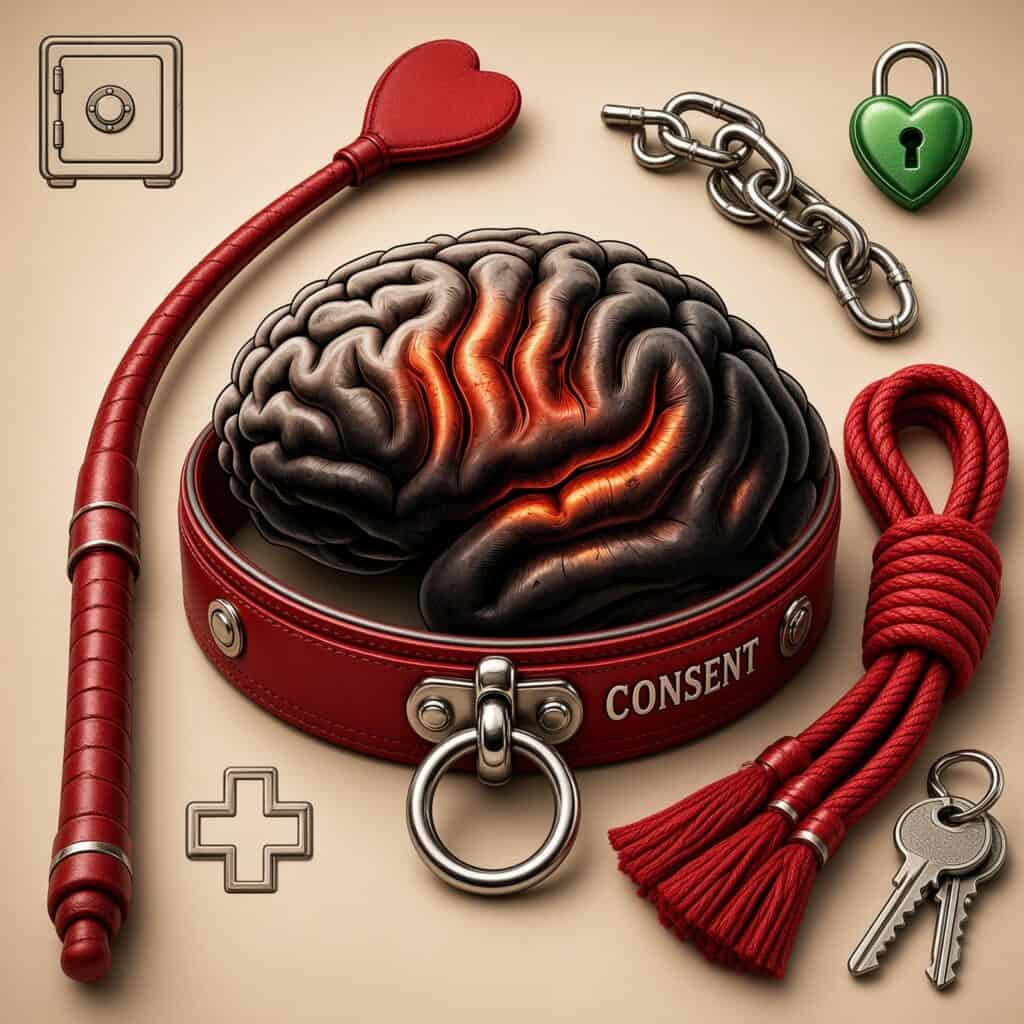
Consent changes the psychological, ethical, and legal structure of the encounter. In consensual BDSM, participants negotiate what will happen, establish limits, communicate, and retain a meaningful ability to stop. The purpose is mutually agreed sexual expression, not the violation of an unwilling person. A review by Cara Dunkley and Lori Brotto identified mutual informed consent as the central feature distinguishing BDSM from abuse and psychopathology.
A systematic scoping review of 60 studies found little support for treating BDSM interests as evidence of a psychological disorder. In the samples reviewed, practitioners did not show higher rates of mental-health or relationship problems. The research has limitations, including selection effects and uneven demographic representation, but it directly contradicts the assumption that consensual interest in pain or power exchange predicts criminal violence.
Consent is not a magic word that makes every act safe. It must be informed, voluntary, specific enough to guide the encounter, and capable of being withdrawn. Intoxication, coercion, deception, incapacity, or disregard of agreed limits can invalidate it. Some jurisdictions also restrict the degree of bodily harm to which a person may legally consent. Those legal questions vary. Clinically, however, consensual BDSM without significant distress, impairment, or non-consensual harm is not sexual sadism disorder.
This boundary matters beyond sexual-health reporting. When journalists describe a homicide as “BDSM gone wrong” without evidence, they can obscure deliberate violence and stigmatize a community. When defense or prosecution narratives use consensual interests as proof of dangerousness, they substitute prejudice for assessment. The presence of restraints, specialized equipment, or unusual sexual material does not answer whether the conduct was consensual or whether another person’s suffering was a preferred source of arousal.
Violence Is Not Automatically Sexual Sadism
Sexual assault often involves force, threats, restraint, humiliation, or injury. Those acts are criminal and harmful regardless of diagnosis. Yet the violence may serve different purposes. It may force compliance, prevent escape, punish resistance, silence a witness, express anger, or reflect generalized antisocial aggression. Sexual sadism requires affirmative evidence that suffering itself was sexually arousing.
Allen Frances and Richard Wollert warned against misusing the diagnosis in sexually violent predator proceedings. Their review emphasized that rape and sexual sadism can look superficially similar because both may involve violence and indifference to suffering. The motivational structure differs. In most rape cases, violence is instrumental, expressive, or both. In sexual sadism, pain, fear, humiliation, or domination is a preferred or necessary element of sexual arousal.
That does not make non-sadistic sexual violence less serious. It means that psychiatric language should not be used to explain criminal behavior when the evidence supports only the crime. A diagnosis can carry major legal consequences, including treatment conditions and post-sentence civil commitment. It therefore requires more than the observation that an offense was exceptionally cruel.
The same caution applies to homicide. Killing during a sexual assault may be intended to prevent identification, overcome resistance, or result from escalating violence. In erotophonophilia, sometimes called lust murder, the killing itself is erotically significant. In sexual sadism, the victim’s suffering is the source of arousal. These constructs can overlap, but they are not interchangeable. The site’s feature on erotophonophilia and sexual homicide examines the distinction between a sexually motivated killing and a killing in which suffering is the central erotic stimulus.
What Investigators Look For
Investigators may recognize behavior that raises a sexual-sadism hypothesis: prolonged captivity, repeated torture, deliberate humiliation, control of the victim’s responses, rehearsal, sexualized threats, recordings, collections of violent material, or similar conduct across offenses. No item is diagnostic in isolation. Restraint can be practical. Injuries can result from resistance. Photography can serve intimidation, documentation, fantasy, or distribution. Planning can reflect forensic awareness rather than sexual preference.
Jay Healey, Patrick Lussier, and Eric Beauregard studied crime-scene indicators among 268 adult men imprisoned in Canada. Several behaviors overlapped with a clinical diagnosis of sexual sadism, but the indicators associated with that diagnosis were not identical to those associated with sexual homicide. The result is a warning against circular reasoning: a murder is not proof of sadism, and an apparently sadistic feature is not proof that the homicide occurred because of it.
Researchers have developed dimensional tools to make assessments more consistent. The Sexual Sadism Scale, or SeSaS, uses behavioral indicators rather than relying only on an all-or-nothing clinical label. A validation study involving 350 men convicted of sexual homicide in England and Wales found that control and torture were among the more informative items. The scale showed useful reliability within that selected forensic sample.
The SADSEX-SH scale was designed for suspected sexual-homicide cases using crime-scene and investigative information. In one validation study comparing 20 offenders classified with sexual sadism and 20 without it, a revised eight-item version showed promising sensitivity and specificity. The sample was small, and the tool does not transform a scene into a diagnosis. It helps structure judgment and identify cases requiring fuller clinical investigation.
Diagnostic reliability remains contested. One study found unsatisfactory agreement when 15 forensic psychiatrists assessed detailed files on 12 offenders. A later study reported much higher agreement among 34 evaluators reviewing structured summaries. The difference suggests that information quality, definitions, case selection, and statistical methods matter. “Experts disagree” is too simple a conclusion. So, the claim is that the diagnosis can be applied with mechanical certainty.
The Assessment Must Extend Beyond the Scene
A responsible forensic evaluation uses several kinds of evidence. The clinician examines whether the person has a sustained pattern of sexual arousal involving suffering, whether that pattern predates the charged offense, and whether alternative explanations better account for the behavior. The assessment should distinguish preference from experimentation, intoxication, generalized aggression, situational anger, coercion used to complete an assault, and conduct arising during psychosis or another mental state.

Clinical interviews matter, but self-report is vulnerable to denial, minimization, exaggeration, shame, strategic presentation, and memory problems. Collateral records can include prior assessments, intimate-partner reports, offense histories, communications, pornography or written fantasies, internet activity, medical records, and institutional behavior. Each source has its own limitations. Possession of fictional violent material, for example, does not establish that a person wants to harm someone in reality.
Some forensic services use penile plethysmography, which measures changes in penile response while sexual stimuli are presented. Research suggests that arousal to depictions of violence may add information in selected assessments, but the method is intrusive and sensitive to stimulus design, suppression attempts, testing conditions, interpretation, and legal admissibility. It should never be described as a mind-reading device or used alone to determine diagnosis or future risk.
The evaluator must also consider duration. A persistent arousal pattern is different from an isolated act. Repetition across fantasies, relationships, media, offenses, or time can strengthen a conclusion, but repetition alone does not identify the erotic function. The central question remains whether suffering is sexually exciting, rather than merely present.
Sexual Sadism, Psychopathy, and Personality
Sexual sadism and psychopathy are often paired in true-crime profiles as if they formed one diagnosis. They do not. Psychopathy is a personality construct involving interpersonal, affective, and behavioral traits such as manipulation, shallow affect, callousness, irresponsibility, and persistent antisocial conduct. Sexual sadism concerns the erotic role of suffering. A person may show one without the other.
Research has found associations between sadistic traits and psychopathy in some offender samples, but association is not identity. Small or selected prison samples cannot establish a universal sexual-sadist personality. Antisocial traits may increase the likelihood that someone acts on harmful interests, disregards consent, or persists in criminal behavior. They do not prove what produces sexual arousal.
The combination can be especially concerning in an individual assessment because a persistent coercive arousal pattern may intersect with impulsivity, entitlement, callousness, or criminal versatility. Even then, risk must be assessed through validated methods and current circumstances. A dramatic diagnostic label is not a substitute for structured evaluation.
Psychosis is another source of confusion. Extreme or bizarre violence may occur during a psychotic episode, but bizarre conduct is not proof of psychosis. Sexual sadism disorder does not require a loss of contact with reality. When psychotic symptoms are present, the evaluator must determine whether delusions or hallucinations drove the conduct, whether a separate paraphilic pattern existed, and how each condition affected legal capacities. The answer cannot be inferred from brutality alone.
Sexual Sadism, Necrophilia, and Necrosadism
Sexual sadism can intersect with post-mortem behavior, but death changes the analysis. A deceased person no longer experiences pain or fear. If an offender derives sexual gratification from mutilating or degrading a corpse, the relevant forensic concept may be necrosadism or necromutilophilia rather than sexual sadism in its ordinary suffering-based sense.
Necrophilia is a sexual interest in or sexual activity involving corpses. It does not require inflicting suffering. The site’s guide to what necrophilia means in forensic psychology explains why post-mortem sexual behavior, persistent attraction, and homicidal motive must be assessed separately.
Necrosadism is most precisely used for sexually gratifying post-mortem mutilation. The term remains conceptually difficult because a corpse cannot feel pain. Its “sadistic” element lies in the offender’s fantasy, degradation, or destruction of human remains rather than suffering experienced after death. The full feature on necrosadism and the cases that defined it traces that distinction through historical, forensic, and legal developments.
A homicide can involve all three concepts, two of them, one, or none. An offender may torture a living victim for sexual arousal, kill for another purpose, and then engage in opportunistic post-mortem activity. Another may kill specifically to obtain a corpse without prolonging suffering. A third may mutilate a body for concealment with no sexual purpose. Accurate reporting assigns terms to demonstrated acts and motives rather than allowing a single label to encompass the entire crime.
Causes Are Not Established by a Childhood Narrative
There is no single proven cause of sexual sadism disorder. Proposed explanations include learning and conditioning, repeated fantasy rehearsal, reinforcement, difficulty with intimacy, antisocial traits, emotional regulation problems, developmental adversity, and neurobiological factors. The evidence is uneven and drawn heavily from people who entered the forensic system after committing an offence.
Childhood abuse is frequently invoked in profiles of violent offenders. It may be relevant to an individual’s history, but it cannot be treated as a direct cause of sexual sadism. Most people who experience abuse do not become violent or develop a coercive paraphilic disorder. Retrospective accounts can be incomplete, and samples drawn from prisons cannot show which factors distinguish people who offend from those who share a background but do not.
Fantasy is equally easy to overstate. Recurrent fantasies may shape behavior, become more elaborate, or be reinforced through masturbation and rehearsal in some cases. There is no universal sequence in which fantasy inevitably escalates to torture or homicide. A forensic evaluator can document a person’s actual pattern. A journalist cannot responsibly invent the missing stages.
The limited evidence supports a multifactorial view. A sexual interest, opportunity, inhibition, personality, relationships, substance use, situational stress, and criminal decision-making may interact differently across cases. Explanation must remain individualized.
Risk Assessment Is Not Diagnosis

A diagnosis identifies a clinical pattern. Risk assessment estimates the likelihood and nature of future harm under defined conditions. The two tasks overlap but are not interchangeable. A person can meet diagnostic criteria and present different risks depending on age, criminal history, access, treatment engagement, supervision, substance use, relationships, and current functioning.
A twenty-year follow-up study of 586 adult men assessed after sexual offenses compared a DSM sexual-sadism diagnosis with behavioral indicators and phallometric response. The psychiatric diagnosis did not predict recidivism in that sample as well as some behaviorally operationalized measures. That finding does not make the diagnosis meaningless. It shows why a label should not be used as a risk score.
Modern sexual recidivism assessments combine structured actuarial data with clinically relevant dynamic factors. Tools such as Static-99R, VRS-SO, and SVR-20 were developed for different purposes and populations. A 2026 meta-analysis of ten instruments found them broadly useful but with overlapping predictive validity and emphasized that they should be used alongside other information. No instrument can predict an individual act with certainty.
Risk statements should therefore identify the outcome being estimated, the population on which the tool was validated, the time horizon, protective factors, uncertainties, and the management conditions assumed. “High-risk sadist” is not an adequate forensic conclusion.
Treatment and Management
Treatment depends on the person’s needs, risk, consent, legal status, and co-occurring conditions. The Merck Manual describes cognitive-behavioral therapy and, in selected cases, medication used for other paraphilic disorders. The World Federation of Societies of Biological Psychiatry has issued guidelines covering options such as selective serotonin reuptake inhibitors, antiandrogens, and gonadotropin-releasing hormone approaches, matched to severity and risk.
Medication that reduces sexual drive carries significant ethical and medical implications. It requires informed consent where legally possible, careful assessment, laboratory and physical monitoring, attention to adverse effects, and review of proportionality. It is not a punishment and should not be presented as a simple chemical solution to violence.
Psychological treatment may address self-regulation, offense-supportive beliefs, victim awareness, intimacy, coping, relapse prevention, and management of sexual interests. Co-occurring substance-use, mood, trauma-related, or personality problems may require separate attention. Evidence for sexual-sadism-specific treatment is limited, and outcomes in highly selected forensic populations should not be generalized casually.
Management can also reduce opportunity through supervision, digital restrictions, residence conditions, relationship support, substance-use controls, and monitoring appropriate to the established risk. The goal is not to prove that an internal interest has disappeared. It is to reduce harmful behavior while supporting stable functioning and lawful sexuality.
Writing About Sexual Sadism Without Diagnosing From Afar
True-crime writing often uses “sexual sadist” as a synonym for a person who commits prolonged violence. That wording may be accurate when a qualified expert diagnoses the offender, and the evidentiary basis is known. In many cases, it is speculation dressed as medicine.
A more defensible article identifies what is established. It can state that the offender restrained, terrorized, injured, or humiliated the victim. It can report that prosecutors alleged a sexual motive, that an expert diagnosed sexual sadism disorder, that another expert disagreed, or that a court accepted or rejected the opinion. It should not infer a diagnosis from photographs, demeanor, a nickname, the number of injuries, or the writer’s belief that no ordinary motive could explain the crime.
The same restraint protects victims. Calling violence “sadistic” can shift attention toward the offender’s imagined gratification and turn suffering into spectacle. Detail is justified when it explains the cause of death, intent, evidence, legal findings, or investigative decisions. It becomes exploitative when it invites the reader to inhabit the offender’s excitement.
Sexual sadism disorder is real, rare, and consequential. It is also easy to misuse. The responsible conclusion is not that psychology can explain every act of cruelty. It is that diagnosis begins only when evidence connects cruelty to a persistent pattern of sexual arousal and survives serious consideration of other explanations.
Frequently Asked Questions
What is sexual sadism disorder?
Sexual sadism disorder is a paraphilic disorder in which recurrent and intense sexual arousal is connected to another person’s physical or psychological suffering, and the person has acted with someone who did not consent or experiences clinically significant distress or impairment.
Is sexual sadism disorder the same as BDSM?
No. Consensual BDSM involves negotiated activity between adults and is not, by itself, a mental disorder. Coercion, non-consent, clinically significant distress, impairment, or harmful conduct changes the assessment.
Is every sexually violent offender a sexual sadist?
No. Sexual violence can involve force, injury, and humiliation without evidence that suffering itself produces sexual arousal. Most rape should not be diagnosed as sexual sadism solely because violence occurred.
Can a crime scene prove sexual sadism?
A crime scene may contain indicators that support further assessment, but it cannot establish a diagnosis on its own. Investigators need the behavioral sequence, clinical evidence, history, digital material, collateral information, and alternative explanations.
Is sexual sadism the same as psychopathy?
No. Psychopathy is a personality construct; sexual sadism concerns the erotic role of another person’s suffering. They may co-occur, but one does not prove the other.
What causes sexual sadism disorder?
No single cause has been established. Research considers learning, fantasy reinforcement, personality, developmental experiences, relationships, inhibition, opportunity, and possible biological factors, but the evidence is limited and heavily based on forensic samples.
Can sexual sadism disorder be treated?
Treatment may include cognitive-behavioral approaches, management of co-occurring conditions, and medication in selected higher-risk cases. Evidence specific to sexual sadism is limited, so treatment and monitoring must be individualized.
Sources & Further Reading
Research and primary sources used in this article.
- American Psychiatric Association, Paraphilic Disorders fact sheet
- World Health Organization, ICD-11 Clinical Descriptions and Diagnostic Requirements
- Merck Manual Professional Edition, Sexual Sadism Disorder
- Allen Frances and Richard Wollert, “Sexual Sadism: Avoiding Its Misuse”
- Richard B. Krueger, “The DSM Diagnostic Criteria for Sexual Sadism”
- W. L. Marshall et al., “Diagnosing Sexual Sadism in Sexual Offenders”
- Dennis Doren and Richard Elwood, “The Diagnostic Reliability of Sexual Sadism”
- Jay Healey, Patrick Lussier and Eric Beauregard, “Sexual Sadism in the Context of Rape and Sexual Homicide”
- Ewa B. Stefanska et al., “Validation of the Sexual Sadism Scale”
- Wade C. Myers, Eric Beauregard and William Menard, “Sexual Homicide Crime Scene Rating Scale for Sexual Sadism”
- Drew A. Kingston et al., “Indicators of Sexual Sadism as Predictors of Recidivism”
- Cara R. Dunkley and Lori A. Brotto, “The Role of Consent in the Context of BDSM”
- Andrea K. Klement et al., “A Systematic Scoping Review of Factors Associated With BDSM”
- Nele De Neef et al., “BDSM From an Integrative Biopsychosocial Perspective”
- WFSBP Guidelines for Pharmacological Treatment of Paraphilic Disorders
- Risk Assessment Instruments for Predicting Sexual Recidivism: A 2026 Meta-Analysis
Discover more from The Dark Side of Humanity
Subscribe to get the latest posts sent to your email.