Ted Bundy Case

From the Pacific Northwest to a Florida electric chair, Ted Bundy used charm, impersonation and sudden violence to abduct and kill young women across four states between 1974 and 1978. This dossier separates convictions, confessions and disputed attributions — documenting the bludgeoning, strangulation, decapitation and postmortem abuse behind one of America's most infamous serial killer cases.
1. Case Overview

Ted Bundy

Washington, Utah, Colorado and Florida • 1974–1978 main known series
Ted Bundy used charm, impersonation and sudden force to abduct young women across several American states in the 1970s. He was executed in Florida in 1989 after convictions for the murders of Chi Omega victims Lisa Levy and Margaret Bowman, and twelve-year-old Kimberly Leach. Before his execution he confessed to thirty homicides, though investigators have long suspected the true total may have been higher. This dossier separates legally established facts, confession-backed admissions, and unresolved or disputed victim attributions, while documenting the graphic realities of bludgeoning, strangulation, sexual assault, necrophilia, decapitation and dump-site decomposition.
Forensic detail notice

This dossier does not sanitize the record. It discusses head injuries, strangulation, sexual assault, postmortem intercourse, decomposition, scavenger damage, decapitation, severed heads retained by Bundy, bite wounds at Chi Omega, and the aftermath of Florida’s electric-chair execution.

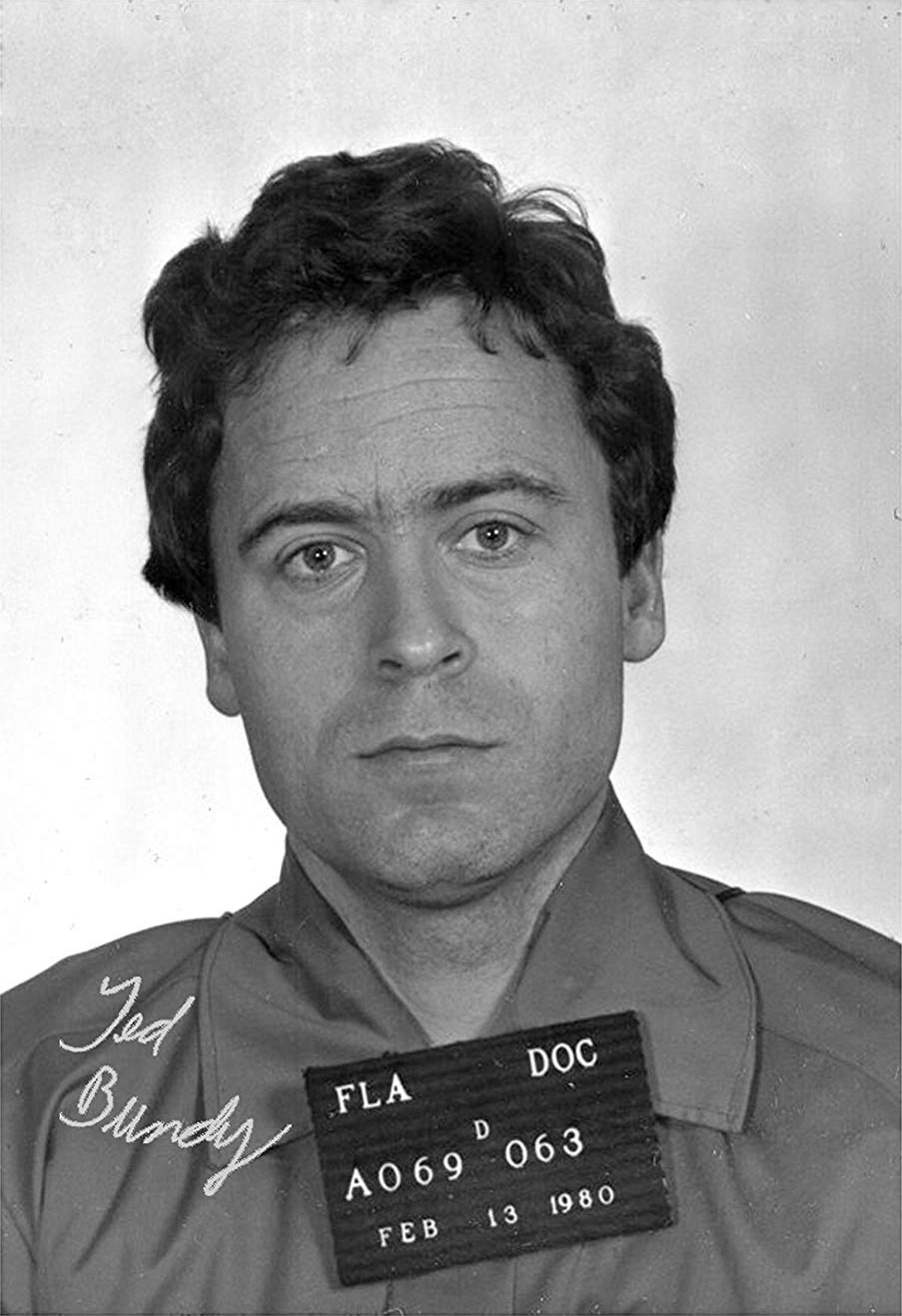
1980 Florida Department Of Corrections Mugshot Used In The Ted Bundy Case Dossier
TED BUNDY — FLORIDA DEPARTMENT OF CORRECTIONS MUGSHOT13 February 1980. State Archives of Florida / Florida Memory. Public-domain government record; credit retained.
2

Victim Ledger

Early-series victims, confirmed murders, survivors and the legal distinction between conviction, confession and historical attribution.

Archival Photo Record

Archival Portrait Of Lynda Ann Healy
Lynda Ann HealyNewspaper publication via Wikimedia Commons — PD-US record
Archival Portrait Of Donna Gail Manson
Donna Gail MansonNew York Daily News publication via Wikimedia Commons — PD-US record
Archival Photograph Identified As Susan Rancourt
Susan RancourtKIRO 7 archival case gallery — publication rights should be verified
Archival Photograph Identified As Roberta Kathleen Parks
Roberta ParksKIRO 7 archival case gallery — publication rights should be verified
Identification Photograph Of Brenda Carol Ball
Brenda BallIdentification image in KIRO 7 archival case gallery — verify republication rights
Archival Portrait Of Georgann Hawkins
Georgann HawkinsNewspaper publication via Wikimedia Commons — PD-US record
Archival Full-Length Photograph Identified As Janice Ann Ott
Janice OttKIRO 7 archival case gallery — publication rights should be verified
Archival Portrait Of Denise Naslund
Denise NaslundLongview Daily News publication via Wikimedia Commons — PD-US record
Official Missing-Person Photograph Of Nancy Wilcox
Nancy WilcoxUtah Department of Public Safety missing-person case page
Official Cold-Case Photograph Of Melissa Ann Smith
Melissa SmithUtah Department of Public Safety cold-case photograph
Official Cold-Case Photograph Of Laura Ann Aime
Laura AimeUtah Department of Public Safety cold-case photograph
Archival Photograph Identified As Caryn Eilene Campbell
Caryn CampbellKIRO 7 archival case gallery — publication rights should be verified
Official Missing-Person Photograph Of Susan Curtis
Susan CurtisUtah Department of Public Safety missing-person case page
Archival Portraits Of Lisa Levy And Margaret Bowman
Lisa Levy and Margaret BowmanState Archives of Florida / Florida Memory — public-domain archival image
Archival Portrait Of Kimberly Diane Leach
Kimberly LeachTampa Tribune publication via Wikimedia Commons — PD-US record

Photo ledger update: 12 primary victim cards now contain sourced photographs.

Public-domain archiveCommons and Florida Memory items are linked to their rights records.
Government case pageUtah DPS photographs are displayed from official missing-person or cold-case pages.
News archiveKIRO 7 victim images are directly attributed; confirm republication rights before commercial reuse.
Archival Portrait Of Lynda Ann Healy

Lynda Ann Healy

Age: 21
Zone: Washington
Status: Strongly attributed
Abducted from her basement bedroom; blood and disturbed bedding indicated a violent removal.

Archival Portrait Of Donna Gail Manson

Donna Gail Manson

Age: 19
Zone: Washington
Status: Attributed / confessed
Disappeared after leaving her dorm for a concert.

Archival Photograph Identified As Susan Rancourt

Susan Rancourt

Age: 18
Zone: Washington
Status: Attributed / confessed
Last seen near Central Washington State College.

Archival Photograph Identified As Roberta Kathleen Parks

Roberta Parks

Age: 22
Zone: Oregon
Status: Attributed / confessed
Vanished in Corvallis after leaving campus.

Identification Photograph Of Brenda Carol Ball

Brenda Ball

Age: 22
Zone: Washington
Status: Attributed / confessed
Missing after leaving a tavern in Burien.

Archival Portrait Of Georgann Hawkins

Georgann Hawkins

Age: 18
Zone: Washington
Status: Strongly attributed
Taken from a Seattle alley after being walked home area.

Archival Full-Length Photograph Identified As Janice Ann Ott

Janice Ott

Age: 23
Zone: Lake Sammamish
Status: Confessed
Abducted from the crowded park after Bundy used the name Ted.

Archival Portrait Of Denise Naslund

Denise Naslund

Age: 18
Zone: Lake Sammamish
Status: Confessed
Taken only hours after Ott, showing Bundy’s escalating boldness.

Official Missing-Person Photograph Of Nancy Wilcox

Nancy Wilcox

Age: 16
Zone: Utah
Status: Attributed / confessed
Teen victim from Holladay.

Official Cold-Case Photograph Of Melissa Ann Smith

Melissa Smith

Age: 17
Zone: Utah
Status: Confirmed victim
Body found nude with signs of sexual assault and beating.

Official Cold-Case Photograph Of Laura Ann Aime

Laura Aime

Age: 17
Zone: Utah
Status: Confirmed victim
Bludgeoned and strangled; body left in a canyon.

Archival Photograph Identified As Caryn Eilene Campbell

Caryn Campbell

Age: 23
Zone: Colorado
Status: Confirmed victim
Abducted from a hotel; skull fracture and exposure injuries documented.

Victim / personAgeRegionStatusCase note
Lynda Ann Healy21WashingtonStrongly attributedAbducted from her basement bedroom; blood and disturbed bedding indicated a violent removal.
Donna Gail Manson19WashingtonAttributed / confessedDisappeared after leaving her dorm for a concert.
Susan Rancourt18WashingtonAttributed / confessedLast seen near Central Washington State College.
Roberta Parks22OregonAttributed / confessedVanished in Corvallis after leaving campus.
Brenda Ball22WashingtonAttributed / confessedMissing after leaving a tavern in Burien.
Georgann Hawkins18WashingtonStrongly attributedTaken from a Seattle alley after being walked home area.
Janice Ott23Lake SammamishConfessedAbducted from the crowded park after Bundy used the name Ted.
Denise Naslund18Lake SammamishConfessedTaken only hours after Ott, showing Bundy’s escalating boldness.
Nancy Wilcox16UtahAttributed / confessedTeen victim from Holladay.
Melissa Smith17UtahConfirmed victimBody found nude with signs of sexual assault and beating.
Laura Aime17UtahConfirmed victimBludgeoned and strangled; body left in a canyon.
Caryn Campbell23ColoradoConfirmed victimAbducted from a hotel; skull fracture and exposure injuries documented.
Debra Kent17UtahStrongly attributedVanished from school parking lot; evidence linked Bundy.
Carol DaRonch18UtahSurvivorEscaped Bundy after a fake-police abduction attempt; her testimony was central to his prosecution.
Julie Cunningham26ColoradoConfessedSki-town waitress; body never officially recovered.
Denise Oliverson24ColoradoConfessedCyclist taken in Grand Junction; no body recovered.
Lynette Culver12IdahoConfessedSchoolgirl abducted in Pocatello.
Susan Curtis15UtahConfessedDisappeared from a youth conference at BYU.
Margaret Bowman21FloridaConvicted victimBludgeoned to death at the Chi Omega house.
Lisa Levy20FloridaConvicted victimBeaten, strangled and bitten; bite-mark evidence proved crucial.
Karen Chandler21FloridaSurvivorBrutally beaten in the sorority attack but lived.
Kathy Kleiner20FloridaSurvivorSeverely bludgeoned in the sorority house and survived.
Kimberly Leach12FloridaConvicted victimAbducted from school, murdered and left in a remote shed area.
3

Case Geography

Bundy’s series moved from the Pacific Northwest into Utah and Colorado, then exploded in Florida after two escapes.

Washington & Oregon

The early known sequence clustered around Seattle, Tacoma, Burien, Corvallis and the Taylor Mountain / Issaquah recovery zones. The Lake Sammamish abductions occurred in broad daylight in a crowded state park.

Utah & Colorado

Salt Lake City, Holladay, Bountiful, Midvale, Snowmass and Grand Junction form the central mountain-west sequence. Here Bundy refined the fake-authority and fake-injury ruses while becoming more openly violent.

Florida

After escaping Colorado custody twice, Bundy reached Tallahassee. The Chi Omega sorority assault and the murder of Kimberly Leach were quicker, more chaotic and more visibly savage than many of the earlier abductions.

4

Chronology

Major movements from the first 1974 disappearances to the electric chair in 1989.

Pacific Northwest

Lynda Ann Healy disappeared from her basement bedroom in January 1974. By the summer, Bundy had escalated to public-park abductions, taking Janice Ott and Denise Naslund from Lake Sammamish after presenting himself as “Ted” and pretending to need help with a sailboat.

Mountain-west phase

Victims including Melissa Smith, Laura Aime and Caryn Campbell were abducted, sexually assaulted, bludgeoned or strangled, and left in remote areas where decomposition and weather stripped scenes of clarity.

Initial break

Traffic stop evidence, suspicious items in Bundy’s car, and survivor Carol DaRonch’s identification began converting a multistate mystery into a prosecutable offender case.

Custody failures

Bundy escaped once from a courthouse library window in Aspen, was recaptured, then escaped again by cutting through his cell ceiling. Those failures directly preceded the Florida murders.

Florida

Bundy entered the sorority house and in minutes bludgeoned and strangled Margaret Bowman and Lisa Levy, sexually assaulted Levy, and brutally beat survivors Karen Chandler and Kathy Kleiner. The scene was chaotic, close-range and far bloodier than many of the skeletal-recovery cases that defined the earlier years.

Lake City, Florida

Twelve-year-old Kimberly Leach disappeared from school. Her body was later recovered in a remote shed area. The case produced one of Bundy’s final murder convictions.

Endgame

Bundy was convicted in Florida, spent years on death row, then in the last days before execution gave interviews and confessions describing dump sites, revisits and acts of decapitation and necrophilia. He was executed in Florida’s electric chair in January 1989.

5

Abduction Method

Charm and staging concealed a predatory mechanics built around sudden cranial blows, restraint and transport.

Approach

Bundy often wore a sling or cast, used crutches, or claimed to be an authority figure. The point was to pull the victim close enough to a car door or doorway for a surprise strike.

Control

Victims were frequently incapacitated by a blow to the head, handcuffed or restrained, then moved into the Volkswagen Beetle. Injuries in some cases suggest bludgeoning before strangulation rather than one clean fatal act.

Remote assault

The lethal stage usually occurred in wooded pull-offs, mountain roads, quarries or brush. The remoteness allowed sexual assault, murder, revisits and body repositioning away from immediate witnesses.

6

Washington and Oregon Files

The early series established Bundy’s pattern and his later habit of revisiting remains.

Lynda Ann Healy

Healy’s basement room showed a violent removal: blood, a disturbed bed and evidence that the victim had been carried out rather than simply vanishing. That domestic bedroom scene is important because it preserved the abduction violence that remote dump sites later obscured.

Bundy later admitted that some early victims were decapitated after death and their heads retained temporarily in his room or apartment. Healy is among the women most often associated with that postmortem behavior.

Lake Sammamish

Janice Ott and Denise Naslund were taken in public on 14 July 1974. Bundy moved fast, using the same first name and injury ruse in a crowded recreational setting. Their skeletal remains were later recovered in rough terrain. Weather, scavengers and time stripped soft tissue, but Bundy’s admissions and body distribution patterns later illuminated what had happened between the park and the hillside.

Graphic core
Bundy’s own late confessions described returning to corpse sites for sexual access after death and severing heads from some victims so that the face and hair could be revisited privately. This is one of the grimmest documented features of the case.
7

Utah and Colorado Files

Confirmed and strongly linked victims show escalating blunt-force trauma, strangulation and increasingly clear postmortem abuse.

Utah • confirmed victim

Melissa Smith disappeared in October 1974. Her body was recovered in mountainous terrain. Reports documented nude recovery, beating, sexual assault and strangulation. In forensic terms, the body-site evidence showed a mixed assault rather than a single tidy mechanism of death.

Utah • confirmed victim

Laura Aime’s body bore head trauma and strangulation evidence. Her recovery in a canyon environment made clear how Bundy used geography itself as an accomplice, letting snow, animals and delayed discovery erase fine-grain evidence while leaving only the blunt anatomy of murder.

Colorado • confirmed victim

Campbell vanished from a hotel during a ski trip. Her body was later found outdoors with skull fractures, exposure effects and signs of assault. The case underscored Bundy’s ability to enter a populated environment, isolate a victim in minutes, and leave investigators with a decomposing body far from the point of capture.

Strongly attributed

Kent disappeared from a school parking lot in Utah. Physical items and witness material tied Bundy to the disappearance, but the absence of a full body recovery kept the case partly inferential. It remains one of the strongest examples of how some Bundy files are nearly certain without being as complete as later Florida trials.

8

Chi Omega Sorority House

The Florida attack was compressed, savage and unusually well documented because several victims were found immediately and two survivors lived.

Margaret Bowman and Lisa Levy

Bundy entered the Chi Omega house in Tallahassee shortly after 3 a.m. Margaret Bowman was bludgeoned in bed with such force that the room retained unmistakable impact violence. Lisa Levy suffered beating, strangulation and sexual assault. Her body showed bite wounds to the buttock, a detail that became pivotal in court. The fast sequence suggests a frenzy of room-to-room violence rather than the more controlled transport method seen in earlier cases.

What makes the scene especially grim is proximity: beds, pillows, blood-spattered bedding, facial trauma, and attack intervals measured in minutes.

Survivors Karen Chandler and Kathy Kleiner

Both women were bludgeoned so severely that survival itself became remarkable. Jaw fractures, skull injuries and shattered teeth underscored Bundy’s reliance on head trauma as an opening or terminal mechanism. Because these women lived, the Chi Omega case did not rest only on remote-body reconstruction; it contained living testimony about the damage he could inflict at arm’s length.

Archival Portraits Of Lisa Levy And Margaret Bowman Used In The Chi Omega Case Section
Lisa Levy and Margaret BowmanState Archives of Florida / Florida Memory — public-domain archival image
9

Kimberly Leach

The murder of a twelve-year-old schoolgirl widened the horror and delivered another death sentence.

Abduction

Kimberly Leach disappeared from Lake City Junior High School in February 1978. She was last seen moving between school spaces during an ordinary day, a brutal contrast with the remote mountain disappearances that had characterized much of Bundy’s earlier series.

Recovery and injury context

Her remains were discovered in a remote shed area after decomposition had advanced. Investigators concluded she had been sexually assaulted and murdered. Although decomposition limited some precision, the case remained strong enough to support conviction. The forensic cruelty is obvious even through the missing tissue: a child taken out of daylight, raped, killed and discarded alone in the woods.

Archival Portrait Associated With Kimberly Leach
Kimberly LeachTampa Tribune publication via Wikimedia Commons; PD-US record
10

Body Disposal and Recovery

Bundy selected places where terrain, weather and animals could strip bodies into skeletal puzzles.

Dump-site logic

Steep slopes, brush, mountain pull-offs and wooded ravines slowed discovery. When remains were finally found, they were often partial or skeletonized, with bones scattered by scavengers and time.

Revisit behavior

Bundy admitted revisiting some remains repeatedly for sexual contact after death. By his own account he sometimes groomed or staged bodies and returned until decomposition made contact impossible.

Decapitation

Some victims were decapitated after death. Bundy described carrying severed heads home and keeping them for a time. This postmortem mutilation converts the case from serial murder alone into one involving trophy retention and extended corpse abuse.

11

Sexual Violence and Postmortem Abuse

The case cannot be understood honestly without naming rape, corpse abuse and fetishized control over the dead.

During-life assault

Several victims were sexually assaulted before death, with beatings and strangulation layered together. The rape was not incidental; it was structurally tied to Bundy’s domination, humiliation and control.

At Chi Omega, evidence indicated sexual assault in addition to blunt-force trauma and ligature or manual strangulation. With earlier victims, decomposition often erased the soft-tissue proof but did not erase Bundy’s later admissions.

After death

Bundy told investigators that he returned to bodies for intercourse after death and sometimes severed heads so the facial identity remained available to him. This is among the most graphic and psychologically revealing parts of the record: murder did not end possession; it stabilized it. The body could then be revisited, manipulated and fetishized without resistance.

12

Evidence Locker

Court exhibits, scene records, confession materials and the physical traces that turned a charming law student into a death-row defendant.

ExhibitItemStatusWhy it mattered
E-01Volkswagen Beetle and front-passenger removal patternPhysical / investigativeCentral to Bundy’s method: fake injury, quick incapacitation, handcuffs, and transport.
E-02Lake Sammamish composite and witness sightingsInvestigativeNamed ‘Ted’, linked public sightings to Janice Ott and Denise Naslund.
E-03Utah and Colorado crime-scene fibers / tool associationsMixed physicalHelped connect Bundy across jurisdictions though 1970s forensics were limited.
E-04Chi Omega bite-mark impressionsCourt evidenceOne of the most famous bite-mark uses in American criminal court; persuasive then, debated now.
E-05Sorority house blood and hair evidenceCourt evidencePlaced violent assault sequence inside the Chi Omega bedrooms.
E-06Pantyhose mask / burglary tools after Florida stopPhysical evidenceAssociated Bundy with prowling and attack preparation in Florida.
E-07Kimberly Leach recovery site evidenceCourt evidenceClothing, decomposition context, and movement pattern supported the homicide case.
E-08Severed heads and skeletal recoveries in Washington mountainsRecovery evidenceConfirmed postmortem mutilation in several early cases.
E-09Confession tapes to investigatorsAdmission evidenceBundy described dump sites, decapitations, and revisit behavior before execution.
E-10Dental testimony for bite marksCourt evidence / contested scienceDamaging at trial, though modern forensic standards treat bite-mark certainty with caution.
E-11Escape records from Aspen and Colorado jailDocumentaryImportant to chronology and the transition to the Florida murders.
E-12Body-site photographs and skeletal mappingRecovery documentationEstablished how Bundy dispersed remains and how animals and weather altered them.
E-13Survivor testimony from Carol DaRonchCourt evidenceShowed the abduction ruse and Bundy’s capacity for sudden lethal escalation.
E-14Execution-prior confession summariesAdmission evidenceExpanded the victim list but did not resolve every attribution question.
13

Investigation and Bite Marks

The Bundy case sits at the intersection of classic detective work and now-contested forensic techniques.

Witness patterning

The name “Ted,” the arm sling, the Volkswagen and the crowded-park witness cluster helped investigators convert rumor into a suspect profile.

Carol DaRonch

DaRonch escaped Bundy in Utah and gave some of the most important living testimony in the entire case. Her survival established how Bundy moved from impersonation to attempted restraint in seconds.

Bite-mark controversy

At the time, Lisa Levy’s bite wounds were dramatic and persuasive courtroom evidence. Modern forensic standards treat bite-mark certainty much more skeptically, so the dossier preserves both truths: it helped convict Bundy, and its scientific confidence is viewed more cautiously today.

14

Confessions and Reliability

Bundy confessed late, strategically and incompletely.

Execution-eve admissions

Bundy confessed to thirty homicides and described details of dump sites, revisits, decapitations and postmortem intercourse. These admissions clarified many skeletal cases but came after years of lies, minimization and self-serving manipulation.

Confession boundary

Bundy was bargaining for time and relevance. He withheld names, collapsed timelines and sometimes gave investigators just enough truth to keep them listening. The dossier therefore grades late confessions as powerful but not automatically infallible.

Unresolved count

Thirty is the official confession figure, not necessarily the final count. Some investigators believed he killed more; others treat uncorroborated attributions with restraint. No honest dossier should flatten this uncertainty into false certainty.

15

Trial and Execution

Florida delivered the legal climax: convictions, death sentences and one of the most famous executions in modern American history.

Courtroom record

Bundy represented himself in part, cultivated spectacle, and was convicted for the murders of Lisa Levy and Margaret Bowman, then later for Kimberly Leach. The trials fused witness testimony, physical evidence, survivor accounts and the bite-mark presentation into a narrative of methodical predation.

Electric chair

Bundy was executed at Florida State Prison on 24 January 1989. Electric-chair death is not clinically gentle: straps fix the body in place, the skull cap and leg electrode are attached, current courses through the body, muscles convulse, and heat can char tissue. Contemporary coverage emphasized smoke and the intense public atmosphere outside the prison. It was a violent state ending to a violent private career.

16

Open Questions

What remains unsettled even after conviction and confession.

Body-count uncertainty

Thirty confessed victims is the official baseline, but some investigators and writers suspect more. A few probable cases remain debated because the physical record is fragmentary or confession detail is thin.

Postmortem attribution issue

Bundy’s admissions about keeping heads are credible in broad outline, but the exact victim-by-victim mapping is not equally firm for every case.

Forensic caution

They were central in 1979 but are much more controversial today. Bundy’s conviction does not stand on bite marks alone, yet their historic role should be neither erased nor overstated.

17

Key Sources

Primary records, survivor accounts, trial reporting and later investigations that shape the case core.

Court records

Florida Trial Materials

Convictions for the murders of Lisa Levy, Margaret Bowman and Kimberly Leach, plus the role of the Chi Omega evidence and testimony.

Survivor evidence

Carol DaRonch Testimony

Critical for understanding Bundy’s abduction method and the Utah prosecution sequence.

Confessions

Execution-Eve Interviews

Bundy’s late admissions on thirty murders, revisiting bodies, decapitation and necrophilia, used cautiously because of his manipulative style.

Investigative history

Multistate Police Records

Lake Sammamish, Utah and Colorado investigative files that show how disparate disappearances were linked.

Journalistic synthesis

Contemporary and Later Books

Ann Rule, rule-of-law reporting and later archival reconstructions remain important secondary syntheses.

Editorial rule

Evidence Boundary

This dossier separates convictions, strong documentary linkage, confession-only claims and still-open attributions rather than flattening all victims into one certainty level.

Legally Narrow, Historically Vast

The courtroom core is smaller than the historical horror. Bundy’s death sentences came from Florida, but the full dossier necessarily stretches across years of skeletal recoveries, confessions and unresolved victim accounting.

18

Glossary

Working terms used in this forensic dossier.

A victim whose murder was proven in court, such as Lisa Levy, Margaret Bowman or Kimberly Leach.

A victim accepted through Bundy’s admissions, investigative consensus or strong circumstantial linkage, but not necessarily the subject of a formal murder conviction.

Sexual activity involving a corpse. Bundy’s own late confessions place it directly inside his offending pattern.

Comparative dental evidence used prominently in the Lisa Levy murder prosecution. Historically important, scientifically contested.


Discover more from The Dark Side of Humanity

Subscribe to get the latest posts sent to your email.

✚ Latest ✚

A Deconstruction Of Albert Fish: Sadism, Psychosis, And The Boogey Man Archetype

A Deconstruction of Albert Fish: Sadism, Psychosis, and the Boogey Man Archetype

In the late 1920s, the city of New York was terrorized by a…
Elizabeth Báthory, The Notorious Female Serial Killer From History'S Dark Past

Elizabeth Báthory’s Barbaric Lust for Blood: History’s Most Heinous Female Serial Killer

Discover the chilling true story of Elizabeth Báthory, the inspiration for Dracula, a…