Execution attempted · Pike reported alive, receiving medical care
Status as of 11:29 p.m. ET, Wednesday, September 30, 2026: Tennessee began a lethal-injection execution after the U.S. Supreme Court vacated the Sixth Circuit stay (Nelsen v. Pike, No. 26A428).545556 Defense counsel and media witnesses reported that Pike remained alive after two doses of pentobarbital.565758 A federal judge later ruled her emergency motion moot after the state said medical staff had begun treating her.56 No time of death has been announced, and the Tennessee Department of Correction has not issued a public statement on the outcome.5658
Nelsen v. Pike, No. 26A428 (U.S. Sept. 30, 2026) (order vacating stay; Sotomayor, J., joined by Kagan and Jackson, JJ., dissenting) · Supreme Court docket ↗ · Reporting: Tennessean, WSMV, WVLT
Christa Pike
The torture-murder of Colleen Slemmer, 19, on the University of Tennessee agricultural campus, and the three decades of trials, appeals and grief that followed.
Execution attempted · Pike reported alive, receiving medical care · as of 11:29 p.m. ET, Wednesday, September 30, 2026
Established facts come from appellate opinions summarizing trial evidence, Pike’s recorded statement as quoted by the courts, and cited reporting. Four points remain disputed: who carved the pentagram, Peterson’s role in the violence, whether prenatal alcohol caused brain damage, and whether the skull fragment was returned.
- Trial court
- Knox County Criminal Court, Tenn.12
- Convicted
- Mar. 22, 1996 · first-degree murder; conspiracy18
- Tenn. Crim. App. · direct
- 03C01-9611-CR-00408 · affirmed Nov. 26, 199741
- Tenn. Supreme Court
- 978 S.W.2d 904 · affirmed Oct. 5, 199812
- U.S. Supreme Court · direct
- Cert. denied, 526 U.S. 1147 (1999)44
- Federal habeas
- Pike v. Freeman · E.D. Tenn. 1:12-cv-35 · denied Mar. 11, 201644
- Sixth Circuit
- No. 16-5854 · 936 F.3d 372 · affirmed Aug. 22, 201926
- U.S. Supreme Court
- 19-1054 (cert. denied June 8, 2020) · 26A414 / 26-5696 (denied Sept. 29, 2026) · 26A428 (6th Cir. stay vacated Sept. 30, 2026)55455
- Execution order
- Tenn. Sup. Ct. M2020-01156-SC-DPE-DD · date set Sept. 30, 20254
- TDOC number
- #2613684
- Method · place
- Lethal injection · Riverbend Maximum Security Institution, Nashville4
- Co-defendants
- Tadaryl Shipp (03C01-9711-CR-00492) · Shadolla Peterson (plea)7
- Case
- Knox Co. · 1995
- Victim
- C. Slemmer, 19
Items in the trial record
- Bone fragment · inside pocket of Pike’s leather jacket223
- Bloody piece of asphalt; photos of bloody chunks28
- Victim’s bloody clothing28
- Two I.D. cards + black gloves · Texaco trash can, Cumberland Ave.28
- Pike’s bloodstained, mud-rubbed jeans28
- Police photos, Jan. 14: pentagram necklaces28
- Reconstructed skull (Dr. Murray Marks)223
SRC: State v. Pike, 978 S.W.2d 904, *908–912
Execution stayed by the Sixth Circuit on Sept. 30, 2026; the U.S. Supreme Court vacated the stay that evening, and Tennessee began a lethal-injection execution. Defense counsel and media witnesses reported that Pike remained alive after two doses of pentobarbital, and the state told a federal court that medical personnel had begun administering medical care. No time of death had been announced; status as of 11:29 p.m. ET, Wednesday, September 30, 2026.
The U.S. Court of Appeals for the Sixth Circuit stayed Pike’s execution on the morning of Sept. 30, 2026; the U.S. Supreme Court vacated the stay shortly before 7 p.m. ET, and Tennessee then began a lethal-injection execution at Riverbend Maximum Security Institution, Nashville.545556 Defense counsel and media witnesses reported that she remained alive after two doses of pentobarbital; a federal judge ruled her emergency motion moot after the state said medical personnel had begun administering medical care. No time of death has been announced.565758 The execution had been scheduled for 10:00 a.m. CDT (11:00 a.m. ET).4 Gov. Bill Lee denied clemency on Sept. 28;1051 the U.S. Supreme Court denied a stay and certiorari on Sept. 29.5
Execution attempted · no time of death announced · status as of 11:29 p.m. ET, Wednesday, September 30, 2026.
This file describes the torture and murder of a 19-year-old woman in graphic detail, drawn from court opinions and trial testimony: sharp- and blunt-force injuries, autopsy findings, the treatment of her remains, and the killer’s own words. It also discusses child abuse, sexual assault and suicide. Court quotations are exact. Where an opinion paraphrases testimony, the text says so.
What happened to Colleen Slemmer?
The Animal in the Brush · direct answer first
Who is Christa Pike, and why is she on death row?
Christa Gail Pike was 18 when she and two other Knoxville Job Corps students, Tadaryl Shipp (17) and Shadolla Peterson (18), led 19-year-old Colleen Slemmer to a secluded spot on the University of Tennessee agricultural campus on January 12, 1995. Slemmer was beaten, cut and killed by blows to the head. A Knox County jury convicted Pike of first-degree murder and sentenced her to death in March 1996. After three decades of appeals, Tennessee scheduled her execution for 11:00 a.m. ET on September 30, 2026. That day, the U.S. Court of Appeals for the Sixth Circuit stayed the execution; that evening, the U.S. Supreme Court vacated the stay and Tennessee began a lethal-injection execution. Defense counsel and media witnesses reported that Pike remained alive after two doses of pentobarbital, and the state told a federal court that medical personnel had begun administering medical care. No time of death had been announced (status as of 11:29 p.m. ET, Wednesday, September 30, 2026).123455455565758
An animal in the brush
On the morning of January 13, 1995, at about 8:05 a.m., an employee of the University of Tennessee Grounds Department came upon a scene of profound horror near the greenhouses on the school’s agricultural campus in Knoxville. What he saw was so mangled and brutalized that his mind initially refused to process it as human; as the Tennessee Supreme Court summarized his testimony, the body “was so badly beaten that he had first mistaken it for the corpse of an animal.” Only upon closer inspection, when he saw the victim’s clothes and her nude breast, did he realize the truth: he had discovered the body of a young woman.1
Three fellow students
The victim was 19-year-old Colleen Slemmer. Her body, nude from the waist up and covered in blood and dirt, was the endpoint of a prolonged and sadistic attack. The perpetrators were not strangers who had stalked her from the shadows, but three of her fellow students from the Knoxville Job Corps Center: Christa Gail Pike, 18; her boyfriend, Tadaryl Shipp, 17; and their friend, Shadolla Peterson, 18.67
The groundskeeper’s initial misidentification was more than a gruesome detail; it was a chillingly accurate assessment of the perpetrators’ intent. The violence inflicted upon Colleen Slemmer was so extreme that it served to erase her humanity, to reduce her to a state unrecognizable even to a neutral observer. This act of dehumanization, which began in the minds of her killers, was made brutally manifest on her body, culminating in a crime that would shock the state of Tennessee and make Christa Pike, sentenced at 20, the youngest woman sentenced to death in Tennessee’s modern era.89 This report provides a comprehensive examination of the case, from the volatile environment that fostered the violence to the meticulous details of the crime and its decades-long legal and personal aftermath.
Where does the case stand today?
Case snapshot · docket numbers · status as of 11:29 p.m. ET, Wednesday, September 30, 2026

Who were the four teenagers?
The people, from the record
 Photo: Slemmer family (handout) / BBC News
Colleen Slemmer
- From
- Florida; came to the Knoxville Job Corps after high school at her grandfather’s encouragement
- Remembered for
- Helping disabled children at lunch, volunteering at Special Olympics, roller-skating, and building computers with her stepfather
- Family
- Mother May Martinez
Photo: Tennessee Dept. of Correction (handout) / BBC NewsChrista Gail Pike
- Born
- March 1976, Beckley, West Virginia
- Convicted
- First-degree murder; conspiracy; later attempted first-degree murder
- Sentence
- Death, plus 25 + 25 years
- Status
- Execution stayed by the Sixth Circuit Sept. 30, 2026; stay vacated by the U.S. Supreme Court that evening; execution then begun. Her attorneys and media witnesses reported her alive after two doses of pentobarbital, and the state told a federal court medical care had begun. No time of death announced (as of 11:29 p.m. ET, Wednesday, September 30, 2026)
Tadaryl Shipp
- Relation
- Pike’s boyfriend
- Convicted
- First-degree murder; conspiracy (tried as an adult)
- Sentence
- Life plus 25 years (consecutive service vacated and remanded, 1998)
- Parole
- Denied Oct. 2025; next review Oct. 2031
Shadolla Peterson
- Plea
- Guilty, accessory after the fact
- Sentence
- Six-year probationary sentence
- Disputed
- Shipp’s statement says she cut the victim and struck her with asphalt
- Now
- Not a matter of public record
Sources 7
What was the Knoxville Job Corps like in 1995?
Part I · Chapter 1: A Program on the Brink

A program on the brink
The Job Corps was established as a government program with a noble mission: to help low-income and at-risk youth gain vocational training and career skills. For Christa Pike, who aspired to be a nursing assistant, it represented a potential escape from a life of trauma and instability.15
However, the reality of the Knoxville Job Corps Center on Dale Avenue in the mid-1990s was a stark and dangerous departure from this ideal. Andrew Drace, a student who arrived in October 1994, later testified at Pike’s post-conviction hearing that the program was a “pretty rough, violent place,” where gang members “would come into students’ rooms, place sheets over them, and beat them up,” and where many students, out of fear for their own safety, hid in their rooms. He named Tadaryl Shipp as one of the gang members and said he was “in fear of him on a daily basis.”16 Weeks after the murder, the University of Tennessee’s student newspaper reported that Knoxville police had “directly connected 15 assaults and four rapes to Job Corps students in the 1994 calendar year”; Job Corps officials said charges were dropped in three of those cases.17
The unheeded warning
This environment was not merely a backdrop for the murder of Colleen Slemmer; it was a contributing factor. The program concentrated a population of vulnerable, often traumatized young people into a high-stress, low-security setting with a documented history of violence. This was not a theoretical danger. More than a year before Slemmer’s death, in December 1993, two Job Corps residents were accused of attacking a pair of University of Tennessee students who were sitting in a car at the fringe of campus. The male student was badly beaten, and the female student was driven to another location and raped. Both Job Corps students were convicted.18
This prior incident established a clear pattern of danger emanating from the center and a specific, vulnerable geography: the unsecured “fringe” between the Job Corps center and the UT campus. The failure of authorities to adequately address this known threat effectively created a blueprint for the 1995 murder, which would occur in the exact same zone of institutional neglect. The 1993 attack was a clear, unheeded warning that the program’s lack of security and volatile population were a direct threat to the neighboring university community.
The breaking point
The murder of Colleen Slemmer was the breaking point. On January 18, 1995, less than a week later, the chair of the U.S. Senate Committee on Labor and Human Resources, Sen. Nancy Landon Kassebaum, opened a Job Corps oversight hearing on “the incidence of violence at Job Corps sites” by invoking it: “Just this past weekend, a Job Corps student was brutally murdered, and three other Job Corps students are being held for the murder in Knoxville, TN. Sadly, this is not an isolated case.”19 In Knoxville, Cumberland Avenue merchants asked that the center be moved away from their businesses, while Job Corps officials called the killing an isolated incident.17 The Dale Avenue center closed in 1995,18 and, according to Drace, its students were “shipped” to Gulfport, Mississippi.16 For a troubled young woman like Christa Pike, the center was not a place of healing or opportunity; it was an environment that concentrated the kind of violence that had defined her life.
Who was Christa Pike before the murder?
Chapter 2: The Four Teenagers · Christa Pike

Born into chaos
Born prematurely in Beckley, West Virginia, in March 1976,15 Christa Pike’s life was marked by chaos and abuse from its earliest moments. Her mother testified at trial that she had been a drug abuser and heavy drinker during Pike’s childhood,20 and her aunt, Carrie Ross, later recalled the infant Pike “crawling around through piles of dog stool all over the house.”21
What the experts said
Whether Pike also suffered brain damage before birth is contested. Her lawyers have argued that her mother “continued drinking alcohol” while pregnant, “causing brain damage in utero to Pike’s frontal lobe, the region in the brain that controls executive functioning and behavioral regulation.”22 The court record is more complicated. At trial, defense psychologist Dr. Eric Engum reported, in the Tennessee Supreme Court’s summary, that “the tests unequivocally showed that Pike had no symptoms of brain damage.”23 At her post-conviction hearing, neurologist Dr. Jonathan Henry Pincus pointed to an MRI abnormality, a small heterotopia near the frontal lobe, and testified that her “frontal lobes [are not] put together properly.” He attributed it to “some maternal factor,” noting that the most common cause of such a malformation is a mother’s exposure to alcohol, but he did not establish that alcohol caused it here. Pike’s mother testified that while she was pregnant a patient on the psychiatric unit where she worked “threw [her] through some double swinging doors,” that she began leaking amniotic fluid, and that Pike was later born prematurely by Caesarean section.15 The Sixth Circuit ultimately treated the later mental-health evidence as largely cumulative of what the jury had already heard.20
The abuse came early
What is not in dispute is that the abuse came early and from many directions. According to her 2020 Supreme Court petition, which draws on the post-conviction record, her mother’s fourth husband whipped Pike and her sister with a leather strap, and a later boyfriend beat her with a belt and “fe[lt] her up” while wrestling with her until he was charged with punching her in the nose.22 Trial testimony confirms that one of her mother’s boyfriends whipped Pike with a belt and was arrested.24 The petition also states that as a pre-teen she was held down in a weed patch and raped by a neighbor, who was indicted and later pleaded no contest to a reduced offense, and that her mother’s refusal to believe her led to a suicide attempt.22 At trial her mother testified that Pike attempted suicide by overdose shortly after the 1988 death of her paternal grandmother, the relative who had largely raised her and, as Pike told the defense’s mitigation expert, “the only person who really loved her.” The social history described that as her first attempt, and her mother acknowledged she had not gotten her much psychiatric or psychological help afterward.242022 In January 1994, at 17, Pike reported being thrown to the ground and raped by a stranger in Carrboro, North Carolina; hospital staff documented her injuries, but the man was never identified.9 Later evaluations diagnosed Bipolar Disorder and Post-Traumatic Stress Disorder. None of this reached the jury through an expert witness, and the courts that later reviewed that omission held it did not warrant a new sentencing hearing (see Chapter 12).26
Who was Colleen Slemmer?
Chapter 2 · Colleen Slemmer · in her mother’s words
Colleen, 19
Colleen Slemmer was a 19-year-old from Florida who, like Pike, had come to the Knoxville Job Corps seeking a better future; her mother says she went at her grandfather’s encouragement after high school.9 She lived at the same Dale Avenue residence as her attackers.18 Her mother, May Martinez, remembers her as easygoing and often smiling, a girl who loved roller-skating and looked for ways to help other students.11 “She worked with the handicapped children at lunch and fed them and made sure they could get around,” Martinez said. Colleen volunteered at Special Olympics events, once spent a summer helping paint her school’s building, and loved building computers and taking them apart with her stepfather; the family had her favorite “computer geek” T-shirt made into a teddy bear.9 On the evening of January 12, 1995, Colleen tried to call her mother in Florida. The call was brief, broken up by a faulty signal. “I called her back about 10 or 10:15 p.m. She was already gone,” Martinez said.9 During the assault, as she begged for her life, Colleen promised she would walk back to her home in Florida without returning to the Job Corps facility for her belongings27, a heartbreaking glimpse into the mind of a terrified young woman whose only thought was of escape and survival.
What roles did Shipp and Peterson play?
Chapter 2 · Tadaryl Shipp · Shadolla Peterson
Tadaryl Shipp
Tadaryl Shipp, 17 at the time of the crime, was Christa Pike’s boyfriend.17 Their relationship was intense, and together they developed an interest in the occult and Satanism, a theme that would manifest in the murder: both were photographed wearing pentagram necklaces two days after the killing.28 Andrew Drace, a fellow student, described Shipp as a gang member he feared “on a daily basis.”16
Shipp was not a passive observer but an active and essential participant in the crime. By his own statement to police, when Slemmer tried to flee and fell in the mud, he “went to her and brought her back,” and he said he found a rag by a dumpster and tied it over her mouth “to keep her quiet.”7 Affirming his convictions, the Court of Criminal Appeals found that he “tripped her once and brought her back another time so that he, Pike and Peterson could continue their assault,” and that he “gagged Slemmer so she would not scream.”7 (Pike, by contrast, told police that she had tied a rag from her own hair around Slemmer’s mouth.28) His actions were integral to the prolonged nature of the assault.
Shadolla Peterson
Shadolla Peterson, 18 at the time, was the third accomplice. She was present from the beginning, walking with the group as it led Colleen away from the Job Corps center.1 Earlier that day, according to testimony at Shipp’s trial, Pike and Peterson asked another student whether he had seen Slemmer, and Shipp said, “[W]hen we find her, she’s dead”; the witness said all three were in agreement, though he conceded he may once have attributed the remark to Pike.7 According to the statement Tadaryl Shipp gave police, Peterson’s role was far from that of a mere lookout: he said Peterson also struck Slemmer, “had a box cutter and joined Pike in cutting and stabbing the victim,” and “hit Slemmer with a brick or piece of asphalt.”7
Faced with the overwhelming evidence against the group, Peterson (who, in the University of Tennessee’s Volopedia account, “turned informant”18) pleaded guilty to being an accessory after the fact and “received a six year probationary sentence.”7 Although her cooperation is widely reported, the Tennessee Supreme Court’s summary of the proof at Pike’s trial does not list Peterson among the witnesses who testified.29
Two external factors
The legal outcomes for the three participants were determined not by their respective levels of moral or physical culpability, but by two external factors. First, Tadaryl Shipp, despite his active and brutal participation, was 17 years old. Though he was tried as an adult for first-degree murder and conspiracy,7 his age put a death sentence beyond reach: a legal bright line that had no bearing on his actions; Pike was the only one of the three to be capitally charged.8 Second, Shadolla Peterson, an 18-year-old adult who (according to Shipp) actively participated in the violence, was able to plead to a far lesser charge.
This left Christa Pike, at 18, as the only defendant the state capitally prosecuted. By necessity, the prosecution’s narrative was forced to center on Pike as the sole mastermind and primary aggressor. The gross disparity in sentencing that would later define the case, death; life with parole eligibility plus 25 years; and probation7, was thus baked into the legal proceedings from the moment of arrest, a direct result of legal technicalities and prosecutorial strategy rather than a nuanced assessment of guilt.
Why was Colleen targeted?
Part II · Chapter 3: Teenage Jealousy and Premeditated Malice
“Felt mean that day”
The motive presented at trial was rooted in teenage jealousy. Pike had become convinced that Colleen Slemmer was trying to “get [her] boyfriend” and was “running her mouth” about her around the Job Corps campus. This perceived romantic rivalry served as the catalyst for the violence.27
However, evidence of premeditation suggests a deeper, more detached malice. On January 11, 1995, the day before the murder, Pike confided in another student, Kim Iloilo, that she intended to kill Slemmer. When Iloilo asked why, Pike’s reason was not jealousy or anger over a specific transgression. Her chillingly simple explanation was that she “had just felt mean that day”.29
Why one sentence mattered
This single statement, delivered 24 hours before the crime, was legally devastating. To secure a conviction for first-degree murder, the prosecution had to prove two elements: premeditation (an intention formed beforehand) and deliberation (a “cool reflection” or calculated choice). The “jealousy” motive, while a plausible catalyst, is legally messy; a defense attorney could argue it as a “crime of passion” or an emotional disturbance that “got out of control”, negating the element of cool reflection. Pike’s “felt mean that day” quote, however, is the literal definition of premeditation and deliberation. It provided the prosecution with direct, irrefutable evidence of a “cool,” passionless, and pre-formed intent to kill, eviscerating any potential defense against the capital charge.
Pentagrams and “human sacrifice”
The shared interest in Satanism between Pike and Shipp provided a dark aesthetic for the crime, most notably in the pentagram carved on the victim’s chest. In police photographs taken on January 14, 1995, both Pike and Shipp were wearing pentagram necklaces.28 How central the occult was remains debated. The phrase “human sacrifice” was not merely a media invention: a student testified at Shipp’s trial that Shipp, who had a Ouija board with him, said days before the killing that “he had to make a human sacrifice because the celestial bodies were in alignment.”7 At Pike’s trial, however, defense psychiatrist Dr. William Bernet concluded that “although there were satanic elements in this crime, the pattern was that of an adolescent dabbling in Satanism”23, a reading that treats the occult trappings as a stylistic flourish rather than the primary motivation.
How was Colleen lured to the steam plant?
Chapter 4: The Lure and the Ambush

Four left, three returned
The plan was put into motion on the evening of January 12, 1995. At about 8:00 p.m., Kim Iloilo watched Pike, Slemmer, Peterson and Shipp walk away from the Job Corps center toward 17th Street; at about 10:15 p.m. she saw Pike, Peterson and Shipp return without Slemmer.1 Shipp’s own statement gives different times: departure at 8:50 p.m., and his own return, alone, at 10:50.7
A layered lie and two weapons
The ruse was layered. Pike first told Slemmer they were walking to a Blockbuster Music store. Along the way, to guide Slemmer toward the isolated agricultural campus, Pike claimed she had a bag of marijuana hidden in nearby Tyson Park. The promise of smoking together was the final bait used to lead Slemmer to the secluded spot where she would be murdered.27
Pike’s premeditation was further confirmed by her own admission that she had armed herself before they left, carrying a box cutter and a miniature meat cleaver she had borrowed from someone she refused to name.27 Who supplied the box cutter is less clear. On the day of the murder, Pike told Iloilo she was “looking for Peterson to get a box cutter from her,” and Shipp’s statement to police said Peterson had one.7 Shipp later testified at a post-conviction hearing that he himself had used the box cutter to carve the pentagram.9 Regardless of who carried which weapon, the group left the dormitory armed and with a clear, pre-planned intention.
What happened behind the steam plant?
Chapter 5: A Narrative of the Assault · graphic court record
Time from testimonyNo time in the record: order within the day onlyNot in the record
Times are approximate, as given by witnesses; where Shipp’s statement differs, both are shown. There was no drive: the record says the group walked.17
The first blows
The attack took place in a secluded area behind the steam plant on the University of Tennessee’s agricultural campus. Based on Pike’s detailed forty-six-page statement and subsequent trial testimony, the assault was a prolonged act of torture that lasted, by Pike’s own estimate, “for about thirty minutes to an hour.”2728
At the steam plant, Pike and Slemmer exchanged words. What followed is set out in the Tennessee Supreme Court’s summary of Pike’s recorded statement:
Pike then began hitting Slemmer and banging Slemmer’s head on her knee. Pike threw Slemmer to the ground and kicked her repeatedly. According to Pike, as she slammed Slemmer’s head against the concrete, Slemmer repeatedly asked, “Why are you doing this to me?” When Slemmer threatened to report Pike so she would be terminated from the Job Corps program, Pike again repeatedly kicked Slemmer in the face and side.27
Pike told police that as the assault went on she heard a voice telling her she had to do something to keep Slemmer from reporting it and sending her to prison for attempted murder; when Slemmer begged for her life, Pike said she was not going to be “rotting in jail” because of her. That evidence became the basis for the prosecution’s second statutory aggravating circumstance: murder to avoid prosecution.30
“Just watching her bleed”
Slemmer lay on the ground and cried for a time, then tried to run, “but another person with Pike caught Slemmer and pushed her to the ground.”27 Pike never named that person to police, calling him only “he”; Shipp’s own statement admits bringing Slemmer back when she fled.7 The court’s account of Pike’s statement continues:
Pike and the other person, who Pike referred to as “he,” held Slemmer down until she stopped struggling, then dragged her to another area where Pike cut Slemmer’s stomach with the box cutter. As Slemmer “screamed and screamed,” Pike recounted how she began to hear voices telling her that she had to do something to prevent Slemmer from telling on her and sending her to prison for attempted murder.
At this point Pike said she was just looking at Slemmer and “just watching her bleed.” When Slemmer rolled over, stood up and tried to run away again, Pike cut Slemmer’s back, “the big long cut on her back.”27
Slemmer bargained for her life, begging Pike to talk to her and promising to walk home to Florida. Pike told her to “shut up” because it “was harder to hurt somebody when they’re talking to you,” and said that the more Slemmer talked, the more she kicked her in the face.27 When Slemmer asked what Pike was going to do to her, Pike thought she heard a noise and left to make sure no one was around. Then:
When she returned, Pike began cutting Slemmer across the throat. When Slemmer continued to talk and beg for her life, Pike cut Slemmer’s throat several other times. Pike said that Slemmer continued to talk and tried to sit up even though her throat had been cut several times, and that Pike and the other person would push her back on the ground.27
Pike admitted that she and the other person forced Slemmer to remove her blouse and bra so she could not run away, and that she tied a rag from her hair around Slemmer’s mouth to stop her talking.28 At some point, a pentagram was carved into Slemmer’s chest. Who carved it is contested. Pike denied carving it and said the other person had cut the victim’s chest.28 Shipp’s statement to police said he and Pike carved it together,7 and he later testified that he used the box cutter to do it;9 the Associated Press reported in 2026 that Shipp “has admitted that he was the one who carved a pentagram.”31 Iloilo testified that on the night of the murder Pike told her a pentagram had been carved onto the victim’s forehead and chest.1
The final blows
The final, fatal blows came from rocks and asphalt. When Slemmer tried to run again, Pike threw a rock that hit her in the back of the head, and, Pike said, “the other person” also hit her in the head with a rock.28 (Shipp’s account names Pike and Peterson as the ones who struck with rocks, a brick or asphalt; he said he walked down a hill and returned to find Slemmer’s head “all busted open on the side,” gurgling and breathing.7) Pike did not stop. The Tennessee Supreme Court recounted her statement:
When Slemmer fell to the ground, Pike continued to hit her. Eventually Pike said she could hear Slemmer “breathing blood in and out,” and she could see Slemmer “jerking,” but Pike “kept hitting her and hitting her and hitting her.” Pike eventually asked Slemmer, “Colleen, do you know who’s doing this to you?” Slemmer’s only response was groaning noises.28
Pike said she and the other person then each grabbed one of Slemmer’s feet and dragged her to an area near some trees, leaving her on a pile of dirt and debris, with her clothing left in the surrounding bushes.28
What did the scene and the autopsy show?
Chapters 6–7: The Forensic Record · The Pathological Record
A scene that tripled in size
The forensic evidence recovered from the UT agricultural campus provided a silent witness that perfectly corroborated the narrative of a prolonged, roving torture-murder.
The body was discovered at about 8:05 a.m. on January 13, 1995. Officers from the Knoxville Police Department and the University of Tennessee Police Department were summoned to the scene. According to the court’s summary of his testimony, Officer John Terry Johnson found that the body “was lying on debris and was nude from the waist up. Blood and dirt covered the body and remaining clothing. The victim’s head had been bludgeoned. Multiple cuts and slashes appeared on her torso.” He “thought he was looking at the victim’s face but he could not be sure because it was extremely mutilated.”1 The body was lying face down on the debris pile; when officers turned it over, they found that her throat had been slashed and that a bloody rag was around her neck.1
The initial scene around the body, however, was just the beginning. As other officers arrived and “discovered other areas of blood, articles of clothing, footprints, and broken foliage, the crime scene tripled in size, eventually encompassing an area 100 feet long by 60 feet wide.”1
Mud, blood and asphalt
The crime scene was “wet and muddy,” and there was “evidence of a scuffle, with trampled bushes, hand and knee prints in the mud, and drag marks.”1 Photographs introduced at trial showed “blood drippings on leaves, and pools of blood.”28 A large pool of blood was located about 30 feet from where Slemmer’s body was ultimately left on a pile of debris, consistent with Pike’s account that she and the other person dragged her there by the feet.128
The weapons were only partially recovered. “Photographs of bloody chunks of asphalt” were introduced into evidence, along with “the bloody piece of asphalt” itself.28 The box cutter and miniature meat cleaver were not found at the scene. According to Pike’s statement, the group discarded the box cutter, and Pike returned the miniature meat cleaver to the person at Job Corps from whom she had borrowed it: a person she never identified.28
To explain the complex, roving nature of the scene to the jury, Officer Lanny Janeway “used a chart to illustrate each of the locations where blood or evidence was found”.28
A simple, impulsive murder might leave a single point of violence. A 100×60 ft crime scene with multiple blood pools, blood-spattered leaves, and, most importantly, “drag marks,” serves as physical corroboration of a prolonged, roving assault that Pike herself put at thirty minutes to an hour. The blood trail is consistent with Slemmer’s repeated attempts to flee; the drag marks with Pike’s account that Slemmer was held down and dragged to another area, and finally dragged by the feet to the debris pile.2728 This physical evidence made it impossible for the defense to argue against the facts of the crime, shifting their (ultimately failed) strategy to a psychological one (i.e., why it happened, not if it happened).
Dr. Sandra Elkins
The testimony of Dr. Sandra Elkins, the Knox County Medical Examiner, was arguably the most critical element in the capital phase of the trial. Her clinical, step-by-step analysis of Slemmer’s injuries provided the legal foundation for the prosecution’s “torture” aggravator.28
Dr. Elkins described the body as covered with dirt and twigs; Slemmer “was nude from the waist up clothed only with jeans, socks, and shoes.” She was later identified by dental records.28 Dr. Elkins’ autopsy findings meticulously separated the non-fatal wounds from the fatal ones.
Wounds too many to letter
Sharp-Force Wounds (Torture): Dr. Elkins tried to catalog the slash and stab wounds on the torso by assigning each a letter of the alphabet, but there were so many that she catalogued only the most serious; to record every one, she said, she would have had to go through the alphabet again and stay in the morgue for “three days.” Eventually, she testified, she “basically threw up [her] hands and just said, enumerable [sic] more superficial slash wounds on the back, arms and chest.”2 She found purple contusions on the knees, “indicating fresh bruising consistent with crawling,” and defensive wounds on the right arm; “a six inch gaping wound across the middle of the victim’s neck which had penetrated the fat and muscles of the neck”; ten other slash wounds on the throat; slash wounds on the face; and “what appeared to be a pentagram carved onto the victim’s chest.” Because “the area around each wound was red in appearance,” Dr. Elkins concluded that “the victim’s heart had been beating when the wounds were inflicted,” and that Slemmer “would not have been rendered unconscious by any of the stab or slash wounds.”2 She was alive (and, on that medical account, conscious) through this entire portion of the assault, including, on Dr. Elkins’ reading of the wounds, the carving of the pentagram.
The skull
Blunt-Force Trauma (Murder): Dr. Elkins determined that the victim’s death “was caused by blunt force injuries to the head.” Slemmer had suffered “multiple and extensive skull fractures,” and “a minimum of four blows to her head; two to the left side of the head, one over the right eye, and one in the nose area.” The major wound, labeled injury “W,” “involved most of the left side of the victim’s head”; caused by blunt force to the left side while the right side of her head was against a firm surface, it “also had fractured the right side of the skull and imbedded a portion of the skull into the victim’s brain.”2 The Tennessee Supreme Court would later describe her skull as “virtually shattered.”6
Weapon Match: Dr. Elkins found “small divots in the victim’s skull containing black particles from an asphalt chunk which was later determined to have been used to administer the blows,” a direct physical match to the bloody asphalt recovered at the scene. She also testified that “blood in the victim’s sinus cavity indicated she had been alive and probably conscious when the injuries were inflicted.”2 Taken with Pike’s own account of hearing Slemmer “breathing blood in and out,”28 the medical evidence establishes that Colleen Slemmer was still alive, and probably conscious, as the blows fell. The cause of death was the blunt force injuries to her head.
A fragment that fit
The damage was so severe that, to determine the cause of death, Dr. Elkins had to “remove the head of the victim and have the skull prepared by Dr. Murray Marks, a forensic anthropologist at the University of Tennessee.” Portions of skull had been driven into the brain; Dr. Elkins removed them and forwarded them to Dr. Marks, who reconstructed the skull, fitting the loose pieces into its left side. One area on the left side remained unfilled. In front of the jury, Dr. Elkins took a piece of skull that had been given to her shortly before trial and “demonstrated that it fit perfectly into the remaining area of the victim’s skull.” Dr. Marks later repeated the demonstration with the fragment recovered from Pike’s jacket.223
This testimony was the lynchpin for the death sentence. The prosecution sought the death penalty by alleging the aggravating circumstance that “[t]he murder was especially heinous, atrocious or cruel in that it involved torture or serious physical abuse beyond that necessary to produce death.”24 By clinically separating the non-fatal (but conscious) sharp-force wounds from the fatal blunt-force wounds, Dr. Elkins provided the factual foundation for this aggravator. She showed the jury, through medical evidence, that Slemmer was tortured before she was killed.
What did Pike do afterwards?
Chapter 8: The Trophy, the Boast, and the Return to the Scene
The souvenir
Before leaving the scene, Pike picked up a piece of Slemmer’s shattered skull, her “souvenir.”16 Upon returning to the Job Corps center at about 10:15 p.m., Pike immediately began a bizarre and chilling performance for her peers.
She went to the room of her friend Kim Iloilo, showed her the piece of skull, and recounted the murder in graphic detail: that she had cut the victim’s throat six times, beaten her, and thrown asphalt at her head, and that the victim had begged “them” to stop, but Pike did not stop because the victim continued to talk. As she did so, Iloilo testified, Pike was “dancing in a circle, smiling, and singing ‘la, la, la.’” The next morning at breakfast, when Iloilo asked what she had done with the skull fragment, Pike replied that it was in her pocket, adding, “And, yes, I’m eating breakfast with it.”1
“That ain’t mud on my shoes”
Later that morning in a class, she approached another student, Stephanie Wilson, and pointed to brown spots on her shoes, declaring, “that ain’t mud on my shoes, that’s blood.” She then pulled a napkin from her pocket and showed Wilson the bone fragment, telling her she had slashed Slemmer’s throat six times and beaten her in the head with a rock, and that the victim’s blood and brains had been pouring out.1
Pike’s behavior culminated on the afternoon of January 13, after the body had been discovered and the area secured as a crime scene. Between four and five p.m., she returned to the scene with “three to five other females.” UT Officer Harold James Underwood, Jr., who was securing the scene, testified in rebuttal at the sentencing phase that Pike asked him why the area had been marked off and questioned him about the victim’s identity and whether police had any suspects. None of the other young women spoke during the fifteen minutes the group was there; Underwood said Pike “appeared amused and giggled and moved around.” He also noticed that she was wearing “an unusual necklace in the shape of a pentagram,” and after learning at roll call on January 14 that a pentagram had been carved on the victim, he reported her behavior to his superiors.24
A transactional performance
This behavior was not merely a sign of a disturbed mind; it was a transactional performance. For an individual like Pike, whose life had been a series of victimizations leaving her powerless, the murder was an act of ultimate control. The skull fragment became a tangible symbol of this newfound power. By immediately and performatively displaying her “trophy” within the violent subculture of the Job Corps center, she was attempting to leverage the horror of her crime into a new, fearsome social status. (At trial, Dr. Engum offered a related reading: taking and displaying the skull was her way of getting recognition, “no matter how distorted” the recognition.23) Her stunning lack of remorse was later noted by the Tennessee Supreme Court, which cited a letter she wrote to Shipp shortly after the jury sentenced her to death. On the day she was sentenced, Pike handed the letter to Knox County corrections officer Debbie Wade and asked that it be passed to Shipp; Wade gave it to her lieutenant, and it was never delivered. It was introduced at the sentencing hearing on the conspiracy conviction.32 In it, Pike complained about her sentence and wrote that she “went ahead and bashed her brains out so she’d die quickly instead of letting her bleed to death and suffer more…”6
How was the case solved?
Part III · Chapter 9: The Investigation: Confessions and Physical Evidence
Within a day
The formal investigation, led by the Knoxville Police Department and the UT Police Department, was swift. KPD Investigator Randy York began work on January 13, the day the body was found, and interviewed Pike and Shipp separately in the early morning hours of January 14, little more than a day after the discovery.17
Neither Iloilo nor Wilson immediately reported Pike’s statements to police.1 The appellate opinions do not describe how investigators first focused on the trio; at trial, Iloilo’s eyewitness account of four leaving and three returning was central. Officer Underwood, meanwhile, reported Pike’s giggling visit to the scene and her pentagram necklace to his superiors after learning at roll call on January 14 that a pentagram had been carved on the victim.24
On January 14, 1995, York interviewed Pike and Shipp separately at the Knoxville Police Department. Pike was advised of her Miranda rights and chose to waive them;27 Shipp also gave a statement, which was used at his own trial.7 Pike’s statement was tape-recorded and transcribed in some forty-six pages; jurors received copies of the transcript and listened to the tape through individual headphones.27
The Texaco, the jeans, the jacket
The statements led investigators to a wealth of corroborating physical evidence. Officer Mark A. Waggoner retrieved two of Slemmer’s I.D. cards and her black gloves from a trash can at a Texaco station on Cumberland Avenue, where Pike said she had discarded them. Pike told York that her bloodstained jeans were still in her room and that she had rubbed mud from her shoes onto them to conceal the blood. She consented to a search of her room, retraced her steps from the Job Corps center, and led York to the exact place where the body had been found. Blood samples were also taken from Shipp’s clothing and shoes.28
The investigation’s most damning piece of physical evidence surfaced four days after the murder. On the afternoon of January 13, Pike had left her black leather jacket hanging on a chair in the office of orientation specialist Robert Pollock after speaking with him about a misplaced I.D. card. When Pollock returned on the morning of January 17, having heard over the weekend that Pike was a suspect, he turned the jacket over to Job Corps security captain William Hudson, who gave it to KPD Officer Arthur Bohanan. Bohanan found a small piece of bone in the inside pocket and took it immediately to Dr. Marks: the fragment of Colleen Slemmer’s skull.223
An avalanche of evidence
Forensic analysis conducted in 1995–1996, while not as advanced as modern methods, was sufficient to seal the case. Margaret Bush, an employee of the Tennessee Bureau of Investigation’s DNA unit, testified that the blood samples taken from the clothing of both Pike and Shipp “matched the DNA profile of the victim.” She also testified that she had been unable to perform a DNA analysis on the blood taken from the shoes of Pike and Shipp;28 the record does not say why. In the context of the case, this limitation was irrelevant. The combination of detailed statements, the DNA match on the clothing, the recovery of the victim’s property from the Texaco, and the victim’s skull in the perpetrator’s pocket created an unassailable avalanche of evidence.
The following table summarizes the principal evidence described in the appellate record (guilt phase unless noted).
| Evidence Category | Specific Item / Testimony | Significance |
|---|---|---|
| Statement | Christa Pike’s 46-page recorded statement | Miranda waived. Detailed the assault, weapons and disposal of evidence; refused to name the others.27 |
| Statement | Tadaryl Shipp’s statement to police | Used at Shipp’s own trial. Admitted bringing Slemmer back and gagging her; said he and Pike carved the pentagram.7 |
| Co-defendant | Shadolla Peterson | Pleaded guilty as an accessory after the fact; no testimony by Peterson appears in the Tennessee Supreme Court’s summary of the guilt-phase proof.729 |
| Witness (pre-crime) | Kim Iloilo’s “felt mean that day” testimony | Premeditation and deliberation, the day before the murder.1 |
| Witness (post-crime) | Iloilo’s “dancing in a circle… ‘la, la, la’” testimony | Lack of remorse; the skull “souvenir.”1 |
| Witness (post-crime) | Stephanie Wilson’s “that ain’t mud… that’s blood” testimony | Corroborated Pike’s boasting and display of the fragment.1 |
| Witness (scene; penalty-phase rebuttal) | Officer H. J. Underwood Jr. (“appeared amused and giggled”) | Lack of remorse; return to the scene.24 |
| Physical (scene) | 100×60 ft scene; drag marks; hand and knee prints; blood pools | Corroborated a prolonged, roving assault.1 |
| Physical (weapon) | Bloody asphalt | Matched to black particles in divots in the victim’s skull.2 |
| Physical (disposed) | Victim’s I.D. cards and gloves | Recovered from a Texaco trash can, as Pike described.28 |
| Physical (suspects) | Pike’s mud-rubbed jeans; blood samples from both suspects’ clothing | Recovered from the dorm; tested by TBI.28 |
| Forensic (DNA) | TBI (Margaret Bush) | Blood on Pike’s and Shipp’s clothing matched the victim’s DNA profile.28 |
| Forensic (pathology) | Dr. Sandra Elkins’ autopsy | Separated conscious sharp-force injury from fatal blunt-force injury.2 |
| The “trophy” | Fragment of Slemmer’s skull | Found in Pike’s jacket pocket; Drs. Elkins and Marks showed it fit the reconstructed skull.23 |
How were the three defendants sentenced?
Chapter 10: The Trials, the Deal, and the Disparate Fates

- Guilty on both counts, Knox County jury, Mar. 22, 199618
- Execution by lethal injection, set for 11:00 a.m. ET, Sept. 30, 2026: stayed by the Sixth Circuit that day; stay vacated by the U.S. Supreme Court that evening; execution then begun. Her attorneys and media witnesses reported her alive after two doses of pentobarbital; the state told a federal court medical care had begun. No time of death announced (as of 11:29 p.m. ET, Wednesday, September 30, 2026)455455565758
Death, life, probation
The prosecution’s case against the trio was formidable. The legal proceedings, however, resulted in three dramatically different outcomes, a disparity that has fueled decades of legal challenges and debates over the fairness of the sentences.
- Shadolla Peterson (age 18): Pleaded guilty to being an accessory after the fact and received a six-year probationary sentence.7 Volopedia describes her as having “turned informant.”18
- Tadaryl Shipp (age 17): Tried as an adult for first-degree murder and conspiracy, he was convicted and sentenced to life plus 25 years. On appeal, the Court of Criminal Appeals affirmed the convictions but vacated the consecutive sentencing and remanded for new findings.7 His life sentence carried parole eligibility; his first parole hearing came in October 2025.14
- Christa Pike (age 18): On March 22, 1996, a Knox County jury found her guilty of first-degree murder and conspiracy to commit first-degree murder. On March 30, she was sentenced to death by electrocution;183 the trial judge imposed 25 years on the conspiracy count.33 Pike and her current lawyers say she turned down a pretrial offer of life without parole on her trial lawyer’s assurance that a Knoxville jury would not sentence her to death.34
The legal labyrinth
The table below starkly illustrates the legal labyrinth of the case.
| Defendant | Age at Crime | Charges | Plea / Strategy | Conviction | Sentence |
|---|---|---|---|---|---|
| Christa G. Pike | 18 | First-degree murder; conspiracy | Not guilty; tried | Guilty on both counts (Mar. 22, 1996) | Death by electrocution + 25 years333 |
| Tadaryl D. Shipp | 17 | First-degree murder; conspiracy | Not guilty; tried as an adult | Guilty on both counts | Life + 25 years (consecutive service vacated and remanded on appeal)7 |
| Shadolla R. Peterson | 18 | Not found in a primary source | Pleaded guilty | Accessory after the fact | Six-year probationary sentence7 |
What did the defense argue at trial?
Chapter 11: The Guilt Phase: A Battle of Psychological Experts
A battle of experts
With the facts of the murder rendered irrefutable by the confessions and forensic evidence, Pike’s defense team was left with only one viable strategy: to challenge her mens rea, or mental state. They attempted to argue that she did not possess the “premeditation” and “deliberation” required for a first-degree murder conviction.
The defense called Dr. Eric Engum, a clinical psychologist, who described Pike as an “extremely bright young woman” with a full-scale IQ of 111, found that she had no symptoms of brain damage and was not insane, and diagnosed “a very severe borderline personality disorder.” On direct examination, as the Tennessee Supreme Court summarized it, he opined that she had not acted with deliberation or premeditation but in a manner consistent with that diagnosis: “she had lost control.”23
A second defense expert, Dr. William Bernet, medical director of the psychiatric hospital at Vanderbilt University, addressed the Satanism evidence, concluding that “the pattern was that of an adolescent dabbling in Satanism.” He also described “collective aggression,” in which “a group of people gather and become emotionally aroused and the end result is that they engage in some kind of violent behavior.” On cross-examination, he admitted that he had spoken with neither Pike nor any other witness and did not have enough information to offer an opinion on whether she acted with premeditation.23
Dead on arrival
This psychological defense was dead on arrival, as it was in direct contradiction to the prosecution’s factual evidence. The “lost control” and “collective aggression” theories were fatally undermined by:
- Kim Iloilo’s testimony of the “felt mean that day” conversation 24 hours prior, which established premeditation.
- Pike’s admission of arming herself with a meat cleaver and box cutter, which established planning.
- The multi-stage lure from the Job Corps to the ag campus, which established a calculated plot.
The prosecution confronted the defense experts with these facts, getting Dr. Engum to concede that Pike’s act of carrying weapons with her indicates deliberation and that she had time to “calm down and consider her actions” during the attack when she briefly left Slemmer to investigate a noise. The jury was presented with a choice: a theoretical psychological state or a mountain of factual evidence pointing to a cold, calculated plan. They chose the facts.23
Why did the jury choose death?
Chapter 12: The Penalty Phase: Aggravators vs. Ineffective Counsel
Two statutory circumstances
The subsequent sentencing phase focused on whether the circumstances of the crime warranted the state’s ultimate punishment.
The prosecution’s case for death rested on the evidence from the guilt phase. The jury found the existence of two statutory aggravating circumstances beyond a reasonable doubt:24
- The murder was “especially heinous, atrocious or cruel in that it involved torture or serious physical abuse beyond that necessary to produce death.” This was supported by Dr. Elkins’ pathological testimony and by Pike’s own statements.30
- The murder was committed “for the purpose of avoiding, interfering with or preventing a lawful arrest or prosecution of the defendant or another.” This rested on Pike’s statements that during the assault she heard a voice telling her she had to keep the victim from reporting it, and that she would not be “rotting in jail” because of her.30
A lawyer under review
Against these powerful aggravators, Pike’s defense was, as her appeals have consistently argued, plagued by inexperience and a conflict of interest. Pike and her current lawyers say her court-appointed lead counsel, William Talman, was handling his first capital case,34 a claim not addressed in the court opinions reviewed for this report.
At the very time Talman was representing Pike, a disciplinary matter he had reported against himself was pending. According to the federal district court, between 1993 and 1994 Talman learned that the state Comptroller’s Office was auditing indigent-defense billing for attorneys who might have overbilled the fund. He self-reported to the Board of Professional Responsibility, conducted an internal audit, and repaid approximately $67,000 to the fund “shortly before he was appointed as counsel in Petitioner’s case.” The complaint was “still pending before the Board of Professional Responsibility during the time he represented Petitioner, and was not fully resolved until the day after the Tennessee Supreme Court affirmed Petitioner’s conviction and sentence, when Mr. Talman’s license was suspended for eleven months and twenty-nine days.”35 Pike has argued that counsel “still faced the possibility of ethical and criminal charges” while defending her, a structural conflict that, she contends, discouraged a vigorous, expensive and time-consuming capital defense that would have required more billing and scrutiny. The state court found that she had failed to offer “more than mere speculation” about the reasons behind counsel’s actions, and the federal courts denied relief.3526
The last-minute switch
Her lawyers argue that the conflict showed in the mitigation strategy. Talman “originally intended to rely solely on the testimony of Dr. Diana McCoy, a mitigation expert hired by the defense. But shortly before the sentencing hearing, Talman switched his plan and called only Pike’s aunt, father, and mother.”33 At the post-conviction hearing, Talman gave several reasons: McCoy would not corroborate Dr. Engum; her report contained “negative things” about Pike’s history that he did not want in the record; the family could supply substantially the same testimony; and the defense had learned shortly before trial that McCoy was in a romantic relationship with William Crabtree, the lead prosecutor on the case. He called the decision “one of those last minute decisions,” made the morning the penalty phase began, in “one of those little huddles outside during a break.”36 As a result, no expert presented Pike’s social history to the jury. Her current lawyers call that evidence compelling; the Sixth Circuit, assuming McCoy would have testified consistently with her report, concluded that “the jury already got much of the social history’s general content during the penalty phase of the trial.”20
“You take her fame”
Talman’s penalty-phase opening statement advanced a bizarre “strategy.” He told the jury that “Ms. Pike has a personality that she derives and gains her self-esteem, her self-worth from those around her,” and that a life sentence would make her “just another inmate serving a life sentence”: “what you take from her is her notoriety. You take her fame.” A death sentence, he argued, would “thrust her into a spot light, a national spot light.”37
This argument was a perverse inversion of his duty as defense counsel. He adopted the prosecution’s theme (Pike as a fame-seeking monster) and used it as a reason for life, an argument so illogical it likely insulted the jury and may have even given them a motive to sentence her to death (i.e., to not give her the “spotlight” he claimed she wanted). This systemic collapse of the defense function is the primary basis for Pike’s three decades of appeals.
On March 30, 1996, the jury found that the two aggravating circumstances outweighed any mitigating circumstances beyond a reasonable doubt and sentenced Christa Pike to death by electrocution.243
What has happened in prison since 1996?
Part IV · Chapter 13: The Sole Woman on Death Row
The only woman on death row
After her 1996 sentencing, Christa Pike was sent to the Tennessee Prison for Women, now the Debra K. Johnson Rehabilitation Center, and for nearly all of the three decades since she has been the only woman on Tennessee’s death row.8 Her attorneys argued that this status amounted to unconstitutional de facto solitary confinement. In a lawsuit filed in 2022, they said she had been held in isolation for decades; attorney Angela Bergman described “a cell the size of a parking space, where she has had nearly no meaningful human contact,” in contrast to men on death row, who could socialize and work together. The case never reached a ruling: in September 2024 the state settled, agreeing to give Pike opportunities comparable to those of men on death row, including a job, shared meals with other incarcerated women and more time out of her cell.38
The attack on Patricia Jones
Pike’s violent behavior did not end upon her incarceration. In the early morning hours of August 24, 2001, a fire forced the evacuation of inmates from the maximum-security unit, and Pike, Patricia Jones and Natasha Cornett were placed together in a recreation cage. A dispute arose between Jones and Cornett; Pike, claiming she was protecting Cornett, came up behind Jones and choked her into unconsciousness “with a heavy shoe or boot lace.” On cross-examination, Cornett admitted that Pike “continued to choke the victim after the victim had become unconscious, her eyelids were ‘flipped up’ and she was making gurgling noises.”13 In recorded prison phone calls to her mother, Pike laughed about the attack and said, “I betcha if she gets near me, I’m gonna do it again.”39 In 2004, Pike was convicted of attempted first-degree murder and sentenced to 25 years as a Range II offender, in addition to her death sentence.1339
The escape plot
In 2012, an escape plot was uncovered and thwarted by a joint investigation involving the Tennessee Department of Correction and the Tennessee Bureau of Investigation. On March 21, 2012, the state announced that former correctional officer Justin Heflin, 23, who had been fired on March 5, was indicted on charges including bribery, official misconduct, conspiracy and facilitation, and that Donald Kohut, 34, of Flemington, New Jersey, was also involved.40 Kohut, who had frequently visited Pike in prison, was charged with bribery and conspiracy to commit escape.39
How did the appeals unfold?
Chapter 14: The Decades of Appeals
- 1996Knox County Criminal CourtConvicted Mar. 22; sentenced to death Mar. 30.183
- 1997Tenn. Court of Criminal AppealsAffirmed Nov. 26, 1997 · 03C01-9611-CR-00408.41
- 1998Tennessee Supreme CourtAffirmed Oct. 5, 1998 · 978 S.W.2d 904.12
- 1999U.S. Supreme CourtCertiorari denied on direct appeal · 526 U.S. 1147.44
- 2001–05Post-conviction: the waiverPike withdraws her petition (2001–02); the CCA upholds it (2004); the Tennessee Supreme Court lets her revoke the waiver (May 12, 2005).4243
- 2011Post-conviction deniedThe CCA affirms the denial, Apr. 25, 2011; the U.S. Supreme Court declines review in 2012.1533
- 2016Federal habeas · E.D. Tenn.Denied Mar. 11, 2016 · Pike v. Freeman, 1:12-cv-35.44
- 2019U.S. Court of Appeals, 6th Cir.Affirmed Aug. 22, 2019 · No. 16-5854, 936 F.3d 372.26
- 2020U.S. Supreme CourtCertiorari denied June 8, 2020 · No. 19-1054.45
- Sept. 30, 2025Tennessee Supreme CourtSets the execution date: Sept. 30, 2026 · M2020-01156-SC-DPE-DD.4
- Sept. 28, 2026Governor Bill LeeClemency denied.1051
- Sept. 29, 2026U.S. Supreme CourtStay and certiorari denied · 26A414 / 26-5696.5
- Sept. 30, 2026Riverbend, NashvilleScheduled for 10:00 a.m. CDT (11:00 a.m. ET), lethal injection. Not carried out at the scheduled time.4
- Sept. 30, 2026U.S. Court of Appeals, 6th Cir.Execution stayed until further order of the court · No. 26-5864 (Griffin, J., dissenting).54
- Sept. 30, 2026U.S. Supreme CourtSixth Circuit stay vacated · Nelsen v. Pike, No. 26A428 (Sotomayor, Kagan and Jackson, JJ., dissenting).55
- Sept. 30, 2026 · eveningRiverbend, NashvilleLethal-injection execution begun. Her attorneys and media witnesses reported she remained alive after two doses of pentobarbital; a federal judge (E.D. Tenn.) ruled her emergency motion moot after the state said medical care had begun. No time of death announced. Status as of 11:29 p.m. ET, Wednesday, September 30, 2026.565758
Separate case: the Aug. 24, 2001 attack on inmate Patricia Jones led to a 2004 conviction for attempted first-degree murder (25 years); post-conviction relief in that case was denied (Tenn. Crim. App. 2013).13
Three decades in court
Pike’s journey through the legal system has been long and convoluted. The Tennessee Court of Criminal Appeals affirmed her conviction and sentence in November 1997, and the Tennessee Supreme Court affirmed on October 5, 1998.4112 In 2001–02 she withdrew her post-conviction petition, effectively asking that her execution proceed; her own counsel appealed the order approving the withdrawal. The Court of Criminal Appeals upheld it in 2004, but in 2005 the Tennessee Supreme Court held that she could revoke the waiver, reopening her appeals.4243 Post-conviction relief was denied, and in 2011 the Court of Criminal Appeals affirmed; the U.S. Supreme Court declined review in 2012.1533 The U.S. District Court for the Eastern District of Tennessee denied federal habeas relief in 2016, the Sixth Circuit affirmed in 2019, and the U.S. Supreme Court denied certiorari on June 8, 2020.442645 In 2023 her lawyers sought to reopen the case under the Tennessee Supreme Court’s ruling on juvenile life sentences in State v. Booker; a Knox County judge denied the request, ruling that Booker applied only to juvenile offenders.25
What her lawyers argued
Her legal challenges and petitions for clemency have consistently revolved around a core set of arguments:
- Ineffective Assistance of Counsel: The primary claim is that her trial lawyers were unprepared for a capital case and, because of a conflict of interest, failed to present the jury with extensive mitigating evidence of her lifelong trauma, contested evidence of brain damage (see Chapter 2), and later-diagnosed mental illness. The Tennessee Court of Criminal Appeals and the federal courts rejected these claims.1526
- Youthfulness: Her attorneys argue that scientific understanding of adolescent brain development has evolved significantly since 1996. Citing neuroscience and cases like Roper v. Simmons, they contend that at 18 her brain was not fully mature, making her less culpable and more susceptible to impulsive behavior, and that a death sentence for a crime committed at that age violates evolving standards of decency.
- Disproportionate Sentence: A central and persistent argument is the disparity between her death sentence and the sentences of her co-defendants. Shipp, an active participant, received life with parole eligibility, in part because he was 17; Peterson, whom Shipp accused of cutting and striking the victim, received probation after pleading to a lesser charge.7
What happened to Colleen’s remains?
Chapter 15: A Mother’s Unending Fight for Her Daughter’s Remains
A box of ashes
For Colleen Slemmer’s mother, May Martinez, the three decades since her daughter’s murder have been a continuous and agonizing battle for justice and dignity. Her fight has centered on a uniquely cruel consequence of the crime and the legal process: the handling of Colleen’s remains, and above all the piece of skull that Christa Pike took as a trophy.
For years, Martinez pleaded with authorities to return her daughter’s remains so that she could give Colleen a complete burial. In January 2015, on the 20th anniversary of the murder, she told reporters that a box holding most of Colleen’s cremated remains sat in her Florida home and that she would not bury her daughter until all of her remains were together. “I can’t put flowers on a grave. There is nothing there. She is just in a box,” she said.4647 “Over the years, Tennessee has mailed me body parts in a box not saying what is or anything like that,” she added; she had by then brought Colleen’s skull home on a plane, but was still missing the fragment Pike kept.47 At that time, WBIR reported, Tennessee said it would not return the fragment until after Pike was executed, because it was evidence in an open case.46
Returned, or lost?
The legal backdrop is a real statute. Tennessee Code Annotated § 40-35-322(b), enacted in 2016, provides: “All biological evidence collected for a criminal offense… in which one (1) or more of the defendants received a sentence of death… shall be preserved until all defendants receiving a death sentence… are executed, otherwise die, or all related charges… are dismissed.” Its definition of biological evidence expressly includes “bone.”48 Whether it governed this fragment is less clear: by its terms, it applies to evidence collected on or after April 27, 2016, or to earlier evidence still in the custody of a court clerk or law enforcement agency on that date.48
What happened next is disputed. In September 2026, as the execution date approached, Martinez told the Nashville Banner that the state had sporadically mailed pieces of Colleen’s remains back to her over the years, and she told Knoxville’s WBIR that the skull fragment Pike took was never returned and has since been lost. Pike’s attorneys dispute that, saying they “have confirmed numerous times with the State that all evidence from the trial associated with Colleen’s remains, including all pieces of skull retained as evidence, was returned to Colleen’s mother.”9 In a documentary released ahead of the execution, Martinez described the ordeal: “After 16 years of me fighting and writing letters and going back and forth, I got Colleen’s skull back, and then Tennessee University sent me body parts in a box and they wouldn’t tell you what it was.”49 The original version of this report described the 2016 preservation statute as an “innocence-protection trap” that made Martinez’s ability to bury her daughter contingent on Pike’s execution. The tension it names is real, evidence rules written to protect the potentially innocent can prolong a victim’s family’s grief, but on the 2026 accounts, the fragment is either already returned or lost, not held pending execution.
Where does everyone stand now?
Chapter 16: Current Status · Conclusion: Echoes of a Savage Crime
Christa Pike
Execution attempted · Pike reported alive, receiving medical care · as of 11:29 p.m. ET, Wednesday, September 30, 2026
As of 11:29 p.m. ET, Wednesday, September 30, 2026, the key figures in the case stood as follows.
Christa Pike: Now 50, she remains the only woman on Tennessee’s death row.31 On September 30, 2025, the Tennessee Supreme Court set her execution for September 30, 2026. The Tennessee Department of Correction scheduled it for 10:00 a.m. CDT (11:00 a.m. ET) at Riverbend Maximum Security Institution in Nashville, by lethal injection.4 In the 14 days before the execution date she was returned to solitary confinement, as the state’s lethal-injection protocol requires, her lawyers told the U.S. Supreme Court.50 Gov. Bill Lee denied clemency on September 28.1051 On September 29, the U.S. Supreme Court docket recorded: “Application (26A414) for stay of execution of sentence of death presented to Justice Kavanaugh and by him referred to the Court is denied. The petition for a writ of certiorari is denied.”552 On September 30, 2026, the U.S. Court of Appeals for the Sixth Circuit stayed the execution “until further order of this court” to decide whether her Rule 60(b)(6) motion to reopen the federal habeas judgment is a true Rule 60(b) motion or a second or successive habeas petition; Judge Griffin dissented.54 Shortly before 7 p.m. ET, the U.S. Supreme Court granted the State’s application and vacated the stay (Nelsen v. Pike, No. 26A428); Justice Sotomayor, joined by Justices Kagan and Jackson, dissented.5556 Tennessee then began a lethal-injection execution. Defense counsel and media witnesses reported that Pike remained alive after two doses of pentobarbital; in an emergency motion in the U.S. District Court for the Eastern District of Tennessee, her attorneys wrote that she “has not lost consciousness and still has a heartbeat and is audibly snoring.” U.S. District Judge Clifton L. Corker ruled the motion moot after the state told the court that medical personnel had begun administering medical care.565758 As of 11:29 p.m. ET, Wednesday, September 30, 2026, no time of death had been announced, and the Tennessee Department of Correction had issued no public statement on the outcome.5658 If Tennessee executes her, she will be the first woman executed by the state in more than 200 years.8
Shipp and Peterson
Tadaryl Shipp: Shipp has been incarcerated since January 1995. At his first parole hearing, in October 2025, board member Tim Gobble voted to deny parole, citing the seriousness of Slemmer’s murder; the full board denied parole and set his next review for October 2031.5314
Shadolla Peterson: Peterson pleaded guilty as an accessory after the fact and received a six-year probationary sentence.7 Her life after the case is not a matter of public record.
Echoes of a savage crime
The murder of Colleen Slemmer is a case defined by a cascade of systemic failures. It is the story of the failure of social and familial systems to protect a deeply traumatized and mentally ill child, Christa Pike, from a cycle of abuse that culminated in her becoming a perpetrator of horrific violence. It is the story of the failure of a government program, the Knoxville Job Corps, to provide a safe and therapeutic environment, instead creating a volatile crucible that amplified the worst impulses of its vulnerable population. Finally, it is the story of a legal system that, while securing convictions, delivered a fractured and disproportionate form of justice that has failed to provide closure or a sense of resolution for the victim’s family.
The case of Christa Pike continues to pose profound and unsettling questions. Is the death penalty a just or proportionate punishment for a crime committed by an 18-year-old with a history of extensive abuse, later-diagnosed mental illness and contested evidence of brain damage, especially when co-defendants whom the record places in the violence received life with parole eligibility and probation? The decades of appeals force a confrontation with society’s evolving standards of decency regarding youth, mental culpability, and the application of capital punishment.
Ultimately, the enduring image of the case is not of Christa Pike on death row, but of May Martinez, who spent decades fighting for the return of her daughter’s remains and who, in 2015, kept a box of Colleen’s ashes at home, waiting to bury her whole.47 Whether the last piece ever came home is now itself disputed.9 It is a tragic and powerful symbol of a savage crime whose consequences continue to echo, a testament to a wound that, for many, will never fully heal.
How did it unfold, date by date?
Timeline · every row sourced
Born in Beckley
Christa Gail Pike is born prematurely in Beckley, West Virginia.15
A grandmother’s death
Her paternal grandmother, who largely raised her, dies. Her mother later testified that Pike attempted suicide by overdose shortly afterwards.24
The first warning
Two Knoxville Job Corps residents attack two University of Tennessee students at the edge of campus; both are later convicted.18
Arrival at Job Corps
Pike arrives at the Knoxville Job Corps Center, where she hopes to earn a GED and train as a nursing assistant.15
“Felt mean that day”
Pike tells fellow student Kim Iloilo that she intends to kill Colleen Slemmer.29
Three come back
Pike, Peterson and Shipp return without Slemmer. Pike shows Iloilo a piece of skull.1
The body is found
A UT Grounds Department employee finds Slemmer’s body near the greenhouses and first mistakes it for an animal.1
Return to the scene
Pike returns with three to five other young women and questions UT Officer Harold Underwood, who says she “appeared amused and giggled.”24
Convicted
A Knox County jury convicts Pike of first-degree murder and conspiracy to commit first-degree murder.18
Affirmed
The Tennessee Supreme Court affirms the conviction and sentence.12
Attack in prison
Pike chokes inmate Patricia Jones unconscious “with a heavy shoe or boot lace”; she is later convicted of attempted first-degree murder.13
Post-conviction denied
The Court of Criminal Appeals rejects her ineffective-assistance and conflict claims.15
Escape plot foiled
TDOC and TBI announce charges against a fired correctional officer and a New Jersey man.40
Solitary suit settled
The state settles her lawsuit over decades of de facto solitary confinement, without a ruling.38
Date set
The Tennessee Supreme Court sets her execution for Sept. 30, 2026.4
Supreme Court declines
The U.S. Supreme Court denies the stay application (26A414) and certiorari.5
Sixth Circuit stays the execution
The U.S. Court of Appeals for the Sixth Circuit stays the execution “until further order of this court” to decide whether her Rule 60(b)(6) motion is a true Rule 60(b) motion or a second or successive habeas petition; Judge Griffin dissents.54
Execution attempted; Pike reported alive
Tennessee begins a lethal-injection execution at Riverbend. Defense counsel and media witnesses report that Pike remains alive, with a heartbeat and audible snoring, after two doses of pentobarbital. Her attorneys file an emergency motion in the U.S. District Court for the Eastern District of Tennessee; Judge Clifton L. Corker rules it moot after the state says medical personnel have begun administering medical care. Status as of 11:29 p.m. ET, Wednesday, September 30, 2026: no time of death announced; no public statement from the Tennessee Department of Correction on the outcome.565758
What does the record say, word for word?
Exact quotations from the appellate opinions · court exhibits
In the court’s words
These passages are quoted exactly from the appellate opinions, which summarize the trial evidence. Words in quotation marks within a passage are those of Pike or a witness as quoted by the court. Omissions are marked “…”.
I. The lure and the attack: Pike’s recorded statement
According to Pike, she asked Slemmer to accompany her to the Blockbuster Music Store, and as they were walking, Pike told Slemmer that she had a bag of “weed” hidden in Tyson Park.
State v. Pike, 978 S.W.2d 904, 909 (Tenn. 1998)
Pike then began hitting Slemmer and banging Slemmer’s head on her knee. Pike threw Slemmer to the ground and kicked her repeatedly. According to Pike, as she slammed Slemmer’s head against the concrete, Slemmer repeatedly asked, “Why are you doing this to me?”
State v. Pike, 978 S.W.2d 904, 909 (Tenn. 1998)
Pike recounted how Slemmer bargained for her life, begging Pike to talk to her and telling Pike that if she would just let her go, she would walk back to her home in Florida without returning to the Job Corps facility for her belongings. Pike told Slemmer to “shut up” because it “was harder to hurt somebody when they’re talking to you.”
State v. Pike, 978 S.W.2d 904, 909 (Tenn. 1998)
Eventually Pike said she could hear Slemmer “breathing blood in and out,” and she could see Slemmer “jerking,” but Pike “kept hitting her and hitting her and hitting her.” Pike eventually asked Slemmer, “Colleen, do you know who’s doing this to you?” Slemmer’s only response was groaning noises.
State v. Pike, 978 S.W.2d 904, 910 (Tenn. 1998)
II. The co-defendant’s account
Slemmer attempted to flee, but she fell in some mud. The defendant went to her and brought her back. Pike began hitting Slemmer with rocks. Peterson hit Slemmer with a brick or piece of asphalt. … [He] later returned to the scene to find Slemmer’s head “all busted open on the side.” Slemmer was gurgling and breathing. Pike and the defendant carved a pentagram in Slemmer’s chest.
State v. Shipp, No. 03C01-9711-CR-00492 (Tenn. Crim. App. 1998), summarizing Shipp’s statement to police
III. The scene and the autopsy
The victim’s body was actually lying face down on a pile of debris. When officers turned the body over, they discovered that the victim’s throat had been slashed. A bloody rag was around her neck.
State v. Pike, 978 S.W.2d 904, 908 (Tenn. 1998)
She found a six inch gaping wound across the middle of the victim’s neck which had penetrated the fat and muscles of the neck. In addition, Dr. Elkins had found ten other slash wounds on the victim’s throat. … Because the area around each wound was red in appearance, Dr. Elkins concluded that the victim’s heart had been beating when the wounds were inflicted.
State v. Pike, 978 S.W.2d 904, 911 (Tenn. 1998)
Finally, Dr. Elkins testified that blood in the victim’s sinus cavity indicated she had been alive and probably conscious when the injuries were inflicted.
State v. Pike, 978 S.W.2d 904, 911 (Tenn. 1998)
IV. Afterwards
Iloilo said that Pike was dancing in a circle, smiling, and singing “la, la, la” while she related these details about the murder. When Iloilo saw Pike at breakfast the next morning she asked Pike what she had done with the piece of the victim’s skull. Pike replied that it was in her pocket and then said, “And, yes, I’m eating breakfast with it.”
State v. Pike, 978 S.W.2d 904, 908 (Tenn. 1998)
I went ahead and bashed her brains out so she’d die quickly instead of letting her bleed to death and suffer more …
Letter from Pike intended for Shipp, handed to a corrections officer on the day of sentencing and never delivered; quoted at State v. Pike, 978 S.W.2d 904, 920 (Tenn. 1998); delivery history at 927
had just felt mean that dayPike to Kim Iloilo, Jan. 11, 1995, the day before the killing. State v. Pike, 978 S.W.2d 904, 907–908 (Tenn. 1998)
harder to hurt somebody when they’re talking to youPike’s recorded statement, Jan. 14, 1995. State v. Pike, 978 S.W.2d 904, 909 (Tenn. 1998)
The merciless assault upon the victim continued for a period of thirty minutes to an hour.Tennessee Supreme Court, upholding the torture aggravator. State v. Pike, 978 S.W.2d 904, 918 (Tenn. 1998)
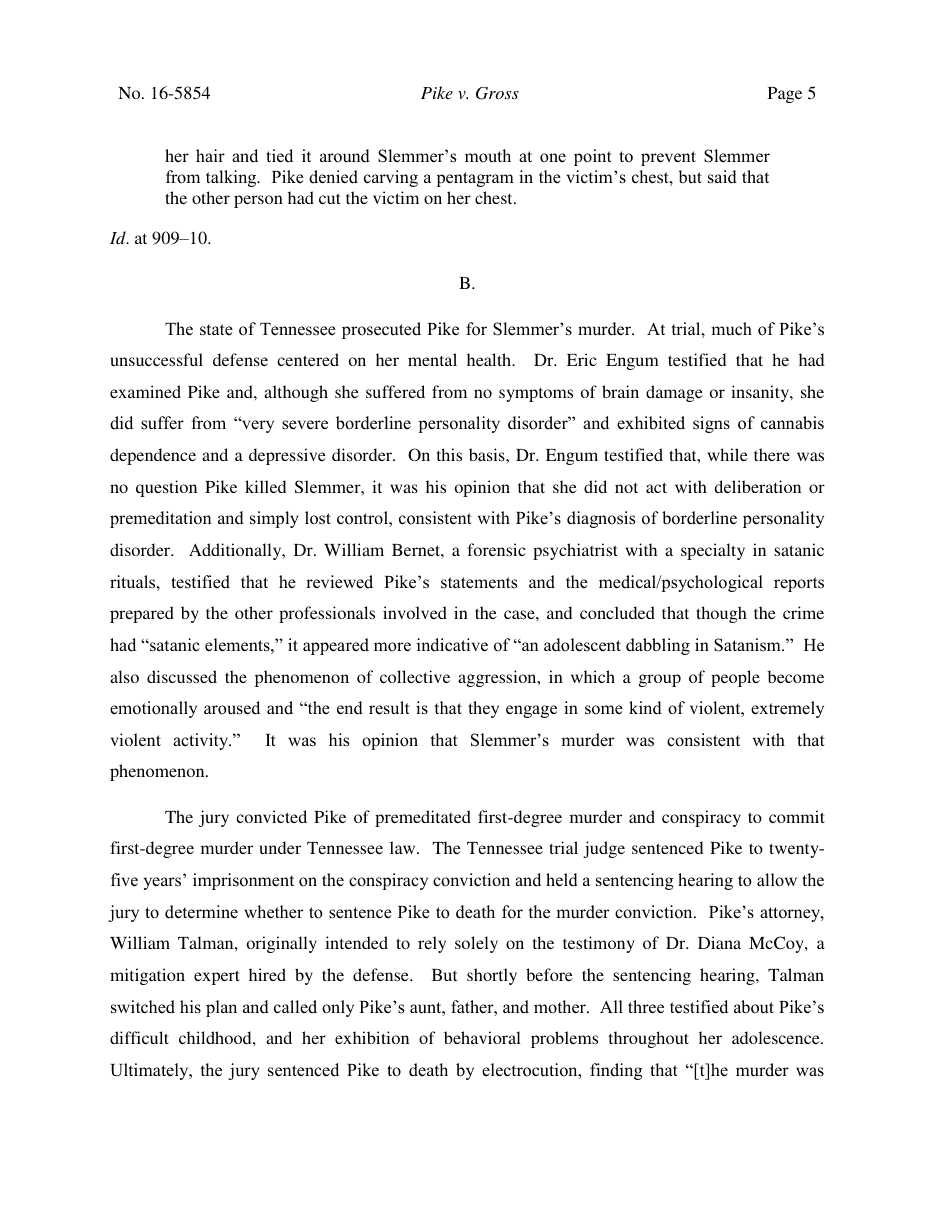
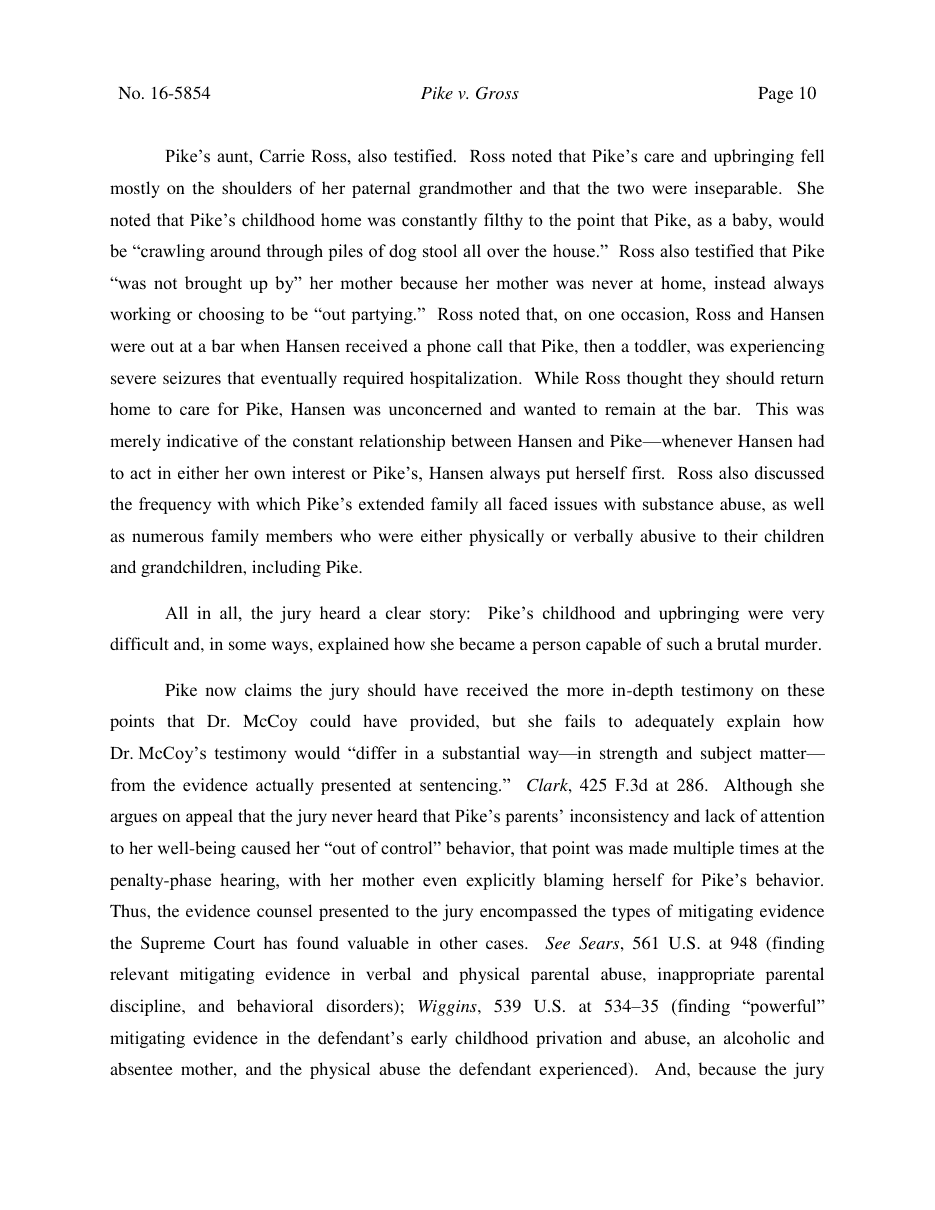
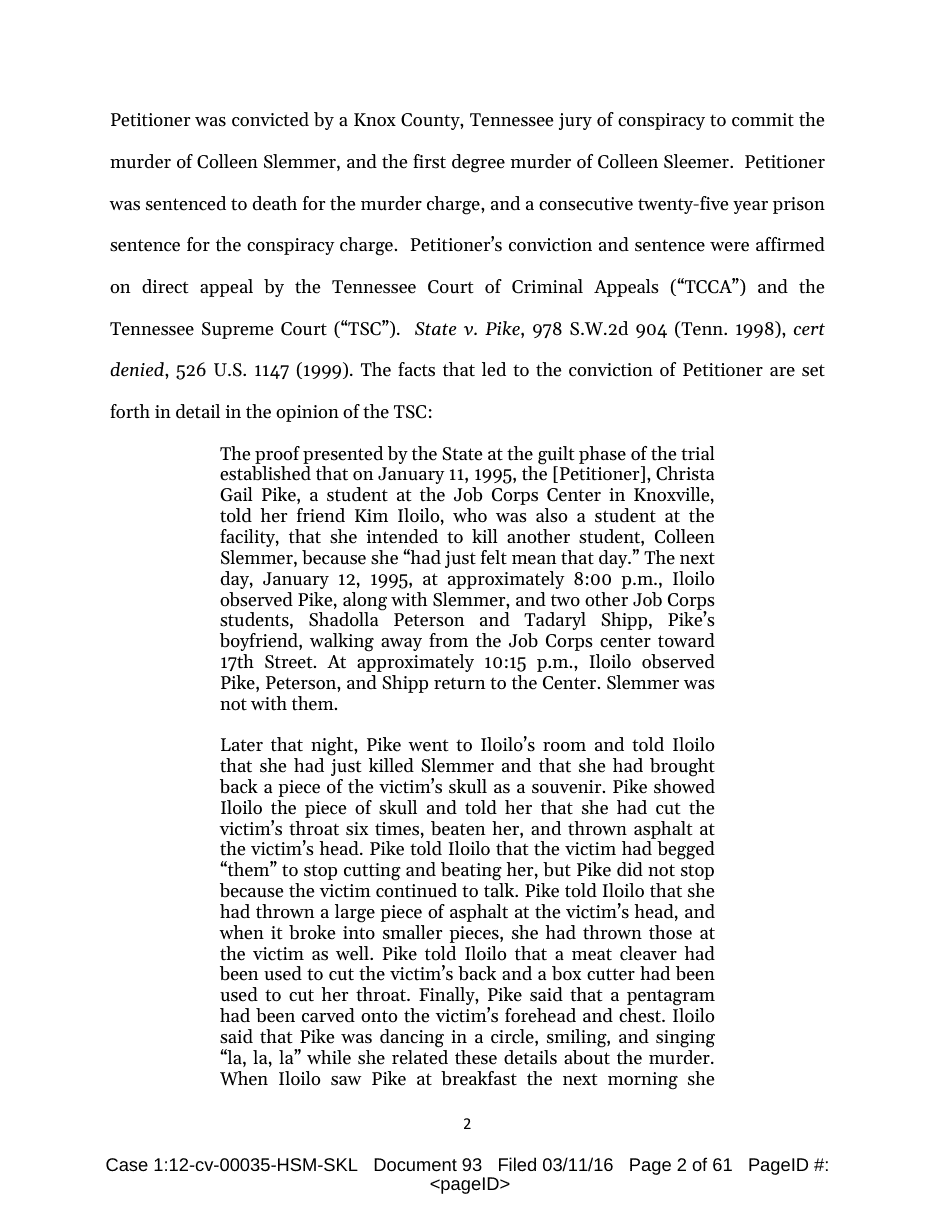
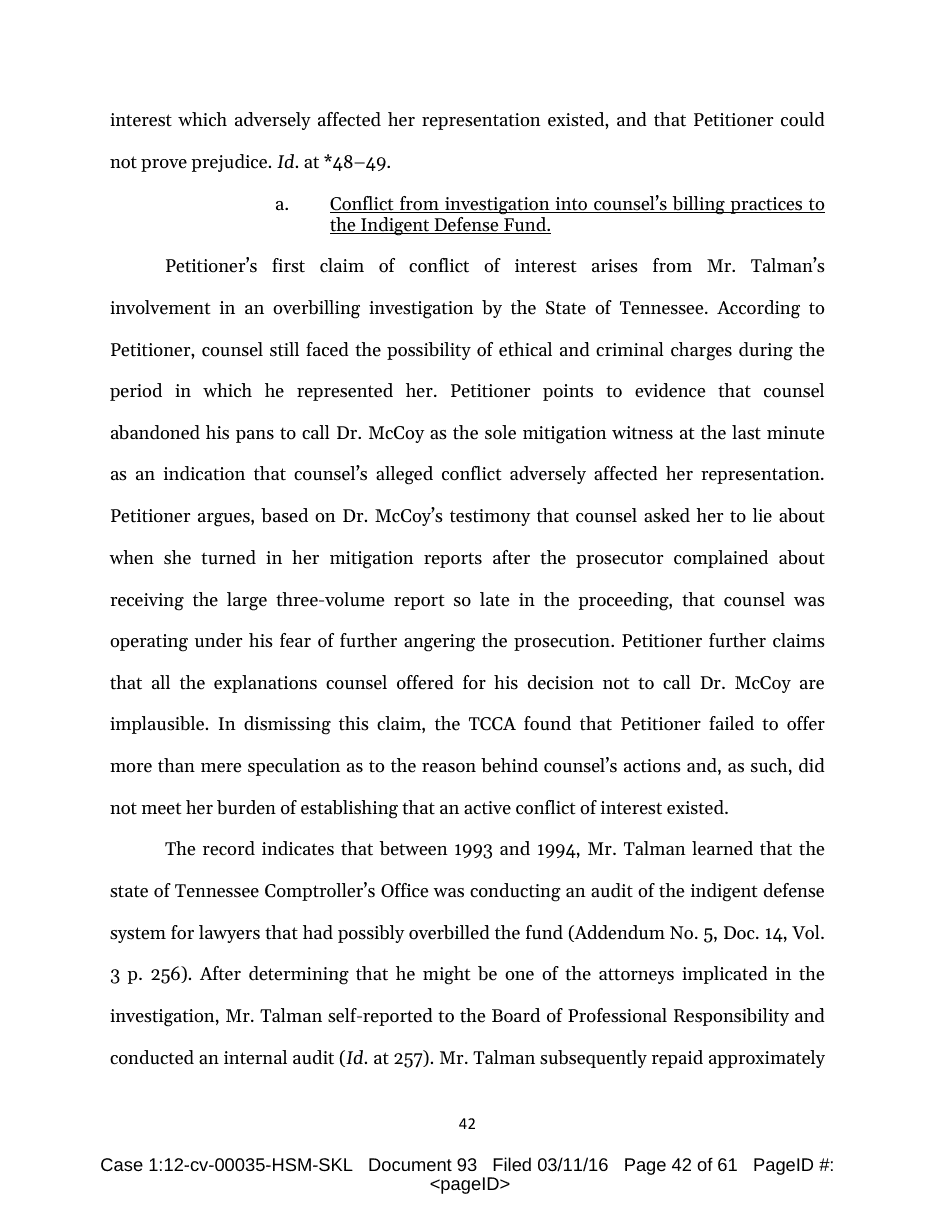
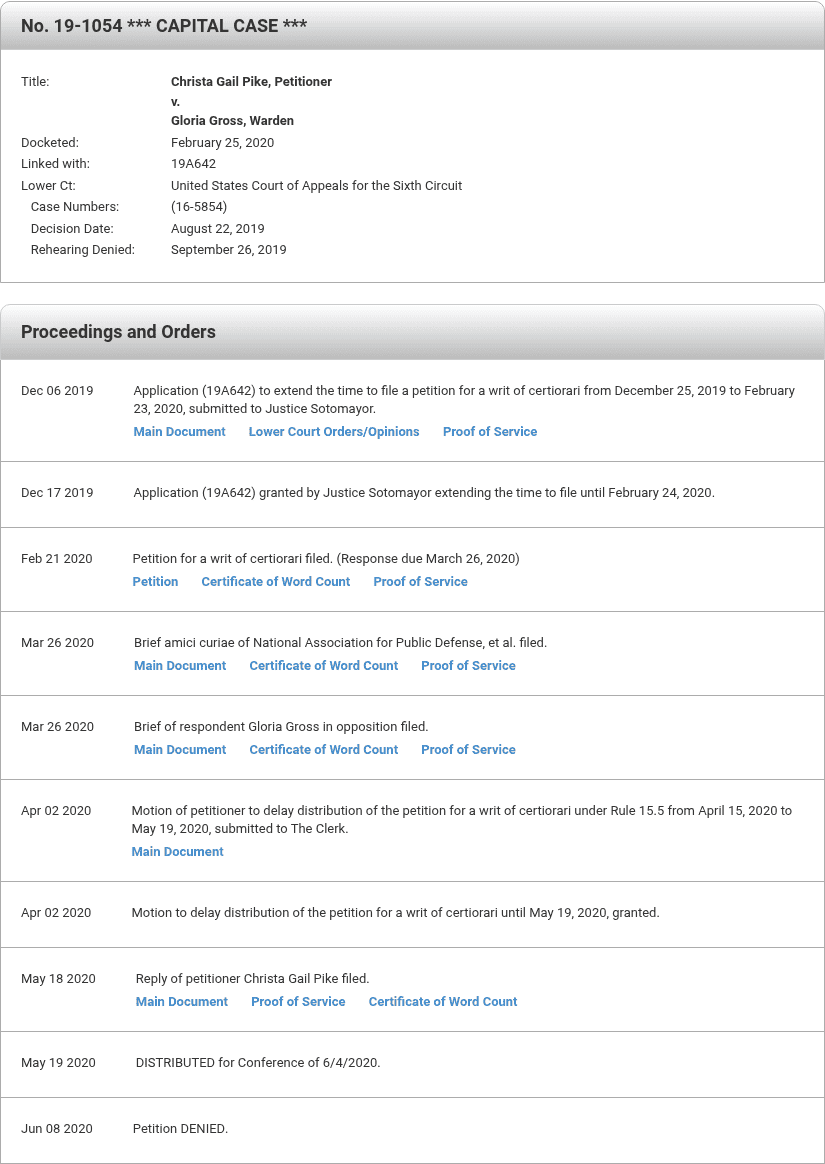
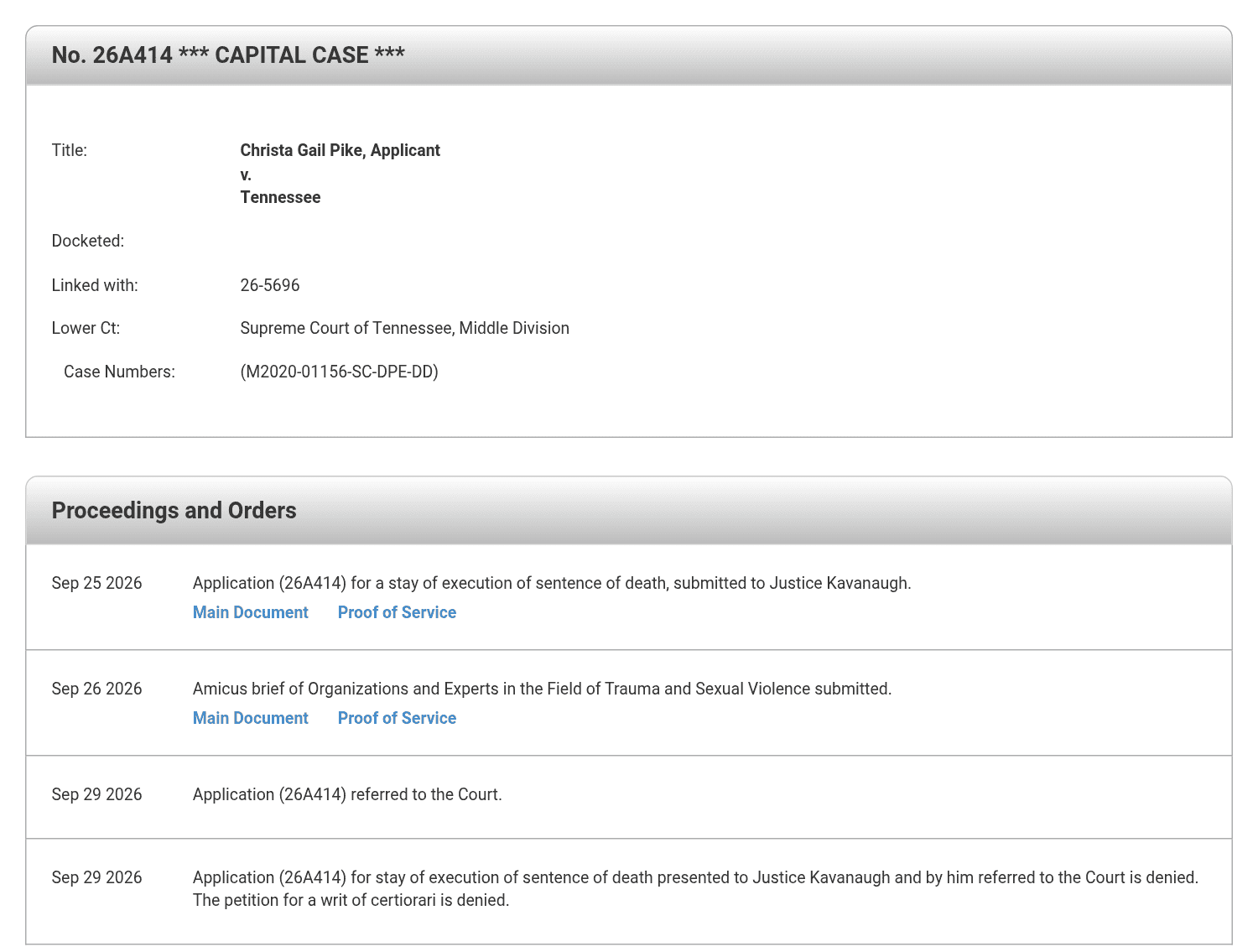
What is established, and what is still disputed?
Record check · yellow = disputed, unresolved or unknown
| Claim | Status | Basis |
|---|---|---|
| Pike, Shipp and Peterson walked Slemmer away from the Job Corps center on Jan. 12, 1995, and returned without her. | ESTABLISHED | Eyewitness Kim Iloilo at trial; Shipp’s statement differs on the times.17 |
| Pike beat, kicked and cut Slemmer and struck her with rocks, by her own recorded statement. | ESTABLISHED | 46-page statement, Miranda waived; summarized by the Tennessee Supreme Court.2728 |
| Cause of death: blunt force injuries to the head; Slemmer alive and probably conscious. | ESTABLISHED | Dr. Sandra Elkins’ autopsy testimony. “Drowning in her own blood” was removed as unsupported.2 |
| Pike kept a piece of Slemmer’s skull, which fit the reconstructed skull. | ESTABLISHED | Iloilo and Wilson testimony; jacket chain of custody; Drs. Elkins and Marks.1223 |
| Who carved the pentagram. | DISPUTED | Pike denied it; Shipp’s statement says he and Pike did; he later testified that he did it with the box cutter.2879 |
| Peterson cut and struck the victim. | DISPUTED | Rests on Shipp’s statement. Peterson pleaded guilty as an accessory after the fact; no Peterson testimony appears in the TSC summary of Pike’s trial.729 |
| Prenatal alcohol exposure caused brain damage. | DISPUTED | Claimed by Pike’s lawyers. The trial expert found no brain damage; the post-conviction neurologist found a heterotopia and cited “some maternal factor.”222315 |
| The skull fragment was returned to Colleen’s mother. | DISPUTED | Pike’s lawyers say all pieces were returned; May Martinez says the fragment Pike took was lost.9 |
| Pike was the youngest woman sentenced to death in the U.S. modern era. | UNRESOLVED | “Youngest in Tennessee’s modern era” is supported (DPIC). CBS News states the national claim; not confirmed here against DPIC data.850 |
| Trial counsel William Talman was handling his first capital case. | UNRESOLVED | A claim by Pike and her legal team; not addressed in the court opinions reviewed.34 |
| The 2022 solitary-confinement lawsuit. | ESTABLISHED | Settled in September 2024. No court ruled the confinement unconstitutional.38 |
| Shipp’s parole. | ESTABLISHED | Denied in October 2025; next review October 2031.5314 |
| Execution of Christa Pike. | ATTEMPTED | Scheduled for 11:00 a.m. ET, Sept. 30, 2026. Stayed by the Sixth Circuit that day; the U.S. Supreme Court vacated the stay that evening, and Tennessee began the execution. Her attorneys and media witnesses reported she remained alive after two doses of pentobarbital; the state told a federal court medical care had begun. No time of death announced (as of 11:29 p.m. ET, Wednesday, September 30, 2026).455455565758 |
The full claim-by-claim fact-check (75 notes) and the revision changelog are kept off-page for editors.
What do readers ask most?
Short answers, sourced
Who is Christa Pike?
Christa Gail Pike, born in March 1976, was 18 when she and two other Knoxville Job Corps students killed 19-year-old Colleen Slemmer on January 12, 1995. A Knox County jury sentenced her to death in 1996. She has been the only woman on Tennessee’s death row for nearly all of the decades since.128
What did Christa Pike do to Colleen Slemmer?
By her own recorded statement, Pike beat and kicked Slemmer, cut her with a box cutter, including across the throat, and struck her in the head with rocks and asphalt behind a steam plant on the University of Tennessee agricultural campus. The medical examiner found that the cause of death was blunt force injuries to the head. Pike kept a piece of Slemmer’s skull.27282
Why did Pike receive the death penalty when her co-defendants did not?
Tadaryl Shipp was 17, which put a death sentence out of reach; he received life plus 25 years. Shadolla Peterson pleaded guilty as an accessory after the fact and received a six-year probationary sentence. The jury sentenced Pike to death after finding that the murder was especially heinous, atrocious or cruel and was committed to avoid prosecution.730
Who carved the pentagram into Colleen Slemmer’s chest?
It is disputed. Pike denied carving it and blamed “the other person.” Shipp’s statement to police said he and Pike carved it together, and he later testified that he did it himself with the box cutter.2879
Has Christa Pike been executed?
As of 11:29 p.m. ET, Wednesday, September 30, 2026, no time of death had been announced, and the Tennessee Department of Correction had issued no public statement on the outcome. Tennessee had scheduled her execution by lethal injection for 10:00 a.m. CDT (11:00 a.m. ET) on September 30, 2026. The U.S. Supreme Court denied a stay on September 29, and Gov. Bill Lee denied clemency on September 28. On September 30, the U.S. Court of Appeals for the Sixth Circuit stayed the execution; that evening, the U.S. Supreme Court vacated the stay, and Tennessee began a lethal-injection execution. Defense counsel and media witnesses reported that Pike remained alive after two doses of pentobarbital, and the state told a federal court that medical personnel had begun administering medical care.45105455565758
What happened to Tadaryl Shipp and Shadolla Peterson?
Shipp remains in prison. He was denied parole in October 2025, and his next review is set for October 2031. Peterson served a six-year probationary sentence, and her life since the case is not a matter of public record.147
Where do these facts come from?
Source ledger · numbered notes
State v. Pike, 978 S.W.2d (Tenn. Oct. 5, 1998), reh’g denied Nov. 23, 1998.
Trial evidence summaries, Pike’s recorded statement, autopsy testimony, aggravators, the undelivered letter and proportionality review.
Notes 1, 2, 3, 6, 12, 23, 24, 27, 28, 29, 30, 32
Open source ↗State v. Pike, No. 03C01-9611-CR-00408 (Tenn. Crim. App. Nov. 26, 1997).
The 1997 direct-appeal affirmance.
Notes 41
Open source ↗State v. Shipp, No. 03C01-9711-CR-00492 (Tenn. Crim. App., May 1998 session) (direct appeal; summarizing trial evidence and Shipp’s statement to police).
Shipp’s statement to police, Peterson’s plea and sentence, the “human sacrifice” testimony and Shipp’s sentence.
Notes 7
Open source ↗Pike v. State, No. E2002-00766-CCA-R3-PD (Tenn. Crim. App. July 15, 2004).
The 2004 ruling on Pike’s withdrawal of her post-conviction petition.
Notes 42
Open source ↗Pike v. State, 164 S.W.3d 257 (Tenn. May 12, 2005).
The 2005 holding that Pike could revoke her waiver.
Notes 43
Open source ↗Pike v. State, No. E2009-00016-CCA-R3-PD (Tenn. Crim. App. Apr. 25, 2011).
Birth and prenatal history, Dr. Pincus’ testimony, and Andrew Drace’s description of Job Corps (post-conviction record).
Notes 15, 16
Open source ↗Pike v. State, No. M2012-01640-CCA-R3-PC (Tenn. Crim. App. Sept. 30, 2013) (attempted murder of Patricia Jones).
The 2001 attack on Patricia Jones and the resulting conviction.
Notes 13
Open source ↗Pike v. Freeman, No. 1:12-cv-35, Memorandum Opinion, Doc. 93 (E.D. Tenn. Mar. 11, 2016).
Talman’s billing audit and self-report, the McCoy decision, and the penalty-phase opening statement.
Notes 35, 36, 37, 44
Open source ↗Pike v. Gross, 936 F.3d 372 (6th Cir. Aug. 22, 2019), reh’g denied Sept. 26, 2019.
The mitigation switch, the social history, and the aunt’s testimony about Pike’s infancy.
Notes 20, 21, 26, 33
Open source ↗In re Christa Gail Pike, No. 26-5864 (6th Cir. Sept. 30, 2026) (order; Griffin, J., dissenting).
The order staying the execution until further order of the court, and the dissent.
Notes 54
Open source ↗Nelsen v. Pike, No. 26A428 (U.S. Sept. 30, 2026) (order vacating stay; Sotomayor, J., joined by Kagan and Jackson, JJ., dissenting).
The order granting the State’s application and vacating the Sixth Circuit’s stay of execution; docket checked 11:29 p.m. ET, Wednesday, September 30, 2026.
Notes 55
Open source ↗Petition for a Writ of Certiorari, Pike v. Gross, No. 19-1054 (U.S. filed Feb. 21, 2020), pp. 4–7 (advocacy document; allegations cite the post-conviction record).
Abuse-history allegations drawn from the post-conviction record, attributed as Pike’s claims.
Notes 22
Open source ↗U.S. Supreme Court docket No. 19-1054 (petition denied June 8, 2020).
Certiorari denied June 8, 2020.
Notes 45
Open source ↗U.S. Supreme Court docket No. 26A414, linked with 26-5696 (Sept. 29, 2026 entry; checked 11:29 p.m. ET, Wednesday, September 30, 2026).
The Sept. 29, 2026 denial of the stay and certiorari; checked 11:29 p.m. ET, Wednesday, September 30, 2026.
Notes 5
Open source ↗Tennessee Department of Correction, “Execution Advisory & Media Guidelines: Christa Pike” (Sept. 14, 2026).
Execution date, time, place and method.
Notes 4
Open source ↗TN.gov, “TDOC and TBI Foil Escape Attempt” (Mar. 21, 2012).
The 2012 escape-plot announcement.
Notes 40
Open source ↗Tenn. Code Ann. § 40-35-322 (Acts 2016, ch. 988, § 1).
Text and scope of the 2016 biological-evidence preservation law.
Notes 48
Open source ↗Job Corps Oversight: Hearings Before the S. Comm. on Labor and Human Resources, S. Hrg. 104-12, 104th Cong. (Jan. 18–19, 1995) (opening statement of the Chairman, Sen. Nancy Landon Kassebaum).
The January 1995 Senate Job Corps oversight hearing.
Notes 19
Open source ↗Volopedia (University of Tennessee Libraries), “Job Corps Student Murdered on Agriculture Campus.”
The 1993 attack, the convictions, Peterson “turned informant,” and the 1995 closure.
Notes 18
Open source ↗Wikipedia, “Christa Pike” (accessed Sept. 30, 2026) (tertiary source; used only where attributed).
Used only where attributed in the text.
Notes 25
Open source ↗The Daily Beacon (University of Tennessee), “Merchants want Job Corps out” (Feb. 2, 1995).
Police assault figures and the merchants’ meeting.
Notes 17
Open source ↗Death Penalty Information Center, “Tennessee’s Execution of Christa Pike Would Make Her the First Woman to be Executed in the State in Over 200 Years.”
“Youngest woman sentenced to death in Tennessee’s modern era”; first woman executed in more than 200 years.
Notes 8
Open source ↗Death Penalty Information Center, “Governor Bill Lee Denies Clemency for Christa Pike…” (Sept. 2026).
Gov. Lee’s clemency denial.
Notes 51
Open source ↗BBC News, “Christa Pike execution: Tennessee governor rejects plea for clemency” (Sept. 28, 2026).
Gov. Lee’s clemency denial.
Notes 10
Open source ↗Nashville Banner, “Pike’s solitary confinement ends after settlement with state” (Sept. 17, 2024).
The 2022 solitary-confinement lawsuit and its 2024 settlement.
Notes 38
Open source ↗Nashville Banner, “As Christa Pike execution draws near, lawyers point to her past” (Sept. 14, 2026).
Colleen’s life and last phone call, the Carrboro assault, the dispute over the skull fragment, and Shipp’s later testimony.
Notes 9
Open source ↗WKRN, “Before TN executes Christa Pike, Colleen Slemmer’s mother remembers her daughter” (Sept. 2026).
May Martinez’s memories of her daughter.
Notes 11
Open source ↗WBIR, “Murder victim’s mother begs TN to release skull fragment” (Jan. 2015).
The state’s 2015 position on the skull fragment.
Notes 46
Open source ↗WUSA9/First Coast News, “Fla. mother wants murdered daughter’s skull after two decades” (Jan. 2015).
Martinez keeping Colleen’s ashes, and the remains mailed in a box.
Notes 47
Open source ↗UNILAD, “Christa Pike victim’s mother details 16-year battle to recover daughter’s remains” (Sept. 18, 2026) (quoting the documentary Christa Pike’s Last Fight to Stop Her Execution).
Martinez’s documentary account of recovering Colleen’s remains.
Notes 49
Open source ↗WVLT, “First board member recommends denying paroling man convicted in ‘Job Corps Murder’” (Oct. 8, 2025).
The parole board member’s vote on Shipp.
Notes 53
Open source ↗WVLT, “Board denies parole for man convicted in 1995 ‘Job Corps Murder’” (Oct. 21, 2025).
The board’s parole denial and Shipp’s next review date.
Notes 14
Open source ↗Florida Sun Journal, “Tennessee’s Lone Death Row Female is Scheduled for Execution Wednesday for 1995 Torture/Murder” (Sept. 26, 2026) (reporting claims by Pike and her legal team).
Claims by Pike’s legal team about counsel and a pretrial plea offer.
Notes 34
Open source ↗The Tennessean via Corrections1, “Tenn. female death row inmate challenges conviction” (2012).
The 2012 escape charges and Pike’s recorded prison calls.
Notes 39
Open source ↗Associated Press (Kim Chandler and Kristin M. Hall), “Tennessee prepares to execute a woman for a crime she committed at age 18,” via ABC News (Sept. 30, 2026).
Pike’s age and Shipp’s admission about the pentagram.
Notes 31
Open source ↗CBS News (Emily Mae Czachor), “What to know about Christa Pike, first woman to be executed in Tennessee in more than 200 years” (Sept. 29, 2026).
The pre-execution solitary requirement and the national “youngest” claim.
Notes 50
Open source ↗USA Today (Amanda Lee Myers), “Christa Pike out of appeals after Supreme Court denies execution stay” (Sept. 29, 2026).
The Supreme Court’s denial of the stay.
Notes 52
Open source ↗Tennessean (Kirsten Fiscus, Evan Mealins, Keith Sharon, Molly Davis and Liz Schubauer), Christa Pike execution live updates, including “Medical care given to Christa Pike after attempted execution” (Sept. 30, 2026; updated 11:11 p.m. ET).
The Supreme Court’s order and dissent, the execution attempt as media witnesses described it, the emergency motion, and Judge Corker’s order finding it moot after the state said medical care had begun.
Notes 56
Open source ↗WSMV (Li Cohen), “Attorneys for Christa Pike file emergency motion to halt execution after she was ‘still alive and snoring’ after receiving lethal injection” (Sept. 30, 2026).
The emergency motion’s account that Pike remained conscious, with a heartbeat and audible snoring, after both syringes of pentobarbital.
Notes 57
Open source ↗WVLT (Camruinn Morgan-Rumsey), “Tennessee death row inmate Christa Pike is still alive after receiving lethal injections, attorney says. Witnesses have questions” (Sept. 30, 2026).
Defense attorney Luke Ihnen’s account that Pike was alive after two syringes; media witnesses’ accounts; no TDOC statement.
Notes 58
Open source ↗Numbered notes
- State v. Pike, 978 S.W.2d 904, 908 (Tenn. 1998). www.courtlistener.com
- State v. Pike, 978 S.W.2d 904, 910–911 (Tenn. 1998) (testimony of Dr. Sandra Elkins). www.courtlistener.com
- State v. Pike, 978 S.W.2d 904, 913–914 (Tenn. 1998). www.courtlistener.com
- Tennessee Department of Correction, “Execution Advisory & Media Guidelines: Christa Pike” (Sept. 14, 2026). www.tn.gov
- U.S. Supreme Court docket No. 26A414, linked with 26-5696 (Sept. 29, 2026 entry; checked 11:29 p.m. ET, Wednesday, September 30, 2026). www.supremecourt.gov
- State v. Pike, 978 S.W.2d 904, 919–920 (Tenn. 1998) (proportionality review). www.courtlistener.com
- State v. Shipp, No. 03C01-9711-CR-00492 (Tenn. Crim. App., May 1998 session) (direct appeal; summarizing trial evidence and Shipp’s statement to police). www.courtlistener.com
- Death Penalty Information Center, “Tennessee’s Execution of Christa Pike Would Make Her the First Woman to be Executed in the State in Over 200 Years.” deathpenaltyinfo.org
- Nashville Banner, “As Christa Pike execution draws near, lawyers point to her past” (Sept. 14, 2026). nashvillebanner.com
- BBC News, “Christa Pike execution: Tennessee governor rejects plea for clemency” (Sept. 28, 2026). www.bbc.com
- WKRN, “Before TN executes Christa Pike, Colleen Slemmer’s mother remembers her daughter” (Sept. 2026). www.wkrn.com
- State v. Pike, 978 S.W.2d 904 (Tenn. Oct. 5, 1998), reh’g denied Nov. 23, 1998. www.courtlistener.com
- Pike v. State, No. M2012-01640-CCA-R3-PC (Tenn. Crim. App. Sept. 30, 2013) (attempted murder of Patricia Jones). www.courtlistener.com
- WVLT, “Board denies parole for man convicted in 1995 ‘Job Corps Murder’” (Oct. 21, 2025). www.wvlt.tv
- Pike v. State, No. E2009-00016-CCA-R3-PD (Tenn. Crim. App. Apr. 25, 2011) (post-conviction; testimony of Carissa Henson and Dr. Jonathan Pincus). www.courtlistener.com
- Pike v. State, No. E2009-00016-CCA-R3-PD (Tenn. Crim. App. Apr. 25, 2011) (post-conviction testimony of former Job Corps student Andrew Drace). www.courtlistener.com
- The Daily Beacon (University of Tennessee), “Merchants want Job Corps out” (Feb. 2, 1995). utdailybeacon.com
- Volopedia (University of Tennessee Libraries), “Job Corps Student Murdered on Agriculture Campus.” volopedia.lib.utk.edu
- Job Corps Oversight: Hearings Before the S. Comm. on Labor and Human Resources, S. Hrg. 104-12, 104th Cong. (Jan. 18–19, 1995) (opening statement of the Chairman, Sen. Nancy Landon Kassebaum). www.govinfo.gov
- Pike v. Gross, 936 F.3d 372, slip op. at 9 (6th Cir. Aug. 22, 2019). www.opn.ca6.uscourts.gov
- Pike v. Gross, 936 F.3d 372, slip op. at 10 (6th Cir. Aug. 22, 2019) (aunt Carrie Ross’s post-conviction testimony). www.opn.ca6.uscourts.gov
- Petition for a Writ of Certiorari, Pike v. Gross, No. 19-1054 (U.S. filed Feb. 21, 2020), pp. 4–7 (advocacy document; allegations cite the post-conviction record). www.supremecourt.gov
- State v. Pike, 978 S.W.2d 904, 911–912 (Tenn. 1998). www.courtlistener.com
- State v. Pike, 978 S.W.2d 904, 913 (Tenn. 1998) (sentencing-phase evidence). www.courtlistener.com
- Wikipedia, “Christa Pike” (accessed Sept. 30, 2026) (tertiary source; used only where attributed). en.wikipedia.org
- Pike v. Gross, 936 F.3d 372 (6th Cir. Aug. 22, 2019), reh’g denied Sept. 26, 2019. www.opn.ca6.uscourts.gov
- State v. Pike, 978 S.W.2d 904, 909 (Tenn. 1998) (summarizing Pike’s recorded statement). www.courtlistener.com
- State v. Pike, 978 S.W.2d 904, 910 (Tenn. 1998). www.courtlistener.com
- State v. Pike, 978 S.W.2d 904, 907–908 (Tenn. 1998) (factual background). www.courtlistener.com
- State v. Pike, 978 S.W.2d 904, 917–918 (Tenn. 1998) (aggravating circumstances). www.courtlistener.com
- Associated Press (Kim Chandler and Kristin M. Hall), “Tennessee prepares to execute a woman for a crime she committed at age 18,” via ABC News (Sept. 30, 2026). abcnews.com
- State v. Pike, 978 S.W.2d 904, 926–927 (Tenn. 1998) (appendix: Court of Criminal Appeals opinion on the conspiracy sentence). www.courtlistener.com
- Pike v. Gross, 936 F.3d 372, slip op. at 5 (6th Cir. Aug. 22, 2019). www.opn.ca6.uscourts.gov
- Florida Sun Journal, “Tennessee’s Lone Death Row Female is Scheduled for Execution Wednesday for 1995 Torture/Murder” (Sept. 26, 2026) (reporting claims by Pike and her legal team). www.floridasunjournal.com
- Pike v. Freeman, No. 1:12-cv-35, Memorandum Opinion, Doc. 93, pp. 42–43 (E.D. Tenn. Mar. 11, 2016). www.govinfo.gov
- Pike v. Freeman, No. 1:12-cv-35, Memorandum Opinion, Doc. 93, pp. 25–26 (E.D. Tenn. Mar. 11, 2016). www.govinfo.gov
- Pike v. Freeman, No. 1:12-cv-35, Memorandum Opinion, Doc. 93, pp. 37–38 (E.D. Tenn. Mar. 11, 2016) (quoting counsel’s penalty-phase opening statement). www.govinfo.gov
- Nashville Banner, “Pike’s solitary confinement ends after settlement with state” (Sept. 17, 2024). nashvillebanner.com
- The Tennessean via Corrections1, “Tenn. female death row inmate challenges conviction” (2012). www.corrections1.com
- TN.gov, “TDOC and TBI Foil Escape Attempt” (Mar. 21, 2012). www.tn.gov
- State v. Pike, No. 03C01-9611-CR-00408 (Tenn. Crim. App. Nov. 26, 1997). www.courtlistener.com
- Pike v. State, No. E2002-00766-CCA-R3-PD (Tenn. Crim. App. July 15, 2004). www.courtlistener.com
- Pike v. State, 164 S.W.3d 257 (Tenn. May 12, 2005). www.courtlistener.com
- Pike v. Freeman, No. 1:12-cv-35, Memorandum Opinion, Doc. 93 (E.D. Tenn. Mar. 11, 2016). www.govinfo.gov
- U.S. Supreme Court docket No. 19-1054 (petition denied June 8, 2020). www.supremecourt.gov
- WBIR, “Murder victim’s mother begs TN to release skull fragment” (Jan. 2015). www.wbir.com
- WUSA9/First Coast News, “Fla. mother wants murdered daughter’s skull after two decades” (Jan. 2015). www.wusa9.com
- Tenn. Code Ann. § 40-35-322 (Acts 2016, ch. 988, § 1). law.justia.com
- UNILAD, “Christa Pike victim’s mother details 16-year battle to recover daughter’s remains” (Sept. 18, 2026) (quoting the documentary Christa Pike’s Last Fight to Stop Her Execution). www.unilad.com
- CBS News (Emily Mae Czachor), “What to know about Christa Pike, first woman to be executed in Tennessee in more than 200 years” (Sept. 29, 2026). www.cbsnews.com
- Death Penalty Information Center, “Governor Bill Lee Denies Clemency for Christa Pike…” (Sept. 2026). deathpenaltyinfo.org
- USA Today (Amanda Lee Myers), “Christa Pike out of appeals after Supreme Court denies execution stay” (Sept. 29, 2026). www.usatoday.com
- WVLT, “First board member recommends denying paroling man convicted in ‘Job Corps Murder’” (Oct. 8, 2025). www.wvlt.tv
- In re Christa Gail Pike, No. 26-5864 (6th Cir. Sept. 30, 2026) (order staying execution; Stranch, J., joined by Moore, J.; Griffin, J., dissenting). www.opn.ca6.uscourts.gov
- Nelsen v. Pike, No. 26A428 (U.S. Sept. 30, 2026) (order granting application to vacate stay of execution; Sotomayor, J., joined by Kagan and Jackson, JJ., dissenting); docket checked 11:29 p.m. ET, Wednesday, September 30, 2026. www.supremecourt.gov
- Tennessean (Kirsten Fiscus, Evan Mealins, Keith Sharon, Molly Davis and Liz Schubauer), Christa Pike execution live updates, including “Medical care given to Christa Pike after attempted execution” (Sept. 30, 2026; updated 11:11 p.m. ET). www.tennessean.com
- WSMV (Li Cohen), “Attorneys for Christa Pike file emergency motion to halt execution after she was ‘still alive and snoring’ after receiving lethal injection” (Sept. 30, 2026). www.wsmv.com
- WVLT (Camruinn Morgan-Rumsey), “Tennessee death row inmate Christa Pike is still alive after receiving lethal injections, attorney says. Witnesses have questions” (Sept. 30, 2026). www.wvlt.tv
Discover more from The Dark Side of Humanity
Subscribe to get the latest posts sent to your email.