FILE NO. 0109Case status Convicted
Aileen Wuornos
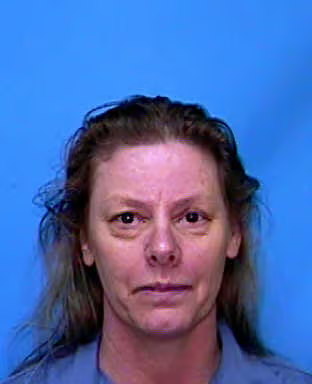
Between December 1989 and November 1990, seven men who crossed paths with Aileen Wuornos on Florida’s highways were shot and robbed. Six bodies were found in wooded pull-offs and rural roadsides across five counties. The seventh man, Peter Siems, was never found. The cases were tied together by small-caliber bullets, abandoned cars, pawned property, a storage unit, witness sketches and a palm print, and then by Wuornos’s own confessions. She first said every man had raped or tried to rape her. Over the following decade her accounts changed, and some of them admitted plain robbery.
Wuornos was convicted by a jury of murdering Richard Mallory and pleaded no contest or guilty to five more murders. She received six death sentences, dropped her remaining appeals after a court found her competent to do so, and was executed by lethal injection at Florida State Prison on October 9, 2002. This dossier sets out what the court record establishes, what depends on her changing statements, and where the sources disagree.
Case Facts at a Glance
- Attributed deaths: 7. Wuornos confessed to killing all seven men, and the Florida Supreme Court opinions and the Florida Commission on Capital Cases account for each of them.
- Murder convictions: 6. Mallory (jury verdict, January 27, 1992), then Spears, Burress, Humphreys, Carskaddon and Antonio (pleas). Each ended in a death sentence.
- Body not recovered: 1. Peter Siems. The Mallory opinion records that “Siems’ body has never been found,” and he was never the subject of a murder charge.
- Primary weapon class: .22 caliber. The Commission on Capital Cases quotes her confession describing a “.22 High Standard 9 shot single action revolver.”
- Main series: December 1989 to November 1990.
- Execution: October 9, 2002, lethal injection, pronounced dead at 9:47 a.m.
Case Overview
Where and when: Central and North Florida, December 1989 to November 1990. Seven men are attributed to Wuornos.
Six of the men were found shot in Volusia, Citrus, Pasco, Marion and Dixie Counties. Their cars turned up somewhere else, often in another county. Wallets were emptied, and tools, cameras, a radar detector, a gun and a ring passed through pawn shops or ended up in a storage unit rented under an alias. The seventh man, 65-year-old Peter Siems of Jupiter, disappeared in June 1990. His crashed car became the investigation’s turning point, but his body was never recovered and no one was charged with his death.
Wuornos’s explanation moved over the years. At first she said every man had raped or tried to rape her. At the Mallory trial she testified that he had tied her up, raped and tortured her, and she maintained that claim about Mallory alone in later court statements. By the end of her life she was describing robberies and killings that had no defensive purpose. This dossier keeps those accounts, the forensic evidence and the capital-case record apart.
Victim boundary: Richard Mallory, David Spears, Charles Carskaddon, Peter Siems, Troy Burress, Charles Humphreys and Walter Antonio are not supporting characters in an offender biography. Each is covered once, in full, in the victim section below.
Record Boundary
The case combines convictions, confessions, later reversals, media mythology and one presumed death without a body. Each category below is used consistently throughout the dossier.
- Court-established: Wuornos murdered Mallory, Spears, Carskaddon, Burress, Humphreys and Antonio, took or possessed their property, and received six death sentences. The Florida Supreme Court affirmed all six in four published opinions between 1994 and 1996.
- Corroborated series evidence: Similar small-caliber bullets, displaced vehicles, pawned property, a storage unit, witness descriptions, the Siems palm print and the revolver recovered from Rose Bay connected the cases beyond her confession alone.
- Confession-dependent: What happened inside each vehicle, whether each man threatened sexual violence, the order of the shots and some disposal details rest heavily on her changing accounts.
- Historically attributed: Peter Siems is treated as the seventh victim because of his car, the palm print, eyewitness evidence and her confession. No body was found and no murder charge followed.
- Disputed: Whether Mallory raped Wuornos, whether self-defense played any part in the later killings, and how far mental illness shaped her decision to waive appeals all remain contested.
- Excluded: A 2008 FBI behavioral analysis concluded that Wuornos did not kill James Weston Chambers, who was found shot in his car in Lee County in August 1984.
- Early over-attribution: Before the case narrowed, investigators looked at more deaths than the seven. A December 1990 FBI teletype counted “ten white males murdered or missing,” including a John Doe near the Georgia line. In January 1991 UPI listed Douglas Giddens of Georgia, an unidentified man found in south Georgia, and a missing Titusville man, Curtis Reid, among possible victims. None of them became part of the court record against Wuornos.
The Seven Victims
Each man is covered once here: who he was, his last known movements, the scene and autopsy record, how his case was linked to Wuornos, and how it ended in court. No public-domain photographs of the seven men are available, so none is shown. Newspaper crops are not used as substitutes.
Ages follow the controlling Florida Supreme Court opinion where it gives one, and otherwise contemporary reporting. Where sources disagree, the disagreement is stated. Many of the personal details below come from a set of victim profiles The Tampa Tribune published in December 1990, before Wuornos was identified. A copy of that page is kept in the FBI’s Wuornos file, and it is credited as “the Tribune profiles.”
| Name | Age | Last seen or reported missing | Body found | County of recovery | Legal outcome |
|---|---|---|---|---|---|
| Richard Mallory | 51 | November 30, 1989 | December 13, 1989 (car found December 1) | Volusia | Jury conviction; death sentence January 31, 1992 |
| David Andrew Spears | 43 | May 1990 | June 1, 1990 | Citrus | No-contest plea; death sentence May 15, 1992 |
| Charles Edmund Carskaddon | 40 | May 31, 1990 | June 6, 1990 | Pasco | Guilty plea; death sentence |
| Peter Abraham Siems | 65 | June 7, 1990 | Never found (car found July 4, 1990) | Marion (car) | Never charged |
| Troy Eugene Burress | 50 | July 30, 1990 | August 4, 1990 | Marion | No-contest plea; death sentence May 15, 1992 |
| Charles Richard “Dick” Humphreys | 56 | Reported missing September 11, 1990 | September 12, 1990 | Marion | No-contest plea; death sentence May 15, 1992 |
| Walter Jeno “Gino” Antonio | 62 (60 in early reports) | November 18, 1990 | November 19, 1990 | Dixie | Guilty plea; death sentence February 4, 1993 |
Richard Mallory
Who he was: A Clearwater television and electronics repair shop owner. His age is given as 51 in the Orlando Sentinel and the Chicago Tribune, and as 52 in the Tribune profiles and in UPI’s first report. His wife, Linda Mallory, met him at a party in July 1986 and married him five months later. She told the Tribune that “if he saw a woman in distress, he would stop and help her.” She also admitted he could be unpredictable: “Sometimes he was so sweet and 10 minutes later he would be the opposite.” Larry Horzepa, a Volusia County sheriff’s investigator, said he “kept to himself and was always pleasant.” The Chicago Tribune’s trial preview, citing court records, said his business was “steeped in debt.”
Last movements: According to the Tribune profiles, he closed his shop on November 30, 1989, and drove his 1977 Cadillac towards Daytona Beach. The FBI victim matrix also lists November 30 as the day he was last seen, and the Chicago Tribune dated his meeting with Wuornos to that Thursday. According to the Mallory opinion, a Volusia County deputy found his abandoned car on December 1, 1989. That same day Wuornos came back drunk to the Volusia County motel she shared with Tyria Moore and told her she had shot and killed a man “early that morning.” She said she had left his car near Ormond Beach and his body in a wooded area.
Scene and autopsy: His body was found on December 13, 1989, several miles from the car. The Orlando Sentinel reported that it lay “beneath a scrap of ratty, old carpet near Ormond Beach,” which matches her first confession that she covered him with a scrap of rug. The Florida Supreme Court found that he “had been shot several times, but two bullets to the left lung were found to have caused hemorrhaging and ultimately death.” The Commission on Capital Cases says he was shot four times and that his pockets had been turned inside out. The medical examiner found he had been drinking but could not say whether he was legally intoxicated. Sue Russell, who covered the case and later wrote a book about Wuornos, wrote in The Washington Post in 2004 that he was found “fully clothed, his pants zipped, his belt buckled,” and that a firearms expert testified a hole in the back of his sleeve showed the gun was fired from behind.
Case link: Wuornos pawned his camera and radar detector, according to the Commission on Capital Cases. The Mallory opinion records that a camera from his car was found in the storage unit she had rented under an alias, opened with a key taken from her. Other items from the car had been pawned or given away.
Legal outcome: Mallory’s was the only murder tried before a jury on guilt. Wuornos was convicted on January 27, 1992, and sentenced to death on January 31.
Evidence boundary: Mallory’s past is part of the record and part of the argument. Wikipedia, citing institutional records, says he was held for treatment from 1958 to 1962 after a charge of assault with intent to rape. Russell wrote that he had been convicted of a sexual assault at 19 but that his record had been clean for decades. That history makes Wuornos’s allegation one to take seriously. It does not prove what happened in the car. The jury rejected self-defense, and Justice Kogan wrote that the record presented “two quite different pictures” of her.
David Andrew Spears
Who he was: A 43-year-old concrete worker from Winter Garden and a father of three. According to the Tribune profiles, when Universal Concrete closed its Ocoee plant, he was the only one of its 45 employees offered a job at its Sarasota plant, as loading supervisor. He took it, staying in a rented trailer during the week and going home to his family at weekends. Roy Wright, the company’s general manager, called him “just as good, honest, hardworking and trustworthy as they come,” and “the kind of guy who would stop for a hitchhiker or help someone broken down on the road.” UPI later described him as “a Sarasota concrete company foreman.”
Last movements: The Tribune profiles say he disappeared on May 19, 1990, on one of those weekend trips home. His 1983 Dodge pickup was found on May 28 near Ocala, and the FBI matrix places it off Interstate 75 in Marion County.
Scene and autopsy: Officers found his body on June 1, 1990, in a remote area of southwest Citrus County. Except for a baseball cap he was nude, and a used condom was found nearby. The body was badly decomposed, and the Tribune profiles say a forensic dentist identified him from dental X-rays. A forensic anthropologist concluded that he died of six gunshot wounds to the torso.
Case link: His truck was found at a separate location, abandoned with a flat tire. His toolbox, clothing, a ceramic panther, the vehicle tag and the keys were missing.
Legal outcome: Wuornos pleaded no contest on March 31, 1992, and was sentenced to death in Citrus County case 91-112 on May 15, 1992.
Evidence boundary: Nudity and a condom are not proof of sexual assault, and decomposition limited what the soft tissue could show. What the court established is six torso wounds, remote disposal, missing property and a truck abandoned elsewhere.
Charles Edmund Carskaddon
Who he was: Charles E. “Sonny” Carskaddon, aged 40, of Prairie Home, Missouri, a part-time rodeo worker. UPI’s first report gave his age as 41. According to the Tribune profiles, he had given up cross-country trucking after developing glaucoma. He and his girlfriend, Peggy Hood, planned to return to his boyhood home in Missouri and marry once he had found work there as a press operator. His mother, Florence Carskaddon, said he liked the slower pace of life in the Midwest.
Last movements: He was last seen alive on May 31, 1990, when he left home on a trip to Tampa in his Cadillac. The Tribune profiles say he was going to pick up his bride-to-be. The FBI victim database printout and a newspaper clipping kept in the FBI file both identify it as a 1975 Cadillac.
Scene and autopsy: His body was found on June 6, 1990, in a secluded area of Pasco County, covered by an electric blanket and a large amount of uprooted tall grass. It was badly decomposed. In the Carskaddon opinion, the medical examiner recovered eight small-caliber bullets (the opinion prints “.20 caliber”) from regions that could each cause death, and she could not say which one was fatal. Decomposition also meant his true height and weight at death could not be determined.
Case link: His car and its contents were found separately on June 6 or 7, 1990. The Florida Highway Patrol red-tagged it, it was towed away on June 13, and sheriff’s officers later recovered it. Witnesses had seen Wuornos in possession of his car, and she had pawned a gun identified as his.
Legal outcome: Wuornos pleaded guilty in Pasco County case 91-01232 and waived a penalty-phase jury, mitigation and her own presence. The trial judge sentenced her to death. The Florida Supreme Court struck the cold, calculated premeditation finding but upheld the sentence on September 21, 1995.
Evidence boundary: The bullet count differs between court documents, as the pathology section below explains. This dossier uses eight, the figure from his own case. The Tribune profiles also report that his car was found “stripped and burned” near Wildwood on June 9. That does not match the dates and red tag in the court record, so the Carskaddon opinion’s account is followed.
Peter Abraham Siems
Who he was: A 65-year-old former merchant seaman from Jupiter who worked as a missionary for the Christ is the Answer Crusade, an evangelical organisation. Bill Lowery of the Crusade told the Tribune, “He would give you the shirt off his back. He was a real trusting soul.” His son, Stefan Siems, said he had given up hope that his father was alive. His niece, Suzanne Lewis, told the Orlando Sentinel in 1991, “My Uncle Pete was as gentle as a kitten. He wouldn’t hurt anybody.”
Last movements: A December 1990 FBI teletype says he was last seen on June 7, 1990, leaving his home in Jupiter to travel to Arkansas. An Ocala Star-Banner clipping kept in the FBI file says he was going to visit relatives there. The Mallory opinion says only that he left Jupiter in June 1990, and it gives New Jersey as his destination. The sources disagree on where he was going.
Scene: No body was recovered, so there is no autopsy. On July 4, 1990, his car crashed in Orange Springs, in Marion County. The Star-Banner clipping identifies it as a 1988 gray Pontiac Sunbird and says it was wrecked near Church Street, about a mile southeast of Orange Springs. The two women then drove it three or four miles and abandoned it on County Road 315 between Orange Springs and Fort McCoy. The FBI teletype says one of the women was “cut slightly, leaving blood on the abandoned vehicle,” which was preserved for evidence. The Tribune profiles say a paramedic and a firefighter offered the two women medical care and later described them to investigators.
Case link: Witnesses identified Moore and Wuornos as the two people seen leaving the car. A palm print on the interior door handle matched Wuornos.
Legal outcome: No charge was filed. The Orlando Sentinel reported in December 1991 that Siems was still officially listed as “missing and endangered.”
Evidence boundary: The palm print proves she was in his car. It does not by itself prove when, where or how he died. He is historically attributed on the strength of the car, the eyewitnesses, the print and her confession.
Troy Eugene Burress
Who he was: A 50-year-old delivery driver from Ocala and a father of two, who drove a refrigerated truck for the Gilchrist Sausage Co. The Chicago Tribune gave his nickname as “Buddy.” His wife, Sharon Burress, told the Tribune that company policy barred drivers from picking anyone up, but that he would stop for anyone who seemed to need help: “He never knew a stranger, which might have been his downfall.” His sister, Letha Prater of Micanopy, also spoke for the family.
Last movements: He vanished while making deliveries on July 30, 1990. The Tribune profiles say he left Ocala early that morning with 1,000 to 1,500 pounds of smoked sausage, on a route through the Ocala National Forest with stops at Salt Springs, Fort McCoy and Citra, and that he made it only as far as Salt Springs. The FBI matrix notes he was last seen at a store in Seville. His truck was found the next day at the intersection of State Roads 40 and 19, with the keys and his delivery receipts missing.
Scene and autopsy: On August 4, 1990, campers found his body, according to the Tribune profiles. It lay in a wooded area along State Road 19 in Marion County, about eight miles from where the truck was abandoned. It was substantially decomposed. The autopsy showed he died of two gunshot wounds to the chest and back. A memo in the FBI file says the autopsy was done on August 5, 1990.
Case link: His wallet, credit cards and receipts were found, but his cash was gone. The separation of truck and body fits the wider pattern.
Legal outcome: Wuornos pleaded no contest on March 31, 1992, and was sentenced to death in Marion County case 91-463 on May 15, 1992.
Evidence boundary: No surviving public record shows how the encounter began: whether he stopped to help, whether sex was offered, or whether he was deceived some other way.
Charles Richard “Dick” Humphreys
Who he was: A 56-year-old from Crystal River, a former police chief of Sylacauga, Alabama, and a retired Air Force officer. The Tribune profiles call him a retired security officer, and the Orlando Sentinel called him “a retired Air Force major, an instructor in terrorist negotiations.” He was working as a child-abuse investigator for the state Department of Health and Rehabilitative Services, based in Sumterville. According to the Tribune, he and his wife Shirley had celebrated their 35th wedding anniversary over dinner the night before he died. She told the Sentinel, “He was not a hitchhiker picker-upper either. But he was a compassionate man.”
Last movements: The Tribune profiles say he was last heard from at about 4 p.m. on September 11, 1990, when he called his office to say he was on his way home. His family reported him missing that night. At 2:30 a.m. on September 12, five sheriff’s deputies came to his wife’s door.
Scene and autopsy: The next day two young boys found his body in an isolated area of Marion County. It was fully clothed, and the pockets were turned inside out. The autopsy, which a memo in the FBI file dates to September 13, 1990, found seven gunshot wounds “in a pattern consistent with someone twisting or turning while standing or lying on the ground.” The Florida Supreme Court added that he had bruises and abrasions and was shot “while in the act of twisting or writhing in a vain effort to avoid his attacker.”
Case link: His wallet and identification turned up about fifty miles away. His car was found behind an abandoned gas station on U.S. 90 at Interstate 10, and the Mallory opinion places it in Suwannee County. The Commission on Capital Cases says the car had been wiped clean and its tag and bumper sticker removed. UPI reported in January 1991 that investigators believed the handcuffs recovered from Rose Bay had come from the state caseworker. The Commission quotes her confession that she shot him extra times “to put him out of his misery.”
Legal outcome: Wuornos pleaded no contest on March 31, 1992, and was sentenced to death in Marion County case 91-304 on May 15, 1992. This was the only one of the three Marion and Citrus murders in which the judge found the killing heinous, atrocious or cruel.
Evidence boundary: The Mallory opinion’s summary of similar crimes says six shots. His own case, the Commission and his widow’s statement to UPI all say seven, and seven is used here.
Walter Jeno “Gino” Antonio

Who he was: A security guard and reserve deputy sheriff from Merritt Island. The Antonio opinion and the Tribune profiles give his age as 62, while the FBI matrix, UPI and the Orlando Sentinel said 60. According to the Tribune, he usually carried a gun but left his 9mm pistol at home on his last trip. His employer, Eagle Patrol and Security in Cocoa Beach, said he had finished top of his class in marksmanship. His fiancee, Alean Berry, said he was going to Alabama for a trucking job: “I wouldn’t let him go.” The Sentinel reported that his fiancee and her daughters had bought him a diamond ring before he vanished.
Last movements: According to the Antonio opinion, he left Cocoa on November 18, 1990, heading for Montgomery, Alabama. The fiancee’s account supports an Alabama destination. A December 1990 FBI teletype, though, says he was reported missing from Titusville on his way to Arkansas.
Scene and autopsy: The next day his body was found in a wooded area north of Cross City. The Antonio opinion says he was nude and “shot four times in the back with a .22 caliber gun.” The Mallory opinion describes the body as “nearly nude” and the wounds as “in the back and head.” The Tribune profiles say he was left naked except for his socks on a seldom-used hunting road.
Case link: His car was found five days later in Brevard County. The FBI teletype describes it as a maroon Pontiac Grand Prix recovered on November 24, 1990, and notes that Wuornos was seen driving a maroon General Motors car with no tag on November 18. She pawned his ring. The FBI matrix records that it was pawned in Daytona Beach on December 7, 1990, and that a thumbprint on the pawn ticket was identified as hers. Many of his belongings were found in her rented storage unit. Moore showed officers where Wuornos had thrown his pocket knife, handcuffs, flashlights and the murder weapon into a bay near where she had lived, and the items were recovered.
Legal outcome: Wuornos pleaded guilty in Dixie County case 92-52. The jury recommended death by seven to five, and she was sentenced on February 4, 1993, to death and a consecutive 17 years for armed robbery.
Evidence boundary: In her confession, Antonio showed a false police badge, demanded free sex and struggled with her; she shot him twice, and twice more after he insulted her. On appeal she argued he had contributed to his own death. The Florida Supreme Court rejected that, saying the mitigator covers a victim who knowingly joins a deadly transaction, “two persons participating in a duel,” not one who is surprised “with deadly force, as happened here under any construction of the facts.”
Subject File
This is a short offender profile. It does not treat trauma as destiny or a diagnosis as an explanation.
Identity: Aileen Carol Wuornos, born Aileen Carol Pittman on February 29, 1956, in Rochester, Michigan. Florida Department of Corrections number 150924. The Commission on Capital Cases lists the aliases Cammie Marsh Greene, Lori Kristine Grody and Susan Lynn Blahovec.
Livelihood: According to the Mallory opinion, she said she began prostitution at about 16, settled in Florida at about 20, and worked as a highway prostitute at least four days a week. She told investigators the work was dangerous and that customers had sometimes maced, beaten and raped her. That exposure to violence was real. It does not establish that every homicide was defensive.
Legal end state: One jury conviction, five pleas, six death sentences, a decade on death row, a court-approved waiver of her remaining appeals in April 2002, and execution by lethal injection on October 9, 2002.
Two things can be true at once. Wuornos suffered severe victimization and social abandonment, and the evidence supported repeated intentional killings and theft.
Early Life and Development
The mitigation record is extensive, but family witnesses disputed parts of it, so it should not be flattened into a single certain biography. Each statement below says which part of the record it comes from.
Court record (Mallory penalty phase): Her parents were divorced when she was born. Her biological father hanged himself in prison, where he was serving time for rape and kidnapping. Her mother abandoned her, and her grandparents adopted her. Her grandfather was an alcoholic who later killed himself. Her grandmother drank heavily and died of a liver disorder. Her brother died of cancer at 21.
Court record (school history): In junior high she began to show hearing loss, vision problems and trouble in school. Her IQ was measured at 81, “in the low dull-normal range.” School officials urged counseling and gave her a mild tranquilizer to try to improve her behavior.
Mitigation evidence: At about 14 she was raped by a family friend, according to the defense evidence summarized in the Mallory opinion. She waited six months before revealing she was pregnant, her grandparents blamed her, and her grandfather made her give the child up for adoption. Wikipedia dates the birth to March 23, 1971, at a home for unwed mothers. Her own account varied. She told her adoptive mother, Arlene Pralle, that the rapist was a stranger who picked her up while she was hitchhiking, and the Orlando Sentinel reported that version in 1991.
Rebuttal evidence: At the Mallory penalty phase her biological uncle and adoptive brother, Barry Wuornos, testified that the family had a “normal lifestyle” and was “a straight and narrow family.” He said he never saw his father beat Aileen, though she was sometimes spanked. In the Marion and Citrus cases, a Citrus County investigator who interviewed family members in Michigan testified that they denied any physical abuse at home.
Court-established background: She left home. When she tried to return, her grandfather refused to take her back, and she went onto the streets, into prostitution and alcohol and drug abuse. That history bears on vulnerability, attachment and impulse control. It does not mechanically produce homicide.
Contemporary reporting: The Orlando Sentinel reported in 1991 that her father, Leo Pittman, was in jail on a charge of raping a 7-year-old girl when he hanged himself, and that she dropped out of high school in the 10th grade. Her childhood friend Dawn Botkins told the paper, “I always thought Aileen would be involved in something like this, but I figured it would have been her who would have been the one killed.”
Adult History Before the Murders
Before the homicide series came a marriage, arrests, an armed robbery and years of roadside instability.
Brief marriage
According to Wikipedia, she hitchhiked to Florida in 1976 and married Lewis Gratz Fell, a 69-year-old yacht club president. Within weeks he had a restraining order against her after she hit him with his own cane, and the marriage was annulled on July 21, 1976, after about nine weeks. The Orlando Sentinel’s account of her statements to a psychiatrist agrees in outline: a marriage to a much older man “lasted only a month, because he beat her with his cane.” The two versions do not agree on who used the cane on whom, so that detail is left open.
Weapons and assault
A December 1990 FBI teletype describes her as having “an extensive criminal history with use of weapons,” including an earlier arrest with a .22-caliber revolver. Wikipedia records a 1976 arrest in Antrim County, Michigan, for throwing a cue ball at a bartender’s head. In the Marion and Citrus penalty phase, the State called a witness who said she had threatened to kill a man who gave her a ride. He had seen her gun, tricked her into getting out and driven away as she brandished it.
1981 armed robbery
The Orlando Sentinel reported that she robbed a convenience store clerk at gunpoint in Edgewater, in south Volusia County, botched the getaway and was arrested almost immediately. Wikipedia dates the arrest to May 20, 1981, the prison sentence to May 4, 1982, and her release to June 30, 1983. The two sources give different amounts for the money taken, so neither is used. The Mallory opinion lists “a 1982 robbery conviction” as her prior violent felony.
Aliases and mobility
She moved often, used several names, lived in motels and temporary rooms, and kept property in rented storage units. All of this slowed early cross-county linkage. The warrant used to arrest her in January 1991 had been issued in the name Lori Grody, according to Wikipedia.
Suicide attempts
The Orlando Sentinel, summarising her statements to a psychiatrist after the 1981 arrest, reported that she had attempted suicide six times, the last in 1978, when she was admitted to Halifax Medical Center in Daytona Beach with a gunshot wound to the abdomen. The same psychiatrist found “no indication of a thought disorder.”
Tyria Moore and the Recorded Calls
Moore was Wuornos’s partner, a witness, and a cooperating participant in getting the confession. She was never convicted of any homicide.
A four-and-a-half-year relationship
The Mallory opinion states that Moore and Wuornos “lived together as lovers for about four and a half years.” Moore worked as a maid, and Wuornos worked as a prostitute along Central Florida highways. Wikipedia says they met in 1986 at a Daytona Beach gay bar. Moore told police that after three of the deaths Wuornos came home with a different car, cash and other items, according to the Orlando Sentinel, and that Moore assumed they had come from sex work.
Moore heard at least some admissions. On the day Mallory’s car was found, Wuornos told her she had shot a man. The public record does not show Moore present at any shooting, and police said she was not involved.
Flight, cooperation and the calls
When media reports said police wanted two women, Moore became afraid and left. The Orlando Sentinel says she fled to her parents’ home in Ohio on December 3, 1990. A December 27, 1990, FBI teletype records Marion County investigators on their way to Ohio to follow up. The Mallory opinion says officers later reached her in Pennsylvania and that she agreed to return “in an attempt to clear herself of any wrongdoing.” Wikipedia says she cooperated in exchange for immunity from prosecution.
Back in Florida, Moore made recorded calls to Wuornos in jail. The Orlando Sentinel reported that Wuornos admitted the killings “after Moore coaxed her with tears and threats of suicide,” and quoted her: “I will not let you be involved in the picture. You’re not the one. … I am the one who did everything.” The Florida Supreme Court found that the exchanges “may have contained misstatements and exaggerations by both parties,” but that her will was not overborne by any official misconduct.
Florida Road Geography
The series crossed county lines and repeatedly separated each man, his body, his vehicle and his property.
Jurisdictional fragmentation

Bodies were found in Volusia, Citrus, Pasco, Marion and Dixie Counties. Vehicles and identification turned up in Marion, Suwannee and Brevard Counties and near Ormond Beach, and property went to pawn shops in other towns again. The FBI’s December 1990 teletype says the vehicles “have been located some distance from their bodies,” and an Ocala Star-Banner report in the FBI file says the investigation was “pooling resources from nine law enforcement agencies across the state.”
The Marion County Sheriff’s Office acted as lead agency, “inasmuch as this area seems to be the focal point of the investigation,” according to the FBI. The case moved quickly only once the Siems crash, the composite sketches, fingerprints and pawn records came together.
The corridors
The records name the roads: Interstate 75 and State Road 19 through Marion and Citrus Counties, State Road 40 through the Ocala National Forest, Interstate 4 between Tampa and Volusia County, U.S. 1 through Port Orange, and County Road 315 at Orange Springs. A January 1991 UPI report described the bodies as found “along the I-75 corridor.”
Dedicated Chronology
The record runs from her birth on February 29, 1956, through Mallory’s disappearance on November 30, 1989, her arrest on January 9, 1991, her last death sentence on February 4, 1993, and her execution on October 9, 2002. Each entry gives its date and the record it comes from.
- February 29, 1956: Born Aileen Carol Pittman in Rochester, Michigan (Commission on Capital Cases for the date; Wikipedia for the place).
- March 23, 1971: Gives birth to a son at a home for unwed mothers. The child is placed for adoption at her grandfather’s insistence (Wikipedia; Mallory opinion).
- 1976: Marries Lewis Gratz Fell in Florida. The marriage is annulled on July 21, 1976 (Wikipedia).
- May 20, 1981: Arrested for armed robbery of an Edgewater convenience store. Sentenced May 4, 1982, released June 30, 1983 (Wikipedia; Orlando Sentinel).
- 1986: Meets Tyria Moore in Daytona Beach (Wikipedia). They live together for about four and a half years (Mallory opinion).
- November 30, 1989: Richard Mallory leaves Clearwater for Daytona Beach and is last seen (Tribune profiles; FBI matrix).
- December 1, 1989: A Volusia County deputy finds Mallory’s abandoned car. Wuornos tells Moore she shot a man “early that morning” (Mallory opinion).
- December 13, 1989: Mallory’s body is found several miles away in a wooded area (Mallory opinion; Commission on Capital Cases).
- May 19, 1990: David Spears disappears on a weekend trip home (Tribune profiles). His body is found in Citrus County on June 1 (Mallory opinion).
- May 31, 1990: Charles Carskaddon leaves for Tampa. His body is found in Pasco County on June 6 (Carskaddon opinion).
- June 7, 1990: Peter Siems is last seen leaving Jupiter (FBI teletype; Ocala Star-Banner).
- July 4, 1990: Siems’s car is wrecked at Orange Springs. Two women are seen leaving it (Mallory opinion; FBI teletype).
- July 30, 1990: Troy Burress vanishes on his delivery route. His truck is found July 31 and his body August 4 (Marion and Citrus opinion).
- September 11, 1990: Dick Humphreys is reported missing. His body is found September 12 (Marion and Citrus opinion).
- November 18, 1990: Walter Antonio leaves Cocoa. His body is found north of Cross City on November 19, and his car in Brevard County on November 24 (Antonio opinion; FBI teletype).
- November 30, 1990: Investigators release sketches of the two women to newspapers and television (Orlando Sentinel).
- December 3, 1990: Moore leaves for her parents’ home in Ohio (Orlando Sentinel).
- December 7, 1990: Antonio’s ring is pawned in Daytona Beach, and a thumbprint on the ticket is later identified as Wuornos’s (FBI matrix).
- December 17, 1990: Marion County hosts a meeting on the series, with an FBI agent attending (FBI teletype).
- January 9, 1991: Wuornos is arrested at The Last Resort in Port Orange on an outstanding warrant (Orlando Sentinel; UPI).
- January 16, 1991: After the recorded calls, she confesses on videotape at the Volusia County Jail (Orlando Sentinel; FBI behavioral analysis).
- January 27, 1992: A jury in DeLand convicts her of Mallory’s murder after 1 hour and 35 minutes (Los Angeles Times; Commission on Capital Cases).
- January 30 and 31, 1992: The jury recommends death 12 to 0, and Judge Uriel Blount imposes it (Commission on Capital Cases).
- March 31, 1992: No-contest pleas in the Spears, Burress and Humphreys cases (Marion and Citrus opinion).
- May 7 and 15, 1992: A jury recommends death 10 to 2, and Judge Thomas Sawaya imposes three death sentences (Commission on Capital Cases; UPI).
- July 14, 1992: The Carskaddon penalty hearing opens with a defense letter calling her incompetent. Two court experts find her competent (Carskaddon opinion).
- February 4, 1993: Guilty plea and death sentence in the Antonio case after a 7 to 5 jury recommendation (Commission on Capital Cases).
- September 22, 1994, to May 9, 1996: The Florida Supreme Court affirms all six death sentences in four opinions (Justia).
- March 20 to 23, 2001: FBI behavioral analysts interview her on death row for nearly 40 hours over four days (FBI file).
- April 2001: She writes to the Florida Supreme Court asking to drop her lawyers and her appeals (Commission on Capital Cases).
- July 20, 2001: A circuit court finds her competent to waive (Commission on Capital Cases).
- April 1, 2002: The Florida Supreme Court approves the competency ruling, discharges her collateral counsel and dismisses her appeals (Commission on Capital Cases).
- September 5, 2002: Governor Jeb Bush signs the death warrant (Commission on Capital Cases).
- October 9, 2002: Executed by lethal injection at Florida State Prison and pronounced dead at 9:47 a.m. (UPI).
- January 11, 2008: The FBI’s Behavioral Analysis Unit concludes she did not kill James Weston Chambers (FBI file).
Gunshot Pathology and Count Conflicts
The court documents do not always agree on the number of wounds or bullets. The Mallory opinion of September 1994 summarised the other killings as similar-crimes evidence before most of those cases had their own appeals. Its figures sometimes differ from the later opinions that decided each case. This table shows each source and the figure used in this dossier.
| Victim | Mallory opinion (1994) | Victim’s own case opinion | Commission on Capital Cases | Used here |
|---|---|---|---|---|
| Richard Mallory | “Shot several times”; two bullets to the left lung caused fatal hemorrhage | Same opinion | Shot four times with a .22 “while sitting behind the wheel” | Shot several times; two left-lung wounds fatal. The Commission’s four is noted. |
| David Spears | Six bullet wounds to the torso | Six gunshot wounds | Six gunshot wounds | Six |
| Charles Carskaddon | “Nine small caliber bullets in his lower chest and upper abdomen” | Eight bullets recovered, all in potentially fatal regions | Shot eight times | Eight, from his own case. Nine appears in the Mallory opinion and in Wikipedia. |
| Peter Siems | Body never found | No case | No case | No autopsy |
| Troy Burress | Shot twice | Two gunshot wounds to the chest and back | Two gunshot wounds to the chest and back | Two |
| Dick Humphreys | “Shot six times in the head and torso” | Seven gunshot wounds | Shot seven times | Seven, from his own case |
| Walter Antonio | “Shot four times in the back and head” | “Shot four times in the back” | Four times in the back | Four in the back. The Mallory opinion’s “head” is noted. |
The Mallory opinion adds that “for the five bodies that were recovered, the bullets all bore similar characteristics,” but that “the grooving pattern was fairly common and could have come from weapons other than the one Wuornos used.” The ballistic evidence fits the series. It is not a unique match for every bullet.
Repeated gunfire bears on intent, control, movement, and whether an immediate defensive response is plausible. In the Mallory case, the State relied on her first confession: she shot him in the car, ran around the front as he stood up, and shot him again. In Humphreys’s case, the trial judge relied on the twisting wound pattern to find the killing heinous, atrocious or cruel. Neither proves the whole confrontation.
Modus Operandi
The series followed a recurring roadside sequence, with important variations. Not every encounter can be reconstructed from her confessions.
Roadside access
Wuornos hitchhiked or offered sex along the main routes. Marion County Sgt. Robert Douglas told UPI in January 1991 that “many of the men apparently stopped to help Wuornos who was posing as a motorist with car trouble,” and that some “may have been lured to wooded areas with the promise of sex.” Her own confessions describe sex-work encounters with Mallory and Antonio.
Isolation
The confessions and the scenes put the shootings at wooded pull-offs, logging and hunting roads, and dead-end streets, where witnesses were unlikely.
Gun control
She was armed in advance. The Antonio opinion notes that her account was “further undermined by the fact that she armed herself in advance.” Several victims were shot repeatedly, some from behind or while moving.
Property conversion and clean-up
The FBI’s December 1990 teletype set out the pattern investigators saw: the vehicles “have been wiped clean and identifying stickers and data were removed from the cars,” while identification and credit cards were usually left “near the bodies” and “any cash was missing.” Cars, tools, guns, cameras, a radar detector and a ring were taken, pawned, stored, given away or dumped.
Not a fixed ritual: The common practical elements are clear, but the evidence does not show one identical script. Clothing, wound count, concealment, vehicle handling and the threats she claimed all differed. The Florida Supreme Court made the same point in the Carskaddon appeal. It struck the trial judge’s finding that she “carefully and calculatingly selected this victim, stalked him and lured him,” because nothing apart from the improper use of the other killings supported it.
Vehicles, Property and Financial Trail
The most durable evidence often came after the bodies were found: pawn slips, abandoned cars, tools and a storage unit key.
Vehicle separation
Bodies and cars were usually left in different places, often in different counties. That delayed linkage and let Wuornos use a car for a while before abandoning it. According to Sue Russell’s account of Moore’s trial testimony, Wuornos drove Mallory’s car when the two women used it to move.
Pawn and gift network
Victim property entered ordinary commerce. Mallory’s camera and radar detector, Carskaddon’s gun and Antonio’s ring were pawned, and some of Mallory’s belongings were given away. Wikipedia reports that a fingerprint on a pawn receipt matched the print in Siems’s car, and the FBI matrix records a thumbprint on the ticket for Antonio’s ring.
Storage unit
A key taken from Wuornos opened a rented unit holding a camera from Mallory’s car and “a number of” Antonio’s belongings, according to the Mallory and Antonio opinions. The Orlando Sentinel reported in 1991 that investigators said the unit held property from six of the seven victims. The court opinions confirm only Mallory and Antonio.
Numbered Evidence Locker
Sixteen exhibits, each with what it is, what it shows, and where its limits lie.
| Exhibit | Item | Recovery | Status | Meaning | Limit |
|---|---|---|---|---|---|
| AWU-E01 | .22-caliber revolver | Rose Bay, south of the motel where Wuornos was staying, after Tyria Moore showed officers where it was | Physical / ballistic | Its grooves were similar to the markings on the fatal bullets. | An expert testified the grooves were “fairly common and could be found in other weapons.” |
| AWU-E02 | Bullets from the recovered victims | Autopsies across five counties | Comparative firearms evidence | Created a cross-county pattern of small-caliber shootings with similar characteristics. | Class characteristics only, as the Mallory opinion notes. |
| AWU-E03 | Mallory’s camera and radar detector | Pawn transactions and the storage unit | Property linkage | Put Wuornos in possession of items from his car after his death. | Strong corroboration of robbery. Does not settle how the shooting happened. |
| AWU-E04 | Rented storage unit | Opened with a key taken from Wuornos | Physical / documentary | Held property from Mallory and Antonio. | Rented under an alias. Press reports of property from six victims go beyond the opinions. |
| AWU-E05 | Pawn records | Florida pawn shops, including Daytona Beach | Financially documented | Linked Wuornos to Antonio’s ring and Carskaddon’s gun. | Show possession and disposal, not the moment of the killing. |
| AWU-E06 | Peter Siems’s 1988 Pontiac Sunbird | County Road 315, Orange Springs, after the July 4, 1990, wreck | Vehicle evidence | Witnesses saw two women leave it, and their descriptions produced the sketches. | The car was driven and handled after the wreck. |
| AWU-E07 | Wuornos palm print | Interior door handle of Siems’s car | Identification evidence | Directly linked her to the missing man’s car. | Does not by itself establish murder, because no body was found. |
| AWU-E08 | Composite sketches | Three groups of witnesses to the Siems wreck, per the FBI | Investigative lead | Released November 30, 1990, and generated hundreds of calls. | Composite likenesses are not forensic identifications. |
| AWU-E09 | Victim vehicles | Abandoned away from the body sites | Pattern evidence | Wiped, with stickers and tags removed, per the FBI and the Commission on Capital Cases. | Each car had its own recovery and contamination history. |
| AWU-E10 | Recorded telephone calls | Moore’s police-monitored calls to Wuornos in January 1991 | Admission evidence | Led to the confession and to her repeated insistence that Moore was not involved. | Emotional pressure and Moore’s own fear of prosecution are essential context. |
| AWU-E11 | Videotaped confession | Volusia County Jail, January 16, 1991 | Confession evidence | Gave scene narratives, self-defense claims and property admissions. | Given against the advice of a public defender who was present. Her accounts changed substantially later. |
| AWU-E12 | Antonio’s knife, handcuffs and flashlights | Recovered from the bay with the gun after Moore directed officers | Victim property | Corroborated the disposal of stolen property. | Show Moore knew where items were thrown. Do not establish that she took part in a killing. |
| AWU-E13 | Body-site coverings | Carskaddon scene; rug over Mallory | Scene evidence | Electric blanket, uprooted grass and a carpet scrap show concealment. | Cannot establish motive or the exact staging sequence. |
| AWU-E14 | Pockets and clothing | Mallory, Humphreys, Spears and Antonio scenes | Robbery / control evidence | Turned-out pockets, nudity and missing clothing fit a property-taking pattern. | Nudity is not automatic proof of sexual assault. |
| AWU-E15 | FBI victim matrices | Marion County fact sheets sent to the FBI in December 1990 | Investigative comparison | Put dates, vehicles, calibers, recovery and property data side by side. | Included unrelated deaths and missing persons before suspects were narrowed. |
| AWU-E16 | FBI 2008 Chambers review | Behavioral Analysis Unit 3 at Quantico | Exclusionary analysis | Compared a 1984 Lee County homicide with her seven known murders and concluded she did not commit it. | Behavioral analysis is advisory and based on probabilities, but the exclusion guards against over-attribution. |


The Multi-County Investigation
The case moved from separate roadside deaths to a single series through data comparison, press coverage and property evidence.
Separate agencies: Deaths were first handled in Volusia, Citrus, Pasco, Marion and Dixie Counties. Different vehicles, recovery dates and levels of decomposition hid the common offender.
The FBI picture in December 1990: On December 17, 1990, the Marion County Sheriff’s Office hosted a meeting attended by an FBI agent. Two days later it faxed fact sheets on each murder or missing-person case to the FBI’s Investigative Support Unit. The resulting teletype counted ten white men murdered or missing in Central Florida between April 15 and November 30, 1990, aged 39 to 65. Six had been shot with a .22, one with a small-caliber weapon that could have been a .22, and one with a .38 believed to be his own. The window as typed leaves out Mallory’s December 1989 death, although he appears on the FBI matrix pages.
Narrowing the suspects: A December 27, 1990, teletype names two prime suspects, notes that Wuornos had used “numerous aliases and identifications,” and says both women had stayed at the Fairview Motel in Port Orange until December 10, 1990.
Documentary corroboration: Investigators turned ordinary commercial records into a timeline of stolen property. The FBI matrix entry for Antonio, for example, ties a pawn ticket dated December 7, 1990, to a thumbprint identified as hers.
Evidence boundary: The FBI offered help with communications, comparative analysis and, much later, behavioral review. The case was not solved by profiling. Local investigators, witnesses, property evidence and her admissions solved it.
The Composite-Sketch Breakthrough
A crash in a missing man’s car produced the first public image of the two women investigators wanted.
What happened

According to the FBI teletype, the Siems car was seen “driving erratically on a limerock road in Orange Springs” on July 4, 1990, and “eventually crashed into a pole.” Three separate groups of people saw the two women and helped artists draw them. The FBI recorded one as about 5 feet 8 inches tall, in her late 20s, with straight blonde hair and “aggressive behavior,” and the other as about 5 feet 1 inch, heavy, with short dark hair. The Orlando Sentinel reported that the women refused treatment from paramedics and denied knowing anything about the crash.
The sketches did not go public until investigators suspected female offenders. The Orlando Sentinel dates the release to November 30, 1990. By mid-December, according to that paper, investigators had more than 800 leads, four of which gave them the names Tyria Moore and “Lee.” The FBI teletype from the same weeks records “in excess of 250 names” phoned in to the Marion County Sheriff’s Office. The two figures count different things, leads and names, and both are reported as given.
A coincidence in Ocala
An Associated Press story preserved in the FBI file reports that a month before the arrest, the Ocala mother of the California film producer Jackelyn Giroux recognized Wuornos from the sketches in a supermarket and handed her her daughter’s business card. The mother called police, but Wuornos had gone by the time they arrived. Marion County deputies confirmed the sighting report on December 4, according to the AP, which cited The Miami Herald.
Forensic boundary: Facial composites can focus an investigation. They are not scientifically precise matches. The decisive physical link to the Siems car was the palm print on the interior door handle.
Arrest and Interrogation
Wuornos was first held on an outstanding warrant. Only then was she confronted with a case built from vehicles, property, prints and Moore’s cooperation.

The Last Resort
The Orlando Sentinel reported that by January 8, 1991, two undercover officers watching the bars along U.S. 1 in Port Orange had spotted her inside The Last Resort, a biker bar. They watched her spend the night on a vinyl seat inside and arrested her the next day, January 9. UPI said the warrant was for “violating parole by carrying a concealed weapon,” and Wikipedia says it was issued in the name Lori Grody. The bar’s owner, Al Bulling, told UPI she “was not the type of woman you’d take home to mother.”
Moore located
Officers reached Moore in Pennsylvania, according to the Mallory opinion. She returned to Florida and made the recorded calls. The Florida Supreme Court noted she did so “in part because of Moore’s own fears of being prosecuted as an accomplice.”
Confession to protect Moore
On January 16, 1991, Wuornos confessed on videotape to investigators at the Volusia County Jail. The Mallory opinion records that when she said she wanted to talk, she also asked for a lawyer. An assistant public defender came and “strongly advised Wuornos against confessing both before and during her comments.” She went ahead anyway. The Commission on Capital Cases lists January 16, 1991, as the date of her arrest on the Mallory charge, and UPI reported that she was formally charged with his murder that week.
The FBI’s 2008 analysis compared that confession with what she told FBI interviewers in 2001 and found the information about her homicides “elementally the same.”
Confessions, Retractions and Changing Accounts
Her admissions are extensive, but they changed in motive, in the level of threat she described, in moral justification and in remorse. The Mallory opinion put it plainly: the statements “are inconsistent with each other on major points.”
First Mallory account (to police): Mallory picked her up while she was hitchhiking, and they went to a secluded wooded area for sex. They argued because he wanted sex after only unzipping his pants, and she felt he was going to “roll her” and rape her. She won a struggle over the bag holding her gun, told him “You son of a bitch, I knew you were going to rape me,” and he answered, “No, I wasn’t. No, I wasn’t.” She said she shot him at least once while he sat behind the wheel, then ran around the front of the car as he stood and shot him again, and twice more as he lay on the ground. Then she went through his pockets and covered him with a scrap of rug.
Later Mallory account (trial testimony): She now said they had talked, drunk and smoked marijuana for about five hours. Around 5 a.m. he refused to pay, whipped a cord around her neck, tied her hands to the steering wheel and violently raped her. Afterwards, she said, he told her “You’re dead, bitch. You’re dead,” and she got her gun in a struggle and shot him. Sue Russell wrote that Wuornos did not allege rape until she took the witness stand, “a full year after her original confession to police.”
Witness elimination: A law officer testified that she said she wanted Mallory dead because she “could not afford to be arrested,” which would have ended her work. The Marion and Citrus opinion records that “Wuornos herself stated in one of her confessions that she killed to eliminate witnesses.”
At the 1992 pleas: In her statement to the court when she pleaded no contest on March 31, 1992, she said, as quoted by Wikipedia, “I wanted to confess to you that Richard Mallory did violently rape me as I’ve told you; but these others did not. [They] only began to start to.” The Florida Supreme Court noted that during the colloquy she also said her religious beliefs required her to go to the electric chair.
Later admissions: When she asked to be executed, CNN reported, she said, “I killed those men, robbed them as cold as ice. And I’d do it again, too.” In July 2001 she said, “There is no point in sparing me. It’s a waste of taxpayers’ money.” Wikipedia reports that in an off-camera moment with the filmmaker Nick Broomfield she went back to self-defense, saying she simply could not stand death row any longer.
Editorial method: A detail from a confession is used only where it matches the scene, recovered property, a witness or a fact not then public. A changing confession can prove participation and still be unreliable about motive.
The Mallory Trial
The State used the pattern of the other killings to answer her claim of self-defense. The defense presented trauma, impairment and Mallory’s alleged violence.
Before trial
According to the Commission on Capital Cases, the Seventh Circuit public defender’s office was allowed to withdraw in March 1991, and an assistant public defender from the Fifth Circuit, Tricia Jenkins, was appointed. On December 13, 1991, the State’s motion to recuse the first judge, Gayle Graziano, was granted, and Judge Uriel Blount was assigned. The defense asked for a change of venue because of the publicity. The Florida Supreme Court later held that refusing it was within the trial court’s discretion, because every juror chosen agreed the publicity would not bias them.
The Chicago Tribune reported before trial that the defense might point to another early suspect, a Tampa-area woman who told police she had had sex with Mallory the night he disappeared. The State attorney’s office found the evidence against her insufficient to file charges.
Guilt phase
The trial was held in DeLand in January 1992. Under Florida’s Williams Rule, the State introduced evidence of the Humphreys, Siems, Antonio, Burress, Spears and Carskaddon cases. The Florida Supreme Court later held this was a proper use of similar-crimes evidence, because it was offered “to rebut Wuornos’ claims regarding her level of intent and whether she had acted in self-defense,” not merely to show bad character. Moore testified, property records were introduced, and Wuornos testified herself.
The defense proffered testimony from Mallory’s girlfriend, Jacqueline Davis, about his treatment of women. The Florida Supreme Court recorded that Davis said, apart from hearsay, that to her own knowledge “Mallory always had been gentle toward women,” and that the defense then chose not to call her before the jury.
At the end of the two-week trial, State Attorney John Tanner told the jury, “She has left you no reasonable choice except to find her guilty,” according to the Los Angeles Times. On January 27, 1992, the jury convicted her of first-degree murder and armed robbery after deliberating for an hour and 35 minutes. As the jurors filed out she said, “I am innocent,” and then, as her lawyers tried to restrain her, “I was raped!”
Penalty phase
The penalty phase began on January 28, 1992. Three defense psychologists concluded she had borderline personality disorder, causing extreme mental or emotional disturbance, with substantially impaired capacity and evidence of brain damage. Dr. Krop testified that she lacked impulse control and had impaired cognition. Dr. Toomer said she believed she was in imminent danger. The State’s psychologist, Dr. Bernard, agreed on borderline personality disorder but also diagnosed antisocial personality disorder, and found the impairment not substantial and the disturbance not extreme.
On January 30 the jury recommended death 12 to 0. On January 31 Judge Blount found five aggravating circumstances (a prior violent felony, murder during a robbery, murder to avoid arrest, heinous, atrocious or cruel, and cold, calculated premeditation) and one mitigating factor, borderline personality disorder. He sentenced her to death for the murder and to ten years for the armed robbery.
The 1994 appeal
The Florida Supreme Court affirmed on September 22, 1994. It found no discovery violation, held that the confession was voluntary because she “freely waived her rights and confessed, contrary to advice of counsel,” and found that some victim details in the similar-crimes evidence, such as “the religious activities of one victim,” were relevant because one confession had called that victim “the Christian guy.” The jury instruction on cold, calculated premeditation was the one the court had since found invalid, but the error was held harmless. The court also found that the trial judge should have weighed her alcoholism, her childhood and some impaired capacity in mitigation, and held that this error too was harmless. The U.S. Supreme Court denied review on April 17, 1995.
Justice Kogan wrote separately: “One of these pictures is of a woman who has lived a horrible life of victimization, violence, and little help from anyone, who later lashed out at one of her victimizers. The other is of a cold-blooded killer who lured men to their deaths to steal their property.” He concluded that the evidence supported the second view “as to this murder.”
The Remaining Cases and Six Death Sentences
Five more cases ended in pleas rather than guilt-phase trials.
| Case | Court and judge | Plea | Jury recommendation | Sentence | Florida Supreme Court |
|---|---|---|---|---|---|
| Spears (Citrus 91-112), Burress (Marion 91-463), Humphreys (Marion 91-304) | Fifth Circuit, Judge Thomas D. Sawaya | No contest, March 31, 1992 | Death, 10 to 2, May 7, 1992 | Three death sentences and 40-year robbery terms, May 15, 1992 | Affirmed October 6, 1994 |
| Carskaddon (Pasco 91-01232) | Sixth Circuit, Judge Wayne L. Cobb | Guilty, 1992 | Jury waived | Death | Affirmed September 21, 1995 |
| Antonio (Dixie 92-52) | Third Circuit, Judge Royce Agner | Guilty | Death, 7 to 5 | Death and 17 years for robbery, February 4, 1993 | Affirmed May 9, 1996 |
| Siems | None | None | None | None | Never charged |
Marion and Citrus: pleas, Pralle and three sentences
Wuornos pleaded no contest to all six counts on March 31, 1992, with her lawyer’s advice. She told the court she wanted to return to her cell and avoid the stress of another trial, and later waived her right to attend the penalty phase. Her main defense witness was Arlene Pralle, who had adopted her. Pralle testified that she wrote to Wuornos in prison after Jesus told her to, and she repeated hearsay about an abusive childhood. The State showed that Pralle “screened” media requests to Wuornos and had received a $7,500 fee for a broadcast appearance. It also called a Citrus County investigator who said relatives in Michigan denied any abuse.
The jury recommended death by 10 to 2. Judge Sawaya found four aggravating factors in each killing and a fifth, heinous, atrocious or cruel, for Humphreys. UPI reported that after the sentences were announced on May 15, 1992, Wuornos told the court, “Thank you, and I’ll be up in heaven while you all rot in hell.” Shirley Humphreys told UPI, “If God can forgive her, then he is much more magnanimous than I am. I’m glad it’s over.”
On appeal Wuornos argued that her plea was not voluntary and that her rambling in the colloquy should have prompted a competency evaluation. The Florida Supreme Court disagreed. It held that statements such as wanting to “get off this crooked, evil planet” were consistent with the religious conversion she claimed, and that “fervently held religious beliefs do not equate to serious instability.”
Pasco: the waived penalty phase
In the Carskaddon case she told the court she wanted to plead guilty while still saying she had killed every victim in self-defense. The judge warned her that a guilty plea would end any self-defense claim. On July 14, 1992, the day set for the penalty phase, the defense produced a letter from Dr. Harry Krop saying she was delusional and incompetent. Two court-appointed experts found her competent, though with a personality disorder. She then waived a penalty jury, mitigation and her own presence. She complained that “she already had five death sentences,” that male serial killers received only about two, and that she just wanted to go back to death row. At sentencing the judge threatened to bind and gag her. The State had dropped two aggravators, and the judge found three and no mitigation.
On appeal the Florida Supreme Court found the plea colloquy fell short of the procedural rule but caused no prejudice. It held that cold, calculated premeditation had been proved only through improper propensity evidence, and that her personality disorder should have been weighed. Because she herself had refused to present mitigation, and two strong aggravators remained, it found the errors harmless.
Dixie: Antonio
A Dixie County grand jury indicted her on April 16, 1992. She pleaded guilty, and a penalty jury recommended death by seven to five. The trial judge found four aggravators, including nine prior violent felony convictions, and five nonstatutory mitigators: antisocial and borderline personality disorders, possible physical abuse as a child, the suicides of her father and grandfather, her grandmother’s death as an alcoholic, and her mother’s abandonment of her as an infant. The Florida Supreme Court affirmed on May 9, 1996.
Mental Health, Trauma and Criminal Responsibility
The clinical findings were substantial, contested and legally mitigating. They are not a substitute for the evidence.
Borderline pathology
Every expert who examined her agreed she had a personality disorder, as the Carskaddon opinion notes. Three defense psychologists in the Mallory case diagnosed borderline personality disorder causing extreme mental or emotional disturbance.
Antisocial findings
The State’s expert, Dr. Bernard, also diagnosed antisocial personality disorder. In cross-examination the State used her inconsistent statements about the Carskaddon killing to suggest deliberate untruthfulness. The Florida Supreme Court held that “it is for the finder of fact to determine what motivated the inconsistency.”
Neurocognitive limits
The defense evidence included an IQ of 81, hearing and vision problems in childhood, alcoholism and possible brain damage. In the Antonio case, the trial court declined to rely on Dr. Krop’s testimony because it was equivocal and because she had not fully cooperated with him.
A diagnosis describes a pattern of functioning. It does not prove a person is violent, remove agency, or answer whether a particular shooting was defensive.
Appeals, Waiver and Competency
The last legal controversy was not guilt. It was whether she rationally chose to end review and accept execution.
Automatic and collateral review
The Florida Supreme Court affirmed each case on direct appeal: Mallory on September 22, 1994, Spears, Burress and Humphreys on October 6, 1994, Carskaddon on September 21, 1995, and Antonio on May 9, 1996. The U.S. Supreme Court denied review in each. Postconviction motions under Florida’s Rule 3.850 followed in every county from 1997. The Commission on Capital Cases noted that collateral counsel was trying to coordinate the cases “to avoid duplicative efforts.”
Competency to waive

In April 2001 she wrote to the Florida Supreme Court asking to drop her collateral counsel and the rest of her appeals. UPI later quoted a letter she wrote to the court in 2001: she “would prefer to cut to the chase and get on with the execution. Taxpayers’ money has been squandered and the families have suffered enough.” On June 13, 2001, the court cancelled oral argument set for October 2, consolidated her postconviction cases and sent them back for 90 days to the Seventh Judicial Circuit to decide her competency under Durocher v. State. On July 20, 2001, the circuit court found her competent. On April 1, 2002, the Florida Supreme Court approved that finding, discharged the Capital Collateral Regional Counsel and dismissed her appeals without further review.
In March 2001, before the competency hearing, FBI behavioral analysts interviewed her on death row at Broward Correctional Institution for nearly 40 hours over four days, as part of a research project on serial killers. Their later report said that, “in an effort to demonstrate her competency, she was willing and ready to speak with anyone who had an interest in her crimes.”
Execution-volunteer issue: Her later statements included paranoia and bizarre beliefs. UPI reported that on October 8, 2002, the day before the execution, the Florida Supreme Court turned down two appeals filed on her behalf arguing she was insane and not competent. Critics argue that deterioration and a wish to die undermined the voluntariness of her choice. The courts found the legal threshold met.
Execution at Florida State Prison
She was executed by lethal injection after waiving her remaining appeals.
October 9, 2002
Governor Jeb Bush signed the death warrant on September 5, 2002, setting the execution for October 9. According to UPI, a prison spokesman said she was woken at 5:30 a.m. and asked for a towel and washcloth. She declined the traditional last meal and was given a cup of coffee. She was strapped to a gurney with two intravenous lines in place, and 32 witnesses watched. She was pronounced dead at 9:47 a.m., six minutes after the injection began.
Her final statement, as UPI reported it: “Yes, I would just like to say I’m sailing with the rock, and I’ll be back, like Independence Day with Jesus. June 6, like the movie. Big mother ship and all, I’ll be back, I’ll be back.”
State Attorney John Tanner, who had prosecuted the Mallory case, told UPI that “she expressed in her last psychiatric examination relief that the electric chair had been abolished in the state of Florida.” She was the first woman executed in Florida since Judy Buenoano in March 1998. Wikipedia counts her as the second woman executed in Florida, and the tenth in the United States, since capital punishment resumed in 1976.
Mechanics and source limit
The 2002 Florida Statutes, section 922.10, provided that “a death sentence shall be executed by electrocution or lethal injection” and that the warrant “shall be read to the convicted person immediately before execution.” Wikipedia names the three drugs used as sodium thiopental, pancuronium bromide and potassium chloride. No Department of Corrections protocol document for her execution was opened for this edition, so doses and procedure are not given.
Media Rights, Documentaries and Commercial Pressure
From the arrest onwards, the case was surrounded by story contracts, paid appearances and ethical concerns about officials profiting from access.
An early rights deal
An Associated Press story preserved in the FBI file, citing The Miami Herald, reported that while she was held in the Marion County Jail, Wuornos signed a contract giving Jackelyn Giroux of Studio City, California, exclusive rights to her life story. According to that report, Giroux’s mother had met Wuornos in an Ocala supermarket a month before the arrest and handed her Giroux’s business card, and after the January 9 arrest an attorney called Giroux and the deal was worked out. In December 1991 the Orlando Sentinel reported that Giroux’s screenplay, Angel of Death, had been turned down for having too much about Wuornos’s past and not enough about the killings.
Police and film rights
The FBI file contains two 1992 teletypes from the Jacksonville office about the television series “FBI: The Untold Stories.” The first, dated September 30, 1992, said the local agencies had no objection to helping the producers. The second reported that on October 23, 1992, the producers had been told the Wuornos episode set for the 1993 season “would be untimely,” and asked that the story be withdrawn “until the present circumstances at the Marion County Sheriff’s Office are resolved.” Those circumstances, it said, involved “an allegation that one or more members of the Sheriff’s Office may have signed a contract with or been hired as a consultant by a company attempting to secure rights to film a TV movie based on the Wuornos case.”
Paid intermediaries
In the Marion and Citrus penalty phase, the State introduced evidence that Arlene Pralle had “screened” media requests to Wuornos and had received a $7,500 fee to appear on a broadcast show about the murders, according to the Florida Supreme Court. In the Carskaddon colloquy, Wuornos herself complained “about a movie portraying the various killings in which she was implicated.” UPI reported in May 1992 that she continued to accuse police officers, judges and attorneys of lying and scheming to sentence her to death “so they can make book and movie deals.”
Selling of a Serial Killer
The filmmaker Nick Broomfield directed two documentaries about her, “Aileen Wuornos: The Selling of a Serial Killer” (1992) and “Aileen: Life and Death of a Serial Killer” (2003). Wikipedia reports that she gave him a series of interviews in the weeks before her execution, and that in one interview, believing the cameras were off, she told him the killings had in fact been self-defense.
Monster and later retellings
The 2003 feature film Monster starred Charlize Theron as Wuornos, a performance that won the Academy Award for Best Actress, and Christina Ricci as a character based on Tyria Moore, according to Wikipedia. Sue Russell, writing in The Washington Post in 2004, identified writer and director Patty Jenkins’s source for the film’s rape scene as Wuornos’s own trial testimony, first given a full year after her original confession, and wrote that the account “simply didn’t match the physical evidence.” UPI’s execution report said her life had been chronicled in three books, two television movies and “a production by the San Francisco Opera.” Wikipedia instead credits the 2001 opera Wuornos, by Carla Lucero, to the Jon Sims Center for the Performing Arts at San Francisco’s Yerba Buena Center for the Arts, so the producer is left unresolved here.
Editorial standard: A dramatization is not a source. Film scenes, composite characters and recreated dialogue are never used here as proof of what happened in a victim’s car or at a body site.
Gender, Sex Work and the “First Female Serial Killer” Myth
The case became a cultural argument about women’s violence, male victimhood, and whose claims of self-defense are believed.
False novelty
Wuornos was repeatedly called America’s “first female serial killer.” In December 1991, Marion County Sgt. Bruce Munster told the Orlando Sentinel, “She’s the first female, acting alone, to be a predator, to seek out men to kill them.” State Attorney John Tanner told UPI in January 1991 that women accused of multiple killings “have not used firearms, have not gone about it in this manner.” Women had committed serial murder long before 1989, and UPI’s 2002 execution report itself pointed to a case from the early seventeenth century. What was unusual was a woman accused of repeatedly shooting adult male strangers in roadside encounters.
Sex-work context
Highway sex work exposed Wuornos to real risks of rape, robbery and beating. She told a psychiatrist in 1981 that she had been raped 10 to 12 times while hitchhiking, according to the Orlando Sentinel. That structural danger is necessary context. It does not make every claimed assault true, and it does not erase the pattern of taking property.
Justice Kogan’s concurrence in the Mallory appeal described women “forced into prostitution at a young age” as caught in a cycle where “early victimization leads to even greater victimization.” He added that “social awareness” does not decide the legal issues: “Whether Wuornos were male or female, the facts remain that the State’s theory of this case is sufficiently supported by the record.”
Male victims as full persons
Public storytelling sometimes treats the seven men as interchangeable clients, or assumes they were morally guilty because they stopped for her. Russell argued that, apart from the men found naked, “it’s just as likely that some were simply good Samaritans lending a helping hand.” In the Antonio appeal, the Florida Supreme Court rejected the argument that by seeking a prostitute’s services a victim “assumed the risk” of harm, comparing the narrow statutory exception to a duel.
Offender victimization without exoneration
Taking her childhood abuse and adult sexual vulnerability seriously does not require romanticizing her, denying the evidence, or turning murder into uncomplicated revenge.
Excluded Case Review: James Weston Chambers
This is a rare documented example of investigators testing a historical attribution and rejecting it.
Why the case was reviewed
James Weston Chambers was found shot to death in his car on August 11, 1984, on northbound Interstate 75 about a mile south of Corkscrew Road in Lee County, Florida. On May 3, 2007, the FBI’s Fort Myers office asked the National Center for the Analysis of Violent Crime to assess “the probability that Wournos murdered Chambers.” A timeline prepared by the Violent Criminal Apprehension Program “could place Wuornos traveling in the vicinity of the murder site during that period of time.”
Method
Behavioral Analysis Unit 3 worked from the Lee County Sheriff’s Office materials, the ViCAP timeline, FBI files on Wuornos, and recordings of the March 2001 death-row interviews. It compared Chambers’s death with her seven known murders, looking at approach, method, ritual and “signature,” which the NCAVC defines as “the extremely rare combination of M.O. and Ritual that allows one case to be linked to others.”
Conclusion
In its report dated January 11, 2008, the unit concluded “that James West Chambers was not murdered by Aileen” Wuornos. The file also points to evidentiary items that had not been tested for DNA. The case shows that proximity, the victim’s sex and an unsolved road-related death are not enough to assign a murder to a famous offender.
Victim and Family Impact
The seven cases left seven different circles of grief, uncertainty and legal closure.
Families waiting for news
Several families first learned of a death through a knock at the door after days or months of waiting. Shirley Humphreys told the Tampa Tribune, “As soon as I saw their shadows in the door, I knew what it was. You don’t spend 35 years married to a cop without knowing what that means.” Decomposition and recovery in different counties added delay. The Tribune reported in December 1990 that investigators had called in a forensic anthropologist and run a nationwide search of dental records to identify remains.
Families in court
Letha Prater, Troy Burress’s sister, told the Orlando Sentinel before the Mallory trial, “There are so many people who have rough childhoods. … All I know is what happened. Troy’s last moments on this Earth were horrible.” Shirley Humphreys said, “I don’t give diddly squat about her childhood. She took a big chunk out of my life and out of my children’s lives.”
Peter Siems’s unresolved absence
Siems’s family never received a body or a death scene. Jupiter Detective John Wisnieski told the Tribune, “He was your basic retiree who was going to do a little traveling. All of a sudden he just drops off the face of the earth.” His 17-year-old niece, Suzanne Lewis, told the Orlando Sentinel in 1991 that she would not want to decide Wuornos’s fate because she would feel badly if Wuornos were sentenced to the electric chair.
Media displacement
Her gender, her outbursts in court, her trauma history and her execution often overshadowed the men. Victim-centered reporting restores their work, relationships and final plans without sanitizing the evidence.
Unresolved Questions
Legal guilt is settled in six cases. Historical and forensic uncertainty remains.
Unresolved, Siems’s remains: Wuornos gave general information about disposal, but no body was found. A daylong search by about 30 officers south of Orange Springs, reported by the Ocala Star-Banner in a clipping preserved in the FBI file, found no “additional trace” of him. Time and terrain make recovery increasingly unlikely.
Disputed, the Mallory encounter: Mallory’s earlier sexual-offense history makes her allegation serious enough to examine, but no independent witness or surviving forensic record proves the encounter as she described it. The sleeve-hole evidence Russell reported points the other way.
Disputed, self-defense in the other cases: She maintained versions of attempted assault and later renounced them. Repeated property theft, back wounds and changing statements weakened the claim, but the plea cases never had a full guilt-phase test.
Forensic limit, the ballistics: The bullets shared class characteristics, but the court stressed that the grooving pattern was common. The revolver fits the series without uniquely matching every projectile.
Ethical question, the rights deals: Contracts and paid access created conflicts around investigators, intermediaries and family advocates. The FBI file documents the allegation against Marion County personnel but not its outcome.
Legal finding, clinical dispute: The courts found her competent to waive appeals. Critics point to paranoia, hostility, delusional statements and a possible wish for state-assisted death. The legal ruling does not end the psychiatric debate.
Not established, other cases: The FBI file documents other deaths considered during the investigation and one later formal exclusion. No other homicide has been established to the same evidentiary standard.
Forensic and Legal Glossary
Working definitions used throughout this dossier.
- Williams Rule
- A Florida evidence doctrine, from Williams v. State (Fla. 1959), that allows proof of other crimes or acts for a relevant purpose such as identity, plan or absence of mistake, and not simply to show bad character. Similar-crimes evidence shaped the Mallory trial.
- Court-established
- A fact accepted through a conviction, plea, sentencing order or appellate opinion.
- Confession-dependent
- A claim known mainly from Wuornos’s own shifting statements and not independently proved in every detail.
- Corroboration
- Independent evidence supporting part of a statement, such as a pawn record, palm print, recovered property or accurate knowledge of the scene.
- Chain of custody
- The recorded history of who collected, stored, transferred and tested an item. It determines how much confidence can be placed in later forensic interpretation.
- Modus operandi
- The practical actions used to gain access, control a victim, kill, take property and escape. The NCAVC describes it as “dynamic,” meaning it can change over time.
- Signature behavior
- Conduct beyond what is needed to commit the crime that may express psychological needs. The public record does not establish a unique ritual signature across the Wuornos cases.
- Borderline personality disorder
- A clinical diagnosis involving instability in relationships, identity, mood and impulse control. A diagnosis is not a legal excuse and should not be used as shorthand for violence.
- Antisocial personality disorder
- A diagnosis involving persistent disregard for the rights of others and for social norms. The State’s expert diagnosed it, while the defense experts emphasized impairment and trauma.
- Competency to waive appeals
- The legal capacity to understand the proceedings and knowingly give up counsel or postconviction review. It is a narrower question than whether someone is psychologically healthy.
- Execution volunteer
- A condemned prisoner who waives or tries to waive appeals so that the execution can go ahead. Mental-health concerns often complicate whether the choice is autonomous.
- Retrospective attribution
- Linking an old or uncharged death to an offender once later evidence appears. Peter Siems is historically attributed but was never the subject of a murder charge.
- Cold, calculated premeditation
- A Florida aggravating factor that requires a careful plan made in advance, heightened premeditation, and no pretense of moral or legal justification. It was upheld in the Mallory, Marion and Citrus, and Antonio cases and struck in the Carskaddon case.
- Rule 3.850 motion
- Florida’s procedure for postconviction relief after a direct appeal. Wuornos had 3.850 motions pending in several counties when she asked to drop her appeals.
Related Dark Side Files
- Women Serial Killers: Rare Offenders, Common Victims: what the research says about women who kill repeatedly
- Their Own Words: Female Killers, Confessions and Verified Statements: a source-checked archive of quotes and disputed attributions
- Christa Pike Case File: The Torture-Murder of Colleen Slemmer: another woman sentenced to death, in Tennessee
- Ted Bundy Case: The Damning Evidence That Finally Bit Back: a Florida death-penalty case
- Luis Garavito: The Case File of “La Bestia”: another file in the same dossier format
- The Case File Index: Every TDSH Dossier A to Z: every dossier-format file
Frequently Asked Questions
Who was Aileen Wuornos?
Aileen Carol Wuornos was born Aileen Carol Pittman on February 29, 1956, in Rochester, Michigan. She worked as a roadside prostitute along Central Florida highways and carried a gun. She used several aliases, which the Commission on Capital Cases lists as Cammie Marsh Greene, Lori Kristine Grody and Susan Lynn Blahovec. She was executed by lethal injection at Florida State Prison on October 9, 2002.
How many men did Aileen Wuornos kill?
Seven deaths are attributed to her: Richard Mallory, David Spears, Charles Carskaddon, Peter Siems, Troy Burress, Charles Humphreys and Walter Antonio. She was convicted of six murders and received six death sentences. Siems’s body has never been found and she was never charged with his death. His case rests on his car, her palm print on its interior door handle, witnesses and her own statements.
How were the victims killed?
Each recovered victim had been shot several times with a .22 caliber weapon, usually in the torso and in several cases in the back. The bodies were left in wooded or remote spots, and the men’s cars were abandoned separately, often in another county. Their property was kept, pawned, stored or given away.
How was Aileen Wuornos caught?
Witnesses saw two women leave Peter Siems’s car after it crashed at Orange Springs on July 4, 1990. Composite sketches released on November 30, 1990, brought in more than 800 leads, according to the Orlando Sentinel, and some of them named Tyria Moore and a woman called “Lee.” Wuornos was arrested at The Last Resort in Port Orange on January 9, 1991, on an outstanding warrant.
What role did Tyria Moore play?
Moore lived with Wuornos for about four and a half years. She left Florida in December 1990, was reached by officers in Pennsylvania, and returned to make recorded calls in which she urged Wuornos to confess. Wuornos confessed and insisted that Moore had nothing to do with the killings. According to Wikipedia she cooperated in exchange for immunity from prosecution, and she testified at the Mallory trial.
Did Aileen Wuornos kill in self-defense?
She claimed so, but her accounts kept changing. In her first confession she said Mallory had only threatened her. At trial she testified that he had tied her up and raped her. The jury rejected self-defense, and the Florida Supreme Court found the claim “largely controverted” by the facts and by the similar crimes evidence. When she later asked to be executed, CNN reported her saying, “I killed those men, robbed them as cold as ice. And I’d do it again, too.”
What sentences did she receive?
A DeLand jury convicted her of murdering Richard Mallory on January 27, 1992, after 1 hour and 35 minutes, and recommended death 12 to 0. She then pleaded no contest or guilty in the Spears, Burress, Humphreys, Carskaddon and Antonio cases and received a death sentence in each one. All six sentences were upheld on direct appeal.
When and how was Aileen Wuornos executed?
Governor Jeb Bush signed her death warrant on September 5, 2002. She was executed by lethal injection at Florida State Prison and pronounced dead at 9:47 a.m. on October 9, 2002, after a court found her competent to drop her appeals. According to UPI, she declined the traditional last meal and was given a cup of coffee, and 32 witnesses watched.
Was Aileen Wuornos the first female serial killer?
No. Investigators and prosecutors in 1991 described her as a new kind of offender, but women had committed serial murder long before 1989. What was unusual was a woman repeatedly shooting adult male strangers she met on the road.
Citations & Sources
Sources and Verification
Primary court opinions, federal files and government case records carry the most weight. Every source below was opened for this edition on October 17, 2026.
- Florida Supreme Court, Wuornos v. State, 644 So. 2d 1000 (Fla. 1994), Mallory: the controlling summary of the Mallory murder, confessions, similar-crimes evidence, mitigation and penalty. Justia
- Florida Supreme Court, Wuornos v. State, 644 So. 2d 1012 (Fla. 1994), Humphreys, Burress and Spears: scenes, wounds, pleas, the Pralle testimony and sentencing findings. Justia
- Florida Supreme Court, Wuornos v. State, 676 So. 2d 966 (Fla. 1995), Carskaddon: disappearance, concealment, bullets, the car, the waived penalty phase and the struck aggravator. Justia
- Florida Supreme Court, Wuornos v. State, 676 So. 2d 972 (Fla. 1996), Antonio: recovery, four back wounds, the confession, recovered property and mitigation. Justia
- Florida Commission on Capital Cases, inmate case history: case numbers, judges, sentence dates, appeal history, the competency proceedings and the warrant. Commission page
- FBI Records: The Vault, Aileen Wuornos Part 01: 121 pages, including the 1990 teletypes, victim matrices, newspaper clippings (among them the Tampa Tribune victim profiles and an Ocala Star-Banner report), the 1992 media-rights teletypes and the 2007 to 2008 Chambers review. Read from the released PDF. FBI Vault
- 2002 Florida Statutes, section 922.10: method of execution and reading of the warrant. Florida Senate
- Orlando Sentinel, December 8, 1991, “Childhood, police profile follow Wuornos to court”: background, the sketches, the arrest, the recorded calls and family statements. Orlando Sentinel
- Chicago Tribune, January 13, 1992, “Trial starts for alleged Florida serial killer”: trial preview, victim list and the judge. Chicago Tribune
- Los Angeles Times, January 28, 1992, “Woman Guilty in First of Seven Road Slayings”: the verdict and the deliberation time. Los Angeles Times
- UPI, January 19, 1991: the early victim list, the Rose Bay recovery and the arrest warrant. UPI
- UPI, May 16, 1992: the three Marion and Citrus death sentences. UPI
- UPI, October 9, 2002, “Serial killer Aileen Wuornos executed”: the execution time, final statement and witnesses. UPI
- Sue Russell, The Washington Post, February 8, 2004, “More of a Monster Than Hollywood Could Picture”: trial evidence and a critique of the film, read from the author’s archived copy. Author’s copy
- Wikipedia, “Aileen Wuornos”: used only for single, credited details: birthplace, the 1976 marriage, the 1981 to 1983 dates, the 1971 birth, the plea statement, the films and the execution drugs. Wikipedia
- Wikimedia Commons, Florida Department of Corrections photograph: public domain. Commons file page
Browse every case in the Case File Index
Discover more from The Dark Side of Humanity
Subscribe to get the latest posts sent to your email.