FILE NO. 0127Case status Unsolved
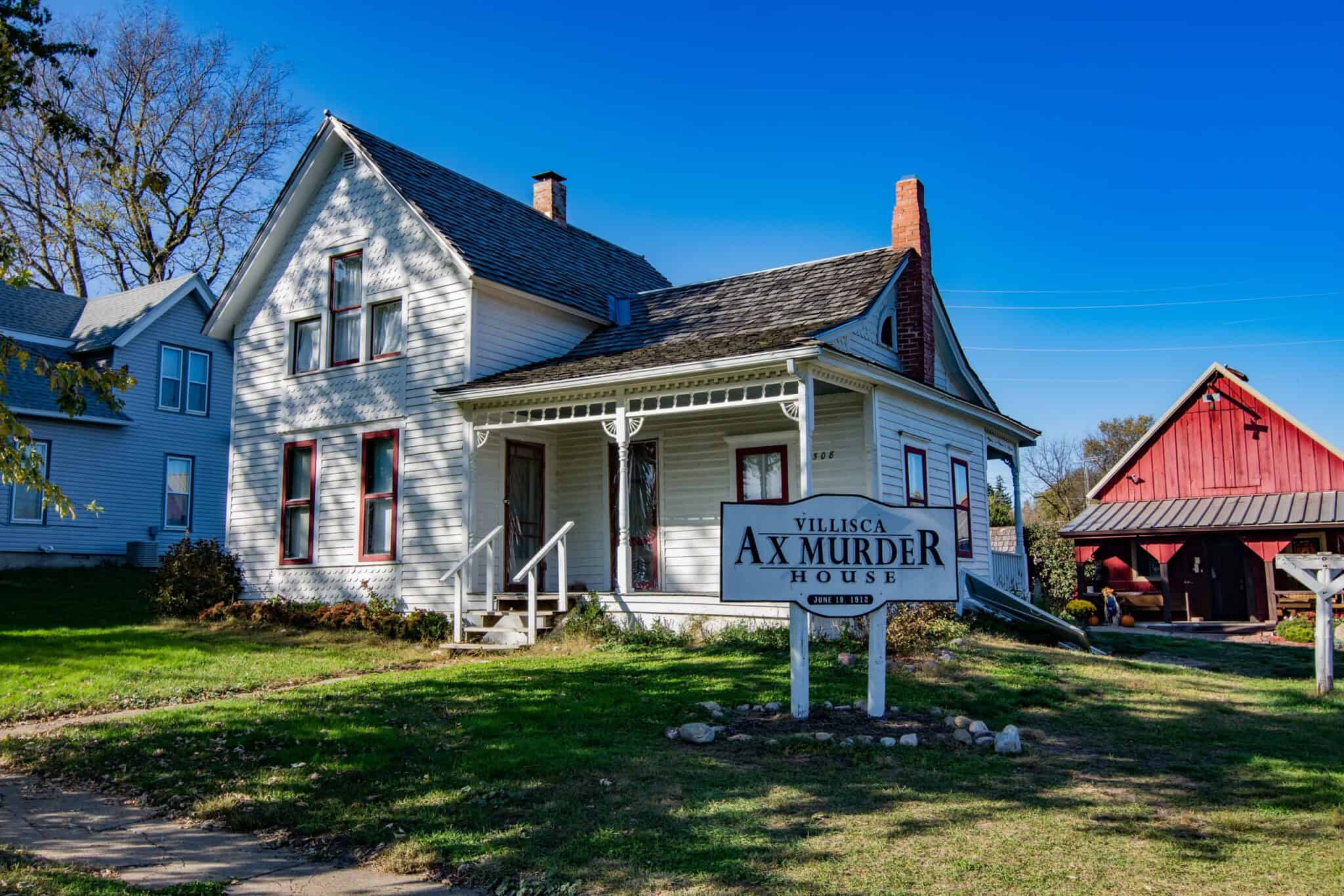
CASE FILE: Josiah B. & Sara Moore House / Villisca, Iowa.
Jurisdiction: Town of Villisca (Marshal Henry “Hank” Horton) → Montgomery County (Coroner L. A. Linquist; county officers) → State of Iowa (Attorney General’s office; Red Oak trials) → archival / historical research.
Address: 508 East Second Street, Villisca, Montgomery County, Iowa.
Status: Eight homicides. No conviction. Only defendant (Lyn George Jacklin Kelly) acquitted after two 1917 trials. Officially unsolved.
During the night of June 9 to 10, 1912, eight people were murdered inside the Moore family home in Villisca, Iowa. The victims were Josiah and Sarah Moore, their four children, and two young overnight guests, Lena and Ina Stillinger. All eight sustained severe cranial trauma inflicted with an axe associated with the Moore property.
Investigators struggled with extreme crime-scene contamination and competing theories. Traveling preacher Lyn George Jacklin Kelly was tried for Lena Stillinger’s murder after signing a confession he later said he did not remember making; he was acquitted in 1917. No suspect was ever conclusively linked to the scene by reliable physical evidence, and the homicides remain officially unsolved.
This dossier strengthens the forensic and documentary record: inquest testimony, period newspaper reporting of the Kelly confession and trials, National Register / NPS social-history context, Iowa legislative historical compilation, Smithsonian synthesis of the Midwest axe-murder cluster, and explicit separation of court-established facts, inquest-derived scene detail, and later rumor. It does not invent a killer.
Graphic forensic record: this page describes severe injuries to adults and children. Detail is included to document the evidence, not to turn the victims into spectacle.
Related unsolved dossiers: Who Put Bella In The Wych Elm? · Hinterkaifeck Murders
Current Villisca Case Status
| Field | Record |
|---|---|
| Last checked | September 21, 2026 (ET) |
| Case posture | Still unsolved |
| Living charged suspect | None publicly reported |
| Conviction | None |
| DNA / forensic breakthrough | No publicly reported breakthrough restoring a usable offender profile from authenticated 1912 exhibits |
| Recent attention | Historical lectures, authorship (incl. Edgar Epperly’s Fiend Incarnate), tourism, and renewed discussion, not a new prosecution |
What Were The Villisca Axe Murders?

The Villisca Axe Murders were the unsolved killings of Josiah and Sarah Moore, their four children, and sisters Lena and Ina Stillinger in Villisca, Iowa, during the night of June 9 to 10, 1912. All eight were attacked inside the Moore home with an axe belonging to the family. Travelling preacher Lyn George Jacklin Kelly was tried and acquitted in 1917, and no killer has ever been conclusively identified.
Were the murders solved?
No. The murders remain officially unresolved. Kelly was the only person tried; he recanted his confession and was acquitted after a second trial.
Who committed them?
No person has been proven to have committed the Villisca Axe Murders. The major suspect field remains historical, disputed, and legally unresolved.
How many victims?
Eight people were killed: two adults and six children, including two overnight guests from the Stillinger family.
Record Boundary: Confirmed Facts vs. Disputed Claims
Graphic detail is useful only when the evidentiary grade remains attached to it. Later podcasts and tourism copy often harden rumor into “known facts.”
| Grade | What belongs here |
|---|---|
| Court-established | Eight homicides occurred in the Moore home. Kelly was tried for Lena Stillinger’s murder and acquitted (first jury hung 11 to 1 for acquittal; second jury acquitted, Nov. 1917). No other person was tried and convicted. |
| Corroborated scene | The axe was left downstairs; victims’ heads/faces were covered; reflective surfaces and door glass were draped; repeated fatal head trauma occurred in all three sleeping rooms; ceiling marks upstairs were attributed to the axe’s backswing. |
| Inquest-derived | Body positions, physician descriptions of wound appearance, lamp placement at discovery, locked-door observations, and early timing estimates rest on June 11, 1912 coroner’s-inquest testimony (14 witnesses). |
| Reported / contested | Lena’s “defensive wound,” attic concealment / closet smoking, uneaten or half-eaten meal as offender staging, exact blow counts (often “20 to 30”), blade-versus-poll assignment per victim, keychain fragment, and some early “prior knowledge” train accounts. Historian Edgar Epperly has publicly cautioned that some of these are rumor overlays. |
| Unresolved | Entry route, exact sequence, offender count, motive, sexual intent, serial linkage, and the psychological meaning of staging. |
Epperly caution (public comments preserved via Iowa Cold Cases): to the best of his knowledge, surviving physical remnants of the crime scene are essentially the house, the axe, and a few photographs; furnishings were dispersed, bedding burned, and the house cleaned/fumigated/repapered soon after. He has stated that what many podcasts call Lena’s defensive arm wound was blood that washed off during burial preparation; that closet-smoking / attic-waiting stories are doubtful; and that he could not find solid evidence of a half-eaten meal left as staging. These points are expert historical caution, not modern laboratory re-examination.
Villisca Axe Murders Victims
Names, ages, and lives come before the weapon and suspects. Ages below follow the widely cited Iowa Cold Cases / Iowa legislative historical compilation (Ina commonly listed as 8; some local corrections and early press give 9: note the discrepancy rather than invent a “correct” age).
The eight Villisca victims were: Josiah B. Moore, 43; Sarah Montgomery Moore, 39; Herman Moore, 11; Mary Katherine Moore, 10; Arthur Boyd Moore, 7; Paul Vernon Moore, 5; Lena Gertrude Stillinger, 12; and Ina May Stillinger, 8 (sometimes reported as 9).
Josiah B. “Joe” Moore, 43
Husband, father, implement dealer, and former employee of Frank F. Jones. He left Jones’s business and later operated a competing John Deere dealership. Contemporary reporting often treated him as the likely primary target; motive was never proved.
Sarah Montgomery Moore, 39
Wife, mother, and co-director of the Presbyterian Children’s Day program held on the family’s final evening.
Herman Montgomery Moore, 11
Oldest Moore child. Period trial reporting notes he spoke a piece about “God Watching Over the Sparrows” at the Children’s Day program.
Mary Katherine Moore, 10
Moore daughter, commonly identified as Katherine in case records.
Arthur Boyd Moore, 7
Moore son, generally identified as Boyd.
Paul Vernon Moore, 5
Youngest Moore child. Inquest physician testimony describes him found with a gauze undershirt over his head, soaked with blood.
Lena Gertrude Stillinger, 12
Overnight guest. Her displaced position, exposed nightgown, and a reported forearm injury led physicians to consider whether she awakened or attempted to protect herself. Attending physicians reported no confirmed rape. Caveat: Epperly later disputed the lasting “defensive wound” claim as blood rather than tissue injury.
Ina May Stillinger, 8 (sometimes 9)
Overnight guest and Lena’s younger sister. The girls were staying after the church program with parental permission arranged by telephone through sister Blanche Stillinger.
The Moore Family’s Final Night
A normal church program became the final public record of all eight victims alive.
- Children’s Day program. The Moore family and Stillinger sisters attended the Presbyterian event. Sarah co-directed; the children performed recitations and exercises. The service ended with social mingling lasting until at least about 9:30 p.m. Weather is often described in secondary sources as cloudy, damp, and cool.
- Short walk home. The group walked roughly three blocks to 508 East Second Street, arriving between about 9:45 and 10:00 p.m. in common reconstructions.
- Sleeping arrangements. Joe and Sarah went upstairs (rear/north bedroom in inquest orientation); the four Moore children occupied the adjoining upper room; Lena and Ina slept in the first-floor bedroom off the parlor.
- No verified alarm. Neighbor Mary Peckham heard nothing during the night. Edward Landers, staying nearby, later described intermittent outdoor sounds around 11:00 p.m. that he later wondered might have been moaning, not a proven contemporaneous identification of the murders. Silence is a fact of the surviving witness record, not proof that every victim remained asleep.
Inside the Villisca Axe Murder House

The murders occurred at 508 East Second Street in Villisca, Iowa. The National Register of Historic Places nomination (listed 1997; historic name Moore, Josiah B. and Sara, House) describes a modest Queen Anne-influenced wood-frame dwelling built around 1900 to 1901, later used as a museum. The federal form emphasizes social-history significance: the murders exposed and amplified class, religious, and political tensions inside Villisca.
Spatial facts that matter forensically
- No conventional second-floor hall. Passage between the two upstairs bedrooms was direct: through the rooms.
- Attic access. The attic of the wing portion is accessed through a closet at the head of the stairwell (NPS / owner floor-plan description). Concealment there is not proved.
- Low ceilings. Ceiling gouges upstairs were attributed to the axe backswing. Epperly has recalled approximate ceiling heights on the order of about 7 ft 6 in in the parents’ room and about 8 ft 6 in in the children’s room, memory-based figures, useful for understanding constrained swings, not a surveyed 1912 forensic measurement.
- Downstairs weapon recovery. The axe was found in the Stillinger bedroom, making that room both a homicide scene and the weapon-deposition site.
- Locked doors at discovery. Inquest testimony (Peckham, Charles Moore) supports that doors were locked and that Joe’s habit was to lock from the inside and keep a key inside. That does not prove the offender locked the house after leaving, or that entry required a key.
The preserved building helps explain movement. It is not an untouched 1912 forensic environment.
How the Villisca Murders Were Discovered
The earliest movements through the house became part of the evidence problem.
Mary Peckham notices no morning activity
At approximately 7:00 to 7:30 a.m., neighbor Mary Peckham became concerned that the household had not begun normal chores. She knocked and called without response, let chickens out, checked livestock, and telephoned Ross Moore’s household. She testified she heard no noises from the house overnight and that doors were locked with no key visible in the lock from outside.
Ross Moore sees the downstairs bedroom
Ross entered using a key, opened the first-floor bedroom off the parlor, saw covered forms and blood, and withdrew rather than conducting a full search. He instructed Peckham to call for help / the marshal.
Marshal Henry Horton searches all rooms
Horton entered and moved through the house, confirming that every person inside was dead. His reported description, someone murdered in every bed, became the public shorthand for the scene. He locked the house and left keys with Peckham while summoning coroner and sheriff.
Physicians and townspeople overwhelm the property
Dr. J. Clark Cooper was among the first physicians in; Dr. F. S. Williams was the first to examine the bodies more carefully. Presbyterian minister Wesley Ewing also entered with early responders. Smithsonian and other secondary syntheses note that scores of curious neighbors and townspeople later tramped through, destroying what little hope remained of controlled fingerprint or trace work. No modern perimeter, entry log, protective clothing, or evidence-routing system existed.
The June 11, 1912 Coroner’s Inquest
The inquest is the nearest thing Villisca has to a primary medical-legal record. A published facsimile (Fourth Wall Press; introduction by Edgar V. Epperly) identifies fourteen witnesses, including Mary Peckham, Marshal Hank Horton, Ed Landers, Ross Moore, Fen Moore, Jessie Moore, Harry Moore, Charles Moore, Ed Selley, Blanche Stillinger, Joe Stillinger, Lee Van Gilder, Dr. Clark Cooper, and Dr. Frank (F. S.) Williams.
What early testimony established (without modernizing it)
- Discovery chain: Peckham → Ross Moore → Horton → physicians.
- Time-of-death window: Cooper estimated death at least five to six hours before his morning examination; later medical consensus commonly places deaths between midnight and about 5 a.m.: an estimate, not a stopwatch.
- No anesthetic odor: Cooper and Horton reported no unusual antiseptic smell that might suggest chloroform or similar.
- Covered faces: Faces appeared covered after death; Cooper noted sheets/pillows without holes cut for wounds.
- Lamp in the way upstairs: Cooper described a lamp on the floor at the top of the stairs / foot of the parents’ bed that Horton moved aside, consistent with later “chimney removed / wick low” reconstructions, though those lamp-preparation details are reconstruction, not a single photographically proved sequence.
- Lena’s position: Williams described Lena displaced down the bed, left hand thrown back near the pillow, and a wound appearance showing the axe edge on forehead/side of head; Ina’s injuries concentrated at the back of the head. He looked for evidence of rape and reported none.
- Possible enemies: Selley testified Joe had mentioned a brother-in-law (Sam Moyer) who “don’t like me” and would “get even”, a lead investigated and cleared by alibi in later summaries.
- Weapon ownership: Charles Moore could not positively identify the recovered axe as Joe’s, but said Joe kept an axe in the coal shed.
The inquest answers what was seen early. It does not identify the offender.
Villisca Axe Murders Crime Scene Reconstruction
A room-to-room reconstruction that does not pretend the precise order is known.
Entry, concealment, and the first movement
Unresolved. No preserved trace proves how the offender entered. Accounts propose an unlocked door, prior concealment (attic, barn, closet), or entry through a window. Smithsonian’s popular reconstruction opens with a silently lifted back-door latch and an unlocked house: plausible for 1912 Villisca, not proved for this night. The physical scene was too contaminated to establish one route.
The most defensible reconstruction begins only when the offender was inside and able to move upstairs without raising a confirmed alarm.
Upstairs attack sequence
Inquest-derived reconstruction. Parents were found in the rear upstairs bedroom; the four Moore children in the adjoining south room. Ceiling gouges in both upstairs rooms were attributed to the axe striking low/sloped ceiling during the backswing.
Common narrative order (adults first, then children, then downstairs guests) is a reconstruction, supported by the need to neutralize adults and by the axe’s final location downstairs, but not filmed, timed, or forensically sequenced.
Return blows and repeated trauma
Corroborated pattern. Contemporary medical descriptions and later case syntheses agree victims sustained repeated cranial blows far beyond a single incapacitating strike. The often-repeated estimate of twenty to thirty blows per victim is a historical estimate, not a modern autopsy tally. Epperly has described particularly extreme damage to the parents after initial kills: again as historical synthesis.
Downstairs guest room
Corroborated location. Lena and Ina were found in the first-floor bedroom. The axe was left there, leaning against or near the south wall in common accounts, partly wiped. A slab of bacon (often described as about two to four pounds) was reported near the axe. Lena’s nightgown exposure prompted sexual-motive speculation; physicians reported no confirmed sexual assault.
Post-homicide activity
Documented scene pattern. Bedclothes or garments covered victims’ heads. Mirrors and glass panels were draped with clothing taken from drawers/storage. Lamps were reportedly altered for minimal light. A bowl containing bloody water and a plate of food were reported in the kitchen, with Epperly caution against treating a “half-eaten meal” as solid staging evidence.
These actions imply time spent after lethal violence. Their psychological meaning remains speculative.
Scene File A: Parents’ Bedroom
The most severe craniofacial destruction was reported in the upstairs rear room.
Josiah Moore
Found on the bed with head at or near the pillow. Contemporary descriptions state his face and skull were crushed beyond normal visual recognition after repeated impacts. Some later accounts say the sharp edge was used on him; others describe the poll/flat. That distinction is not secure across sources.
Sarah Moore
Found beside her husband with fatal head and facial injuries. Some inquest-based retellings describe narrower cuts that may reflect blade contact; broader summaries group her with poll-end victims.
Bloodied shoe
Coroner-related secondary accounts note blood inside and beneath a shoe near the bed, interpreted as a possible marker of blood flow and later movement. This is inquest-derived secondary detail.
What cannot be reconstructed
No preserved pattern photographs, cast-off measurements, or complete autopsy diagrams permit a modern determination of stance, handedness, exact strike count, or whether one victim awakened. Coroner Linquist’s left-handed inference from blood spatters appears in secondary sources (incl. Smithsonian) and was later used against Kelly; it is not equivalent to a modern spatter expert report.
Scene File B: Moore Children’s Room
Four children were killed in the adjoining upstairs room, where ceiling damage again recorded weapon mechanics.
- Two beds / four children; heads or faces covered.
- Massive head injury described in contemporary language; exact wound inventories not preserved in modern medical format.
- Ceiling gouges support high-force overhead motion in constrained architecture.
The children are not “secondary victims.” Their room represents deliberate continuation of lethal violence after the adults had already been attacked, if the common sequence is correct.
Scene File C: Stillinger Bedroom
The downstairs room contains the clearest evidence that one victim may have moved or resisted, and also the strongest folklore pressure.
Ina May Stillinger
Found with fatal head injuries and covered after the attack. Some later accounts say her body was turned or repositioned; original documentation is not complete enough to fix when or why.
Lena Gertrude Stillinger
Williams’s inquest description places Lena partly down the bed with one foot displaced and one hand near or under the pillow. A forearm injury was interpreted as possible defensive trauma; Epperly later disputed lasting tissue injury. Nightgown exposure does not prove sexual assault; physicians reported none confirmed.
Weapon and bacon
Axe left in this room, reportedly partly wiped. Bacon slab placed near the weapon, documented in early scene descriptions; symbolic meaning unproved.
Villisca Axe Murders Autopsy and Injury Evidence
What can be stated clinically, and where repeated historical claims exceed the surviving record.
| Finding | Victim / area | Forensic description | Evidentiary status |
|---|---|---|---|
| Cranial trauma | All eight | Fatal blunt and/or sharp-force injury concentrated on the head; massive fractures and facial destruction | Court and inquest record; exact wound counts vary |
| Repeated impacts | All rooms | Secondary summaries commonly state ~20 to 30 strikes per victim | Historical estimate, not modern autopsy tally |
| Blade-versus-poll | Josiah and others | Conflicting reconstructions | Disputed |
| Defensive injury | Lena | Forearm wound interpreted as possible defense; later Epperly caution that blood washed off at burial prep | Contested |
| Sexual assault | Lena | Exposure prompted suspicion; physicians reportedly found no rape | Contemporary medical conclusion |
| Injuries below neck | Household | Most summaries: trauma concentrated above the neck aside from Lena’s reported forearm injury / blood transfer | Broadly reported; original files incomplete |
The Villisca Murder Weapon

The central exhibit survived in photographs and, according to Epperly’s public comments, later entered the collection of the Montgomery County Historical Center in Red Oak, Iowa, after long private custody. A weapon can be authentic without retaining testable offender DNA.
Ownership and recovery
Axe associated with the Moore property; found in the downstairs bedroom. Taking a household tool allowed the offender to arrive and leave without visibly transporting an axe.
Poll, blade, and wiping
Broad conclusion: an axe caused the fatal cranial injuries. Specific blade-versus-poll assignments conflict. Early accounts describe the axe as partly wiped rather than clean. No complete public inventory establishes surviving blood, hair, tissue, fingerprints, or later storage conditions for modern testing.
Why Were the Victims and Mirrors Covered?
The offender altered the house after the killings; purpose of each act is unknown.
- Faces covered: avoidance, depersonalization, concealment, or offender-specific ritual.
- Mirrors and glass draped, required searching storage and moving through the house after attacks. Period mourning customs (covering mirrors after death) are sometimes invoked; that does not prove the offender intended a funeral rite.
- Lamps reduced: chimneys removed and wicks turned down or bent in common reconstructions (Smithsonian cites coroner’s reconstruction of chimney under a chair, wick bent, flame minimized). Useful for navigation with little exterior light.
- Bloody water: bowl/pan on kitchen table commonly interpreted as washing; no laboratory analysis establishes whose blood.
- Food left behind: plate of food reported; whether prepared by offender, intended to eat, or merely disturbed cannot be resolved. Epperly doubts a “half-eaten meal” staging story.
- Time inside: coverings, lamp changes, and weapon placement indicate extended post-homicide activity rather than immediate flight.
Villisca Axe Murders Evidence Locker
A numbered exhibit ledger separating scene relevance from power to identify an offender.
| ID | Exhibit | Recovery / report | Status | Forensic meaning |
|---|---|---|---|---|
| EV-01 | Moore household axe | Downstairs Stillinger bedroom; historic photo; later historical-society custody per Epperly | Documented object | High scene relevance / weak offender attribution |
| EV-02 | Ceiling gouges | Parents’ and children’s rooms | Architectural trace | Supports overhead swing reconstruction |
| EV-03 | Victim coverings | All sleeping rooms | Corroborated pattern | Staging / motive unknown |
| EV-04 | Covered mirrors / door glass | Throughout house | Corroborated pattern | Deliberate scene control |
| EV-05 | Altered kerosene lamps | Reported at bedsides / stair | Contemporary report + reconstruction | Limited illumination |
| EV-06 | Bowl of bloody water | Kitchen table | Contemporary report | Interpretation unresolved |
| EV-07 | Plate of food | Kitchen | Contemporary report; “half-eaten” staging disputed | Could indicate lingering, or not |
| EV-08 | Slab of bacon | Near axe | Documented; weight descriptions vary | Symbolic meaning unproved |
| EV-09 | Bloodied shoe | Parents’ bedroom | Inquest-derived secondary | Possible sequence marker |
| EV-10 | Lena’s forearm mark | Downstairs bedroom | Medical observation contested by Epperly | Possible wakefulness / resistance, or blood only |
| EV-11 | Cash / valuables left | House | Investigative observation | Burglary motive weakened |
| EV-12 | Attic cigarettes / barn impression | Attic / barn as later reported | Disputed / low confidence (Epperly doubts closet smoking story) | Not identity evidence |
| EV-13 | Keychain fragment | Downstairs in later accounts | Unverified / lost | No reliable attribution |
| EV-14 | Entry condition | Doors / windows | Unresolved | “Locked-room” label is misleading |
How Crime Scene Contamination Damaged the Villisca Case
The house was treated as a public spectacle before it could become a controlled laboratory.
- No secure perimeter. Residents, officials, doctors, reporters, and spectators entered.
- Delayed specialist work. Fingerprint examination existed in 1912, but traffic preceded any useful specialist pass.
- Incomplete photography. Surviving public visuals do not provide modern room-by-room, scale-referenced documentation.
- Body movement and removal. Early entry and examination altered positions.
- Cleaning and property dispersal. House cleaned/fumigated; later repapered/painted; furnishings distributed; bedding burned; house sold (Epperly: 1913 or 1914). Lived in by many families until opened to the public in the 1990s.
- Modern DNA limits. Testing helps only when an item survives, provenance is documented, and contamination can be assessed. An old axe does not guarantee an interpretable offender profile.
Villisca Axe Murders Timeline
| When | What the record supports |
|---|---|
| 9 Jun 1912, evening | Children’s Day program; group leaves ~9:30 p.m.; walks to 508 E. Second |
| Late evening | Household settles: parents & Moore children upstairs; Stillinger sisters downstairs |
| After midnight-before dawn | Killings; exact order/time unknown; medical window commonly midnight-~5 a.m. |
| ~5:19 a.m., 10 Jun | Kelly leaves Villisca on westbound train (per trial/news reporting); bodies not yet publicly discovered |
| ~7:00 to 7:30 a.m. | Mary Peckham notices silence |
| ~8:00 a.m. | Ross Moore enters; sees Stillinger bedroom |
| ~8:30 a.m. | Marshal Horton confirms victims in every bed; scene opens to officials/public |
| 10 to 11 Jun | Scene integrity collapses; coroner’s inquest 11 Jun (14 witnesses) |
| 12 Jun | Mass funeral in town square; thousands; National Guard; cortege reported ~50 carriages; burial at Villisca Cemetery |
| 1912 to 1916 | Grand juries, private detectives, rival theories (Jones/Mansfield, transients, series hypothesis) |
| 1914 | Kelly convicted of sending obscene material by mail; confined at St. Elizabeths (federal mental hospital), Washington, D.C. |
| 1916 to 1917 | Wilkerson campaign; Mansfield grand jury fails to indict; Jones-Wilkerson slander litigation |
| Apr-Aug 1917 | Kelly indicted; prolonged interrogation; Logan confession signed ~31 Aug 1917 |
| Sep 1917 | First trial (Lena Stillinger murder charge), Red Oak; hung jury 11 to 1 for acquittal |
| Nov 1917 | Second jury acquits Kelly |
| 1997-present | National Register listing; museum / paranormal tourism; case remains unsolved |
Villisca Murder Investigation
Overlapping public, private, and political investigations generated suspects faster than reliable evidence.
Local and county response
A town marshal, county officials, and local physicians confronted an unprecedented mass homicide without standardized scene command. Bloodhounds and countryside searches for a transient failed to produce a proved offender.
State attention and private detectives
Outside investigators brought resources and competing methods. Burns Agency operative J. N. Wilkerson became the catalyst for the Jones murder-for-hire theory, public rallies, fundraising, and the Iowa Protective Association, which later also organized Kelly’s defense. NPS nomination and period reporting document deep community fracture: Methodist vs. Presbyterian alignments, elite vs. middle-class cleavage, and lasting social damage even without a conviction.
Grand juries
Repeated hearings examined suspects and rumors. Mansfield was not indicted (period reporting: grand jury vote short of indictment threshold). Kelly was indicted in 1917. No grand jury produced a sustainable, ultimately convicting case against Jones or Mansfield.
Legislative / institutional afterlife
Iowa historical compilations note that the crime’s investigative aftermath helped spur development of a predecessor to Iowa’s modern state criminal investigation capacity. Separately, period reporting describes legislation aimed at restraining Wilkerson’s public campaigning (the “Thompson Bill,” sometimes called the anti-Wilkerson bill): evidence of how political the investigation became.
Was George Kelly the Villisca Axe Murderer?
Lyn George Jacklin Kelly was the only person tried for a Villisca murder, but he was never convicted. His confession followed prolonged interrogation; he later said he did not remember signing it; the first jury deadlocked 11 to 1 for acquittal; the second jury acquitted him. No reliable physical evidence placed him inside the Moore home during the murders.
Why he drew suspicion
- Present in Villisca for Children’s Day-related church activity; stayed overnight at Rev. W. J. Ewing’s home the night of the murders (Ewings sleeping in a tent; Kelly assigned an upstairs room: per confession narrative and trial reporting).
- Left on the early (~5:19 a.m.) train Monday, hours before public discovery.
- Returned, showed intense interest, wrote letters, and (per secondary accounts) posed in ways that raised suspicion, including seeking a tour of the house.
- History of mental illness, peeping allegations, and 1914 federal obscenity conviction / St. Elizabeths confinement.
- Left-handed; secondary sources say Coroner Linquist inferred a left-handed swing from spatters.
- Small stature (secondary sources: about 5′2″, ~119 lb), used both for and against him.
- Disputed claims of premature knowledge of the murders and of a bloody shirt sent to laundry.
Why suspicion was insufficient
No reliable exhibit placed his blood, fingerprints, clothing fibers, or proved movements inside the Moore home during the homicide window. Mental illness and sexual misconduct increased suspicion but did not prove murder. Key “prior knowledge” witnesses shifted stories in later accounts (Smithsonian). Physical capacity arguments cut both ways.
The Logan confession (August 1917)
The Omaha Daily Bee (19 Sept 1917) printed the confession as offered in evidence at Red Oak, read by prosecutor F. F. Faville. In the published text, Kelly swore he left Ewing’s house restless, followed a divine command to “Slay Utterly,” found an axe, entered the Moore house, killed “children” upstairs first, then parents, then two children downstairs, left the axe, returned to bed, and caught the 5:19 train to Macedonia.
At trial, Kelly told counsel he had no recollection of signing the paper and remembered being “sweated” from evening until morning. Defense argued paranoia / obsession with guilt for another’s crime, suggestion, and “third degree” methods (including alleged decoy cellmates). The confession is a prosecution exhibit with documented coercion claims, not a solved case.
Trials
- Charged specifically with Lena Stillinger’s murder (though evidence addressed the whole household).
- First jury (Sept 1917): hung 11 to 1 for acquittal.
- Second jury (Nov 1917): acquittal.
- Acquittal means the state failed to prove guilt beyond a reasonable doubt. It does not identify someone else.
Frank Jones, William Mansfield, and the Murder-for-Hire Theory
A local business rivalry became a murder-for-hire theory amplified by private detective J. N. Wilkerson.
Frank F. Jones
Former employer of Joe Moore; prosperous implement dealer, banker, and Iowa legislator; Methodist-aligned elite in NPS social-history framing. Motives alleged in town lore: Moore’s departure with the John Deere account; gossip about Jones’s daughter-in-law Dona and Joe Moore; open personal enmity (crossing the street to avoid each other). Never charged with the murders. Grand-jury and political pressure damaged his career; Jones sued Wilkerson for slander and lost the suit (period reporting). Many residents, including some victims’ relatives, continued to believe in Jones’s guilt even after Mansfield’s release.
William “Blackie” Mansfield
Promoted by Wilkerson as hired killer; linked in campaign rhetoric to other axe murders (incl. Blue Island, Illinois family killings for which he was a suspect). Payroll/alibi showing work hundreds of miles away in Illinois at the relevant time led to release for lack of evidence (Iowa legislative / Smithsonian syntheses). A 1916 grand jury did not indict.
Ed Landers testimony (disputed)
Period trial reporting notes Landers testified in the Jones-Wilkerson slander suit, and again around the Kelly trial, that on the Sunday night of the crime he saw Albert Jones (Frank’s son) enter the Moore home. That claim was fiercely contested political evidence, not a courtroom conviction. It does not prove that Albert Jones entered the house.
Other Villisca Axe Murders Suspects
| Suspect | Why suspected | What weakens the theory | Legal result |
|---|---|---|---|
| Lyn G. J. Kelly | Presence, letters, confession, odd behavior | Recantation, coercion claims, no physical evidence | Acquitted |
| Frank F. Jones | Business conflict; local motive lore; Wilkerson campaign | No scene evidence; never charged | Never charged |
| William Mansfield | Murder-for-hire theory; other axe associations | Illinois payroll alibi; no indictment | Not prosecuted |
| Andrew Sawyer | Muddy wet clothing morning of discovery; axe-sleeping; talk of murders; claimed Villisca presence | Alibi: Osceola vagrancy arrest; sheriff put him on a train ~11 p.m. night of murders | Released / no prosecution |
| Sam Moyer | Brother-in-law threats reported at inquest | Alibi cleared him in later investigation summaries | No prosecution |
| Henry Lee Moore | Later Missouri family axe conviction; series theorizing | No evidence placing him in Villisca; different motive pattern in his known case | No Villisca prosecution |
| Unknown traveler | Rail access; Midwest cluster hypothesis | No identity evidence | Unresolved |
Andrew Sawyer (detail)
Bridge foreman Thomas Dyer’s account (Iowa legislative compilation): Sawyer joined a Burlington Railroad crew at Creston about 6:00 a.m. the morning bodies were found, muddy shoes, wet pants, intense interest in newspaper coverage, slept clothed with an axe. He reportedly admitted Villisca presence and flight from suspicion. Cleared when Osceola officers confirmed a vagrancy arrest and outbound train around 11:00 p.m. Sunday.
Henry Lee Moore
No relation to the victims. Convicted in the Columbia, Missouri murders of his mother and grandmother (Dec 1912). Special Agent Matthew McClaughry promoted a serial linkage across Midwest cases; modern researchers often doubt Moore as the Villisca offender even when they take the broader cluster seriously.
Were the Villisca Murders Part of a Serial Axe-Murder Series?
Similar family axe murders near rail lines may reflect one offender, or retrospective pattern construction. Smithsonian (Mike Dash, 2012), drawing on Beth Klingensmith’s overview of the McClaughry theory and other research, notes striking comparisons across 1911 to 1912 Midwest cases (Colorado Springs; Monmouth, Ill.; Ellsworth, Kan.; Paola, Kan.: Hudson murders only days before Villisca; Mount Pleasant, Iowa; Rainier, Wash.; Columbia, Mo.; and others).
Supporting features (comparative, not identifying)
- Households attacked at night in bed.
- Axes often taken from the victims’ property and left at the scene.
- Rail access and rapid departure opportunities.
- Victims’ faces covered and/or mirrors/windows draped in some reports.
- Chimneyless / low-wick lamps reported at Ellsworth and Paola as well as Villisca.
- Little theft and no obvious local motive in several cases.
- Linger / wash-at-scene reports in multiple cases.
Limits
- Newspapers copied and amplified details.
- Axes and railroads were common.
- Record quality differs by jurisdiction.
- No biological, documentary, or eyewitness evidence identifies one traveler for Villisca.
- Matching cases can be selected while contradictions are ignored.
- Knowing the Moore bedroom layout in near-darkness is a genuine puzzle for a pure-stranger theory, and not proof of a local killer either.
Internal comparative reading on TDSH: Clementine Barnabet and the Southern Pacific Axe Murders; Austin’s Servant Girl Annihilator.
Funeral, Media, and Myth
Mass funeral (12 June 1912)
Iowa historical compilations describe services in Villisca’s town square with thousands attending; National Guardsmen controlling the street; caskets later carried by wagon to Villisca Cemetery; cortege reported about fifty carriages long. The Moore and Stillinger burials remain marked in cemetery records.
1912 sensation
Headlines emphasized a roaming mad murderer, connected unproved cases, and transformed scene oddities into national folklore. Early press also mangled victim names (e.g., “Spillinger”): a reminder that contemporaneous newspapers are primary for coverage, not always for accuracy.
Suspect reputation
Repeated publication made theories about Kelly, Jones, and Mansfield feel more certain than the evidence.
Paranormal commerce
Overnight investigations and ghost branding monetize the location. Paranormal claims do not identify an offender or clarify the historical record. Inquest and court records carry more weight than tourism copy.
The Villisca Axe Murder House Today

National Register record
Listed for social-history significance (Criterion A). The federal nomination emphasizes community division after the murders, not “haunted architecture.” Period of significance: 1912.
Preservation boundary
Floor plan and architecture assist reconstruction. Furnishings, bed arrangements, and coverings presented today are restorative or interpretive, not original 1912 evidence. Darwin Linn is named as property owner on the 1997 nomination form; the current commercial operation is a presentation layer, not a forensic authority.
Why Were the Villisca Axe Murders Never Solved?
Forensic damage
Uncontrolled scene entry, limited 1912 forensic capability, incomplete chain of custody, competing investigators, press contamination, confession problems, and fragmented suspect theories.
Could DNA solve Villisca?
Only if authentic evidence survives with documented provenance and contamination history. A usable offender profile is not guaranteed; genealogy would still require a viable comparison path. Epperly’s inventory of surviving physical remnants is narrow.
Is the house haunted?
Paranormal claims are part of modern tourism history, not evidence in the 1912 investigation.
Open investigative questions
- How did the offender enter and leave?
- One offender or more than one?
- Was Joe Moore the principal target, or was this a predatory household attack?
- What did the coverings mean?
- Was Villisca one crime in a larger series?
- Could modern testing of authenticated remnants still help?
Inquest Voices (Attributed)
These paraphrases and short attributed descriptions come from the published inquest summary / facsimile tradition (Cooper, Williams, Peckham, Selley, Charles Moore, and others). They are testimony about a contaminated morning, not body-cam truth.
Mary Peckham
Heard nothing overnight. Noticed unusual stillness near 7 a.m., found doors locked, tended livestock, called Ross Moore’s household. Remained on the porch when Ross entered and opened the downstairs bedroom door; then called for the marshal/sheriff as instructed.
Dr. J. Clark Cooper
Called ~8:15 a.m. Entered with Horton, Dr. Hough, and Rev. Ewing. In the downstairs bedroom saw an arm under covers and blood on pillows; did not recognize the Stillinger girls at first glance. Upstairs, a lamp sat in the way at the foot of the parents’ bed; Horton moved it. Cooper estimated death at least five to six hours earlier based on drying blood/brain matter. Smelled no unusual antiseptic odor. Believed faces covered after murder; saw no holes cut through sheets/pillows for wounds.
Dr. F. S. Williams
First physician to examine bodies more carefully. Described Joe on his back, left hand on chest, faces beaten in; Sarah beside him. In the children’s room: Paul on his stomach with gauze undershirt over the crushed top of his head; Katherine with a dress over her head; Herman and Arthur with tops of heads beaten in. Downstairs: Lena displaced down the bed after being struck, left hand thrown back below the pillow, axe-edge appearance on forehead/side of head; Ina’s occiput destroyed. Looked for rape evidence and reported none. Found no footprints he could use.
Ed Selley
Opened the store; telephone chain with Ross and Peckham; fetched Horton; left after seeing blood downstairs. Recalled Joe mentioning a threatening brother-in-law (Sam Moyer).
Charles Moore
Could not swear the recovered axe was Joe’s; Joe kept an axe in the coal shed. Believed Joe locked the house from inside at night and kept the key inside.
The reconstruction rests on these voices, not on an imagined view from the killer’s perspective.
Common Myths About the Villisca Axe Murders
| Popular claim | What the record shows |
|---|---|
| “Lena had a defensive wound, so she fought” | Williams’s position notes are on record; Epperly raises a blood-wash caution |
| “Killer hid in the attic/closet all evening” | Possible hypothesis; Epperly doubts closet smoking/wait story; not proved |
| “Half-eaten meal proves he lingered to eat” | Food reported; “half-eaten staging” disputed |
| “Kelly confessed, so he did it” | Confession entered; coercion/recantation; two juries refused conviction |
| “Jones hired Mansfield: case closed socially” | Campaign theory; Mansfield alibi; no conviction |
| “DNA will finish this next year” | Only if authenticated, chain-documented material exists |
| “The house is still the crime scene” | Architecture preserved; 1912 soft evidence is not |
Entity Map (Search & Research)
| Entity | Role in the record |
|---|---|
| Josiah B. “Joe” Moore | Adult victim; implement / John Deere dealer; former Jones employee |
| Sarah Montgomery Moore | Adult victim; Children’s Day co-director |
| Herman / Katherine / Boyd / Paul Moore | Child victims, ages ~11 / 10 / 7 / 5 |
| Lena & Ina Stillinger | Overnight guests; Lena charged as named victim in Kelly trial |
| 508 E. Second St. | Crime scene; National Register house |
| Mary Peckham | Neighbor; first alarm |
| Ross Moore | Brother; first family entry |
| Marshal Hank Horton | First official full search |
| Drs. Cooper / Williams / Hough; Coroner Linquist | Early medical-legal observers |
| Rev. W. J. Ewing | Presbyterian pastor; Kelly’s overnight host |
| Lyn George Jacklin Kelly | Only defendant; acquitted |
| Attorney General Havner; F. F. Faville | Prosecution side (Kelly trials) |
| Frank F. Jones; Albert Jones; Dona Jones | Local rivalry / gossip / Wilkerson target field |
| J. N. Wilkerson (Burns) | Private detective; Jones theory; Kelly defense organizer |
| William Mansfield | Alleged hired killer; alibied / not indicted |
| Andrew Sawyer; Sam Moyer; Henry Lee Moore | Cleared or unplaced suspects |
| Iowa Protective Association | Fundraising / political organization around Kelly defense & “bring guilty to justice” rhetoric |
| Edgar V. Epperly | Leading modern historian; Fiend Incarnate; inquest facsimile introduction |
| Montgomery County Historical Center (Red Oak) | Reported current axe repository (Epperly) |
Kelly Confession: What the Document Claims vs. What Trial Exposed
The Logan confession is the most dramatic single document in the Villisca paper trail. It is also the most dangerous to mistreat as a solved case.
What the published confession narrates
As printed by the Omaha Daily Bee (19 Sept 1917) from the state’s exhibit:
- Kelly arrived in the Villisca area the night before the murders; lodged with Emerson household contacts; returned Sunday evening to Rev. Ewing’s home; attended church; stayed up visiting until about 11:00 to 11:30 p.m.; was shown to a room alone while the Ewings slept in a tent.
- Restless, he dressed, left by the front door, walked toward the Presbyterian church, fixated on a sermon text “Slay Utterly,” followed a “shadow,” found an axe, entered a house under divine command, climbed stairs he likened to Jacob’s ladder, killed children upstairs first, then parents, then two children downstairs as further “blood sacrifices,” left the axe, returned to Ewing’s, and took the 5:19 train to Macedonia.
What the defense put against it
Period reporting of the same trial week shows:
- Kelly’s immediate claim: no recollection of signing; remembered prolonged overnight interrogation (“sweating”).
- Defense theory: paranoia / obsession that he was guilty of another’s crime; susceptibility to suggestion; “third degree” theatrics (alleged decoy cellmates described as highwaymen).
- Alibi framing: same clothes/effects returned Monday; home with his wife in Macedonia during hours when some Macedonia witnesses claimed he discussed the murders; first day in Villisca was the Sunday of the crime; did not know the Moores/Stillingers as intimates.
- Mental-history evidence: prior odd religious claims and persecution fears; medical/legal discussion of paranoia symptoms.
How to read it
Read it with its context: the coercion claims, the recantation, and the hung jury followed by acquittal. Divine-command narrative details (Jacob’s ladder; “suffer little children”) are not independent corroboration of scene facts: those details were available in press coverage and rumor by 1917.
Community Fracture: Why Villisca Still Feels Like Two Cases
The National Register nomination argues the Moore house is significant because the murders became a conduit for pre-existing social tensions: money and status, Methodist vs. Presbyterian alignments, elite vs. rising middle class, and competing theories of guilt that mapped onto those lines.
Documented social consequences (NPS / period reporting)
- Residents who believed Jones guilty joined protective/fundraising organizations; others defended him as persecuted elite.
- Church membership and business relationships fractured; local stories describe separate chautauqua entrances by faction.
- Jones left bank board pressure and political damage; Wilkerson’s campaigning helped derail re-election efforts.
- Relatives of victims, including Joe Stillinger and Ross Moore in various alignments, appear in period reporting on both the Jones feud and Kelly defense fundraising.
- Attorney General Havner was himself indicted in Montgomery County on a witness-intimidation affidavit (Alice Willard): a separate legal thread showing how poisoned the county’s legal climate became. Outcome details of that indictment belong to contemporaneous court reporting and should not be overstated without the full docket.
The point for a homicide dossier is not gossip. It is that investigative energy was spent on factional war, while the physical scene had already been destroyed.
Midwest Axe Cluster: Comparative Notes (Not Attribution)
These comparisons show patterns; they do not prove that a named serial killer committed the Villisca murders.
| Case (as commonly compared) | Timing | Comparative notes often cited |
|---|---|---|
| Colorado Springs family | Sept 1911 | Bed killings; axe; covering / wash reports in secondary literature |
| Monmouth, Ill. | 1911 to 12 cluster | Sometimes included; weapon may differ (pipe in some summaries) |
| Ellsworth, Kan. (Showman family) | Oct 1911 | Chimneyless lamp; clothing heaped over telephone (Smithsonian) |
| Paola, Kan. (Hudsons) | ~4 to 5 days before Villisca | Lamp chimney / low light; possible second-house approach same night |
| Villisca, Iowa | 9 to 10 Jun 1912 | Eight dead; covered faces; draped glass; bacon; axe left downstairs |
| Mount Pleasant, Iowa; Rainier, Wash.; others | 1911 to 12 | Face covering / linger / rail proximity in some reports |
| Columbia, Mo. (Wilson / Georgia Moore) | Dec 1912 | Henry Lee Moore convicted locally; motive framed as property/greed in many accounts |
McClaughry theory: DOJ Bureau of Investigation special agent Matthew McClaughry argued Henry Lee Moore linked a Midwest chain. Later researchers (Klingensmith overview; Smithsonian synthesis; Epperly tradition) often find the pattern interesting while rejecting Moore as Villisca’s proved offender.
Paola timing: A stranger theory gains atmospheric support from a similar Kansas crime days earlier, and still fails without identity evidence in Iowa.
Investigation Chronology (Deepened)
- Immediate hours (10 Jun): Peckham → Ross → Horton → physicians → public flood. Bloodhounds; countryside search; lock sales and rumor.
- Inquest (11 Jun): Fourteen witnesses; medical-legal baseline locked in testimony rather than modern autopsy files.
- Early suspect churn (1912): Transient sweeps; Sam Moyer threat lead; Sawyer detention and clearance; Van Alstine and other local names briefly held in period press (treat each as “arrested/held ≠ guilty”).
- Private detection era: Multiple agencies and freelancers; competing theories sold to grieving families and newspapers.
- Wilkerson / Jones phase (c. 1916): Mansfield arrest and failed indictment; slander suit; political rallies; Iowa Protective Association fundraising.
- Kelly phase (1917): Indictment for Lena Stillinger’s murder; Logan confession; two Red Oak trials; acquittal; county feud continues.
- Long afterlife: Documentaries (Villisca: Living with a Mystery), Epperly scholarship, National Register listing (1997), tourism, paranormal branding, periodic anniversary journalism, no conviction.
What Remains Physically (Honest Inventory)
Per Epperly’s public statements (preserved on Iowa Cold Cases discussion):
- House, cleaned, fumigated, later repapered/painted; lived in for decades; now museum.
- Axe: long private custody; later Montgomery County Historical Center collection (Epperly).
- Photographs, limited historic images; not a modern scene package.
- Furnishings / bedding, distributed or burned; not a recoverable DNA pantry.
- Rumors, closet smoking, attic wait, half-eaten meal, defensive wound as soft tissue injury: treat as folklore until primary notes say otherwise.
This inventory explains why “just DNA it” is not a plan. It is a wish list colliding with 1912 evidence practice.
Frequently Asked Questions
What were the Villisca axe murders?
On the night of June 9 to 10, 1912, eight people were killed with an axe in the Moore family home at 508 East Second Street, Villisca, Iowa.
Who were the victims?
Josiah and Sarah Moore, their four children, and two visiting sisters, Lena and Ina Stillinger.
Was anyone convicted?
No. The case is officially unsolved.
Who was tried?
Traveling preacher Lyn George Jacklin Kelly, for Lena Stillinger’s murder. He had signed a confession he later said he did not remember making. The first jury hung 11 to 1 for acquittal and the second acquitted him in 1917.
What weapon was used?
An axe associated with the Moore property, recovered at the house. All eight victims had severe head injuries.
Why was the case never solved?
Crowds walked through the house before it was secured, contaminating the scene, and the investigation split into competing suspect theories.
Can you visit the house today?
Yes. The house was restored in the 1990s and is listed on the National Register of Historic Places.
Sources and Verification Ledger
Citations & Sources
What were the Villisca axe murders?
On the night of June 9 to 10, 1912, eight people were killed with an axe in the Moore family home at 508 East Second Street, Villisca, Iowa.
Who were the victims?
Josiah and Sarah Moore, their four children, and two visiting sisters, Lena and Ina Stillinger.
Was anyone convicted?
No. The case is officially unsolved.
Who was tried?
Traveling preacher Lyn George Jacklin Kelly, for Lena Stillinger’s murder. He had signed a confession he later said he did not remember making. The first jury hung 11 to 1 for acquittal and the second acquitted him in 1917.
What weapon was used?
An axe associated with the Moore property, recovered at the house. All eight victims had severe head injuries.
Why was the case never solved?
Crowds walked through the house before it was secured, contaminating the scene, and the investigation split into competing suspect theories.
Can you visit the house today?
Yes. The house was restored in the 1990s and is listed on the National Register of Historic Places.
Citations & Sources
Hierarchy: primary/official (NPS/National Register; period newspapers; inquest facsimile) → primary-derived (Iowa legislative historical compilation; careful secondary synthesis by Iowa Cold Cases / Smithsonian) → commercial house-operator material (site context only).
- National Park Service / National Register nomination, Moore, Josiah B. and Sara, House (NPS Form 10-900; listed 1997), https://npgallery.nps.gov/GetAsset/3c07fd01-1a5e-4e31-bade-1b6b255402a4
- Iowa Cold Cases: “The Villisca Axe Murders” case summary (incl. Epperly public comments in discussion): https://iowacoldcases.org/case-summaries/villisca-axe-murders/
- Library of Congress Chronicling America, The Day Book (Chicago), 14 June 1912, https://chroniclingamerica.loc.gov/lccn/sn83045487/1912-06-14/ed-1/seq-24/
- Nebraska Newspapers / Omaha Daily Bee, 19 Sept 1917, Kelly confession text as entered at Red Oak trial, https://nebnewspapers.unl.edu/lccn/sn99021999/1917-09-19/ed-1/seq-1/ocr/
- Omaha Daily Bee, 27 Sept 1917, trial overview (reproduced via Strange Ago transcription), https://strangeago.com/2023/09/11/reverend-kelly-villisca-ax-murders/
- Iowa Legislature, Pieces of Iowa’s Past (13 May 2015): “1912 Axe Murders in Villisca Remain Unsolved”, https://www.legis.iowa.gov/docs/publications/TB/663533.pdf
- Smithsonian Magazine, Mike Dash, “The Ax Murderer Who Got Away” (8 June 2012), https://www.smithsonianmag.com/history/the-ax-murderer-who-got-away-117037374/
- Villisca Axe Murder House site, inquest summary / witness list (operator site; use for transcription access, not as neutral proof), https://murderhouse.com/the-house-and-murders/the-inquest/
- Bibliographic record, 1912 Villisca, Iowa Axe Murders: Coroner’s Inquest (Fourth Wall Press; Epperly introduction), https://books.google.com/books/about/1912_Villisca_Iowa_Axe_Murders_Coroner_s.html?id=eucpnQEACAAJ
- IAGenWeb Montgomery County, contemporaneous newspaper transcriptions / name corrections, http://iagenweb.org/boards/montgomery/documents/index.cgi?read=114416
- Villisca Historical Society, community preservation framing, https://villiscahistory.wordpress.com/about/
- Wikimedia Commons, Moore house (Ryan Moomey, CC BY 2.0); historic axe image (public domain), https://commons.wikimedia.org/wiki/File:Moore_family_house,_Villisca.jpg
- Edgar V. Epperly, Fiend Incarnate: Villisca Axe Murders of 1912 (2021) and public lectures (Messenger / Webster City coverage 2023 to 2026), secondary authority; cite specific claims when used
- Beth H. Klingensmith, “The 1910s Ax Murders: An Overview of the McClaughry Theory” (Emporia State research seminar, 2006), cited via Smithsonian bibliography for series context
Forensic Glossary
- Chain of custody, documented collection, packaging, transfer, storage, testing. Most 1912 Villisca exhibits lack a modern-quality chain.
- Corroboration: independent support for a claim, confession, or witness account.
- Crime-scene contamination: introduction, movement, or destruction of material through uncontrolled access.
- Defensive wound: injury sustained while shielding/resisting; for Lena, treat as contested.
- Inquest: formal inquiry into cause/circumstances of death; central because modern autopsy files do not exist.
- Modus operandi: practical methods to enter, control, kill, escape; may change between crimes.
- Postmortem staging: deliberate alteration after death; motive unknown.
- Retrospective linkage, connecting old cases after later patterns emerge; useful and bias-prone.
- Sharp-force trauma: cutting-edge injury, distinct from blunt poll/flat impact.
- Unresolved: evidence cannot support a reliable conclusion.


