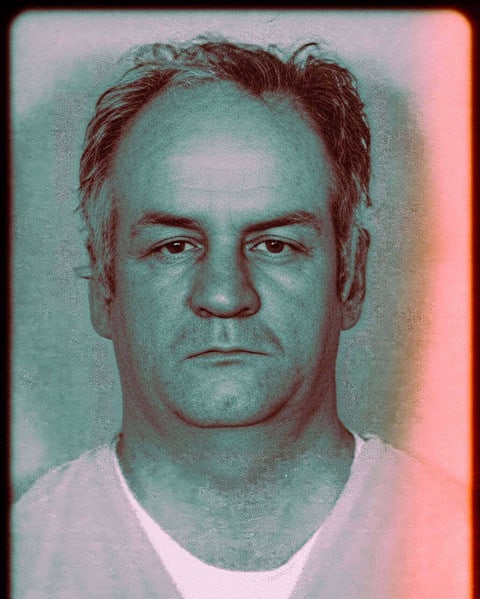
FILE NO. 0103Case status Mixed Outcomes
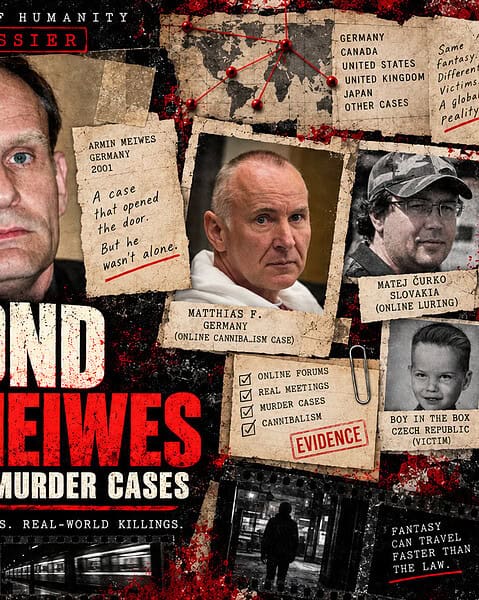
15 Cannibalism Cases: Fact, Myth & Evidence
From Armin Meiwes and Jeffrey Dahmer to Vince Li, Issei Sagawa and the cases that were labelled “cannibal” before the evidence caught up, this dossier separates confirmed human consumption from confession, allegation, biting, media mythology and psychiatric crisis.
Are all fifteen people in this dossier proven cannibals? No. That is the point of the comparison. Some cases contain direct, corroborated proof of human consumption; others rest on offender admissions, disputed reporting, postmortem biting, or a cannibal label that became more famous than the evidence.
The most useful way to read these cases is as an evidence spectrum. The dossier therefore distinguishes confirmed consumption, admitted or strongly corroborated consumption, reported but not adjudicated consumption, biting or chewing without proven ingestion, and cannibalistic intent or allegation that was never tested at trial.
Evidence Index
Jump file. Open ledger layout, no button wall.
What Counts as a Cannibalism Case?
A criminal label is only useful when it describes what the evidence actually establishes.
Direct evidence or strong corroboration
Cases such as Armin Meiwes, Issei Sagawa and Peter Bryan contain unusually strong proof that human tissue was actually consumed. The record can include admissions, eyewitness evidence, physical evidence, documented preparation of tissue, or case materials that make the act itself difficult to dispute.
That does not mean every lurid detail repeated online is equally reliable. A confirmed act of consumption does not automatically validate every later anecdote, claimed motive or nickname attached to the offender.
Chewing, mutilation and ingestion must be separated
The Miami Causeway attack and the Matthew Williams case show why the word cannibal can become misleading. A person can bite, tear or chew human tissue during an attack without the record proving that tissue was swallowed or that the act was driven by a stable cannibalistic fantasy.
When ingestion is unproven, this dossier says so. The distinction matters because media labels often outlive the forensic details that originally created them.
An admission can be powerful without being complete
Albert Fish wrote that he consumed Grace Budd’s remains, and later accounts tied cannibalistic conduct to other victims. The murder conviction is certain, while the exact scope of consumption depends heavily on Fish’s own statements and correspondence rather than a modern forensic reconstruction.
Likewise, some cases from China, the former Soviet Union and post-Soviet Russia survive through uneven official records, translated reporting and later retellings. Where the homicide is firmly documented but the cannibalism evidence is thinner, the page keeps those evidentiary layers separate.
No diagnosis by nickname
“Cannibal killer” is not a psychiatric diagnosis. Cannibalistic conduct can appear in sexualized fantasy, psychosis, domination, postmortem possession, intoxicated disorganization, survival contexts, ritual systems and other very different situations.
This comparison therefore does not treat one grotesque act as proof of one shared pathology. The criminal act, psychiatric findings, legal responsibility and media label are four separate questions.
The 15-Case Evidence Register
What is proven, what is reported, and what legal outcome followed.
| Case | Place / period | Cannibalism evidence | Legal posture | Current / final status |
|---|---|---|---|---|
| Armin Meiwes | Germany, 2001 | Confirmed Recorded killing, admissions, stored remains and later consumption. | Murder conviction after retrial. | Life sentence. |
| Albert Fish | United States, 1920s | Admitted / historical Consumption described in his Grace Budd letter and confessions. | Convicted of Grace Budd’s murder. | Executed in 1936. |
| Jeffrey Dahmer | United States, 1978-1991 | Confirmed Admissions and physical evidence within a larger pattern of dismemberment and preservation. | Multiple murder convictions; insanity defense rejected. | Killed in prison in 1994. |
| Issei Sagawa | France, 1981 | Confirmed Admissions and recovered remains. | Found unfit / insane in France; later deported, not prosecuted in Japan. | Died in 2022. |
| Vince Li / Will Baker | Canada, 2008 | Confirmed Witness and forensic record in the Greyhound killing. | Not criminally responsible because of mental disorder. | Absolute discharge granted in 2017. |
| Peter Bryan | England, 1993-2004 | Confirmed Police found human brain tissue being cooked; Bryan admitted eating it. | Manslaughter pleas on diminished responsibility for later killings. | Life sentences / secure psychiatric detention. |
| Matthew Williams | Wales, 2014 | Cannibal label disputed Biting and mutilation were established; later inquest reporting said cannibalism claims were unfounded. | No criminal trial; Williams died at the scene. | Inquest found Cerys Yemm unlawfully killed. |
| Austin Harrouff | United States, 2016 | Chewing / no proven ingestion Found chewing a victim’s face during the attack. | Not guilty by reason of insanity accepted in 2022. | Committed to secure mental health treatment. |
| Rudy Eugene | United States, 2012 | Biting / no proven ingestion Severe facial biting; toxicology did not support the “bath salts” story. | No trial; killed by police during the attack. | Ronald Poppo survived with catastrophic injuries. |
| Antron Singleton / Big Lurch | United States, 2002 | Confirmed at trial Prosecutors established that part of Tynisha Ysais’s lung was eaten. | First-degree murder, torture and aggravated mayhem convictions. | Life without parole. |
| Tsutomu Miyazaki | Japan, 1988-1989 | Reported / not core conviction Cannibalistic and blood-related acts appear in case accounts, but the four child murders are the firm legal record. | Convicted of four murders. | Executed in 2008. |
| Zhang Yongming | China, 2008-2012 | Reported, not central to court ruling Human-flesh and “ostrich meat” claims circulated widely; the court ruling firmly established 11 murders and body destruction. | Intentional homicide conviction. | Executed in 2013. |
| Nikolai Dzhumagaliev | Kazakh SSR, 1979-1980 | Historical record Confessions and later accounts describe consumption; documentation outside Russian-language records is uneven. | Declared mentally ill and subjected to compulsory psychiatric treatment. | Publicly verifiable current details remain limited. |
| Alexander Spesivtsev | Russia, 1990s | Strong witness / scene reporting Surviving victim testimony and scene evidence underpin cannibalism accounts; inflated victim totals should be treated cautiously. | Convicted for a smaller number of murders; psychiatric measures imposed. | Reportedly confined in psychiatric custody. |
| Matej Čurko | Slovakia, 2010-2011 | Intent suspected / no trial Online cannibal and slaughter communications plus dismemberment evidence; consumption was never tested in court. | No trial; died after police sting shootout. | Two identified homicide victims; full scope uncertain. |
There Is No Single Cannibal Killer Profile
The act may look similar from a distance while the mechanism underneath it is completely different.
Possession and sexualized fantasy
Meiwes, Dahmer, Sagawa and Fish are repeatedly discussed in relation to long-standing fantasy, possession, sexualized violence or body-focused compulsion. Even within this group, the structure differs: Dahmer’s concern with keeping victims from leaving is not the same phenomenon as Meiwes’s ritualized fantasy or Sagawa’s fixation.
Psychotic collapse
Vince Li and Austin Harrouff were found not criminally responsible or not guilty by reason of insanity because their reality testing was profoundly impaired at the time. Their legal outcomes arose from psychiatric evidence about criminal responsibility, not from the mere grotesqueness of the acts.
Disorganized violence and intoxication
Matthew Williams and Antron Singleton illustrate a different problem: violence occurring alongside drug use, psychosis or extreme disinhibition. The law does not automatically treat intoxication as insanity, and the factual record can diverge sharply from sensational headlines written in the first hours after a crime.
Postmortem domination and concealment
Some offenders combined cannibalistic conduct with dismemberment, corpse control, evidence destruction or serial predation. In such cases consumption can be only one component of a much broader system of violence rather than the central motive.
Case Files I-V
The strongest confirmed records: fantasy, consumption and criminal responsibility.
Armin Meiwes: The Recorded Pact
Armin Meiwes is indispensable to any serious comparison because the evidence is unusually complete. Bernd Jürgen Brandes responded to Meiwes’s online advertisement, travelled to his home near Rotenburg an der Fulda, and participated in a documented scenario that included mutilation and a stated wish to die. The encounter was recorded, allowing courts to examine the difference between a victim’s expressed wishes and the offender’s criminal responsibility.
The original 2004 court treated the case as manslaughter and imposed an eight-and-a-half-year sentence. Germany’s Federal Court of Justice rejected that resolution, and a 2006 retrial convicted Meiwes of murder and imposed life imprisonment. The case became a legal study in the limit of consent: agreement to injury or death did not convert homicide into a private contract beyond the reach of criminal law.
Consumption itself is not seriously disputed. Meiwes admitted storing and eating portions of Brandes’s body after the killing. The more important analytical point is that the cannibalism was organized, anticipated and integrated into a long-standing fantasy rather than arising from a sudden psychotic break.

The German town associated with the Meiwes case. This is a contemporary context image, not the crime property. Photo: Gerd Eichmann, Wikimedia Commons, CC BY 4.0. Image source.

Public-domain historical mugshot. The image predates the Grace Budd murder by decades and should not be read as evidence about the later crime. Image source.
Albert Fish: Confession, Letter and Myth
Albert Fish was convicted of the 1928 kidnapping and murder of 10-year-old Grace Budd. The investigation broke open years later because Fish sent Grace’s family a letter describing the killing and claiming that he had eaten parts of her body. Stationery used for the letter helped Detective William King trace Fish to a Manhattan rooming house, turning a grotesque confession into the investigative error that identified him.
Fish also confessed to the murders of Billy Gaffney and Francis McDonnell, although the enormous victim totals attributed to him in popular culture are not supported by equivalent evidence. His cannibalism claims likewise require a historical-source warning. The Grace Budd letter is powerful evidence of what Fish said he did, but the exact scope of human consumption across other victims cannot be reconstructed with modern forensic certainty.
The trial became a major sanity contest. The jury rejected the insanity defense and convicted Fish of first-degree murder; he was executed at Sing Sing in 1936. The case belongs here because cannibalism is embedded in the offender’s own surviving record, but the dossier refuses the common mistake of treating every boast as independently verified fact.
Jeffrey Dahmer: Consumption as Possession
Jeffrey Dahmer murdered 17 boys and young men between 1978 and 1991. His crimes included drugging, sexual assault, killing, dismemberment, preservation of body parts and, in some cases, consumption of human tissue. The FBI’s later release of investigative records reinforces how much physical evidence police encountered after Tracy Edwards escaped and led officers back to Apartment 213 in Milwaukee.
Dahmer described fantasies of permanent possession and attempted to create compliant victims through crude neurological injuries before killing them when those attempts failed. Cannibalism fit the same logic of control and incorporation, but it was not the only or even necessarily the primary act defining the series. The murders were a broader system of domination, sexual violence and corpse possession.
At trial, Dahmer admitted the killings but pleaded not guilty by reason of mental disease. The jury found him legally sane, and he received multiple life sentences. He was killed by another prisoner in 1994. The case also remains inseparable from institutional failure, especially the return of 14-year-old Konerak Sinthasomphone to Dahmer after the child escaped and police accepted Dahmer’s false explanation.

High-school yearbook image released on Wikimedia Commons under CC0. It predates most of Dahmer’s known murders and is included as historical context, not as a crime-scene image. Image source.

Representative Greyhound Canada coach photographed in 2011. This is not Bus 1170 and is used only to establish the intercity travel context of the Vince Li case. Photo: Secondarywaltz, Wikimedia Commons, CC BY 3.0. Image source.
Issei Sagawa: Murder, Consumption and Celebrity
In June 1981, Issei Sagawa killed fellow student Renée Hartevelt in Paris, sexually violated her body and consumed portions of her remains. He attempted to dispose of the body in suitcases, but the remains were discovered and the disposal route quickly led investigators back to him. His own repeated admissions left little doubt about the cannibalistic conduct.
The legal aftermath became nearly as infamous as the crime. French proceedings were halted after psychiatric findings, and Sagawa was eventually deported to Japan. Because of the interaction between the French case disposition and the transfer of records, Japanese authorities did not put him on trial for Hartevelt’s murder, and he later lived freely.
What followed turned the case into an enduring example of offender-centered media exploitation. Sagawa published, gave interviews and participated in entertainment built around his notoriety. The result was a second form of erasure in which the murderer’s appetite became a marketable persona while Hartevelt’s life was repeatedly reduced to the act committed against her.
Vince Li: The Greyhound Killing
On July 30, 2008, Timothy McLean was killed aboard a Greyhound bus near Portage la Prairie, Manitoba, by fellow passenger Vince Weiguang Li, who later changed his name to Will Baker. The attack was sudden and occurred in view of other passengers, who fled the bus as the driver stopped. The subsequent standoff and forensic record established decapitation, mutilation and cannibalistic acts.
Psychiatric evidence was central from the beginning. Li was experiencing untreated schizophrenia and severe delusions, including beliefs that McLean represented an existential threat and that he was acting under divine command. In 2009 he was found not criminally responsible on account of mental disorder, a Canadian legal finding that addresses criminal responsibility rather than denying that the act occurred.
After years of treatment and progressively reduced restrictions, the Manitoba Criminal Code Review Board granted an absolute discharge in February 2017. The decision remains controversial, particularly for McLean’s family, but the legal logic was risk-based: once a person found NCR is no longer considered a significant threat to public safety, indefinite detention cannot function as punishment for an act committed without criminal responsibility.
Case Files VI-X
Psychiatric systems, disputed cannibal labels and intoxication.
Peter Bryan: A System Failed Twice
Peter Bryan killed Nisha Sheth in 1993 and was detained in secure psychiatric care after a manslaughter conviction on diminished responsibility grounds. Years later, after moving through less restrictive settings, he killed Brian Cherry in 2004. Police found Cherry dismembered and discovered human brain tissue in a frying pan; Bryan told investigators that he had eaten it.
Only weeks later, after transfer to Broadmoor Hospital, Bryan attacked fellow patient Richard Loudwell, who later died. Subsequent inquiries found serious shortcomings in observation, assessment and communication. The case is therefore not reducible to one shocking meal: it is a documented sequence in which risk was repeatedly underestimated across different levels of the mental-health system.
Bryan pleaded guilty to manslaughter on diminished responsibility for the later killings and received life sentences. The record shows that psychosis can coexist with planning, concealment and apparently calm presentation, which is precisely why simplistic “look for obvious madness” risk models can fail.

An 1867 Illustrated London News view of Broadmoor, preserved by the Wellcome Collection. It predates Bryan’s case by more than a century and is used as institutional history, not as a depiction of the 2004 ward. Image source.

The causeway where Rudy Eugene attacked Ronald Poppo in 2012. Photo: Marc Averette, Wikimedia Commons, CC BY 3.0. Image source.
Matthew Williams: When the Cannibal Headline Outran the Inquest
Matthew Williams unlawfully killed 22-year-old Cerys Yemm at the Sirhowy Arms in Argoed two weeks after his release from prison. Witnesses described a savage attack involving biting and cutting, and a 999 caller said he was “eating” Yemm. Williams died after police used Tasers while trying to stop and restrain him, so there was never a criminal trial.
The later inquest changed the evidentiary picture. Reporting from the proceedings established biting and mutilation, but Williams’s family said the cannibalism claims had been shown to be unfounded. The jury concluded that Yemm had been unlawfully killed while Williams was experiencing a psychotic episode associated with cannabis and amphetamine use.
This is exactly the kind of case a serious cannibalism dossier should keep rather than quietly discard, because it demonstrates how a label is born. The cannibal headline emerged from the appearance of the scene and an emergency call. The later legal-medical inquiry supported a horrific homicide and biting attack, but not the confident claim of proven human consumption.
Austin Harrouff: Psychosis and the Face-Biting Case
Austin Harrouff killed John Stevens III and Michelle Mishcon Stevens at their Florida home in August 2016 and seriously injured a neighbor who tried to intervene. Responding officers found Harrouff on top of John Stevens and chewing the victim’s face. The crime was random in the sense that the couple had no meaningful prior relationship with him.
The early public narrative reached immediately for exotic drugs, including “bath salts,” because the behavior seemed too bizarre to explain otherwise. The legal case ultimately centered instead on psychosis. In November 2022, a judge accepted a not-guilty-by-reason-of-insanity resolution agreed to by the prosecution and defense after experts concluded Harrouff was legally insane at the time.
Harrouff was committed to a secure mental-health facility, where release depends on future clinical and judicial findings rather than a fixed prison term. The case belongs on the cannibalism evidence spectrum because chewing human tissue is documented, but it should not be upgraded into a proven pattern of deliberate consumption without evidence of ingestion.
Rudy Eugene: The “Miami Zombie” Myth
Rudy Eugene attacked Ronald Poppo on the MacArthur Causeway in broad daylight in May 2012, beating him and tearing away facial tissue with his teeth. Police shot Eugene when he did not stop the attack. Poppo survived but sustained catastrophic facial injuries and permanent blindness.
The case became an instant internet legend. Headlines called Eugene the “Miami Zombie,” while speculation about synthetic cathinones, especially “bath salts,” spread globally. Toxicology later found marijuana but did not identify the exotic-drug explanation that had dominated the early coverage.
Just as important, the word cannibal is more definite than the evidence. Eugene’s biting and tissue destruction are beyond dispute, but the surviving record does not establish a sustained cannibalistic motive or confirmed swallowing of human flesh. The better classification is a severe biting attack that became culturally coded as cannibalism.
Big Lurch: PCP Did Not Erase Responsibility
Antron Singleton, the rapper known as Big Lurch, was convicted of murdering 21-year-old Tynisha Ysais in Los Angeles in 2002. Prosecutors established that Ysais had been mutilated and that part of her lung was eaten. Singleton was found nearby naked and blood-covered after a period of heavy PCP use.
The defense argued that a PCP-induced psychotic state left Singleton legally insane, but the judge rejected that theory under California law governing mental states caused by voluntary drug use. The jury had already convicted him of first-degree murder, torture and aggravated mayhem. He received life imprisonment without the possibility of parole plus an additional consecutive life term.
The case is analytically useful because it separates psychiatric symptoms from the legal doctrine of insanity. A person may be hallucinating, dissociated or psychotic while intoxicated and still remain criminally responsible if the jurisdiction treats the condition as the product of voluntary drug use rather than an independent qualifying mental disease.
Case Files XI-XV
Serial predation, opaque records and cases where cannibalism was reported more confidently than it was litigated.
Tsutomu Miyazaki: Murder Before Moral Panic
Tsutomu Miyazaki abducted and murdered four young girls in Tokyo and Saitama between 1988 and 1989. The confirmed case record includes sexual violence, postmortem abuse, taunting communications and the delivery of a victim’s remains to her family. Cannibalistic and blood-related conduct appears in many accounts, but the four murders, not a separately adjudicated cannibalism offense, form the core legal record.
Miyazaki’s arrest also produced one of Japan’s most influential modern moral panics. Reporting fixated on his large collection of videotapes, manga and pornography, helping turn the word “otaku” into a cultural shorthand for dangerous obsession. That social diagnosis was much broader than the evidence justified.
Japanese courts rejected claims that Miyazaki lacked criminal responsibility and imposed death. He was executed in 2008. A careful dossier should therefore distinguish what the murder judgments established from the later attempt to explain the crimes by blaming an entire media subculture.
Zhang Yongming: Eleven Murders, One Inflated Headline
Zhang Yongming was convicted in China of murdering 11 males in Yunnan Province between 2008 and 2012. Official reporting from Xinhua and China Daily described DNA evidence tying the victims to Zhang and said he used dismemberment, burning and burial to destroy evidence. The case also triggered disciplinary action against police after families complained that disappearances had not been taken seriously.
International coverage quickly emphasized claims that human flesh had been preserved, fed to dogs or sold as “ostrich meat.” Those allegations became the defining global image of the case, yet the public court ruling reported by Xinhua focused on 11 intentional homicides and disposal methods rather than separately proving the market-meat story.
That gap does not mean the cannibalism claims were invented. It means the evidentiary status is different. The murders and dismemberment were adjudicated; some of the most sensational consumption details survive primarily through police leaks, state-media summaries and international retellings. Zhang was sentenced to death and executed in January 2013.
Nikolai Dzhumagaliev: The Problem of the Soviet Record
Nikolai Dzhumagaliev, often called “Metal Fang,” is one of the most frequently cited Soviet-era cannibal killers. Accounts describe multiple murders of women, dismemberment and consumption of human tissue, followed by a finding of severe mental illness and compulsory psychiatric treatment. The core case is real, but the English-language record is fragmented and often repeats the same dramatic anecdotes without transparent sourcing.
This is especially important for claims that he secretly served human meat to guests or accumulated extremely high victim totals. Some details may be true, but the evidentiary chain is much weaker than it is in a case like Meiwes, where courts, video evidence and contemporary reporting are accessible.
Dzhumagaliev therefore belongs in the register with a visible source-quality warning. Soviet secrecy, translation problems and decades of retelling can turn a documented killer into folklore. The correct editorial approach is to preserve the established homicide and cannibalism record while refusing to inflate the parts that cannot be checked.
Alexander Spesivtsev: The Apartment and the Missed Warnings
Alexander Spesivtsev’s crimes were uncovered in Novokuznetsk after plumbers and police entered the apartment he shared with his mother. Investigators found dismembered remains and a critically injured teenage girl who survived long enough to describe the confinement and killing of her companions. Contemporary Los Angeles Times reporting also documented earlier complaints from neighbors about the smell of death that failed to trigger an effective police response.
Cannibalism accounts are tied to survivor testimony and later investigative reporting, including allegations that flesh was prepared in the apartment. The mother’s role in luring victims and disposing of remains became part of the criminal case. At the same time, later internet accounts greatly inflate the number of victims, sometimes attributing dozens or even scores of murders that were never proven in court.
The strongest version of the story is already devastating without numerical escalation. Spesivtsev was convicted in a smaller set of killings and subjected to psychiatric measures. The case is a study in domestic confinement, family complicity, police inaction and the way suspected victim counts can grow as a notorious case migrates from record into legend.
Matej Čurko: Online Cannibal Fantasy Without a Trial
Matej Čurko’s case emerged through online communications with a man who became alarmed by discussions of killing and cannibalism and contacted authorities. Slovak police arranged a sting in May 2011. Čurko arrived armed, exchanged gunfire with officers and later died from his wounds.
The investigation then connected him to two women who had disappeared in 2010, Lucia Uchnárová and Elena Gudjová, whose remains were recovered. Evidence supported homicide and dismemberment, while investigators suspected a cannibalistic motive. Because Čurko died before prosecution, however, there was no trial to test what the women understood, whether they consented to any aspect of the encounter, or whether human tissue was actually consumed.
That makes the case a warning against turning internet fantasy into retroactive certainty. The online messages are relevant evidence of intent and planning, but “cannibal victim” and “consensual cannibalism” go beyond what a court ever established. The dedicated European comparison on this site treats Čurko alongside Meiwes and later German cases precisely because their consent and evidence postures are not the same.
What the Fifteen Cases Actually Show
Different mechanisms can produce superficially similar headlines.
Reality testing, not grotesqueness
The legal findings in the Vince Li and Austin Harrouff cases were based on expert evidence about delusions, cognition and criminal responsibility. Cannibalistic or face-biting behavior may look “insane” to a lay observer, but bizarre conduct alone is not the legal test for insanity.
Most people with psychotic disorders are not violent, and the presence of schizophrenia does not explain every act committed by a person who has the diagnosis. Case-specific symptoms and risk factors matter.
Consumption as incorporation
Dahmer, Meiwes, Sagawa and Fish are often grouped together because cannibalism appears connected to long-standing fantasy or sexualized body possession. Even here there is no single template. Meiwes sought a willing participant; Dahmer sought control over unwilling victims; Sagawa’s act centered on a specific fixation; Fish’s statements belong to an older and more difficult documentary record.
Drugs can alter behavior without creating one legal outcome
Williams’s inquest tied his psychotic state to cannabis and amphetamine use, while Singleton’s defense relied heavily on PCP. The legal results diverged because different jurisdictions, evidence and doctrines govern intoxication and insanity. “He was on drugs” is therefore a description of context, not a complete explanation or a universal defense.
The body becomes the final controlled object
In several cases, cannibalism sits beside dismemberment, preservation, sexual abuse or postmortem possession. Consumption may function symbolically as incorporation, destruction or continuation of control. The act can be meaningful to the offender without being the original reason the victim was targeted.
Some stories are also systems stories
Dahmer’s series includes police failure around Konerak Sinthasomphone; Bryan’s case includes repeated failures in psychiatric risk management; Zhang’s case led to discipline for officers after families said disappearances had been ignored. These are not side notes. They help explain why known risks, complaints or vulnerable victims failed to produce timely intervention.
The nickname can become stronger than the record
“Miami Zombie,” “cannibal hostel killer,” “Metal Fang” and “Milwaukee Cannibal” compress complex cases into marketable identities. Sometimes the label is grounded in confirmed conduct; sometimes it overstates what happened. The more memorable the nickname, the more important it becomes to reopen the evidence underneath it.
Consent Does Not Make Homicide Private
The Meiwes and Čurko files show why “consensual cannibalism” is often a legally misleading phrase.
Documented agreement, murder conviction
Brandes’s willingness was legally relevant, but it did not erase the state’s interest in protecting life or eliminate Meiwes’s own motive. The 2006 murder conviction followed a retrial specifically because the earlier manslaughter treatment was judged insufficient.
Victim awareness remains uncertain
Because Čurko died before trial, public descriptions of his victims as willing participants go further than the tested record. Online contact with suicidal or vulnerable people is not proof that they consented to every later act, particularly cannibalism.
Consent is act-specific
Agreement to meet, to discuss fantasy, to be injured, to die, to be dismembered and to have one’s body consumed are not interchangeable permissions. A responsible case file identifies which acts were actually agreed to and which were inferred after the victim could no longer speak.
Myth vs Record
The stories most likely to be repeated incorrectly.
Image Source Ledger
The six non-graphic archival and location images used above are documented here without duplicating the files a second time.
MacArthur Causeway
Wikimedia Commons file page for the Miami causeway used to establish the location of the 2012 attack on Ronald Poppo.
Open image recordGreyhound Canada
Representative intercity coach used only as travel context for the Vince Li case. It is explicitly not identified as Bus 1170.
Open image recordJeffrey Dahmer, 1978
CC0 high-school yearbook image used as historical context and not as crime-scene evidence.
Open image recordAlbert Fish, 1903
Public-domain mugshot that predates the Grace Budd murder by decades and is therefore captioned as archival context.
Open image recordBroadmoor, 1867
Wellcome Collection image of Broadmoor used to establish institutional history, not to depict Peter Bryan’s 2004 ward.
Open image recordRotenburg an der Fulda
Contemporary streetscape from the German town associated with the Meiwes case. It is not presented as the crime property.
Open image recordFrequently Asked Questions
Quick answers without flattening the evidence.
Who are the most famous real-life cannibals?
Jeffrey Dahmer, Armin Meiwes, Issei Sagawa, Albert Fish and Peter Bryan are among the best-known modern criminal cases associated with human consumption. Their cases are not equivalent, however: they differ in motive, psychiatric findings, victim consent, legal responsibility and the quality of surviving evidence.
Was Jeffrey Dahmer really a cannibal?
Yes. Dahmer admitted consuming portions of some victims, and the wider physical record from his apartment corroborated extensive body preservation and dismemberment. Cannibalism was only one part of a 17-victim pattern centered on sexual violence, control and postmortem possession.
Was Armin Meiwes convicted of murder even though his victim consented?
Yes. Meiwes initially received a manslaughter conviction, but Germany’s Federal Court of Justice ordered a retrial. In 2006 he was convicted of murder and sentenced to life imprisonment, showing that victim agreement did not make the killing legally private.
Did Rudy Eugene eat Ronald Poppo’s face?
Eugene unquestionably bit and tore facial tissue during the 2012 MacArthur Causeway attack. The record does not establish a long-term cannibalistic motive or confirmed ingestion to the same evidentiary level as cases such as Meiwes or Peter Bryan, so “face-eating cannibal” is stronger than the proven facts.
Were bath salts responsible for the Miami Causeway attack?
The early bath-salts theory was not supported by toxicology. Reporting later identified marijuana but no synthetic stimulant that explained Eugene’s behavior, which is why the drug explanation should be treated as an early media hypothesis rather than a solved cause.
Was Matthew Williams proven to be a cannibal?
No. Williams killed and bit Cerys Yemm in a horrific 2014 attack, but later inquest reporting said claims that he had actually cannibalized her were unfounded. He died at the scene, so no criminal trial ever tested the first-wave headlines.
What happened to Vince Li after the Greyhound killing?
Li, later known as Will Baker, was found not criminally responsible because of mental disorder after killing Timothy McLean in 2008. Following years of treatment and review-board supervision, he received an absolute discharge in 2017.
Does schizophrenia cause cannibalism?
No. Schizophrenia is not a cannibalism disorder, and most people with schizophrenia are not violent. A few cases in this dossier involved psychosis, while others involved organized fantasy, sexualized domination, intoxication, serial predation or uncertain motives.
Can a person legally consent to being killed and eaten?
Consent to death does not generally erase homicide liability. The Meiwes case is the clearest modern example: Brandes’s participation mattered to the factual and legal analysis, but German courts still convicted Meiwes of murder.
Why do true-crime cannibal stories contain so many myths?
The acts are rare, visually shocking and culturally taboo, which makes them unusually vulnerable to headline inflation. Nicknames, translated reports, offender boasts and high suspected victim counts can be repeated for decades after the underlying evidence has become secondary.
Which cases in this list have the strongest proof of actual consumption?
Meiwes, Sagawa, Peter Bryan, Dahmer, Vince Li and Antron Singleton have especially strong records of consumption or cannibalistic acts. Fish is supported heavily by his own letter and admissions, while several other cases require stronger caution because ingestion was unproven or the historical record is less transparent.
Why replace some commonly repeated “cannibal cases” with better documented ones?
This page prioritizes cases that can survive source checking. Cases based mainly on tabloid relay, ambiguous biting or unsupported psychological speculation may still be discussed as examples of media labeling, but they should not displace well-documented cases such as Armin Meiwes or Albert Fish.
Research & Source Ledger
Primary and high-quality secondary records used to separate homicide, consumption, diagnosis and legal outcome.
Guardian, 2006 murder conviction
Contemporary reporting on the Frankfurt retrial and life sentence after the Federal Court of Justice rejected the original manslaughter outcome.
Open sourceCanadian Press via Global News
2017 report confirming the absolute discharge granted to Vince Li, later known as Will Baker.
Open sourceAssociated Press, 2022
Report on the accepted insanity resolution, the two homicide charges and secure mental-health commitment.
Open sourceMiami Herald
Retrospective reporting on the MacArthur Causeway attack and toxicology that found marijuana but not the early bath-salts explanation.
Open sourceGuardian, 2017 inquest
Inquest reporting separating the established biting and mutilation attack from later claims that cannibalism allegations had been shown to be unfounded.
Open sourceLos Angeles Times, 2003
Sentencing report on the first-degree murder conviction, lung consumption evidence and rejected PCP-insanity theory.
Open sourceGuardian / Old Bailey reporting
Contemporary account of Bryan’s manslaughter pleas, life sentences and admitted consumption of Brian Cherry’s brain.
Open sourceThe Japan Times, 2008
Contemporary report on Miyazaki’s execution and the four child murders for which he was convicted.
Open sourceXinhua via China Daily
Official-state reporting on the 11 murders, DNA evidence, dismemberment and the death sentence, useful for separating adjudicated facts from later cannibal folklore.
Open sourceLos Angeles Times, 1997
Contemporary reporting on the apartment discovery, surviving witness and earlier police inaction.
Open sourceFBI Vault
Federal investigative records and an official FBI-hosted Milwaukee County Sheriff’s Department mugshot provide a primary-document anchor for the Dahmer case.
Open FBI fileHistory of Cannibalism
The site’s broader framework for separating criminal cannibalism from survival, ritual, medicinal and culturally sanctioned contexts.
Read the full historyThe Taboo Is Not the Explanation
Cannibalism is powerful as a headline because it seems to identify the offender immediately: a person has crossed a boundary most people cannot imagine crossing. But the act does not tell us why it happened, whether the offender understood reality, whether consumption was planned or incidental, whether the victim agreed to anything, or whether the most famous detail was ever proven.
The more sensational the crime, the more disciplined the evidence has to become. These fifteen cases are disturbing not because they reveal one hidden species of human monster, but because they show how very different forms of violence can converge on the same taboo while carrying completely different meanings, motives and legal consequences.
Browse every case in the Case File Index
Discover more from The Dark Side of Humanity
Subscribe to get the latest posts sent to your email.