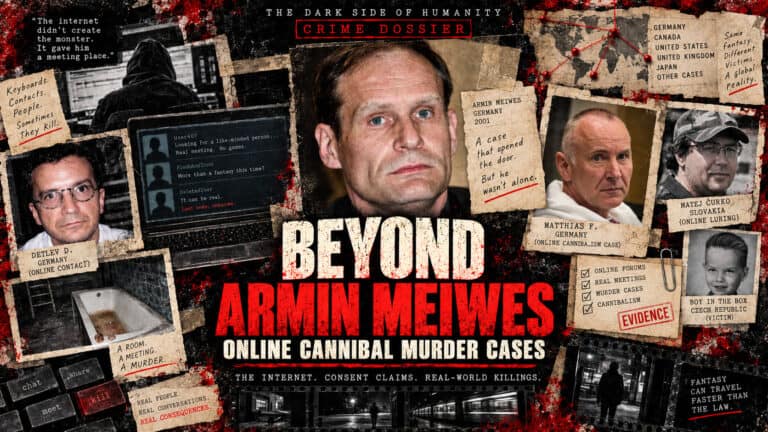
A small number of European homicides involved online cannibal and slaughter fantasies. While cases involving Armin Meiwes and Detlev Günzel contained evidence of victim requests for death or dismemberment, other cases, such as those of Stefan R. and Matej Čurko, lacked victim consent to killing or cannibalism.
Legal rulings show that a victim’s request does not legalise homicide or prevent murder convictions, especially when offenders pursue separate sexual motives. Furthermore, online fantasies do not establish an organized criminal network, and confirmed human consumption was unproven in several of these cases.
Beyond Armin Meiwes
When online slaughter and cannibal fantasies crossed into homicide, the victims did not all agree to the same thing. This dossier compares the unusually documented Meiwes case with Detlev Günzel, Stefan R. and Matej Čurko, separating fantasy from preparation, consent to one act from consent to another, and proven consumption from cannibal-themed motive.

Were There Other Cannibal Murder Cases Like Armin Meiwes?
Only a handful of later European cases involved online cannibal or slaughter fantasies, and none was an exact repeat of the Meiwes and Brandes case. Wojciech Stempniewicz documented a desire to die and be treated as a slaughtered body. Stefan Trogisch expected a sexual encounter and did not consent to death. Matej Čurko died before trial, leaving major uncertainty about what two dead women understood or agreed to.
The strongest common thread is not “consensual cannibalism.” It is the use of online spaces to move from fantasy or vulnerability into real-world contact, followed by homicide, dismemberment or suspected consumption under sharply different consent conditions.
Evidence Index
Were There Other Cases Like Armin Meiwes?
There is no large, verified series of European “vore murders” comparable to conventional categories of serial homicide. The documented cases are exceptionally rare, and even among them, the evidence of mutual participation varies sharply.
Armin Meiwes and Bernd Brandes produced an extraordinary evidentiary record: extensive messages, a written agreement and a video of the encounter. Brandes travelled to Meiwes specifically for mutilation, death and postmortem consumption. Meiwes initially received a manslaughter conviction, but a retrial resulted in a murder conviction and life sentence.
The other cases are not simple repetitions of that arrangement.
Günzel and Stempniewicz exchanged detailed communications showing that Stempniewicz wanted to die and be treated as a slaughtered body, but the crucial moment of death was not recorded. Günzel denied killing him and claimed the man had caused his own fatal strangulation.
Stefan R.’s victim did not knowingly enter a slaughter arrangement. The German courts found that he expected a sexual meeting and did not anticipate an attack.
Čurko’s victims could never be questioned, and Čurko died before trial. Public descriptions of them as “willing cannibal victims” therefore go further than the surviving evidence supports.
The most accurate description is that Europe has experienced a small number of online-facilitated homicides involving cannibal, slaughter or death fantasies. Only some involved documented consent to death, and consent did not make the killings lawful.
Case Register
| Case | Date | Online connection | Victim agreement | Actual cannibalism | Legal outcome |
|---|---|---|---|---|---|
| Armin Meiwes and Bernd Brandes, Germany | 2001 | Extreme-fetish forums and private messages | Extensive evidence that Brandes agreed to mutilation and death | Confirmed | Murder conviction; life imprisonment |
| Detlev Günzel and Wojciech Stempniewicz, Germany | 2013 | Cannibal and slaughter-fantasy website | Strong evidence Stempniewicz wanted to be killed and dismembered | No reliable proof of consumption | Murder and corpse-desecration convictions; life imprisonment |
| Matej Čurko and two identified women, Slovakia | 2010–2011 | Suicide-related contacts and online correspondence | Evidence the women may have sought death; awareness of cannibalism remains uncertain | Investigators suspected consumption, but no trial tested the evidence | Čurko died after a police shootout; no trial |
| Stefan R. and Stefan Trogisch, Germany | 2020 | Online dating platform; defendant’s separate cannibal searches and chats | No evidence the victim agreed to injury, death or consumption | Court record found cannibalistic motive and postmortem conduct; appellate reporting states partial consumption | Murder and corpse-desecration convictions; life imprisonment with particular gravity of guilt |
The register shows why the phrase “consensual cannibalism case” should not be applied indiscriminately. Only the first two cases contained substantial evidence that the deceased person had contemplated or requested a fatal slaughter scenario.
What Is Vore and Does It Mean Someone Is Dangerous?
Vorarephilia, commonly shortened to “vore,” broadly refers to sexualized fantasies about consuming another being or being consumed. The fantasy often appears in fiction, illustration, animation or consensual role-play and may involve impossible scenarios such as an intact person being swallowed whole.
For most people who engage with such material, the fantasy does not indicate an intention to injure anyone. Researchers and clinicians interviewed about the subject have emphasized that most cannibal-themed fantasies remain symbolic or fictional and that participants typically distinguish them from actual violence.
Literal human cannibalism is fundamentally different. For historical and cultural context beyond these internet-facilitated homicides, see our history and classifications of cannibalism. It requires access to human remains and, where the person is living, necessarily involves grave injury or death. The language of “hard vore,” “slaughter” and “long pig” can move closer to realistic mutilation imagery, but words and drawings alone still do not establish criminal intent.
The legal boundary is crossed when a person moves from fantasy into concrete preparation, solicitation, assault, homicide or the abuse of human remains.
The cases involving Meiwes, Günzel, Čurko and Stefan R. matter not because they prove that people with unusual fantasies are generally dangerous. They matter because each contained additional evidence that a particular individual had converted fantasy into a plan involving a real human body.
Detlev Günzel and Wojciech Stempniewicz
The Website
Detlev Günzel was a longtime employee of the Saxony State Criminal Police Office. He had worked as a handwriting specialist and possessed professional familiarity with criminal investigation. Outside work, he maintained a rural guesthouse near Hartmannsdorf-Reichenau, southeast of Dresden.
The property included a cellar that Günzel had equipped for sadomasochistic activity. It contained restraints, tools and an electric hoist later used during Stempniewicz’s death.
Günzel met Stempniewicz through an online forum devoted to fantasies of slaughter and cannibalism. The website called itself a leading destination for “exotic meat” and reportedly had thousands of registered accounts. Günzel used the name “Caligula31,” while Stempniewicz called himself “Heszla-Longpig,” using an old euphemism for human flesh.
Their communications were not casual flirtation. They discussed Stempniewicz’s wish to be killed, dismembered and treated like an animal prepared for consumption. Messages between them bore the heading “Schlachtfest,” a German word associated with a feast following the slaughter of livestock.
Stempniewicz had reportedly described a desire to become a “slaughter victim” since childhood. Günzel said his own excitement centred not on eating human flesh but on cutting apart a body. The complementary fantasies brought the two men together: one wanted to become the body, while the other wanted to perform the dismemberment.
The Meeting
On November 4, 2013, the men met in Dresden and travelled to Günzel’s property. The precise sequence inside the cellar remained disputed through multiple trials.
The prosecution said Günzel restrained Stempniewicz with his agreement. His hands were secured behind his back with plastic ties. Tape was wrapped around the mouth and head, and a rope attached to the electric hoist was positioned around his neck.
Günzel claimed he then left the room, telling Stempniewicz that the arrangement would be stopped if he remained standing when Günzel returned approximately 20 minutes later. When Günzel came back, he said, Stempniewicz was dead.
The defence maintained that Stempniewicz had intentionally caused his own strangulation, possibly by using the hoist’s remote control. Investigators reportedly found the victim’s fingerprints on the control. The prosecution argued that Günzel had caused the death and had initially confessed to cutting Stempniewicz’s throat while he was still alive.
That first account was inconsistent with the forensic evidence. Examiners concluded that the remains indicated asphyxiation rather than death from a cut throat. Günzel withdrew the confession and said he had been unable to carry out Stempniewicz’s request for a direct killing.
The uncertainty surrounding the final minutes became the most difficult part of the prosecution. Stempniewicz’s desire to die was clear. Whether he acted alone or Günzel actively completed the killing was not captured on camera.
The Video
Günzel recorded what happened after Stempniewicz was dead.
The video showed the body suspended with the knees bent beneath the ligature. Günzel then removed the head and genitalia and divided the torso with an electric saw. The footage depicted a prolonged and sexually charged postmortem mutilation, but the camera had not recorded the moment at which Stempniewicz died. The distinction between consumption, mutilation and other postmortem sexualized conduct also matters in our explainer on sexualized postmortem mutilation.
Günzel later deleted the recording. Investigators recovered enough of the file to reconstruct and show it in court. He was heard expressing disbelief at what he had done while continuing the dismemberment.
The body was reduced to numerous pieces and buried around the garden. Although Stempniewicz had discussed being eaten, prosecutors found no reliable evidence that Günzel consumed any part of him.
That distinction is essential. Günzel was routinely called a cannibal in headlines because of the website, victim’s fantasy and physical treatment of the corpse. The proven conduct was murder and dismemberment connected to cannibal-themed sexual interests,not confirmed consumption.

Why Detlev Günzel's Murder Case Took Years to Resolve
The Dresden Regional Court convicted Günzel in 2015 of murder and disturbing the peace of the dead, Germany’s offence covering serious abuse or desecration of a corpse. The court imposed eight years and six months rather than life imprisonment, reasoning that the victim’s persistent death wish made the case extraordinarily different from an ordinary murder.
Both the prosecution and defence appealed. Germany’s Federal Court of Justice overturned the decision in 2016. It found shortcomings in the lower court’s treatment of the suicide theory and also questioned how a defendant convicted of murder could receive a term of years when German law ordinarily mandates life imprisonment for that offence.
A second trial again found Günzel guilty of murder. The new court imposed eight years and seven months, once more attempting to account for Stempniewicz’s request to be killed.
The prosecution appealed again.
In February 2018, the Federal Court of Justice replaced the reduced term with life imprisonment. The court concluded that the exceptional doctrine allowing a lower penalty for murder did not apply simply because the victim had requested death. Günzel had not acted under coercion, extreme pressure or provocation. He had voluntarily participated because the dismemberment served his own sexual interests.
The ruling produced a stark legal conclusion:
Stempniewicz’s desire to die was relevant to understanding the encounter.
It did not entitle his killer to a reduced murder sentence.
German Law on Killing at the Victim's Request
German law contains a specific offence known as Tötung auf Verlangen, or killing at the victim’s request. Section 216 of the German Criminal Code provides a sentence of six months to five years where the killer was induced to act by the victim’s explicit and earnest request.
The provision recognizes that a requested killing can differ from an attack on an unwilling victim. It does not legalize the act.
The Günzel litigation demonstrated a further limitation. A defendant cannot necessarily rely on Section 216 when the killing satisfies the legal elements of murder for independent reasons, such as sexual gratification or enabling a separate offence against the corpse.
The courts found that Günzel’s conduct was not simply the reluctant fulfilment of another man’s death wish. He participated because he wanted the body and the opportunity to dismember it.
Consent explained why Stempniewicz entered the cellar.
It did not erase Günzel’s motive or actions.

Stefan R. and Stefan Trogisch
A Sexual Meeting, Not a Slaughter Agreement
The Berlin case that surfaced in 2020 initially appeared to repeat the Meiwes pattern. Human remains were found in several locations. The suspect had searched for cannibalism online and discussed the subject with sexual contacts. The victim and accused had met through the Internet.
The similarity ended there.
Stefan Trogisch, a high-voltage electrical worker in his forties, arranged a sexual meeting with a Berlin teacher identified under German privacy practices as Stefan R. They connected through an online dating service and met at R.’s apartment in Berlin-Pankow during the early hours of September 6, 2020.
Trogisch voluntarily consumed a drink containing gamma-butyrolactone, or GBL, a substance that can impair consciousness. The court found that he expected a consensual sexual encounter and did not anticipate an assault on his body or life.
Once Trogisch was vulnerable, Stefan R. attacked him with a concealed knife, severing a major blood vessel. Trogisch died from rapid blood loss. The court classified the killing as treacherous because he had been rendered defenceless and had no reason to expect the attack.
This was not a case in which a victim’s death wish placed the legal meaning of consent at the centre of the trial. The court found that the victim did not consent to injury or death.
The cannibalism fantasy belonged to the killer.
The Dismemberment
After killing Trogisch, Stefan R. dismembered the body inside the apartment. He removed intimate body parts, divided the remains and transported portions to different locations around Berlin.
A walker discovered bones from a human leg near the northern edge of the city in November 2020. Early examination revealed unusual marks and missing tissue, leading investigators to consider possible cannibalism. Search dogs and digital evidence eventually connected the remains to Stefan R.’s apartment.
Investigators found knives, a surgical-style bone saw and a large cooling container. They also discovered substantial quantities of sodium hydroxide, a chemical capable of breaking down organic material, although the defendant offered an unrelated explanation for possessing it.
The Berlin court concluded that Stefan R. killed Trogisch to fulfil cannibal and slaughter fantasies that had developed through his online activities. Later legal reporting described the body as having been partially consumed.
The exact quantity and identity of every consumed part were not necessary to establish the homicide. The decisive facts were that Stefan R. intentionally killed a defenceless man, sexually motivated himself through the act and then desecrated the body.

Why Stefan R. Was Convicted of Murder
In January 2022, the Berlin Regional Court convicted Stefan R. of murder and disturbing the peace of the dead. It imposed life imprisonment and found a particular gravity of guilt, a finding that makes release after the ordinary minimum period substantially less likely.
The court found several murder characteristics. The victim was attacked by surprise while defenceless. The killing served the offender’s sexual gratification and enabled the subsequent abuse and dismemberment of the body.
Stefan R. appealed, but Germany’s Federal Court of Justice rejected the challenge in October 2022. The conviction and sentence became final.
The case demonstrates why an online cannibal interest is not evidence of consent. A person may meet a stranger through an adult dating site and agree to sex or drug use without authorizing mutilation, death or consumption.
Trogisch entered the apartment as a sexual partner.
The court found that Stefan R. had selected him as a victim.
Matej Čurko and the Slovak Investigation
The Swiss Contact
Matej Čurko was a Slovak computer technician who communicated online with people expressing an interest in death. The case emerged in 2011 after a Swiss man engaged with someone offering to kill, dismember and consume him.
The Swiss contact eventually alerted authorities. Slovak police arranged an operation in which an undercover officer went to a planned meeting near Kysak, in eastern Slovakia.
Čurko arrived carrying equipment associated with restraint, cutting and disposal. When police attempted to arrest him, he drew a firearm and shot an officer. Police returned fire, and Čurko later died from his wounds. The injured officer survived after a lengthy hospitalization.
The operation stopped the proposed killing.
It also eliminated the possibility of interrogating Čurko at trial.
The Two Women
Investigators examining Čurko’s electronic records and surrounding land later found the remains of two women who had disappeared in 2010. The women were publicly identified in Slovak reporting as Lucia Uchnárová and Elena Gudjaková, although English transliterations and spellings vary.
Their bodies had been dismembered and concealed in wooded or rural locations. Missing body tissue and the material recovered during the investigation led authorities to suspect postmortem consumption.
The two women had reportedly communicated online with Čurko and expressed suicidal thoughts. This history prompted some international reports to label them consenting cannibal victims.
That description is not adequately supported.
Available accounts indicate that Čurko offered at least one woman a supposedly painless death. The surviving communications do not clearly establish that she knew he planned to dismember or consume her after death. The evidence of an explicit cannibal arrangement was substantially stronger in his correspondence with the Swiss man who contacted police than in the known messages involving the two dead women.
The distinction matters because a wish to die is not the same as a desire to be mutilated or eaten. Even agreement to death would not have made the killing lawful.
No Trial, No Final Reconstruction
Čurko’s death prevented a criminal trial. There was no contested hearing examining the authenticity of the messages, the women’s capacity, the forensic evidence or the degree of cannibalism.
Claims that he killed numerous women across Europe also remained unproven. Italian authorities compared missing-person cases with information emerging from Slovakia, but no reliable evidence established that dozens of missing Italian women were his victims.
The responsible conclusion is limited:
Čurko was intercepted while preparing to meet someone in connection with a proposed killing and cannibalism scenario.
Police later connected him to two dead women he had met online. Čurko also appears in our broader register of other documented cannibalism cases, but this dossier keeps the unresolved evidentiary limits visible.
Their remains showed extensive mutilation.
Investigators suspected that he had consumed human tissue.
Because he died before trial, the complete scope of his offending and the victims’ understanding can never be judicially established.

Why Čurko Was Not Another Meiwes
The Meiwes and Brandes case involved prolonged negotiation between two people with complementary fantasies. Brandes’s conduct before and during the encounter left unusually strong evidence that he knowingly accepted death and consumption.
Čurko appears to have approached a different population: people expressing suicidal despair. A person in such a state may agree to death without sharing the killer’s sexual or cannibal motive.
That dynamic resembles predation more than equal participation.
An offender can present homicide as a service to a suicidal person while privately pursuing domination, postmortem mutilation or sexual gratification. The victim’s vulnerability becomes the means of access.
Calling such a person “willing meat” adopts the offender’s framing and erases the possibility that suicidal intent was manipulated.
Fantasy, Planning and Action
Online messages can occupy several different evidentiary levels.
At the first level is fictional expression: stories, artwork, role-play and impossible scenarios that no participant intends to perform.
At the second level is realistic fantasy between adults who still expect every person to survive. They may discuss butchery, captivity or consumption while treating the words as an imaginative sexual script.
At the third level is preparation. The participants exchange real names, addresses, travel plans, photographs, proposed dates and detailed discussions of physical conduct.
The final level is action: travel, restraint, assault, homicide, dismemberment or consumption.
Meiwes, Günzel, Čurko and Stefan R. crossed from digital expression into physical conduct, but they did so through different paths.
Meiwes openly solicited a person who wanted the entire fantasy enacted.
Günzel met a man who clearly wanted to become a slaughter victim, though the exact mechanism of death remained contested.
Čurko appears to have approached suicidal people whose awareness of his cannibal intentions is uncertain.
Stefan R. arranged an ordinary sexual meeting while concealing his plan to kill.
The shared vocabulary did not create a shared degree of consent.
How Online Search Histories Become Murder Evidence
The Berlin prosecution used Stefan R.’s online history to establish motive and planning. Searches involving cannibalism, prior conversations about human consumption and messages to sexual contacts helped the court understand why the body was dismembered and why intimate parts were missing.
In the Günzel case, the messages performed an additional role. They supported the defence as well as the prosecution.
They showed that Stempniewicz had requested death, weakening any suggestion that Günzel lured an unsuspecting man into the cellar. At the same time, they showed Günzel’s sexual investment in the dismemberment and established that the fatal event had been planned in advance.
Online evidence is rarely one-directional. A message can prove consent to one act while showing preparation for another crime. It can establish that a victim entered voluntarily while also demonstrating that the offender possessed a specific homicidal motive.
The question is not merely whether messages existed.
It is what each participant believed would occur.
The Missing Video Evidence in the Günzel Case
Both the Meiwes and Günzel cases involved recordings, but only Meiwes’s documented the fatal process in a manner that left little doubt about who performed the killing.
Günzel’s recording began too late to settle the central dispute. It showed Stempniewicz dead in the ligature and showed Günzel mutilating the corpse, but it did not show whether Günzel activated the hoist, applied fatal force or allowed a self-directed death to proceed.
This gap explains why the case moved through repeated trials and appeals. The victim’s death wish was undisputed. The defendant’s precise contribution to the asphyxiation had to be inferred from forensic findings, contradictory statements and surrounding conduct.
The German courts ultimately found Günzel criminally responsible for murder. The years of litigation demonstrate that even an extensive digital record may fail to answer what happened in the final seconds.

Consent Is Not a Transfer of Agency
Descriptions of these cases sometimes portray the killer as a passive instrument acting on another person’s request.
That interpretation is legally and morally incomplete.
Günzel was not compelled to accept Stempniewicz’s invitation. Other users on similar sites communicated about violent fantasies without killing anyone. Meiwes himself reportedly met people who withdrew and allowed them to leave before Brandes arrived.
The person who applies the ligature, uses the knife or conceals the remains continues making independent decisions. A victim’s request may affect the criminal charge or punishment, but it does not remove the offender’s agency.
Germany’s killing-at-request statute illustrates this principle. It can substantially reduce punishment when an earnest victim request truly motivated the act, but the killing remains a criminal offence.
A request is evidence.
It is not immunity.
Cannibalism and the Homicide
Actual consumption is not always the most important legal fact.
Günzel received life imprisonment despite the absence of proof that he ate human tissue. His murder conviction rested on the killing, sexual motive and intended postmortem desecration.
Stefan R. was convicted after the court found that he killed to enact cannibal fantasies and later abused the body. Whether every missing part could be forensically traced to consumption did not determine whether the victim had been murdered.
In Čurko’s case, the suspected consumption increased the horror and investigative interest, but the primary crimes would have been the intentional killings of the women.
Cannibalism may explain motive, concealment or what happened to missing remains. For broader forensic context, see our forensic classification of criminal dismemberment, where fragmentation is treated as evidence rather than spectacle. It should not distract from the fact that a living person first had to be killed.
Is There a Real Online Cannibal Murder Underground?
Reporting about these cases often describes a vast secret underground where users routinely arrange real human slaughter. The available evidence does not support that picture.
The online forums contained thousands of registered users, but only a tiny number became linked to known homicides. Many members appear to have used the spaces for fantasy, fiction, role-play or identity exploration rather than criminal planning.
Meiwes’s contact list reportedly contained hundreds of people. Some agreed to meetings and then withdrew. Others wrote extravagant messages without taking physical action. Only Brandes completed the fatal encounter.
That does not make such platforms harmless. They can connect someone with violent intent to a person experiencing suicidal despair or a complementary death fantasy. They can normalize increasingly specific planning and allow users to treat another human being as an imagined body rather than a person.
The risk lies not in assuming every user is dangerous, but in recognizing when communication moves from fantasy to identifiable preparation.
Warning Signs in the Messages
Investigators examining a purported fantasy must distinguish expressive speech from evidence of an impending crime. No single phrase proves intent, but combinations can become significant.
Indicators may include the exchange of real-world addresses, tickets or travel schedules; photographs intended to assess a person’s body; a confirmed meeting date; acquisition of specialized equipment; discussions of concealment; attempts to erase communications; previous unexplained disappearances; or images apparently documenting real injury.
In Meiwes’s case, an online observer eventually reported him after he claimed that he had already killed someone. In the Čurko investigation, the Swiss contact provided authorities with detailed communications and material suggesting that the sender’s claims were more than fantasy.
A person describing fictional cannibalism is not equivalent to someone sending photographs of suspected human remains while arranging an armed meeting in a forest.
Context converts words into evidence.
Vulnerability and the Search for a Victim
These cases also differ in how the eventual victim was selected.
Brandes appears to have actively searched for someone willing to perform the violence he desired.
Stempniewicz entered a specialized environment and publicly represented himself through the role of a slaughter victim.
Trogisch sought a sexual meeting, not death.
Čurko appears to have found people through expressions of suicidality.
The last category raises the greatest danger of mistaking vulnerability for consent. A person experiencing suicidal thoughts may agree to irreversible conduct during a crisis while lacking the stable, autonomous intention implied by the phrase “willing victim.”
The killer may then use the messages as advance protection, claiming that the victim arranged the death and therefore bears responsibility for it.
Criminal law generally rejects that conclusion. The victim’s state of mind can affect classification, but the person who intentionally causes the death remains answerable for the act.
Why Meiwes Remains Unique
The Meiwes case continues to dominate discussions because its documentation was nearly unparalleled.
The men communicated extensively.
They formalized their intentions.
Brandes travelled to the farmhouse after opportunities to withdraw.
The encounter was recorded.
Meiwes admitted what he had done.
Human flesh was recovered from his freezer.
He acknowledged consuming it over an extended period.
The dispute was not whether cannibalism occurred. It was how the law should classify an intentional killing requested by the victim.
The cases that followed contained larger factual gaps.
Günzel denied committing the fatal act and did not consume the body.
Stefan R.’s victim did not consent.
Čurko never stood trial.
That is why none provides an exact legal or factual duplicate of Meiwes and Brandes.
Can Someone Consent to Cannibalism or Being Killed?
The word “consensual” can become dangerously broad in reporting.
A victim may consent to meeting.
A victim may consent to sex.
A victim may consent to restraint.
A victim may express a desire to die.
A victim may consent to postmortem treatment in fantasy.
Those are separate propositions.
Trogisch consented to a sexual meeting and the ingestion of a consciousness-altering drink. He did not consent to being attacked with a hidden knife.
Čurko’s victims may have sought death, but the evidence does not clearly establish that they agreed to being dismembered or eaten.
Stempniewicz’s correspondence came closest to comprehensive agreement. Even then, German law treated Günzel’s participation as murder rather than a private arrangement outside state authority.
A report that labels all of them consensual cannibalism victims erases the difference between participation and deception.
The Victims Behind the Labels
Cannibalism cases tend to preserve the offender’s identity more vividly than the victim’s.
The killer receives a nickname.
The crime receives a brand.
The victim becomes “willing meat,” “the electrician,” “the businessman” or “the man from the dating app.”
Wojciech Stempniewicz was a 59-year-old business consultant from Hanover. His unusual desires became the central evidence through which his death was interpreted, but they did not reduce him to an object waiting for slaughter.
Stefan Trogisch worked around high-voltage infrastructure and lived with roommates who reported him missing. He expected to return from a sexual meeting. The evidence accepted by the court established that he did not know he was entering a homicide scene.
Lucia Uchnárová and Elena Gudjaková were young women whose psychological vulnerability became the route through which Čurko allegedly reached them. Their names should not be replaced by his claimed appetite.
Each victim had a life outside the fantasy selected by the person who killed them.
What Remains Unknown
The Günzel case never produced an uncontested reconstruction of the exact moment of death. The courts determined that he murdered Stempniewicz, but the missing section of the video and the victim’s fingerprints on the hoist control gave the defence a theory that required years of litigation.
The Berlin judgment established intentional murder, dismemberment and partial consumption, but many details of Stefan R.’s actions remained sealed within the evidentiary record and German privacy protections.
The Čurko investigation contains the largest uncertainties. There was no trial, no cross-examination and no final judicial ruling concerning the two women. The extent of cannibalism, the number of victims and the precise nature of their agreements remain unresolved.
Even the online communities are imperfectly documented. Websites disappeared, accounts were deleted and sensational reporting sometimes merged separate forums or attributed names that were not used in the original contact.
The cases permit strong conclusions about individual crimes.
They do not establish the existence of an organized European cannibal network.
Consent Was Not One Question
The cases become clearer when consent is broken into separate acts. Agreement to meet does not establish agreement to restraint. Agreement to sex does not establish agreement to injury. A death wish does not establish agreement to postmortem mutilation or consumption.
Meiwes / Brandes
Unusually strong evidence of agreement to a fatal encounter and postmortem consumption. Consent remained legally limited and did not prevent a later murder conviction.
Günzel / Stempniewicz
Strong evidence of a requested death and dismemberment scenario. The precise fatal act was disputed, and the courts still imposed murder liability.
Stefan R. / Trogisch
Consent to a sexual meeting and sedating drink did not extend to attack, homicide, mutilation or consumption.
Čurko / Two Women
Evidence suggests suicidal vulnerability, but no trial established informed agreement to cannibalism or the full scope of postmortem conduct.
Master Timeline: Fantasy, Contact, Homicide, Judgment
Bernd Brandes travels to meet Armin Meiwes after extensive online negotiation. The encounter is recorded. Meiwes later consumes portions of the remains.
Meiwes is initially convicted of manslaughter and sentenced to eight years and six months.
The Federal Court of Justice orders a retrial. Meiwes is convicted of murder in 2006, and the murder conviction becomes final in 2007.
Matej Čurko communicates online with people expressing suicidal intent. A Swiss contact alerts authorities. Čurko is shot during the arrest operation and dies; investigators later find two women’s bodies linked to his digital records.
Detlev Günzel and Wojciech Stempniewicz arrange a fatal slaughter scenario after meeting through an online fantasy community.
Günzel’s case moves through conviction, reversal, retrial and further appeal. The Federal Court of Justice ultimately leaves him facing life imprisonment for murder.
Stefan Trogisch meets Stefan R. in Berlin after arranging a sexual encounter online. The Berlin court later finds that Trogisch did not anticipate the lethal attack.
Stefan R. receives life imprisonment with particular gravity of guilt. The Federal Court of Justice rejects his appeal in October 2022, making the conviction final.
Myth vs Record
Every Case Was Consensual
No. The evidence ranges from an extensively negotiated fatal scenario to a sexual meeting in which the victim did not expect any attack.
Günzel Was Proven to Have Eaten His Victim
No reliable proof of consumption was established. The proven record centres on homicide, dismemberment and sexually charged postmortem conduct.
Čurko’s Victims Agreed to Be Eaten
The surviving record does not support that categorical claim. Čurko died before trial, and the women’s understanding of his alleged cannibal plans was never judicially tested.
Thousands of Forum Users Prove a Cannibal Underground
No. Large fantasy communities do not establish a coordinated network of real-world killers. The documented homicide cases remain exceptionally rare.
A Victim Can Make Homicide Legal by Asking for It
No. German law recognizes killing upon request as a separate offence in qualifying circumstances, but the act remains criminal and murder liability can still apply.
Vore Fantasy Means Someone Is Dangerous
No. Fantasy alone is not proof of criminal intent. The relevant cases involved additional conduct such as real-world planning, travel, weapon or restraint preparation, homicide, or concealment.
Archival Context File
This archive deliberately avoids graphic remains and sensational offender imagery. The visuals locate the cases in the places and institutions that shaped the investigations and appeals.
Frequently Asked Questions
Were there other cannibal murder cases like Armin Meiwes?
Yes, but only a few later European cases involved comparable online cannibal or slaughter themes, and none reproduced the same combination of negotiation, documentation and confirmed consumption.
Was Detlev Günzel actually a cannibal?
His case involved cannibal-themed communications and intended postmortem treatment, but no reliable proof established that he consumed Stempniewicz’s remains.
Did Wojciech Stempniewicz consent to being killed?
His communications strongly documented a desire to die and be treated as a slaughtered body. The exact mechanism of his death remained contested, and German courts still imposed murder liability on Günzel.
Did Stefan Trogisch consent to cannibalism?
No. The Berlin court found that he expected a sexual encounter and did not anticipate an attack on his body or life.
Did Matej Čurko eat his victims?
Investigators suspected cannibalism, but Čurko died before trial. The exact scope of consumption and what the two women understood were never judicially established.
What does vore mean?
Vorarephilia is a fantasy involving being consumed or consuming another being. Fantasy by itself does not establish criminal intent or dangerousness.
Is consensual killing legal in Germany?
No. Section 216 of the German Criminal Code addresses killing upon an express and earnest request, but it remains a criminal offence and does not prevent murder liability where other legal elements are satisfied.
Is there evidence of an online cannibal murder underground?
No evidence supports the idea of a large organized European network routinely arranging actual homicides. The documented cases are rare and factually distinct.
Source Ledger
The dossier uses the supplied research report as its narrative base and gives priority to court records and official legal sources where available. Claims about consumption, consent and the exact fatal mechanism are kept at the narrowest level supported by the record.
German Criminal Code, §216
Official English translation of Germany’s offence of killing upon request.
Federal Ministry of Justice textArmin Meiwes, BGH 2 StR 310/04
The 2005 Federal Court of Justice decision that overturned the original manslaughter treatment and required a retrial.
Bundesgerichtshof recordDetlev Günzel Appeal Record
Federal Court of Justice material on the Günzel case and the final sentencing path.
Bundesgerichtshof recordStefan R., Landgericht Berlin
Official court press release on the 2022 murder conviction, cannibalistic motive and particular gravity of guilt.
Berlin judiciary releaseStefan R., BGH 5 StR 302/22
The Federal Court of Justice rejected the appeal in October 2022, leaving the Berlin judgment final.
Case record and linksČurko Investigation and Kysak Operation
Contemporary Slovak reporting quoting police on the planned killing, the arrest operation and later discovery of two women.
Pravda reportLimits of the Čurko Reconstruction
Contemporary reporting emphasized that investigators had not established a broad victim series and continued to test competing theories.
Pravda reportSupplied Research Report
The longform source provided for this dossier, updated through August 3, 2026, with explicit cautions about consent, cannibalism claims and unresolved evidence.
Coda: The Screen and the Body
Online fantasy creates distance.
A person becomes a username.
A body becomes “meat.”
Death becomes a scene discussed in messages rather than the irreversible end of a human life.
For Meiwes and Brandes, that distance collapsed inside a farmhouse.
For Günzel and Stempniewicz, it collapsed in a cellar beneath a rural guesthouse.
For Stefan Trogisch, the fantasy was not his at all. He entered an apartment believing he had arranged sex and became the body through which another man enacted private desires.
For Čurko’s victims, the promise may have been death without suffering. What followed was concealment, dismemberment and suspected consumption.
The Internet did not create cannibalism, sadism or suicidal despair. It allowed people with complementary,or deceptively presented,intentions to find one another beyond the limits of geography and ordinary social life.
Most fantasies remained words.
These did not.
The legal record that followed established a principle more durable than the websites themselves:
A person may describe the destruction of their own body.
They may even request it.
The person who turns that request,or the appearance of one,into a homicide still has to answer for the killing.
Discover more from The Dark Side of Humanity
Subscribe to get the latest posts sent to your email.