Across Europe, prior consent does not legalize fatal harm or serious injury resulting from sexual strangulation or asphyxia. While prior agreement can influence how courts evaluate intent and culpability, legal systems generally hold that consent ends when conduct becomes fatal or leads to loss of consciousness.
Forensic literature shows that partnered sexual asphyxia fatalities are rare, with strangulation being the primary physical mechanism. Documented legal outcomes vary widely across jurisdictions, resulting in accidental death classifications, complete acquittals, or convictions for assault, manslaughter, or murder depending on evidence of intent and negligence.
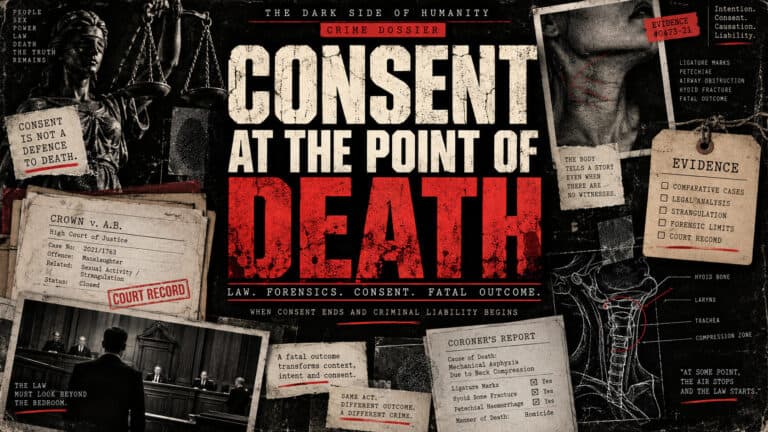
Consent at the Point of Death
Europe’s Fatal BDSM and Asphyxia Cases
From mutual rope suspension and partner-applied strangulation to sealed airways and improvised restraints, a small but recurring group of European deaths has forced courts and forensic investigators to confront the same question: what legal meaning can consent retain after the agreed activity becomes fatal?
Content warning: This report concerns fatal strangulation, hanging, suffocation, sexual activity, bondage and postmortem investigation. It describes potentially lethal conduct but does not provide instructions for performing it.
Can someone legally consent to fatal sexual strangulation?
Generally, no. European legal systems distinguish consensual sexual activity from consent to serious injury or death. Prior agreement can affect how intent, negligence, causation and culpability are assessed, but it does not automatically legalize conduct that causes fatal harm. Documented outcomes range from accidental-death findings and acquittals to manslaughter, serious-assault and murder convictions.
The forensic literature is also much smaller than popular coverage suggests. A systematic review identified only 17 published partnered BDSM fatalities from 1986 through 2020, with strangulation involved in 15. That literature is useful for mechanisms and scene reconstruction, but many reports do not provide a final criminal disposition.
Case Register: Fatal Sexual Strangulation, BDSM Deaths and Legal Outcomes
| Country | Case | Fatal mechanism | Evidence of consent | Legal / evidence status | Why it matters |
|---|---|---|---|---|---|
| Italy | Double-suspension fatality | Mechanical asphyxia during partnered suspension | Scene began by agreement | Forensic report only | Medical mechanism documented; final prosecution not established |
| Germany | Sealed-airway case | Fatal airway obstruction during partnered activity | Request for unconsciousness reported | Forensic report only | Do not convert a pathology report into a manslaughter conviction |
| Switzerland | Bern case series | Three fatal strangulation/restraint cases | Consensual context supported by scene reconstruction | Forensic reports | Published reports emphasized reconstruction, not comprehensive final judgments |
| Poland | Partnered neck-compression reports | External neck compression | Consensual context reported | Forensic reports | Legal outcomes not established in the cited medical reports |
| Greece | Accidental sexual-strangulation report | Neck compression | Consensual sexual context | Accidental classification | Medical classification should not be treated as a complete legal disposition |
| England | Sophie Moss / Sam Pybus | Sustained neck compression | Prior consensual activity was part of the evidence | Manslaughter conviction | Pybus received four years and eight months; consent was not a complete defence |
| England | Michael Barron / Josh Baxter | Severe neck compression and oxygen deprivation | Messages showed prior consent to choking | Manslaughter acquittal; GBH + intentional strangulation convictions | CPS confirmed four-year sentence in February 2026 |
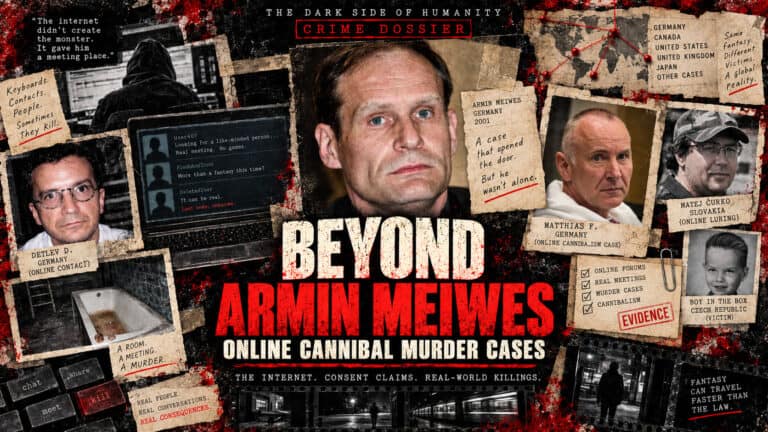
| Germany | Armin Meiwes / Bernd Brandes | Intentional killing by agreement | Death itself was the intended objective | Murder comparator | Different from an encounter expected to end with both participants alive |
The register deliberately distinguishes a forensic report from a criminal conviction. Where the supplied literature does not document the final court outcome, the dossier says so rather than filling the gap with inference.
Forensic finding does not equal court verdict
Pathology papers answer questions about mechanism, injury and manner of death. Criminal courts answer questions about legal responsibility under a specific jurisdiction’s law. An article that calls a death accidental does not automatically establish that no offence occurred, while an arrest or prosecution does not prove that the medical evidence established homicide. This dossier keeps those layers separate.
How Common Are Fatal BDSM and Partnered Asphyxia Cases?
It is too broad to say that partner-assisted sexual-asphyxia deaths are routinely prosecuted as manslaughter throughout Europe.
A 2022 systematic review of published partnered BDSM fatalities found only 17 cases reported in the international medical literature between 1986 and 2020. Fifteen of the 17 deaths involved strangulation. Where toxicology results were available, alcohol or other substances were present in eight of 13 cases. The authors concluded that fatal partnered BDSM incidents were rare when compared with autoerotic deaths and other deaths associated with sexual activity.
Seventeen published cases over 34 years do not establish a large or steadily recurring category of European manslaughter prosecutions. They establish a small, incompletely documented group of deaths spread across several countries and legal systems.
The reported outcomes vary considerably:
- Some deaths were classified forensically as accidents.
- Some surviving partners were investigated or temporarily detained but not convicted of homicide.
- Some defendants pleaded guilty to or were convicted of manslaughter or negligent homicide.
- Some were prosecuted for murder when prosecutors believed consent had been invented or exceeded.
- Some were acquitted of homicide but convicted of assault, strangulation or other offences.
- In many published medical reports, the final legal outcome was never stated.
The most defensible conclusion is that prior agreement does not normally provide complete immunity when one participant causes another’s death. It may nevertheless influence the charge, the interpretation of intent and the eventual sentence.
Partnered BDSM, Autoerotic Death and Disguised Homicide
Three categories are frequently confused. Partnered BDSM fatality refers to a death occurring during sexual or erotic activity involving at least one other participant. The scene may have begun consensually, but a restraint, suspension, neck compression or airway obstruction became fatal.
Autoerotic fatality generally involves a person acting alone while deliberately reducing oxygen to intensify sexual arousal. The death is usually unintended and may occur when an escape mechanism fails or consciousness is lost too quickly.
Homicide presented as consensual activity describes an intentional assault or killing in which the surviving person claims the deceased requested or accepted the violence. Investigators must determine whether the sexual explanation is genuine, exaggerated or entirely fabricated.
The physical scene may look similar in all three categories. Ropes, restraints, masks, plastic material, gags, sexual objects and partial undress can appear in both accidental and intentional deaths. That is why the presence of BDSM equipment does not prove consent, accident or homicide by itself.
The reconstruction must combine the scene, autopsy, toxicology, digital communications, witness statements and the surviving participant’s behaviour before and after the death.
For a separate forensic explanation of why sexual context alone does not establish sexual-homicide motive, see how forensic investigators distinguish sexual homicide from sexual context.
Why Strangulation Dominates Fatal Partnered BDSM Cases
Of the 17 partnered BDSM deaths identified in the systematic review, 15 involved strangulation. Some involved hands or an arm placed around the neck. Others involved ropes, belts, collars, chains or suspension systems. Several victims were also gagged, restrained or otherwise prevented from releasing themselves.
The word “choking” appears frequently in ordinary discussion, but it is medically imprecise. Choking usually means that an object obstructs the airway from inside the throat. Strangulation refers to pressure applied externally to the neck, potentially restricting the airway, blood vessels or both.
A person does not need to suffer a broken neck or dramatic external injury to die. Pressure can impair blood flow to the brain, obstruct breathing, trigger a fatal cardiac response or produce unconsciousness before the endangered person can communicate distress.
Once consciousness is lost, the central protection associated with consent disappears. The restrained participant can no longer withdraw agreement, use a safeword, release equipment or signal that the pressure has become dangerous.
The Italian Double-Suspension Death
The Italian case involving two women is one of the clearest illustrations of how a mutually agreed scene can change in seconds.
Both participants were suspended through a rope arrangement that linked their body weights. A male observer was present, but he was not equipped to release the system immediately after one woman became unconscious. Her collapse altered the tension on the ropes and left the other participant hanging.
The surviving woman developed respiratory failure and fell into a coma. Toxicology identified alcohol and cannabinoids. The other woman died from mechanical asphyxia.
The medical report treated the death as an unintended consequence of an elaborate shibari-style suspension. It also revealed several compounding risks: neck loading, mutual dependence between the participants, intoxicants and the absence of an immediately usable emergency-release method.
The published account did not provide a clear final prosecution or sentencing outcome. Presenting it as a confirmed manslaughter conviction would therefore be inaccurate.
This is characteristic of the literature. The medical mechanism is documented. The criminal resolution is not.
The German Case of the Sealed Airway
A German forensic report concerned a 49-year-old man whose mouth had been sealed with adhesive tape while his arms and legs were restrained. A female BDSM partner then pressed her hands over his mouth and nose.
Both participants were described as experienced, and toxicology was negative. The man had reportedly offered women money to render him unconscious. He died after the combined restraint and obstruction prevented adequate breathing.
The case undermines two common assumptions. The first is that experience prevents fatal errors. The participants were not novices, yet the scene still ended in death.
The second is that a person’s request to lose consciousness transfers complete legal and practical responsibility away from the person controlling the airway. Once unconsciousness occurred, the restrained man could no longer communicate, intervene or protect himself.
The medical publication focused on the death investigation rather than supplying a full public court history. It should therefore be treated as a documented fatality, not automatically described as a German manslaughter conviction.
Germany’s Legal Distinctions
German criminal law does not recognize a general private right to authorize another person to kill.
Section 216 of the German Criminal Code addresses killing at the victim’s request. When a person is induced to kill by the victim’s explicit and serious request, the offence can carry a lower penalty than murder or intentional homicide – between six months and five years’ imprisonment. The request reduces the offence; it does not make the killing lawful.
Negligently causing another person’s death is governed by Section 222 and may be punished by imprisonment of up to five years or a fine. Intentional killing without the additional legal characteristics of murder falls under a substantially more serious provision.
English-language reporting can create confusion by translating the German offence of Totschlag as “manslaughter.” In German law, it generally refers to intentional killing that does not satisfy the specific statutory characteristics of murder. It is therefore considerably more serious than the involuntary or negligent manslaughter offences commonly associated with an accidental sexual death in Britain or North America.
A German court examining a fatal BDSM encounter would therefore need to distinguish among several possibilities:
- An unforeseen accident without criminal negligence.
- Negligent homicide.
- Killing at the victim’s explicit request.
- Intentional homicide.
- Murder involving additional aggravating characteristics.
Consent may alter the factual and legal analysis, but it does not erase the death.
Three BDSM Deaths in a German Autopsy Study
A German study reviewed 16,437 autopsies conducted over 25 years, from 1993 through 2017. It identified 74 non-natural deaths associated with sexual activity. Only three were classified as BDSM-related, representing approximately 4 percent of the sex-associated non-natural deaths and 0.018 percent of all autopsies reviewed.
The cases included fatal restraint or strangulation scenarios and a death involving severe bleeding during BDSM activity. The tiny proportion is important because media attention can make such incidents appear far more common than the forensic record supports.
The study also shows why the phrase “cases appear regularly” needs qualification. They recur across time and jurisdictions, but they remain rare events within large autopsy populations.
The Bern Case Series
A forensic team in Bern published three deaths arising from consensually initiated BDSM activity. Two men died during encounters with female dominants, while a third died during activity with a casual male partner. In all three cases, investigators found equipment and scene characteristics consistent with the sexual explanation, and the autopsies supported death through strangulation.
One man was found restrained against a wooden board while wearing a straightjacket, headgear and a gag. Shoelaces or similar ligatures connected the neck area to the equipment. Alcohol was detected in his body, while cocaine was identified in the surviving partner.
Another man died in an incomplete hanging involving a collar and chain attached to a ceiling fixture. Cannabis-related substances were detected.
The third had a chain around his neck connected to a fixed structure. He had also been gagged and subjected to electrical stimulation. Substances associated with inhaled nitrites, commonly called poppers, were detected.
The authors described the deaths as unintentional and emphasized the difficulty of reconstructing scenes involving unusual equipment, intimate conduct and a surviving participant with potential criminal exposure. The article did not provide a comprehensive public account of final criminal judgments.
It would therefore be misleading to call all three Swiss manslaughter cases. They were three forensic homicide-screening cases in which the available evidence supported fatal consensual activity rather than a disguised intentional assault.
The Polish Forensic Reports
A Polish forensic publication described at least two partnered BDSM deaths involving external neck compression.
In one, a 30-year-old woman died after manual pressure was applied to her neck while her mouth and nose were also covered. The male partner was described as experienced in BDSM, and both participants had consumed alcohol.
In another, a 41-year-old man died while a male partner controlled a rope around his neck. His arms and legs were restrained. Both men were described as experienced, and toxicology was negative.
The contrast is instructive. Alcohol was present in one case and absent in the other. Experience was reported in both. Neither sobriety nor experience guaranteed survival.
The reports again provide stronger medical evidence than legal documentation. They cannot responsibly be presented as confirmed Polish manslaughter convictions unless separate court records establish that outcome.
The Greek Accidental-Strangulation Report
An earlier Greek forensic report concerned a 32-year-old man who died when a male sexual partner applied an arm around his neck. The death was described in the medical literature as accidental sexual strangulation. Toxicology was negative.
The classification did not mean that the physical act was safe. It meant that the forensic authors concluded the fatal result was unintended within the sexual context they reconstructed.
Whether the surviving participant faced a separate criminal-negligence analysis was not clearly documented in the accessible medical summary. That uncertainty again demonstrates why forensic classifications and court verdicts must not be treated as interchangeable.
“Accidental” in a death certificate or pathology article describes manner and apparent intent. It does not automatically answer every question about legal culpability.
An Accident Finding Can Exonerate a Partner
Another published European case concerned lethal asphyxiation initially suspicious enough for the surviving partner to be detained. Investigators examined whether the death resulted from intentional violence or from sexual activity involving a known asphyxia-related interest.
The authors concluded that recognising the deceased’s established paraphilic behaviour and reconstructing the scene supported accidental strangulation during erotic activity. That conclusion contributed to the surviving partner being cleared rather than prosecuted as a killer.
The case is important because it shows that European legal systems do not always treat a fatal partner-assisted scene as manslaughter. Where the evidence supports accident and does not establish criminal negligence or intent, homicide liability may not follow.
The same sexual evidence can therefore operate in opposite directions. It can expose an offender’s false account, or it can prevent an accidental death from being misclassified as murder.
England and Wales: Consent Is Not a Complete Defence
The law in England and Wales is comparatively explicit. section 71 of the Domestic Abuse Act 2021 provides that a person cannot rely on another person’s consent to serious harm for purposes of sexual gratification. Government guidance states that the principle applies beyond formally defined domestic relationships and extends to conduct causing serious injury or death.
The provision did not invent an entirely new principle. It reinforced and clarified the existing common-law position that consent does not generally legalize the intentional infliction of serious bodily harm during sexual activity.
That does not mean every fatal sexual-strangulation case becomes murder. Prosecutors must still establish what the defendant intended and which homicide offence the evidence supports.
A person may be guilty of murder if there was an intention to kill or cause really serious harm. Manslaughter may apply where the fatal act was unlawful, grossly negligent or carried out without the intent required for murder. A homicide charge may fail where causation or the necessary mental element cannot be proven.
Consent cannot authorize death, but it can still influence how the surrounding conduct and the defendant’s state of mind are interpreted.
Sophie Moss: Sam Pybus and the Fatal Strangulation Manslaughter Case
The 2021 death of Sophie Moss became one of Britain’s most prominent fatal sexual-strangulation cases.
Sam Pybus admitted applying pressure to Moss’s neck during sexual activity. He claimed she had previously encouraged the practice. He had consumed 24 bottles of lager and said he could not clearly remember the fatal act.
Moss died from sustained neck compression. Prosecutors accepted that they could not prove Pybus intended to kill her or cause really serious harm, and he pleaded guilty to manslaughter rather than murder. He received four years and eight months in prison. The Court of Appeal later refused the attorney general’s request to increase the sentence.
The appellate court did not hold that Moss could lawfully consent to being killed. It explicitly accepted that consent was not a defence to manslaughter. The dispute concerned Pybus’s level of culpability, the evidence of prior consensual activity and whether the original sentence fell outside the range a judge could reasonably impose.
The case demonstrates why saying that “consent is no defence” does not end the legal analysis. It prevents complete exoneration based only on agreement, but the court must still determine whether the killing was intentional, reckless or negligent.
The later public debate around this prosecution sits within a longer history of consent-to-harm arguments. See the history of the “rough sex” defence.
Michael Barron and Josh Baxter: Why the Manslaughter Charge Failed
A more recent English case produced a different result. Michael Barron died in January 2025 after meeting Josh Baxter through an online dating platform. Prosecutors alleged that Baxter applied significant pressure to Barron’s neck during sexual activity. Medical evidence indicated severe neck compression, including a fractured structure in the neck, followed by cerebral oxygen deprivation and cardiac arrest.
Evidence presented by prosecutors also concerned Baxter’s behaviour after Barron became unresponsive. He delayed contacting emergency services, searched online for information relating to imprisonment and collected a takeaway meal before assistance was summoned.
Baxter was tried for manslaughter but acquitted of that homicide charge. The jury convicted him instead of intentional strangulation and causing grievous bodily harm. In February 2026, he was sentenced to four years’ imprisonment.
The outcome demonstrates that even where a death follows neck compression, a manslaughter conviction is not automatic. The prosecution must establish causation and all required elements beyond a reasonable doubt. A jury may conclude that serious unlawful violence occurred while remaining unconvinced that the specific homicide charge has been proved.
The Barron and Moss cases therefore sit beside one another without producing a simple rule. Pybus admitted manslaughter. Baxter was acquitted of it but convicted of serious nonfatal offences arising from the same encounter in which Barron died.
The Crown Prosecution Service case update confirms Baxter was acquitted of manslaughter, convicted of intentional strangulation or suffocation and section 20 grievous bodily harm, and sentenced to four years on February 24, 2026.
How the “Rough Sex” Defence Works in Fatal Strangulation Cases
Fatal “rough sex” cases create an unavoidable evidentiary imbalance. The surviving participant can describe what the deceased supposedly requested, enjoyed or permitted. The deceased cannot challenge that account.
Digital messages, prior witnesses, medical findings and recordings may corroborate or undermine the claim, but many encounters occur in private and leave only one living narrator. Campaigners argue that this imbalance can allow the alleged sexual preferences of a dead woman or man to reduce the charge or sentence.
Courts must nevertheless decide cases on admissible evidence rather than automatically rejecting a defendant’s account because the other participant is dead. The challenge is to test the consent narrative without allowing it to become a substitute for investigating force, duration, withdrawal, intoxication and post-incident conduct.
Section 71 addresses only part of that problem. It prevents consent from legalising serious harm. It cannot supply missing evidence about intent or determine precisely what occurred inside a private room.
The Netherlands: A Legal Comparison, Not a Verified Named Case
Targeted searches did not produce a responsibly verifiable, named Dutch case matching the exact pattern of a consensual BDSM-asphyxia death followed by a publicly reported manslaughter conviction.
That absence should not be filled with an invented example. Dutch court decisions are frequently anonymised, and only a selection of judgments is published through the national Rechtspraak system. Names may be removed, facts abbreviated and lower-court decisions omitted from public databases. The lack of an easily searchable international report therefore does not prove that no such Dutch prosecution has occurred.
The broader Dutch legal principle is clearer. The Netherlands’ regulated euthanasia system does not create a general private right to kill a consenting person. Intentional termination of life and assistance in suicide remain criminal offences unless a physician satisfies the strict statutory due-care requirements governing euthanasia and assisted dying.
A private sexual partner therefore cannot rely on the Netherlands’ euthanasia laws as authority to cause death during BDSM activity. The legal analysis would still turn on intention, negligence, causation and the applicable homicide provisions.
The Netherlands belongs in the comparative discussion because of that legal framework, but no specific named Dutch manslaughter case should be asserted without a verifiable judgment.
Why Armin Meiwes Was Different
The German case of Armin Meiwes dominates international discussion of “consensual homicide,” but it involved materially different conduct.
Meiwes intentionally killed a man who had expressed a desire to be killed and consumed. The death was not an unintended failure during an activity meant to stop before fatal injury. The victim’s death was the planned objective.
Partnered asphyxia cases more often involve a dispute about whether death was intended at all. The surviving person may claim that the goal was temporary restraint, unconsciousness, humiliation or intensified sensation – not killing.
That distinction explains why Meiwes became a murder case while other fatal sexual encounters have produced negligent-homicide, manslaughter or accidental-death findings.
The common principle is narrower: a victim’s willingness does not automatically legalize intentional killing.
That case is useful precisely because the intended outcome was death, unlike many partnered-asphyxia cases in which survival was expected. Read the full Armin Meiwes case file.
Why Fatal Sexual Strangulation Can Lead to Murder, Manslaughter or Acquittal
Several factors determine whether a fatal BDSM encounter becomes murder, manslaughter, negligent homicide or no homicide prosecution.
Intent
The central question is often whether the surviving participant meant to kill or cause grave injury. Messages discussing death, threats, prior violence or deliberate continuation after obvious unconsciousness may support an intentional-homicide charge.
Foreseeability
Even without an intention to kill, an act may be so dangerous that continuing it constitutes criminal negligence or recklessness. Restricting the airway of a restrained person creates a risk that does not disappear because the person initially agreed.
Causation
Prosecutors must prove that the accused person’s conduct caused the death. Intoxication, underlying disease, several simultaneous restraints or delayed medical treatment can complicate the analysis.
Scope of agreement
Consent to bondage does not necessarily include neck compression. Consent to brief pressure does not establish consent to unconsciousness. Consent at the beginning of an encounter does not prove continued agreement after distress or withdrawal.
Capacity
Alcohol, sedatives and other drugs can affect the ability to give informed consent, recognise danger and communicate. In the published review, intoxicants appeared in a majority of the cases where toxicology information was available.
Scene alteration
A surviving participant may remove restraints, clean the room, move the body or conceal equipment before calling for help. Those actions can reflect panic, attempted resuscitation, shame or deliberate concealment. They also make forensic reconstruction more difficult.
Digital evidence
Messages, photographs, videos and online profiles can show what was discussed before the meeting. They may corroborate consent to some acts while proving that the fatal act was never requested.
Post-incident conduct
Immediate emergency assistance can support the claim that death was unintended, although it does not erase earlier recklessness. Delayed reporting, deceptive explanations or disposal of evidence may support a more serious interpretation.
No single factor decides every case.
The Survivor Controls the First Narrative
When one participant dies, the other often supplies the first detailed explanation.
The survivor may say that the deceased requested strangulation, insisted on increased force or resisted being released. Those claims may be true, partly true or constructed after the death. Investigators must avoid both automatic belief and automatic disbelief.
The forensic review warned that sexual-death scenes are particularly vulnerable to alteration. Surviving partners may remove embarrassing equipment, relatives may clean or rearrange the scene, and shocked witnesses may provide incomplete accounts. Digital recordings can sometimes resolve those uncertainties, but many encounters are not recorded.
The legal problem is not unique to BDSM. Similar asymmetry arises whenever a defendant claims self-defence, accident or consent in a private encounter with no surviving witness.
What distinguishes fatal asphyxia is how quickly the deceased may lose the ability to communicate and how little visible injury may initially appear.
Experience Does Not Eliminate the Risk
The published cases included experienced participants as well as novices. At least nine involved people described as familiar with BDSM practices. Some had previously discussed emergencies or resuscitation. Those precautions did not prevent death.
Experience may reduce certain mistakes, but it cannot make oxygen deprivation predictable. The transition from consciousness to incapacitation can be rapid, and the person applying force cannot directly see cerebral blood flow or oxygen levels.
The forensic literature also documents failures involving equipment rather than a participant’s deliberate continuation. Rope systems tightened unexpectedly. Body weight changed the load. Restraints prevented self-release. An observer could not undo a suspension after a participant collapsed.
The recurring danger is loss of control. The person who appears to be participating voluntarily can become incapable of protecting themselves before the other person recognises the emergency.
Consent Ends Before Death
The phrase “consensual asphyxia” can suggest that consent covers the entire event, including the fatal outcome. In most cases, the agreement is more limited.
A person may consent to a sensation, role or restraint while expecting to survive. Death transforms the event into something they may never have authorised. Even an expressed desire to become unconscious does not necessarily amount to a serious request to be killed.
Legal systems therefore examine the point at which the agreed activity exceeded its limits. That point may be reached when pressure becomes injurious, when a safeword is ignored, when the person becomes unconscious or when the surviving participant continues despite recognising a substantial risk of death.
Once the person is unconscious, consent cannot be actively maintained. The responsibility to stop rests with the person who remains conscious and physically in control.
BDSM Is Not Synonymous With Violence or Homicide
A responsible account must distinguish consensual BDSM from abuse. Most BDSM activity does not result in serious injury or death. Participants may negotiate limits, establish signals and avoid activities they regard as unacceptably dangerous. The existence of rare fatal incidents does not justify portraying an entire community as inherently criminal or pathological.
The forensic review itself noted that BDSM communities use consent frameworks and risk-awareness principles. It also concluded that no framework can eliminate the danger of activity involving intentional oxygen restriction.
The critical legal divide is not between conventional and unconventional sex. It is between consensual activity and the unlawful infliction of injury or death.
Unusual sexual interests do not remove legal protection from the person who dies.
For the diagnostic boundary, see why consensual BDSM is not the same as sexual sadism disorder.
The Problems With “He Asked for It”
In many of these cases, public attention moves quickly toward the deceased person’s preferences.
He wanted to be rendered unconscious. She had participated in strangulation before.
They met through a BDSM forum. He paid a professional dominant.
She designed the rope arrangement. Those facts can be relevant. They can explain why restraints were present and why the parties entered the encounter. They can also become a form of victim-blaming when used to imply that the surviving participant had no independent duty to stop before death.
Consent does not transform the surviving person into a passive instrument. The person applying pressure, securing equipment or controlling release continues making decisions.
They can refuse. They can stop.
They can call for help. They remain legally responsible for their own conduct.
The same evidentiary problem appears in historic homicide litigation where the surviving defendant supplied the only account of a private sexual encounter. The Preppie Murder legal autopsy traces that older “rough sex” defence history.
What the Literature Cannot Tell Us
The published medical record is incomplete by design. Case reports tend to focus on unusual mechanisms of death, autopsy findings and scene reconstruction. They may omit names to protect privacy and provide only brief descriptions of police findings. Criminal proceedings can occur months or years after publication, leaving the article without a final disposition.
Publication bias also matters. An unusual rope-suspension death is more likely to become a journal article than an ordinary accidental hanging. Cases from countries with active forensic publishing networks may appear more frequently than comparable deaths elsewhere.
The 17-case review therefore should not be read as a complete count of every European fatal BDSM encounter. It is a count of cases that reached accessible scientific publication and met the authors’ criteria.
It is strong evidence about mechanisms. It is weaker evidence about the frequency of prosecutions.
What Can Be Said With Confidence
Several conclusions are supported across the medical and legal records. Partner-assisted fatal asphyxia is rare but repeatedly documented.
External neck compression is the dominant mechanism in published partnered BDSM deaths.
Alcohol and drugs are common complicating factors but are not present in every case.
Experienced participants have died despite familiarity with the activity.
The presence of BDSM equipment does not prove that a death was accidental.
Prior agreement does not automatically legalise serious injury or death.
A manslaughter conviction is possible, but it is not inevitable. The final legal outcome depends on the evidence of intent, negligence, causation, capacity and the boundaries of any agreement.
Coda: The Last Boundary
A consensual encounter begins with two living people capable of making decisions.
One person may agree to be tied, suspended, restrained or placed under another’s control. The agreement may include fear, discomfort and the performance of danger. It ordinarily includes an assumption that the person will still be alive when the scene ends.
Fatal asphyxia destroys that assumption. The instant consciousness disappears, one participant loses the power to stop what is happening. The surviving participant becomes the only person capable of releasing the restraint, removing the obstruction or summoning assistance.
European courts do not respond to every resulting death in the same way. Some see unforeseeable accident. Others find criminal negligence, manslaughter or intentional homicide. In some cases, the evidence proves serious unlawful violence but fails to establish the homicide charge.
What the law generally does not accept is that consent makes death legally irrelevant.
A person may agree to risk. They cannot make another person’s fatal act disappear.
Courts, Jurisdictions and the Legal Record
The image file is intentionally institutional rather than sensational. These are legal and forensic comparison cases, so the visual record emphasizes the courts and jurisdictions that determine criminal responsibility.


Frequently Asked Questions
Can someone consent to being strangled?
A person may agree to sexual activity involving neck pressure, but consent is not unlimited. In England and Wales, consent cannot provide a defence to the infliction of serious harm for sexual gratification. A fatal outcome still requires investigation of intent, causation, negligence and the scope of any prior agreement.
Can someone legally consent to serious harm during sex?
Not generally in England and Wales. Section 71 of the Domestic Abuse Act 2021 restates that a person cannot consent to serious harm for sexual gratification and, by extension, cannot consent to their own death.
Is a fatal BDSM accident automatically manslaughter?
No. Published European cases include accidental classifications, cases without documented prosecution outcomes, manslaughter convictions, acquittals and other serious-offence convictions. The legal result depends on the evidence and jurisdiction.
What is the “rough sex” defence?
The phrase refers to cases in which a defendant says serious or fatal violence occurred during consensual sexual activity. It is not a free-standing legal defence. In England and Wales, section 71 prevents consent to serious harm for sexual gratification from operating as a defence to relevant offences.
What does section 71 of the Domestic Abuse Act 2021 do?
It restates the principle that a person cannot consent to the infliction of serious harm for sexual gratification and cannot consent to their own death. Prosecutors still must prove the elements of the charged offence.
What is Germany’s killing-at-the-victim’s-request law?
Section 216 of the German Criminal Code applies where a person is induced to kill by the victim’s express and earnest request. It carries six months to five years imprisonment. The request can reduce the offence, but it does not make the killing lawful.
Was Sam Pybus convicted of murder?
No. Pybus pleaded guilty to manslaughter in the death of Sophie Moss and received four years and eight months imprisonment. A later bid to increase the sentence was rejected.
Why was Josh Baxter acquitted of manslaughter?
The jury did not find the manslaughter charge proved beyond a reasonable doubt. It did convict Baxter of intentional strangulation or suffocation and section 20 grievous bodily harm. The CPS reported a four-year sentence in February 2026.
Is consensual BDSM the same as sexual sadism disorder?
No. Consensual BDSM is not, by itself, a mental disorder or evidence of criminal pathology. Sexual sadism disorder is a clinical diagnosis requiring a specific pattern of sexual arousal linked to another person’s suffering plus non-consensual conduct or clinically significant distress or impairment.
How do pathologists distinguish accident from homicide in a sexual death?
They integrate scene findings, autopsy results, toxicology, injury patterns, digital communications, witness accounts and the surviving participant’s conduct. No single prop, restraint or sexual context establishes the manner of death by itself.
Primary Law, Court Material and Forensic Literature
Source hierarchy: official legislation and prosecution material first, then peer-reviewed forensic literature, then established reporting where a public judgment was not readily available. The legal status of each case is stated only as narrowly as the record supports.
Domestic Abuse Act 2021, section 71 explanatory notes
Official UK legislation explaining consent to serious harm for sexual gratification.
Open sourceGerman Criminal Code, sections 216 and 222
Official English translation covering killing upon request and negligent killing.
Open sourceCrown Prosecution Service: Josh Baxter / Michael Barron
Official prosecution update confirming verdicts and February 2026 sentence.
Open sourceHow safe is BDSM? A literature review on fatal outcome in BDSM play
Systematic review identifying 17 published partnered BDSM fatalities and summarizing mechanisms, toxicology and experience.
Open sourceSophie Moss / Sam Pybus sentencing and appeal coverage
Established reporting on the manslaughter sentence and unsuccessful unduly-lenient appeal.
Open sourceThe Preppie Murder Killing in Central Park: A Legal Autopsy
Internal legal-history comparison for consent-to-harm and victim-blaming arguments.
Open sourceArmin Meiwes: The Rotenburg Cannibal and Consensual Murder
Comparator for intentional killing at the victim’s request.
Open sourceDiscover more from The Dark Side of Humanity
Subscribe to get the latest posts sent to your email.