FILE NO. 0153Case status Convicted
TDSH · CASE FILE · L.A. CO. CA / WHATCOM CO. WANo. 82123-7-I
Case fileLos Angeles County · 1977 to 78Bellingham, Wash. · 197912 victims namedEvidence-led file
The Hillside Stranglers
Kenneth Bianchi and Angelo Buono Jr.: ten murders of women and girls in Los Angeles, two more in Bellingham, the fake-police ruse, the fibers that corroborated a liar, and the two-year trial that prosecutors tried to abandon.
Buono: died in prison, 2002 · Bianchi: in custody in Washington
Record boundaryThe Los Angeles series is ten murders between Oct. 17, 1977 and Feb. 1978. Bianchi killed Karen Mandic and Diane Wilder in Bellingham, Washington, alone, on Jan. 11, 1979. He pleaded guilty to seven murders: two in Washington and five in Los Angeles. A jury convicted Buono of nine of the ten Los Angeles murders and acquitted him of Yolanda Washington’s. Established facts come from appellate opinions, the trial prosecutor’s published account, Washington historical records and contemporaneous wire reports. Where they conflict, this file says so.
DefendantD-01
Angelo Buono Jr.
d. Sept. 21, 2002, aged 67
DefendantD-02
Kenneth A. Bianchi
b. May 22, 1951 · renamed Anthony D’Amato, 2023
Victim roll12 named · L.A. + Bellingham
- V-01Yolanda WashingtonOct. 17, 1977 · age 19
- V-02Judith Ann MillerNight of Oct. 30 to 31, 1977 · age 15
- V-03Elissa “Lissa” Teresa KastinNov. 5 or 6, 1977 · age 21
- V-04Jane Evelyn KingNov. 9, 1977 · age 28
- V-05Dolores “Dolly” CepedaNov. 13, 1977 · age 12
- V-06Sonja JohnsonNov. 13, 1977 · age 14
- V-07Kristina WecklerNov. 19, 1977 · age 20
- V-08Lauren Rae WagnerNov. 28, 1977 · age 18
- V-09Kimberly Diane MartinDec. 13, 1977 · age 17
- V-10Cindy Lee HudspethFeb. 16 or 17, 1978 · age 20
- V-11Karen L. MandicJan. 11, 1979 · age 22
- V-12Diane A. WilderJan. 11, 1979 · age 27
Docket sheetTDSH-CF-1977-LAX · numbers from the court record
- Victims · L.A.
- Ten women and girls, aged 12 to 28 · Oct. 17, 1977, Feb. 1978
- Victims · Wash.
- Karen Mandic, 22 · Diane Wilder, 27 · Jan. 11, 1979
- Arrests
- Bianchi, Jan. 12, 1979 (Bellingham) · Buono, Oct. 1979 (Glendale)
- Wash. pleas
- Oct. 19, 1979 · Whatcom Co. Super. Ct. · 2 counts first-degree murder
- Calif. pleas
- Oct. 22, 1979 · L.A. Super. Ct. · 5 murders, conspiracy, sodomy
- Buono trial
- Nov. 16, 1981, Nov. 18, 1983 · Judge Ronald M. George
- Verdicts
- Guilty on 9 counts of murder · not guilty on 1 (Yolanda Washington)
- Sentences
- Buono: life without parole · Bianchi: two consecutive life terms (Wash.) + life (Calif.)
- Wash. minimum term
- 1,424 months (702 + 722), set 1990 · +120 months, 2018
- Latest ruling
- Personal restraint petition denied · Wash. Ct. App. No. 82123-7-I · Oct. 3, 2022
Status · checked Sept. 30, 2026 (ET)Illustrative stamp
Parole deniedCalif. · July 2025
Bianchi’s California parole was denied in July 2025 for ten years. Buono died in prison in 2002.
Kenneth Bianchi, now Anthony D’Amato, 75, is in the Washington State Penitentiary at Walla Walla. California’s Board of Parole Hearings denied him parole in July 2025 and set his next hearing ten years out. Washington’s Indeterminate Sentence Review Board heard his case in late June 2025. This file has not confirmed that board’s published decision.
Angelo Buono Jr. died of a heart attack in his cell at Calipatria State Prison on Sept. 21, 2002, aged 67.
Even if Washington released him, a California detainer requires that he be returned to serve his California life sentence.
Dossier index26 sections · 00 to 25
- 00What were the Hillside Strangler murders?
- 01Case snapshot
- 02Who were the key people?
- 03The criminal partnership
- 04Before the murders
- 05How the murder system worked
- 06The victims
- 07Victim pattern without victim blaming
- 08Los Angeles timeline
- 09Geography of disposal
- 10The authority ruse
- 11The task force
- 12Bellingham breaks the case
- 13The psychiatry fight
- 14The plea bargain
- 15The trial that nearly vanished
- 16Evidence ledger
- 17Charges and sentences
- 18Legal path
- 19Sentences, deaths, afterlife
- 20The Veronica Compton plot
- 21Court-document exhibits
- 22Myth vs. record
- 23Related case frameworks
- 24FAQ
- 25Source ledger and notes
Content & source warningThis file describes the abduction, rape, torture and strangulation of ten women and girls, two of them aged 12 and 14, plus two more murders in Washington. The detail comes from court opinions, the trial prosecutor’s account, autopsy findings reported at trial, and contemporaneous reporting: ligature marks, electrical burns, attempted gassing and the dumping of nude bodies. It also discusses the sexual exploitation of teenage girls. Quotations are exact. Where a source paraphrases testimony, the text says so.
TDSH-CF-1977-LAX · §00
What were the Hillside Strangler murders?
The case before the mythology · direct answer first
Direct answer
What were the Hillside Strangler murders?
The Hillside Strangler murders were the abduction, rape and strangling of ten women and girls in Los Angeles County between October 1977 and February 1978 by the adoptive cousins Kenneth Bianchi and Angelo Buono Jr. The victims were aged 12 to 28. The two men often posed as police officers, took most of their victims to Buono’s home and upholstery shop at 703 East Colorado Street in Glendale, and dumped the nude bodies on hillsides and roadside slopes around Glendale. Bianchi moved to Bellingham, Washington, and in January 1979 strangled two Western Washington University students, Karen Mandic and Diane Wilder. His arrest there led detectives back to Los Angeles. Bianchi pleaded guilty to seven murders and testified against Buono, who was convicted of nine of the Los Angeles murders after a trial that lasted two years.
Key numbersEvery figure from the cited record · derived figures say so
Los Angeles victims
Washington victims, killed by Bianchi alone
12 to 28age range of the Los Angeles victims
9 of 10Buono’s murder convictions
162officers on the task force at its peak
10,000+clues logged by the task force
2 yrs 2 daysBuono’s trial, Nov. 16, 1981, Nov. 18, 1983
392 · 1,807witnesses · exhibits
~6 monthsBianchi on the witness stand; four of them under cross-examination
1,424months: Bianchi’s Washington minimum term, set in 1990 (about 118 years, derived)
120months added by Washington’s parole board in 2018
earlier petitions dismissed, listed by the 2022 court (count derived)
TDSH-CF-1977-LAX · §01
Case snapshot
Two offenders, two states, one evidentiary chain
Ten victims, Oct. 1977, Feb. 1978
The linked California series ran from October 17, 1977 to February 1978: ten murders on nine separate nights, since two schoolgirls were taken together. Four victims were abducted in Hollywood, five in or around Glendale and one in the San Fernando Valley. All were killed at night, and the bodies were found on hillsides, roadside slopes and urban margins in an arc around Glendale.
Two more murders, Jan. 11, 1979
Karen Mandic, 22, and Diane Wilder, 27, both students at Western Washington University, were strangled in Bellingham on January 11, 1979. Bianchi had moved north in 1978 and was working as a security guard. He killed them alone. Bellingham police arrested him the next day.
“Strangler” was not one man
The name “Hillside Strangler” became official late in 1977, when the LAPD set up the Hillside Strangler Task Force, and it was singular. Some detectives already suspected more than one killer, because the scenes had no drag marks. An LAPD commander was quoted as saying there “may be as many as 4 or 5 sets of stranglers.” Witnesses later described two men staging what looked like a police arrest. What investigators faced was a two-man partnership in which each killer could cover for, blame and conceal the other.
One evidentiary chain
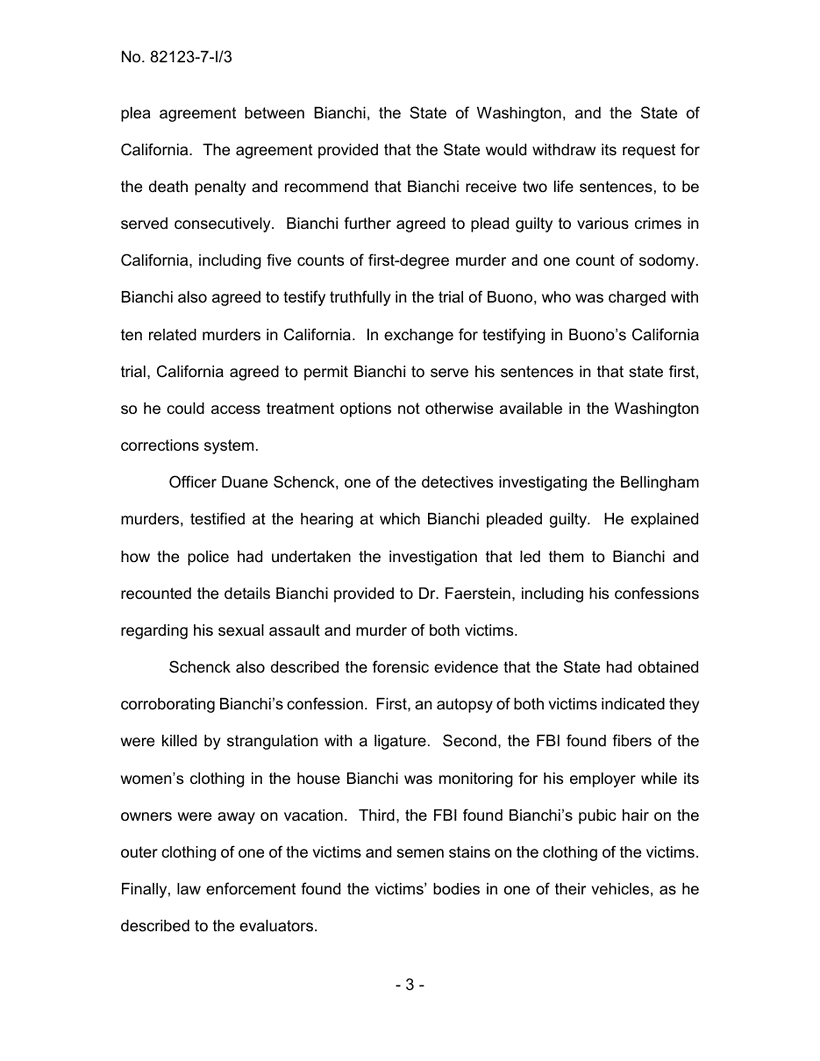
Washington prosecuted the Bellingham murders, and California prosecuted the Los Angeles murders. The two states negotiated a single plea agreement covering both. In exchange for his pleas, Bianchi was spared the death penalty, other charges were dismissed, and he was given the possibility of parole and a chance to serve his California sentence first, in California. That last benefit depended on his testifying fully and truthfully against Buono.
TDSH-CF-1977-LAX · §02
Who were the key people in the case?
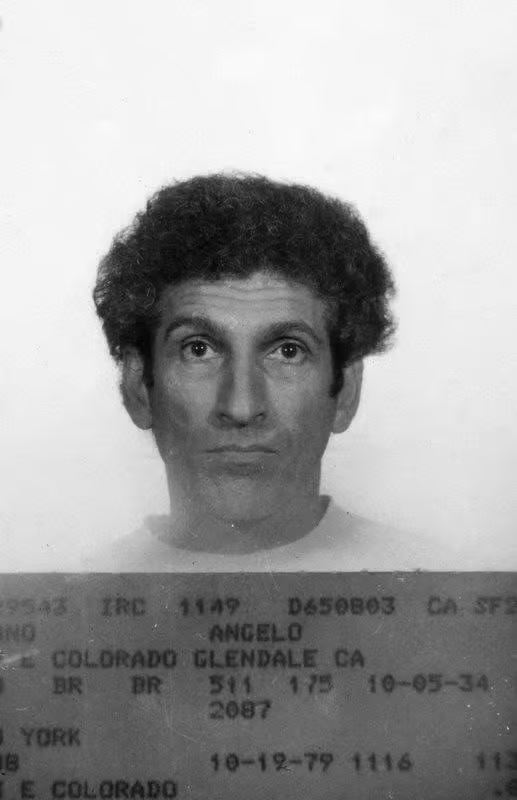
Key-people cards · names and roles from the record
DefendantP-01
Angelo Buono Jr.
- Role
- Older adoptive cousin; ran a one-man auto-upholstery business from his home at 703 E. Colorado St., Glendale
- Convicted
- Nine counts of first-degree murder, Oct. 31, Nov. 14, 1983
- Sentence
- Life without parole, Jan. 9, 1984
- Died
- Sept. 21, 2002, Calipatria State Prison, aged 67
Sources
DefendantP-02
Kenneth A. Bianchi
- Born
- May 22, 1951, Rochester, N.Y.; adopted as an infant
- Role
- Younger cousin; failed police applicant and security guard; posed as a psychologist with forged credentials
- Pleas
- Two murders (Wash.), five murders, conspiracy and sodomy (Calif.), Oct. 1979
- Now
- Renamed Anthony D’Amato (2023); held at Walla Walla
Sources
AccompliceP-03
Veronica Lyn Compton
- Role
- Wrote to Bianchi in jail in 1980 and plotted a “copycat” strangling
- Convicted
- First-degree attempted murder, Whatcom Co., Mar. 20, 1981
- Sentence
- Life with possibility of parole; paroled 2003
Sources
Trial judgeP-04
Ronald M. George
- Role
- L.A. Superior Court judge who refused to dismiss the murder counts in 1981 and presided over Buono’s trial
- Later
- Chief Justice of California
Sources
ProsecutionP-05
Roger W. Boren · Michael Nash
- Role
- Deputy attorneys general who took over the case in August 1981 and tried Buono
- Record
- Boren later published a first-hand account (33 Loy. L.A. L. Rev. 705)
Sources
DefenseP-06
Gerald Chaleff · Katherine Mader
- Role
- Buono’s trial lawyers; also the real parties in interest in Littlefield v. Superior Court (1982)
Sources
InvestigatorsP-07
Frank Salerno · Dudley Varney
- Role
- L.A. County sheriff’s detectives on the task force; flew to Bellingham on Jan. 14, 1979
- Quote
- “There was really no coordination whatsoever.” (Salerno, 2025)
Sources
InvestigatorsP-08
Fred Nolte · Terry Wight
- Role
- Bellingham police detectives assigned full time to the Mandic-Wilder disappearance; Nolte called Los Angeles about Bianchi’s license address
Sources
Expert · StateP-09
Dr. Martin T. Orne
- Role
- Hypnosis researcher retained by the prosecution; concluded Bianchi was simulating both hypnosis and multiple personality
- Diagnosis
- Antisocial personality disorder with sexual sadism
Sources
Expert · defenseP-10
Dr. John G. Watkins
- Role
- Psychologist who hypnotized Bianchi in March 1979 and elicited “Steve”; maintained the multiple-personality diagnosis
Sources
Defendant photographs are left as labelled empty slots. The booking photos on Wikimedia Commons have unclear rights, so none are used.
TDSH-CF-1977-LAX · §03
How did the Bianchi-Buono partnership work?
Why a two-man crime needs more than a “mastermind and follower” story
Older cousin, fixed base
Buono, 44 at the time of the murders by the Los Angeles Times’s count, ran a one-man auto-upholstery business out of the garage of his house at 703 East Colorado Street in Glendale and was “a sometime pimp.” Bianchi later told investigators that nine of the ten Los Angeles victims were killed in that house. The prosecution tied the location to the crimes with fibers from the shop’s upholstery material and from a chair and carpet in the house, with Buono’s destruction of a gas pipe, and with Bianchi’s testimony. Buono was convicted of nine murders and sentenced to life without parole.
Younger cousin, deceptive access
Bianchi had studied police science, been rejected by police forces and worked as a security guard. In Los Angeles he posed as a psychologist, using forged diplomas built from the transcripts of a real psychologist named Steve Walker, which he obtained through a fake help-wanted advertisement. Detectives called him “Slick Ken.” He pleaded guilty to five California murders and the two Bellingham murders, and his testimony became central to Buono’s prosecution despite his repeated changes of story.
Ruse, confinement, assault, disposal
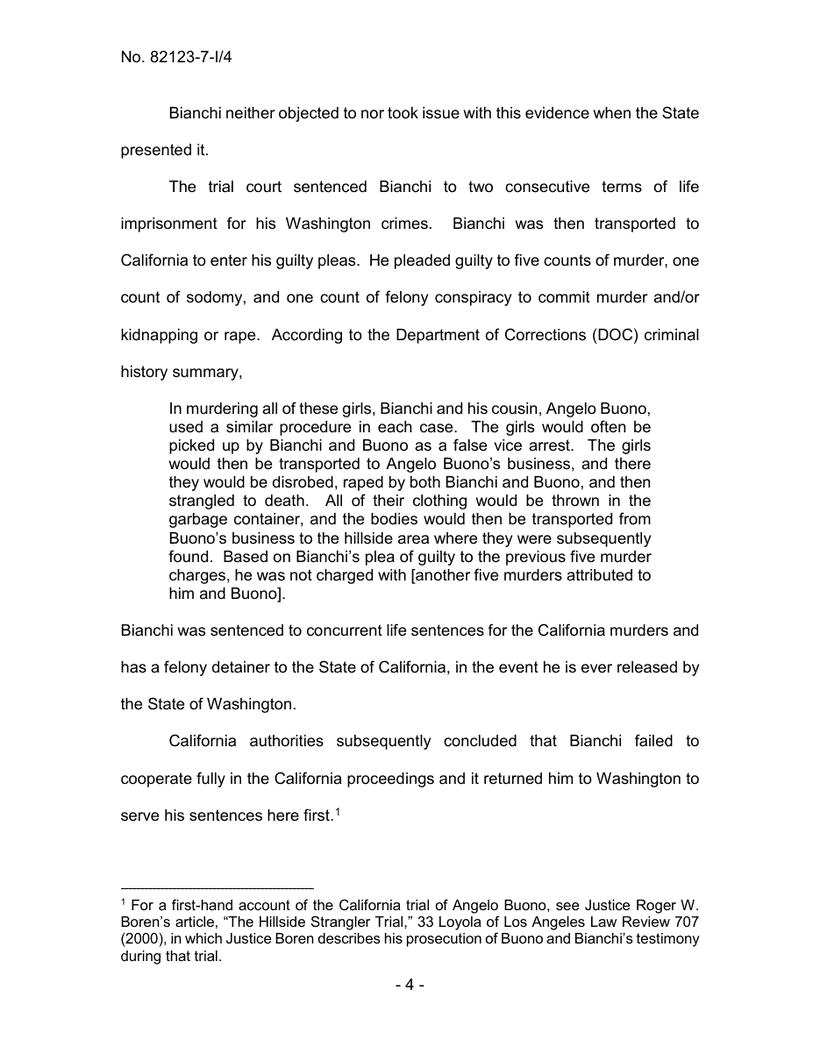
The Washington Department of Corrections’ criminal history summary, quoted by the Washington Court of Appeals in 2022, describes the method this way: “The girls would often be picked up by Bianchi and Buono as a false vice arrest. The girls would then be transported to Angelo Buono’s business, and there they would be disrobed, raped by both Bianchi and Buono, and then strangled to death. All of their clothing would be thrown in the garbage container, and the bodies would then be transported from Buono’s business to the hillside area where they were subsequently found.” Working as a pair made controlling a victim easier. It also meant each man’s only witness was his accomplice.
Don’t diagnose the partnership from headlines
Labels such as “folie à deux,” “psychopath,” “dependent partner” or “dominant sadist” can be useful hypotheses, but they are no substitute for the legal record. Bianchi gave at least four versions of events involving Buono: sometimes the two men took turns strangling victims, sometimes he said he wasn’t there, and sometimes he said he watched Buono do it. The strongest analysis starts from conduct, roles, corroboration and the record of his changing accounts. For the clinical concept, see shared delusion (folie à deux).
VERIFIED“At least four different versions”: Littlefield, 136 Cal.App.3d at 482. The turn-taking and absence claims: L.A. Times 2025.
TDSH-CF-1977-LAX · §04
What happened before the murders?
Exploitation, false authority and the period in which coercion became routine
Women were being exploited before bodies appeared
Bianchi moved from Rochester, New York, to Los Angeles in January 1976, and Buono later said he had let his younger cousin stay with him briefly, as a favour to his aunt. After the arrests, it emerged that the two men had run pimping and pandering using teenage runaways from Arizona, in an outcall prostitution operation whose clients reportedly included prominent businessmen and a former police chief. Buono was charged with pimping and pandering, extortion and sodomy alongside the murders, and the judge severed those counts from the murder trial. That history matters because the murders didn’t come out of nowhere: sexual coercion and economic exploitation of young women were already part of the partnership.
Police identity without police accountability
Bianchi kept trying for the status that comes with law enforcement. He took police-science courses, applied to police departments and worked security. In Bellingham he became a security company’s “patrol captain,” applied to be a reserve sheriff’s deputy and was taking police courses. An aide to a Los Angeles County supervisor had given him a large official county seal that could be used for special parking and other privileges. Investigators also found plenty of evidence that both men had police badges. In the murders, false police authority was a practical tool: a badge and an “arrest” turned ordinary compliance into captivity.
Buono’s property changed the logistics
A controlled location in Glendale gave the two men privacy, tools, time and distance from the dump sites. Bianchi testified that victims were placed in a particular chair and then assaulted and strangled on the bedroom floor. Separating the abduction, the assault and the disposal complicated the forensic picture: investigators were looking at bodies left on hillsides while the critical indoor scene was miles away, in a house Buono had cleaned so thoroughly that an April 1979 search found no fingerprints at all, not even his own.
Biography is not destiny
Later books and profiles often work backward from the murders, turning Bianchi’s adoption, childhood or personality into inevitability. This file does not. HistoryLink records that he was born in Rochester on May 22, 1951 and adopted that August. The evidence that counts here is behaviour: prior exploitation, deception, coercion, police impersonation, shared offending, and the physical record that later tied both men to the murders.
TDSH-CF-1977-LAX · §05
How did the killers operate?
Access, control, kill site, disposal, and the advantages of working as a pair
AccessVictims were met through street contact, ordinary public settings (a bus stop, a bus ride from a shopping mall) or Bianchi’s own social circle. A false vice arrest, with badges and handcuffs, could stop resistance before any force was visible.
TransportTwo men could split the driving, the watching and the control of the victim. A witness saw two men force Lauren Wagner from her Ford Mustang into a larger, dark car.
Controlled siteBuono’s house and shop in Glendale. Victims were blindfolded with upholstery-type material, placed in a chair, then raped and strangled on the bedroom floor.
Cause of deathLigature strangulation, with matching ligature marks on the neck, wrists and ankles. One pathologist performed seven of the ten autopsies; each pathologist testified to the same mode of strangulation and to signs of sexual assault.
TortureElectrical wires were taped to Lauren Wagner’s hands in an attempt to electrocute her before she was strangled; her palms bore electrical burns. The men tried to kill Kristina Weckler with natural gas through a flexible gas pipe and injected her with cleaning fluid.
Body disposalNude bodies with no identification were left in remote spots near hillsides in or around Glendale; clothing went into the garbage.
Counter-forensicsClothes were discarded and Buono’s house was wiped of fingerprints. After Bianchi’s arrest, Buono destroyed the gas pipe and its petcock. Fibers survived anyway: in the tape adhesive on Wagner’s wrists, and on Judith Miller’s eye.
Investigative lesson
The Hillside Strangler series wasn’t simply a run of strangulations. It was a repeatable system in which false authority, the control that two men had over one victim, an indoor base and dumping the body somewhere else each solved a different problem for the killers.
TDSH-CF-1977-LAX · §06
Who were the victims?
Twelve names across the California and Washington record
Victim · 19V-01
Yolanda Washington
Worked as a waitress; contemporaneous accounts say she also worked in Hollywood street prostitution. Her mother, Catherine Campbell, and stepfather, Jimmy Campbell, a Baptist gospel preacher, sat through the verdict.
- Taken
- Oct. 17, 1977 · Hollywood. Bianchi testified that the two men, posing as police, took her toward the Hollywood Hills, and that he strangled her at Buono’s direction. An investigative source said she was strangled in a car.
- Found
- Oct. 18 · face-down in bushes near 6510 Forest Lawn Dr., by Forest Lawn cemetery and Griffith Park
- Scene
- LAPD
- Outcome
- Not guilty · Nov. 3, 1983 · “weakest evidence” (prosecutor)
Sources
Victim · 15V-02
Judith Ann Miller
A 15-year-old girl in Hollywood whose mother had last seen her on Oct. 15. A trial witness who said he was acting as her pimp testified that she got into an older Cadillac limousine on Sunset Boulevard.
- Taken
- Night of Oct. 30 to 31, 1977 · outside Carney’s, 8300 block of Sunset Blvd., Hollywood
- Found
- Oct. 31, about 6 a.m. · across from 1844 Alta Terrace, La Crescenta foothills, near the house of a teenage girl Buono knew. A white polyester fiber on her eye matched upholstery in Buono’s shop.
- Scene
- L.A. County Sheriff
- Outcome
- Guilty · early Nov. 1983
Sources
Victim · 21V-03
Elissa “Lissa” Teresa Kastin
A waitress at a Hollywood health-food restaurant who also danced and hoped to go into show business. The 1979 complaint summary noted she was “not considered part of the Hollywood street scene.”
- Taken
- Nov. 5 or 6, 1977 · Hollywood
- Found
- Next day · a hilly stretch of Glendale near the Chevy Chase Country Club
- Scene
- Glendale Police
- Outcome
- Guilty · Nov. 10, 1983
Sources
Victim · 28V-04
Jane Evelyn King
An actress and model who, by trial accounts, had left an actors’ workshop before she was picked up.
- Taken
- Nov. 9, 1977 · near 5900 Franklin Ave., Hollywood: “persuaded” into the car, the complaint says
- Found
- About two weeks later, Nov. 23 · near the southbound Golden State Fwy off-ramp to Los Feliz Blvd.
- Scene
- LAPD
- Outcome
- Guilty · Nov. 10, 1983
Sources
Victim · 12V-05
Dolores “Dolly” Cepeda
A Highland Park schoolgirl. She and her friend Sonja were riding a bus home from the Eagle Rock Plaza when the men followed them.
- Taken
- Nov. 13, 1977 · near N. Ave. 46 and York Blvd.
- Found
- Nov. 20 · Landa St. near Stadium Way, Elysian Park, among discarded mattresses; boys who found them first thought they were mannequins
- Scene
- LAPD
- Outcome
- Guilty · Nov. 8, 1983
Sources
Victim · 14V-06
Sonja Johnson
A Highland Park schoolgirl taken with Dolores Cepeda. The jury stood on Landa Street at night in December 1982 to see where the two girls were thrown.
- Taken
- Nov. 13, 1977 · near N. Ave. 46 and York Blvd.
- Found
- Nov. 20 · same Landa St. hillside
- Scene
- LAPD
- Outcome
- Guilty · Nov. 8, 1983
Sources
Victim · 20V-07
Kristina Weckler
An art student at the Art Center College of Design in Pasadena who lived in the same Glendale apartment complex as Bianchi.
- Taken
- Nov. 19, 1977 · lured by Bianchi with the promise of a party, the complaint says
- Found
- Nov. 20 · under a tree, 4100 block of Ranons Way, Highland Park
- Scene
- LAPD
- Outcome
- Guilty · Nov. 10, 1983
Sources
Victim · 18V-08
Lauren Rae Wagner
A business-college student from Sepulveda in the San Fernando Valley, abducted on her way back from her boyfriend’s house. “Lauren Wagner never got the career she wanted,” prosecutor Michael Nash told the jury.
- Taken
- Nov. 28, 1977 · less than a block from her parents’ home; a neighbour saw two men force her from her Ford Mustang into a larger, dark car
- Found
- Next day · residential Mount Washington. Electrical burns on her palms; fibers in tape adhesive on her wrists.
- Scene
- LAPD
- Outcome
- Guilty · Oct. 31, 1983: the first verdict
Sources
Victim · 17V-09
Kimberly Diane Martin
Worked for an escort service. “Kimberly Martin never had the chance to have a child,” Nash told the jury.
- Taken
- Dec. 13, 1977 · abducted from an apartment at 1950 Tamarind Ave., Hollywood, the building where Bianchi had lived
- Found
- Dec. 14 · steep hillside below the 2000 block of N. Alvarado St.
- Scene
- LAPD
- Outcome
- Guilty · Nov. 8, 1983
Sources
Victim · 20V-10
Cindy Lee Hudspeth
A Glendale college student and waitress who lived across the street from Bianchi. She was last seen at Glendale Ave. and Colorado St., about a block and a half from Buono’s house.
- Taken
- Feb. 16 or 17, 1978 · taken to the upholstery shop and the house next to it, per the complaint
- Found
- Feb. 17 · nude, in the trunk of her Datsun, pushed off the Angeles Crest Highway above La Crescenta
- Scene
- L.A. County Sheriff
- Outcome
- Guilty · mid-Nov. 1983: the ninth and last verdict
Sources
Victim · 22V-11
Karen L. Mandic
A Western Washington University junior in business administration, from Bellevue, who worked at the Fred Meyer store where Bianchi had worked security.
- Taken
- Jan. 11, 1979 · lured with a $100 house-sitting offer to 334 Bayside Rd., Edgemoor
- Found
- Jan. 12, 4:30 p.m. · in her green 1978 Mercury Bobcat, Willow Court N cul-de-sac
- Scene
- Bellingham Police
- Outcome
- Bianchi pleaded guilty · Oct. 19, 1979
Sources
Victim · 27V-12
Diane A. Wilder
A transfer student majoring in dance at WWU’s Fairhaven College, from Bremerton. She went with her friend Karen to the house-sitting job.
- Taken
- Jan. 11, 1979 · 334 Bayside Rd., Edgemoor
- Found
- Jan. 12 · in the same car
- Scene
- Bellingham Police
- Outcome
- Bianchi pleaded guilty · Oct. 19, 1979
Sources
The record behind each card
TDSH-CF-1977-LAX · §07
Who did the killers target?
The series widened over time; vulnerability was situational, not moral
Exploited where they were visible
The first two victims, Yolanda Washington and 15-year-old Judith Miller, were taken from Hollywood streets where the killers could approach young women without immediately drawing attention, and contemporaneous accounts tie both to street prostitution. That doesn’t make them responsible for the danger. It describes the environment the killers chose to exploit, and the pimping operation the two men themselves had run.
The target pool widened
Later victims included students, a waitress, an actress and two schoolgirls met in ordinary public places: a bus stop, a bus ride from a shopping mall, Bianchi’s own apartment complex, the street outside his building. The murders of Dolores Cepeda, 12, and Sonja Johnson, 14, ended any idea that the threat was confined to one adult subculture. Real panic began that November, when four victims were found in a single week.
VERIFIED“Four victims were found during a one-week stretch” in November 1977 (L.A. Times 2025).
Children through adults
The Los Angeles victims were aged 12 to 28. That spread says more than any offender-generated “type” would: opportunity, control and perceived vulnerability mattered more than a narrow demographic template.
Don’t label people “high risk” and stop there
Terms such as “high-risk victim” can hide the actual mechanism. The useful question is which conditions the killers manipulated: public trust, transport, age, isolation, economic vulnerability, and the assumption that a badge meant safety. After Lauren Wagner’s murder, young women in Los Angeles grew afraid of submitting to police stops. The LAPD told its own officers not to chase women who ran from them.
TDSH-CF-1977-LAX · §08
When did the Los Angeles murders happen?
Los Angeles, October 1977 to February 1978: escalation, variation and visibility
The killings ran from Oct. 17, 1977 to Feb. 1978. Five victims died in November alone, and two of them were children. Then the killings stopped. “Why did it stop, if there were two?” sheriff’s detective Frank Salerno recalled asking. “Were both of them in custody? Did one kill the other?”
Jan. 1976
Bianchi arrives
Kenneth Bianchi moves from Rochester to Los Angeles.
Oct. 17, 1977
Yolanda Washington
Taken in Hollywood; found next day near Forest Lawn Drive. The first recognized killing.
Oct. 31
Judith Miller, 15
Taken outside Carney’s on Sunset; found at dawn on Alta Terrace, La Crescenta.
Nov. 5 to 6
Lissa Kastin
Found in the Glendale hills near the Chevy Chase Country Club.
Nov. 9
Jane King
Taken near Franklin Avenue; not found until Nov. 23.
Nov. 13
Dolores Cepeda, 12 · Sonja Johnson, 14
Followed from the Eagle Rock Plaza on a bus; found Nov. 20 off Landa Street.
Nov. 19
Kristina Weckler
Lured from Bianchi’s Glendale complex; found next day in Highland Park.
Nov. 28
Lauren Wagner
Abducted near her parents’ home in the San Fernando Valley; found next day on Mount Washington.
Late 1977
Task force
The LAPD launches the Hillside Strangler Task Force, which grows to 162 officers by early 1978.
Dec. 13
Kimberly Martin
Abducted from 1950 Tamarind Avenue; found next day below North Alvarado Street.
Feb. 16, 1978
Jan Simms intervenes
In North Hollywood, a grandmother pulls a young woman away from a man she later identified as Bianchi, beside an Excalibur-like car she said Buono was driving.
Feb. 16 to 17
Cindy Hudspeth
Last seen at Glendale Avenue and Colorado Street; found in the trunk of her car off the Angeles Crest Highway. The Los Angeles killings stop.
1978
Bianchi moves north
Bianchi follows his girlfriend and their son to Bellingham, where he takes security jobs.
TDSH-CF-1977-LAX · §09
Where were the bodies found?
Why the hillsides became the public face of crimes committed elsewhere
The hillsides were not the whole crime scene
Where the bodies were left, on roadsides, embankments and canyon routes, gave the case its nickname. But by Bianchi’s account, nine of the ten victims were killed inside Buono’s house. Treating the dump sites as the only scenes risked over-reading the geography and missing the indoor scene and the transport between the two.
“Should have been called the ‘Glendale Strangler’”
In his closing argument, Boren drew a circle around Glendale centred on the intersection of Glendale Avenue and Colorado Street. Within it, he showed, lay roughly every site where a body was found, each easy to reach from that intersection by major surface streets and the Golden State Freeway. Cindy Hudspeth was last seen at that intersection, and Buono’s home and shop were a block and a half away. A television reporter told Boren the case should have been called the “Glendale Strangler.”
Los Angeles helped fragment the evidence
In a car-dependent city with many police jurisdictions, a series with this many scenes was hard to pull together. The LAPD handled seven crime scenes, the Sheriff’s Department two (Miller and Hudspeth), and Glendale police one (Kastin). In December 1982, Judge George took the jury out at night in sheriff’s vans, driving the route from each abduction site to Buono’s house and on to each dump site, usually two murders a night, with a court-ordered media caravan behind them.
Dump-site patterns don’t prove motive
Leaving bodies in the open may reflect haste, access, practical disposal, contempt, a wish for them to be found, or several of these at once. The Los Angeles Times later wrote that the bodies were left “in ways that seemed designed to taunt police and maximize public terror,” and the 2002 obituary said Buono had arranged them. The record supports the locations. Explaining why those places were chosen calls for more caution.
PARTIAL“Posed” and “arranged” are newspaper characterizations (L.A. Times 2025; L.A. Times 2002), not court findings. They are kept here as attributed quotations.
TDSH-CF-1977-LAX · §10
How did the fake-police ruse work?
How counterfeit legitimacy became a weapon
“Vice officers”
The two men posed as vice officers, flashed fake badges and used handcuffs. The aim wasn’t theatre. Authority reduced resistance and caused confusion, and it let them turn a public encounter into controlled transport. Before the arrests, investigators already believed the killers were using some kind of police ruse.
The abduction they abandoned
Bianchi told investigators about one aborted abduction before his plea. Investigators then found Catherine “Cathy” Lorre, daughter of the actor Peter Lorre, who described the same encounter: two men stopped her crossing near Hollywood Boulevard and Highland Avenue, showed police badges and asked for identification, then let her go. Bianchi gave inconsistent reasons, saying either that they saw a photo in her wallet of her on her father’s lap, or that it was something about her appearance. At trial, defence lawyer Gerald Chaleff undermined her general credibility, though Boren thought it “highly unlikely” she could have invented a story matching Bianchi’s.
Feb. 16, 1978, North Hollywood
On the day Cindy Hudspeth was killed, Jan Simms, a grandmother driving north of the Ventura Freeway, saw a man gripping a young blonde woman by the wrists and pulling her toward a tan Excalibur or Excalibur-like sports car. Simms told the woman to get into her station wagon, and she did. The man said, “God will get you for this.” Simms later identified him as Bianchi and the driver as Buono. Her report became one of the task force’s 10,000 clues.
Hypnosis cost the prosecution
Before trial, Judge George held a month-long hearing on hypnotized witnesses under the California Supreme Court’s new rule in People v. Shirley (1982). He found that Bianchi had faked being hypnotized and could testify. Beulah Stofer, who watched Lauren Wagner’s abduction and thought it looked like a police arrest, had not in fact been hypnotized and could testify. Others were excluded: Stofer’s neighbour, who saw two men transfer Wagner from her Mustang into a larger, dark car, and the defence lawyer Ronald LeMieux, who said he saw Yolanda Washington’s abduction.
The ruse weaponized compliance
A woman who believes she is being detained by police faces an impossible choice, because resisting may feel dangerous or even criminal. Suspicion that the killer was a police officer was so widespread that LAPD Chief Daryl Gates told officers: “If a woman runs from you … don’t chase her. Understand that she may be panicking, thinking that you’re him.” The case is also a study in how symbols of state authority can be exploited by offenders.
TDSH-CF-1977-LAX · §11
Why couldn’t the task force catch them?
The 162-officer task force: scale did not automatically create coordination
A massive investigation
By early 1978 the Hillside Strangler Task Force had grown to 162 officers from the LAPD, the Sheriff’s Department and Glendale police, with a 24-hour tip line. Gates later wrote: “We had, in time, more than 10,000 clues, 4,800 parolees to check out, and 120,000 fingerprint cards to run for comparison.” The problem was no longer a lack of information. It was deciding which information mattered.
More investigators, more seams
“There was really no coordination whatsoever,” sheriff’s detective Frank Salerno told the Los Angeles Times in 2025. “Investigation by committee doesn’t work.” The LAPD’s new clue computer was haphazardly managed, and investigators spread across agencies did not reliably share what they had. Under pressure, the LAPD arrested a Beverly Hills handyman on a jailhouse informant’s word, then released him three days later with a public apology from Gates.
Bianchi surfaced before the break
Bianchi’s name came up several times during the Los Angeles investigation (three times, by Boren’s count), and at one point he agreed to take a polygraph. No one followed up. “Our computer software could not collate all the information fed into it, and Bianchi’s name was spelled differently each time,” Gates wrote. “It continues to haunt me today that I didn’t personally go over every detail.” The point is not that police “should have known” he was a killer from his personality, but that his fixation on authority kept placing him near the institutions he imitated.
The breakthrough came from another jurisdiction
The Los Angeles investigation didn’t crack because the task force finally found one decisive clue. Bellingham detectives arrested Bianchi for two new murders, saw his California driver’s licence and called Los Angeles. The address on it, 1950 Tamarind Avenue, was where Kimberly Martin had been abducted. Another of his former addresses was Kristina Weckler’s apartment complex, and a third victim had lived across the street.
TDSH-CF-1977-LAX · §12
How was Bianchi caught?

Bellingham breaks the case: two murders, a smaller investigation, and the mistake that exposed Los Angeles
Karen Mandic, 22, and Diane Wilder, 27
Bianchi offered the two women $100 each, through Mandic, to guard a house in the secluded Edgemoor neighbourhood for two hours while its alarm system was repaired, and told them to keep it secret. The house, at 334 Bayside Road overlooking Chuckanut Bay, belonged to a retired executive who was away in Europe. Mandic told friends anyway, and named “Ken Bianchi” of Whatcom Security. The two women were killed on the night of January 11, 1979. At 4:30 p.m. the next day, a resident spotted Mandic’s green 1978 Mercury Bobcat at the end of Willow Court N, a wooded, undeveloped cul-de-sac. The two bodies were in the back seat.
The alibi collapsed
Bianchi’s employer reached him by phone, and he claimed he had been at a sheriff’s reserve-unit meeting and didn’t know Mandic. The reserve commander said Bianchi had asked to be excused from that meeting. Detectives took him into custody at a guard shack at the Port of Bellingham. His alibis were, in HistoryLink’s words, “so contradictory” that detectives believed they had their man. A witness had seen a man matching his description driving a Whatcom Security pickup in the area that night.
The FBI lab and the Catlow house
The bodies were wrapped in clean sheets to preserve trace evidence, and the medical examiner, Dr. Robert P. Gibb, found that both women had been strangled with a ligature. At Bianchi’s 1979 plea hearing, Detective Duane Schenck testified to the corroborating forensics: the ligature autopsies, FBI fiber matches between the women’s clothing and the house, and Bianchi’s pubic hair on a victim’s outer clothing.
Salerno flies north
On January 13, Detective Fred Nolte called the Los Angeles County Sheriff’s Department about Bianchi’s California licence, and the call happened to be referred to Sgt. Frank Salerno of the task force. On Sunday, January 14, Salerno and his partner Dudley Varney arrived in Bellingham. A search of Bianchi’s house turned up property stolen from places he guarded, and a cache of jewelry. At least two pieces, a large turquoise ring and a gold ram’s-horn necklace, matched descriptions of jewelry worn by Hillside Strangler victims.
The press fight
Prosecution and defence jointly asked the court to seal the probable-cause affidavit because of speculation linking Bianchi to the Los Angeles murders. The trial court let The Bellingham Herald intervene to contest the sealing. On April 30, 1979, the Washington Supreme Court reversed, holding that “such intervention in a criminal proceeding is improper,” and that the paper’s remedy lay in a separate action.
TDSH-CF-1977-LAX · §13
Did Bianchi have multiple personalities?
The “multiple personality” fight: hypnosis, “Steve Walker,” disagreeing experts and a performance
“Steve Walker”
Bianchi pleaded not guilty, then changed his plea to not guilty by reason of insanity in March 1979, when Washington announced it would seek the death penalty. He said he had no memory of the murders. Under hypnosis by the psychologist John G. Watkins on March 21 to 22, 1979, an alternate personality called “Steve” emerged, confessed to the Bellingham murders, talked about the Los Angeles killings and implicated Buono. Watkins and Dr. Ralph Allison, who also hypnotized him, both concluded that he had multiple personality disorder.
The experts did not agree
Judge Jack Kurtz appointed a panel of six to examine Bianchi. Two believed he had multiple personalities, two (both retained by the state) concluded he was faking both the hypnosis and the disorder, and two said they couldn’t be sure. All six found him competent to stand trial.
Demand characteristics: the third personality
Martin T. Orne, the prosecution’s hypnosis expert, tested whether Bianchi would shape his symptoms to an examiner’s cues. He casually remarked, in Bianchi’s hearing, that true multiples rarely have only two personalities, then asked to speak to the part that was neither Ken nor Steve. A third personality, “Billy,” said it needed more time and emerged after a two-hour dinner break as “an enthusiastic, pleasant hustler.” Orne concluded that Bianchi was simulating both hypnosis and multiple personality, and diagnosed antisocial personality disorder with sexual sadism.
VERIFIED“Billy,” the casual cue and the diagnosis (Orne et al. 1984).
A real “Steve Walker” existed
Sheriff’s detectives found that Steve Walker was the name of a real psychologist. Bianchi had duped him into sending his school transcripts by placing a help-wanted advertisement in the Los Angeles Times for a fake therapy practice, then used them to forge credentials and pose as a psychologist. Detectives spent nearly two weeks at the newspaper’s microfiche machine before they found the ad. “Basically his multiple personality defense is destroyed,” detective Peter Finnigan said, “because your primary multiple personality isn’t yours, it’s a real person.”
Evidence about malingering, not a verdict on DID
Bianchi’s performance is often used as a cultural argument against dissociative identity disorder in general, and that goes too far. The case supports conclusions about his conduct, the testing context and his credibility. It can’t, on its own, settle whether an entire diagnosis is valid. What it did show was how suggestive interviewing can reward the very symptom being tested for.
The plea replaced the insanity fight
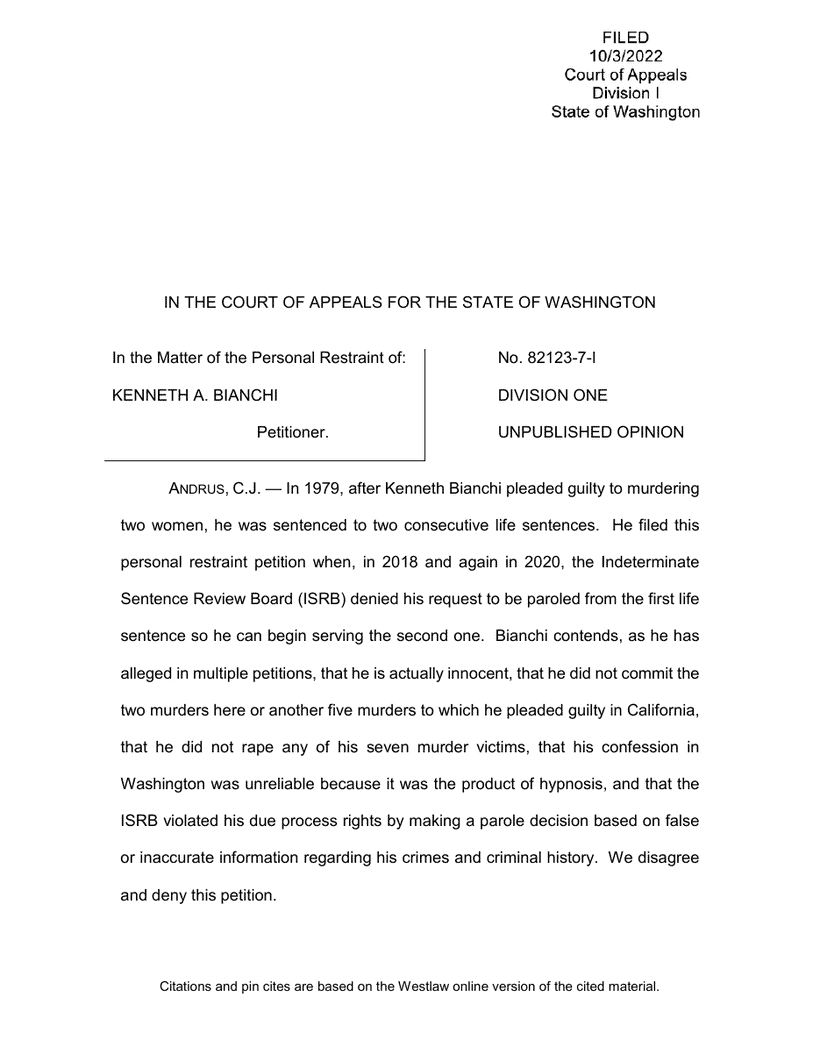
No jury ever ruled on the insanity defence. On October 19, 1979, after all six experts found him competent, Bianchi stipulated to his competency, withdrew the insanity plea and pleaded guilty to two counts of first-degree murder. The finding that he faked hypnosis came later, from Judge George, after a month-long pretrial hearing in Los Angeles. In 2022 the Washington Court of Appeals again rejected his claim that “hypnotic manipulation” produced his confession, holding that he had “failed to demonstrate that he was in fact in a state of hypnosis when he confessed.”
TDSH-CF-1977-LAX · §14
What plea deal did Bianchi make?
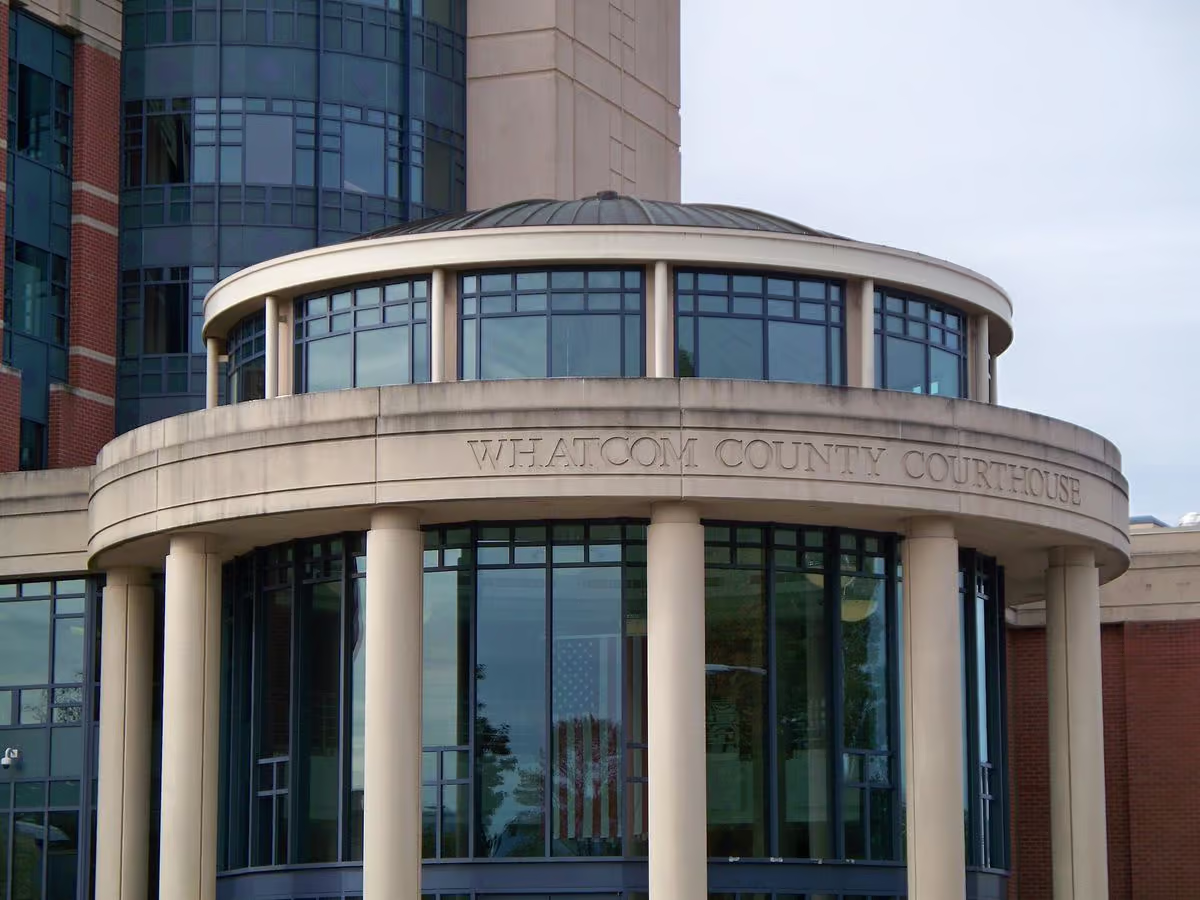
Two states, one agreement and the condition he broke
Two pleas, two consecutive life terms
In Whatcom County Superior Court, Bianchi pleaded guilty to the first-degree murders of Karen Mandic and Diane Wilder. Prosecutor David McEachran withdrew his request for the death penalty, and Judge Kurtz imposed two consecutive life terms. Those terms carried the possibility of parole. In 1981, UPI calculated that he could not be considered for parole in Washington for 26 years and eight months.
Five murders, conspiracy, sodomy
Flown to Los Angeles, Bianchi pleaded guilty before Superior Court Judge William B. Keen to five of the ten murders, one count of conspiracy to commit murder (and/or kidnapping or rape) and one count of sodomy. Keen imposed life terms that, under California law, merged. “I wish I had the power to have the sentences run consecutively,” he said. Under the joint agreement, he was not charged with the other five murders attributed to him and Buono. Within about 30 minutes of the Los Angeles plea, the task force arrested Buono at 703 East Colorado Street. He was charged with 24 felonies, including ten murders, extortion, conspiracy, sodomy, and pimping and pandering.
“Fully and truthfully”
The benefit Bianchi wanted most was to serve his time in California, near treatment programmes unavailable in Washington. It depended on his testifying fully and truthfully against Buono. On January 9, 1984, after Buono’s trial, Judge George affirmed the prosecutor’s finding that Bianchi had not done so and sent him back to Washington. On February 1, 1984, California filed a detainer ensuring that if Washington ever released him, he would be handed over to finish his California life sentence. “Thus, both states would have to grant parole or clemency in order for Bianchi to be released from custody.”
TDSH-CF-1977-LAX · §15
Why did Buono’s trial nearly collapse?
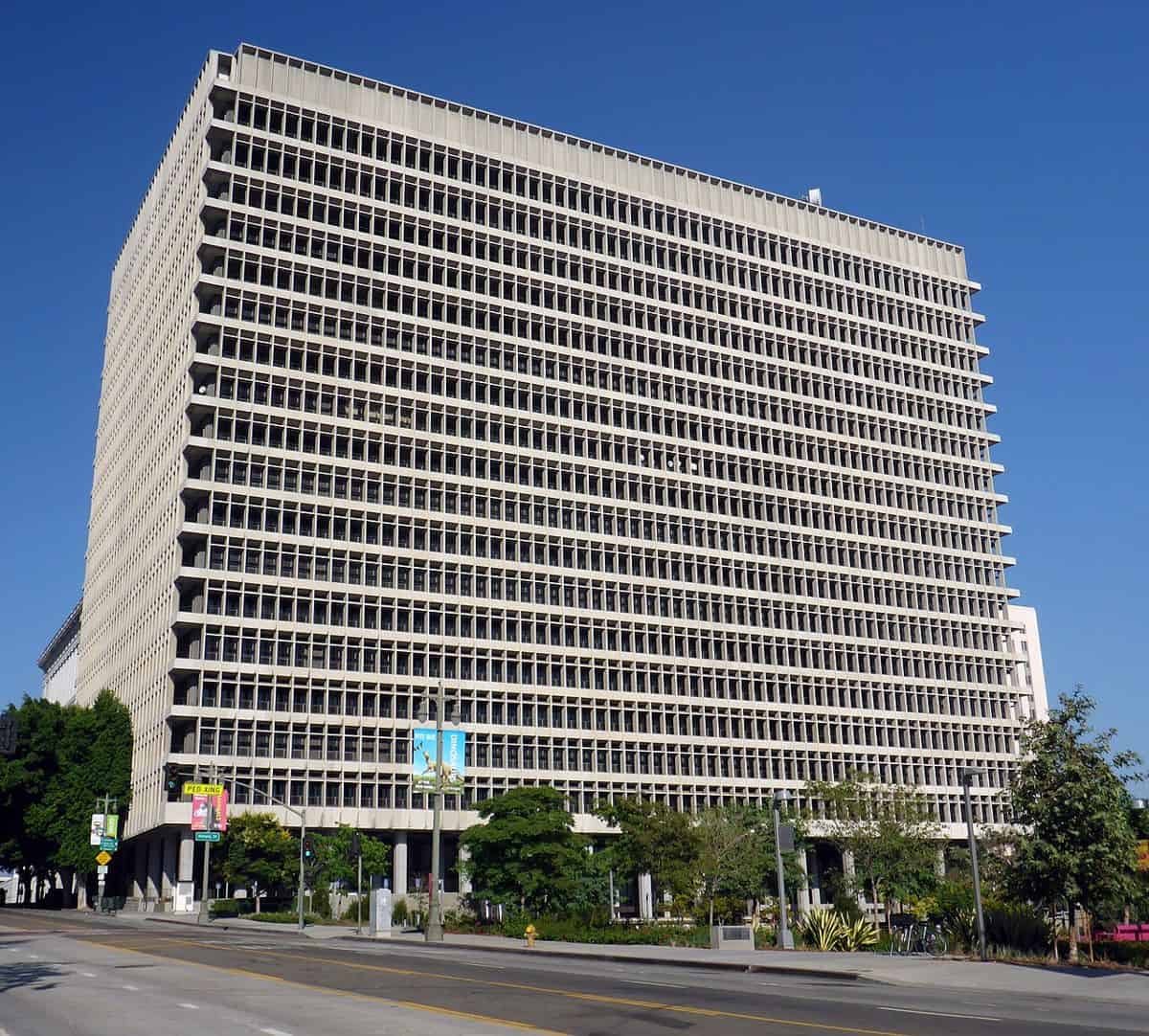
The trial that nearly vanished: could a lying accomplice still be corroborated?
Prosecutors move to dismiss
Before trial, Judge George granted a defence motion to sever the prostitution and sexual-assault counts. Bianchi, meanwhile, recanted, disowned his recantations and gave contradictory versions; at times he claimed he hadn’t been present at all. In a July 2 memo, prosecutors Roger Kelly and James Heins told District Attorney John Van de Kamp that Bianchi “would not be believable” and listed holes in all ten murder cases. One was a palm print on Cindy Hudspeth’s car that matched neither man. Another was that three people said they had seen Jane King alive after the date Bianchi gave for her murder. On July 13 the district attorney moved to dismiss all ten murder counts and pursue only the pimping charges. Kelly called it the “self-immolation” of Bianchi’s credibility.
Judge Ronald George refuses
Judge George spent more than an hour reading aloud a 36-page ruling. Bianchi’s account was a “morass of contradictions,” he found, but there was a great deal of evidence to corroborate it that prosecutors had “glossed over,” including Catherine Lorre’s account and polyester fibers on two victims that matched material in Buono’s shop. He ordered the office to “vigorously and effectively resume” the prosecution or he would hand it to the attorney general. “Ten bodies don’t just get swept under the carpet!” he later told a reporter. Van de Kamp declared a conflict of interest, and in August 1981 Attorney General George Deukmejian assigned deputies Roger Boren and Michael Nash, who told the court a two-week review showed Buono could be tried on all ten counts.
Privilege, hypnosis and a compromised eyewitness
The defence argued that Bianchi had learned key facts from his own lawyers. The Court of Appeal noted that Bianchi “has told at least four different versions of the events” involving Buono, and had admitted that some of those changes came from information his attorneys gave him. It nonetheless blocked Buono from cross-examining him about his confidential conversations with the public defender, because Bianchi’s credibility was “already open to attack.” The only eyewitness who linked Buono to a victim was Markust Camden, who testified that he saw 15-year-old Judy Miller get into a Cadillac limousine driven by a man he identified as Buono. Katherine Mader later showed that Camden had been released from a mental hospital in Indiana two days before he identified Buono from photographs.
The longest murder trial in U.S. history
The trial began on November 16, 1981, with an estimate that it would last a year. Jury selection alone took three and a half months. It ended on November 18, 1983, “two years and two days” later. The Los Angeles Times counts 729 days from jury selection to the nine guilty verdicts, with 392 witnesses and 1,807 exhibits. Bianchi was on the witness stand for about six months (80 days, by UPI’s count), four of them under cross-examination. The trial took place in the Criminal Courts Building in downtown Los Angeles, with other serial-murder trials running on the same 15th floor.
What carried the case past Bianchi
The Wagner count was the strongest, and the jury’s first guilty verdict. Tape used to attach electrical wires to her palms had left adhesive on her wrists. Nylon and acrylic fibers clinging to it matched a particular chair in Buono’s house, and Bianchi had described putting victims in that chair. Buono’s purchase and later destruction of a flexible gas pipe showed consciousness of guilt and corroborated Bianchi’s account of trying to gas Kristina Weckler. In final argument, the defence suggested that whoever left Cindy Hudspeth’s car on the Angeles Crest Highway had walked out with a bicycle stowed in its back seat. Jurors spent a week studying photographs of the small Datsun before deciding that was improbable. The California Court of Appeal later called Bianchi’s testimony “abundantly corroborated.”
Verdict sequence · 1983Count by count, as the jury returned them
- Oct. 21, 1983Deliberations beginSeven women, five men; sequestered
- Oct. 31Lauren WagnerGuilty · the first verdict
- Nov. 3Yolanda WashingtonNot guilty
- Early Nov.Judith MillerGuilty
- Nov. 8Cepeda · Johnson · MartinGuilty × 3
- Nov. 10Kastin · King · WecklerGuilty × 3 · jury “hopelessly deadlocked” on Hudspeth
- Mid-Nov.Cindy HudspethGuilty · ninth and last, after a week on the “bicycle” theory
- Nov. 18PenaltyLife without parole, after about one hour
Sources: UPI, Oct. 31 and Nov. 4, 9, 10 and 18, 1983; HistoryLink; Boren. Miller’s and Hudspeth’s dates are inferred from UPI’s running totals. UPI dates the start of deliberations to Oct. 20.
Verdicts and sentence
The jury found Buono not guilty of Yolanda Washington’s murder, the count with the “weakest evidence” in prosecutor Boren’s own words, where defence lawyer Gerald Chaleff said there was “no evidence … other than Mr. Bianchi.” Her mother, Catherine Campbell, said: “He will get whatever sentence he deserves eventually.” The jury convicted him of the other nine and, after about an hour, chose life without parole over death. “Not to impose the death penalty simply cheapens the lives of these girls,” Boren had argued. On January 9, 1984, Judge George imposed nine concurrent terms of life without parole. “I would not have the slightest reluctance to impose the death penalty. If there ever was a case for which the death penalty was appropriate, it is this case,” he said, adding that the killers had used “every form of legalized execution.”
TDSH-CF-1977-LAX · §16
What evidence convicted Buono?
The evidence ledger: what established the case, and what each category couldn’t establish alone
| Evidence | What it supported | Boundary |
|---|---|---|
| Bianchi’s guilty pleas | Five California murders, conspiracy and sodomy; two Washington murders. | A plea establishes legal guilt on the pleaded counts. It doesn’t make every later statement reliable. |
| Bianchi’s testimony | An inside account of Buono’s role, the locations, the ruses and details of the crimes, including the cleaning-fluid injection. | His credibility was savaged: at least four versions of events, recantations, and an in-court admission that earlier testimony was false. |
| Fiber and trace evidence | Fibers from Wagner’s wrist adhesive matched to a chair and carpet in Buono’s house; a fiber on Miller’s eye matched to his shop’s upholstery. | Trace associations need context, and they can’t narrate the crime by themselves. |
| Consciousness of guilt | Buono bought, then destroyed, a gas pipe and petcock; his house had been wiped of fingerprints. | This is circumstantial evidence. It supports Bianchi’s account of trying to gas Weckler without proving it. |
| Jewelry | A turquoise ring and ram’s-horn necklace found in Bianchi’s Bellingham home matched descriptions of jewelry worn by Los Angeles victims; at the preliminary hearing, Bianchi admitted a ring was “that of one young victim.” | Identification of the items and chain of custody have to be weighed. The jewelry was in Bianchi’s possession, not Buono’s. |
| Witness accounts | Lorre (badges, Hollywood), Simms (Feb. 16, 1978), Stofer (Wagner’s abduction), Camden (Miller). | Lorre’s credibility was attacked, Camden had just left a mental hospital, and hypnotized witnesses were excluded. |
| Bellingham physical evidence | The note, the gas-tank dent, fibers, hairs, the coat, stolen property. | It proved the Mandic-Wilder murders and brought Bianchi into custody, but didn’t independently prove any Los Angeles count. |
| Weak points (1981 memo) | A palm print on Hudspeth’s car matching neither man; three claimed sightings of Jane King after Nov. 9. | The jury convicted on both counts anyway, after deliberating on each separately. |
TDSH-CF-1977-LAX · §17
What were they charged with and sentenced to?
Charges and sentences matrix
Charges → verdict → sentenceThree defendants, three outcomes · from the court record
DefendantChargedVerdict / pleaSentenceNow
Angelo Buono Jr.L.A. Super. Ct.
Charged
- 10 counts of murder; with extortion, conspiracy, sodomy, pimping and pandering, 24 felonies in all
Verdict / plea
- Guilty on 9 murder counts; not guilty on Yolanda Washington (Oct. 31, Nov. 1983)
- 11 non-murder counts still pending, Oct. 1983
Sentence
- Nine concurrent terms of life without parole, Jan. 9, 1984
Now
- Affirmed 1988; review denied Feb. 23, 1989
- Died in prison Sept. 21, 2002
Kenneth A. BianchiWhatcom Co. + L.A.
Charged
- Wash.: 2 counts of first-degree murder
- Calif.: murder counts; 5 others not charged under the deal
Verdict / plea
- Wash.: guilty pleas, Oct. 19, 1979
- Calif.: guilty pleas to 5 murders, conspiracy and sodomy, Oct. 22, 1979
Sentence
- Wash.: two consecutive life terms; minimum 1,424 months (1990)
- Calif.: merged life terms; detainer filed Feb. 1, 1984
Now
- Not parolable (Wash. ISRB, 2018 and 2020)
- Calif. parole denied 1985, 2010 and July 2025
Veronica L. ComptonWhatcom Co.
Charged
- First-degree attempted murder of Kim Breed
Verdict / plea
- Jury verdict: guilty, with a deadly-weapon finding (the ligature), Mar. 20, 1981
Sentence
- Life with possibility of parole, May 22, 1981
Now
- Escaped 1988, recaptured; paroled 2003
One case, three outcomes
Three people were convicted in connection with the case, by three different routes. Buono was the only one tried for the Los Angeles murders, and his trial ran two years. Bianchi was never tried: he pleaded guilty in Bellingham and then in Los Angeles, and his deal turned on testifying truthfully against Buono. Compton was tried by a Whatcom County jury for the attempted strangling of Kim Breed, which she staged to make it look as though the killer was still at large while Bianchi was in jail.
TDSH-CF-1977-LAX · §18
How did the appeals unfold?
Appeals and legal path: four decades of litigation
The legal path · 1979 → 2025Read left to right, row by row · every stop sourced
State courtsFederal courtsParole boardsLatest
- 01Apr. 1979Washington Supreme CourtState v. Bianchi, 92 Wn.2d 91: newspaper intervention to unseal the probable-cause affidavit reversed.
- 02Oct. 1979Whatcom Co. · L.A. Superior CourtsGuilty pleas Oct. 19 (Wash.) and Oct. 22 (Calif.); joint two-state agreement.
- 03Mar. 1981L.A. Municipal CourtAfter a 10-month preliminary hearing, Judge H. Randolph Moore holds Buono to answer for murder.
- 04July-Aug. 1981L.A. Superior CourtJudge George denies the district attorney’s motion to dismiss; the attorney general takes over.
- 05Sept. 1981Washington Supreme CourtFederated Publications v. Swedberg, 96 Wn.2d 13: press-access conditions in State v. Compton, No. 80-1-00322-7.
- 06Oct. 1982Calif. Court of AppealLittlefield v. Superior Court, 136 Cal.App.3d 477: Bianchi’s attorney-client privilege upheld; Calif. Supreme Court denies hearing Dec. 9, 1982.
- 07Nov. 1983, Jan. 1984L.A. Superior CourtNine guilty verdicts; life without parole; Bianchi found in breach and returned to Washington.
- 08Nov. 1988 · Feb. 1989Calif. Court of Appeal · Supreme CourtConviction affirmed in an unpublished 29-page opinion by Justice Lynn D. Compton; review denied Feb. 23, 1989.
- 09July 1990U.S. Court of Appeals, 9th Cir.Bianchi v. Bellingham Police Dept., 909 F.2d 1316: his civil-rights suit revived on tolling grounds.
- 101990Wash. Indeterminate Sentence Review BoardMinimum terms set: 702 + 722 months = 1,424, run consecutively.
- 11Jan. 1991U.S. Court of Appeals, 9th Cir.Bianchi v. Blodgett, 925 F.2d 305: dismissal of a habeas petition attacking both states’ judgments affirmed.
- 122018 · 2020Wash. ISRBNot parolable; 120 months added in 2018; no time added in 2020.
- 13Oct. 2022Wash. Court of AppealsIn re Pers. Restraint of Bianchi, No. 82123-7-I: petition denied.
- 142025Calif. BPH · Wash. ISRBCalifornia denies parole in July (next hearing in 10 years); Washington hearing held in late June.
“An essentially inescapable conclusion”
Buono’s lawyers filed 1,300 pages of briefs. In November 1988 the Court of Appeal rejected his fair-trial challenge in a 29-page opinion by Justice Lynn D. Compton (no relation to Veronica Compton), finding Bianchi’s testimony “abundantly corroborated” by independent evidence sufficient by itself to support the conviction. It might seem improbable that anyone could be capable of such brutality, Compton wrote: “Yet it is certain that Bianchi and one other person were so capable. Once such a premise is accepted … the probability that (Buono) was that other person is an essentially inescapable conclusion.”
TDSH-CF-1977-LAX · §19
What happened to Bianchi and Buono?
Sentences, deaths and the long afterlife: the case didn’t end with the 1983 verdict
Nine murder convictions, died in custody
Buono was sent to Folsom Prison, where in 1986 he married for the fourth time. On September 21, 2002, aged 67, he died of a heart attack in his cell at Calipatria State Prison. Retired Bellingham detective Fred Nolte told CNN: “The world will probably [be] a better place without him. He will not be missed.”
California and Washington sentences
Bianchi pleaded guilty to five California murders and the two Bellingham murders. In 1990 Washington set his minimum terms at 702 and 722 months, to run consecutively: 1,424 months in all. The board cited multiple victims, a high degree of sophistication and deliberate cruelty, and found that he represented “a very high risk for future dangerousness.” In 2018 he refused a psychological evaluation, telling the evaluator his file was full of “garbage.” She scored him as meeting the criteria for psychopathy on the PCL-R. The board found him not parolable and added 120 months. In 2020 he attended with counsel, said he had earned several degrees and had had no serious infraction since 1996, and was again found not parolable. He changed his name to Anthony D’Amato in 2023. He has filed more than a dozen petitions, and “no court has deemed any of his factual claims credible.”
The cooperating killer never became a clean narrator
The plea deal made Bianchi indispensable and dangerous at the same time. He had first-hand knowledge, but also every incentive to minimize, redirect and manipulate. Buono’s prosecution became a test of whether independent evidence could carry a case built around a compromised accomplice. “The state made a deal with the devil,” Chaleff told the penalty jury, “and Mr. Buono was the devil’s due.”
The case changed more than serial-killer lore
The case’s lasting significance lies in multi-agency linkage, trace evidence, corroboration of an accomplice, forensic assessment of malingering, the admissibility of hypnotically refreshed testimony after People v. Shirley, and the question of what prosecutors should do when their essential witness is also a proven liar. District Attorney Van de Kamp later admitted that seeking dismissal “was an error,” and rivals used it against him in his 1990 run for governor.
VERIFIED“It was an error” (L.A. Times 2025); the 1990 campaign (Boren, 33 Loy. L.A. L. Rev. 705).
TDSH-CF-1977-LAX · §20
Who was Veronica Compton?
The Veronica Compton plot: an attempt to manufacture reasonable doubt from jail
Copycat logic
Veronica Lyn Compton, 24, a self-described actress and playwright, wrote to Bianchi at the Los Angeles County Jail in June 1980, asking for help with a screenplay about a female serial killer. Between June and September they plotted to prove his innocence. She would fly to Bellingham, strangle a woman with white clothesline, and plant evidence to mimic the Mandic-Wilder murders. At their last meeting, Bianchi gave her a semen sample in the fingertip of a latex glove, hidden in the spine of a book, to leave on the victim’s body.
Kim Breed fought her off
In Bellingham, Compton befriended Kim Breed, 26, at a tavern and lured her to a room at the Shangri-La Downtown Motel with a promise of cocaine. She tied Breed’s hands and twice strangled her almost to unconsciousness. Breed, larger and unusually strong, struggled free and escaped. “I knew I was gonna die,” she later testified.
Life with possibility of parole
Compton was arrested in Carson, California, on October 2, 1980. At trial, before a jury brought in from Pierce County, she claimed the attack was a publicity stunt and that Breed was in on it. On March 20, 1981, the jury convicted her of first-degree attempted murder, finding that she was armed with a deadly weapon, the ligature. On May 22, 1981, Judge Byron L. Swedberg sentenced her to life with the possibility of parole. She escaped in 1988, was recaptured nine days later, and was paroled in 2003.
TDSH-CF-1977-LAX · §21
What do the court records show?
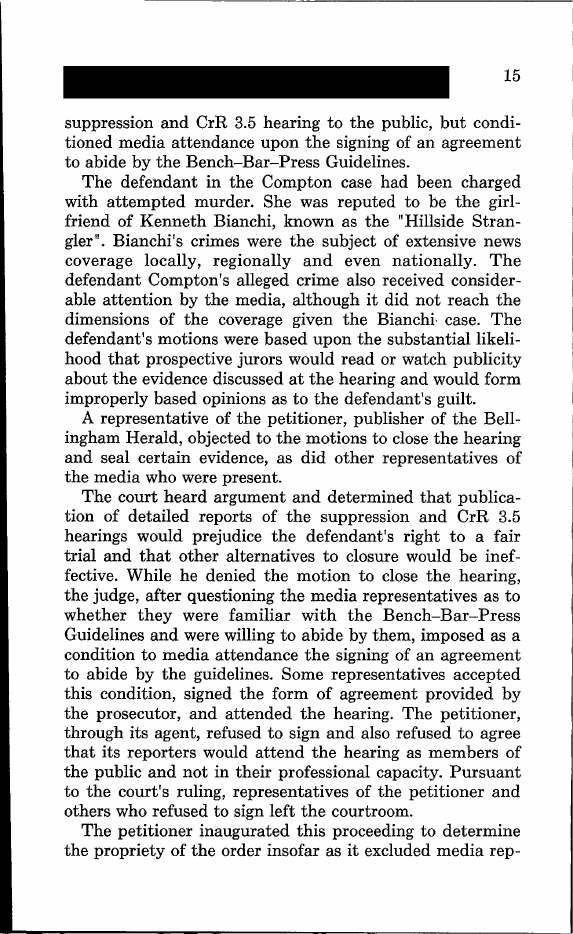
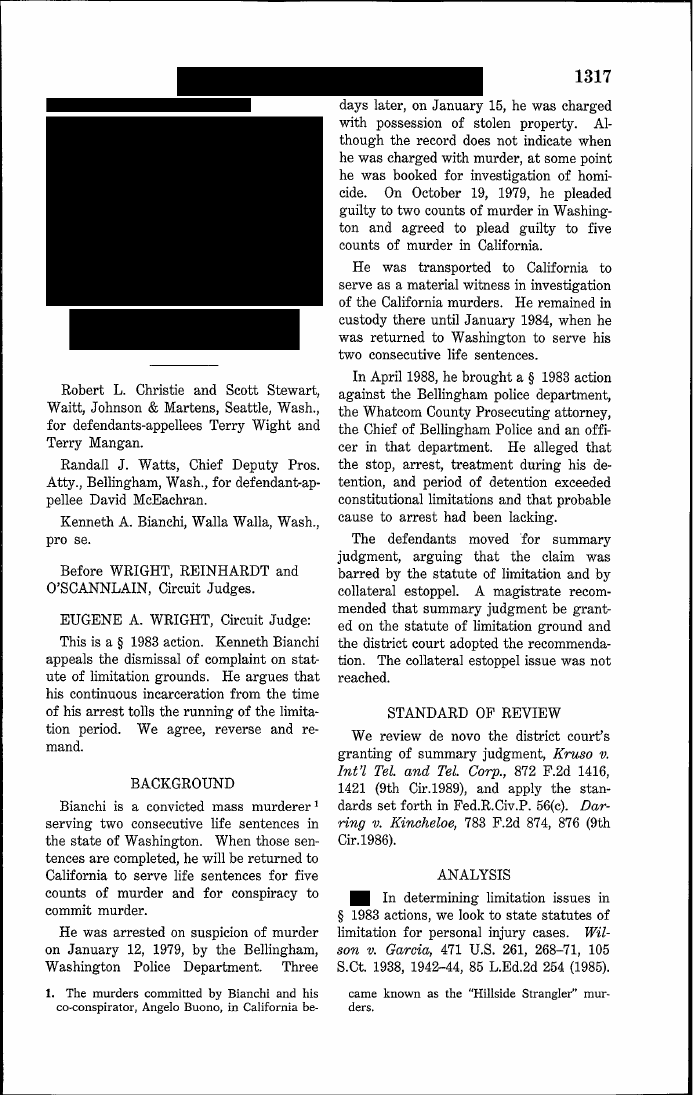
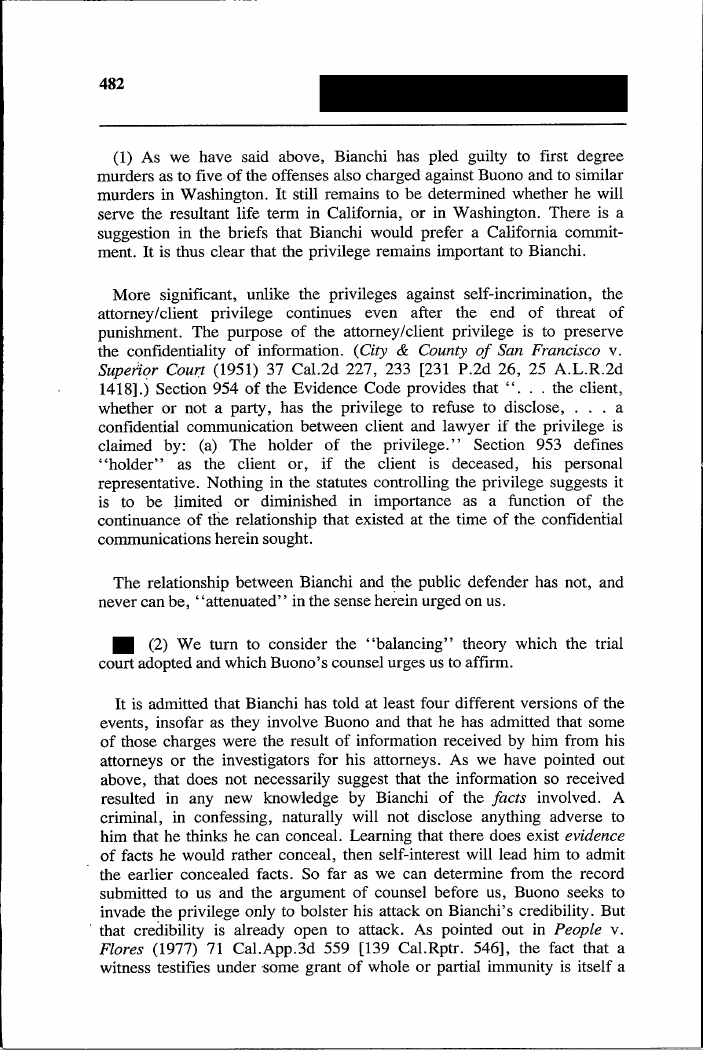
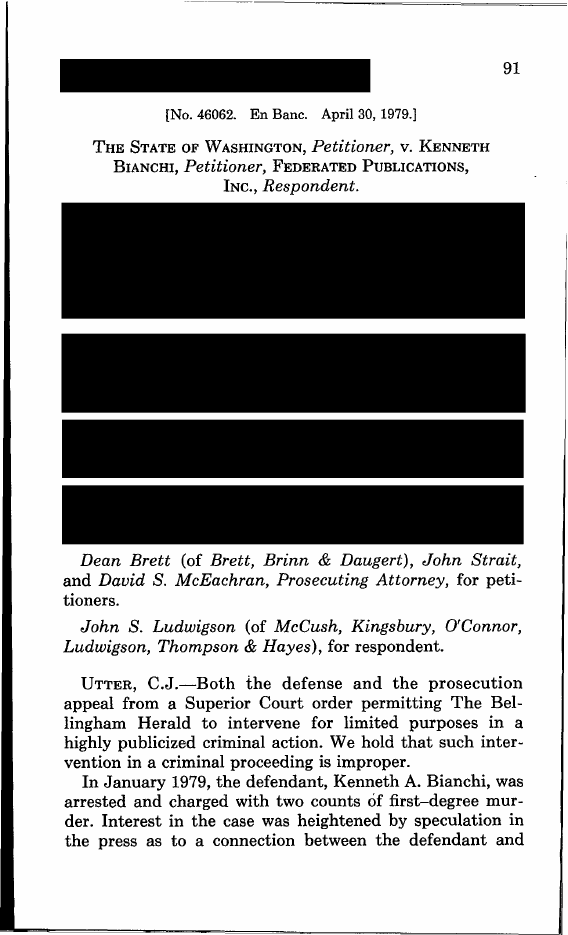
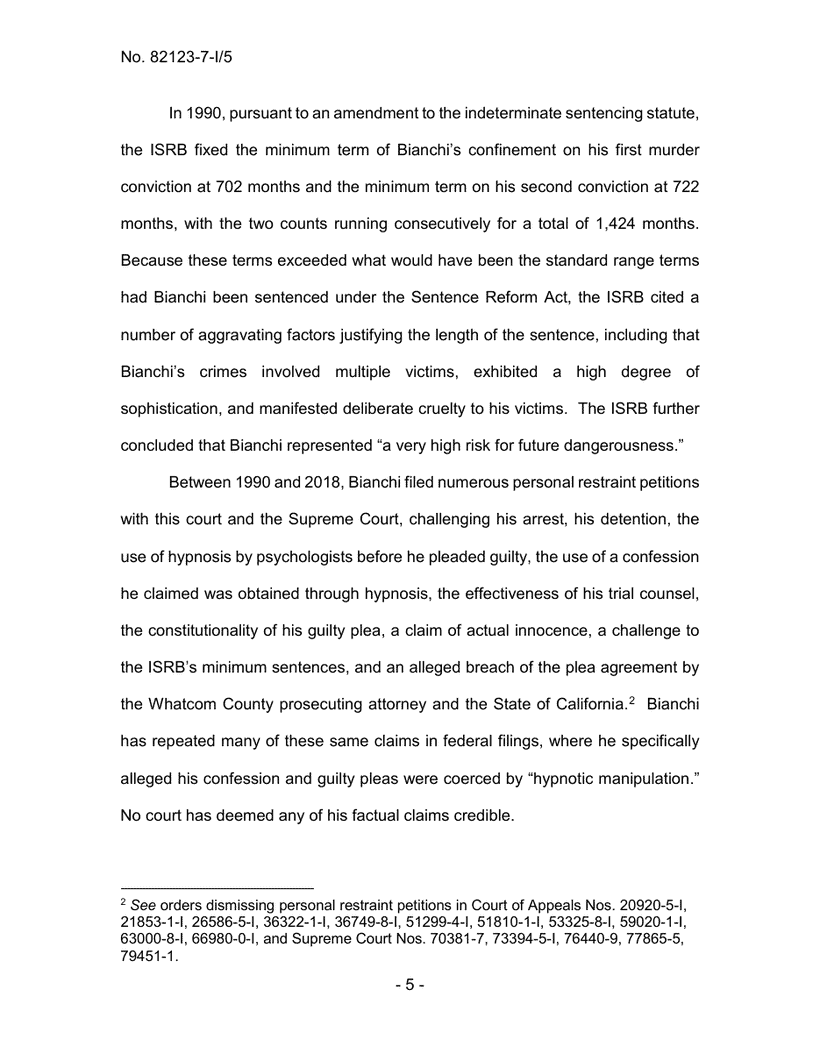
Archival geography and the wall of court documents
Place without spectacle. The pages below are the record itself: Washington and federal opinions and California Court of Appeal decisions, rendered from public court files and scans. No crime-scene or autopsy images are used.
Court-exhibit wall · CF-1 to CF-8Pages rendered from the official opinions and scans · tap a page to open the source
Angelo Buono courtroom photographs
The Los Angeles Times archive holds trial-era photographs of Buono and of the two-year prosecution. They are licensed editorial photography, so this file links to them instead of reproducing them.
TDSH-CF-1977-LAX · §22
What do people get wrong about the case?
Myth vs. record: the nickname is simpler than the evidence
There was one “Hillside Strangler”
False. The singular nickname predated the discovery that two men, Bianchi and Buono, were working together. Some detectives suspected multiple killers as early as 1977.
Bianchi’s lies didn’t erase the corroboration
His credibility was badly damaged, but Buono’s convictions didn’t rest on his testimony alone. The independent evidence is why the case survived the motion to dismiss, and why the appeal court called his testimony “abundantly corroborated.”
The insanity defence proved DID
No. The experts split two, two and two. Bianchi stipulated to competency and pleaded guilty before any ruling on insanity, and Judge George later found that he had faked hypnosis.
Bianchi got life without parole in Washington
The plea gave him the possibility of parole, which is why Washington’s board has held parolability hearings. He remains in custody because the board keeps finding him not parolable, and because a California detainer would follow any release.
Buono was convicted of all ten
The jury found him not guilty of Yolanda Washington’s murder, where the only evidence was Bianchi’s word.
Don’t turn the victims into a body-count graphic
The legal record matters because it gives each victim a place in the case. The two-killer mythology should never become more memorable than the twelve people whose deaths anchor this file.
TDSH-CF-1977-LAX · §23
What other cases are related?
Related case frameworks on partnership crime, ruses and victim vulnerability
- Criminal partnership · Paul BernardoCompare the mutually reinforcing dynamics of Paul Bernardo and Karla Homolka, and the evidentiary problem when two offenders share violence, concealment and self-serving stories.
- Canada’s “Ken and Barbie” killersAnother TDSH file on Canada’s most notorious killing couple.
- Dyadic violence · Brady and HindleyAnother framework for joint offending that doesn’t reduce one offender to a passive extension of the other.
- Erotophonophilia and sexual homicideThe site’s broader discussion of sexual homicide, ruses and lowering a victim’s resistance.
- Sexual sadism disorderThe diagnosis Orne gave Bianchi alongside antisocial personality disorder, and its forensic limits.
- Victim invisibility · David Parker RayHow offenders can exploit women whose reports or disappearances may be discounted.
- Serial killer cycle phasesA framework to test against the Los Angeles timeline, with caution.
- Crime Dossier archiveEvery dossier-format file.
- The DocketCase files and court coverage.
- Christa Pike case fileThe case file that set this dossier format.
- Charles Manson case fileThe next case file in the series.
TDSH-CF-1977-LAX · §24
TDSH-CF-1977-LAX · §25
Frequently Asked Questions
Who were the Hillside Stranglers?
Cousins Kenneth Bianchi and Angelo Buono Jr., who killed ten women and girls in Los Angeles between October 1977 and February 1978.
How did they lure victims?
With a fake-police ruse: posing as officers making an arrest.
How was Bianchi caught?
He killed Karen Mandic and Diane Wilder in Bellingham, Washington, alone, on January 11, 1979, and was arrested there.
What did Bianchi plead guilty to?
Seven murders, two in Washington and five in Los Angeles, at the Whatcom County Superior Court and later in California.
What was Buono convicted of?
Nine of the ten Los Angeles murders. The jury acquitted him of Yolanda Washington’s. He was sentenced to life without parole and died in prison on Sept. 21, 2002.
Where is Bianchi now?
Kenneth Bianchi, now Anthony D’Amato, is in the Washington State Penitentiary at Walla Walla. Both states would have to grant parole or clemency for him to be released.
Did Bianchi have multiple personalities?
The courts did not accept it. Bianchi told at least four different versions of events, according to Littlefield v. Superior Court (1982).
Source ledger
Citations & Sources
Court records, legal history and archival reporting before retrospective lore
Washington court record
In re Pers. Restraint of Bianchi, No. 82123-7-I (Wash. Ct. App. Div. I, Oct. 3, 2022) (unpublished)
The 2022 Court of Appeals opinion: pleas, the DOC method summary, plea-hearing forensics, the 1982 Bellingham testimony, the minimum terms and parolability.
Notes 1
Washington Supreme Court
State v. Bianchi, 92 Wn.2d 91, 593 P.2d 1330 (Wash. 1979)
The 1979 ruling on the Bellingham Herald’s intervention.
Notes 23
Washington Supreme Court
Federated Publications, Inc. v. Swedberg, 96 Wn.2d 13, 633 P.2d 74 (1981)
State v. Compton cause number and the press-access ruling.
Notes 28
Federal appellate
Bianchi v. Bellingham Police Dept., 909 F.2d 1316 (9th Cir. 1990)
Bianchi’s civil-rights suit; his sentences as summarized by the Ninth Circuit.
Notes 8
Federal appellate
Bianchi v. Blodgett, 925 F.2d 305 (9th Cir. 1991)
The interstate plea terms, the Jan. 9, 1984 breach finding and the Feb. 1, 1984 detainer.
Notes 2
California case law
Littlefield v. Superior Court, 136 Cal.App.3d 477 (1982)
Bianchi’s “at least four different versions”; the privilege ruling during Buono’s trial.
Notes 14
Legal history · first-hand
Roger W. Boren, “The Hillside Strangler Trial,” with foreword by Ronald M. George, 33 Loy. L.A. L. Rev. 705 (2000)
The trial prosecutor’s account, published with Chief Justice George’s foreword: evidence, witnesses, jury views, the Glendale circle. The live post credited it to George alone.
Notes 7
Historical record
Daryl C. McClary, HistoryLink Essay 8613 (2008)
The Bellingham investigation, the pleas, the Compton plot and later events.
Notes 5
Clinical debate
Martin T. Orne, David F. Dinges & Emily Carota Orne, “On the Differential Diagnosis of Multiple Personality in the Forensic Context,” Int’l J. Clinical & Experimental Hypnosis 32:118 to 169 (1984)
The prosecution expert’s published analysis of malingering, “Billy” and the diagnosis.
Notes 15
Clinical debate
John G. Watkins, “The Bianchi (L.A. Hillside Strangler) Case: Sociopath or Multiple Personality?” Int’l J. Clinical & Experimental Hypnosis 32:67 to 101 (1984)
The defence expert’s published view.
Notes 16
Archive reporting
Christopher Goffard, “The Hillside Stranglers case: The trial that nearly did not happen,” Los Angeles Times, July 31, 2025
The task force, the near misses, the dismissal fight and the trial statistics.
Notes 12
Archive reporting
“‘Hillside Strangler’ Dies at 67,” Los Angeles Times, Sept. 22, 2002
Buono’s death; trial statistics.
Notes 4
Archive reporting
“Buono Challenge to Void Murder Conviction Fails,” Los Angeles Times, Feb. 24, 1989
The 1988 appellate opinion and the 1989 denial of review.
Notes 26
Wire archive
UPI, Oct. 31, 1983 (Wagner verdict)
Verdict-by-verdict reporting, Oct.-Nov. 1983 (with the other UPI entries in the notes).
Notes 20
Contemporaneous summary
Riley Hooper, “Killers Close to Home,” The Occidental, Jan. 1, 2016 (quoting the 1979 Los Angeles Times summary of the district attorney’s complaint)
The 1979 L.A. Times summary of the district attorney’s complaint, quoted in 2016: abduction and recovery addresses.
Notes 17
Recent reporting
“‘Hillside Strangler’ serial killer is denied parole in California,” Los Angeles Times, via The Seattle Times, July 11, 2025
The 2025 California parole denial; the name change; Walla Walla.
Notes 6
Numbered notes
- In re Pers. Restraint of Bianchi, No. 82123-7-I (Wash. Ct. App. Div. I, Oct. 3, 2022) (unpublished). www.courts.wa.gov
- Bianchi v. Blodgett, 925 F.2d 305 (9th Cir. 1991). www.courtlistener.com
- UPI, Nov. 4, 1983 (Washington count). www.upi.com
- “‘Hillside Strangler’ Dies at 67,” Los Angeles Times, Sept. 22, 2002. www.latimes.com
- Daryl C. McClary, HistoryLink Essay 8613 (2008). www.historylink.org
- “‘Hillside Strangler’ serial killer is denied parole in California,” Los Angeles Times, via The Seattle Times, July 11, 2025. www.seattletimes.com
- Roger W. Boren, “The Hillside Strangler Trial,” with foreword by Ronald M. George, 33 Loy. L.A. L. Rev. 705 (2000). digitalcommons.lmu.edu
- Bianchi v. Bellingham Police Dept., 909 F.2d 1316 (9th Cir. 1990). www.courtlistener.com
- UPI, Jan. 10, 1984 (sentencing). www.upi.com
- “‘Hillside Strangler’ Kenneth Bianchi … is denied parole,” CBS Los Angeles, July 11, 2025. www.cbsnews.com
- “WA board to consider parole for ‘Hillside Strangler,’” The Seattle Times, June 24, 2025. www.seattletimes.com
- Christopher Goffard, “The Hillside Stranglers case: The trial that nearly did not happen,” Los Angeles Times, July 31, 2025. www.latimes.com
- UPI, Aug. 14, 1981 (attorney general takes over). www.upi.com
- Littlefield v. Superior Court, 136 Cal.App.3d 477 (1982). www.courtlistener.com
- Martin T. Orne, David F. Dinges & Emily Carota Orne, “On the Differential Diagnosis of Multiple Personality in the Forensic Context,” Int’l J. Clinical & Experimental Hypnosis 32:118 to 169 (1984). www.psych.upenn.edu
- John G. Watkins, “The Bianchi (L.A. Hillside Strangler) Case: Sociopath or Multiple Personality?” Int’l J. Clinical & Experimental Hypnosis 32:67 to 101 (1984). www.tandfonline.com
- Riley Hooper, “Killers Close to Home,” The Occidental, Jan. 1, 2016 (quoting the 1979 Los Angeles Times summary of the district attorney’s complaint). www.theoccidentalnews.com
- Robert Chacon, “Area focused on grisly case,” Glendale News-Press, May 20, 2005. www.latimes.com
- UPI, Nov. 9, 1983 (Cepeda, Johnson, Martin verdicts). www.upi.com
- UPI, Oct. 31, 1983 (Wagner verdict). www.upi.com
- UPI, Nov. 10, 1983 (Kastin, King, Weckler verdicts). www.upi.com
- UPI, Nov. 18, 1983 (penalty verdict). www.upi.com
- State v. Bianchi, 92 Wn.2d 91, 593 P.2d 1330 (Wash. 1979). www.courtlistener.com
- UPI, July 15, 1981. www.upi.com
- UPI, July 26, 1981 (prosecutors’ memo). www.upi.com
- “Buono Challenge to Void Murder Conviction Fails,” Los Angeles Times, Feb. 24, 1989. www.latimes.com
- UPI, Sept. 17, 1985 (California parole hearing). www.upi.com
- Federated Publications, Inc. v. Swedberg, 96 Wn.2d 13, 633 P.2d 74 (1981). www.courtlistener.com
- “Where Is the Hillside Strangler’s Ex-Girlfriend Veronica Compton Now?” People. people.com
Revised case file prepared Sept. 30, 2026 (ET) from TDSH’s “Hillside Stranglers Case File” (Sept. 4, 2026), with fact-check corrections applied. Editorial standard: this file separates guilty pleas, jury verdicts, corroborated testimony, later interpretation and disputed psychiatric claims. Victims’ identities and the legal outcomes take precedence over offender mythology.
Who were the Hillside Stranglers?
Cousins Kenneth Bianchi and Angelo Buono Jr., who killed ten women and girls in Los Angeles between October 1977 and February 1978.
How did they lure victims?
With a fake-police ruse: posing as officers making an arrest.
How was Bianchi caught?
He killed Karen Mandic and Diane Wilder in Bellingham, Washington, alone, on January 11, 1979, and was arrested there.
What did Bianchi plead guilty to?
Seven murders, two in Washington and five in Los Angeles, at the Whatcom County Superior Court and later in California.
What was Buono convicted of?
Nine of the ten Los Angeles murders. The jury acquitted him of Yolanda Washington’s. He was sentenced to life without parole and died in prison on Sept. 21, 2002.
Where is Bianchi now?
Kenneth Bianchi, now Anthony D’Amato, is in the Washington State Penitentiary at Walla Walla. Both states would have to grant parole or clemency for him to be released.
Did Bianchi have multiple personalities?
The courts did not accept it. Bianchi told at least four different versions of events, according to Littlefield v. Superior Court (1982).
Citations & Sources
Court records, legal history and archival reporting before retrospective lore
In re Pers. Restraint of Bianchi, No. 82123-7-I (Wash. Ct. App. Div. I, Oct. 3, 2022) (unpublished)
The 2022 Court of Appeals opinion: pleas, the DOC method summary, plea-hearing forensics, the 1982 Bellingham testimony, the minimum terms and parolability.
Notes 1
State v. Bianchi, 92 Wn.2d 91, 593 P.2d 1330 (Wash. 1979)
The 1979 ruling on the Bellingham Herald’s intervention.
Notes 23
Federated Publications, Inc. v. Swedberg, 96 Wn.2d 13, 633 P.2d 74 (1981)
State v. Compton cause number and the press-access ruling.
Notes 28
Bianchi v. Bellingham Police Dept., 909 F.2d 1316 (9th Cir. 1990)
Bianchi’s civil-rights suit; his sentences as summarized by the Ninth Circuit.
Notes 8
Bianchi v. Blodgett, 925 F.2d 305 (9th Cir. 1991)
The interstate plea terms, the Jan. 9, 1984 breach finding and the Feb. 1, 1984 detainer.
Notes 2
Littlefield v. Superior Court, 136 Cal.App.3d 477 (1982)
Bianchi’s “at least four different versions”; the privilege ruling during Buono’s trial.
Notes 14
Roger W. Boren, “The Hillside Strangler Trial,” with foreword by Ronald M. George, 33 Loy. L.A. L. Rev. 705 (2000)
The trial prosecutor’s account, published with Chief Justice George’s foreword: evidence, witnesses, jury views, the Glendale circle. The live post credited it to George alone.
Notes 7
Daryl C. McClary, HistoryLink Essay 8613 (2008)
The Bellingham investigation, the pleas, the Compton plot and later events.
Notes 5
Martin T. Orne, David F. Dinges & Emily Carota Orne, “On the Differential Diagnosis of Multiple Personality in the Forensic Context,” Int’l J. Clinical & Experimental Hypnosis 32:118 to 169 (1984)
The prosecution expert’s published analysis of malingering, “Billy” and the diagnosis.
Notes 15
John G. Watkins, “The Bianchi (L.A. Hillside Strangler) Case: Sociopath or Multiple Personality?” Int’l J. Clinical & Experimental Hypnosis 32:67 to 101 (1984)
The defence expert’s published view.
Notes 16
Christopher Goffard, “The Hillside Stranglers case: The trial that nearly did not happen,” Los Angeles Times, July 31, 2025
The task force, the near misses, the dismissal fight and the trial statistics.
Notes 12
“‘Hillside Strangler’ Dies at 67,” Los Angeles Times, Sept. 22, 2002
Buono’s death; trial statistics.
Notes 4
“Buono Challenge to Void Murder Conviction Fails,” Los Angeles Times, Feb. 24, 1989
The 1988 appellate opinion and the 1989 denial of review.
Notes 26
UPI, Oct. 31, 1983 (Wagner verdict)
Verdict-by-verdict reporting, Oct.-Nov. 1983 (with the other UPI entries in the notes).
Notes 20
Riley Hooper, “Killers Close to Home,” The Occidental, Jan. 1, 2016 (quoting the 1979 Los Angeles Times summary of the district attorney’s complaint)
The 1979 L.A. Times summary of the district attorney’s complaint, quoted in 2016: abduction and recovery addresses.
Notes 17
“‘Hillside Strangler’ serial killer is denied parole in California,” Los Angeles Times, via The Seattle Times, July 11, 2025
The 2025 California parole denial; the name change; Walla Walla.
Notes 6
Numbered notes
- In re Pers. Restraint of Bianchi, No. 82123-7-I (Wash. Ct. App. Div. I, Oct. 3, 2022) (unpublished). www.courts.wa.gov
- Bianchi v. Blodgett, 925 F.2d 305 (9th Cir. 1991). www.courtlistener.com
- UPI, Nov. 4, 1983 (Washington count). www.upi.com
- “‘Hillside Strangler’ Dies at 67,” Los Angeles Times, Sept. 22, 2002. www.latimes.com
- Daryl C. McClary, HistoryLink Essay 8613 (2008). www.historylink.org
- “‘Hillside Strangler’ serial killer is denied parole in California,” Los Angeles Times, via The Seattle Times, July 11, 2025. www.seattletimes.com
- Roger W. Boren, “The Hillside Strangler Trial,” with foreword by Ronald M. George, 33 Loy. L.A. L. Rev. 705 (2000). digitalcommons.lmu.edu
- Bianchi v. Bellingham Police Dept., 909 F.2d 1316 (9th Cir. 1990). www.courtlistener.com
- UPI, Jan. 10, 1984 (sentencing). www.upi.com
- “‘Hillside Strangler’ Kenneth Bianchi … is denied parole,” CBS Los Angeles, July 11, 2025. www.cbsnews.com
- “WA board to consider parole for ‘Hillside Strangler,’” The Seattle Times, June 24, 2025. www.seattletimes.com
- Christopher Goffard, “The Hillside Stranglers case: The trial that nearly did not happen,” Los Angeles Times, July 31, 2025. www.latimes.com
- UPI, Aug. 14, 1981 (attorney general takes over). www.upi.com
- Littlefield v. Superior Court, 136 Cal.App.3d 477 (1982). www.courtlistener.com
- Martin T. Orne, David F. Dinges & Emily Carota Orne, “On the Differential Diagnosis of Multiple Personality in the Forensic Context,” Int’l J. Clinical & Experimental Hypnosis 32:118 to 169 (1984). www.psych.upenn.edu
- John G. Watkins, “The Bianchi (L.A. Hillside Strangler) Case: Sociopath or Multiple Personality?” Int’l J. Clinical & Experimental Hypnosis 32:67 to 101 (1984). www.tandfonline.com
- Riley Hooper, “Killers Close to Home,” The Occidental, Jan. 1, 2016 (quoting the 1979 Los Angeles Times summary of the district attorney’s complaint). www.theoccidentalnews.com
- Robert Chacon, “Area focused on grisly case,” Glendale News-Press, May 20, 2005. www.latimes.com
- UPI, Nov. 9, 1983 (Cepeda, Johnson, Martin verdicts). www.upi.com
- UPI, Oct. 31, 1983 (Wagner verdict). www.upi.com
- UPI, Nov. 10, 1983 (Kastin, King, Weckler verdicts). www.upi.com
- UPI, Nov. 18, 1983 (penalty verdict). www.upi.com
- State v. Bianchi, 92 Wn.2d 91, 593 P.2d 1330 (Wash. 1979). www.courtlistener.com
- UPI, July 15, 1981. www.upi.com
- UPI, July 26, 1981 (prosecutors’ memo). www.upi.com
- “Buono Challenge to Void Murder Conviction Fails,” Los Angeles Times, Feb. 24, 1989. www.latimes.com
- UPI, Sept. 17, 1985 (California parole hearing). www.upi.com
- Federated Publications, Inc. v. Swedberg, 96 Wn.2d 13, 633 P.2d 74 (1981). www.courtlistener.com
- “Where Is the Hillside Strangler’s Ex-Girlfriend Veronica Compton Now?” People. people.com
Revised case file prepared Sept. 30, 2026 (ET) from TDSH’s “Hillside Stranglers Case File” (Sept. 4, 2026), with fact-check corrections applied. Editorial standard: this file separates guilty pleas, jury verdicts, corroborated testimony, later interpretation and disputed psychiatric claims. Victims’ identities and the legal outcomes take precedence over offender mythology.
Discover more from The Dark Side of Humanity
Subscribe to get the latest posts sent to your email.