FILE NO. 0194
Case snapshot
- Victims: Andrew Jackson Borden and his wife, Abby Durfee Borden, killed on the morning of Thursday, August 4, 1892, at 92 Second Street, Fall River, Massachusetts
- Weapon: Thought to be a hatchet, not an axe; the hatchet head the Commonwealth produced was never convincingly shown to be the weapon
- Charged: Lizzie Borden, Andrew’s younger daughter, arrested on August 11, 1892, and indicted on December 2, 1892
- Verdict: Not guilty, from a New Bedford jury of twelve men on June 20, 1893; the remaining indictments were dropped the same day
- Status: Officially unsolved; no one else was ever charged
- Afterward: She lived another 34 years in Fall River as Lizbeth A. Borden and died there on June 1, 1927, at 66
Lizzie Borden was charged with the murders of her father, Andrew Jackson Borden, and her stepmother, Abby Durfee Borden, and was indicted by a Bristol County grand jury on December 2, 1892. A jury in New Bedford, Massachusetts, found her not guilty on June 20, 1893, and the remaining indictments against her were dropped the same day. She was never convicted of any crime connected to the deaths. No one else was ever charged. The murders remain officially unsolved. Every theory below about who killed the Bordens, including the theory that Lizzie did, is the opinion of the writer or investigator named beside it and was never proved in court.
A little after eleven o’clock on the morning of Thursday, August 4, 1892, the Irish maid of a wealthy household in Fall River, Massachusetts, was resting in her attic room after washing the outside windows. She heard the bell at City Hall strike the hour. A few minutes later the younger daughter of the house called up the stairs. According to the account of the case by Douglas O. Linder of the University of Missouri-Kansas City law school, the words were: “Maggie, come down! Come down quick; Father’s dead; somebody came in and killed him.”
Andrew Jackson Borden, one of the richest men in Fall River, was lying on the sofa in the downstairs sitting room. He had been struck in the head about ten times with a hatchet or a similar blade. Upstairs, in the guest room, a neighbor and the maid soon found his wife, Abby, face down on the floor. She had been killed the same way, and her body was already cold. Andrew’s was still warm.
Ten months later the woman who had called down the stairs, Lizzie Andrew Borden, 32, Sunday school teacher and secretary of a Christian society, sat in a New Bedford courtroom charged with both murders. The trial was covered by newspapers across the United States. After thirteen days of evidence and argument, a jury of twelve men found her not guilty.
She lived another 34 years in Fall River, in a bigger house on a better street, under a slightly different name. She was never charged with anything else in connection with the deaths, and no one else ever was. A playground rhyme about forty whacks made her one of the best-known names in American crime anyway. What follows is what is documented about the morning of August 4, 1892, what the police did, what the jury heard and did not hear, and why, more than 130 years on, the Borden murders are still, in the words of the Fall River Historical Society, “one of the most famous unsolved mysteries of all time.”
The Bordens of Second Street
One of the richest men in Fall River kept a privy in his basement. Lizzie Andrew Borden was born in Fall River on July 19, 1860, the third child of Sarah Anthony Morse Borden and Andrew Jackson Borden. An older sister, Alice Esther, died of hydrocephalus at 22 months. Another, Emma Lenora, about ten years older than Lizzie, would outlive her by nine days. Their mother died in 1863, when Lizzie was not yet three. During the 1892 inquest Lizzie told the court she had been christened Lizzie, not Elizabeth.
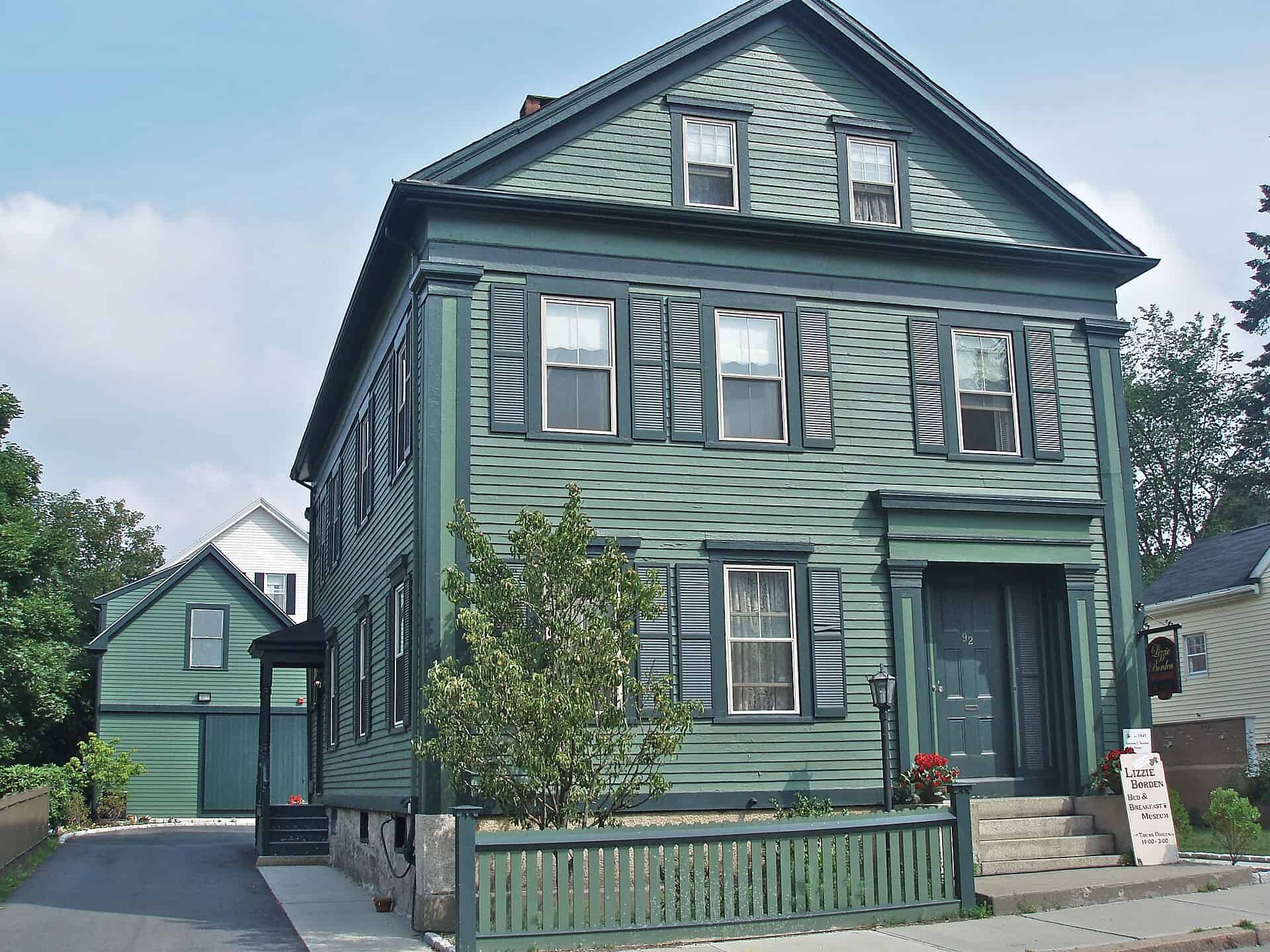
Andrew Borden came from an old and once powerful Fall River family, but he had grown up with little and made his own money, first in furniture and coffins and then in property. By 1892 he was a director of several textile mills, president of the Union Savings Bank and a director of the Durfee Safe Deposit and Trust Company. His estate at his death was valued at about $300,000. He was also famously careful with it. The family house at 92 Second Street, close to his business on Main Street, was a converted two-family building with no indoor plumbing or electricity. He had bought it in 1872, put a privy in the basement, and moved his household in. Richer families in Fall River lived on the Hill, the higher ground away from the mills.
On June 6, 1865, about two years after Sarah’s death, Andrew married Abby Durfee Gray, the daughter of Oliver Gray. A Fall River account published in 1893 gave his age at his death as seventy and hers as sixty-seven; the birth years usually given for them, 1822 and 1828, would make them 69 and 64. Lizzie was later recorded as saying that she called her stepmother “Mrs. Borden” and that she was not sure whether their relationship was cordial. She believed, according to the Wikipedia summary of the case, that Abby had married her father for his money.
The sisters grew up in the Central Congregational Church. As a young woman Lizzie taught Sunday school to the children of recent immigrants, served as secretary-treasurer of the Christian Endeavor Society, and belonged to the Woman’s Christian Temperance Union and the Ladies’ Fruit and Flower Mission. Neither sister married. In August 1892 Lizzie was 32, and both sisters were still living in their father’s house.
By 1890 the household also included a live-in maid, Bridget Sullivan, an Irish immigrant then about 25, whom the sisters called Maggie. At the trial she testified that the two daughters rarely ate meals with their father and stepmother.
A house under strain: summer 1892

It came down to property. Histories of the case agree that by the summer of 1892 the house on Second Street was not a happy one, though they disagree about how bad things were. The main grievance, as later reconstructed, was property. Andrew had given real estate to members of Abby’s family, including a house for Abby’s half-sister. The daughters objected, and in response were given the house they had lived in until their mother’s death, which they bought from their father for one dollar. In July 1892 they sold it back to him for $5,000.
At the trial, Emma Borden admitted she still felt some resentment about the transfer of what she called “grandfather’s house” to Abby’s family, according to the Famous Trials account, while insisting that relations between Lizzie and her stepmother were cordial. A dressmaker, Hannah H. Gifford, gave a different picture. She testified that a few months before the killings Lizzie had called her stepmother “a mean good-for nothing thing” and told her, “I don’t have much to do with her; I stay in my room most of the time.” Bridget Sullivan, by contrast, told the jury: “Everything was pleasant,” and “Lizzie and her mother always spoke to each other.”
Two other episodes from 1892 are often repeated. In May, Andrew killed pigeons in his barn with a hatchet, believing they carried disease. Lizzie had recently built them a roost, and it has been widely said that she was distressed. The author Sarah Miller, in her 2016 book The Borden Murders, called that story unfounded and part of the myth around the case. And in July, after a family argument, both sisters left for extended stays in New Bedford. Lizzie came back to Fall River and spent four days in a rooming house before returning home. Emma went on to Fairhaven, about 15 miles away, where she was staying on the day of the murders.
In the first days of August the whole household was violently sick. A family friend later suggested it was mutton left on the stove and served for several days running. Abby, according to the Wikipedia summary, feared poison, because her husband was not a popular man in town. On the evening of August 3, Lizzie visited a friend and neighbor, Alice Russell. At the trial Russell said Lizzie told her she felt “that something is hanging over me” and that “I cannot tell what it is,” and, “I feel afraid something is going to happen.” Lizzie, Russell said, blamed the illness on bad “baker’s bread,” and spoke of wanting to sleep “with one eye open half the time for fear somebody might burn the house down or hurt her father because he was so discourteous to people.”
That same evening, John Vinnicum Morse, the brother of Lizzie’s dead mother, arrived to stay for a few days. Andrew had invited him to talk business. He slept in the guest room.
August 4, 1892: the murders at 92 Second Street
The morning began with breakfast and ended with two bodies. What happened inside 92 Second Street is known almost entirely from the accounts of the people who were there, given to police, to the inquest and to the trial, and those accounts did not always agree with each other or with themselves. What follows is the sequence most histories accept, with the disputed points marked.
Andrew, Abby, John Morse and Bridget Sullivan ate breakfast together. Andrew and Morse talked in the sitting room for close to an hour. Morse left at about 8:48 a.m. to buy a pair of oxen and visit relatives in town, planning to come back for lunch at noon. Andrew went out on his usual morning round of business some time after nine. Emma was away in Fairhaven. That left three people in the house: Abby, Lizzie and Bridget, who spent much of the morning washing the outside windows.
Some time between 9:00 and 10:30, Abby went up to the guest room to make the bed Morse had slept in. According to the forensic findings summarized by later histories, she was facing her attacker when the first blow struck the side of her head above the ear. She fell face down. She was struck many more times from behind. Wikipedia’s summary of the evidence puts the total at 18 or 19 blows.
Andrew came home at about 10:30. His key would not open the door, so he knocked. Bridget came to let him in, found the lock jammed and swore. She later testified that at that moment she heard Lizzie laugh, from the top of the stairs. If that was right, it mattered: Abby’s body was by then lying in the guest room, and it would have been visible from the upstairs landing. Lizzie later denied she had been upstairs. She said her father asked where Abby was, and she told him a messenger had brought Abby a note asking her to visit a sick friend. No note was ever found, and no messenger or sick friend ever came forward.
Andrew lay down on the sitting-room sofa. Lizzie later said he had changed into slippers first; police photographs show him still wearing his boots. Bridget went up to her room in the attic to rest. Lizzie said she went out to the barn behind the house, looking for “irons,” lead sinkers for a fishing trip, and stayed there, by her various accounts, from a few minutes to “twenty minutes or possibly a half an hour”. When she came back into the house, she said, she found her father dead.
Andrew had been struck ten or eleven times in the head and face as he lay on the sofa. One eye had been split, which investigators took to mean he was asleep. His wounds were still bleeding. At about 11:10 Lizzie called Bridget down. She told her not to go into the sitting room, and sent her across the street for the family doctor, Seabury Bowen. Neighbors began to arrive. It was some time before anyone thought to look for Abby. When someone asked where her stepmother was, Lizzie repeated the story of the note and said she thought she had heard Abby come back in. Bridget and the next-door neighbor, Adelaide Churchill, went up the stairs. Halfway up, with their eyes level with the floor of the upstairs hall, they could see through to the guest room and Abby’s body on the floor.
Dr. Bowen pronounced both of them dead. Abby’s body was cold, Andrew’s warm. Abby, it was concluded, had been killed at least an hour, and probably an hour and a half, before her husband. Through all of that time, the only people known to have been in the house with her were her stepdaughter and the maid.
Edwin H. Porter, whose history of the case was published in Fall River in 1893, described the rooms afterwards as “in perfect order.” The house had not been robbed. “The servant was in the attic,” he wrote, “and the daughter was in the barn not more than thirty feet from the back door of the house.” Whoever had done it, he wrote, “had come and gone as gently as the south wind.”
The police and the “peculiar woman”
The first newspaper theories pointed outward. According to Linder’s account, the Fall River Herald reported speculation about a “Portuguese laborer” who had supposedly come to the house that morning and “asked for the wages due him,” only to be told by Andrew Borden that he had no money and “to call later.” The same story said medical evidence suggested Abby had been killed “by a tall man, who struck the woman from behind.” Porter’s history mentions another early lead: “a mysterious man had been seen on the doorsteps arguing with Mr. Borden only a few days before.” Neither lead produced a suspect who could be placed in the house.
The officers who talked to Lizzie that day were not impressed. Many reported disliking her manner; some thought her too calm. City Marshal Hilliard told reporters she struck him as “a very peculiar woman.” Her story also moved. At first she said she had heard a groan, or a scraping noise, or a call for help, before she came in from the barn. Two hours later she told police she had heard nothing. When Assistant Marshal John Fleet called Abby her mother, she corrected him: “She was not my mother, sir,” he later testified she said. “She was my stepmother: my mother died when I was a child.”
The search itself was patchy, and the police were criticized for it at the time and since. Nobody examined Lizzie’s hair or clothes that day. Officers looked into her room only briefly; at the trial they admitted they had not searched it properly because she was unwell. In the basement they found two axes, two hatchets and a hatchet head with a broken handle. The break looked fresh, and the head was coated with ash and dust that some officers thought had been rubbed on deliberately. None of these tools was taken away that day. A pail of what looked like bloodied cloths was also seen in the basement; Lizzie said they were from menstruation, and the pail was not examined further.
Barn alibi or not, investigators doubted her. According to Linder, the loft where she said she had searched for sinkers showed no footprints in the dust, and the heat up there made a long search seem unlikely. (At the trial, two tradesmen testified for the defense that they had been in that loft a day or two before, which undercut the footprint point.)
Then a pharmacy clerk came forward. Eli Bence, of S. R. Smith’s drug store, told police that on August 3, the day before the murders, Lizzie had come in and tried to buy ten cents’ worth of prussic acid, a deadly poison. He said he refused to sell it without a doctor’s prescription. Porter wrote in 1893 that Bence and others positively identified the customer as Lizzie Borden. Lizzie’s side would later say she wanted it to clean a sealskin cloak. Both bodies were tested for poison because of the illness in the house; none was found.
Over the next few days, the friend from next door, Alice Russell, stayed with the sisters. On the night of the murders an officer posted outside said he saw Lizzie and Russell go down to the cellar with a lamp and a slop pail, then saw Lizzie go back alone and bend over the sink. On Saturday, August 6, police searched the house again, more thoroughly, and took the broken-handled hatchet head. That evening the mayor and a police officer told Lizzie she was a suspect.
On the Sunday morning after the murders, Russell came into the kitchen and found Lizzie holding a dress at the stove. Russell later testified that Lizzie said: “I am going to burn this old thing up; it is covered with paint.” Whether it was the dress she had worn on the morning of August 4 was never established.
The inquest, the arrest and the indictment
She faced the questions alone, and on morphine. On August 9, an inquest opened in the courtroom over the Fall River police headquarters, before the district court judge, Josiah Blaisdell. District Attorney Hosea M. Knowlton questioned Lizzie, Bridget Sullivan, John Morse and others. (Some accounts date the start of Lizzie’s questioning to August 8.) Lizzie asked to have her family’s lawyer with her; she was refused, on the ground that state law required an inquest to be held in private. She had been given morphine by Dr. Bowen to calm her nerves, a point her defense later used to explain her answers.
Those answers were confused and contradictory, according to Linder’s account and the Wikipedia summary. She told the inquest that when her father came home she was in the kitchen reading a magazine; then that she was in the dining room ironing; then that she was coming down the stairs. Linder describes a four-hour examination. Newspapers that reported on the inquest wrote of her “stolid demeanor” and that she “bit her lips, flushed, and bent toward attorney Adams,” and reported that the testimony had “caused a change of opinion among her friends who have heretofore strongly maintained her innocence.”
On August 11, at the end of the inquest, Marshal Hilliard served her with a warrant and she was arrested. The next day she pleaded not guilty to the charge of murder and was taken by train to the jail at Taunton. At her preliminary hearing, which opened in Fall River on August 22, Judge Blaisdell found her “probably guilty” and sent the case to a grand jury. Porter reported that the old magistrate was close to tears. He asked the courtroom to imagine the same facts against a man: “Suppose for a single moment a man was standing there,” he said, a man found near both bodies whose only account of himself “was the unreasonable one that he was out in the barn looking for sinkers.” The judgment of the court, he said, “is that you are probably guilty, and you are ordered committed to await the action of the Superior Court.” Lizzie, according to Porter, “sat like a statue of stone, totally unmoved.”
The grand jury began hearing evidence on November 7. According to Linder, it at first declined to indict, then reconvened and heard Alice Russell describe the dress she had seen Lizzie burn. Combined with Bridget Sullivan’s statement that Lizzie had been wearing a blue dress that morning, Linder writes, that was enough. On December 2, 1892, the grand jury indicted Lizzie Borden for the murders of her father and her stepmother. The Borden sisters never spoke to Alice Russell again.
Meanwhile, the case was being tried in the newspapers. In October 1892 the Boston Globe printed a long story, bought from a private detective, that claimed to reveal new witnesses against Lizzie. It was false. Porter, writing in 1893, called it “thirteen columns of lies” and recorded that the paper made “the most humble and abject apology” and printed it as prominently as the original story.
Lizzie spent the ten months between her arrest and her trial in the Taunton jail.
Commonwealth v. Lizzie A. Borden: the prosecution
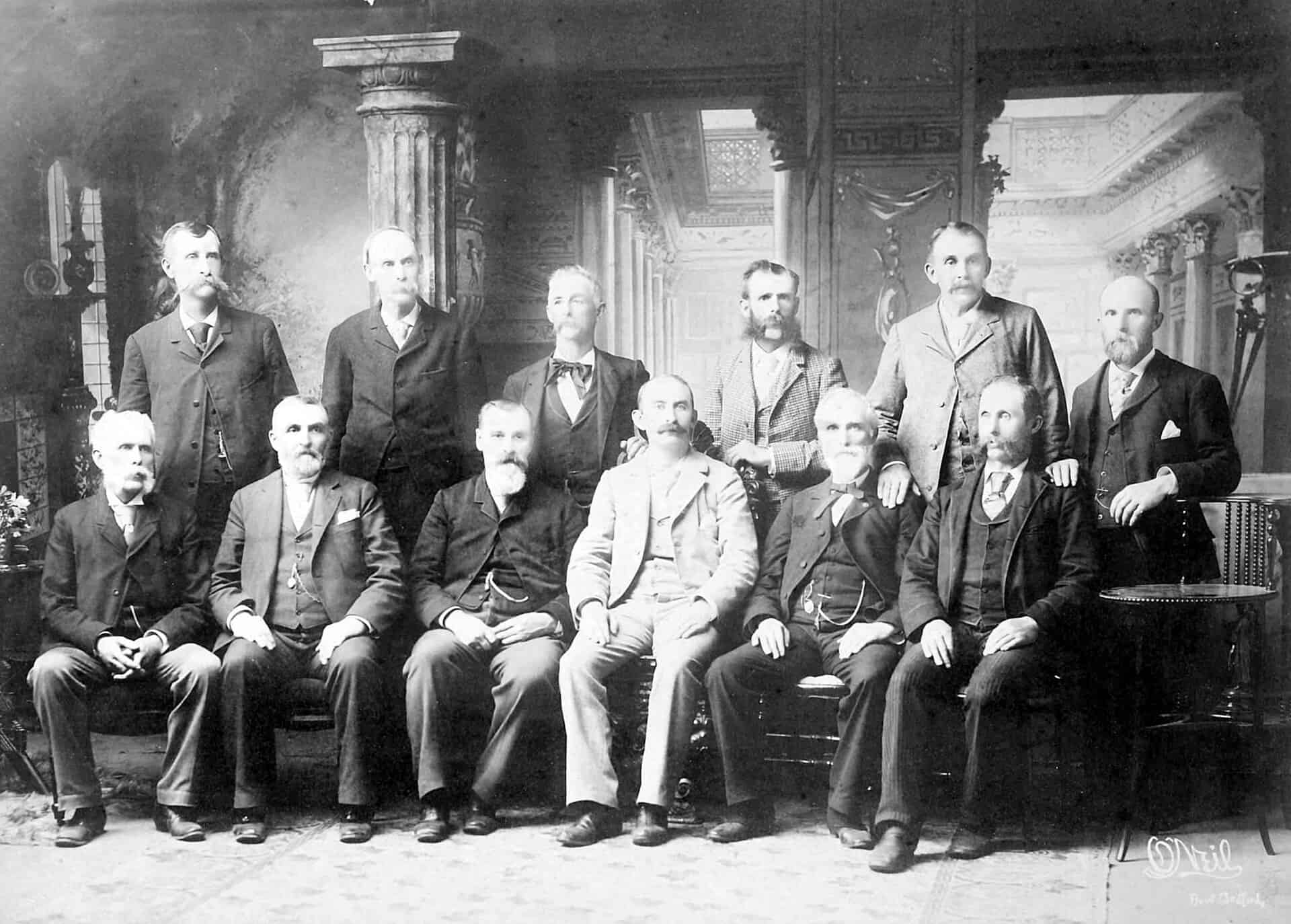
On the first day, the reporters outnumbered the defendant’s friends. The trial opened in the courthouse at New Bedford on Monday, June 5, 1893, before three judges of the Superior Court: Chief Justice Albert Mason and Associate Justices Caleb Blodgett and Justin Dewey. Porter recorded that on the first day the only people in the room apart from court officers were the 150 men in the jury pool, a few of the defendant’s friends and thirty-five newspaper correspondents. Lizzie, he wrote, “to all appearances had not changed in the least during her ten months of confinement in Taunton jail.”
Twelve men were chosen that day. Porter recorded their names and towns: Charles I. Richards of North Attleboro, the foreman; George Potter of Westport; William F. Deane of Taunton; John Wilbur of Somerset; Frederick C. Wilbar of Raynham; Lemuel K. Wilber of Easton; Louis D. Hodges of Taunton; Augustus Swift of New Bedford; Frank G. Cole of Attleboro; John C. Finn of Taunton; William Wescott of Seekonk; and Allen H. Wordell of Dartmouth.
The prosecution was led by the Bristol County district attorney, Hosea M. Knowlton, with William Henry Moody, district attorney of Essex County, who later sat on the United States Supreme Court. Lizzie’s defense was led by George Dexter Robinson, a former congressman who had served three one-year terms as governor of Massachusetts in the 1880s, with Andrew V. Jennings and Melvin O. Adams.
Moody opened for the Commonwealth on the second day. For about two hours, according to Linder, he argued that Lizzie was the only person who had both the motive and the opportunity to kill the Bordens, and he produced from a bag the hatchet head the Commonwealth said was the weapon. Lizzie watched from behind a fan. That afternoon the jury was taken to Fall River to see the house.
The trial’s most famous moment came during the prosecution’s opening. The skulls of Andrew and Abby Borden had been removed at autopsy and were exhibits in the case. According to a newspaper account quoted by Linder, when they were uncovered in the courtroom Lizzie fell “into a feint that lasted for several minutes, sending a thrill of excitement through awe-struck spectators.” Accounts differ on exactly when this happened and what was on the table; see “Where the accounts disagree,” below.
The Commonwealth’s witnesses walked the jury through the morning of August 4. Bridget Sullivan was the most important of them. She testified that Lizzie was the only person she saw in the house when the killings happened. She described the household’s sickness the day before, letting Andrew in at the jammed door, and the cry that brought her down from the attic a few minutes after eleven. But she also gave the defense something: in more than two years with the family, she said, she had seen nothing of the bad blood between Lizzie and her stepmother that the newspapers had described.
Dr. Bowen described Lizzie’s story about looking for sinkers in the barn. Adelaide Churchill remembered her wearing a light blue dress with a diamond pattern that morning, and did not recall seeing any blood on it. Assistant Marshal Fleet repeated the “She was not my mother” exchange. And Alice Russell, Linder writes, gave “the most compelling testimony” of the trial: the anxious visit the night before the murders, the burned dress, and a conversation about the missing note. Russell said she suggested that perhaps Abby had burned the note herself. Lizzie, she testified, replied: “Yes, she must have.”
Under cross-examination, Robinson’s questions suggested that a guilty woman trying to destroy evidence would hardly have burned a dress so openly, in front of a friend. One reporter compared the prosecution case to “a pigeon shooting match in which District Attorney Moody kept flinging up the birds and defying his antagonist to hit them,” with Robinson bringing many of them down.
What the jury never heard
Two rulings by the three judges did more than any witness to shape the outcome. Both took evidence away from the Commonwealth.
The first concerned the inquest. The prosecution wanted to read Lizzie’s own inquest testimony to the jury, with all its shifting accounts of where she had been when her father came home. The defense objected, and the court agreed. According to Linder, the judges concluded that at the time of the inquest she was for all practical purposes already a prisoner accused of two murders, that she had been questioned without her lawyer, and that her testimony was therefore not voluntary. The Commonwealth argued that she had been only a suspect, and that her statements were denials rather than a confession. The judges excluded them anyway. Linder calls it possibly “the decisive moment in the trial.” The inquest testimony, the Wikipedia summary notes, is the basis of most of the modern argument about her guilt; the jury never heard it.
The second ruling concerned the poison. The Commonwealth wanted Eli Bence to tell the jury about the attempt to buy prussic acid the day before the murders. With the jury sent out, the prosecution called doctors, druggists, furriers and chemists to establish what prussic acid was and what it could and could not be used for, including the claim that it was wanted for a sealskin cloak. The judges ruled the evidence out. According to the Wikipedia summary, they found the incident too remote in time to have any connection with the killings. The prosecution rested on June 14.
Other evidence fell away on its own. The hatchet head found in the basement was never convincingly shown to be the weapon. The Commonwealth said its handle had been broken off and disposed of because it would have been bloody, but one officer testified that a handle had been found near the head, and another contradicted him. Where, Robinson kept asking, was the handle? Nobody could produce it. No bloodstained clothing was ever found. And the Commonwealth’s own timeline left, by Linder’s reckoning, between eight and thirteen minutes between Andrew’s death and Lizzie’s call to Bridget. The defense asked the jury to imagine anyone washing blood from body, clothes and weapon and hiding the weapon in that time.
There was also a coincidence the jurors could hardly have missed. On June 1, 1893, days before the trial opened, a woman named Bertha Manchester was found hacked to death in her kitchen in Fall River. The similarities, according to the Wikipedia summary, were noted by jurors. A Portuguese immigrant, Jose Correa de Mello, was convicted of her murder in 1894; he was found not to have been in the Fall River area at the time of the Borden killings.
The defense, the charge and the verdict
The defense called only a handful of witnesses and made most of its case out of the Commonwealth’s. Charles Gifford and Uriah Kirby testified that they had seen a strange man near the Borden house at about eleven o’clock on the night before the murders. A doctor named Handy (spelled “Handfy” in Linder’s account) said he had seen a pale young man on the sidewalk near 92 Second Street at about 10:30 on the morning of August 4. A plumber and a gas fitter said they had been up in the barn loft in the day or two before the murders, which undercut the police claim that the undisturbed dust proved Lizzie had never gone up there.
Emma Borden was the witness everyone had waited for. She told the jury that Lizzie and their father had been close, and that the gold ring on Andrew’s little finger when he died had been a gift from Lizzie ten or fifteen years earlier, which he prized. She insisted that Lizzie and Abby had got on, though she admitted her own resentment over the house her father had given to Abby’s sister. The defense also wanted her to say that the family habitually burned old dress pieces. The court would not allow it.
Lizzie did not give evidence. Before the charge, the court told her she could say anything she wished to the jury in person. Porter recorded her answer: “I am innocent. I leave it to my counsel to speak for me.”
In his closing, Jennings told the jury that “there is not one particle of direct evidence in this case from beginning to end against Lizzie A. Borden. There is not a spot of blood, there is not a weapon that they have connected with her in any way, shape or fashion.” Robinson followed. The killer, he said, must have been a maniac or a devil, not a churchgoing woman of good family. He mocked the idea that she could have kept her clothes clean by killing her father and stepmother “stark naked,” and told the jury that the Commonwealth had not proved its case beyond a reasonable doubt. Knowlton summed up for the prosecution.
Then Justice Dewey charged the jury. He told them the government conceded that the defendant’s character had been good, and not merely in the negative sense, but “one of positive, of active benevolence in religious and charitable work.” One newspaper wrote that if he had “been the senior counsel for the defense, making the closing plea in behalf of the defendant, he could not have more absolutely pointed out the folly of depending upon circumstantial evidence alone.” It called the charge “a plea for the innocent.” Dewey, as the Wikipedia summary notes, had been appointed to the bench by Robinson when Robinson was governor.
The jury went out on June 20, 1893. Porter’s transcript records: “The jury retired to its room and remained one hour and ten minutes.” (Contemporary newspapers put it at 40 minutes, on a single ballot; Linder and HISTORY.com say an hour and a half. The difference may be between deliberation and the full time out of the room.) When the clerk asked for the verdict, the foreman did not wait for him to finish. He said: “NOT GUILTY.”
Porter wrote that there was “an outburst of applause from the spectators which was at once checked by the officers. The prisoner dropped into her seat.” Knowlton then asked that the two other pending indictments be entered as nol prossed because of the verdict, and the court ordered that she be discharged. According to Linder, Lizzie hid her face in her sister’s arms and said: “Now take me home. I want to go to the old place and go at once tonight.” Outside, according to the Wikipedia summary, she told reporters she was “the happiest woman in the world”. Porter closed his book with the line: “Thus ended, on the thirteenth day, the famous trial of Lizzie Andrew Borden, and she returned guiltless to her friends and home in Fall River.”
Most newspapers approved. The New York Times called the acquittal “a condemnation of the police authorities of Fall River who secured the indictment and have conducted the trial,” and described the city’s police as “the usual inept and stupid and muddle-headed sort that such towns manage to get for themselves.” Linder’s own judgment is more measured: however likely it was that she killed her parents, he writes, the prosecution did not prove it beyond a reasonable doubt, and most people in 1893 found it hard to believe that a woman of her background could have done it.
Did Lizzie Borden do it? The theories
The acquittal settled the legal question. Lizzie Borden is not guilty in law, and no one else was ever charged. It did not settle the historical one, and more than 130 years of books, plays and television have tried. Every theory below is the view of the writer named. None has been proved.
Lizzie
Lizzie has remained the prime suspect, the Wikipedia summary notes, despite her acquittal. Linder, in the Famous Trials account, writes of prosecution evidence “that most historians today find compelling.” The jury that heard the case did not find it proved. Theories of why she might have done it vary widely:
- A fugue state. The writer Victoria Lincoln proposed in her 1967 book A Private Disgrace that Lizzie might have committed the murders during a fugue state.
- Abuse. Another suggestion, revisited by the scholar Marcia Carlisle in a 1992 essay in American Heritage, is that Lizzie had been physically and sexually abused by her father. The Wikipedia summary notes that there is little evidence to support this, while pointing out that incest was not something anyone would have discussed openly in 1892.
- A discovered relationship. The crime novelist Evan Hunter, writing as Ed McBain, suggested in his 1984 novel Subject that Lizzie committed the murders after being caught with Bridget Sullivan. In a 1999 television interview he elaborated, speculating that Abby had caught the two together, that Lizzie killed her, and that Lizzie then confessed to Andrew and killed him when he reacted as Abby had. This is a novelist’s speculation, not evidence.
Bridget Sullivan
Bridget Sullivan later married and lived in Butte, Montana, where she died in 1948. A story grew up that she made a deathbed confession to her sister, saying she had changed her testimony to protect Lizzie. The Wikipedia summary says this has been contradicted: the informant on her death record was the county hospital, not a relative.
John Vinnicum Morse
Lizzie’s uncle slept in the house the night before the murders and was, for a time, considered a suspect by the police. According to the Wikipedia summary, law enforcement described his account of his movements as an “absurdly perfect and over-detailed alibi for the death of Abby Borden”. He was never charged.
“William Borden”
The author Arnold Brown, in a 1991 book, proposed a man named William Borden, whom he believed to be Andrew’s illegitimate son, and suggested William had tried and failed to extort money from his father. Later research by the author Leonard Rebello, according to the Wikipedia summary, showed that William was not Andrew’s son.
Emma
Emma was in Fairhaven, about 15 miles away, when the murders happened. The crime writer Frank Spiering, in his 1984 book Lizzie, proposed that she might have traveled secretly to Fall River to kill her father and stepmother and returned in time to receive the telegram telling her of the deaths.
An outsider
The defense’s theory at trial was that someone from outside had slipped in and out of the house unseen. The strange men reported near the house, Andrew’s quarrels with tenants and the mysterious caller reported arguing with Andrew days earlier were all part of it. No such person was ever identified.
Lizbeth of Maplecroft: Lizzie Borden after the acquittal
She was free, rich and shunned. Lizzie went home to Fall River, but not for long to Second Street. She and Emma bought a large, modern house on French Street in the Hill district, the wealthier part of the city. Lizzie named it Maplecroft and began calling herself Lizbeth A. Borden. The sisters kept live-in maids, a housekeeper and a coachman. Because Abby had been found to have died before Andrew, her estate passed to him and then, with the rest of his fortune, to his daughters; a considerable settlement was paid to Abby’s family to resolve their claims.
Fall River did not forgive her. Despite the acquittal, according to the Wikipedia summary, she was ostracized by Fall River society. In 1897 her name was back in the papers when she was accused of shoplifting in Providence, Rhode Island. She grew interested in the theater, went often to plays, and spent time, Linder writes, with actors, artists and “bohemian types.” In 1905, after an argument over a party Lizzie had given for the actress Nance O’Neil, Emma moved out of Maplecroft. The sisters never saw each other again.
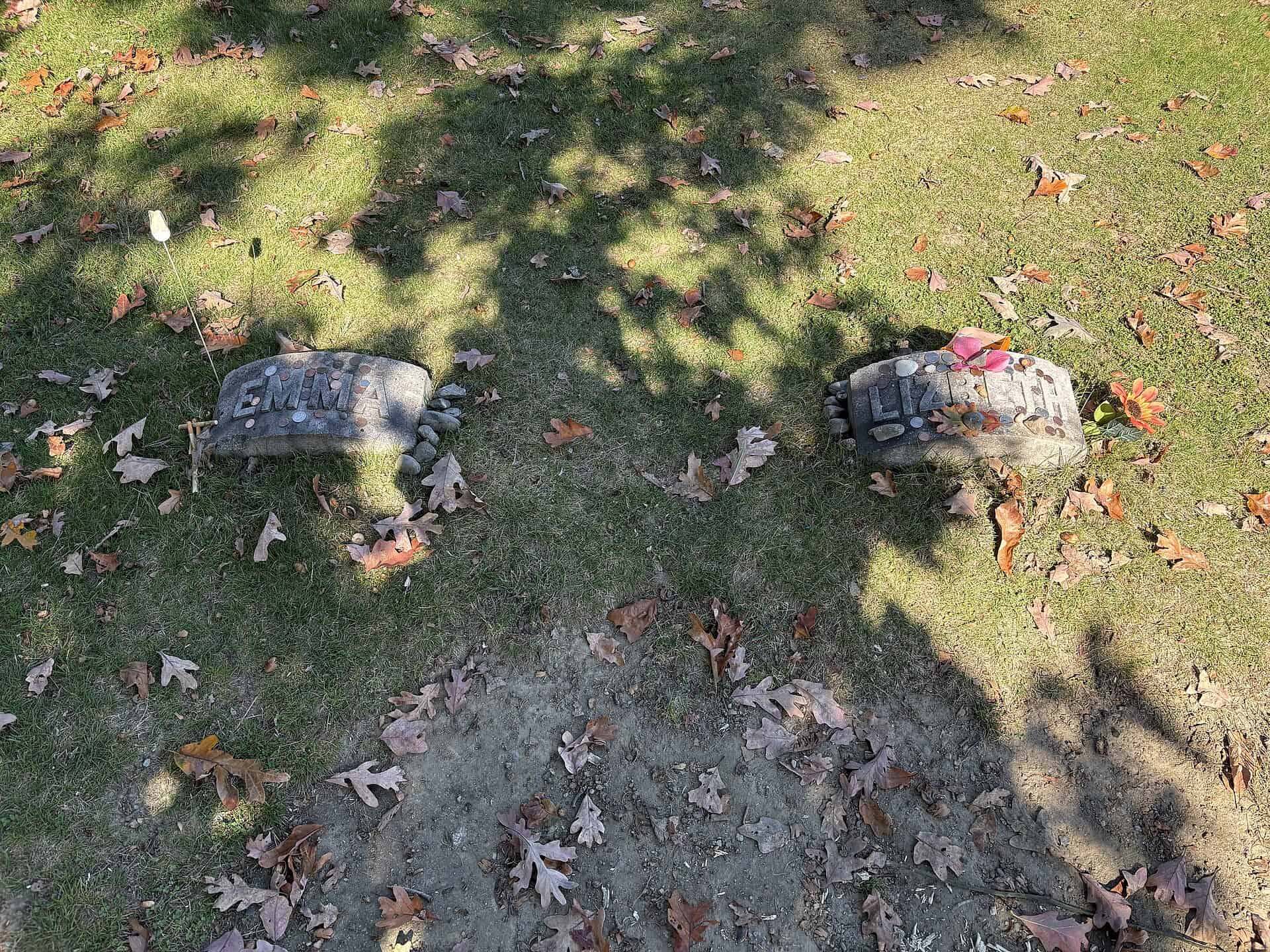
Lizzie was ill in the last year of her life after an operation to remove her gallbladder. She died of pneumonia in Fall River on June 1, 1927, at the age of 66. Funeral details were not published, and few attended. Emma died nine days later, on June 10, at 76, in a nursing home in Newmarket, New Hampshire.
Lizzie left an estate worth more than $250,000, including the house, several office buildings, utility shares, two cars and a good deal of jewelry. She left $30,000 to the Fall River Animal Rescue League and $500 in trust for the perpetual care of her father’s grave.
The sisters were buried side by side in the Borden family plot at Oak Grove Cemetery.
The Lizzie Borden rhyme and the forty whacks legend
Children skipped rope to it. The case was memorialized in a skipping-rope rhyme, sung to the tune of “Ta-ra-ra Boom-de-ay.” In the version Linder quotes, it goes: “Lizzie Borden took an axe, And gave her mother forty whacks, When she saw what she had done, She gave her father forty-one.” The real numbers were smaller and no less terrible. According to the Wikipedia summary of the forensic findings, Abby was struck about 18 times and Andrew ten or eleven. Linder puts the total at 29. The weapon was thought to be a hatchet, not an axe. And Abby was not Lizzie’s mother.
The rhyme also, of course, convicts her. A jury of twelve men did not.
The house on Second Street survives. Its number was changed from 92 to 230 in 1896. It has operated as a bed and breakfast and museum since 1996, and in 2021 it was sold for $2 million to Lance Zaal, who said he would keep it open as a bed and breakfast and add Borden-themed tours. A former owner said the room where Abby was found was the most requested bedroom.
Much of the physical evidence, including the hatchet head, is held by the Fall River Historical Society, which describes its Lizzie Borden Collection as the largest resource of its kind, including forensic evidence and the original crime-scene photographs. Its museum and archive were closed for a major infrastructure project when we checked in October 2026; its website gives a spring reopening.
The story has never stopped being retold. Agnes de Mille’s ballet Fall River Legend (1948), Jack Beeson’s opera Lizzie Borden (1965) and the 1975 television film The Legend of Lizzie Borden, with Elizabeth Montgomery, are among the best known. The fourth season of Netflix’s true-crime anthology Monster, with Ella Beatty as Lizzie, began streaming on September 17, 2026. Like every dramatization, it is a retelling, not history.
The facts are simpler. Lizzie Borden was charged with two murders, tried and acquitted. No one else was ever charged. The murders of Andrew and Abby Borden remain, in the words of the Fall River Historical Society, “one of the most famous unsolved mysteries of all time.”
The trial has been compared, in the Wikipedia summary, with those of Bruno Hauptmann, the Rosenbergs and O.J. Simpson as a landmark in American trial publicity.
Where the accounts disagree
The sources agree on the date, the house, the victims, the verdict and the fact that no one else was ever charged. They differ on many details.
- The ages of Andrew and Abby. A Fall River account published in 1893 gave them as seventy and sixty-seven; the birth years usually given, 1822 and 1828, would make them 69 and 64.
- The blows. Wikipedia’s summary of the evidence puts the blows to Abby at 18 or 19 (about 18 elsewhere in the same summary) and those to Andrew at ten or eleven; Linder puts the total at 29. The rhyme says forty and forty-one.
- The skulls in court. Accounts differ on exactly when Lizzie fainted at the display of the skulls and what was on the table.
- The start of the inquest. The inquest opened on August 9, 1892; some accounts date the start of Lizzie’s questioning to August 8.
- How long the jury was out. Porter’s transcript says one hour and ten minutes; contemporary newspapers said 40 minutes, on a single ballot; Linder and HISTORY.com say an hour and a half.
- The time in the barn. By Lizzie’s various accounts, anything from a few minutes to “twenty minutes or possibly a half an hour”.
- What she heard. At first she said she heard a groan, a scraping noise or a call for help; two hours later she told police she had heard nothing.
- Where she was when her father came home. At the inquest she said in the kitchen reading a magazine, then in the dining room ironing, then coming down the stairs.
- Slippers or boots. Lizzie said her father changed into slippers before lying down; police photographs show him in his boots.
- The barn loft. Police said the dust showed no footprints; two tradesmen testified they had been in the loft a day or two before.
- The hatchet handle. One officer testified that a handle was found near the hatchet head; another contradicted him.
- Life in the house. Emma and Bridget Sullivan described relations between Lizzie and Abby as cordial or pleasant; the dressmaker Hannah Gifford quoted Lizzie calling her stepmother “a mean good-for nothing thing”.
- The pigeons. It has been widely said that Lizzie was distressed when her father killed the pigeons in May 1892; Sarah Miller calls the story unfounded.
- The doctor’s name. The defense witness is Handy in most accounts and “Handfy” in Linder’s.
- Bridget Sullivan’s “confession.” A story says she confessed on her deathbed to changing her testimony to protect Lizzie; the Wikipedia summary says the informant on her death record was the county hospital, not a relative.
Timeline
- July 19, 1860: Lizzie Andrew Borden is born in Fall River, Massachusetts.
- 1863: Her mother, Sarah Anthony Morse Borden, dies.
- June 6, 1865: Andrew Borden marries Abby Durfee Gray.
- 1872: Andrew buys the house at 92 Second Street.
- By 1890: Bridget Sullivan is working as the family’s live-in maid.
- May 1892: Andrew kills the pigeons in his barn with a hatchet.
- July 1892: The sisters sell their mother’s old house back to their father for $5,000, and both leave for stays in New Bedford.
- August 3, 1892: According to Eli Bence, Lizzie tries to buy prussic acid. That evening she visits Alice Russell, and John Morse arrives.
- August 4, 1892: Abby and Andrew Borden are killed at 92 Second Street.
- August 6, 1892: Police search the house again; Lizzie is told she is a suspect.
- August 9, 1892: The inquest opens (some accounts date Lizzie’s questioning to August 8).
- August 11, 1892: Lizzie is arrested; the next day she pleads not guilty and is taken to Taunton jail.
- August 22, 1892: Her preliminary hearing opens; Judge Blaisdell finds her “probably guilty.”
- October 1892: The Boston Globe prints a false story about new witnesses, then apologizes.
- November 7, 1892: The grand jury begins hearing evidence.
- December 2, 1892: Lizzie is indicted for both murders.
- June 1, 1893: Bertha Manchester is killed in Fall River.
- June 5, 1893: The trial opens in New Bedford.
- June 14, 1893: The prosecution rests.
- June 20, 1893: The jury finds Lizzie not guilty; the remaining indictments are dropped and she is discharged.
- 1894: Jose Correa de Mello is convicted of Bertha Manchester’s murder.
- 1896: The house is renumbered from 92 to 230 Second Street.
- 1897: Lizzie is accused of shoplifting in Providence, Rhode Island.
- 1905: Emma moves out of Maplecroft; the sisters never see each other again.
- June 1, 1927: Lizzie dies of pneumonia in Fall River, at 66.
- June 10, 1927: Emma dies in Newmarket, New Hampshire, at 76.
- 1948: Bridget Sullivan dies in Butte, Montana.
Frequently asked questions
Was Lizzie Borden found not guilty?
Yes. On June 20, 1893, a jury of twelve men in New Bedford acquitted her of both murders, and the prosecution dropped the indictments still pending against her. No court ever convicted her of anything connected to the deaths, and no one else was ever charged.
What happened in the Borden house on August 4, 1892?
Abby Borden was killed with a hatchet or a similar blade in the upstairs guest room some time between 9:00 and 10:30 a.m., and her husband, Andrew, was killed the same way on the sitting-room sofa at least an hour later. Lizzie raised the alarm a little after 11, calling the maid, Bridget Sullivan, down from the attic. Nothing had been stolen, and the killer was never identified.
Did Lizzie Borden do it?
No court found that she did: she was acquitted in 1893, no one else was ever charged, and the murders remain officially unsolved. The Wikipedia summary notes that she has remained the prime suspect, and Linder writes that most historians find the prosecution evidence compelling, while other writers have pointed to John Morse, Emma, a man named William Borden or an outsider. None of these theories has ever been proved.
Did Lizzie Borden go to jail?
Only while she awaited trial. After her arrest on August 11, 1892, she was taken to the jail at Taunton and held there for the ten months until her trial in June 1893. She was acquitted, so she never served a sentence; the one later brush with the law described here is an 1897 accusation of shoplifting in Providence, Rhode Island.
What is the Lizzie Borden rhyme?
It is a skipping-rope rhyme sung to the tune of “Ta-ra-ra Boom-de-ay.” In the version Linder quotes: “Lizzie Borden took an axe, And gave her mother forty whacks, When she saw what she had done, She gave her father forty-one.” Almost none of it is accurate: the weapon was thought to be a hatchet, Abby was her stepmother, the blows came to about 29, and the jury acquitted her.
What did Lizzie Borden do after her acquittal?
She stayed in Fall River, moving with Emma to a large house on French Street that she named Maplecroft, and began calling herself Lizbeth A. Borden. Shunned by local society, she took up the theater and its people, and after a quarrel in 1905 Emma left and the sisters never met again.
How did Lizzie Borden die?
She died of pneumonia in Fall River on June 1, 1927, at 66, after a year of illness that followed an operation to remove her gallbladder. Emma died nine days later, and the sisters were buried side by side at Oak Grove Cemetery.
Did Lizzie Borden have children?
Lizzie Borden never married, and no children appear in any account of her life. Her will included $30,000 for the Fall River Animal Rescue League and $500 in trust for the care of her father’s grave.
Can you visit the Lizzie Borden house today?
The house still stands; it was renumbered 230 Second Street in 1896 and has been run as a museum and bed and breakfast since 1996. Much of the physical evidence, including the hatchet head, belongs to the Fall River Historical Society, whose museum and archive were closed for building work when we checked in October 2026, with a spring reopening announced.
Related case files
- O.J. Simpson Trial: Acquittal, Civil Liability and the Record: another landmark criminal trial that ended in an acquittal.
- The Nightmarish Reign of the Axeman in New Orleans
- H.H. Holmes’ Murder Castle: Terror at the 1893 World’s Fair
Works Cited
Trial histories
- Edwin H. Porter, Project Gutenberg ebook 57939, The Fall River Tragedy: A History of the Borden Murders, Fall River: George R. H. Buffinton, 1893.
- Douglas O. Linder, Famous Trials, University of Missouri-Kansas City School of Law, The Trial of Lizzie Borden: An Account.
- HISTORY.com Editors, This Day in History, Lizzie Borden acquitted, June 20.
Archives
- Fall River Historical Society, Lizzie Borden Collections.
Reference
- Wikipedia, Lizzie Borden.
- Wikipedia, Lizzie Borden House.
- Wikipedia, George D. Robinson.
- Wikipedia, Hosea M. Knowlton.
Images
- DkEgy, Borden House Fall River in 2008.jpg, Wikimedia Commons. Public domain.
- Photographer unknown, Lizzie Borden 1890.jpg, Wikimedia Commons. Public domain.
- O’Neil, New Bedford, Mass., Lizzie Borden Trial Jury.jpg, Wikimedia Commons, 1893. Public domain.
- Interstellarity, Emma and Lizzie Borden Graves.jpg, Wikimedia Commons. CC0 1.0.
Image credits
- The Borden house, 2008: DkEgy, via Wikimedia Commons. Public domain (released by the author).
- Lizzie Borden, 1890: photographer unknown, via Wikimedia Commons. Public domain.
- The trial jury, 1893: O’Neil, New Bedford, Mass., via Wikimedia Commons. Public domain.
- The Borden sisters’ graves: Interstellarity, via Wikimedia Commons. CC0 1.0.