FILE NO. 0195
Content warning: This account describes killings, lynchings, executions and an 1875 night raid on a family home that killed a child. It names the dead as the public record does. It contains no images of the dead or of human remains.
Allan Pinkerton: Spymaster, Strikebreaker, Legend
Legal status: Allan Pinkerton was never charged with any crime. He died in Chicago on July 1, 1884. The men his agency pursued are described here as the courts left them: those convicted are named as convicted, and those who were killed by mobs before or after trial are identified as such. No one was ever charged over the 1868 lynchings of the Reno brothers and Charlie Anderson, over the January 1875 raid on the Samuel farm in Clay County, Missouri, or over the December 1875 killings at Wiggans Patch, Pennsylvania. Claims that the Baltimore assassination plot of 1861 was real, and claims about who was behind the raids, are attributed to the people and sources that made them.
A cooper’s son in the Gorbals
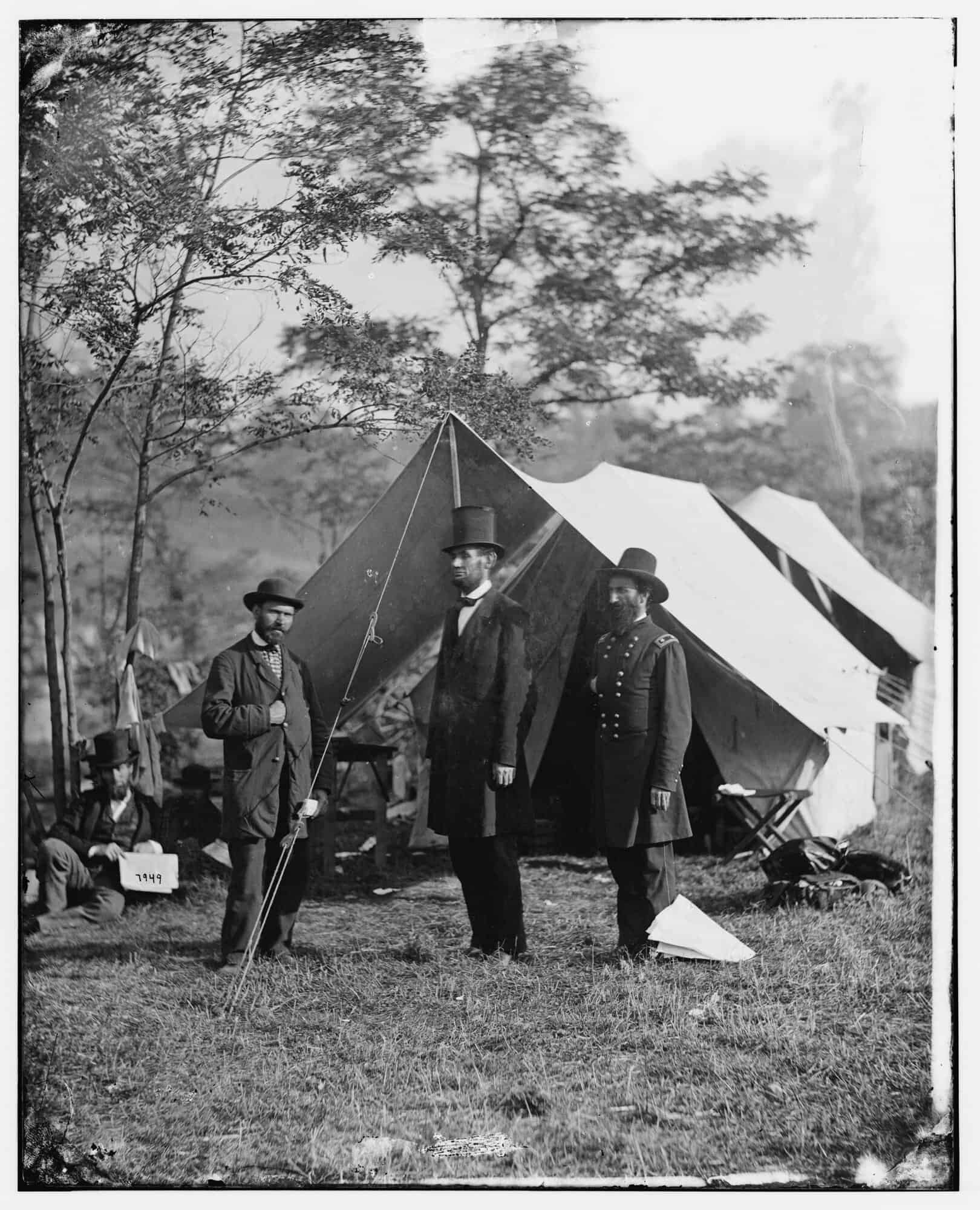
In 1862, after the battle of Antietam, the photographer Alexander Gardner set up his camera outside a tent near the battlefield in Maryland and photographed three men. In the centre stands Abraham Lincoln in his stovepipe hat. On the right is a uniformed general, John A. McClernand. On the left, a little apart, is a stocky bearded man in a plain coat and a low hat. The Library of Congress catalogues him as Allan Pinkerton. By his own account, many of the officers and officials he dealt with that year knew him by another name entirely: Major E. J. Allen.
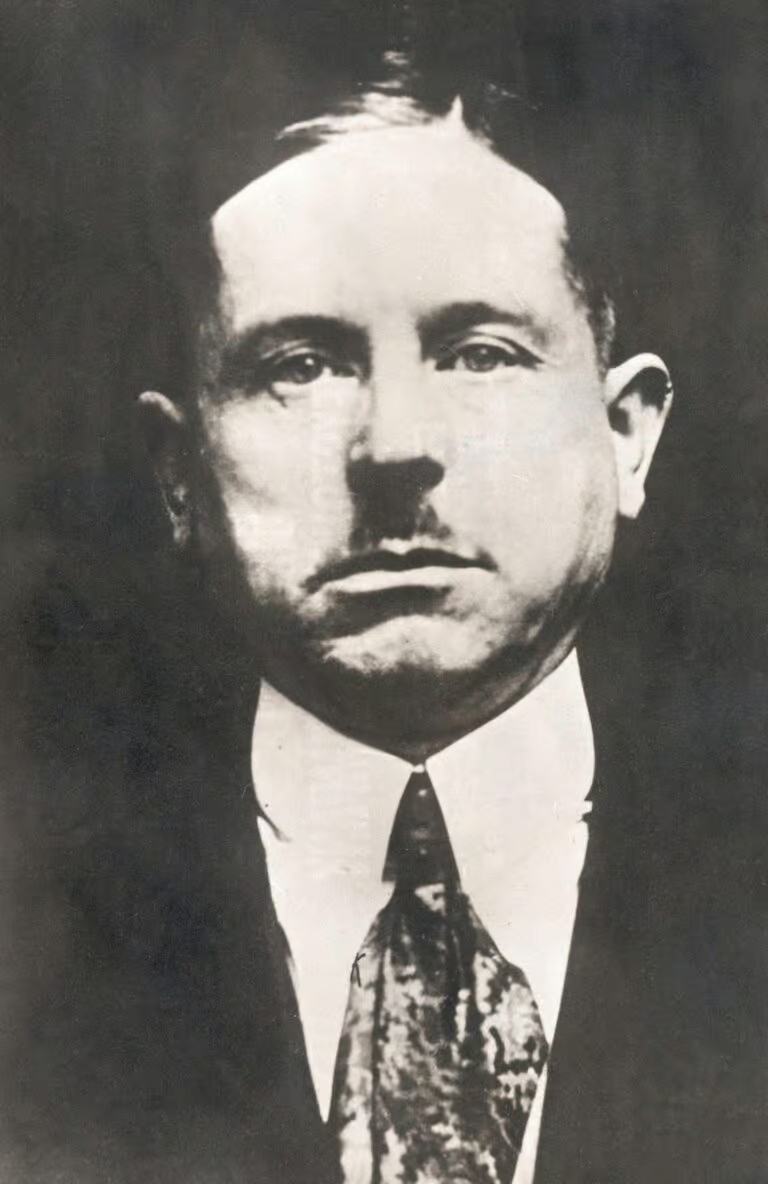
Pinkerton was a Glasgow barrel maker who fled Scotland as a political radical, sheltered fugitives from slavery in a cabin in Illinois, and built the most famous private detective agency in the world. He claimed to have saved Lincoln’s life. He ran the Union’s first intelligence service and is blamed by many historians for some of its worst failures. His men hunted the Reno brothers, Jesse James and the Molly Maguires, and the cases ended in lynchings, a dead child and twenty hangings. By the time he died, the open eye on his agency’s insignia had become a symbol of the detective, and to a large part of the American labour movement, a symbol of the enemy.
This is the record of Allan Pinkerton, drawn from encyclopaedias, government historians, court and archive records, and his own books, which most historians believe were written with the help of ghostwriters and which promoted his agency. Where his account is the only account, this dossier says so.
Allan Pinkerton was born in Glasgow in August 1819. The exact day is not settled. Encyclopaedia Britannica and the National Park Service give August 25, 1819. English Wikipedia says he was born in the Gorbals, a working class district of the city, on August 21, 1819, and baptized on August 25, “which many sources incorrectly give as his birthdate.” The dossier uses August 1819 for that reason.
His father, William Pinkerton, is described by Britannica as a police sergeant and by Wikipedia as a retired policeman. His mother was Isobel McQueen. According to Wikipedia, Allan was the second surviving son, and he left school at the age of 10 after his father died. Britannica says the father’s death left the family “in great poverty.” The boy trained as a cooper, making barrels, and read widely. Wikipedia describes him as largely self-educated and a lifelong atheist.
In his late teens and early twenties he was drawn into Chartism, the working class movement that campaigned in the 1830s and 1840s for the vote for all men, the secret ballot and other political reforms. Britannica says Pinkerton “soon became involved in Chartism, a mass movement that sought political and social reform,” and that “his activities resulted in a warrant for his arrest.” The National Park Service puts it more simply: he was “forced to emigrate from Scotland in 1842 because of his radical, populist views.” Wikipedia records a second, less flattering possibility, that he and his wife left either to escape arrest for his Chartist activity “or the ire of the Chartists having turned informer.” No source saved for this dossier settles which was true.
On March 13, 1842, in Edinburgh, Pinkerton married Joan Carfrae, a singer from Duddingston. The couple sailed for North America soon afterwards. Their ship ran aground on Sable Island, off Nova Scotia. According to Wikipedia, they found passage on a schooner, travelled on to Detroit and, finding no work there, spent the last of their money on a horse and wagon and went west to Chicago, where Pinkerton found work as a cooper for a brewery.
Sources: Encyclopaedia Britannica, “Allan Pinkerton”; National Park Service, “Allan Pinkerton” (Person page, last updated July 31, 2020); Wikipedia, “Allan Pinkerton”; Wikipedia, “Chartism.”
Dundee, Illinois: counterfeiters and the Underground Railroad
In 1843 Pinkerton heard of Dundee, a settlement on the Fox River about fifty miles northwest of Chicago. He built a cabin there, set up a cooperage, and sent for his wife when the cabin was finished. Britannica dates the move to “the next year” after his 1842 arrival and places Dundee in Kane County.
Two things happened in Dundee that shaped the rest of his life. The first was political. According to Wikipedia, “as early as 1844, Pinkerton worked for the Chicago abolitionist leaders, and his Dundee home was a stop on the Underground Railroad,” the network that moved people escaping slavery toward freedom in the northern states and Canada. The National Park Service lists “abolitionist” first among his significance, describing him as “a cooper, abolitionist, and founder of the North-Western Police Agency.”
The second was an accident. Looking for timber to cut into barrel staves, he came across a band of counterfeiters. Britannica says that “while cutting wood on a deserted island one day, he discovered and later captured a gang of counterfeiters.” Wikipedia says he watched their movements for some time and then informed the local sheriff, who arrested them, and adds that they “may have been affiliated with the notorious Banditti of the Prairie.” The modern Pinkerton company dates the episode to 1847 and says the counterfeiters were found “while scouting for barrel timber on the Fox River.” The counterfeiters are not named in any source saved for this dossier.
The capture made the barrel maker a local name. Britannica writes that “following this and other similar achievements, he was appointed deputy sheriff of Kane county in 1846 and soon afterward deputy sheriff of Cook county, with headquarters in Chicago.” The National Park Service adds that he then became a special agent for the United States Post Office in Chicago. In 1849, according to Wikipedia, he was appointed the first police detective in Chicago.
Sources: Encyclopaedia Britannica, “Allan Pinkerton”; National Park Service, “Allan Pinkerton”; Wikipedia, “Allan Pinkerton”; Pinkerton, “Our Story” (company history timeline).
“We never sleep”: the agency is born
Pinkerton’s time on the city force was short. In 1850, according to Britannica, he “resigned from Chicago’s new police force in order to organize a private detective agency that specialized in railway theft cases.” Wikipedia records that he went into partnership that year with a Chicago lawyer, Edward Rucker, to form the North-Western Police Agency, which later became Pinkerton and Co. and finally the Pinkerton National Detective Agency. The company that carries his name today says its first office opened at 80 Washington Street in Chicago in 1850.
The agency’s emblem was a wide open eye above the words “We never sleep.” The National Park Service says the motto and the “prominent, unblinking eye” came “to be associated with all future ‘private eyes.'” The phrase is still used by the modern company, which calls it a statement of “integrity, vigilance, and excellence.”
Pinkerton’s first widely reported success, according to Wikipedia, was a case at the Old French Cemetery near Lake Michigan, where he and his men caught three medical students who admitted robbing graves to obtain bodies for medical research. When the story reached the newspapers, Wikipedia says, “the Pinkerton office was flooded with new clients.” The students are not named in any source saved for this dossier.
The real money was in the railways. Through the 1850s the lines spreading west from Chicago carried cash, bonds and freight across long, thinly policed distances, and they were robbed. Pinkerton’s agency, Wikipedia says, “solved a series of train robberies during the 1850s,” work that brought him into contact with two men who would matter enormously to him: George B. McClellan, then chief engineer and vice president of the Illinois Central Railroad, and Abraham Lincoln, a lawyer who sometimes represented the company. The modern Pinkerton company dates its contract to guard the Illinois Central to 1855.
By 1857 his reputation in Chicago was strong enough that, according to Wikipedia, the Chicago Tribune urged the city to dismiss its police chief and hire Pinkerton in response to a surge in thefts. He stayed in private practice.
Sources: Encyclopaedia Britannica, “Allan Pinkerton”; National Park Service, “Allan Pinkerton”; Wikipedia, “Allan Pinkerton”; Wikipedia, “Pinkerton (detective agency)”; Pinkerton, “Our Story.”
Kate Warne and the Adams Express case
In 1856, a widow of about 23 walked into the agency’s Chicago office and asked for a job as a detective. Her name was Kate Warne. Very little is known about her early life, except, according to Wikipedia, that she was born in Erin, Chemung County, New York, and was widowed by 23.
Pinkerton later told the story himself in The Expressman and the Detective. “At this time female detectives were unheard of,” he wrote. “I told her it was not the custom to employ women as detectives, but asked her what she thought she could do. She replied that she could go and worm out secrets in many places to which it was impossible for male detectives to gain access.” Company records quoted by Wikipedia have a sharper version of his first reaction: “It is not the custom to employ women detectives!” Warne, those records say, answered that “women have an eye for detail and are excellent observers.” He hired her. The modern company describes her as “America’s first woman detective.”
Her first major test was the case that Pinkerton turned into that book. In 1858, according to Wikipedia, Warne was assigned to the embezzlement of money from the Adams Express Company by an expressman, named in Pinkerton’s book as Nathan Maroney, living in Montgomery, Alabama, as Wikipedia describes him. Warne won the confidence of Maroney’s wife and gathered evidence that helped convict him. The Maroneys had taken $50,000. With Warne’s help, $39,515 was recovered, and Maroney was sentenced to ten years. Wikipedia names him only as “Mr. Maroney”; Pinkerton’s book, published years later, gives the fuller story from the agency’s side.
In 1860, Pinkerton put Warne in charge of a new Female Detective Bureau in Chicago. She recruited other women to it, among them Hattie Lawton and Elizabeth H. Baker, according to Wikipedia. Pinkerton’s own later description of her, in The Spy of the Rebellion, called her a “slender, brown-haired woman, graceful in her movements and self-possessed.”
The Adams Express Company would become one of Pinkerton’s most important clients. Britannica lists among the agency’s successes the “capture of the principals in a $700,000 Adams Express Company theft in 1866.” Wikipedia says that in that case he caught a group of thieves who had stolen $700,000 from a train safe and recovered $688,000 of it. The thieves are not named in the saved sources.
Sources: Allan Pinkerton, The Expressman and the Detective (Project Gutenberg); Allan Pinkerton, The Spy of the Rebellion (1883, Project Gutenberg); Wikipedia, “Kate Warne”; Wikipedia, “Allan Pinkerton”; Encyclopaedia Britannica, “Allan Pinkerton”; Pinkerton, “Our Story.”
Five hundred dollars for John Brown
Pinkerton’s abolitionism was not only a matter of sheltering fugitives in Dundee. According to Wikipedia, he “was known to be a friend of abolitionist John Brown.” On March 11, 1859, he “supported Brown by giving him $500 and a ticket on the Michigan Central Railroad to Detroit.” He also attended secret meetings that Brown and Frederick Douglass held in Chicago, together with the abolitionists John Jones and Henry O. Wagoner, and the three men helped buy clothes and supplies for Brown. Jones’s wife, Mary, later guessed that the supplies included the suit Brown was hanged in after his failed raid on Harpers Ferry in 1859.
The episode sits awkwardly with the later history of the agency. The man who financed John Brown would, within twenty years, be accused of helping to break a coal miners’ union and of writing that a vigilance committee should take “fearful revenge” on suspected Molly Maguires. Wikipedia notes another contradiction: in 1872, the Spanish government hired Pinkerton “to help suppress a revolution in Cuba which intended to end slavery and give citizens the right to vote.” It adds that if Pinkerton knew this, “then it directly contradicts statements in his 1883 book The Spy of the Rebellion, where he professes to be an ardent abolitionist and hater of slavery.”
Sources: Wikipedia, “Allan Pinkerton”; National Park Service, “Allan Pinkerton.”
The Baltimore Plot, February 1861
Lincoln was elected president on November 6, 1860. By the time he left Springfield, Illinois, for his inauguration on February 11, 1861, seven Southern states had seceded. According to the White House Historical Association, “wild rumors swirled around the country, including threats to blow up the Capitol, kidnap President James Buchanan, tear up train tracks, blow up bridges, and assassinate Lincoln.”
Pinkerton’s route into the story began with a railway, not a president. Samuel Morse Felton, president of the Philadelphia, Wilmington and Baltimore Railroad, was worried that secessionists in Maryland, still a slave state debating whether to leave the Union, would sabotage the line’s bridges and ferries. On January 21, 1861, the association’s historian Lina Mann writes, Felton met Pinkerton in Philadelphia. “At this point, Felton and Pinkerton were both more concerned with safeguarding the railroad than a possible assassination attempt on Lincoln.”
Pinkerton went to Baltimore with some of his best detectives. He set up an office as “John H. Hutchinson, stock broker,” and with his agent Harry Davies worked the city’s bars and hotels, talking to secessionists. Kate Warne, according to Wikipedia, was one of five agents sent to Baltimore on February 3, posing as a wealthy Southern lady under the names Mrs. Cherry and Mrs. M. Barley. Timothy Webster and Hattie Lawton posed as a Southern gentleman and his wife.
Through a stockbroker named James H. Luckett, Pinkerton was introduced to Cipriano Ferrandini, a barber at Baltimore’s Barnum’s Hotel whom he came to regard as the leader of a plot to kill Lincoln as he changed trains in Baltimore. Lincoln’s published schedule had him arriving at the Calvert Street station on February 23 and travelling about a mile by carriage to Camden Street station for the train to Washington. Pinkerton described the plan in his records: “A row or fight was to be got up by some outsiders to quell which the few policemen at the Depot would rush out, thus leaving Mr. Lincoln entirely unprotected and at the mercy of a mob of secessionists who were to surround him at that time. A small steamer had been chartered and was lying in one of the Bays or little streams running into the Chesapeake, to which the murderers were to flee and it was immediately put off for Virginia.”
No source saved for this dossier records any charge against Ferrandini. Wikipedia notes that “only reports from Pinkerton’s operatives tied Ferrandini to the assassination conspiracy.” A congressional select committee later looked at the threat attributed to him and, according to Wikipedia, “determined that the threat wasn’t real and that the evidence was not substantial.”
On February 21, Pinkerton took what he had to Felton and to Norman Judd, a Lincoln confidant, in Philadelphia, and that evening he met Lincoln for the first time. He urged him to go straight to Washington. Lincoln refused. He later told the historian Benson J. Lossing: “He urged me to go to Washington that night. I didn’t like that. I had made arrangements to visit Harrisburg, and go from there to Baltimore, and I resolved to do so. I could not believe there was a plot to murder me.”
He did agree to change how he travelled after Harrisburg. According to Pinkerton’s record book, Lincoln said: “I shall endeavor to get away quietly from the people at Harrisburg to-morrow evening and shall place myself in your [hands].” The next morning, before he left Philadelphia, Frederick W. Seward, son of the incoming secretary of state, brought Lincoln a separate warning: General Winfield Scott, head of the Army, had also heard of a plot. That second warning, the association says, convinced Lincoln to follow Pinkerton’s plan.
On February 22, after a dinner with Pennsylvania’s governor, Andrew Curtin, Lincoln slipped out of the back door at 5:45 p.m. and swapped his famous top hat for a soft beaver hat a friend had given him in New York. “Then I put on the soft hat and joined my friends without being recognized by strangers, for I was not the same man,” he later recalled. Disguised by the hat and a shawl, he travelled back to Philadelphia alone with his bodyguard, Ward Hill Lamon, in a private car, and as soon as the train left Harrisburg the telegraph wires were cut so that no word of his movements could reach Baltimore. In Philadelphia, Pinkerton and Lamon took him aboard an 11 p.m. train. Kate Warne had reserved four sleeping berths, posing as the sister of an “invalid traveler.” Pinkerton noted that Lincoln remained “cold, calm and collected.”
At 3:30 a.m. the train reached Baltimore’s President Street depot. Railway workers hitched the sleeping car to a team of horses and pulled it a mile through the dark city to Camden Street, where it was attached to a train for Washington. Lincoln arrived at 6 a.m. on February 23 and went to the Willard Hotel. Pinkerton returned to Baltimore and met his informant Luckett, who, the association records, remarked: “if it had not been for damned spies somewhere, Lincoln never could have passed through Baltimore.”
The secret journey made Lincoln a figure of ridicule. Wikipedia records that it became “a humiliating cause célèbre across the nation,” and that a Vanity Fair cartoon showed him in a kilt, and the Baltimore caricaturist Adalbert J. Volck mocked him in an etching titled “Passage through Baltimore.” Lincoln himself came to regret it, writing to a friend that he “did not then, nor do I now believe I should have been assassinated had I gone through Baltimore.”
A disputed plot
Whether there was ever a real plot is still argued. Britannica states flatly that the agency’s successes included “the thwarting of an assassination plot against President-elect Abraham Lincoln in February 1861 in Baltimore,” and the modern Pinkerton company says the agency “safely protects the 16th President, Abraham Lincoln, from the first assassination attempt on his life.” The National Park Service says only that the agency “protected President-elect Abraham Lincoln during his journey from Springfield to Washington.”
Others were and are less sure. Lamon, who was in the sleeping car, refused to back Pinkerton’s account and wrote in his own life of Lincoln that Pinkerton “soon got, or pretended to get, upon a scent that promised a heavier reward.” George William Brown, the mayor of Baltimore at the time, wrote in his memoir that he was not disloyal and, according to Wikipedia, described the plot as exaggerated, sensational and imagined. The Lincoln scholar Harold Holzer has said it was “hard to know” the reality and that if a plot existed, it was “at most ad hoc, poorly organized and probably destined to fail.” The White House Historical Association concludes that the plot’s existence and severity “has been disputed by historians and Lincoln’s contemporaries alike,” that Pinkerton “was known to exaggerate the truth,” and that he “certainly relied heavily on rumors, whispers, and hearsay to establish the facts of the Baltimore Plot case.”
Pinkerton spent the rest of his life defending his version. In 1868, according to the association, he published a privately printed booklet with accounts from Lincoln and members of his party. The episode was later fictionalised in the 1951 film The Tall Target.
Sources: White House Historical Association, Lina Mann, “Spies, Lies and Disguise: Abraham Lincoln and the Baltimore Plot” (originally published May 29, 2019); Wikipedia, “Baltimore Plot”; Wikipedia, “Kate Warne”; Wikipedia, “Timothy Webster”; Encyclopaedia Britannica, “Allan Pinkerton”; National Park Service, “Allan Pinkerton”; National Park Service, Ford’s Theatre National Historic Site, “The Baltimore Plot”; Pinkerton, “Our Story.”
Major E. J. Allen and McClellan’s war
When the war began in April 1861, Pinkerton offered his services to the Union. His old railway contact, George B. McClellan, was given command first in Ohio and then, after the Union defeat at Bull Run, of the forces around Washington that became the Army of the Potomac. The National Park Service says that “when war erupted, Pinkerton was appointed chief of intelligence for Union army commander George McClellan.” Wikipedia describes his organisation as the Union Intelligence Service, which he headed during the first two years of the war.
He worked under a false name. In the introduction to The Spy of the Rebellion, published in 1883, he wrote that many officers and government officials “never knew me by any other name, and the majority of them are to this day in ignorance of the fact that E. J. Allen, late Chief of the Secret Service, and Allan Pinkerton are one and the same person.” He told the story of meeting General Fitz John Porter after the war and telling him the name had been invented. Porter, he wrote, exclaimed: “Fictitious! You are not in earnest, Major?”
According to Wikipedia, Pinkerton himself carried out several undercover missions in the summer of 1861, posing as a Confederate soldier and working across the Deep South to study fortifications and Confederate plans. He was found out in Memphis “and barely escaped with his life.” His agents worked as Confederate soldiers and sympathisers, and he ran counterespionage in Washington. On August 23, 1861, he arrested Rose O’Neal Greenhow, a Washington society hostess suspected of passing military information to the Confederacy, and placed her under house arrest at her home on 16th Street, according to Wikipedia. His men found scraps of coded messages and maps of the city’s fortifications in the house. After an espionage hearing in 1862 she was jailed in Washington for nearly five months and, on May 31, 1862, released without trial on condition that she stay within Confederate lines.
The numbers
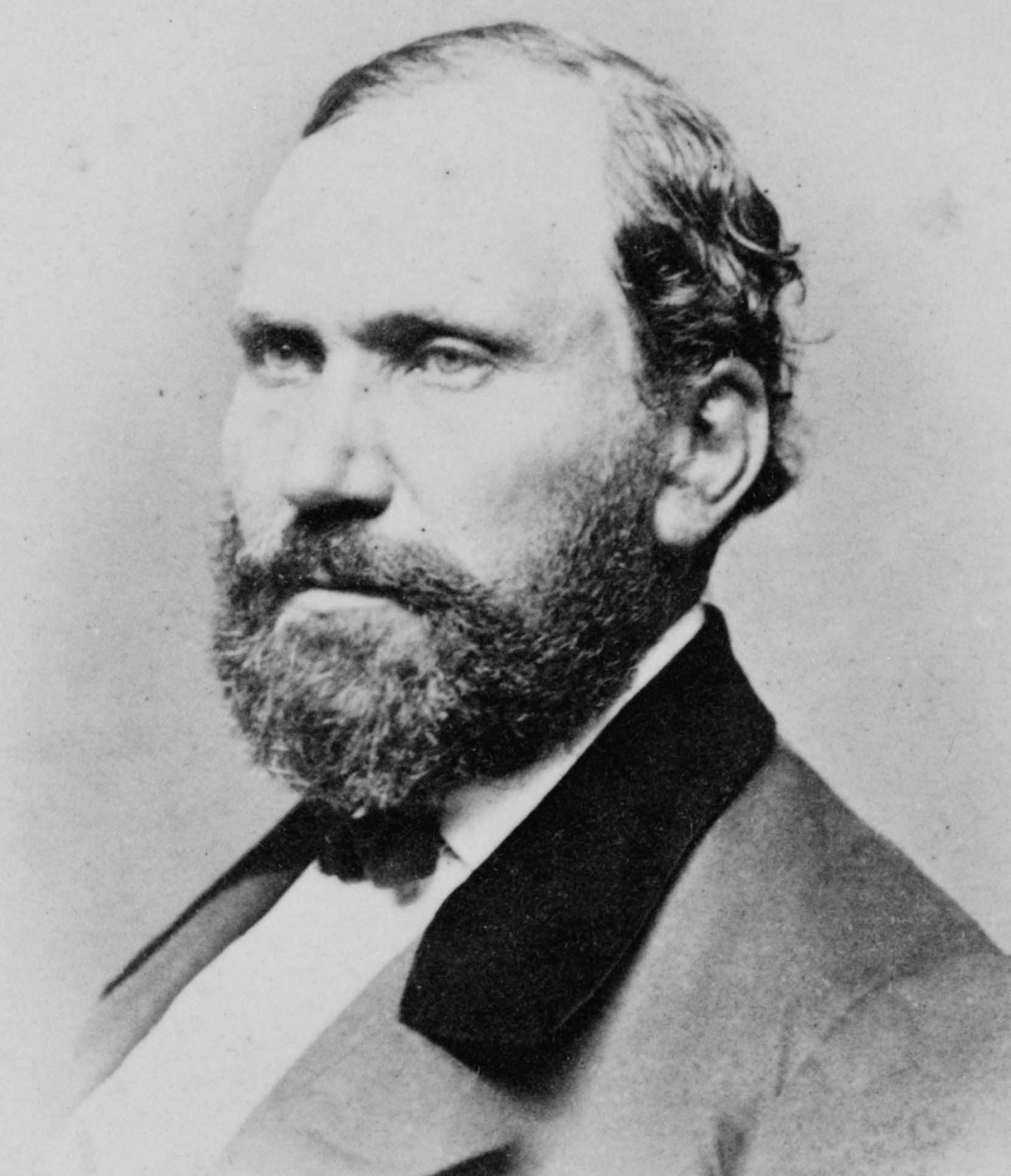
Pinkerton’s reputation as a wartime spymaster rests above all on one question: how many Confederate soldiers did McClellan face? The National Park Service is blunt: “In the early months of the Civil War, McClellan’s cautious nature was often reinforced by Pinkerton’s inflated estimates of Confederate troop strength.”
Many military historians go further. Wikipedia summarises the case against him: his estimates, “derived from his credulous interrogations of Confederate prisoners, deserters, refugees, escaped slaves (‘contrabands’), and civilians unused to counting large bodies of men, badly exaggerated the size of those formations, sometimes almost doubling their actual strength.” McClellan, believing himself outnumbered, was unduly cautious. Critics link that caution to his retreat in the Peninsula Campaign of 1862, his failure to crush Robert E. Lee’s army at Antietam in September 1862, and his delay in pursuing Lee back into Virginia. The historian T. Harry Williams called Pinkerton’s work “the poorest intelligence service any general ever had.”
There is a counter case. Edwin C. Fishel, in The Secret War for the Union, and James Mackay, in his biography Allan Pinkerton: The First Private Eye, argue, in Wikipedia’s words, “that the troop strength figures which Pinkerton passed on to McClellan were relatively accurate, and that McClellan himself held primary responsibility for inflating those numbers to wildly unrealistic levels.” This dossier does not try to settle a dispute that specialists have argued over for decades. What is not in dispute is that the figures that reached the president were wrong, and that Pinkerton’s service was central to producing them.
Pinkerton’s war was tied to McClellan’s. Lincoln removed McClellan from command in November 1862, after the midterm elections and his failure to pursue Lee after Antietam, and Wikipedia dates Pinkerton’s leadership of the intelligence service to the first two years of the war. He was succeeded as chief of the intelligence service by Lafayette Baker, according to Wikipedia. Pinkerton is today counted among the founders of American military intelligence. He was inducted into the Military Intelligence Hall of Fame, and the Army counts his agency as an early predecessor of its counterintelligence work.
Sources: National Park Service, “Allan Pinkerton”; Allan Pinkerton, The Spy of the Rebellion (1883, Project Gutenberg); Wikipedia, “Allan Pinkerton”; Wikipedia, “Rose O’Neal Greenhow”; Wikipedia, “George B. McClellan”; Library of Congress, Civil War photograph collection (via Wikimedia Commons).
The hanging of Timothy Webster
The worst cost of Pinkerton’s war was paid by one of his own men. Timothy Webster was born in Britain on March 12, 1822, came to the United States with his parents in 1830, and was a New York City policeman before Pinkerton hired him in 1856. In 1861 he was the agent who posed with Hattie Lawton as a Southern gentleman and his wife in Baltimore. Through 1861 and into 1862 he carried information from southern Maryland and Richmond, Virginia, winning the confidence of Confederate officers who trusted him with documents.
In early 1862, in Richmond, Webster fell ill with inflammatory rheumatism and his reports stopped. Pinkerton sent two more agents, Pryce Lewis and John Scully, to find him. Both were recognised as Union agents and arrested. According to Wikipedia, Scully “eventually revealed information that caused Webster and Lawton to be arrested.” Lewis and Scully were later released. Lawton was imprisoned and eventually exchanged. Webster was tried as a spy and sentenced to hang.
When the sentence became known, Wikipedia records, Pinkerton and Lincoln sent a message to the Confederacy warning that if Webster was put to death, the Union would hang a Confederate spy in return. Union practice had been to hold Confederate spies and exchange them. The warning was ignored.
On April 29, 1862, Webster was led to the gallows at Camp Lee in Richmond. Pinkerton described what happened next in The Spy of the Rebellion. The knot slipped and Webster fell to the ground. He was carried back up to the scaffold. “I suffer a double death,” Pinkerton wrote that he said. When the rope was replaced, it was pulled painfully tight. “You will choke me to death this time,” Webster said, according to Pinkerton. The second drop killed him. He is recorded as the first spy executed in the Civil War.
Pinkerton did not forget him. In 1871, according to Wikipedia, he sent his agent George Bangs and Webster’s son-in-law, Thomas G. Robinson, to Richmond to find Webster’s body and bring it home to Onarga, Illinois, where he was buried beside his father and his son.
Sources: Wikipedia, “Timothy Webster”; Wikipedia, “Pryce Lewis”; Allan Pinkerton, The Spy of the Rebellion (1883, Project Gutenberg).
The Reno brothers and Hangman Crossing
The Civil War ended in 1865 and the railways went back to being robbed. The first gang to make a business of it came from Jackson County, Indiana. The Reno brothers, Frank, John, Simeon and William, were sons of a farming family from Rockford, near Seymour. According to Wikipedia, Frank, John and possibly Simeon had spent the war as bounty jumpers, taking enlistment money and deserting, and after 1864 a gang formed around them. A fifth brother, Clinton, and their sister Laura were never involved.
On the evening of October 6, 1866, John Reno, Sim Reno and Frank Sparkes boarded an Ohio and Mississippi Railway train as it pulled out of the depot at Seymour. They broke into the express car, restrained the guard, opened a safe holding about $16,000, and pushed a second safe off the moving train to accomplices waiting by the line. Wikipedia describes the gang as having carried out “the first three peacetime train robberies in U.S. history.” The three men were arrested and released on bail. A passenger named George Kinney came forward to identify two of the robbers. He was shot dead. After that, the other passengers would not testify and the charges were dropped. No one is recorded as having been convicted of Kinney’s killing.
The money in the safe belonged to customers of the Adams Express Company, which hired Pinkerton. It was the start of a two year hunt. On November 17, 1867, the Daviess County courthouse in Gallatin, Missouri, was robbed. John Reno was identified, arrested by Pinkerton agents and, in 1868, sentenced to 25 years in the Missouri State Penitentiary. He was released in February 1878.
The rest of the gang went on. In early 1868 they robbed the Harrison County treasury in Iowa of $14,000 and, the next day, the Mills County treasury of $12,000. Pinkerton men, led by Allan Pinkerton’s son William, caught Frank Reno and others at Council Bluffs. On April 1 they broke out of jail. On May 22, 1868, about twelve men boarded a Jeffersonville, Madison and Indianapolis Railroad train at Marshfield, Indiana, in Scott County, uncoupled the passenger cars, broke into the express car and threw the express messenger, Thomas Harkins, off the train. He died of his injuries. The gang took about $96,000.
On July 9, Pinkerton detectives who had learned of another planned robbery waited aboard a train. When the gang broke in, the agents opened fire and wounded two men. Everyone escaped except Volney Elliot, who, according to Wikipedia, named the other gang members in return for leniency. The next day detectives arrested Charlie Roseberry and Theodore Clifton.
The vigilance committee
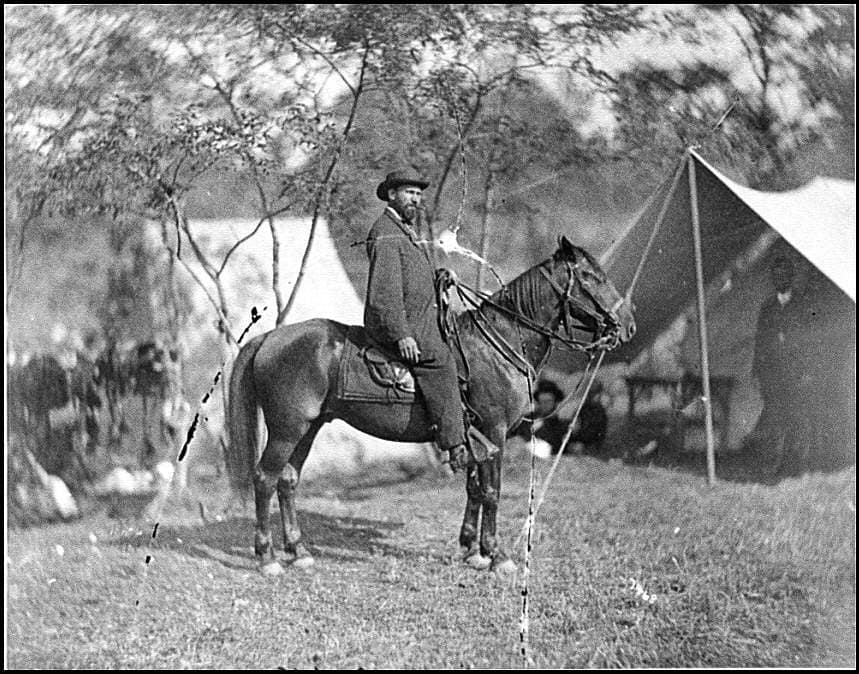
What happened next was the reason the Reno case became infamous. On July 10, 1868, Elliot, Roseberry and Clifton were being taken by train to jail when masked men calling themselves the Jackson County Vigilance Committee stopped them three miles outside Seymour, took them off the train and hanged them from a tree. Three more men accused of belonging to the gang, Henry Jerrell, Frank Sparks and John Moore, were caught soon afterwards in Illinois, brought back to Seymour and hanged by vigilantes from the same tree. The site became known as Hangman Crossing. No source saved for this dossier records that any of these six men had been tried for the crimes the mob claimed to be punishing.
On July 27, 1868, Pinkerton agents captured William and Simeon Reno in Indianapolis. They were tried and convicted of the Marshfield robbery, and for fear of the vigilantes were moved to the stronger Floyd County jail in New Albany. Frank Reno and Charlie Anderson had fled to Windsor, in what is now Ontario. With the help of Secretary of State William H. Seward, they were extradited in October under the Webster-Ashburton Treaty of 1842 and sent to New Albany to await trial.
On the night of December 11, 1868, about 65 hooded men arrived in New Albany by train and marched four abreast to the jail. Just after midnight they forced their way into the jail and the sheriff’s home. They beat Sheriff Thomas Fullenlove and shot him in the arm when he refused to hand over the keys, and his wife gave them up. Frank Reno was taken from his cell and hanged first, then William and Simeon Reno. Charlie Anderson was the last, at about 4:30 a.m. on December 12.
Wikipedia records that “No one was ever charged, named or officially investigated in any of the lynchings.” Frank Reno and Charlie Anderson were technically federal prisoners who had not yet been tried, and their killing is believed to be the only time in American history that federal prisoners were lynched by a mob before trial. Seward wrote a formal letter of apology, and the episode, according to Wikipedia, became “an international diplomatic incident with Canada and Great Britain.” Congress later considered a bill to clarify responsibility for the safety of extradited prisoners.
The sources saved for this dossier do not show Pinkerton directing or approving the lynchings, and this dossier makes no such claim. What they do show is that his agency’s arrests delivered the men into custody, and that the custody did not protect them.
Sources: Wikipedia, “Reno Gang”; Wikipedia, “Allan Pinkerton”; Encyclopaedia Britannica, “Allan Pinkerton.”
Jesse James and the raid on the Samuel farm
The Reno case made the agency’s name with the express companies. The pursuit of Jesse James nearly destroyed it.
Jesse and Frank James were Missouri guerrilla veterans of the Confederate side who, with the Younger brothers, robbed banks and trains through the late 1860s and 1870s. The State Historical Society of Missouri says Pinkerton agents “had been pursuing the James brothers since 1871.” In 1874, according to Wikipedia, the Adams Express Company turned to the agency to stop the James-Younger gang. Because the gang had wide support among former Confederates in Missouri, the agents struggled.
The pursuit cost lives quickly. Joseph Whicher, an agent sent to infiltrate the farm of Jesse James’s mother, Zerelda Samuel, was soon found killed. Two other agents, Captain Louis J. Lull and John Boyle, were sent after the Youngers. On March 17, 1874, Lull was killed in a roadside gunfight with two of the Younger brothers. Before he died he fatally shot John Younger. A deputy sheriff, Edwin Daniels, was also killed. No source saved for this dossier records anyone being convicted of Whicher’s death.
Wikipedia says that Allan Pinkerton “took on the case as a personal vendetta” and began working with former Unionists who lived near the James family farm in Clay County. On the night of January 25, 1875, his agents raided the house. They threw an incendiary device inside. It exploded. It killed Archie Samuel, Jesse James’s young half-brother, and, in Wikipedia’s words, blew off “one of Zerelda Samuel’s arms.” The State Historical Society of Missouri records the same event more cautiously: agents “tossed a flare into the Samuel home,” and the explosion killed James’s half-brother and injured his mother’s hand, “which later had to be amputated.”
Pinkerton denied that the raid was meant to burn the house. The biographer Ted Yeatman, according to Wikipedia, later found a letter from Pinkerton in the Library of Congress in which he declared his intention to “burn the house down.” The raid outraged many Missourians. A bill praising the James and Younger brothers and offering them amnesty was narrowly defeated in the state legislature, and the legislature limited the size of the rewards the governor could offer for fugitives. No one was charged over the death of Archie Samuel in any source saved for this dossier.
The National Park Service notes the outcome in a single clause: the agency “helped bring to justice a number of prominent railway express robbers but failed to apprehend the nation’s most notorious: the James Gang.” Wikipedia adds that after the railways withdrew their financial support, Pinkerton continued the hunt at his own expense, and abandoned it after James allegedly captured and killed one of his undercover agents. Some consider it his greatest defeat. Jesse James was shot dead in 1882 by Robert Ford, a member of his own gang, not by a Pinkerton.
Sources: Wikipedia, “Jesse James”; State Historical Society of Missouri, “Jesse James”; National Park Service, “Allan Pinkerton”; Wikipedia, “Allan Pinkerton.”
The Molly Maguires
The case that most shaped how Pinkerton is remembered took place in the anthracite coal country of eastern Pennsylvania. In the early 1870s, the mines of Schuylkill and Carbon counties were worked largely by Irish immigrants, many of them refugees of the Great Famine, for low pay in dangerous conditions. The Panic of 1873 brought wage cuts and unemployment. A union, the Workingmen’s Benevolent Association, organised the miners. At the same time, the region saw a string of beatings and killings of mine bosses and others, which the owners and much of the press blamed on a secret society of Irish miners known as the Molly Maguires.
Franklin B. Gowen was president of the Philadelphia and Reading Railway and of its coal company, and, in a phrase Wikipedia quotes, “the wealthiest anthracite coal mine owner in the world.” He hired Pinkerton. Pinkerton chose James McParland, also spelled McParlan, a native of County Armagh in Ireland, to go undercover. Britannica says McParlan infiltrated the group from 1873 to 1876. Using the name James McKenna, he based himself in Shenandoah and, by his own account, became a trusted member. He reported to the agency, and worked secretly with Robert J. Linden, a Pinkerton agent serving with the Coal and Iron Police, a private force paid for by the companies.
Whether the Molly Maguires existed as an organised society at all is still argued. Wikipedia notes that it “is generally accepted” that they existed as a secret organisation using the Ancient Order of Hibernians, a lawful Irish fraternal society, as a front. But the historian Joseph Rayback argued that the “identity of the Molly Maguires has never been proved,” and that there was “some evidence to support the charge” that the episode was manufactured by the coal operators to destroy unionism. The state historical marker at Pottsville, erected by the Pennsylvania Historical and Museum Commission, says that “the facts of the labor, class, and ethnic conflicts, even the existence of the organization, remain contested.”
“Let Linden get up a vigilance committee”
On August 29, 1875, Allan Pinkerton wrote to George Bangs, his general superintendent. The letter, quoted by the writer J. Anthony Lukas and by Wikipedia, read in part: “The M.M.’s are a species of Thugs… Let Linden get up a vigilance committee. It will not do to get many men, but let him get those who are prepared to take fearful revenge on the M.M.’s. I think it would open the eyes of all the people and then the M.M.’s would meet with their just deserts.” The full original has not been reviewed for this dossier.
On September 1, 1875, a mine boss, Thomas Sanger, and a miner, William Uren, were killed at Raven Run. Two brothers from the O’Donnell family of Wiggans Patch, near Mahanoy City, were implicated in those killings, according to a 2009 account by the Times News of Lehighton. Nothing had been proven against them. Their sister Mary Ann was married to John “Black Jack” Kehoe, a Girardville innkeeper known, the paper says, as the “King of the Mollies.”
At about 1 a.m. on December 10, 1875, a group of about 20 armed and masked men broke into the O’Donnell family’s home at Wiggans Patch. According to the Times News, they dragged Charles O’Donnell out of the house and shot him dead. Ellen McAllister, born Ellen O’Donnell, who was 20 years old and pregnant, came to the front door and was shot and killed. Her mother, Margaret O’Donnell, a widow, was pistol-whipped. Ellen’s husband, Charles McAllister, escaped through a back window. His brother, James McAllister, was seized with a noose around his neck and got free into the woods. The Times News says Ellen McAllister’s child was due the following day.
Wikipedia’s summary is shorter: three men and two women were attacked in their home by masked men; one man was killed in the house; two supposed Mollies were wounded but escaped; and “a woman, the wife of one of the reputed Mollies, was assassinated.” Lukas wrote that the attack seemed “to reflect the strategy outlined in Pinkerton’s memo.” The victims, according to Wikipedia, had been secretly identified by McParland as Mollies.
McParland was furious. In a letter to his Pinkerton supervisor, Benjamin Franklin, he wrote that he was “satisfied” the O’Donnells “got their just deserving,” but: “Now I wake up this morning to find that I am the murderer of Mrs. McAllister.” He offered his resignation, writing, “I am not going to be an accessory to the murder of women and children.” Franklin, according to Wikipedia, declared himself “anxious to satisfy” McParland that the agency had “nothing to do with” the vigilante murders. McParland was persuaded to stay.
According to Wikipedia, a Pennsylvania National Guard lieutenant, Frank Wenrich, was arrested as the leader of the attackers and released on bail. The Times News account says: “No arrests were made. Nobody ever was charged.” The two sources differ on whether anyone was arrested. They agree that no one was convicted. Wenrich is presumed innocent, and no court ever found him or anyone else responsible for the deaths of Ellen McAllister and Charles O’Donnell.
Black Thursday
McParland’s evidence, gathered over nearly three years, became the core of a series of prosecutions beginning in 1876. The Molly Maguire defendants were arrested by the Coal and Iron Police, and Gowen himself acted as a prosecutor in some of the trials, according to Wikipedia. A later Carbon County judge, John P. Lavelle, described the proceedings this way: “A private corporation initiated the investigation through a private detective agency. A private police force arrested the alleged defenders, and private attorneys for the coal companies prosecuted them. The state provided only the courtroom and the gallows.”
On June 21, 1877, remembered in the anthracite region as Black Thursday, ten men convicted of murder were hanged. In the prison at Pottsville, six men were hanged: Hugh McGeehan, Thomas Munley, James Carroll, James Roarity, James Boyle and Thomas Duffy. At Mauch Chunk, now Jim Thorpe, four were hanged: Alexander Campbell, Michael J. Doyle, Edward J. Kelly and John “Yellow Jack” Donahue. The state’s historical marker records that “ten more were executed in Pa. through 1879.” Among them was John Kehoe. Before his execution, Campbell is said to have pressed a muddy handprint on his cell wall and declared it would “remain forever to shame the county for hanging an innocent man.”
Kehoe proclaimed his innocence until his death. In 1979, after an investigation by the Pennsylvania Board of Pardons, which had been asked to act by one of his descendants, Governor Milton Shapp granted him a posthumous pardon. Shapp praised the men called Molly Maguires as “martyrs to labour.”
Sources: Wikipedia, “Molly Maguires”; Wikipedia, “James McParland”; Donald R. Serfass, “Massacre at Wiggans Patch,” Times News (Lehighton, Pennsylvania), October 30, 2009; Pennsylvania Historical and Museum Commission, “Molly Maguire Executions” marker, Pottsville (inscription as transcribed by HistoricSiteMarkers.com); Pennsylvania State Archives, Molly Maguires records overview; Encyclopaedia Britannica, “Allan Pinkerton.”
Strikes, Cuba and the books
The year of the Molly Maguire hangings, 1877, was also the year of the great railway strikes. Britannica writes that “during the strikes of 1877 the Pinkerton Agency’s harsh policy toward labour unions caused it to be severely criticized in labour circles, although Pinkerton asserted he was helping workers by opposing labour unions.” Wikipedia says that after the war his agents “played a significant role as strikebreakers,” above all during the Great Railroad Strike of 1877, and that through the late nineteenth century the agency was hired as guards in coal, iron and lumber disputes in Illinois, Michigan, New York, Pennsylvania and West Virginia.
The change in Pinkerton himself puzzled people then and still does. The National Park Service calls it ironic, “given Pinkerton’s early pro-labor views.” Wikipedia offers a resolution of sorts: “Though Pinkerton considered himself pro-labor, he opposed strikes and distrusted labor unions.”
His agency was also working for governments. In 1871, according to Wikipedia, Congress gave the new Department of Justice $50,000 to set up a unit for “the detection and prosecution of those guilty of violating federal law.” The sum was too small to build an investigating force, so the department contracted the work to the Pinkerton National Detective Agency. In 1872, the Spanish government hired Pinkerton to help put down the independence uprising in Cuba, a revolution that, Wikipedia notes, sought to end slavery on the island.
From the 1870s, Pinkerton also became a prolific author. His books, issued under his own name, told the stories of the agency’s cases: The Expressman and the Detective, The Molly Maguires and the Detectives (1877), The Spy of the Rebellion (1883) and Thirty Years a Detective (1884), among others. They sold well and fixed his version of events in the public mind. Wikipedia notes that “most historians believe that Allan Pinkerton hired ghostwriters, but the books nonetheless bear his name and no doubt reflect his views,” and that they are considered “more motivated by a desire to promote his detective agency than a literary endeavor.” That is the reason this dossier treats the books as Pinkerton’s own account rather than as independent evidence.
Some of the agency’s methods outlasted him. The modern company claims the agency “invents the mug shot” in 1870, calling its collection a “Rogue’s Gallery.” That claim is the company’s own. At his death, according to Wikipedia, Pinkerton was working on a system to centralise all criminal identification records, the kind of database now kept by the FBI.
Sources: Encyclopaedia Britannica, “Allan Pinkerton”; National Park Service, “Allan Pinkerton”; Wikipedia, “Allan Pinkerton”; Wikipedia, “Pinkerton (detective agency)”; Pinkerton, “Our Story.”
Death and Graceland
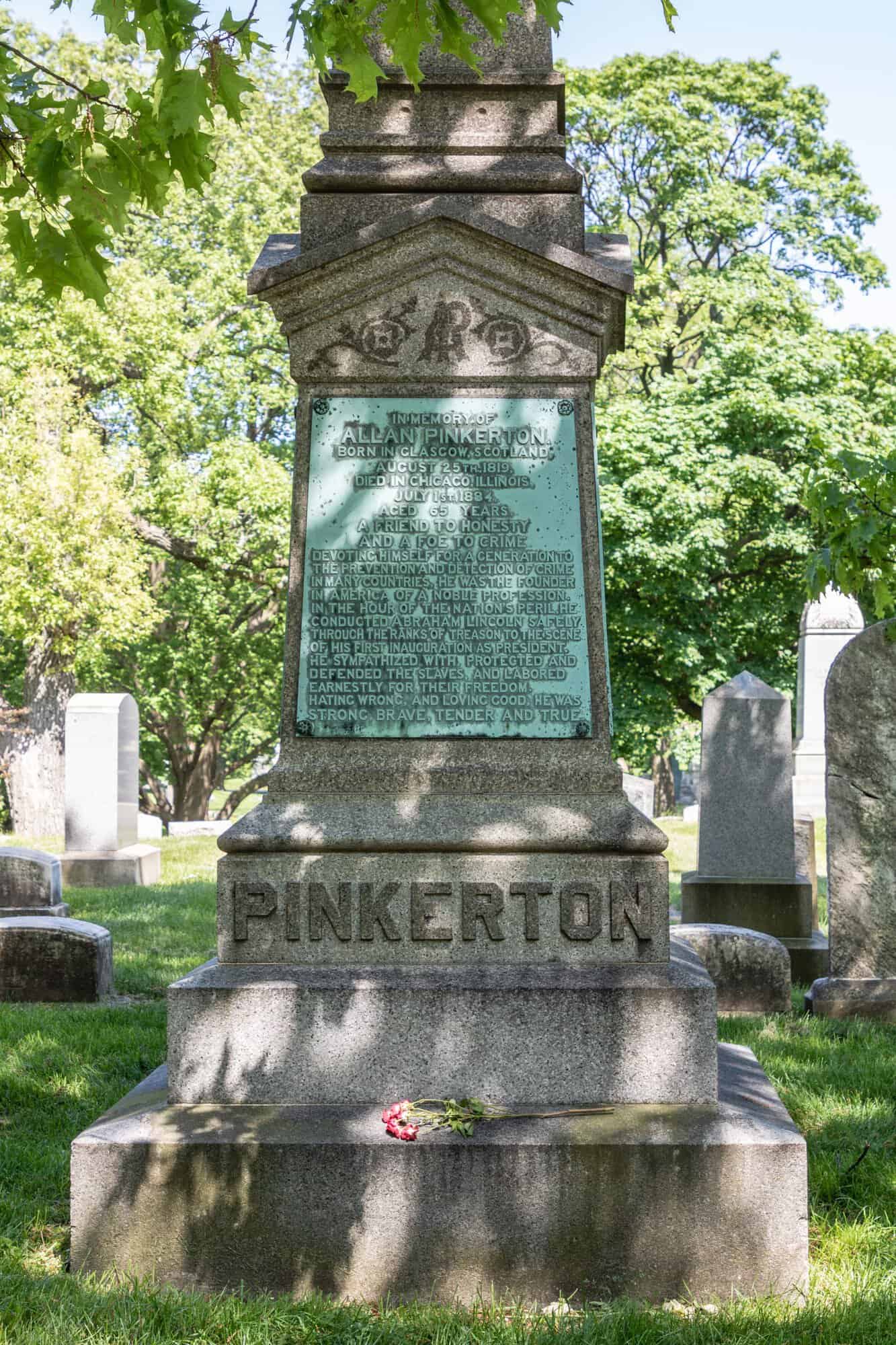
Allan Pinkerton died in Chicago on July 1, 1884, at the age of 64. How he died is another point the sources do not agree on. According to Wikipedia, “it is usually said that Pinkerton slipped on the pavement and bit his tongue, resulting in gangrene.” Contemporary reports gave other causes: a stroke, after one he had suffered a year earlier, or malaria contracted on a trip to the Southern states.
His wife, Joan, died in 1887. The couple had six children, according to Wikipedia: Isabella, William, Joan, Robert, Mary and a second Joan. His son William had already led agents in the Reno pursuit, and the agency carried on under the family name. Wikipedia’s opening summary notes that strikebreaking was “a role that Pinkerton men would continue to play after the death of their founder.”
Pinkerton was buried in the family plot at Graceland Cemetery on Chicago’s North Side. Wikipedia records that he lies between his wife and Kate Warne. Warne had died in January 1868, at an estimated age of 35, and was buried in the Pinkerton family plot. According to Wikipedia, Pinkerton provided in his will that her grave could never be sold.
Sources: Wikipedia, “Allan Pinkerton”; Wikipedia, “Kate Warne”; Encyclopaedia Britannica, “Allan Pinkerton”; Wikimedia Commons, “Graceland Cemetery Chicago Pinkerton Memorial.”
After Pinkerton: Homestead and the Anti-Pinkerton Act
The agency Pinkerton built grew larger after his death. Wikipedia describes it, at its height from the 1870s to the 1890s, as “the largest private law enforcement organization in the world.” It was the agency’s role in labour disputes that defined it for the generation after him, and one confrontation above all.
In 1892, Henry Clay Frick, running Carnegie Steel for Andrew Carnegie, set out to break the Amalgamated Association of Iron and Steel Workers at the Homestead works beside the Monongahela River near Pittsburgh. Frick had contracted the Pinkerton agency in April 1892 to provide security at the plant. On the night of July 5, at 10:30 p.m., about 300 Pinkerton agents gathered at the Davis Island Dam on the Ohio River, about five miles below Pittsburgh. They were given Winchester rifles and badges that read “Watchman, Carnegie Company, Limited,” and were towed upriver on two barges. Many, according to Wikipedia, had been hired out of lodging houses at $2.50 a day and did not know what the job was.
The strikers were waiting. When the barges tried to land at the mill in the early hours of July 6, shooting broke out. Who fired first is disputed. John T. McCurry, a boatman on the steamboat Little Bill, which had been hired to ferry the agents, said he was “willing to take an oath that the workmen fired first.” According to Wikipedia, The New York Times reported that the Pinkertons opened fire and wounded a worker, William Foy. The siege lasted through the day. At 5:00 p.m. the agents raised a white flag. The strike leader, Hugh O’Donnell, guaranteed them safe passage, but as they were marched out of the mill grounds, the crowd formed a gauntlet and beat them.
The death toll is reported differently in different sources. Wikipedia’s article on the strike says that six of the seven Carnegie Steel workers killed are buried in the adjoining St. Mary’s and Homestead cemeteries, which carry a state historical marker. Its article on the agency gives the dead as three Pinkerton agents and nine steelworkers. William Pinkerton told Congress that three agents died, but according to the agents themselves, seven died and eleven were wounded. This dossier does not choose between those figures.
The national outcry was swift. In 1893 Congress passed what is still known as the Anti-Pinkerton Act. Its text reads: “That hereafter no employee of the Pinkerton Detective Agency, or similar agency, shall be employed in any Government service or by any officer of the District of Columbia.” It survives today, in revised form, as section 3108 of Title 5 of the United States Code. The first published court decision interpreting it, in 1977, held that it was aimed at the agency’s activities at the time, offering armed forces for hire in strikebreaking, “and therefore had little application” to the modern company. The National Park Service adds that the violence the agency “helped foment” at Homestead “led to laws in 26 states that banned private guards from participating in labor disputes.”
Sources: Wikipedia, “Homestead strike”; Wikipedia, “Pinkerton (detective agency)”; Wikipedia, “Anti-Pinkerton Act of 1893”; Legal Information Institute, Cornell Law School, 5 U.S. Code 3108; National Park Service, “Allan Pinkerton.”
The eye that never sleeps
The Pinkerton agency appears in many later cases, including some covered on this site. In 1894, Pinkerton agents tracked the serial killer H. H. Holmes from Philadelphia to Boston, where he was arrested on November 17, 1894; he was later convicted of murder and hanged in 1896. That case is told in full in our dossier on H. H. Holmes and the Murder Castle. The agency also inspired fiction: McParland’s infiltration of the Molly Maguires inspired Arthur Conan Doyle’s Sherlock Holmes novel The Valley of Fear.
The company survives. The National Park Service notes that in the early twentieth century, as public police forces professionalised and the public grew “less tolerant of the sometimes ruthless tactics employed by private police forces,” the agency moved away from detective work toward security. In 1999 it was bought by the Swedish security group Securitas AB, and it operates today as a division of that company.
Allan Pinkerton’s record is hard to hold in one hand. He sheltered people escaping slavery and gave money to John Brown. He hired Kate Warne, remembered as the first female detective in the United States, and buried her in his family plot. His agents’ raid on the Samuel farm in Missouri killed a child; and in August 1875 he wrote to his general superintendent that Linden should raise a vigilance committee of men “prepared to take fearful revenge” on the Molly Maguires, less than four months before a pregnant woman was shot dead at her front door at Wiggans Patch. No one was ever convicted of those killings, and no source saved ties Pinkerton to them beyond that letter and what historians have read into it. He built a business that, in Britannica’s words, was “severely criticized in labour circles.” He claimed to have saved Lincoln, a claim his own bodyguard disputed and that Lincoln himself came to doubt. He ran the intelligence that told McClellan he was outnumbered.
No court ever judged him. History has argued about him since his death and has not finished. What remains certain is what the record shows: the names of the people who died in the cases his agency worked, and the open eye, still in use, above the words “We never sleep.”
Sources: The Dark Side of Humanity, “H. H. Holmes’ Murder Castle: Terror at the 1893 World’s Fair”; Wikipedia, “Pinkerton (detective agency)”; National Park Service, “Allan Pinkerton”; Wikipedia, “Allan Pinkerton.”
Frequently asked questions
When did Allan Pinkerton found his detective agency?
In 1850, according to Britannica, he “resigned from Chicago’s new police force in order to organize a private detective agency that specialized in railway theft cases.” Wikipedia records that he went into partnership that year with a Chicago lawyer, Edward Rucker, to form the North-Western Police Agency, which later became Pinkerton and Co. and finally the Pinkerton National Detective Agency. The company that carries his name today says its first office opened at 80 Washington Street in Chicago in 1850.
How did a barrel maker become a detective?
Allan Pinkerton was born in Glasgow in August 1819 and trained as a cooper, making barrels. In Dundee, Illinois, looking for timber to cut into barrel staves, he came across a band of counterfeiters. He had built a cabin there and set up a cooperage. Britannica writes that following this and other similar achievements, he was appointed deputy sheriff of Kane county in 1846 and soon afterward deputy sheriff of Cook county. In 1849, according to Wikipedia, he was appointed the first police detective in Chicago.
Who was E. J. Allen?
E. J. Allen was the false name Pinkerton worked under in the Civil War. The National Park Service says that when war erupted, Pinkerton was appointed chief of intelligence for Union army commander George McClellan. Wikipedia describes his organisation as the Union Intelligence Service, which he headed during the first two years of the war. In The Spy of the Rebellion, published in 1883, he wrote that many officers never knew him by any other name. Lincoln removed McClellan from command in November 1862.
When did Allan Pinkerton die, and where is he buried?
Allan Pinkerton died in Chicago on July 1, 1884, at the age of 64. He was buried in the family plot at Graceland Cemetery on Chicago’s North Side. Wikipedia records that he lies between his wife and Kate Warne. Warne had died in January 1868 and was buried in the Pinkerton family plot. According to Wikipedia, Pinkerton provided in his will that her grave could never be sold. His wife, Joan, died in 1887. The couple had six children, according to Wikipedia.
Citations & Sources
Citations & Sources
Every source cited in the sections above, in one list. Online sources were consulted on October 28, 2026, except where another date is given.
Reference works and historians
- Encyclopaedia Britannica, Allan Pinkerton.
- White House Historical Association, Lina Mann, Spies, Lies and Disguise: Abraham Lincoln and the Baltimore Plot, originally published May 29, 2019.
- State Historical Society of Missouri, Historic Missourians, Jesse James (consulted October 23, 2026).
Government, archives and law
- National Park Service, Allan Pinkerton, last updated July 31, 2020.
- National Park Service, Ford’s Theatre National Historic Site, The Baltimore Plot, last updated December 31, 2024.
- Pennsylvania State Archives, Pennsylvania Historical and Museum Commission, Molly Maguires (research guide and records overview).
- Pennsylvania Historical and Museum Commission, Molly Maguire Executions, state historical marker, Pottsville, Pennsylvania (inscription as transcribed by HistoricSiteMarkers.com).
- Legal Information Institute, Cornell Law School, 5 U.S. Code § 3108 ‐ Employment of detective agencies; restrictions.
- Library of Congress, Prints and Photographs Division, Selected Civil War photographs, 1861-1865: Alexander Gardner, Antietam, Md. Allan Pinkerton, President Lincoln, and Maj. Gen. John A. McClernand, 1862; and Alexander Gardner, Antietam, Md. Allan Pinkerton (‘E. J. Allen’) of the Secret Service on horseback, 1862 (via Wikimedia Commons).
News
- Donald R. Serfass, Massacre at Wiggans Patch, Times News (Lehighton, Pennsylvania), October 30, 2009.
Allan Pinkerton’s own books
- Allan Pinkerton, The Expressman and the Detective, Project Gutenberg eBook #22155, released July 26, 2007.
- Allan Pinkerton, The Spy of the Rebellion (Hartford, Conn.: M. A. Winter & Hatch, 1883), Project Gutenberg eBook #34973, released January 15, 2011.
Company
- Pinkerton, Our Story (company history timeline).
Wikipedia
- Wikipedia, Allan Pinkerton.
- Wikipedia, Pinkerton (detective agency).
- Wikipedia, Chartism.
- Wikipedia, Kate Warne.
- Wikipedia, Baltimore Plot.
- Wikipedia, Timothy Webster.
- Wikipedia, Pryce Lewis.
- Wikipedia, Rose O’Neal Greenhow.
- Wikipedia, George B. McClellan.
- Wikipedia, Reno Gang.
- Wikipedia, Jesse James (consulted October 23, 2026).
- Wikipedia, Molly Maguires.
- Wikipedia, James McParland.
- Wikipedia, Homestead strike.
- Wikipedia, Anti-Pinkerton Act of 1893.
Images
- Paul R. Burley, Graceland Cemetery Chicago Pinkerton Memorial 2019-1623.jpg, Wikimedia Commons, photographed June 2, 2019. CC BY-SA 4.0.
The Dark Side of Humanity
- The Dark Side of Humanity, H.H. Holmes’ Murder Castle: Terror at the 1893 World’s Fair, April 15, 2024.
Image credits
- Image: Alexander Gardner, Library of Congress, via Wikimedia Commons. Public domain.
- Image: Brady’s National Photographic Portrait Galleries, Library of Congress, via Wikimedia Commons. Public domain.
- Image: Alexander Gardner, Library of Congress, via Wikimedia Commons. Public domain.
- Image: Paul R. Burley, via Wikimedia Commons. CC BY-SA 4.0.
Browse every case in the Case File Index
Discover more from The Dark Side of Humanity
Subscribe to get the latest posts sent to your email.