FILE NO. 0118Case status Unsolved
Between 1935 and 1938, an unidentified killer dismembered at least twelve victims in Cleveland, Ohio, leaving remains along rail and industrial corridors. Limited forensic tools and widespread poverty prevented officials from identifying most victims or convicting a suspect, despite high-profile police investigations led by safety director Eliot Ness.
Modern efforts surrounding the case emphasize restoring identity to the unnamed victims through investigative genetic genealogy rather than prosecuting suspects. Because original crime scenes and offender transport routes remain unknown, extracting DNA profiles from exhumed remains offers the most viable path toward resolving long-standing uncertainties.
Cleveland Torso Murderer Kingsbury Run Murders
Kingsbury Run, Depression-era invisibility, Eliot Ness, unidentified victims and a case where geography became more durable than identity.

Cleveland Torso Murderer Case Snapshot
Canonical victims, associated cases, unresolved identity and the limits of a Depression-era investigation
The accepted core series spans twelve victims between 1935 and 1938. The count is useful, but it should not be treated as proof that every death had one offender.
No person was convicted for the Cleveland Torso Murders. Suspicion, confession stories and polygraph lore do not equal a legally proved offender.
The Lady of the Lake is often discussed with the series, but associated does not mean conclusively integrated into the canonical twelve.
Eliot Ness became the name attached to the hunt, while detectives and forensic staff carried the sustained case work.
The most realistic modern progress is victim identification through genetic genealogy, not a clean prosecution of a long-dead suspect.
The offender identity remains unresolved. The case survives as an archive of poverty, forensic limitation and urban disposal geography.
What Was the Cleveland Torso Murderer Case?
A direct answer for readers, search engines and AI extraction
The Cleveland Torso Murderer case refers to a series of dismemberment murders in Cleveland, Ohio, most closely associated with Kingsbury Run and nearby rail, river, lakefront and industrial corridors. The killer was never conclusively identified.
Twelve victims are commonly treated as the canonical series from 1935 to 1938. Some researchers discuss earlier or nearby cases, including the Lady of the Lake, but those are associated or debated rather than proved.
No. Suspects were questioned and theories accumulated around Frank Dolezal, Francis Sweeney and others, but no conviction solved the series. The responsible phrasing is unresolved, not secretly solved.
Yes, but mainly for identification of unidentified victims if authentic biological material survives with clear provenance. DNA cannot repair every scene-management failure or automatically identify the killer.
Cleveland Torso Murderer Timeline
Discovery sequence, associated cases and evidentiary collapse
A partial female body was recovered near Lake Erie. The case is frequently discussed with the Cleveland Torso Murders, but its relationship to the core series remains debated.
Two male bodies were found near Kingsbury Run. Andrassy became one of the few identified victims, while the second man underscored the identification crisis at the centre of the file.
Polillo’s remains were found in Cleveland. Her identification gave the file a name and history, but it did not resolve the offender’s identity or the movement route.
Investigators used tattoos, death masks and public display in an attempt to restore identity. That strategy shows both the desperation and the limits of 1930s identification.
Police and searchers combed ravines and rail-adjacent spaces. The terrain functioned as hiding place, disposal corridor and symbol of urban neglect.
Later discoveries widened the map beyond a single ravine. The series became a geography of industrial margins rather than one clean crime scene.
Eliot Ness ordered raids and the burning of shanties near Kingsbury Run. The episode became famous, but whether it disrupted the killer or displaced vulnerable people remains unresolved.
Modern work is better aimed at identifying the unidentified than at declaring a suspect guilty without courtroom-grade proof.
Cleveland Torso Murderer Victims
Identified people, unidentified people and why the count remains carefully framed
| Victim / group | Status | Why it matters | Editorial caution |
|---|---|---|---|
| Edward Andrassy | Identified | One of the earliest identified victims in the canonical series. | Identification does not clarify offender identity by itself. |
| Florence Genevieve Polillo | Identified | Her named history pushes the dossier away from anonymous-body spectacle. | Her life is more than the disposal-site details. |
| Rose Wallace | Probable / discussed identification | Frequently appears in named-victim discussions and identification review. | Identification confidence depends on the source record. |
| Unidentified men and women | Unidentified | Missing heads, hands, decomposition and poverty blocked recognition. | Unknown names are not lesser lives. |
| Lady of the Lake | Associated | Often compared to the later discoveries due to dismemberment and geography. | Associated is not the same as conclusively canonical. |
Kingsbury Run Geography
Discovery sites are not automatically murder sites
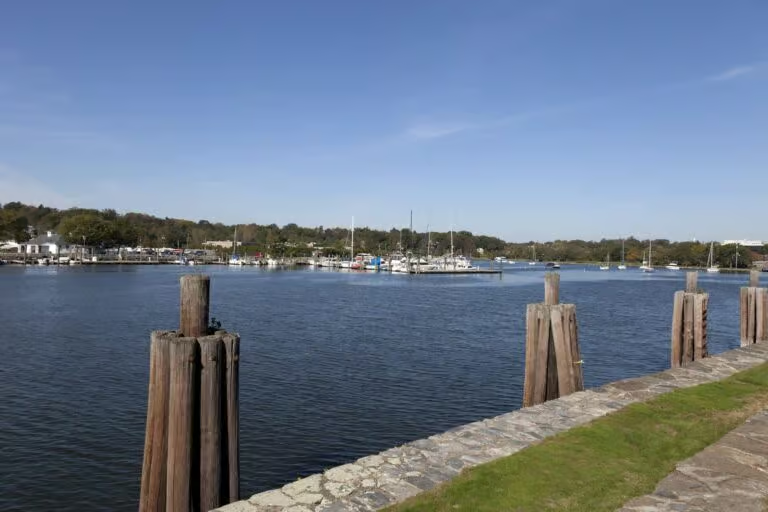
The ravine offered concealment, rail access and proximity to transient encampments. It became the symbolic centre of the file, even when not every discovery belonged physically inside it.
Water complicated timing, decomposition and movement analysis. A body part recovered in water tells investigators less about the original offence location than a controlled scene would.
The offender, or offenders, used spaces where poverty and infrastructure intersected. That geography helped hide victims in plain sight.
Evidence and Forensic Limits in the Cleveland Torso Murders
Dismemberment, missing identifiers and the pre-DNA identification crisis
Removing heads and hands obstructed the most practical identification tools available at the time: visual recognition, dental comparison and fingerprints.
Investigators used death masks and public appeals to identify victims. The tactic can look macabre now, but it was also an attempt to recover names when databases did not exist.
Most discovery sites likely captured disposal, not the full murder sequence. Transport separates victim, scene and offender in ways that 1930s methods struggled to reconnect.
A genetic profile is only as useful as its chain of custody. A profile from a historical object must be shown to belong to a victim or offender rather than a handler, investigator or later contaminant.
Cleveland Torso Murderer Suspects
Suspicion is not conviction; theory is not proof
| Name / group | Why discussed | Evidence problem | Responsible status |
|---|---|---|---|
| Frank Dolezal | Questioned after connections were alleged and a confession narrative emerged. | Confession reliability, custody context and later death make the case against him deeply problematic. | Not proved |
| Francis Sweeney | Often treated as a major suspect due to medical background claims and later lore. | Polygraph stories and suspicion do not create courtroom proof. | Not convicted |
| Transient offenders | The geography involved rail corridors and vulnerable transient populations. | Mobility can explain access but can also become a prejudice-driven catch-all. | Theory class |
| Unknown local offender | Familiarity with disposal routes and victim access may suggest local knowledge. | Local familiarity is broad and cannot identify a single person. | Open |
Eliot Ness and the Shantytown Burning
The public symbol of the case and the ethical problem of spectacle policing
Ness’s name gave the case a famous figure, but fame can distort investigative memory. The work also involved homicide detectives, coroners, searchers, morgue staff and unidentified families who never got a clean answer.
The shantytown burning is often told as dramatic action. It should also be read as displacement of already vulnerable people. A symbolic crackdown is not the same thing as a solved case.
Cleveland Torso Murderer Historical Images
Context images only; no decorative gore
Death-mask display record
The Cleveland Police Museum death-mask material is better handled as a linked source record than a fragile hotlinked image. It documents identification efforts without making unidentified victims into decorative imagery.
Open museum record
No gore as design language
The case involves dismemberment and unidentified victims. This archive uses search scenes, identification displays and official context rather than turning remains into decoration.
Cleveland Torso Murderer Myths and Corrections
The phrases that make the case famous are not always the phrases that make it accurate
The nickname is memorable but offender-centred. It can flatten victims into props and make violence sound like a horror franchise instead of a historical case file.
Dismemberment may suggest anatomical familiarity, but that does not prove a physician. Butchering, industrial work, mortuary contact or repeated practice are separate possibilities.
Ness mattered publicly, but the investigation was not a solo duel between a celebrity lawman and a single cinematic villain.
Private suspicion, interrogation pressure and retrospective suspect lists are not a verdict. The legal outcome remains unsolved.
Why the Cleveland Torso Murderer Case Remains Unsolved
The void that remains after the names, sites and suspect theories are separated
Restoring names may be the most meaningful future development. A victim identification can reshape the timeline, movement pattern and suspect pool.
The canonical grouping is useful but not invulnerable. Copycat activity, opportunistic disposal and investigative grouping bias remain possible.
Discovery sites do not automatically reveal murder or dismemberment sites. Transport is one of the case’s central forensic obstacles.
Testing can identify victims if sample provenance is strong. Declaring an offender would require a much higher chain-of-custody and interpretation threshold.
Cleveland Torso Murderer Sources and Verification
Grouped by historical context, institutional record and forensic method
Encyclopedia of Cleveland History
Useful for the civic history of the Torso Murders and Kingsbury Run context.
Open sourceCleveland Police Museum
Case-history context and police memory around the investigation.
Open sourceWikimedia Commons
Search-scene and Eliot Ness imagery, plus linked institutional image records used as historical visual context.
Open sourceDNA Doe Project
Relevant to the modern identification framework for unidentified decedents.
Open sourceNational Academies
Background on the limits and standards of forensic science, useful when discussing cold-case evidence.
Open sourceFBI Vault: Eliot Ness
Contextual material for Ness as a public law-enforcement figure, not proof that he solved the case.
Open sourceBrowse every case in the Case File Index
Discover more from The Dark Side of Humanity
Subscribe to get the latest posts sent to your email.