FILE NO. 0069Case status Unsolved
✚T.O.C✚
Katarzyna Zowada
In the icy waters of Poland’s Vistula River, the propeller of a tugboat snagged on a bundle of discarded human skin. It was January 6, 1999, and what authorities recovered from the river was not merely the evidence of a murder, but the culmination of a monstrous ritual. A young woman’s torso had been meticulously flayed and fashioned into a grotesque, wearable ‘bodysuit.’ This was the horrifying introduction to the homicide of 23-year-old student Katarzyna Zowada, a crime so depraved it would become a watershed case in the annals of forensic psychopathology.
The dedicated, years long investigation by the Kraków police cold case unit known as “Archiwum X,” driven by technological breakthroughs, led to the 2017 arrest of a man identified in Polish court reporting as Robert J. In September 2022 the Kraków Regional Court convicted him and sentenced him to life in prison, a verdict that was not final. On October 31, 2024, the Kraków Court of Appeal overturned that verdict and acquitted him, and on June 25, 2026, the Supreme Court of Poland dismissed the prosecution’s cassation appeal as manifestly unfounded. The acquittal is final. The killing of Katarzyna Zowada is, in law, unsolved. This report argues that the Zowada homicide is a dual tragedy: first, a crime of extreme cruelty against a young woman; and second, a quarter century in which no court could establish who committed it.
The appeal court was candid about the limits of its ruling. “An acquittal does not mean that the court is absolutely convinced that the defendant did not commit the crime he was charged with,” presiding judge Marek Długosz said, as reported by Rzeczpospolita. The acquittal “had to be” delivered under the rules of criminal procedure, he said, because the court was also not absolutely convinced that guilt had been proven. Under Polish law, Robert J. stands acquitted and is presumed innocent of the charge.

A Benchmark Case in Forensic Criminology
The murder of Katarzyna Zowada was never just another case file. It immediately transcended the borders of a typical criminal investigation, commanding the attention of international experts, including the FBI’s Behavioral Analysis Unit. The sheer audacity of the crime, a homicide that climaxed in an act of ritualistic depersonalization rarely seen outside of fiction, instantly cemented its status as a benchmark case. Zowada’s remains were not a corpse; they were a construct. The “bodysuit” of skin was a grotesque artifact, the physical manifestation of an offender’s meticulously nurtured fantasy.
This report deconstructs the case into its core components: the fragile victim (victimology); the offender’s chillingly precise methods (modus operandi); the deep-seated psychological engine driving the horror (signature analysis); the stuttering forensic and investigative response; and the convoluted, ultimately collapsing, judicial process. It is a chronicle of a perpetrator’s terrifying inner world and a judiciary’s struggle to build a bridge of legal certainty over a chasm of circumstantial evidence.
The case serves as a tragic but perfect natural experiment on the evolution of forensic science. The initial investigation (1998-2000) was an exercise in futility, crippled by the technological limitations of the era before the case went cold. Its resurrection in 2012 was a direct result of scientific advancement, most notably a revolutionary 3D injury reconstruction model that proved, unequivocally, that Katarzyna had been tortured while alive. This stark contrast highlights the temporal dependency of justice itself; for certain “impossible” crimes, resolution is not merely a matter of time but of the future arriving.
This journey from investigative blunder to a closed door trial, a conviction and a final acquittal reveals a narrative of institutional struggle. Before the appeal, the prosecution’s account was publicly challenged by investigative journalist Monika Góra in her book Kryptonim Skóra (“Codename Skin”), which questioned the strength of the evidence. The Zowada case is therefore not only a hunt for a killer but a study of how a justice system handles doubt.
Victimology: The Profile of an Ideal Target
Katarzyna Zowada was fading long before she vanished. Described by those who knew her as ‘kind, but quiet,’ the 23-year-old was adrift in a fog of grief that had settled after her father’s death two years earlier and refused to lift. This was not simple sadness, but a profound depression that hollowed out her world, leaving her isolated and preoccupied. To a predator, this psychological state is a signal. An individual consumed by internal turmoil walks with their head down, their senses turned inward. They are present in body but absent in spirit: the perfect, low-risk target for someone hunting in the shadows.
Her academic instability was a map of this inner turmoil. She had drifted between majors: from psychology to history, before finally anchoring in religious studies, a detail that may have held a dark, symbolic significance for her killer. This pattern paints a picture of a soul in search of stability, a vulnerability perceptible to an observant predator.
The most critical detail is where she was on November 12, 1998, the day she disappeared. She had an appointment with her mother at a psychiatric clinic to treat the very depression that made her so vulnerable. This fact is paramount. At the moment of her abduction, she was mentally and emotionally exposed, her guard down, making her an easy target for a ruse. The offender’s choice was brutally pragmatic: he targeted a woman who would be easy to control and whose initial absence could be tragically misinterpreted as just another symptom of her illness, delaying a police response.
That delay was a tactical gift to the killer, and it proved catastrophic. When Katarzyna’s distraught mother tried to file a missing person’s report, Kraków police instructed her to wait. This institutional inertia sealed her daughter’s fate. The fifty-five days between her disappearance and the discovery of her remains were an uninterrupted window of opportunity for the offender. This timeframe, a gift from a failing system, directly enabled the signature aspects of the crime.
The sadistic rituals of torture and flaying required time, privacy, and absolute control: luxuries the police’s inaction afforded the killer in abundance. The profound suffering of the victim was the centerpiece of the offender’s script, and the system’s failure ensured he could perform it without interruption.
The Anatomy of the Crime: Modus Operandi (MO)
The slaughter of Katarzyna Zowada was the meticulously orchestrated work of a highly organized, process-focused predator. The entire sequence, from target selection to the elaborate disposal of her remains, reveals a chilling fusion of forensic awareness and utter emotional detachment. The killer’s methods, or modus operandi (MO), were not born of rage but of practice: a learned set of behaviors designed to successfully execute his fantasy while minimizing risk.
Approach and Confinement
While the precise abduction method remains unknown, it was likely a quiet con, not a violent blitz. The killer then transported her to a secure primary location, his workshop of horrors. The evidence of prolonged captivity necessitates a site of total isolation (a soundproofed basement, a secluded residence) a place where screams would never be heard and his time-consuming rituals could be performed without fear of discovery.
Weaponry and Tools
The killer wielded his tools with the chilling precision of a surgeon. Forensic analysis revealed that a scalpel-like instrument was used to inflict wounds with a control that suggests either formal training or obsessive, repeated practice. This was no frenzied attack. The 2012 exhumation and the pioneering 3D injury reconstruction model revealed the methodical nature of the torture. The wounds were mapped in virtual space, showing strategic incisions to the neck, armpit, and groin: cuts designed not to kill, but to maximize terror and prolong suffering. Her death was a slow, agonizing exsanguination, a process perfectly calibrated to the perpetrator’s sadistic desires.
Disposal Method
The offender’s MO was a masterclass in risk management. By separating the crime scenes (abduction site, primary murder site, and secondary disposal site) he systematically broke the chain of forensic evidence. After the dismemberment, he employed a hybrid disposal strategy. Dumping remains in a large body of water like the Vistula is a classic tactic to degrade evidence. Yet, the disposal was curiously selective. The “skin suit” and a leg were discarded, but the head, other limbs, and organs were never found.
This blurs the line between a practical MO (destroying evidence) and a psychological signature (keeping trophies to relive the fantasy). The discovery of the skin, snagged by chance on a propeller, was an unforeseen accident: a ghost in the machine that disrupted his plan to have his crimes sink forever into the river’s depths.
The Psychological Fingerprint: Signature Analysis
While the MO tells us how the crime was committed, the signature reveals the soul-shattering why. Signature behaviors are acts not necessary for the crime’s commission but are essential to fulfilling the offender’s violent, deep-seated psychological needs. In the Zowada case, the signature is not just a part of the crime; it is the crime. The murder was merely the prerequisite for a more profound, pathological ceremony.
Primary Signature: The “Skin Suit”
To call the ‘skin suit’ a mere trophy is to fundamentally misunderstand the monstrous alchemy at work. It was a sacrament in a religion of one. The offender was not simply collecting a souvenir; he was performing a terrifying act of transubstantiation, attempting to absorb his victim’s identity and repair his own pathologically fractured psyche.
Every slice of the blade was a prayer; the torture was a purification ritual; the flaying was an act of creation. In his solipsistic universe, he was not a murderer but a high priest, and the skin suit was his sacred vestment: the ultimate icon of his absolute power. He was not a member of a cult; he was the cult, and Katarzyna’s suffering was his liturgy.
Secondary Signatures: Torture and Trophy Retention
The torture itself was a core signature behavior. The methodical, non-lethal wounds confirm that the victim’s pain and terror were not byproducts of the violence; they were the primary objective and the very source of the killer’s sexual arousal. This is the hallmark of the sexual sadist, for whom the fantasy is consummated only through the victim’s torment.
Furthermore, the retention of trophies is a powerful signature. The absence of Katarzyna’s head and limbs strongly indicates the offender kept these parts. For sexual murderers, such trophies are relics used to fuel post-offense fantasies, allowing them to relive the crime’s intoxicating power. The head, the very seat of human identity, is often the most prized possession.
A Nexus of Pathologies
To dismiss this act as a “copycat” of fiction like The Silence of the Lambs is a profound analytical error. This crime was a unique manifestation of a deeply diseased mind, a nexus of severe paraphilias. The cutting points to piquerism (a sexual interest in piercing skin), while the skin itself became a fetish object. The entire ritual was fueled by an all-consuming sexual sadism. This was not a single deviant interest but a tapestry woven from humanity’s most extreme and violent urges.
Forensic Psychiatric Autopsy: Profile of a Pathological Offender
A psychological autopsy, reverse-engineered from the crime scene’s behavioral evidence, sketches a portrait of a highly disturbed but functionally organized individual. The perpetrator is a white male, likely in his 30s to 50s at the time of the crime. The offender is intelligent and forensically savvy, capable of orchestrating a complex, multi-stage crime. He is likely a social isolate, yet able to project a facade of normalcy: the “harmless eccentric” archetype common among organized sexual predators.
Psychopathology: A Malignant Fusion
The offender’s psychological architecture is built on the foundation of psychopathy: a profound lack of empathy, callousness, and a grandiose sense of self, all of which allow for frictionless violence. Fused to this is a severe sexual sadism, where arousal is contingent upon the suffering of another. This combination, a malignant fusion of psychopathy and sadism, is among the most dangerous typologies in forensic psychiatry. He was not psychotic; he was fully in touch with a reality where other people are simply objects for his gratification.
The Accused and the Record
Everything above describes the unknown offender implied by the crime scene, not any identified person. During the trial, prosecutors pointed to the accused man’s background, including past work in an anatomy dissection setting and at an institute that handled animal skins, as evidence that he had the skills the crime required. The first instance trial was held behind closed doors, so the public heard only the verdict and not the reasoning. Those arguments did not survive appeal. The Kraków Court of Appeal acquitted him in October 2024, and the Supreme Court left that acquittal in place in June 2026. No court has found that he committed the crime, and this site does not suggest otherwise.
The Investigation: A Three-Act Tragedy
The history of the Zowada case is a litany of failures punctuated by moments of brilliance, a narrative of justice found and then lost.
Act I: The Botched Beginning (1998 to 2001)
The initial police response was fatally flawed. By turning away Katarzyna’s mother, they handed the killer his most precious commodity: time. Early forensic work was clumsy, and the investigation wasted months chasing a false lead, a man who had scalped his own father but had no connection to the case. In 2000, the case was formally dropped: a clear admission of defeat.
Act II: The Technological Resurrection (2012 to 2017)
The “Archiwum X” unit resurrected the case in 2012, armed with modern forensics and international expertise. The breakthrough came from scientists at Wrocław Medical University, whose 3D injury reconstruction proved the victim was tortured alive. This irrefutable forensic evidence refocused the investigation squarely on a suspect with anatomical knowledge and the profile of a sexual sadist.
Act III: The Contentious Arrest (2017)
Police detained Robert J. in Kraków’s Kazimierz district in 2017. Prosecutors charged him with the murder of Katarzyna Zowada with particular cruelty, with removing her skin, and with desecrating her remains, alleging that she had been held and tortured before her death. He denied the charges throughout.
The Judicial Process: A System Under Scrutiny
The legal process that followed was as controversial as the crime. Robert J. spent seven years in pre trial custody, from 2017 until his release on the day of the appeal verdict. The first instance trial at the Kraków Regional Court was held behind closed doors, so journalists and the public heard only the sentence, not the court’s reasoning. In September 2022 that court convicted him and imposed life imprisonment. Three defense lawyers and the prosecutor appealed.
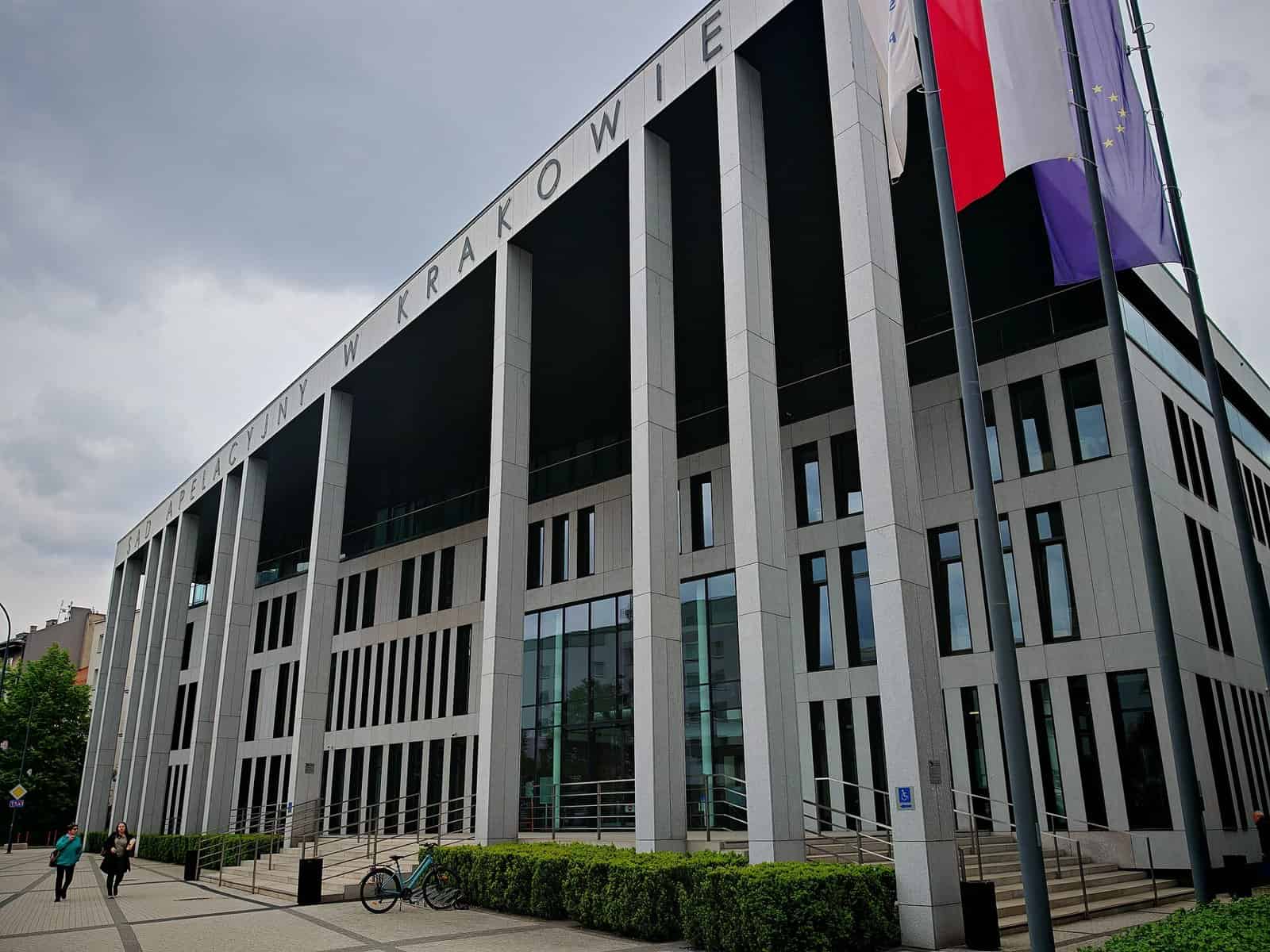
The appeal began on April 17, 2024 and, unlike the first trial, was held in open court. On October 31, 2024, the Kraków Court of Appeal (case II AKa 392/23) acquitted Robert J. and ordered his immediate release, with costs borne by the State Treasury. The court applied the principle of in dubio pro reo, “when in doubt, for the accused,” which in Polish criminal law requires that doubts that cannot be removed are resolved in favor of the defendant. The prosecution filed a cassation appeal. On June 25, 2026, the Supreme Court of Poland dismissed it as manifestly unfounded, ending the case. “Today a case has ended that for almost thirty years stirred emotions, not only among the public but above all in the victim’s family,” the reporting judge, Barbara Skoczkowska, said after the ruling, according to Rzeczpospolita.
For the wider pattern of cases in the city, see our file on 50 years of criminal dismemberment in Kraków, and for how cases are tracked by status on this site, the Docket.
The Counter-Narrative: An Investigation Indicted
Before the appeal, the state’s case was publicly challenged by investigative journalist Monika Góra. Her book, Kryptonim Skóra, argues that the investigation suffered from tunnel vision and that the evidence against the accused was weaker than the first verdict suggested. Her account is a journalist’s argument, not a court finding, and it is summarized here only for context.
Conclusion: A Dual Tragedy of Pathology and Systemic Failure
The Zowada homicide remains a dual tragedy. The crime itself was one of extreme cruelty. The case’s revival through forensic science was a feat of technology and persistence. Yet after a first instance conviction, an acquittal on appeal and a final Supreme Court ruling, no one stands convicted. The final judgment leaves Robert J. acquitted, and leaves Katarzyna Zowada’s family without an answer.
The case leaves behind painful lessons about investigative tunnel vision and the pressure for narrative closure. It is a reminder that in the face of horrific crimes, due process and the demand for proof are not obstacles to justice but part of what defines it. With the Supreme Court’s June 2026 ruling the proceedings against Robert J. are over. More than a quarter century after her remains were pulled from the Vistula, the killing of Katarzyna Zowada remains, in the eyes of the law, a crime without a culprit.
Bibliography
- Góra, M. (2023). Kryptonim “Skóra”: Czy o brutalne morderstwo został oskarżony niewinny człowiek? Wydawnictwo W.A.B.
- Link: https://www.wab.com.pl/
- Hare, R. D. (2003). The Hare Psychopathy Checklist-Revised (2nd ed.). Multi-Health Systems.
- Link: https://www.mhs.com/
- Keppel, R. D., Weisz, J. G., Brown, K. M., & Welch, K. (2005). The Jack the Ripper Murders: A Modus Operandi and Signature Analysis of the 1888 to 1891 Whitechapel Murders.Journal of Investigative Psychology and Offender Profiling, 2(1), 1 to 21.
- Krafft-Ebing, R. von. (1998). Psychopathia Sexualis. (Original work published 1886).
- Pettigrew, M. (2021). Piquerism in homicide: A knife wound analysis of a sexually motivated serial killer.Journal of Forensic Sciences, 66(6), 2349-2355.
- Link: https://onlinelibrary.wiley.com/journal/15564029
- Warren, J., Reboussin, R., & Hazelwood, R. R. (1998).The Criminal Sexual Sadist.FBI Law Enforcement Bulletin, 67(8), 1-8.
Case file · FAQ
Frequently asked questions
Who was Katarzyna Zowada?
Katarzyna Zowada was a 23-year-old student in Kraków. On January 6, 1999, part of her remains was recovered from the Vistula River after a tugboat propeller snagged on it.
Is the case solved?
No. The killing of Katarzyna Zowada is, in law, unsolved.
Was anyone arrested?
Yes. In 2017 the Kraków cold case unit known as Archiwum X arrested a man. In September 2022 the Kraków Regional Court convicted him and sentenced him to life in prison, a verdict that was not final.
What happened on appeal?
On October 31, 2024, the Kraków Court of Appeal overturned that verdict and acquitted him. On June 25, 2026, the Supreme Court of Poland dismissed the prosecution’s cassation appeal. The acquittal is final, and he is presumed innocent.
Browse every case in the Case File Index
Discover more from The Dark Side of Humanity
Subscribe to get the latest posts sent to your email.