FILE NO. 0013Case status Convicted
Chicago: The Man Behind the Murder Castle
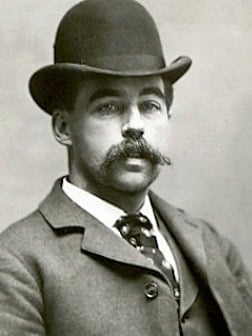
Herman Webster Mudgett called himself Dr. Henry Howard Holmes, and the alias outlived nearly everything else he said. He was a pharmacist, a builder who rarely paid his builders, a bigamist and a career insurance fraudster. In 1895 a Philadelphia jury convicted him of the first-degree murder of his accomplice, Benjamin Pitezel, and on May 7, 1896, he was hanged for it. Everything beyond that single conviction has to be sorted, item by item, into evidence, strong inference and newspaper invention.
The sorting matters because Holmes lied for a living and the press of the 1890s rewarded him for it. His most famous document, a confession to 27 murders, named people who were later found alive.
Gilmanton, New Hampshire: Early Life
Mudgett was born on May 16, 1861, in Gilmanton, New Hampshire, the third child of Levi Horton Mudgett and Theodate Page Price. Stories of a childhood friend’s fatal fall and a skeleton in a doctor’s office come from Holmes’s own later accounts, written while he was trying to sell his life story. They cannot be checked and should be read that way.
On July 4, 1878, at 17, he married Clara Lovering in Alton, New Hampshire. Their son, Robert Lovering Mudgett, was born on February 3, 1880.
Ann Arbor, Michigan: Medical School and Cadavers
He spent a year at the University of Vermont from 1879, transferred to the University of Michigan’s Department of Medicine and Surgery in 1882, and graduated in June 1884. He was not expelled. Years later, when he was suspected of murder and wanted to be seen as a mere swindler, he admitted to using cadavers to defraud life insurers while he was a student.
Clara moved back to New Hampshire in 1884. In late 1886, still legally married to her, Holmes married again.
Englewood, Chicago: The Drugstore and the Building
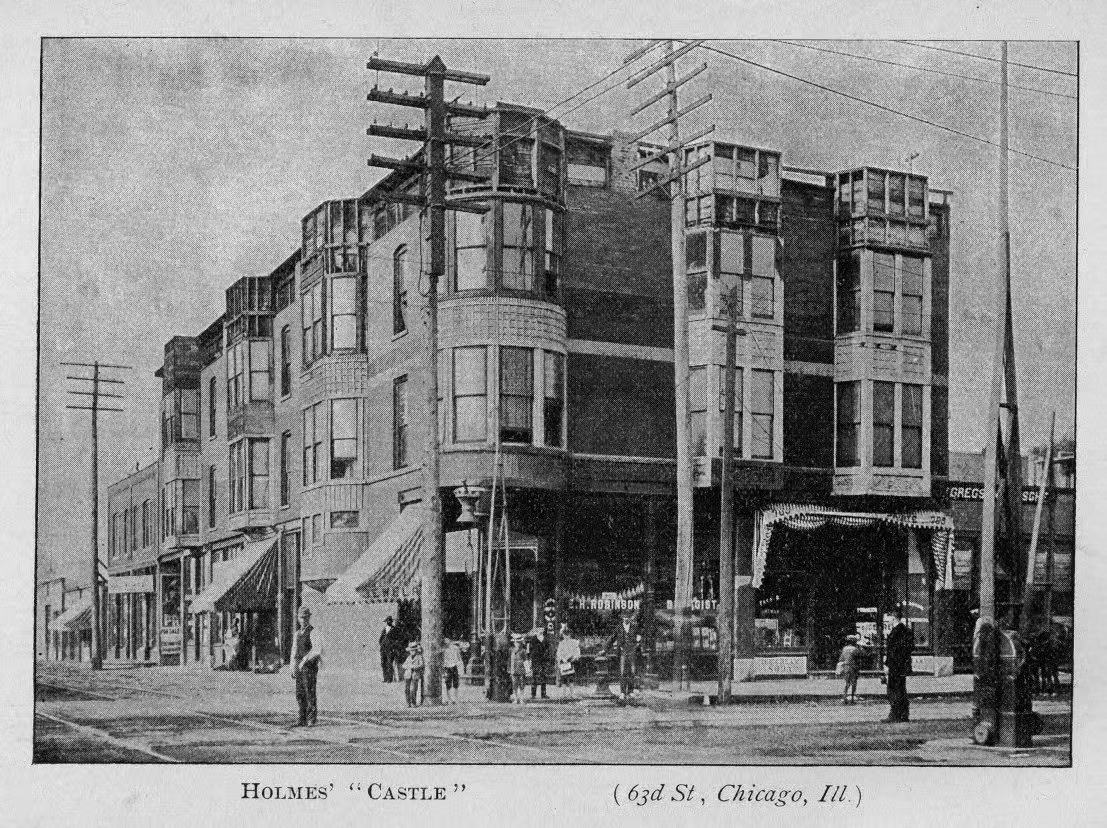
Before moving to Chicago in August 1886, Mudgett took the name Henry Howard Holmes. He found work at a drugstore at the northwest corner of South Wallace Avenue and West 63rd Street in Englewood, owned by Elizabeth Holton, and eventually bought the business. The popular story that he murdered a Dr. E. S. Holton, or that Mrs. Holton vanished, is not supported by the record.
Across the street, construction began in 1887 on a two-story mixed-use building: shops and a new drugstore below, apartments above. Holmes stiffed the architects and the steel supplier, Aetna Iron and Steel, which took him to court in 1888. In 1892 he added a third floor and told investors it would be a hotel for the coming World’s Columbian Exposition.
Englewood, Chicago: What the “Castle” Really Was
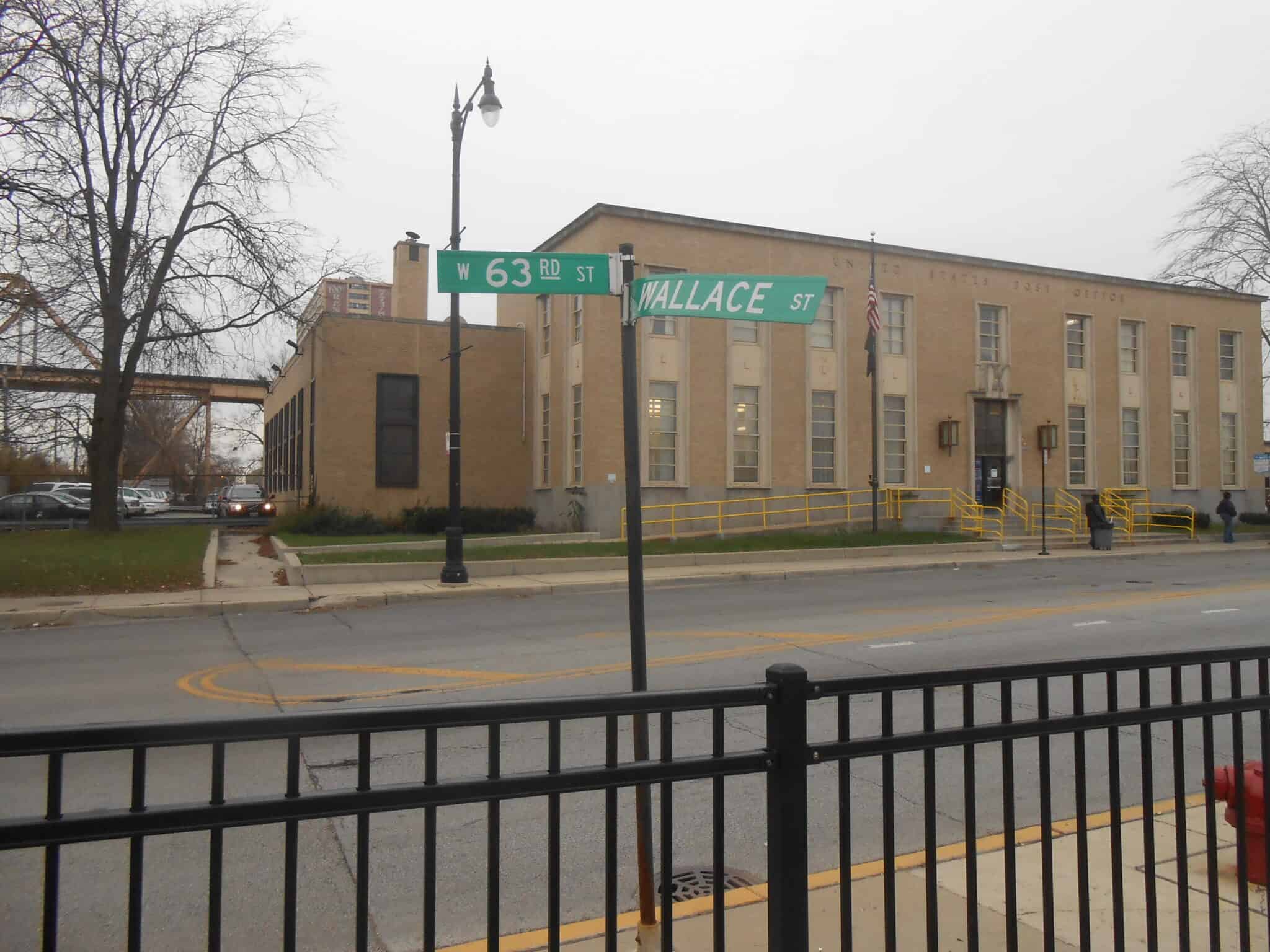
The yellow press named it the Murder Castle and furnished it with gas chambers, trapdoors, torture rooms, chutes and a basement crematorium. Accounts of more than a hundred rooms laid out as a maze belong to the same tradition. The third-floor hotel was in fact moderately sized, unremarkable and never finished, because Holmes was fighting with his builders. It did contain hidden rooms. Their documented use was hiding furniture he had bought on credit and did not intend to pay for.
There is no evidence that Holmes killed fairgoers on the premises. The skeleton trade was real, but he obtained his supply by body snatching. When Chicago police and reporters searched the building in July 1895, they recovered circumstantial traces: a piece of human bone possibly from Julia Conner, remains of a child possibly her daughter Pearl, burned buttons and a watch chain apparently belonging to Minnie Williams, and a tuft of female hair in a chimney flue. None of it was enough to charge him in Chicago.
The building was damaged by an arson fire in August 1895, remained in use, and was torn down in 1938. The site is now occupied by the Englewood branch of the U.S. Postal Service.
Chicago: The Victims Who Can Be Named
Strip out the inventions and a smaller, harder list remains. Julia Conner, the wife of a man who worked at the drugstore’s jewelry counter and Holmes’s mistress, and her four-year-old daughter Pearl are confirmed victims. Emeline Cigrand, 23, of Dwight, Illinois, who went to work in the building in May 1892, was murdered in 1892. Minnie Williams and her sister Anna, known as Nannie, were murdered in 1893. Other names on Holmes’s own list died of natural causes or turned up alive.
Philadelphia: The Pitezel Fraud
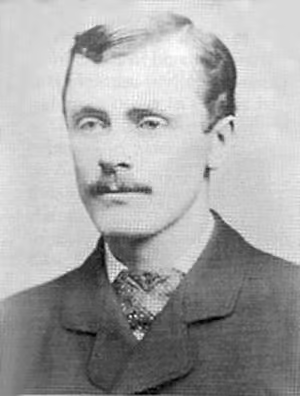
Benjamin Freelon Pitezel was a carpenter with a criminal record whom Holmes used in several schemes. In 1894 they set up a $10,000 life insurance fraud: Pitezel would pose as an inventor named B. F. Perry in Philadelphia and appear to die in a lab accident, with a cadaver standing in for him. Instead, on September 4, 1894, Holmes killed him and set the body on fire with benzene at 1326 Callowhill Street. Trial evidence showed chloroform had been given after death, apparently to stage a suicide. Holmes then identified the body himself, and the payout went through on the real corpse.
Toronto and Indianapolis: The Pitezel Children
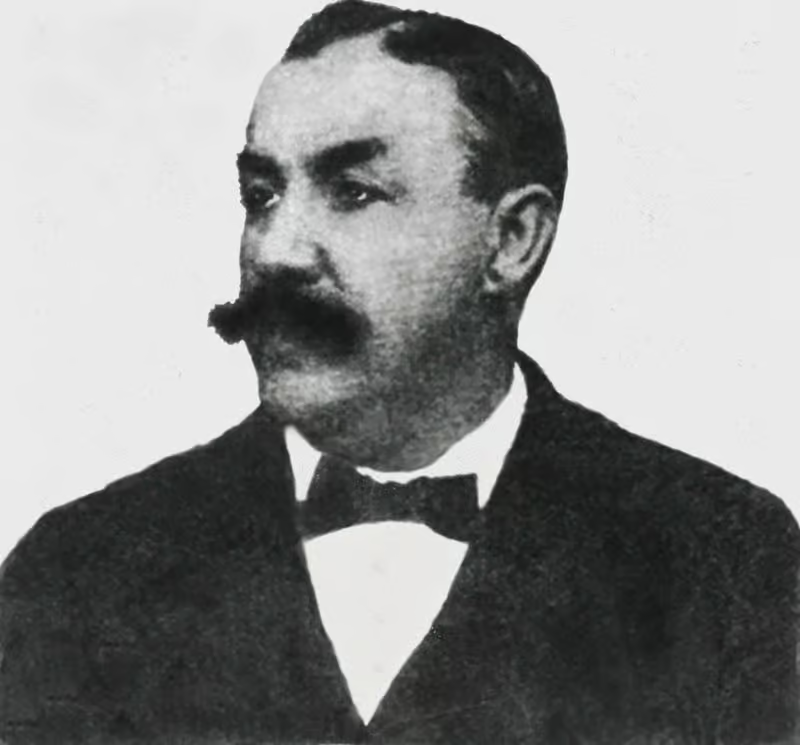
Holmes persuaded Pitezel’s wife, Carrie Canning, that her husband was alive and took three of her five children: Alice, 13, Nellie, 9, and Howard, 7. He moved them across the northeastern United States and into Canada while escorting their mother along a parallel route under false names. He later confessed to killing Howard on October 10, 1894, in a rented house in the Irvington neighborhood of Indianapolis, and to asphyxiating Alice and Nellie in a trunk fed by a gas line on October 25, 1894. He buried the girls in the cellar of 16 St. Vincent Street, Toronto.
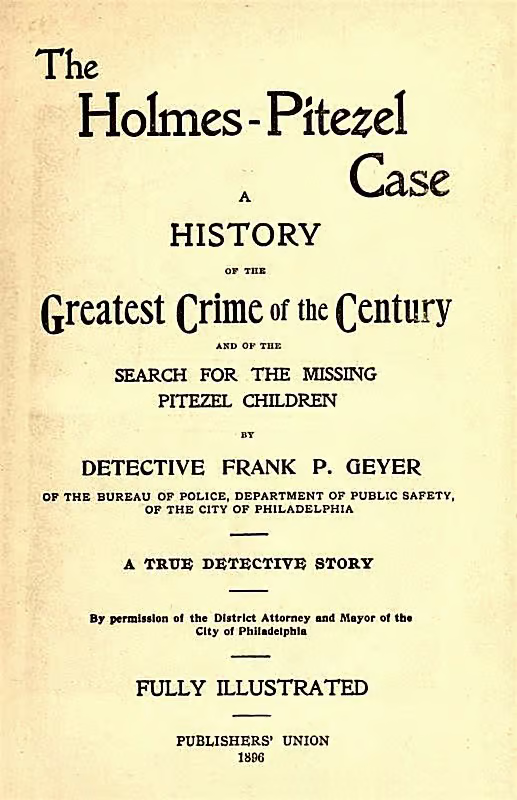
Philadelphia detective Frank P. Geyer began retracing the route in June 1895. He found the girls’ bodies in Toronto, then the boy’s teeth and bone fragments in the chimney of the Irvington house. His 1896 book, The Holmes-Pitezel Case, is the closest thing the case has to a primary investigative record.
Boston and Philadelphia: Arrest, Trial and Confession
Pinkerton agents tracked Holmes from Philadelphia to Boston, where he was arrested on November 17, 1894, and held on an outstanding Texas warrant for horse theft. He was tried in Philadelphia in October 1895 for Pitezel’s murder, convicted of first-degree murder and sentenced to death. After the verdict he confessed to 27 murders in Chicago, Indianapolis and Toronto, plus six attempts. Hearst newspapers paid him $7,500 for it.
Moyamensing Prison, Philadelphia: Execution
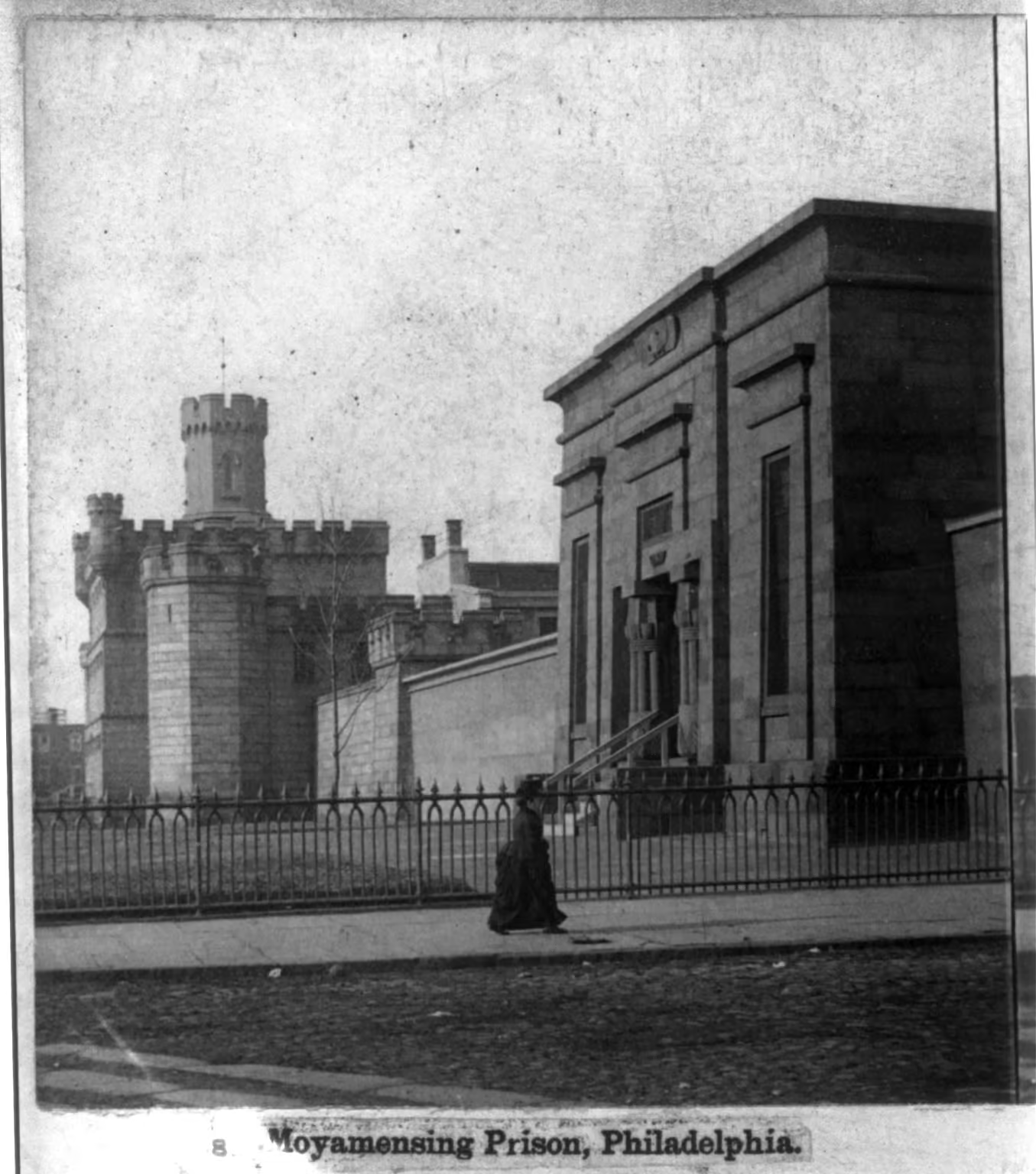
Holmes was hanged at Moyamensing Prison on May 7, 1896. His neck did not break; he strangled slowly and was pronounced dead after more than 15 minutes. He had asked to be buried ten feet down in a coffin sealed in concrete, to keep his body from the dissecting table he had supplied for years. He was buried in an unmarked grave at Holy Cross Cemetery in Yeadon, Pennsylvania.
In 2017, after claims that he had escaped execution, his body was exhumed in a study led by Janet Monge of the University of Pennsylvania Museum of Archaeology and Anthropology. The concrete had slowed decomposition. He was identified by his teeth and reburied.
Frequently Asked Questions
What was H. H. Holmes’s real name?
Herman Webster Mudgett. He was born on May 16, 1861, in Gilmanton, New Hampshire, and took the name Henry Howard Holmes before moving to Chicago in August 1886.
What was H. H. Holmes convicted of?
One murder: the first-degree murder of his accomplice Benjamin Pitezel, in Philadelphia in 1895. He was never charged in Chicago.
How many people did H. H. Holmes kill?
The number cannot be fixed. He confessed to 27 murders, but some people he named were alive. Confirmed or near-certain victims include Benjamin Pitezel, three Pitezel children, Julia and Pearl Conner, Emeline Cigrand, and Minnie and Anna Williams.
Was the Murder Castle really full of trapdoors and gas chambers?
No. Those details came from the yellow press. The third-floor hotel was moderately sized and never finished. It had hidden rooms, used to hide furniture bought on credit, and there is no evidence he killed fairgoers there.
Did Holmes kill visitors to the 1893 World’s Fair?
There is no evidence he murdered Exposition-goers on the premises. He did add a third floor in 1892 and told investors it would serve the fair.
What happened to the Pitezel children?
Holmes took Alice, Nellie and Howard from their mother. He confessed to killing Howard in Irvington, Indianapolis, on October 10, 1894, and Alice and Nellie in Toronto on October 25, 1894. Detective Frank P. Geyer found their remains in 1895.
Where was H. H. Holmes arrested?
In Boston on November 17, 1894, after Pinkerton agents tracked him from Philadelphia. He was held on a Texas horse-theft warrant.
How did H. H. Holmes die?
He was hanged at Moyamensing Prison, Philadelphia, on May 7, 1896. His neck did not break, and he was pronounced dead after more than 15 minutes.
Was his body really buried in concrete?
Yes. He asked for a coffin sealed in concrete, ten feet down, at Holy Cross Cemetery in Yeadon, Pennsylvania. A 2017 exhumation led by the Penn Museum identified him by his teeth.
What stands on the site of the Castle today?
The building was damaged by arson in August 1895, torn down in 1938, and the site is now the Englewood branch of the U.S. Postal Service.
Sources
Citations & Sources
- Geyer, Frank P. The Holmes-Pitezel Case: A History of the Greatest Crime of the Century and of the Search for the Missing Pitezel Children. Philadelphia: Publishers’ Union, 1896.
- “H. H. Holmes.” Wikipedia, accessed October 16, 2026: https://en.wikipedia.org/wiki/H._H._Holmes
Discover more from The Dark Side of Humanity
Subscribe to get the latest posts sent to your email.