FILE NO. 0200
Content warning: this case file discusses murder, including the murder of children, sexual violence, torture and execution, and serious mental illness. Injuries, mutilation and executions are described as the sources record them.
Legal status: Jack Owen Spillman III pleaded guilty in April 1996 to three counts of first-degree murder and is serving life without parole in Washington State. The early modern werewolf cases described here ended in convictions obtained largely through torture, under laws that treated transformation into a wolf as a crime; those confessions are reported as confessions, not as proven fact. Manuel Blanco Romasanta was convicted of nine murders in Spain in 1853. Joseph Vacher was convicted and executed in France in 1898. Patients described in the medical literature are anonymous and are not named here.

Photo: Todd Petit, via Wikimedia Commons. CC BY 2.0.
On the morning of 13 April 1995, a relative went to a house in East Wenatchee, Washington, to check on Rita Huffman and her daughter. Rita, 48, sold cars. Amanda, known as Mandy, was 15. The relative arrived at about 8 a.m. and found them both dead. Rita had been stabbed. Mandy had been killed by a blow to the head and had wounds that showed she tried to fight off her attacker. Both had been sexually mutilated. The coroner found that Rita died of multiple stab wounds to the upper chest and neck, and that Mandy died of a blow with a blunt instrument to the left side of her head. Wikipedia’s account of the case, which draws on later true-crime writing, says Rita was stabbed 31 times, that her breasts were cut off, that “her genital area had been excised and was stuffed into her mouth”, and that both victims were posed in provocative positions. The watch on Rita’s wrist had shattered, and its hands had stopped at about 11:30 p.m. the night before.
The man convicted of their murders, Jack Owen Spillman III, would later be filed in true-crime collections under a heading that sounds like a diagnosis: the “werewolf syndrome”. The phrase has nothing to do with medicine. It comes from crime writing, not from medicine’s older word, lycanthropy, and it sits on top of five centuries of courtrooms, confessions and case notes in which killers, accused witches and psychiatric patients have all been called werewolves. This case file pulls those threads apart: the Washington murders, the werewolf trials of early modern Europe, the Spanish peddler who claimed he was cursed, the French drifter who blamed a rabid dog, and the rare psychiatric condition doctors call clinical lycanthropy.
Sources: The Spokesman-Review, Suspect Seen Near Site Where Knife Was Found (1995); The Seattle Times, Man Pleads Guilty To Mutilation Slayings (1996); Wikipedia, Jack Owen Spillman.
A black pickup in a VFW parking lot
The first lead was a truck. A neighbour saw a black Chevrolet pickup in the parking lot of a school behind the Huffman house at about 11:30 p.m. on 12 April, the time frozen on Rita Huffman’s watch.
Two hours later, at about 1:30 a.m., East Wenatchee police officer Dan Reierson stopped to check on a man sitting alone in a black pickup in the parking lot of a VFW hall. The man got out with his hands up. Douglas County Sheriff Dan LaRoche later said Reierson thought that unusual, but not incriminating. A woman who shared an apartment with the driver told police he had left at about 11 p.m. saying he was going for a drive, and had not come back until about 2 a.m.
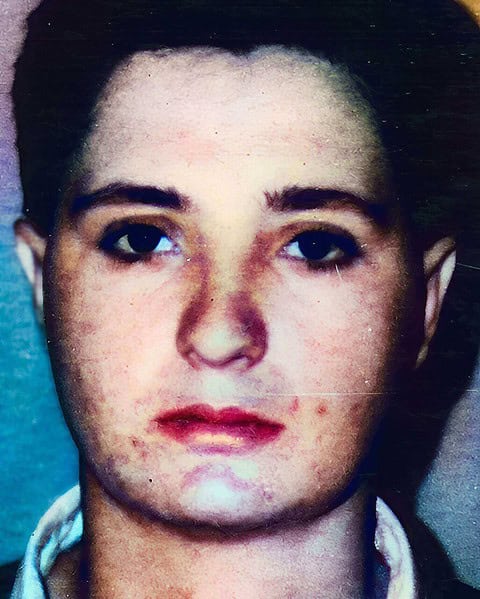
The driver was Jack Owen Spillman III, a 25-year-old former Spokane resident who had lived in Wenatchee for about a month. He did not know the Huffmans, police said. “He became a ‘person of interest’ because of the incident where he was checked by East Wenatchee police,” LaRoche told the Wenatchee World. “The time frame was right.”
Police put Spillman under 24-hour surveillance for nearly a week. On the Friday night after the killings, a 12-inch knife with traces of what appeared to be the victims’ blood was found in a garbage can outside the VFW hall. It appeared to match a knife missing from a three-piece set in the Huffman kitchen. Detectives waited for laboratory results, then arrested Spillman in a rented apartment a few blocks from the hall.
At a 15-minute bail hearing by closed-circuit television, Spillman, “tall and lanky with a mustache and goatee,” told the judge he was unemployed and owned nothing but a 1978 Chevrolet pickup. Douglas County Prosecutor Steven Clem said robbery seemed an unlikely motive. “Based upon the manner in which Mrs. Huffman and her daughter were murdered, it’s doubtful robbery was a motive,” he said.
Sources: The Spokesman-Review, Suspect Seen Near Site Where Knife Was Found (1995); The Spokesman-Review, Spillman Pleads Guilty To Killing Mother, Daughter (1996); Wikipedia, Jack Owen Spillman.
Penny Davis
Spillman’s arrest reopened another case. In September 1994, Penny Lynn Davis, 9, had disappeared from her home in the Aeneas Valley near Tonasket, in Okanogan County. Spillman, a ninth-grade dropout from Tonasket, had been questioned at the time, but there was not enough physical evidence to make him a suspect, Okanogan County Sheriff Dan Weed said. Penny’s remains were found in March 1995 in a shallow grave about 12 miles from her home.
Spillman had a long record. In Spokane he had convictions for burglary, theft, assault and malicious mischief. In 1993 he and a friend were arrested over the rape of a woman they had met at a downtown bar; the charges against both men were later dropped. When he pleaded guilty, he also still faced charges of rape and robbery over an attack on a woman at a business in Kent in 1993, and a burglary charge in Spokane County.
Sources: The Spokesman-Review, Suspect Seen Near Site Where Knife Was Found (1995); The Spokesman-Review, Spillman Pleads Guilty To Killing Mother, Daughter (1996); The Seattle Times, Man Pleads Guilty To Mutilation Slayings (1996).
The plea and the werewolf label
A trial in the Huffman case was set for August 1996, and prosecutors planned to seek the death penalty. Instead, on Monday 29 April 1996, Spillman pleaded guilty to first-degree murder in the deaths of Rita and Mandy Huffman. He also surprised authorities by confessing to killing Penny Davis, a crime he had been formally charged with only that day. He offered no details, and Okanogan County authorities had never been able to establish how she died. Wikipedia’s later account says Penny had also been posed, and that Spillman exhumed her body after her death and raped it before burying her again. The 1996 news reports do not include those details.
Superior Court Judge Carol Wardell sentenced him to life in prison without the possibility of parole for the murder of Rita Huffman, 70 years for the murder of Mandy Huffman, and 45 1/2 years for the murder of Penny Davis. “For the law-enforcement officers, for the families, for the prosecutors, we all feel good about it,” Clem said. “Mr. Spillman will never be on the streets again, we’re guaranteed that,” said Okanogan County Prosecutor Rick Weber.
Documents filed with the plea included the account of Mark Miller, Spillman’s cellmate at the Washington State Penitentiary at Walla Walla from July 1993 to February 1994. Miller told investigators that Spillman read books about serial killers and police forensics, talked of plans to murder young women, and described how he would avoid leaving clues. “Spillman would declare to Miller that he wanted to be the world’s greatest serial killer,” the court papers said.
That is where the contemporary record stops. The werewolf element appears later. Wikipedia’s article on Spillman, which calls him “the Werewolf Butcher,” says he told a cellmate that he stalked his victims while imagining himself as a werewolf, and that his fantasies depicted him “stalking his prey”. The only source the article lists for the werewolf material is a Crime Library feature by the forensic psychologist and true-crime author Katherine Ramsland, titled “The Werewolf Syndrome: Compulsive Bestial Slaughterers”. None of the 1995 and 1996 newspaper reports examined for this case file mentions a werewolf. Readers should treat the claim as a later true-crime attribution, not as evidence from the court file.
The phrase itself, “werewolf syndrome,” is not a medical diagnosis. It is a writer’s label for killers who attack like predators. Doctors use a different term, clinical lycanthropy, for a rare delusion in which a person believes they are turning into an animal. As later sections show, that condition is seldom linked to violence. Spillman was never described in court as psychotic, never pleaded insanity, and pleaded guilty to avoid a possible death sentence.
Sources: The Seattle Times, Man Pleads Guilty To Mutilation Slayings (1996); The Seattle Times, Life Sentence In Rape, Murder (1996); The Spokesman-Review, Spillman Pleads Guilty To Killing Mother, Daughter (1996); Wikipedia, Jack Owen Spillman.
From Lycaon to the Satyricon
The werewolf is far older than any court record. The English word comes from Old English werwulf, “man-wolf”. The learned term, lycanthrope, comes from the Ancient Greek for “wolf-human”.
Herodotus reported that, according to the Scythians and the Greeks living among them, the Neuri, a tribe to the northeast of Scythia, all turned into wolves once a year for several days and then changed back. He added that he did not believe it, although the locals swore it was true. Pausanias told the story of King Lycaon of Arcadia, turned into a wolf for sacrificing a child on the altar of Zeus Lycaeus. In Ovid’s Metamorphoses, Lycaon serves human flesh to Zeus to test whether his guest is really a god, and the disgusted god turns him into a wolf. Pliny the Elder recorded an Arcadian custom in which a man chosen by lot hung his clothes on an oak, swam a marsh and lived as a wolf for nine years.
The earliest werewolf story that reads like modern fiction is in the Satyricon, written around AD 60 by Petronius. At a banquet a character named Niceros describes a friend who strips by the roadside at night. “He pees in a circle round his clothes and then, just like that, turns into a wolf!” Fifteen centuries later, the idea that an injury to the beast would show on the man would turn up in a German courtroom.
Medieval writers kept the werewolf alive in romances. In Bisclavret, a Breton lai by Marie de France from about 1200, the werewolf is the wronged hero: a nobleman whose treacherous wife steals the clothes he needs to change back. Churchmen, meanwhile, argued about whether any real transformation was possible. Following Augustine of Hippo, a 12th-century writer held that only God could change one body into another.
Sources: Wikipedia, Werewolf.
The werewolf trials
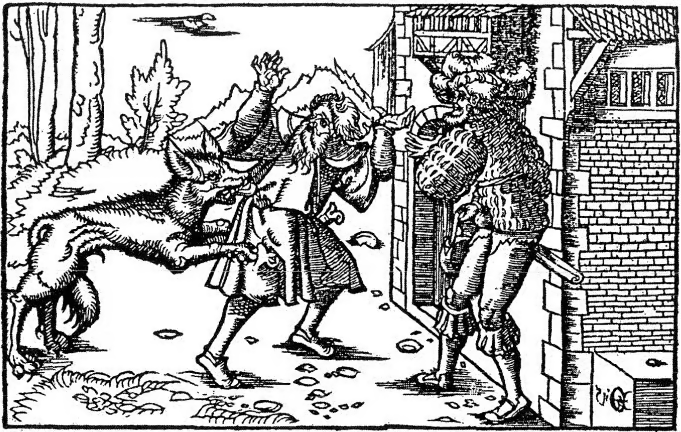
Woodcut: Johannes Geiler von Kaysersberg, Die Emeis (1517), via Wikimedia Commons. Public domain.
Belief in werewolves grew up alongside belief in witches during the late Middle Ages. Like the witch trials, werewolf trials began in what is now Switzerland, especially the Valais and Vaud, in the early 15th century. They spread across Europe in the 16th century, peaked in the 17th, and faded in the 18th. Lycanthropy was only ever a small part of the witch hunts. Most of the accused were charged with witchcraft first, and the wolf was one more piece of the case against them.
In the early period, accusations of turning into a wolf were mixed with accusations of riding wolves or charming them. The trials were not evenly spread. France saw several dozen around the end of the 16th century. The Holy Roman Empire kept its interest longer: at least nine works on lycanthropy were printed in Germany between 1649 and 1679, and in the Austrian and Bavarian Alps belief in werewolves lasted well into the 18th century, with the last cases recorded in Carinthia and Styria.
The legal machinery mattered more than the folklore. Courts treated transformation as proof of a pact with the Devil, and confessions were often extracted under torture or the threat of it. A suspect who admitted to wearing a wolf skin could be steered, question by question, into admitting that Satan had given it to him. That made the werewolf a witch, and witchcraft carried the death penalty.
Sources: Wikipedia, Werewolf witch trials; Wikipedia, Werewolf; Wikimedia Commons, Kaysersberg Emeis Werwolf.
The hermit of Saint Bonnot
The best known French case is that of Gilles Garnier, a reclusive hermit who lived in an area called Saint Bonnot, outside Amange near Dole in the County of Burgundy. Locals already knew him as “The Hermit of St. Bonnot” and had quarrelled with him over trespassing. He had recently married a woman named Appoline and struggled to feed her and their children.
In the early 1570s, several children went missing or were found dead. The authorities of Franche-Comté issued an edict allowing local people to hunt down and kill whoever was responsible. At that time unsolved violent crimes were often blamed on werewolves. One evening a group of workers saw what they first took for a wolf in the half light. Some of them recognised the hermit, with the body of a dead child.
Garnier was arrested, and a confession was extracted through torture. He said that a spectre had appeared to him while he hunted for food one night and given him an ointment that let him take the form of a wolf. He admitted to stalking and killing at least four children between the ages of 9 and 12. In late August he attacked a boy of 12 or 13 near Perrouse; the boy was “torn in half” with bites and his belly was torn open. Around the Feast of Saint Michael he dragged a girl of 10 or 12 into a vineyard near Châtenois, strangled her, stripped her and ate the flesh from her thighs and arms in the Serre forest, then took some of the flesh home to his wife to cook. In mid October he killed a 10-year-old boy, ate from his thighs and belly and tore off a leg to eat later. In early November he bit, scratched and strangled another girl in the meadows between Authume and Châtenois; passers-by interrupted him, and she died of her injuries a few days later. More than 50 witnesses testified that he had attacked and killed children in the fields and vineyards and eaten their raw flesh. He was found guilty of “crimes of lycanthropy and witchcraft” and burned at the stake. His trial was run by the secular courts, not the Inquisition.
Even the basic dates are uncertain. The killings are placed in 1572, 1573, or across both years. His execution is usually dated 18 January 1574, but because the year was written in Roman numerals as MDLXXIIII, it sometimes shifts to 1573.
Sources: Wikipedia, Gilles Garnier; Wikipedia, Werewolf witch trials; Wikipedia, Werewolf.
Bedburg, 1589
Sixteen years later came the case that made werewolf trials a European obsession. Peter Stumpp, also spelled Stubbe, Stübbe or Stumpf, was a wealthy farmer near Bedburg, in Germany. He was probably a Protestant, probably a widower, and had a daughter named Beele and a son. His left hand had been cut off, and the name “Stumpf” may refer to the stump. Investigators said the “werewolf” had lost its left forepaw, so the same injury in the man proved his guilt.
He confessed after being stretched on the rack, before further torture began. He said he had practised black magic since the age of 12 and that the Devil had given him a magical belt that turned him into a wolf. He told the magistrate he had left it in a “certain valley”. The magistrate sent men to find it. No belt was ever found. Under threat of more torture, he confessed to having been for 25 years an “insatiable bloodsucker” who ate goats, lambs and sheep, and women and children. He confessed to killing and eating 14 children and two pregnant women, whose fetuses he said he ripped from their wombs, and “ate their hearts panting hot and raw,” which he called “dainty morsels.” One of the 14 children was his own son, whose brain he was said to have eaten. He was also accused of incest with his daughter and with a distant relative, and confessed to sex with a succubus sent by the Devil.
Stumpp was executed on 31 October 1589 with his daughter Beele and his mistress, Katherine, in one of the most brutal executions on record. He was put on a wheel, where flesh was torn from his body in ten places with red-hot pincers, then from his arms and legs. His limbs were broken with the blunt side of an axe head, he was beheaded, and his body was burned on a pyre. Beele and Katherine had already been flayed and strangled, and were burned with him. The authorities then put up a pole bearing the torture wheel, the figure of a wolf and, at the top, his severed head, as a warning.
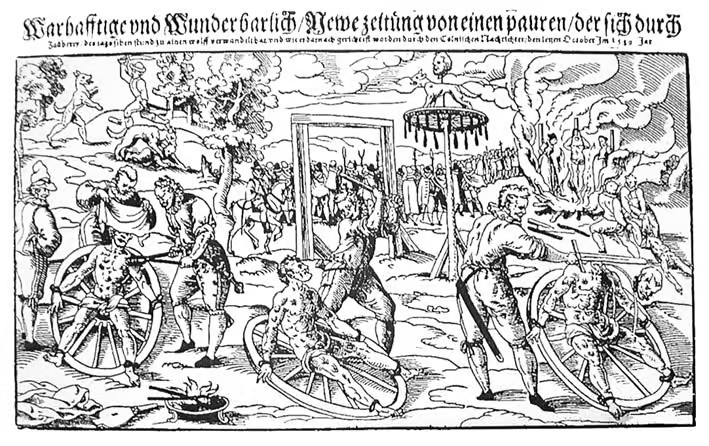
Woodcut: Lucas Mayer, 1589, via Wikimedia Commons. Public domain.
Almost everything known about the case comes from one place: a 16-page pamphlet printed in London in 1590, translated from a German print of which no copy survives. Two copies of the English pamphlet exist. It was rediscovered by the occultist Montague Summers in 1920. Some details are confirmed by the diary of Hermann von Weinsberg, a Cologne alderman, and by illustrated broadsheets printed in southern Germany. The pamphlet’s most lurid passages, the ones still quoted in podcasts and heavy metal songs, rest on a confession made on the rack and retold for a foreign audience.
Sources: Wikipedia, Peter Stumpp; Wikipedia, Werewolf witch trials; Wikipedia, Werewolf.
The tailor of Châlons and the Dutch trials
The case of Nicolas Damont, a tailor with his own workshop in Châlons, is even harder to pin down. He was tried for luring children into his shop and murdering them, and was accused of hunting children in the forest in the form of a wolf. Searchers reportedly found human bones in his basement. He reportedly confessed, and the confession was said to be so horrible that the court ordered the records destroyed. He was burned alive in 1598. Because those documents no longer exist, the reliability of the story that has circulated since is unknown.
Other French cases followed the same pattern: the Gandillon family, Jacques Roulet of Angers, a teenage “werewolf” sentenced to life imprisonment in Bordeaux in 1603. In 1602 the judge Henry Boguet wrote a long chapter on werewolves. In the Vaud, werewolves were convicted in 1602 and 1624, but in 1653 a local pastor wrote a treatise arguing that lycanthropy was purely an illusion. After that, the only record from the Vaud dates to 1670, when a boy claimed he and his mother could change into wolves, and no one took him seriously.
In the Netherlands, an accusation of being a werewolf was treated as essentially the same as an accusation of witchcraft. During the Amersfoort and Utrecht witch trials of 1591 to 1595, Folkert Dirks was accused of sorcery with his five children. One son told investigators the family could turn into wolves or cats at Satan’s command. Folkert Dirks was tortured into confessing that he had been made a werewolf by Satan. He, his daughter Hendrikje and two others named as members of their “pack” were executed for witchcraft. His sons were spared because of their age, and whipped. In Arnhem in 1595, Johan Martensen of Steenhuisen confessed to having been made a werewolf by the Devil three years earlier. He was strangled and burned on 7 August 1595.
In the Spanish Netherlands, six men were executed for sorcery between 1589 and 1661, at least three explicitly for being werewolves. The farmer Jan Vindevogel, from south of Ghent, was said to have been seen as a werewolf several times and was burned alive for witchcraft on 29 July 1652. Others were acquitted. In 1598 Jan van Calster, accused of biting two children in the shape of a wolf, was cleared.
Sources: Wikipedia, Werewolf of Châlons; Wikipedia, Werewolf witch trials; Wikipedia, Werewolf.
Livonia and the hound of God
The werewolf trial lasted longest as a common charge in Livonia, in present-day Estonia and Latvia, where it became the most common form of witch trial in the 17th century. Many Baltic peasants did not believe in Satan or in Satanic pacts, but they did believe in werewolves. When they accused a neighbour of doing harm in wolf form, the German-speaking authorities turned the accusation into one of witchcraft, and torture did the rest. In at least 18 trials between 1527 and 1725, 18 women and 13 men were accused of causing harm as werewolves.
In 1651 a young man named Hans, aged 18, was brought before the court at Idavere. He confessed that he had hunted as a werewolf for two years and that a “man in black” had given him the body of a wolf. Asked whether he felt like a man or a beast while transformed, “he said that he felt himself to be beast”. The court took the man in black to be Satan, which made Hans a witch, and he was sentenced to death.
The strangest case of all ended differently. In 1691 the judges of Jürgensburg, in Swedish Livonia, called an old man known as Thiess of Kaltenbrun as a witness in a church robbery case. Thiess, in his eighties, freely told them he had been a werewolf. In 1681 he had accused a farmer of breaking his nose, saying the farmer, a witch, had struck him with a broomstick in Hell. The court had laughed him out of the room, though one judge confirmed the nose was broken.
Thiess’s werewolves were not the Devil’s servants. He said that on the night of St. Lucia’s Day, and usually also at Pentecost and on St. John’s Night, he and the others became wolves and travelled to Hell to fight the Devil and his witches, to bring back the grain, livestock and fruit the witches had stolen. If they failed, the harvest would be bad. The werewolves, he said, “cannot tolerate the devil” and were “God’s hounds”. The judges could not make him confess to a pact with Satan. They convicted him of leading people away from Christianity, through his folk healing and charms, and sentenced him to be flogged and banished for life. He was whipped on 10 October 1692.
The historian Carlo Ginzburg, in The Night Battles (1966), compared Thiess to the benandanti of Friuli in northeastern Italy, who believed their spirits left their bodies to fight witches for the harvest, and argued that both were survivals of a pre-Christian shamanic tradition. The Dutch historian Willem de Blécourt later criticised that reading. In 2024 the Latvian Radio Choir premiered a concert-play about Thiess’s life and trial.
Sources: Wikipedia, Thiess of Kaltenbrun; Wikipedia, Werewolf witch trials.
The Werewolf of Allariz

Photo: Luis Miguel Bugallo Sánchez (Lmbuga), via Wikimedia Commons. CC BY-SA 3.0.
By the middle of the 19th century, the werewolf had mostly left the courtroom. Diderot’s Encyclopedia put reports of lycanthropy down to a “disorder of the brain”. Then, in 1852, a peddler from Galicia, in northwestern Spain, stood trial for murder and told the judges he could not be blamed, because he was a werewolf.
Manuel Blanco Romasanta, born on 18 November 1809, was small, fair and, by various accounts, “tender looking.” He worked as a dressmaker and married, but his wife died in 1833, and he became a travelling salesman, first in Esgos and then across Galicia and Portugal. He also worked as a guide, leading travellers over the mountains to Castile, Asturias and Cantabria.
In 1844 he was charged with the murder of Vicente Fernández, a court official from León who was found dead after trying to collect a debt Blanco owed. Blanco did not appear and was sentenced in his absence to 10 years. He hid for almost a year, then resurfaced with a false passport under the name Antonio Gómez, living in the village of Rebordechao.
Over the following years, women and children who hired him as a guide began to vanish. Their families were slow to notice, because Blanco brought back letters saying the travellers had arrived safely and were settling in. Suspicion grew when people saw him selling the missing travellers’ clothes, and a rumour spread that he was selling soap made from human fat. That rumour gave him his second nickname, the Tallow Man. In 1852 a complaint was lodged in Escalona alleging that he lured women and children into travelling with him so that he could kill them, remove their fat and sell it. He was arrested in September 1852 in Nombela, in the province of Toledo, and brought to trial in Allariz.
Sources: Wikipedia, Manuel Blanco Romasanta; Wikipedia, Werewolf.
Cause No. 1778
The trial took place during one of the worst of the famines that struck Galicia in the 19th century, a time of mass migration and fear. The case was filed as Cause No. 1778, and its claim of lycanthropy as a defence has never been repeated in Spanish law.
Blanco admitted to 13 murders. He said he had been cursed and had killed in the form of a wolf. “The first time I transformed, was in the mountains of Couso,” he told the court. He described meeting two wolves, falling into convulsions, and roaming with them for five days. The other two, he said, were also cursed men from Valencia, and “we attacked and ate a number of people because we were hungry.” When the prosecutor, Luciano Bastida Hernáez, asked him to show the court a transformation, Blanco said the curse had lasted only 13 years and had run out the week before.
In October 1852, doctors from Allariz gave the court a report, heavily based on phrenology, that accused him of inventing his condition. “His inclination to vice is voluntary and not forced,” they wrote. “The subject is not insane, dim-witted or monomaniacal.”
The court acquitted Blanco of four of the murders he had confessed to, after forensic evidence showed those victims had been killed by real wolves. He was convicted of the other nine, whose remains showed signs of butchering. Among the named victims were travelling mothers and their children: Manuela García, 47, and her daughter Petra; Benita García Blanco, 34, and her son Francisco; Josefa García and her son José Pazos. On 6 April 1853 he was sentenced to death by garrote. The trial had lasted seven months, and the transcript ran to more than 2,000 pages in five volumes titled “Licantropia”.
The sentence bounced between courts. The Territorial Court in A Coruña reduced it to life imprisonment. The prosecution appealed, and a new hearing in March 1854 restored the death sentence. Then a letter arrived at the Ministry of Justice from a “Mr. Phillips”, a French hypnotist living in London who had followed the case in French newspapers. Phillips argued that Blanco suffered from a monomania called lycanthropy and was not responsible, and asked for time to study him. The minister wrote to Queen Isabella II, who commuted the death sentence to life imprisonment by Royal Order of 13 May 1854. There is no documentary proof of who Phillips was. He is thought to have been Joseph-Pierre Durand de Gros, a French physician then exiled in Britain.
For more than a century it was believed that Blanco died within months in the prison at Celanova, whose records no longer exist. Locals said illness killed him. A rumour said a guard shot him to see him transform. In 2011, researchers Félix and Cástor Castro Vicente presented two newspaper reports from December 1863 showing that he had died in the prison at Ceuta. La Esperanza reported that he died there “on 14 of this month being the victim of stomach cancer.”
Blanco’s case inspired the 1970 Spanish film El Bosque del Lobo and the 2004 film Romasanta, directed by Paco Plaza. In Galicia he is remembered as the Werewolf of Allariz.
Sources: Wikipedia, Manuel Blanco Romasanta; Wikipedia, Werewolf.
The killer of shepherds
Forty years later, France produced a killer whose defence touched the same nerve from a different angle. Joseph Vacher was born on 16 November 1869 in Beaufort, near Grenoble, one of 16 children of an illiterate farmer. In 1893, while in the army, he shot a young woman named Louise Barant three times after she refused to marry him, then shot himself twice in the head. Both survived. His face was left partly paralysed and deformed. A court found him not guilty by reason of insanity, and he spent time in two psychiatric hospitals before doctors declared him “completely cured,” and released him on 1 April 1894.
Over the next three years Vacher drifted across southeastern France and murdered and mutilated at least 11 people: one woman, six teenage girls and four teenage boys, many of them shepherds watching flocks in isolated fields. The victims were stabbed repeatedly and often disembowelled, raped and sodomised, sometimes after death. The press called the unknown killer “le tueur de bergers”, the killer of shepherds. His first known victim was Eugénie Delhomme, 21, a silk factory worker killed in Beaurepaire on 19 May 1894. Estimates of his total run from 11 to 50.
He was caught on 4 August 1897 after attacking a woman gathering wood in a field at Champis. She fought back, her husband drove him off, and four neighbours restrained him and locked him in a shed at a nearby inn. On 7 October he confessed, first to eight murders and then to 11.
Vacher then tried to prove he was insane. He claimed that the bite of a rabid dog had poisoned his blood and driven him mad, and later blamed the quack remedy he had taken for the bite. He said he had been sent by God and compared himself to Joan of Arc. A team of doctors that included the eminent professor Alexandre Lacassagne declared him sane. He was convicted at the Cour d’Assises of Ain and sentenced to death on 28 October 1898 for the murder of Victor Portalier, a 16-year-old shepherd. He was guillotined on 31 December 1898 in front of a crowd of 3,500 people.
Vacher is not recorded as claiming to be a werewolf. But his rabid dog story drew on the same fear that sits under many werewolf legends: that a bite from an animal could pass its madness to a human. Researchers would later make exactly that argument about rabies.
Sources: Wikipedia, Joseph Vacher; Wikipedia, Werewolf.
Doctors and the wolf
The idea that a werewolf is a sick person, not a monster, is very old. In the fourth century, the Alexandrian physician Oribasius blamed lycanthropy on melancholia, an “excess of black bile”. In 1563 the Lutheran physician Johann Weyer wrote that werewolves suffered from an imbalance of the melancholic humour and showed paleness, “a dry tongue and a great thirst”, and sunken, dry eyes. Even King James VI of Scotland, later James I of England, a fierce prosecutor of witches, blamed werewolf behaviour in his 1597 treatise Daemonologie on an excess of melancholy, not on the Devil. The writer Catherine Clark Kroeger has noted that some readers of the Bible treat the behaviour of King Nebuchadnezzar in Daniel 4 as an early description of the same condition.
In the 20th century, researchers looked for a physical disease behind the legend. In 1963 Dr Lee Illis of Guy’s Hospital in London argued that some historical werewolves may have had congenital porphyria, a blood disorder whose symptoms include sensitivity to light, reddish teeth and psychosis. Others suggested hypertrichosis, a rare hereditary condition that causes excessive hair growth. The writer Woodward rejected both: werewolves in folklore looked like real wolves, not like sick people, and hypertrichosis was too rare to explain the number of cases. Woodward suggested rabies instead, pointing to the idea that a werewolf’s bite could pass on the curse. Critics note that transmission by bite is not part of the original legends. It appears only in more recent beliefs.
Another explanation is simpler. Wolves were Europe’s most feared predator, and until the 20th century wolf attacks were an occasional but widespread part of life. In regions without wolves, the same folklore uses other animals: werehyenas in Africa, weretigers in India, werejaguars in South America. And as the 19th-century writer Sabine Baring-Gould suggested in The Book of Werewolves, the legend may sometimes have been a way of explaining serial killings that communities could not otherwise understand.
Sources: Wikipedia, Clinical lycanthropy; Wikipedia, Werewolf.
Clinical lycanthropy today
Clinical lycanthropy is a real psychiatric syndrome, but it is very rare. It is a delusion in which a person believes they are turning into, have turned into, or are an animal. Despite the name, the animal is not always a wolf. Patients have described becoming dogs, cats, horses, birds, tigers, hyenas, frogs, snakes and even bees.
Modern study of the condition began with a 1988 paper from McLean Hospital in Belmont, Massachusetts, titled “Lycanthropy: alive and well in the twentieth century.” P. E. Keck and colleagues reviewed patients admitted since 1974 and found 12 cases, lasting from one day to 13 years. The syndrome was “generally associated with severe psychosis, but not with any specific psychiatric diagnosis or neurological findings.” The authors called it “a rare but colourful presentation of psychosis”. Their working criteria were simple: a patient says, in a lucid moment, that they sometimes feel like an animal, or a patient behaves like one, for example by howling, growling or crawling.
Later reviews have kept the numbers small. In 2014 J. D. Blom, of the Parnassia Psychiatric Institute in The Hague, reviewed cases reported since 1850 and found that “only 13 fulfilled the criteria of clinical lycanthropy proper” out of 56 descriptions of transformation into an animal. A 2021 French systematic review led by S. B. Guessoum identified 43 cases of lycanthropy and kynanthropy, the delusion of turning into a dog. The associated diagnoses were schizophrenia, psychotic depression, bipolar disorder and other psychotic disorders. The authors suggested the condition may be a culture-bound syndrome shaped by “Western cultures, myths, and stories on werewolves,” and by exposure to those stories online and in television series. The same team reported what they called the first case in a 12-year-old, asking whether the internet was now feeding such delusions.
The largest review so far, by Blom and B. A. Sharpless in 2025, gathered 77 published cases of what they call clinical therianthropy. Of those, 68 percent involved transformation into canines. Men tended to fall ill at a younger age than women. Psychotic disorders accounted for 41 percent of associated conditions, psychotic depression 24 percent, bipolar disorder 18 percent and Cotard’s syndrome 12 percent. Treatment brought full remission of the animal delusion in 58 percent and partial remission in 33 percent, though the underlying illness was often chronic.
The figure most relevant to true crime is this one: 16 percent of the 77 patients “engaged in other-directed physical violence.” That is a minority. The great majority of people who believe they are turning into animals hurt no one. Brain imaging of two patients found unusual activity in the areas that represent the body’s shape, suggesting that when they report their bodies changing, they may genuinely feel it. Antipsychotic medication is often effective, along with antidepressants or mood stabilisers where depression or bipolar disorder is involved.
Sources: Psychological Medicine, Lycanthropy: alive and well in the twentieth century (1988); History of Psychiatry, When doctors cry wolf (2014); Frontiers in Psychiatry, Clinical Lycanthropy, Neurobiology, Culture: A Systematic Review (2021); Psychiatry and Clinical Neurosciences, First reported case of clinical lycanthropy in a 12-year-old adolescent (2021); Neuroscience and Biobehavioral Reviews, A systematic review on clinical therianthropy (2025); Wikipedia, Clinical lycanthropy.
The full moon and the silver bullet
Two of the best known parts of the legend are modern. The full moon as the trigger for transformation became widespread only in the 20th century. The first film to show it was Frankenstein Meets the Wolf Man in 1943. Older folklore did mention the moon: in Italy, France and Germany it was said that a person who slept outside on certain summer nights with the full moon shining on their face could become a werewolf. But the monthly change was a Hollywood invention.
Silver came the same way. Vulnerability to silver appears in 19th-century German tales and in Baring-Gould’s collection, but the claim that the Beast of Gévaudan, which killed upwards of 80 people in south-central France between 1764 and 1767, was shot with a silver bullet appears to have been added by novelists from 1935 onwards. The first feature film with a man-wolf werewolf, Werewolf of London (1935), had no silver in it at all. Silver weapons entered the film version of the legend with The Wolf Man.
That matters for how the werewolf is used in crime writing. The killer who turns into a wolf under a full moon is a film image, not a historical one. The historical werewolf was usually a poor outsider, a hermit or a peddler, accused by neighbours and pushed into a confession by the courts.
Sources: Wikipedia, Werewolf.
Myth, madness or cover story?
Put the cases side by side and three different things share one name.
The first is the werewolf as accusation. Garnier, Stumpp, the Dirks family, Hans of Idavere and Vindevogel were all convicted on confessions obtained under torture or the threat of it, in courts that already believed in transformation. Some of them may have killed. Garnier was reportedly seen with a dead child, and Damont’s basement reportedly held bones. But the wolf in each case was supplied by the questions. Thiess, who confessed freely, turned the story on its head: his werewolves were God’s hounds.
The second is the werewolf as defence. Romasanta admitted to killing and then claimed the curse made him do it. Doctors rejected that in 1852, and a foreign hypnotist and a queen half accepted it two years later. Vacher used a rabid dog in the same way. In both cases trained examiners found the men responsible for their actions.
The third is the werewolf as a symptom. Clinical lycanthropy is real, rare and treatable, and most patients are not violent. It is a sign of severe psychosis, not a motive for murder.
The “werewolf syndrome” label, as applied to Jack Spillman, belongs to none of these. Nothing in the 1995 and 1996 court reporting suggests he believed he was an animal, claimed a curse, or pleaded insanity. What the court papers do show is a man who told a cellmate he wanted to be “the world’s greatest serial killer” and studied how to avoid leaving clues. The werewolf is a later writer’s frame. Rita Huffman, Mandy Huffman and Penny Davis were killed by a man, and that is how the courts of Washington State recorded it.
Sources: Wikipedia, Werewolf witch trials; Wikipedia, Manuel Blanco Romasanta; Wikipedia, Joseph Vacher; Neuroscience and Biobehavioral Reviews, A systematic review on clinical therianthropy (2025); The Seattle Times, Man Pleads Guilty To Mutilation Slayings (1996); The Spokesman-Review, Spillman Pleads Guilty To Killing Mother, Daughter (1996).
Where the accounts disagree
- The Spillman werewolf claim. Wikipedia says Spillman told a cellmate he stalked victims while imagining himself as a werewolf, and calls him “the Werewolf Butcher”. Its only listed source for that is a Crime Library feature by Katherine Ramsland. The 1995 and 1996 Spokesman-Review and Seattle Times reports, which quote the court papers and the cellmate’s account, do not mention a werewolf.
- Spillman’s age. He was reported as 25 at his April 1995 bail hearing and as 27 when he pleaded guilty a year later. Wikipedia gives his date of birth as 30 August 1969, which would make him 26 at the plea.
- The sentences. The 1996 newspaper reports give life without parole for Rita Huffman, 70 years for Mandy Huffman and 45 1/2 years for Penny Davis. One Seattle Times report and Wikipedia summarise this as life for the Huffman killings.
- Garnier’s dates. The killings are dated to 1572, 1573 or both years, and his execution to 18 January 1574 or 1573, because of the way the year was written in Roman numerals.
- Stumpp’s crimes. The detailed account rests on a single 1590 London pamphlet translated from a lost German original, built on a confession made under torture. Only parts are supported by the Weinsberg diary and German broadsheets.
- The Châlons tailor. The court records were reportedly destroyed, so the reliability of the story is unknown.
- Thiess’s trial date. Thiess was first questioned in 1691 and is usually said to have been tried in 1692. The werewolf trials article describes him as 80; the article on Thiess says he was in his eighties.
- Romasanta’s death. He was long believed to have died within months at Celanova, possibly shot by a guard. A 2009 television documentary suggested A Coruña. Newspaper reports found in 2011 place his death at Ceuta on 14 December 1863, from stomach cancer.
- Vacher’s total. He confessed to 11 murders. Estimates of his real total run as high as 50.
Timeline
- c. AD 60: Petronius writes the Satyricon, including the werewolf tale told by Niceros.
- Early 15th century: Werewolf accusations appear in the Valais witch trials in what is now Switzerland.
- 1527 to 1725: At least 18 werewolf trials in Livonia.
- 1563: Johann Weyer attributes lycanthropy to an imbalance of melancholy.
- 18 January 1574: Gilles Garnier is burned at Dole (sometimes dated 1573).
- 31 October 1589: Peter Stumpp is executed at Bedburg with his daughter and mistress.
- 1590: The London pamphlet on the Stumpp case is printed.
- 1591 to 1595: The Amersfoort and Utrecht witch trials, including the Dirks family.
- 7 August 1595: Johan Martensen is executed at Arnhem.
- 1597: James VI publishes Daemonologie.
- 1598: Nicolas Damont, the tailor of Châlons, is burned.
- 1651: Hans, 18, is tried as a werewolf at Idavere.
- 29 July 1652: Jan Vindevogel is burned alive south of Ghent.
- 10 October 1692: Thiess of Kaltenbrun is whipped after his trial at Jürgensburg.
- 1764 to 1767: The Beast of Gévaudan kills upwards of 80 people in south-central France.
- September 1852: Manuel Blanco Romasanta is arrested at Nombela.
- 6 April 1853: Romasanta is sentenced to death by garrote at Allariz.
- 13 May 1854: A Royal Order commutes his sentence to life imprisonment.
- 14 December 1863: Romasanta dies in prison at Ceuta.
- 4 August 1897: Joseph Vacher is captured at Champis.
- 31 December 1898: Vacher is guillotined.
- 1943: Frankenstein Meets the Wolf Man becomes the first film to show the full moon causing transformation.
- 1963: Lee Illis proposes porphyria as an explanation for werewolf legends.
- 1988: McLean Hospital researchers publish 12 cases of clinical lycanthropy.
- September 1994: Penny Davis, 9, disappears from the Aeneas Valley near Tonasket.
- March 1995: Her remains are found in a shallow grave.
- 12 April 1995: Rita and Mandy Huffman are killed in East Wenatchee.
- April 1995: Jack Owen Spillman III is arrested after nearly a week of surveillance.
- 29 April 1996: Spillman pleads guilty to three counts of first-degree murder and is sentenced.
- 2014: Blom finds only 13 cases of clinical lycanthropy proper among 56 reported since 1850.
- 2021: A systematic review identifies 43 cases; the first case in a 12-year-old is reported.
- 2025: Blom and Sharpless review 77 cases of clinical therianthropy.
Frequently asked questions
What is werewolf syndrome?
It is not a medical diagnosis. In true-crime writing, “werewolf syndrome” is a label for killers who attack like predators. The psychiatric condition in which a person believes they are turning into an animal is called clinical lycanthropy, or more broadly clinical therianthropy.
Is clinical lycanthropy real?
Yes, but it is very rare. A 2025 review found 77 published cases. It is usually linked to severe psychosis, psychotic depression or bipolar disorder, and most patients improve with treatment.
Are people with clinical lycanthropy dangerous?
Most are not. In the 2025 review, 16 percent of patients had been physically violent toward others. The large majority were not.
Was Jack Spillman a werewolf killer?
The werewolf label comes from later true-crime writing. Contemporary reports of his case and plea do not mention it. He pleaded guilty in 1996 to murdering Rita Huffman, Mandy Huffman and Penny Davis and was sentenced to life without parole.
Were people really executed for being werewolves?
Yes. From the 15th to the 18th century, courts across Europe tried people for lycanthropy, usually as a form of witchcraft. Gilles Garnier, Peter Stumpp, Johan Martensen and Jan Vindevogel were among those executed. Most convictions rested on confessions obtained by torture.
Where does the full moon come from?
Mostly from cinema. The full moon as the regular trigger for transformation became widespread only in the 20th century, and first appeared on film in 1943.
Related case files
- Aristocracy of Blood: Historical Serial Killers Before 1900
- Criminal Vampirism: From Myth to Motive
- Bizarre Psychiatric Disorders
- Ritual Murder Claims: Separating Evidence From Myth
- Rostov Ripper: Soviet Horror Story
Citations & Sources
Every source cited in the sections above, in one list. Online sources were consulted on November 1, 2026.
News
- The Spokesman-Review, Suspect Seen Near Site Where Knife Was Found, 21 April 1995.
- The Seattle Times, Man Pleads Guilty To Mutilation Slayings, 30 April 1996.
- The Seattle Times, Life Sentence In Rape, Murder, 1 May 1996.
- The Spokesman-Review, Spillman Pleads Guilty To Killing Mother, Daughter, 1 May 1996.
Medical literature
- Psychological Medicine, Lycanthropy: alive and well in the twentieth century, Keck PE, Pope HG, Hudson JI, McElroy SL, Kulick AR, February 1988.
- History of Psychiatry, When doctors cry wolf: a systematic review of the literature on clinical lycanthropy, Blom JD, March 2014.
- Psychiatry and Clinical Neurosciences, First reported case of clinical lycanthropy in a 12-year-old adolescent: From culture-bound syndromes to Internet-mediated delusions?, Guessoum SB and others, February 2021.
- Frontiers in Psychiatry, Clinical Lycanthropy, Neurobiology, Culture: A Systematic Review, Guessoum SB and others, October 2021.
- Neuroscience and Biobehavioral Reviews, A systematic review on clinical therianthropy and a proposal to conceptualize zoomorphism as a diagnostic spectrum, Blom JD, Sharpless BA, July 2025.
Reference
- Wikipedia, Jack Owen Spillman.
- Wikipedia, Werewolf.
- Wikipedia, Werewolf witch trials.
- Wikipedia, Gilles Garnier.
- Wikipedia, Peter Stumpp.
- Wikipedia, Werewolf of Châlons.
- Wikipedia, Thiess of Kaltenbrun.
- Wikipedia, Manuel Blanco Romasanta.
- Wikipedia, Joseph Vacher.
- Wikipedia, Clinical lycanthropy.
Images
- Wikimedia Commons, Burch Mountain above Wenatchee, Washington, Todd Petit, CC BY 2.0.
- Wikimedia Commons, Werewolf attack, woodcut from Kaysersberg’s Die Emeis (1517), public domain.
- Wikimedia Commons, Execution of Peter Stumpp, broadsheet woodcut (1589), Lucas Mayer, public domain.
- Wikimedia Commons, Allariz, Galicia, Spain, Luis Miguel Bugallo Sánchez (Lmbuga), CC BY-SA 3.0.
Discover more from The Dark Side of Humanity
Subscribe to get the latest posts sent to your email.