FILE NO. 0178
Content warning: this case file discusses state surveillance and harassment, police killings, a letter read as urging suicide, the death of an infant, a death by overdose, and the executions of convicted spies and saboteurs.
If you or someone you know is struggling, help is available: in Canada and the US call or text 988, and in the UK and Ireland call Samaritans on 116 123.
The Life and Career of J. Edgar Hoover
J. Edgar Hoover ran the Bureau of Investigation and then the FBI from 1924 until his death in 1972. He built its labs, files and G-Man image, and he ran secret programs against Americans that a Senate committee later condemned. This is what the record shows.
Legal status: J. Edgar Hoover was never charged with any crime. He died in office on May 2, 1972. The abuses described here are documented in FBI records, in the 1976 final report of the Senate committee chaired by Frank Church, and in federal court rulings. Those findings were made after his death, and he never answered them in any court.
For 48 years one man ran the Federal Bureau of Investigation. He took over a small, discredited agency at the age of 29 and left behind a national police and intelligence service with a laboratory, a fingerprint collection, a training academy and a reputation that eight presidents chose not to challenge. He also left behind secret programs that a Senate committee later described as a “sophisticated vigilante operation” aimed at American citizens.
This case file follows John Edgar Hoover from a Washington boyhood to a state funeral, using the FBI’s own published history, the Church Committee’s findings, court records and reporting on the record. Where a famous story about him has no solid source, we say so.
A Washington boy and a library clerk (1895 to 1917)
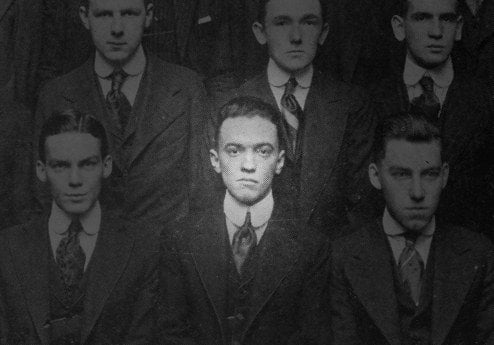
John Edgar Hoover was born in Washington, D.C., on January 1, 1895. In a 2022 interview with the Niskanen Center, his biographer Beverly Gage noted that he lived his entire life in the city and is buried there in Congressional Cemetery, near his parents and a sister he never met.
Gage, a Yale historian whose biography G-Man: J. Edgar Hoover and the Making of the American Century was published in 2022, described his background in a PBS interview with David Rubenstein. His father worked as a mid-level government employee in the printing service of a federal survey office. His mother came from a family of Swiss diplomats. He went through the city’s segregated public schools, and Gage argues that this white, Protestant, government-town upbringing shaped the views he carried into the Bureau.
After high school Hoover went to work at the Library of Congress. The FBI dates his start there to October 13, 1913, in the orders department. He took night classes at George Washington University Law School while he worked. According to the FBI’s official biography, he received his LL.B. in 1916 and his LL.M. the following year.
At GWU he joined Kappa Alpha, a Southern fraternity founded in 1865 with a segregationist outlook, and rose to chapter president. Gage discussed the fraternity in interviews with NPR and WBUR, presenting it as one of the places where his social and racial views took shape.
The library job mattered. In its legacy series the FBI quotes Hoover’s own 1951 account: “[T]his job …trained me in the value of collating material.” The Bureau credits the library’s cataloguing methods with influencing the central records system he later built, in which every case was filed under a numbered classification. Kidnapping, for example, became classification 7 and espionage became 65.
Hoover left the library on July 25, 1917, and started at the Department of Justice the next day. The United States had entered the First World War less than four months earlier.
The Radical Division and the Palmer Raids (1917 to 1920)
Hoover joined Justice at a moment when it was hunting German agents, draft resisters and political radicals. The official biography says he “rose quickly in government service”: he was named an assistant to the attorney general in November 1918, and the next year he took charge of the department’s new General Intelligence Division.
That division was born out of terror. On June 2, 1919, the anarchist Carlo Valdinoci blew himself up with a bomb at the Washington home of Attorney General A. Mitchell Palmer. Coordinated bombs went off in eight cities that night. In the FBI’s account, Palmer responded by creating a small division within Justice to gather intelligence on radicals, and he put Hoover in charge. The FBI’s legacy series says it was also called the “Radical Division”, and its job was to determine whether domestic attacks were connected to foreign revolutionary movements.
Hoover brought his library methods to the work. The division built an index of radicals, their groups and their publications. In the fall of 1919 a wave of arrests swept up foreign-born activists, among them the anarchists Emma Goldman and Alexander Berkman. In December they and other deportees were put aboard the ship the press called the “Soviet Ark” and sent to Russia.
Then came the raids that carry Palmer’s name. In early January 1920, agents and local police arrested thousands of suspected radicals in coordinated sweeps across the country. The FBI’s own history page calls what followed a “nightmare.” People were held without proper warrants, legal process broke down, and many of those detained had no connection to violence. The FBI says plainly that Palmer and Hoover “were roundly criticized” for the raids.
Hoover’s name was attached to a national embarrassment before he turned 26. The lesson he seems to have drawn was not to abandon political intelligence but to do it more quietly. When the General Intelligence Division was moved into the Bureau of Investigation in 1921, the official biography records that he was named the Bureau’s assistant director.
Taking over a scandal-ridden Bureau (1921 to 1932)
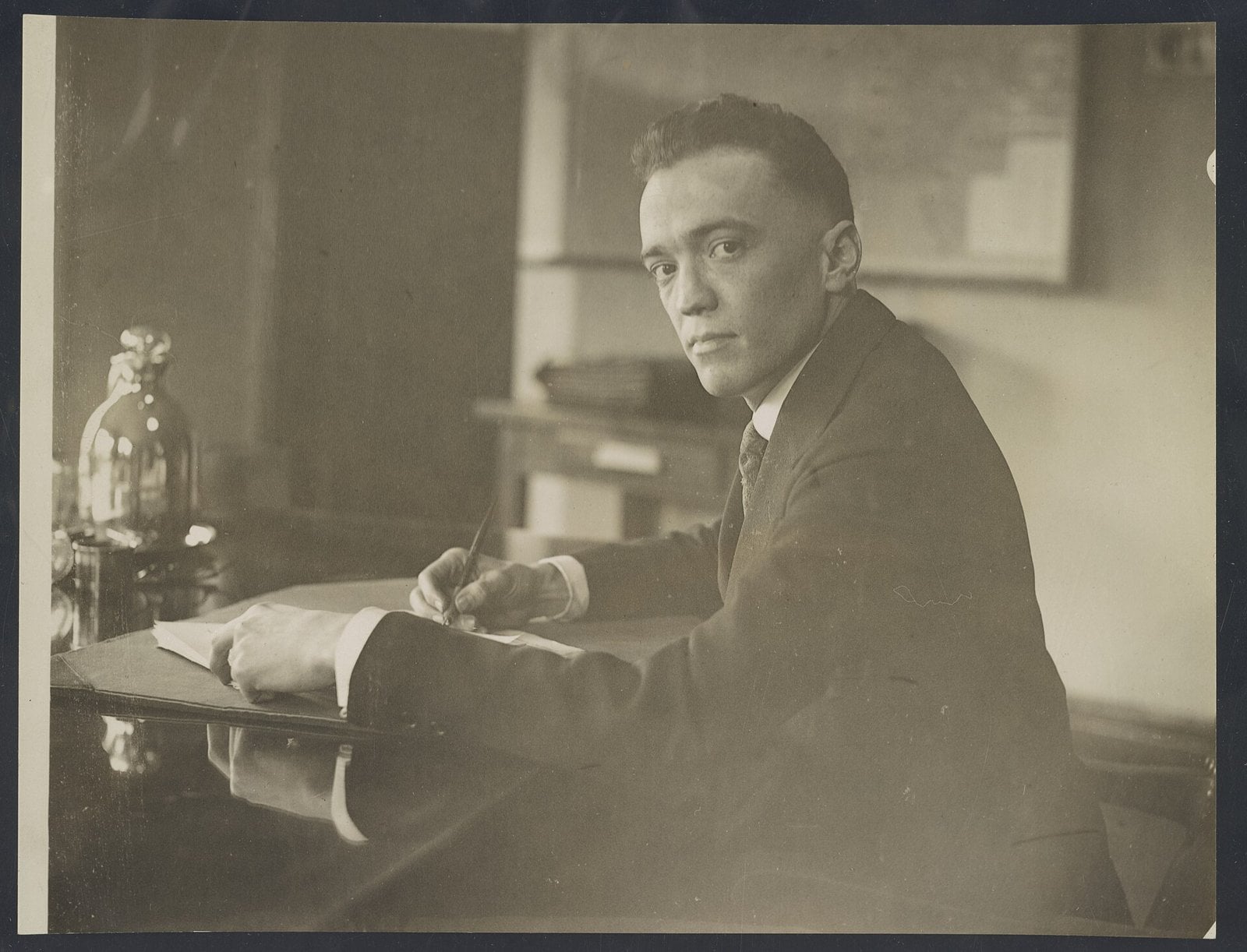
The Bureau of Investigation of the early 1920s was not a respected place. The FBI’s history of the period says it came out that Justice Department officials had sent Bureau agents to spy on members of Congress who had opposed the department’s policies. Soon after that news broke, President Calvin Coolidge fired Harding’s attorney general, Harry Daugherty, and named Harlan Fiske Stone as his successor in 1924. The FBI’s verdict: “A good housecleaning was in order for the Bureau.”
Stone chose Hoover. On May 10, 1924, he appointed the 29-year-old acting director, and by the end of the year Hoover was Director. He fired agents he considered political appointees or unqualified. He ordered background checks, interviews and physical testing for applicants. He revived the earlier policy of requiring agents to have training in law or accounting.
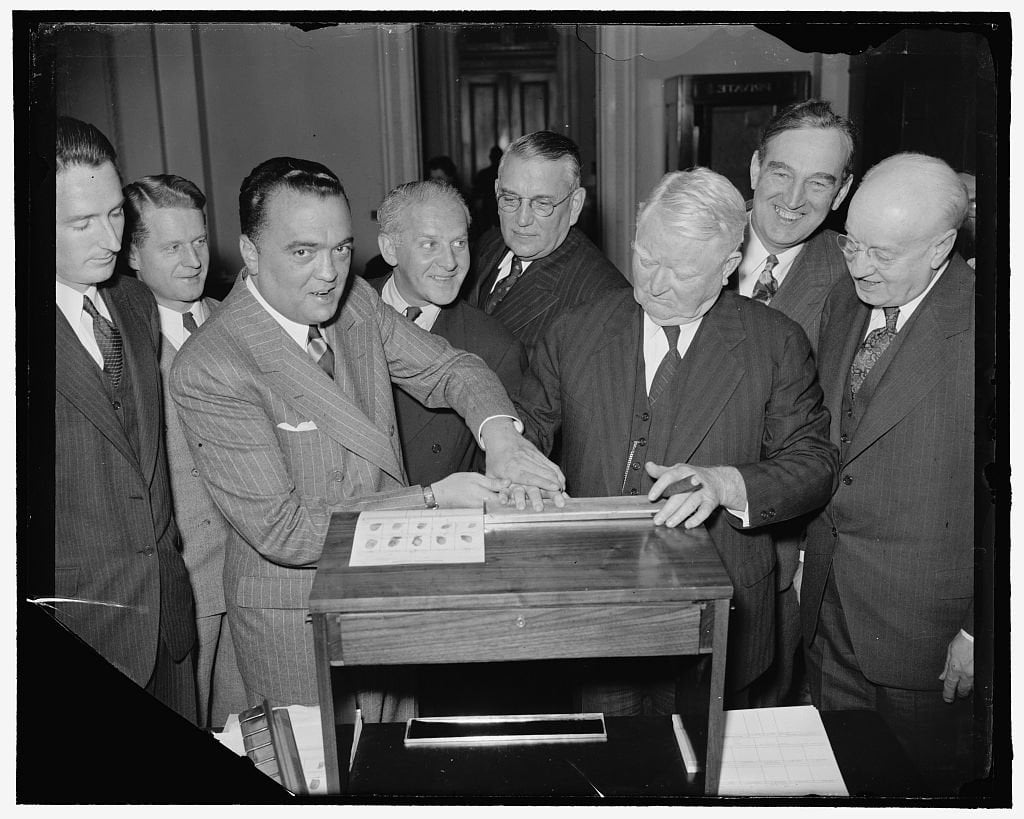
The new director also built infrastructure. The FBI dates its centralized fingerprint identification work to 1924, when the Bureau became the national repository for criminal fingerprint cards sent in by police departments. In 1930 it took on the job of collecting the national Uniform Crime Reports. On November 24, 1932, the Bureau opened what it called its Technical Laboratory, offering forensic analysis to its own agents and, increasingly, to state and local police.
These were bureaucratic achievements, and they lasted. The crime lab, the fingerprint files and the statistical program all still exist in some form. They also gave Hoover something he would rely on for the rest of his career: services that local police and members of Congress came to depend on.
Gage told NPR that much of what Hoover did was understood and approved of by presidents, Congress and a large share of the public for most of his life. The early reforms are a large part of why. He arrived as a young administrator promising an honest, professional, nonpolitical Bureau, and in the 1920s he largely delivered that image.
G-Men: the gangster war and the making of a brand (1932 to 1936)
The early 1930s gave Hoover his public identity. The FBI’s history of the period lists the forces that drew the Bureau into violent crime: the kidnapping of Charles Lindbergh’s infant son in 1932, the “Kansas City Massacre” of June 1933 at a train station that killed four lawmen, among them a Bureau agent, and the rise of John Dillinger.
Federal agents at that point had limited powers. The FBI says Congress gave the Bureau new authority in this period, including the ability to carry guns and make arrests. Using whatever federal laws applied, agents went after the bank robbers and kidnappers the press called public enemies.
By the end of 1934 most of the best-known gangsters had been killed or captured. In July 1934 Melvin Purvis and a team of agents caught up with Dillinger, who was shot dead leaving a Chicago theater. In October 1934 Charles “Pretty Boy” Floyd was killed in a shootout with agents and local police on an Ohio farm. In January 1935 agents arrested “Doc” Barker, and eight days later “Ma” Barker and her son Fred were killed by agents in Florida. In May 1936 Alvin Karpis, whom the FBI calls the brains of the gang, was captured; he ended up in Alcatraz.
The Bureau’s history is candid that these successes came “despite some stumbles along the way.” It also records that Bonnie Parker and Clyde Barrow fell in May 1934 to Texas lawmen, with the Bureau playing only a small supporting role, and that Baby Face Nelson, killed in November 1934, took two agents with him in his final firefight.
Hoover understood publicity. The FBI’s legacy series describes his close working relationship from 1933 with the author and publicist Courtney Ryley Cooper, who wrote magazine articles and books about crime and the Bureau. Attorney General Homer Cummings ran his own “war on crime” publicity campaign at the same time. Toys, games, radio shows and films about G-Men followed. In the FBI’s own words, the “once unknown Bureau” and its “G-Men” became “household names and icons of popular culture.”
In July 1935, as the capstone of that new identity, the agency was renamed the Federal Bureau of Investigation. In the same year, the Bureau graduated the first class of its training program for police executives, the forerunner of today’s FBI National Academy.
The “G-Men” legend
The most famous story of the era concerns George “Machine Gun” Kelly, who had kidnapped the oil magnate Charles Urschel and held him for $200,000 ransom. On September 26, 1933, Bureau agents and Tennessee police found Kelly hiding in a run-down house in Memphis. One version had him emerging with his hands up, crying “Don’t shoot G-Men, don’t shoot.” Some early press reports instead had a tired Kelly mumbling something like “I was expecting you.”
The FBI itself calls the G-Men version “apocryphal.” Its history page notes that before 1934 “G-Man” was underworld slang for any government agent, and that Hoover’s detectives were so little known that they were often confused with Secret Service or Prohibition agents. Either way, Kelly was arrested without violence, and the more colorful version stuck.
The pattern matters for understanding Hoover. He built the FBI’s reputation on real results, and then let the stories grow bigger than the results.
Spies, saboteurs and the Western Hemisphere (1936 to 1945)
The FBI’s legacy series argues that Hoover’s intelligence career has been overshadowed by the gangster years. In the mid-1930s, evidence of German and Japanese espionage, and to a lesser extent Soviet espionage, began to pile up, and the Bureau was asked to investigate. When war came in Europe, President Franklin D. Roosevelt expanded those duties dramatically.
The Bureau’s history of the war years says it uncovered about 50 spies in the period before the United States entered the war. The largest case was the Duquesne spy ring. A German-American named William Sebold, recruited by German intelligence, went to the FBI and worked as a double agent. Agents filmed the spies who visited his bugged Manhattan office. In the end 33 people were brought to justice: 19 pleaded guilty, and 14 were tried in Brooklyn beginning September 3, 1941. All 14 were convicted on December 13, 1941, days after Pearl Harbor. On January 2, 1942, the defendants received combined sentences of more than 300 years. The ring’s namesake, Fritz Duquesne, got 18 years.
Roosevelt also gave the FBI a foreign role. In 1940 he ordered the creation of the Special Intelligence Service, an FBI operation that ran intelligence work across the Western Hemisphere. The legacy series describes Hoover as a “founding father” of the American intelligence community, sorting out jurisdiction among agencies that barely existed before the war. There was no CIA yet, and the Office of Strategic Services would not be created until June 1942, so Roosevelt divided the globe among agencies. The FBI got the area closest to home.
Operation Pastorius
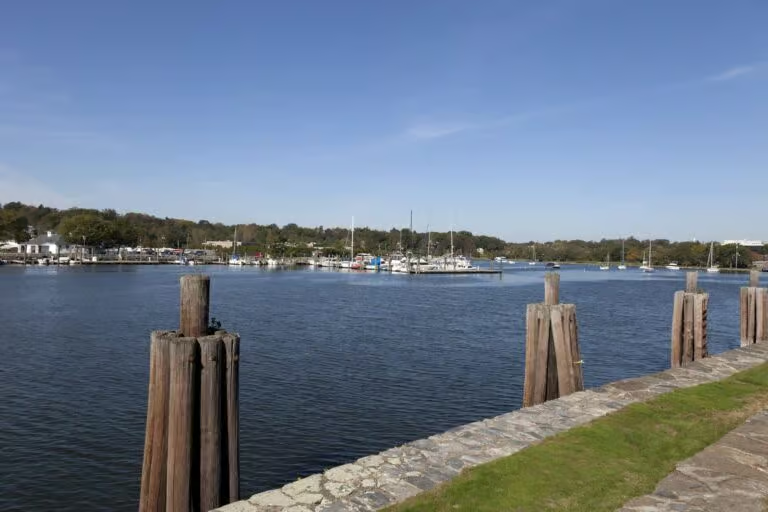
The war’s most dramatic domestic case came in June 1942. German submarines landed two teams of saboteurs: four men at Amagansett on Long Island on June 13, and four more at Ponte Vedra Beach, Florida, on June 17. They carried explosives and about $175,000 in American money.
The plot collapsed from the inside. On June 14, one of the Long Island team, George Dasch, called the FBI’s New York office and identified himself as “Pastorius,” the code name of the operation. On June 19 he called FBI Headquarters from a Washington hotel and was taken into custody. All eight men were in custody by June 27. The FBI recovered $174,588 of the $175,200 the Germans had given them.
A military commission tried the eight. On August 8, 1942, six of them were executed at the District of Columbia Jail. Attorney General Francis Biddle and Hoover appealed to Roosevelt on behalf of Dasch and Ernest Peter Burger, who had also cooperated. Dasch received 30 years and Burger life imprisonment.
In 1955 President Dwight Eisenhower pinned the National Security Medal on Hoover outside the White House. The citation praised his “outstanding contribution to the national security of the United States.”
The Cold War director (1945 to 1957)
The end of the war turned Hoover’s attention from Germany to the Soviet Union. The FBI’s history of the period says the first major breaks came in late 1945 with the defection of the Soviet code clerk Igor Gouzenko and, a few weeks later, of Elizabeth Bentley, an American citizen who had become a Soviet spy. Their information showed how deeply Soviet intelligence had placed agents in sensitive positions during the war.
In 1948 the Time magazine editor Whittaker Chambers accused Alger Hiss, a prominent New Deal lawyer, of spying for the Russians. The FBI’s account says that when Hiss challenged him to prove it, Chambers produced solid evidence that Hiss had passed him classified information. The case made front-page news and fed the congressional hearings that defined the era.
Behind the public cases sat a secret one. An Army Signal Corps project later code-named Venona was decrypting Soviet intelligence telegrams. Over its life, from 1943 to 1980, the FBI and its partners identified some 350 people connected with Soviet intelligence. Venona was kept under wraps for about four decades and was never used in court. The Bureau quietly used it to uncover the espionage ring run by Julius and Ethel Rosenberg.
The FBI’s case page on the Rosenbergs traces the chain from the arrest of the German-born British atomic scientist Klaus Fuchs in Britain in 1950 to Ethel’s brother, David Greenglass, and then to Julius Rosenberg, who was arrested at his home in Knickerbocker Village in New York on July 17, 1950. Both Rosenbergs were convicted. Julius was executed at Sing Sing Prison at 8:05 p.m. on June 19, 1953, and Ethel ten minutes later. Greenglass, who pleaded guilty, received 15 years and was released in 1960.
Hoover also gave the country a lasting piece of crime-fighting culture. In March 1950 the FBI launched its “Ten Most Wanted Fugitives” list. In 1957 the Bureau captured William Fisher, the Soviet “illegal” known as Rudolf Abel, who had posed as a retired photographer in New York.
The Lavender Scare
The FBI’s official biography notes that in the early Cold War the Bureau took on “the added responsibility of investigating the backgrounds of government employees.” That work reached far beyond spies. In her Niskanen Center interview, Gage agreed with the host’s summary that the Bureau was central to the Lavender Scare, the purge of gay men and lesbians from federal jobs that began alongside the Red Scare and outlasted it, damaging and destroying lives. The interview quotes a line from her book: “McCarthyism ultimately was a surface phenomenon, whereas Hooverism came first, lasted longer, and mattered more.”
That irony runs through every serious account of Hoover’s life, and we return to it in the section on Clyde Tolson.
The Mafia question (1953 to 1963)
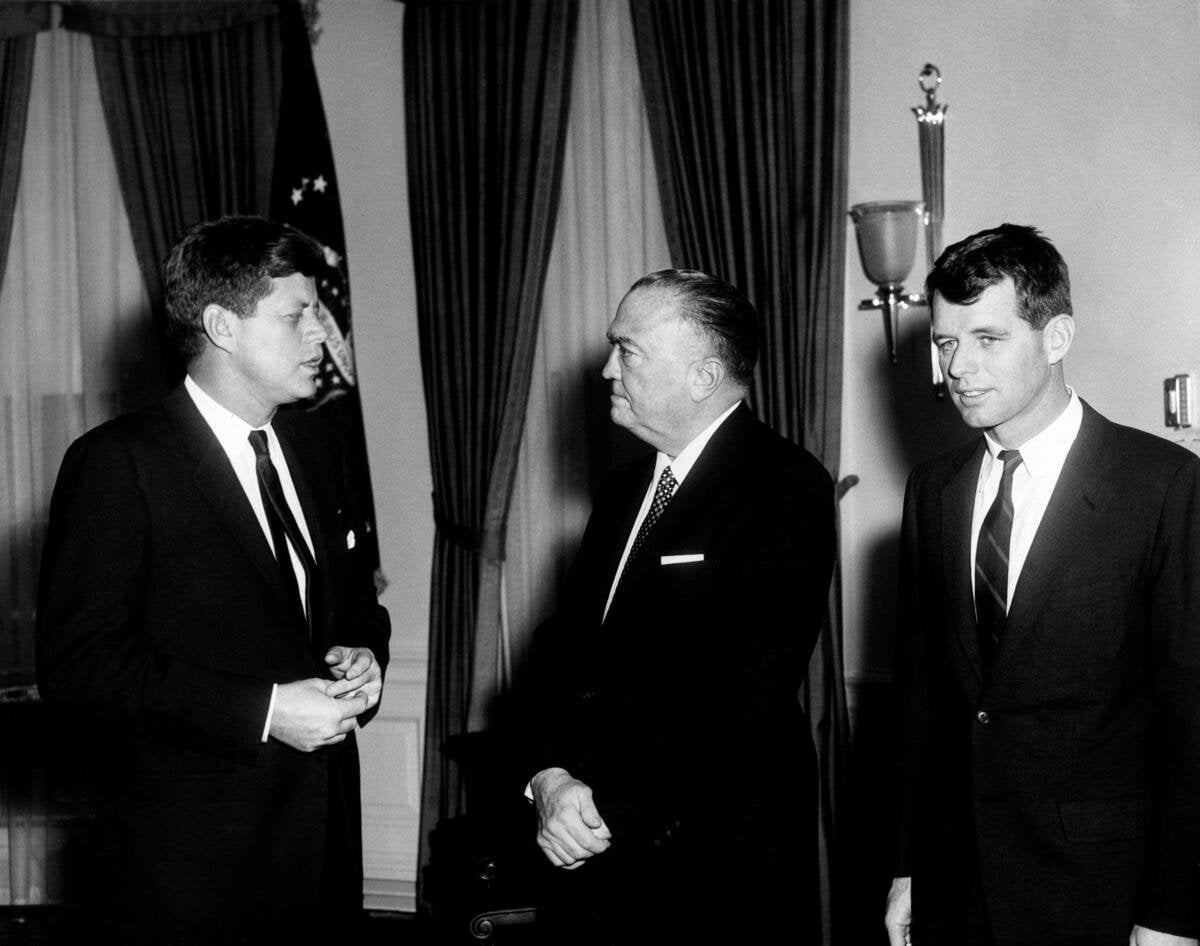
For decades critics have said that Hoover refused to admit the American Mafia existed until a New York state trooper forced his hand. The FBI’s own history answers that charge directly, and the record is more mixed than either side’s version.
On a mid-November day in 1957, a soft-drink bottler named Joseph Barbara hosted a gathering at his estate in Apalachin, New York. Sergeant Edgar Croswell of the New York State Police had seen suspected criminals at the house before. He and Trooper Vincent Vasisko began taking down license plates. When the guests panicked and fled, Croswell set up a roadblock and detained 62 of them, among them Carlo Gambino, Vito Genovese and Santos Trafficante. The FBI’s history says the Bureau immediately checked the names. It had information in its files on 53 of the mobsters, and 40 had criminal records.
The FBI says Croswell’s discovery led it to “intensify its interest in these figures (not begin it, as some have speculated).” It points to an earlier effort: four years before Apalachin, its New York office had asked to open intelligence files on 30 top hoodlums in the city, and on August 25, 1953, the Bureau launched a national “Top Hoodlum Program.”
Hoover faced limits. At the time, most racketeering, including gambling and loan sharking, was beyond the Bureau’s jurisdiction. The Bureau could gather intelligence, but it needed new federal laws before it could bring many cases. In 1963, with the FBI’s help, the mob soldier Joseph Valachi testified before a Senate subcommittee on October 1, naming names and describing the Mafia’s rituals in public for the first time.
The fairest reading of the record is that the FBI was gathering intelligence on major mobsters before Apalachin, but that the scale of the national problem became public, and politically urgent, only after it. Hoover’s critics and his own Bureau both have a point.
COINTELPRO: the secret programs (1956 to 1971)
The program that defines Hoover’s legacy for many Americans began in 1956. It was called COINTELPRO, short for counterintelligence program, and its aim was not to investigate crimes but to disrupt groups the Bureau considered dangerous.
The FBI’s own history page gives the outline. In 1956 the National Security Council approved a program against the Communist Party of the United States. Five years later the Bureau added the Socialist Workers Party. In 1964 it opened a program against the Ku Klux Klan and other white hate groups, and in 1967 one against what it called Black nationalist hate groups, a category that came to include the Black Panther Party.
The Church Committee, which investigated the programs in 1975 and 1976, listed five in all: the Communist Party program (1956 to 1971), the Socialist Workers Party program (1961 to 1969), the “White Hate Group” program (1964 to 1971), the “Black Nationalist-Hate Group” program (1967 to 1971) and the “New Left” program (1968 to 1971). The committee warned that the Bureau’s labels implied a precision of definition and targeting that did not exist. According to the report, the Socialist Workers Party program was started by a headquarters supervisor with Hoover’s concurrence.
The committee’s summary judgment was blunt. COINTELPRO “began in 1956, in part because of frustration with Supreme Court rulings limiting the Government’s power to proceed overtly against dissident groups.” In the 15 years that followed, the report said, the Bureau “conducted a sophisticated vigilante operation” aimed at preventing Americans from exercising their First Amendment rights of speech and association. Elsewhere it put the point more simply: the Bureau “took the law into its own hands.”
The techniques often relied on anonymity. The Church report gives examples such as anonymous calls to newspapers claiming a campus lecture was sponsored by a Communist front, and a letter signed “A Black Parent” mailed to a mayor, a school superintendent and newspapers.
The FBI’s 1954 to 1971 history page acknowledges the program’s targets and dates. The Bureau’s later director, Clarence Kelley, told the Church Committee that COINTELPRO represented only a small fraction of the FBI’s work, and that the nation had expected the Bureau to respond vigorously to the violence of the 1960s while giving it few guidelines.
The Media burglary
The programs might have stayed secret if not for a break-in. On the evening of March 8, 1971, while much of the country was following the first fight between Muhammad Ali and Joe Frazier, a group of antiwar activists pried open the door of the FBI’s small resident agency office in Media, Pennsylvania, outside Philadelphia. They called themselves the Citizens Commission to Investigate the FBI. They took files and mailed copies to reporters.
The Washington Post reporter Betty Medsger was among those who received them, and the Post published the story. Medsger later said one of the most striking files instructed agents to “enhance paranoia,” to make people feel “there’s an FBI agent behind every mailbox.” Other files showed agents opening files on people who simply wrote letters to the editor opposing the war in Vietnam.
One stolen document bore the word “COINTELPRO,” a term unknown outside the Bureau. The Church report says the NBC reporter Carl Stern then filed a Freedom of Information Act lawsuit to force the Bureau to release related records. The Bureau, citing “security reasons,” decided in a memo dated April 27, 1971 to end the programs. Hundreds of agents hunted the burglars, but the case was never solved. After five years the statute of limitations on burglary ran out. In January 2014, Medsger reported, seven of the eight burglars told their story, five by name: William C. Davidon, the Haverford College physics professor who led the group (he died in November 2013); John and Bonnie Raines; Keith Forsyth; and Bob Williamson. Later that year the eighth, Judi Feingold, came forward in The Nation. Two remain unnamed.
Such actions did not entirely stop on that date, the Church Committee later learned. When it asked for a list of any such operations after April 28, 1971, the Bureau first said there were none, then produced two, and the committee found a third on its own.
The campaign against Martin Luther King Jr. (1962 to 1968)
No part of Hoover’s record has done more damage to his reputation than his treatment of Martin Luther King Jr. The Church Committee devoted a full case study to it.
The committee found that Hoover’s dislike of King was known inside the Bureau by early 1962. In February of that year the Director wrote to his domestic intelligence division: “King is no good anyway.” The stated reason for the Bureau’s interest was concern about a King adviser the FBI believed was tied to the Communist Party. The report notes that by April 1964 an FBI field office reported that the adviser was not under the party’s influence.
The surveillance was extensive. Wiretaps, first approved by Attorney General Robert F. Kennedy, were kept on King’s home telephone from October 1963 until mid-1965, and on the phones of the Southern Christian Leadership Conference even longer. The FBI acknowledged 16 occasions on which microphones were hidden in King’s hotel and motel rooms. The committee quoted Bureau records describing the aim as gathering information on the “private activities of King and his advisers” in order to “completely discredit” them.
William Sullivan, the head of domestic intelligence, described the attitude to the committee: “No holds were barred.” Asked whether the techniques used against Soviet agents had been turned on Americans, he answered: “Brought home against any organization against which we were targeted.”
The feud became public on November 18, 1964, when Hoover told a group of women reporters that King was the “most notorious liar” in the country. Off the record, he added: “He is one of the lowest characters in the country.” King responded that the Director appeared to be “faltering” under the responsibilities of his office.
The tape and the letter
Around the same time, the committee found, a decision was made at FBI headquarters to mail King a recording from the microphone surveillance. Sullivan testified that Alan Belmont, an assistant to the Director, told him that Hoover wanted a tape mailed to Coretta King to bring about the couple’s separation. Sullivan said Belmont told him the orders had come from Hoover and Clyde Tolson.
An FBI technician assembled a “composite” tape from hotel room surveillance in Washington, San Francisco and Los Angeles. A travel voucher showed that an agent flew to Miami on November 21, 1964, and the agent said he mailed the package from a post office near the Miami airport, addressed to King. It was not opened until after King returned from accepting the Nobel Peace Prize, probably in January 1965, when King, his aide Andrew Young and others listened to it.
An anonymous letter came with the tape. The Church report prints its text, which ends: “King, there is only one thing left for you to do. You know what it is. You have just 34 days in which to do (this exact number has been selected for a specific reason, it has definite practical significance).” The committee found that King and his associates interpreted it as an invitation to suicide. Young testified that “he felt somebody was trying to get him to commit suicide.”
King met Hoover on December 1, 1964, to call a truce. The committee found that the public criticism stopped but that “the Bureau’s secret campaign to discredit Dr. King continued.” King was assassinated in Memphis on April 4, 1968.
On the other side of the ledger, the FBI’s 1954 to 1971 history describes how the Bureau identified the Klansmen behind the 1964 murders of the civil rights workers James Chaney, Andrew Goodman and Michael Schwerner in Mississippi, a case that came to be called “Mississippi Burning,” arresting 21 men by early December. The same page notes that justice in the courtroom was a different matter: most of the men went free or were convicted of lesser charges. It also quotes King praising the Bureau’s work in that case: “I must commend the Federal Bureau of Investigation for the work they have done in uncovering the perpetrators of this dastardly act.”
The Black Panthers, Fred Hampton and Mark Clark (1968 to 1969)
In September 1968, the Church Committee recorded, Hoover described the Black Panther Party as “the greatest threat to the internal security of the country.” The Panthers became the main target of the Black nationalist COINTELPRO.
In Chicago, the FBI had an informant inside the local Panther chapter. A federal appeals court later identified him as William O’Neal, a “Paid informant for the FBI.” Before dawn on December 4, 1969, fourteen Chicago police officers working for the Cook County State’s Attorney arrived at 2337 West Monroe Street, an apartment used by Panther members. Seven officers entered, and there was what the court called “an enormous burst of gunfire.”
Fred Hampton and Mark Clark, leaders of the Chicago branch of the party, were killed. Four others, Ronald Satchel, Blair Anderson, Brenda Harris and Verlina Brewer, were wounded. Louis Truelock, Deborah Johnson and Harold Bell escaped without physical injury. Johnson had been in the back bedroom with Hampton. The court opinion records expert testimony that only one shot shell was identified with the seized Panther weapons. UPI later reported that police fired nearly 100 shots.
The Church Committee found that before the raid the FBI had given local authorities a detailed inventory of weapons and “a detailed floor plan of the apartment,” along with the identities of the Panthers using it. The court opinion records that on December 11, a week after the raid, the FBI’s Chicago supervisor asked headquarters for a bonus for O’Neal, justified on the grounds that the raid was based on his information. A three hundred dollar bonus was approved shortly afterward.
Survivors and the families of Hampton and Clark sued. In 1979 the Seventh Circuit Court of Appeals, in Hampton v. Hanrahan, reversed directed verdicts that had ended the case for many of the defendants and sent it back for a new trial. UPI later summarized the ruling as citing misconduct by the trial judge, the FBI and lawyers for the federal government. UPI reported in March 1983 that a federal judge approved a $1.85 million settlement, paid in equal shares by the city of Chicago, Cook County and the federal government.
Jean Seberg (1970 to 1979)
The actress Jean Seberg, star of Saint Joan and Breathless, had given money to the Black Panthers. On May 19, 1970, the Los Angeles Times gossip columnist Joyce Haber led her syndicated column with an item headlined “Miss A Rates as Expectant Mother.” Its coy wording made clear that “Miss A” was the pregnant Seberg, and it claimed the father was a Black Panther rather than her husband, the French novelist and diplomat Romain Gary. The column ran in about 100 papers.
According to a 2002 Los Angeles Times account by Allan M. Jalon, Seberg believed the item attacked her for her politics. That August she gave birth prematurely to a daughter, who lived for two days. Her husband and others close to her said the column started a decline that lasted a decade. On September 8, 1979, Seberg was found dead in Paris; her death was attributed to a barbiturate overdose.
Six days later the FBI, responding to Freedom of Information Act requests, disclosed that it had fed information from a wiretap into Haber’s column. Jalon reported that the tip reached Haber through the paper’s metropolitan editor, who said he passed it on assuming someone would verify it first. His note named the supposed father as Ray Hewitt, known as “Masai,” the Panthers’ minister of information. The claim was false; the Guardian called it a “malicious and untrue story” planted by the FBI. The episode happened on Hoover’s watch. Reports that he personally approved it rest on a Bureau memo we could not retrieve.
Clyde Tolson, death and the reckoning (1928 to 1976)
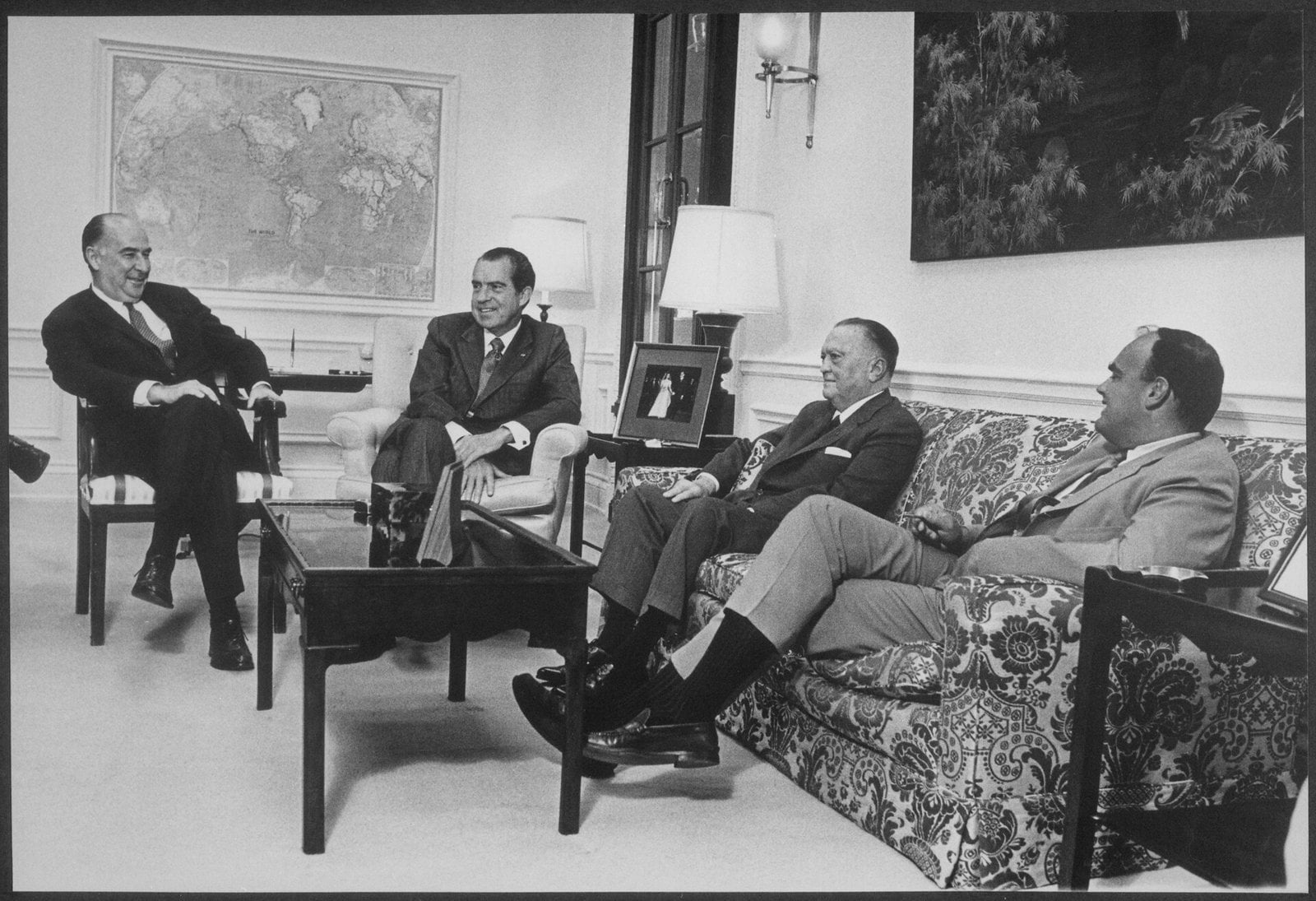
Clyde Tolson joined the Bureau as an agent in 1928 and became Hoover’s second in command. Gage told PBS that gossip columns of the 1930s show the two men together everywhere, especially at the Stork Club with their friend Walter Winchell, and that they “traveled as a couple.” Hoover lived with his mother for his whole adult life. The FBI’s 2012 portrait of a day in 1962 has a Bureau driver collecting Hoover, then Tolson, the two walking the last blocks to the Justice Department and lunching together at the Mayflower Hotel.
The men denied being gay and policed others for it. Gage told the Niskanen Center that the famous sexual stories rest on little firm evidence, but that the two “clearly really did love and care for each other,” in a relationship that lasted more than forty years.
Hoover never retired. On the morning of May 2, 1972, his housekeeper found him dead at home; the FBI says he “died in his sleep.” Flags flew at half-staff. He lay in state in the Capitol Rotunda on May 3 and 4 under a congressional resolution, an honor the FBI calls “afforded to no other civil servant before or since.” That day President Richard Nixon told reporters: “Every American, in my opinion, owes J. Edgar Hoover a great debt for building the FBI into the finest law enforcement organization in the entire world.” At Congressional Cemetery the folded flag from his casket was handed to Tolson.
Gage told PBS that Hoover had instructed his secretary to destroy his personal files, and that she began immediately; the official files survived. Within a year the FBI was caught up in Watergate, and its acting director, L. Patrick Gray, resigned on April 27, 1973. The Church Committee hearings of 1975 exposed COINTELPRO and the King campaign. In 1976 Attorney General Edward Levi issued guidelines allowing domestic security investigations only of groups breaking the law or engaging in violence, and the FBI says such cases fell from over 21,000 in 1973 to 626 by September 1976. The Foreign Intelligence Surveillance Act followed in 1978. Hoover’s name remains on the Bureau’s headquarters building.
Myth versus record
Myth: Hoover wore dresses. Record: the story comes from Anthony Summers’s 1993 book Official and Confidential, whose main source was Susan Rosenstiel. Writing for History News Network in 2002, Ronald Kessler noted that she had served time at Riker’s Island for perjury in a 1971 case and that Summers paid her for the interview. William Hundley, who had a Justice Department lawyer look into her claims, said: “It was made up out of whole cloth.” Summers told Kessler he holds “no firm view one way or the other.”
Myth: the Mafia blackmailed Hoover, so he left it alone. Record: the claim also comes from Summers. Oliver “Buck” Revell, a former FBI associate director, told Kessler that anything the Mafia had on Hoover would have been picked up on the organized crime wiretaps after Apalachin, and there was never a hint of it.
Myth: Kelly cried “Don’t shoot G-Men, don’t shoot.” Record: the FBI calls the Kelly story “apocryphal.”
Myth: Hoover denied the Mafia until Apalachin. Record: the Top Hoodlum Program began in 1953; the FBI concedes Apalachin intensified its effort.
People
- J. Edgar Hoover (1895 to 1972): FBI director, 1924 to 1972.
- Clyde Tolson: associate director and companion.
- Harlan Fiske Stone: attorney general who appointed him.
- A. Mitchell Palmer: attorney general behind the 1920 raids.
- William Sullivan: head of domestic intelligence.
- Martin Luther King Jr.: target of wiretaps and the 1964 letter.
- Fred Hampton and Mark Clark: killed in the 1969 raid.
- Jean Seberg: actress targeted through a 1970 gossip item.
- William O’Neal: FBI informant in the Chicago Panthers.
Timeline
- January 1, 1895: born in Washington, D.C.
- July 26, 1917: joins the Justice Department.
- January 1920: Palmer Raids.
- May 10, 1924: named acting director.
- July 1935: renamed the FBI.
- June 1942: Nazi saboteurs caught.
- 1956: COINTELPRO begins.
- November 1957: Apalachin.
- November 1964: King tape mailed.
- December 4, 1969: Hampton and Clark killed.
- March 8, 1971: Media burglary.
- May 2, 1972: dies in his sleep.
Frequently asked questions
How long did Hoover run the FBI?
48 years, from May 10, 1924, until his death on May 2, 1972.
Was Hoover ever charged with a crime?
No. The Church Committee’s findings came after his death.
Was Hoover gay?
There is no direct proof. Gage argues it is the most straightforward explanation of his life with Tolson.
Did the FBI try to drive King to suicide?
The Church Committee found the FBI mailed King a tape and a letter that he and his associates interpreted as an invitation to suicide.
Citations & Sources
Sources
- FBI: J. Edgar Hoover, May 10, 1924 – May 2, 1972
- FBI: The Hoover Legacy, 40 Years After: Part 1
- FBI: The Hoover Legacy, 40 Years After: Part 2
- FBI: The Hoover Legacy, 40 Years After: Part 3
- FBI: The Hoover Legacy, 40 Years After, Part 4
- FBI: The Hoover Legacy, 40 Years After: Part 5
- FBI: Palmer Raids
- FBI: The FBI and the American Gangster, 1924-1938
- FBI: World War, Cold War, 1939-1953
- FBI: And Justice for All, 1954-1971
- FBI: Crime and Corruption Across America, 1972-1988
- FBI: Duquesne Spy Ring
- FBI: Nazi Saboteurs and George Dasch
- FBI: Atom Spy Case/Rosenbergs
- FBI: Mississippi Burning
- U.S. Senate (Church Committee), via AARC: COINTELPRO: The FBI’s Covert Action Programs Against American Citizens
- U.S. Senate (Church Committee): Dr. Martin Luther King, Jr., Case Study
- U.S. Senate (Church Committee), via AARC: The FBI’s Covert Action Program to Destroy the Black Panther Party
- U.S. Court of Appeals, Seventh Circuit: Hampton v. Hanrahan, 600 F.2d 600
- U.S. Government Publishing Office: Deschler-Brown Precedents, Volume 17, Chapters 34 – 40 – § 12. Lying-in-State; Lying in Honor
- UPI: Survivors of two Black Panther leaders killed by police…
- NPR: The Secret Burglary That Exposed J. Edgar Hoover’s FBI
- Washington Post: Remembering an earlier time when a theft unmasked government surveillance
- The Nation: Breaking 43 Years of Silence, the Last FBI Burglar Tells the Story of Her Years in the Underground
- The Guardian: How the FBI used a gossip columnist to smear a movie star
- NPR: ‘G-Man’ biography traces J. Edgar Hoover’s power at the FBI and his legacy
- Los Angeles Times: A Faulty Tip, a Ruined Life and Hindsight
- Niskanen Center: The paradoxical life of J. Edgar Hoover, with Beverly Gage
- PBS: History with David Rubenstein: Beverly Gage: Season 5: Episode 1
- WBUR On Point: Understanding J. Edgar Hoover’s America
- U.S. Department of Justice: Overview of Investigation Of Allegations Regarding The Assassination Of Dr. Martin Luther King, Jr.
- History News Network: Did J. Edgar Hoover Really Wear Dresses?
Image credits
- Photo: George Washington University yearbook, 1916, via FBI.gov and Wikimedia Commons. Public domain.
- Photo: National Photo Company Collection, Library of Congress, via Wikimedia Commons. Public domain.
- Photo: Harris & Ewing Collection, Library of Congress, via Wikimedia Commons. Public domain.
- Photo: Abbie Rowe, White House Photographs, via the John F. Kennedy Presidential Library and Museum and Wikimedia Commons. Public domain.
- Photo: Byron Schumaker, White House, via the U.S. National Archives and Wikimedia Commons. Public domain.
Browse every case in the Case File Index
Discover more from The Dark Side of Humanity
Subscribe to get the latest posts sent to your email.