FILE NO. 0126Case status Missing
Canadian theatre magnate Ambrose Small disappeared from Toronto on December 2, 1919, shortly after receiving a one-million-dollar payment for the sale of his business. He was last seen at the Grand Opera House following a meeting with his lawyer, leaving behind substantial property and securities.
Despite extensive investigations, no physical evidence or remains were ever recovered. Small’s secretary was convicted of stealing bonds, but no one was charged in connection with the disappearance. Small was legally declared dead in the 1920s, and his ultimate fate remains unsolved.
of HumanityKillers. Cults. Crime.

Ambrose Small Disappearance
The theatre magnate who left his office and disappeared from the record.
What Happened to Ambrose Small?
The direct answer before the long file.
He vanished after a theatre-sale meeting
Ambrose Small was a wealthy Canadian theatre impresario who disappeared in Toronto on December 2, 1919, one day after receiving a $1 million payment toward the sale of his theatre interests. His last reliable contact was a meeting with lawyer E. M. W. Flock at Toronto’s Grand Opera House. Small was never reliably seen again, no confirmed body was recovered, and no one was convicted in connection with his disappearance.
Was Ambrose Small ever found?
No. Ambrose Small was never conclusively found. Numerous sightings and theories emerged after his December 1919 disappearance, but none established a verified later movement, body, or confirmed fate.
Did he disappear with $1 million?
No. The large payment had entered the couple’s banking system. Small did not simply walk away carrying the theatre-sale proceeds in cash.
Last reviewed: September 2026
Archival and legal sources are preferred. Later theories are attributed and graded as documented, separately proved, reported/disputed, or unresolved.
Ambrose Small Disappearance: Key Facts
The disappearance is secure history; the manner and cause are not.
2 Dec 1919
The reliable trail ends after an afternoon meeting at the Grand Opera House.
Grand Opera House
11 Adelaide Street West, Toronto; Small’s office and business headquarters.
About $1.7M
The theatre interests had been sold; $1 million was received on account.
Unresolved
No body, verified ransom demand, proven killer or confirmed voluntary route.
No
No verified remains have ever been identified as Ambrose Small.
$105K theft
John Doughty was convicted of stealing Victory Bonds, not of Small’s disappearance.
What Is Known About Ambrose Small’s Disappearance?
A clean claim ledger prevents coincidence, suspicion and verdict from becoming interchangeable.
Who Was Ambrose Small?
A successful impresario became easier to sensationalize than to trace.
Who was Ambrose Small?
Ambrose Joseph Small was a Canadian theatre impresario born in 1866 who built one of the country’s important early theatre circuits. By the 1910s, he controlled, leased, owned, or booked theatres across Ontario and had become one of the best-known figures in Canadian live entertainment.
From usher to impresario
Born in Bradford in 1866, Small entered the Grand Opera House world as a young worker, ushering, handling bar duties, taking bets and learning how audiences, bookings and touring companies worked.
Aggressive operator
He was energetic, adaptive and commercially shrewd. Contemporaries also described him as ruthless, a gambler and an employer who accumulated enemies. Character evidence may explain the volume of theories; it does not identify what happened.
A public man with private rooms
His affairs and a secret chamber at the Grand became central to press coverage. The sexual history helps explain Theresa’s initial assumption that he had left with a woman, but it does not prove voluntary disappearance.
Ambrose Small’s Theatre Empire
The sale was the endpoint of a real business transition, not merely the opening scene of a mystery.
The booking circuit
Small built influence through theatre ownership, leases and booking control. The circuit connected Toronto with Hamilton, Kingston, Peterborough, St Thomas, London and other centres, positioning him between Canadian audiences and touring companies.
A changing entertainment market
By 1919, touring costs were rising while vaudeville and motion pictures were changing the economics of live theatre. The sale was commercially intelligible and should not be treated as automatic evidence that Small planned to disappear.
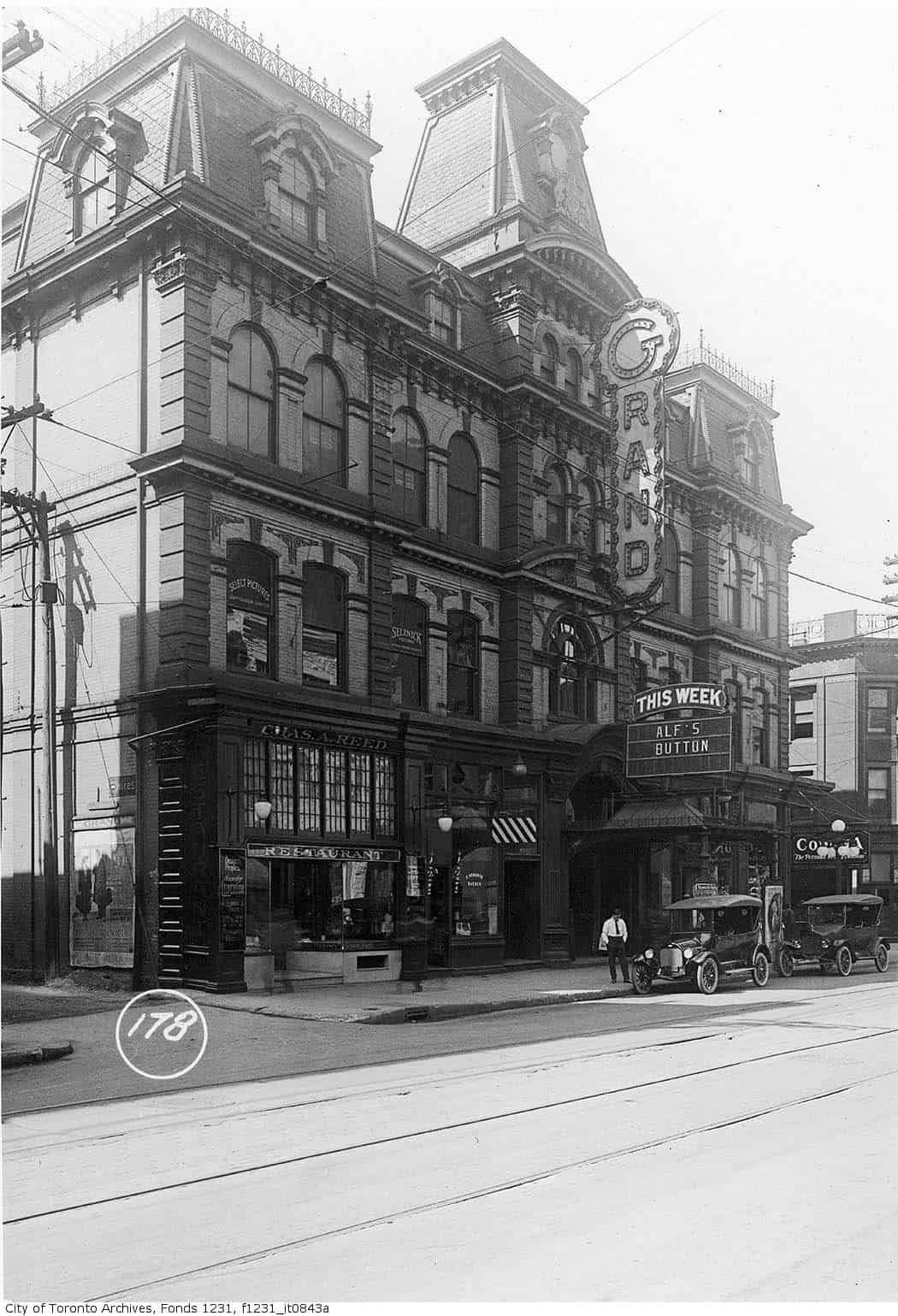
Grand Opera House: Ambrose Small’s Last Known Location
A vanished building became the geographic centre of a vanished-person case.
Toronto in 1919
A modernizing city offered both visibility and anonymity.
Postwar city
Toronto emerged from the First World War amid inflation, labour conflict, returning soldiers and the disruptions of the 1918–19 influenza era. A millionaire disappearance entered a city already negotiating authority and social change.
Streetcars, rail and hotels
A person could move rapidly through downtown, board a train, take a car or disappear into hotel and entertainment networks without leaving the electronic traces expected today.
Class and reputation
Small’s wealth amplified the search while his gambling, business conduct and affairs created a suspect list built partly from social judgement. Money purchased investigators and rewards, but it also generated noise.
The $1.7 Million Theatre Sale Before Ambrose Small Disappeared
A large transaction created motive theories, but the financial trail is more complex than “he vanished with the cheque.”
The money did not vanish with him
The million-dollar payment was deposited. Small did not disappear carrying the entire sale proceeds in cash, and he left substantial securities and property behind. That fact weighs against a simple planned escape but cannot eliminate a concealed financial arrangement.
Modern conversion can mislead
The historical significance lies in purchasing power, business scale and estate control, not in a single present-day inflation number. Any modern equivalent depends on whether one compares consumer prices, wages, GDP share or capital value.
Ambrose Small’s Last Known Day: December 2, 1919
The central evidentiary line ends in an ordinary business meeting, not a witnessed abduction.
Morning: gifts and banking
Theresa deposited the million-dollar cheque while Ambrose reportedly arranged a Cadillac, fur coat and jewellery for her. Those actions are difficult to reconcile with an obvious plan to abandon the marriage that day, though behaviour is not proof of intent.
Afternoon: lawyer at the Grand
Small met London lawyer E. M. W. Flock at the Grand Opera House. Flock left to catch a train. The narrow, responsible statement is that Small was reliably present at the theatre late that afternoon and was never reliably documented again.
Ambrose Small Disappearance Timeline
The order of money, meetings, delay and publicity matters more than any single dramatic theory.
The Smalls agreed to sell their theatre chain to Trans-Canada Theatres Limited for about $1.7 million.
The first major payment was received on account. The business transaction was real and documented.
Theresa handled the bank deposit while Ambrose arranged expensive gifts for her.
Ambrose met lawyer E. M. W. Flock at the Grand Opera House. Flock left for his train.
Later reported sightings exist, but the date, identity or certainty of those sightings is contested.
Theresa initially thought he had left with another woman and feared scandal. The delay cost investigative time.
Rewards, circulars and an international flood of tips transformed the disappearance into a national spectacle.
John Doughty was found in Oregon after fleeing with bonds removed from Small’s bank box.
Doughty was convicted of stealing the bonds. The disappearance itself remained unproved against him.
Small was declared dead for probate purposes, and Theresa’s claim under the will survived litigation.
The last-known building disappeared, taking with it a physical environment that had already been repeatedly searched.
Toronto police closed a massive file after decades of leads, false sightings and unresolved theories.
Was Theresa Small Involved in Ambrose Small’s Disappearance?
Delay, inheritance and marital knowledge made her a target of suspicion; none became a criminal case.
Business partner and spouse
Theresa’s inheritance helped finance the Grand, and the couple acted together in business. She was not merely a passive beneficiary who appeared after the disappearance.
The reporting delay
She did not immediately involve police because Small had left without warning before and she feared an affair-related scandal. The delay damaged the investigation but does not by itself establish guilt.
Estate and accusation
Small’s sisters believed Theresa was involved and challenged the will. Investigators found no evidence sufficient to charge her. She ultimately received the estate and later left much of her wealth to Catholic charities.
John Doughty: Theft, Flight and the Ambrose Small Mystery
The most suspicious documented conduct in the case remained legally separate from the disappearance.
John Doughty had long served as Small’s secretary. He removed $105,000 in Victory Bonds from a safety-deposit box and fled under an alias. The bonds were recovered, and he was convicted of theft.
Doughty’s theft occurred on the day Small vanished. That coincidence is powerful circumstantial context but does not prove abduction, murder or coordination.
Authorities investigated kidnapping and conspiracy possibilities but lacked evidence to establish that Small had been abducted or that Doughty had caused his disappearance.
It proves dishonest appropriation of securities and flight. It does not identify Small’s location, explain the absence of a body or establish that Doughty ever encountered Small after the lawyer left.
The Small Family Conflict
A missing-person investigation became an inheritance battle and a public war over character.
The sisters’ campaign
Mary Florence Maude and Gertrude Mercedes Small rejected Theresa’s position, hired private detective Patrick Sullivan and argued that Ambrose had been murdered. Their campaign intensified the public feud and probate litigation.
Religion and inheritance
Theresa’s stated intention to benefit the Catholic Church inflamed sectarian and family hostility. The resulting tabloid war produced allegations that were politically and religiously charged as well as evidentiary.
Associates, Staff and Rivals
A broad social network offered many possible grievances and very little testable evidence.
E. M. W. Flock
The lawyer who met Small at the Grand on 2 December supplied the last reliable business contact. His departure time anchors the disappearance window.
Theatre employees
Staff knew the Grand’s offices, backstage spaces and routines. Their access generated theories, but ordinary access is not evidence of participation.
Business rivals and creditors
Small’s aggressive practices created enemies. Investigators and journalists repeatedly turned hostility into motive speculation without producing a physical or documentary bridge to the disappearance.
Where Was Ambrose Small Last Seen?
The theatre was a transit environment, not a preserved crime scene.
Not a sealed room
The Grand was a working commercial building with offices, shops, theatre spaces, stage access and street connections. “Vanished from his office” should not be transformed into a literal locked-room claim.
No preserved forensic scene
No one knew immediately that a crime had occurred. There was no rapid scene closure, trace collection, systematic fingerprint survey or controlled reconstruction of who entered and left.
The Search for Ambrose Small
The case exposed the limits of a system designed for local offences, not a wealthy person who simply stopped appearing.
Because Theresa initially expected Ambrose to return, police lost the earliest opportunity to confirm movements, preserve spaces, question witnesses while memory was fresh and alert transportation hubs.
A moustached middle-aged man in a hat and overcoat was not a uniquely identifiable figure in 1919. Publicity produced numerous sincere mistakes and opportunistic claims.
Toronto police, provincial authorities, banks, rail lines, private detectives and distant agencies did not operate through a unified digital system. Information moved by telephone, telegraph, circular and newspaper.
Without a body or reliable death evidence, investigators could not assume homicide, and prosecution theories faced the threshold problem of proving that Small was dead.
Search Operations
Extensive searching produced absence, not an identified route.
Buildings and basements
Investigators and later searchers examined Small-related properties, including the Grand and the Rosedale home. No remains or decisive physical evidence were recovered.
Ravines and waterways
Toronto’s ravines, waterfront and other disposal possibilities entered the search. The absence of a find cannot distinguish between no body, a missed body or a body placed elsewhere.
Intercity theories
Small’s theatre circuit linked Toronto with other Ontario cities. Searches and furnace stories spread beyond the last-known location, increasing scope while reducing evidentiary precision.
Rewards and the Tip Economy
Money expanded the search while making every new claim harder to evaluate.
Rewards amplified reach
Theresa posted rewards, and later offers grew dramatically. The money encouraged national and international reporting, witness contact and the hunt for Doughty.
Rewards amplified contamination
Large rewards also attracted fabricated sightings, self-appointed detectives, blackmail attempts and people reshaping memories to fit the public description.
Psychics, Sightings and Noise
The absence of evidence became a market for stories.
Clairvoyant claims
Psychics supplied locations, visions and narratives. The police file accumulated such tips because the case had no physical centre and the reward made attention valuable.
False sightings
Reports placed Small across North America and beyond. None created a verified chain of travel, financial activity, lodging or communication.
Why the stories persisted
A missing body leaves narrative space. Theatre culture, secret rooms, wealth and a vanished building made the case unusually compatible with supernatural and melodramatic retelling.
Ambrose Small Suspects and Persons of Interest
Every theory requires both the incriminating circumstance and the missing evidentiary bridge.
Theories About What Happened to Ambrose Small
The case offers many plausible reasons and no proved mechanism.
Theresa received the estate under the will. Financial benefit is real, but the sale and marriage had long been financially intertwined, and investigators did not prove a murder arrangement.
Doughty had a powerful reason to prevent rapid discovery of the missing securities. The unresolved question is whether Small’s disappearance was necessary to the theft or merely coincidental to it.
Small’s tactics and personality created grievances. No named rival was tied to a disappearance event through reliable witness, payment, travel or physical evidence.
Affairs created possible aggrieved partners and spouses, but the published record does not establish a specific offender, confrontation or disposal route.
A theatre man understood disguise, travel and performance. Yet leaving the deposited fortune and leaving no verified later financial trace make simple flight difficult to sustain.
An unrecognized accident or suicide could explain the absence of a perpetrator, but no body, location, note or precursor behaviour was established.
The Body-in-the-Furnace Theory
A vivid disposal story survived because it converted total absence into a physical ending.
The London Grand story
A later theory alleged that Theresa and a lover killed Small and burned his body in a furnace at the Grand theatre in London, Ontario. A caretaker’s report of unusual fumes became part of the legend.
Why it remains unproved
The story lacks a recovered body, tested residue, documented transport from Toronto, independently established accomplice conduct or a conviction. Furnace capability and odour are not enough to establish incineration.
Financial Analysis
Follow the assets, but do not confuse benefit with causation.
How Missing-Person Investigations Changed After Cases Like Ambrose Small
The case illustrates how an early assumption of voluntary absence can erase the best investigative window.
Immediate report
Modern practice emphasizes prompt reporting; adults need not wait 24 hours to be reported missing when circumstances are unusual.
Last-seen verification
Separate confirmed observations from publicity-driven sightings and record exact times, routes and confidence.
Financial preservation
Flag accounts, cards, devices and securities while protecting evidence and legal rights.
Scene and digital review
Preserve likely last locations, transit data, camera footage, communications and access logs before systems overwrite them.
Media Obsession
The case became a story about Toronto before it became a solved account of one person’s fate.
National obsession
The combination of wealth, theatre, sexual scandal and a million-dollar transaction made the case irresistible. Newspapers converted investigative uncertainty into daily content.
Character as evidence
Reports alternated between ruthless “bare-knuckle” capitalist, charming impresario and moral degenerate. None of those portraits could establish his final movement.
Cultural afterlife
Books, articles, radio, visual art and fiction, including Michael Ondaatje’s In the Skin of a Lion, kept Small present as a symbol of vanished Toronto wealth.
Why Was Ambrose Small Declared Dead?
Courts can settle ownership while the underlying disappearance remains unknown.
Death for probate purposes
Small was pronounced dead in the early 1920s so the estate could be administered. A civil declaration based on prolonged absence is not a forensic determination of date, place or cause of death.
The will contest
His 1903 will left the estate to Theresa. His sisters challenged the result and failed. The judgment resolved property rights, not criminal responsibility.
Theatre and Toronto Legacy
The man disappeared; the building followed; the story remained.
The Grand’s final years
The theatre continued after Small vanished, reverted to the estate after the purchasing company’s financial problems and closed as entertainment economics changed.
Demolition and urban erasure
The Grand was demolished in 1928. The destruction removed the last-known environment and folded the case into Toronto’s larger history of lost buildings.
Grand Opera Lane
The surviving lane name marks a vanished venue. Responsible local reporting can use the site to discuss theatre, urban development and investigative loss without claiming a haunting as evidence.
Unresolved Questions
The case can be narrowed without being solved.
No reliable witness or trace establishes Small’s movement after the afternoon meeting.
Some reports place him outside the Grand, but uncertainty about timing and identification prevents a secure extension of the timeline.
His conduct was criminal and suspicious, but no surviving proof connects him to Small’s body or disappearance.
The absence weakens a conventional kidnapping theory but does not exclude a failed abduction or murder.
Possible in 1919, but no verified financial, travel, correspondence or death record has established it.
Furnace and chemical-disposal claims remain narrative solutions without tested remains or a documented transport chain.
It funded a massive search while attracting false claims, sectarian conflict, private detectives and press distortion.
Attorney General files, OPP records, court materials, newspaper archives, Flock papers and estate documents can still refine chronology and source reliability.
Ambrose Small Disappearance FAQ
Search-led answers for the missing-millionaire case.
Who was Ambrose Small?
Ambrose Small was a Canadian theatre magnate whose Ontario theatre holdings made him a millionaire before his 1919 disappearance.
When did Ambrose Small disappear?
His reliable trail ends on December 2, 1919, after a meeting at Toronto’s Grand Opera House.
Where was Ambrose Small last seen?
The responsible last-seen location is the Grand Opera House on Adelaide Street West in Toronto.
Was Ambrose Small ever found?
No. No verified body or confirmed later route has established his fate.
Did Ambrose Small disappear with $1 million?
No. The major sale payment was deposited; the case is not simply a story of a man walking away with cash.
Who was John Doughty?
Doughty was Small’s secretary. He was convicted of stealing Victory Bonds, not of killing or abducting Small.
Was Theresa Small suspected?
She was discussed in theory because of delay, inheritance and marriage context, but no criminal case proved her responsible.
What is the furnace theory?
It is the unproved theory that Small was killed and his body destroyed in a theatre furnace. No physical evidence proves that claim.
Could Ambrose Small have disappeared voluntarily?
Voluntary disappearance remains a theory, but it is weakened by the deposited funds, gifts ordered for Theresa, and lack of a reliable later identity or travel trail.
Why was Ambrose Small declared dead?
The declaration allowed estate administration after prolonged absence. It did not prove where, when, or how he died.
Sources, Method and Glossary
Primary-adjacent archives, authoritative biography and careful claim labels provide the strongest research path.
Dictionary of Canadian Biography
Career, marriage, sale, disappearance, estate, furnace allegation and archival references.
Open source ↗Historica Canada / Canadian Encyclopedia
Public-history synthesis of the disappearance and its continuing cultural importance.
Open source ↗University of St. Michael’s College
Description of the Ontario Supreme Court judgment concerning Theresa Small and the estate.
Open source ↗TorontoJourney416
Grand Opera House architecture, archival image references and local chronology.
Open source ↗Archives of Ontario: Criminal justice records
Gateway to OPP, court and investigation record series relevant to historical case research.
Open source ↗Archives of Ontario: Wills and estate files
Research path for probate and estate administration records.
Open source ↗Katie Daubs, The Missing Millionaire
Leading modern narrative built from newspapers and archives; verify individual claims against cited records.
Open source ↗Fred McClement, The Strange Case of Ambrose Small
A major earlier book-length treatment, useful for historiography and comparison of later theories.
Open source ↗Claim ledger
Each statement is labelled documented, separately proved, reported, disputed or unresolved.
- Confirmed last sighting
- The latest observation supported by a reliable witness and a secure date and context.
- Declared dead in absentia
- A legal finding allowing estate administration after prolonged unexplained absence; not a forensic cause-of-death ruling.
- Person of interest
- A person investigators examine because of relationship, opportunity or conduct. It is not a criminal charge.
- Circumstantial evidence
- Facts from which another fact may be inferred. It can be powerful, but each link must be established.
- False sighting
- A report caused by mistaken identity, faulty timing, suggestion, reward seeking or fabrication.
- Probate
- The legal process validating a will and administering a deceased person’s estate.
- Victory Bonds
- Canadian government bonds sold to finance wartime expenditure; the securities Doughty stole were portable assets.
- Ransom demand
- A communication conditioning release or information on payment. None was verified in Small’s disappearance.
- Evidence contamination
- Loss or distortion caused by delay, uncontrolled access, publicity, memory change or handling.
- Voluntary disappearance
- An intentional departure arranged by the missing person. It remains one theory here, not a conclusion.
- Unresolved disappearance
- A case in which the missing person’s location and fate have not been reliably established.
- Narrative closure
- A psychologically satisfying ending, such as a furnace story, that may survive without sufficient evidence.
Browse every case in the Case File Index
Discover more from The Dark Side of Humanity
Subscribe to get the latest posts sent to your email.