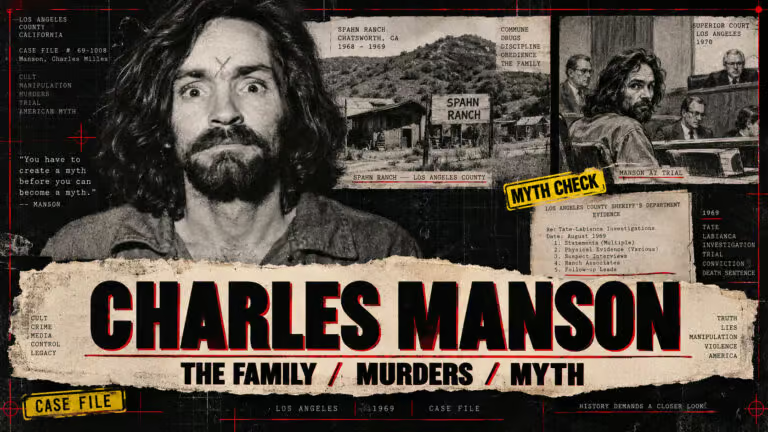
Charles Manson led a coercive commune in California during the late 1960s, using isolation, drugs, and apocalyptic rhetoric to manipulate followers. In 1969, members of the group committed nine murders, including the Tate–LaBianca victims, Gary Hinman, and Donald Shea.
Although Manson rarely inflicted fatal wounds himself, California courts upheld his nine first-degree murder convictions based on conspiracy, solicitation, and command. His death sentence was later commuted to life imprisonment, and he remained in custody until his death in 2017.
Charles
Manson
The Family, the murders, the control system, the music-world bridge, the trial record—and the mythology that made one manipulator larger than the people he harmed.

What Actually Happened?
The compressed answer before the mythology takes over.
Charles Manson built the Manson Family into a coercive communal group in late-1960s California and used status, isolation, sex, drugs, apocalyptic rhetoric, interpersonal domination and criminal loyalty to shape follower behavior. In 1969, members of the group committed the Hinman, Tate–LaBianca and Shea murders. California courts upheld Manson’s murder convictions even where he did not personally inflict the fatal wounds because the prosecution proved conspiracy, solicitation, command and participation sufficient for criminal liability.
Case Snapshot
What is legally established, what is historically inferred, and what should remain separate.
Nine murders
Seven Tate–LaBianca murders in the 1971 judgment, followed later that year by convictions for the murders of Gary Hinman and Donald Shea.
Not one killer
The criminal record names distinct actors with distinct conduct. Manson’s command role matters, but so do the actions of Tex Watson, Susan Atkins, Patricia Krenwinkel, Leslie Van Houten and others.
“Brainwashing” is too simple
The evidence supports a coercive high-control environment, but the followers were not interchangeable puppets. Individual agency, ideology, fear, belonging, violence and criminal participation varied.
Before the Family
Institutionalization, crime, prison culture and the danger of turning biography into destiny.
A life repeatedly inside institutions
Manson was born in Cincinnati in 1934 and spent much of his youth and early adulthood moving through juvenile institutions, reform schools and federal custody. His pre-Family record included theft, auto offenses, forgery, pimping-related conduct and repeated parole violations. By the time he was released from federal prison in March 1967, he had spent a large share of his life under institutional control.
Trauma is not an explanation for murder
The old dossier treated childhood instability and institutional abuse as a direct causal road to homicide. That is too neat. Adversity can shape development, but it does not predict cult leadership or murder. The evidentiary story begins with what Manson later did: manipulation, violence, coercion, criminal direction and repeated exploitation.
The Control System
How belonging became dependency—and dependency became obedience.
For a broader evidence-based framework on coercive groups, see deadly cult evidence and coercive control.
The Music-World Bridge
Dennis Wilson, Terry Melcher, Cielo Drive and the part of the story that was real before it became legend.
Manson got unusually close to the industry
Beach Boys drummer Dennis Wilson became entangled with Manson and his followers in 1968, allowing them into his home and introducing Manson to people in the Los Angeles music business. The Beach Boys later recorded a reworked version of Manson’s “Cease to Exist” as “Never Learn Not to Love.”
Cielo Drive was not an unknown address
Producer Terry Melcher had lived at 10050 Cielo Drive and knew Manson through Wilson. Trial testimony established that Melcher had heard Manson perform at Spahn Ranch. The later murder site was therefore a property Manson knew, even though Melcher no longer lived there when Sharon Tate and Roman Polanski rented it.
“Helter Skelter”
What the prosecution proved, what later retellings simplified, and why motive is not the same as mythology.
Apocalyptic race war
California appellate records preserve testimony that Manson predicted a coming racial conflict and used “Helter Skelter” as a label for the upheaval. The prosecution argued that spectacular murders of white victims could be staged to accelerate or mimic that war.
One motive does not explain every decision
The Helter Skelter theory is part of the evidentiary record, but it should not erase other pressures: Manson’s musical rejection, disputes around Gary Hinman, efforts to protect or free associates, interpersonal domination, opportunism and the group’s escalating violence. A prosecution theory can be legally sufficient without becoming the only psychological explanation.
The Victims
Nine people in Manson’s murder convictions—not a body count, not scenery for offender mythology.
July 1969
Musician and acquaintance of group members. His killing predated the Tate–LaBianca murders and helped expose the Family’s transition from coercive commune to organized lethal violence.
August 9, 1969
Actor, eight months pregnant. Her fame has often made her the shorthand for the entire case, but the night contained five separate victims and a household of distinct lives.
August 9, 1969
Celebrity hairstylist and friend of Tate. He was among those attacked inside 10050 Cielo Drive.
August 9, 1969
Publishing heiress and social activist. She had been staying at the Cielo Drive residence with Wojciech Frykowski.
August 9, 1969
Writer and film-industry associate. He was attacked as he tried to escape the house and property.
August 9, 1969
A recent high-school graduate visiting caretaker William Garretson. He encountered the killers while leaving the property and became the first person killed that night.
August 10, 1969
Grocery executive killed in his Los Feliz home during the second night of violence.
August 10, 1969
Business owner killed alongside her husband. Leslie Van Houten’s later legal history centered on her participation in this killing.
Late August 1969
Spahn Ranch hand and stuntman. Manson was later convicted of his murder; Steve Grogan eventually led authorities to Shea’s remains.
Chronology of Escalation
The sequence is more revealing than the legend.
Release from federal prison
Manson left federal custody and moved into the Bay Area counterculture before drifting south with a growing circle of followers.
Dennis Wilson connection
The Family stayed for a time at Wilson’s home, bringing Manson into contact with music-industry figures including Terry Melcher.
Spahn Ranch
The group settled at the former movie ranch in Chatsworth, where Manson’s authority, criminal networking and internal control intensified.
Gary Hinman murdered
Bobby Beausoleil, Susan Atkins and Mary Brunner were central participants; Manson’s involvement became the basis of a separate murder conviction.
Tate murders
Tex Watson, Susan Atkins, Patricia Krenwinkel and Linda Kasabian were sent to Cielo Drive. Kasabian remained outside and later became the prosecution’s key cooperating witness.
LaBianca murders
Manson accompanied the group, entered the LaBianca house and bound the couple before leaving. Watson, Krenwinkel and Leslie Van Houten committed the fatal attacks.
Donald Shea killed
The Spahn Ranch hand disappeared after tensions with the group. Manson was later convicted of his murder.
Barker Ranch arrests
Manson and followers were arrested during desert raids initially tied to vehicle theft and related offenses, not yet the Tate–LaBianca case.
Atkins talks in jail
Susan Atkins’s jailhouse statements to other inmates helped direct investigators toward the Family and the murder sequence.
Trial and convictions
Manson, Atkins and Krenwinkel were convicted in the Tate–LaBianca case; Van Houten was convicted for the LaBianca murders.
Hinman and Shea convictions
Manson received additional first-degree murder convictions for both deaths.
Death sentences vacated
California’s death penalty was invalidated under People v. Anderson; Manson’s sentence became life imprisonment.
Manson dies in custody
CDCR reported that Manson died of natural causes at age 83 while serving his life sentence.
Who Did What?
Group crime becomes inaccurate when everyone is reduced to “Manson’s followers.”
Command / conspiracy
Issued orders, shaped the ideological frame, participated in selecting or preparing targets, entered the LaBianca residence and was convicted as a principal conspirator and murderer.
Primary physical actor
Central killer at both Tate and LaBianca scenes; used firearm and knife violence and directed others during the attacks.
Tate participant
Participated in the Cielo Drive murders and later made jailhouse statements that became critical to the investigation.
Tate + LaBianca
Participated in both murder nights and was convicted of the Tate–LaBianca killings.
LaBianca participant
Participated in the killing of Rosemary LaBianca. Her later parole history became a major public debate over rehabilitation, culpability and Manson’s influence. Van Houten was released on parole in July 2023 after decades in custody; that later parole assessment did not revise the murder conviction or erase her criminal responsibility.
For wider context on women as active participants in group homicide, see female offenders and active participation in group murder.
Linda Kasabian
Drove and acted as lookout on the first night, did not enter the Tate residence, and later testified for the prosecution under immunity. Her testimony was crucial to reconstructing Manson’s commands and the sequence.
How the Case Broke
Not one clue: overlapping witnesses, jailhouse disclosures, ballistics, scene links, Family associates and police work.
Two nights, linked staging
Blood-written words and the obvious overkill at both scenes suggested connection, but the investigation did not immediately unify the cases. The eventual case depended on connecting scene evidence to people around Spahn Ranch.
Atkins becomes a break point
While jailed on the Hinman matter, Atkins described the Tate murders to fellow inmates. Those disclosures became a major investigative bridge from an already-known Family member to the unsolved August killings.
Kasabian and former insiders
Kasabian’s testimony supplied a first-person account of the murder nights. Other associates described Manson’s statements, Helter Skelter rhetoric, commands and the group’s internal hierarchy.
Weapons, clothing, vehicles and locations
The prosecution tied physical evidence, firearms, vehicles, witness accounts and the group’s movements together. Manson’s liability did not depend on proving that his hands held every weapon.
The Trial Record
Why “he didn’t personally kill them” did not defeat murder liability.
Evidence Ledger
What each category can establish—and where interpretation starts.
| Evidence | Supports | Limit |
|---|---|---|
| California appellate opinions | Charges, testimony summaries, conduct, convictions, legal reasoning. | Appellate opinions summarize trial records; they are not full transcripts. |
| CDCR record | Nine murder convictions, sentence history, date/cause of death. | Administrative history does not explain motive. |
| Kasabian testimony | Manson’s orders, group movement, sequence of murder nights. | Cooperating witnesses require corroboration and credibility assessment. |
| Atkins jailhouse statements | Investigative lead linking the Family to Tate murders. | Atkins changed or embellished accounts over time. |
| Crime-scene staging | Links between scenes, offender messaging, intent to shock or misdirect. | Writing and symbols do not by themselves prove the entire Helter Skelter theory. |
| Melcher testimony | Manson knew Melcher and had been at/connected to Cielo Drive. | Music rejection alone cannot explain all the killings. |
Archival Image File
Public-record and archival visuals—victims and evidence before spectacle.
.jpg)
Sharon Tate, 1967. Publicity portrait from before her murder. Source record.

Manson booking image, January 1971. Source record.

1971 custody images of Susan Atkins, Tex Watson and Patricia Krenwinkel. Source record.
.jpg)
Barker Ranch, later desert refuge associated with the Family’s 1969 arrests. Modern archival context image. Source record.

Sandra Good, 1969 Spahn Ranch raid mugshot. Included as a record of the broader Family network, not as evidence she participated in the Tate–LaBianca murders. Source record.
.jpg)
Sharon Tate and Roman Polanski, 1967 publicity image. Source record.
Manson on the witness stand
Bill Robles’s November 1970 courtroom drawing documents Manson during the Tate–LaBianca trial. Open LOC record.
Manson testifies
Arnold Mesches’s 1970 courtroom drawing provides a second trial-era archival view with no need for sensational crime-scene imagery. Open LOC record.
Myth vs. Record
The case has been retold so often that shorthand now competes with evidence.
False. His criminal liability arose from conspiracy, orders, direct participation in parts of the plan and separate involvement in Hinman/Shea. Different followers inflicted fatal violence in different cases.
False. The nine convicted-murder victims included a musician, a ranch hand, a teenage visitor, business owners and friends of Tate as well as Tate herself.
Too simple. It was a major prosecution theory supported by testimony, but the record also includes criminal disputes, music-industry resentment, loyalty enforcement and escalating group violence.
Too simple. Coercive control matters, but the law and historical record distinguish individual conduct. Different participants made different choices and committed different acts.
The “evil mastermind” frame often turns improvisation, intimidation and opportunism into strategic brilliance. His power depended on a small, unstable social system—not supernatural charisma.
Afterlife of the Case
Parole, pop culture, moral panic and the commercial immortality of Manson’s face.
The offender became the logo
Manson’s image became a commodity—shirts, album covers, films, documentaries, memorabilia and endless “most evil” rankings. That commercial afterlife can make the person who issued orders seem more important than the people who died or the followers who actually carried out the killings.
Put the names back
The cleanest correction is structural: name the nine convicted-murder victims, separate the actors, distinguish proven conduct from legend, and treat every later conspiracy claim as a claim that needs evidence. That same editorial approach runs through the site’s victim-first true crime archive.
Charles Manson FAQ
Direct answers to the case questions most often flattened by mythology.
Did Charles Manson personally kill the Tate–LaBianca victims?
No. Manson’s murder liability came from conspiracy, command, solicitation and participation. The record distinguishes his control role from the people who physically carried out the fatal attacks.
How many murders was Charles Manson convicted of?
Manson was convicted of nine first-degree murders: the seven Tate–LaBianca victims, plus Gary Hinman and Donald “Shorty” Shea.
Who were the Tate–LaBianca victims?
The Tate victims were Sharon Tate, Jay Sebring, Abigail Folger, Wojciech Frykowski and Steven Parent. The LaBianca victims were Leno and Rosemary LaBianca.
What was Helter Skelter?
Helter Skelter was the prosecution’s name for Manson’s apocalyptic race-war theory. It was part of the trial record, but it should not erase other motives, disputes and control dynamics.
Was the Manson Family a cult?
The group showed many high-control features: isolation, dependence, sexual control, ideological pressure, loyalty tests, criminal escalation and obedience to Manson’s authority.
Why does the Manson case still matter?
The case remains important because it shows how coercive groups, offender mythology, media fascination and victim erasure can distort public understanding of murder.
Source Ledger
Court records and official archives first; reputable historical reporting second.
People v. Manson — Tate–LaBianca
California appellate opinion covering the seven-murder prosecution, conspiracy evidence, witness testimony and trial issues. Open opinion.
People v. Manson — Hinman & Shea
California appellate opinion covering the separate Gary Hinman and Donald Shea murder convictions. Open opinion.
California Department of Corrections
CDCR’s death notice summarizes Manson’s nine first-degree murder convictions, sentencing history and 2017 death. Open CDCR record.
FBI Vault: Charles Manson
Four-part federal file collection categorized under violent crime. Open FBI Vault.
Los Angeles Times archive
Contemporary and retrospective reporting on the 1969 investigation, Spahn Ranch, the music-world connection and long-term Los Angeles impact. Open archive story.
Library of Congress
Courtroom illustration records from Manson’s 1970 trial provide archival visual documentation without relying on exploitative crime-scene imagery. Open LOC exhibition.
Discover more from The Dark Side of Humanity
Subscribe to get the latest posts sent to your email.