 Evidence #01
 Evidence #02
 Evidence #03
 Evidence #04
Overview
Eleven murders, and a death judgment left standing
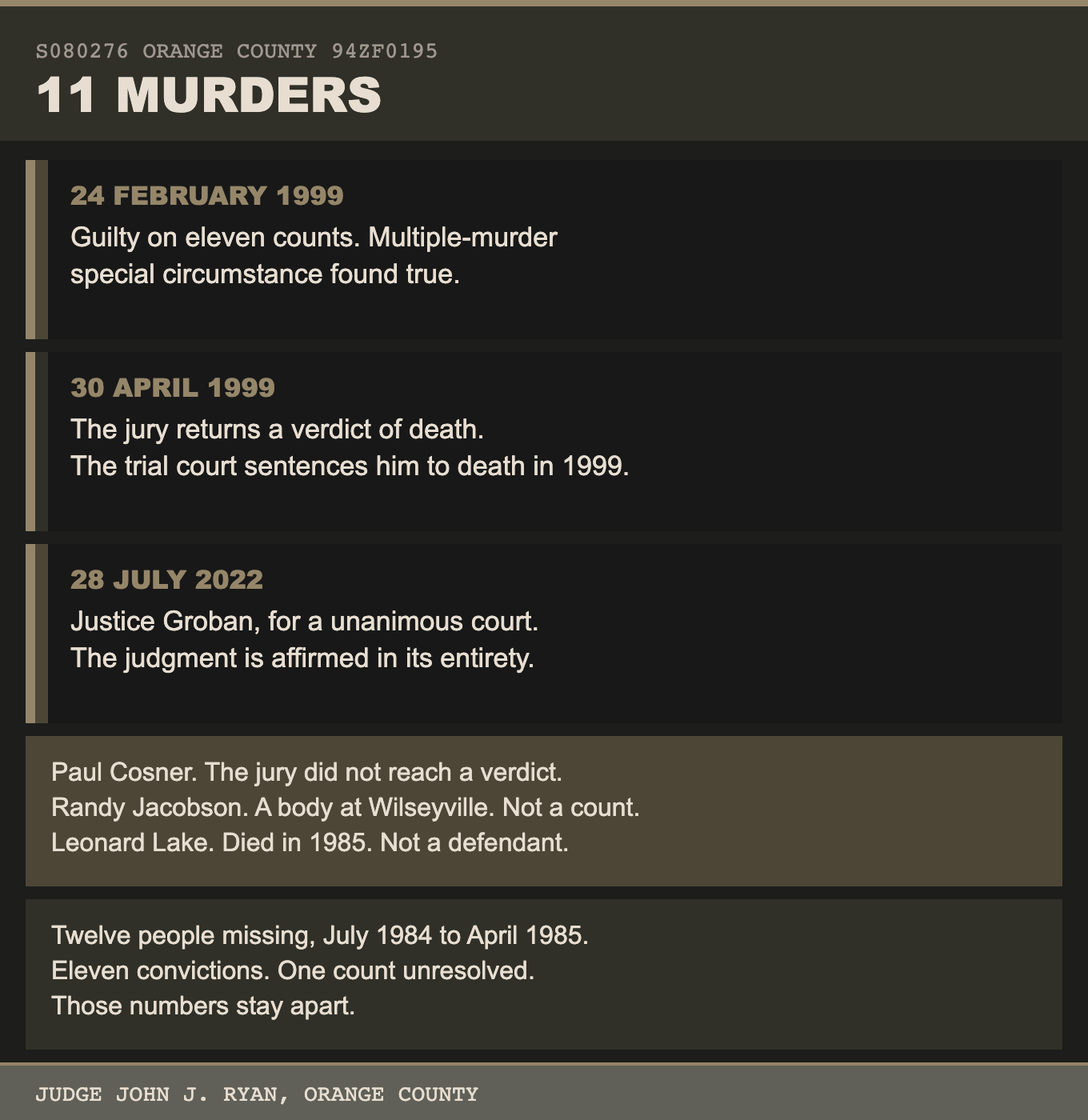
Supreme Court of California. People v. Ng, S080276. Orange County Superior Court No. 94ZF0195. Judge John J. Ryan. On 24 February 1999 a jury convicted Charles Chitat Ng of eleven counts of murder in the first degree, Penal Code section 187. The named dead are Sean Dubs, Deborah Dubs, Harvey Dubs, Clifford Peranteau, Jeffrey Gerald, Michael Carroll, Kathleen Allen, Lonnie Bond, Sr., Lonnie Bond, Jr., Robin Scott Stapley, and Brenda O’Connor. The jury found the multiple-murder special circumstance true, Penal Code section 190.2, subdivision (a)(3). On 30 April 1999 the jury returned a verdict of death. The opinion says the trial court sentenced him to death in 1999. On 28 July 2022 Justice Groban, for a unanimous court, affirmed the judgment in its entirety. Corrigan, Liu, Kruger, Jenkins, Guerrero, and Pollak joined. Pollak sat by assignment as Presiding Justice of the Court of Appeal, First District, Division Four.
Twelve people went missing in Northern California between July 1984 and April 1985. Paul Cosner is the twelfth name in that opening, and he is not one of the eleven convictions. The jury did not reach a verdict on the murder charge against him. Randy Jacobson’s body was found at the Wilseyville property. He is not one of the eleven counts. Leonard Lake swallowed cyanide on 2 June 1985 and died in a hospital a few days later. He is not a defendant in this appeal. Those lines stay apart.
File brief
A vise, a silenced pistol, and a bill for the power
The disappearances sat as separate missing-person files until 2 June 1985, at South City Lumber Company in South San Francisco. John Kallas, a reserve officer for twenty-eight years, watched an Asian man carry a large vise past the checkout counter and out the door. A clerk said it had not been sold. About fifty feet away the man stood at the passenger door of a gold Honda, then walked toward the street. The trunk was ajar. The vise was inside. While Kallas was on the phone to the police, a bearded man, later identified as Leonard Lake, asked if he could pay for the vise.
Officer Daniel Wright ran the plate. The Honda was registered to Lonnie Bond. In the trunk, with the vise, was a backpack. Inside it, a semiautomatic pistol and a silencer. The serial number came back to R. Scott Stapley. Lake said he had paid for the vise his friend took. He gave the name R. Scott Stapley and a California driver’s license in the name Robin Scott Stapley. He said the car belonged to Bond and that Bond was up north. Wright arrested him for possession of a firearm with a silencer. At the station Lake ingested cyanide and began to convulse. He died in the hospital a few days later. Before he convulsed he wrote a note to Lyn. It said, in part, that he loved her, that he forgave her, that freedom is better than all else, and to tell Fern he was sorry. The opinion’s opening calls this a suicide. The facts are the cyanide, the convulsion, and the death in the hospital.
The vehicle identification number belonged to Paul Cosner, missing since November 1984. Inspector Irene Brunn of the San Francisco missing-persons unit, already on Cosner and also on the Dubs family, found a Pacific Gas and Electric bill in the car addressed to Lake’s ex-wife, Claralyn B. The envelope gave an address in Wilseyville, a town in Calaveras County, which the opinion places approximately three hours west of San Francisco. The bill is what took them there.
What holds up
What this opinion can carry
- Eleven convictions of first-degree murder, the multiple-murder special circumstance, a jury verdict of death on 30 April 1999, and a sentence of death in 1999. People v. Ng, S080276, affirmed the judgment in its entirety on 28 July 2022. The appeal was automatic under Penal Code section 1239, subdivision (b).
- The jury did not reach a verdict on Paul Cosner. He is not among the eleven. Ng told Maurice Laberge he shot Cosner because Lake wanted the Honda. On the stand he denied it. Both stay.
- At Wilseyville, over five weeks, four agencies found thousands of bone and tooth fragments. Many hundreds were burned. Two forensic anthropologists said the fragments belonged to at least four adults, one child, and one infant. At least four dental specimens belonged to a child under three. A child’s liver was buried on the property. The opinion does not put a name on those fragments.
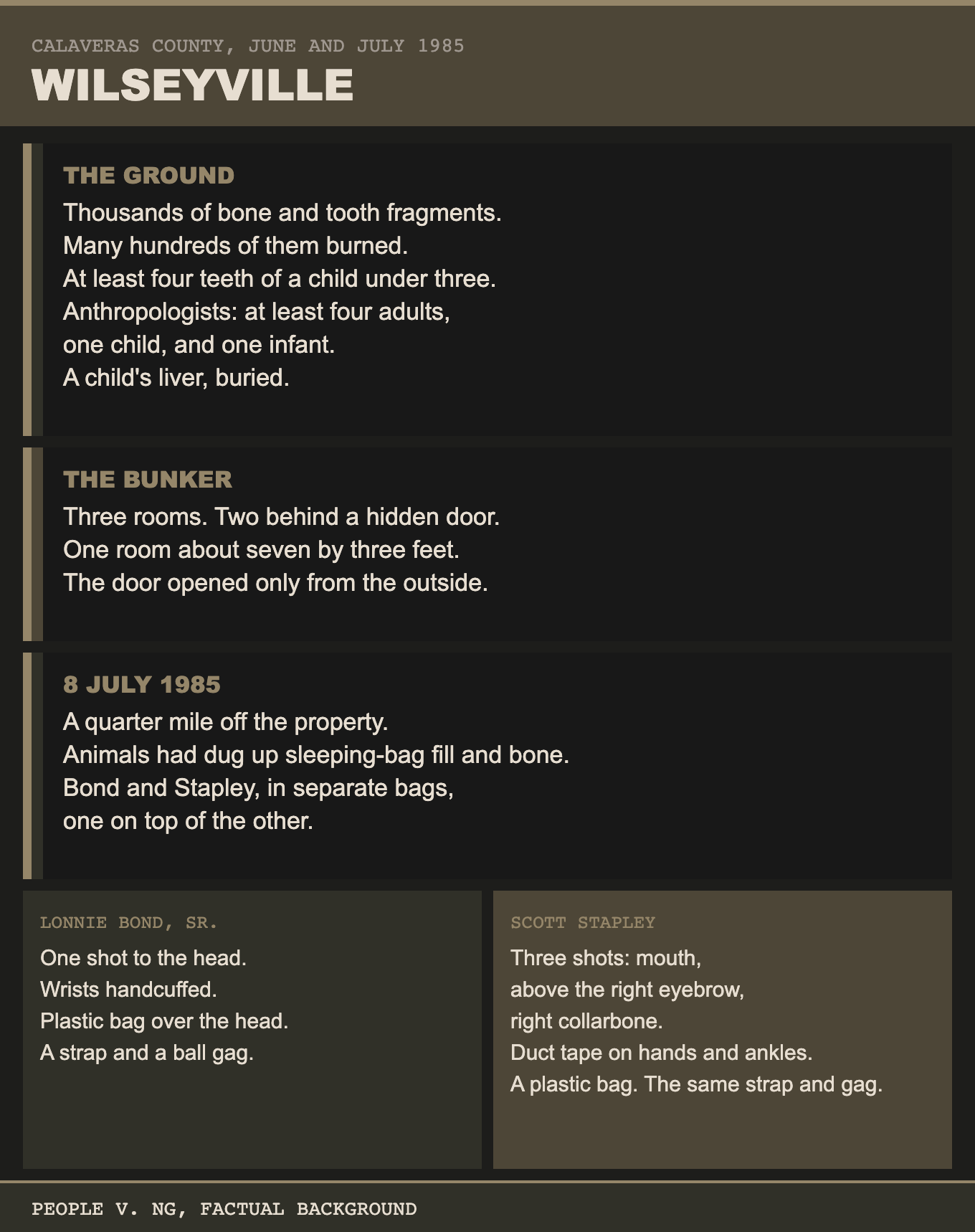
- On 8 July 1985, a quarter mile from the property, officers found Lonnie Bond, Sr., and Scott Stapley in separate sleeping bags, one on top of the other. Bond had been shot once in the head, wrists handcuffed, a plastic bag over the head, a leather strap and a ball gag around the neck. Stapley had been shot three times, hands and ankles bound with duct tape, a plastic bag over the head and shoulders, and the same strap and gag.
- Sean Dubs was sixteen months old. Lonnie Bond, Jr., was an infant. Both are murder counts. Ng told Laberge that killing Sean was not easy, but it was business, part of the operation. The opinion does not describe the manner of either child’s death beyond that, and it does not match a named bone to either child.
Snapshot
The case in figures
Court
Orange County No. 94ZF0195. Judge John J. Ryan.
Verdicts
24 February 1999. Eleven counts. Death on 30 April 1999.
Appeal
S080276. Affirmed in full, 28 July 2022.
Hung count
Paul Cosner. No verdict.
Property
Wilseyville, Calaveras County. Five weeks, four agencies.
Lake
Cyanide, 2 June 1985. Dead within days. Not tried.
The ground
Claralyn gave them a key, then took it back
On 3 June 1985 Inspector Brunn met Claralyn at a cafe and arranged to meet at the Wilseyville property the next day. Claralyn gave her a key and permission to search. In the living room Brunn found two pieces of equipment, including a VCR, missing from the Dubs residence. She called her office, read the serial number, and confirmed it. Claralyn then revoked permission. The officers left, secured the premises, and got a warrant.
The search lasted five weeks and used four law enforcement agencies. Investigators found thousands of bone and tooth fragments buried across the property. At least four dental specimens belonged to a child under the age of three. After reviewing the fragments, two forensic anthropologists concluded they belonged to at least four adults, one child, and one infant. Many hundreds of the bone fragments showed various degrees of burning. Investigators also found a child’s liver buried on the property. The opinion does not say which of the named dead those fragments are. Bond and Stapley were found later, as bodies, off the property. The families of others said there were no remains for a funeral.
Besides the house there was a bunker. It had three rooms. Two were behind a hidden doorway. One hidden room held a bed, a desk, dressers, and some food. The second was about seven by three feet, closed by a wooden door. Inside were a small bed with a foam pad, a plastic bucket, a roll of toilet paper, and a small lamp. The door into that room could be opened only from the outside.
On 7 June, five days after he walked away from the lumber store, police searched Ng’s San Francisco apartment. They found items belonging to Bond and to Peranteau, a map of San Francisco with the Dubses’ street circled, two boxes of .22 caliber ammunition, a pamphlet on how to make a silencer for a .22 caliber gun, and photographs of the bunker under construction.
Calgary
A lean-to, a dugout, and a camera that was not his
Toward the end of June a fourteen-year-old boy playing in a wildlife park in Calgary came on a lean-to near some bushes. An Asian man was lying inside. He said he was tired and asked the boy to leave. The boy had seen a photograph of Ng in the news. He told his parents. On 6 July Ng was arrested for shoplifting. Officers seized a pair of handcuffs and a key, a .22 caliber handgun that had belonged to Lake, and ammunition.
The next day a detective had the boy show him the camp. About thirty meters from the lean-to was a cleared place and a sleeping bag. The bag lay on wood planks. Under the planks was a dugout big enough for a person. In it were a camera belonging to Stapley and a towel from Peranteau’s apartment. Ng was extradited in 1991. Proceedings in this case began then. Laberge, who had the cell next to him in Canada in 1986, was dead in a car crash before trial. What Ng told him was read to the jury from the extradition hearing.
The eleven
Each name, and what was found
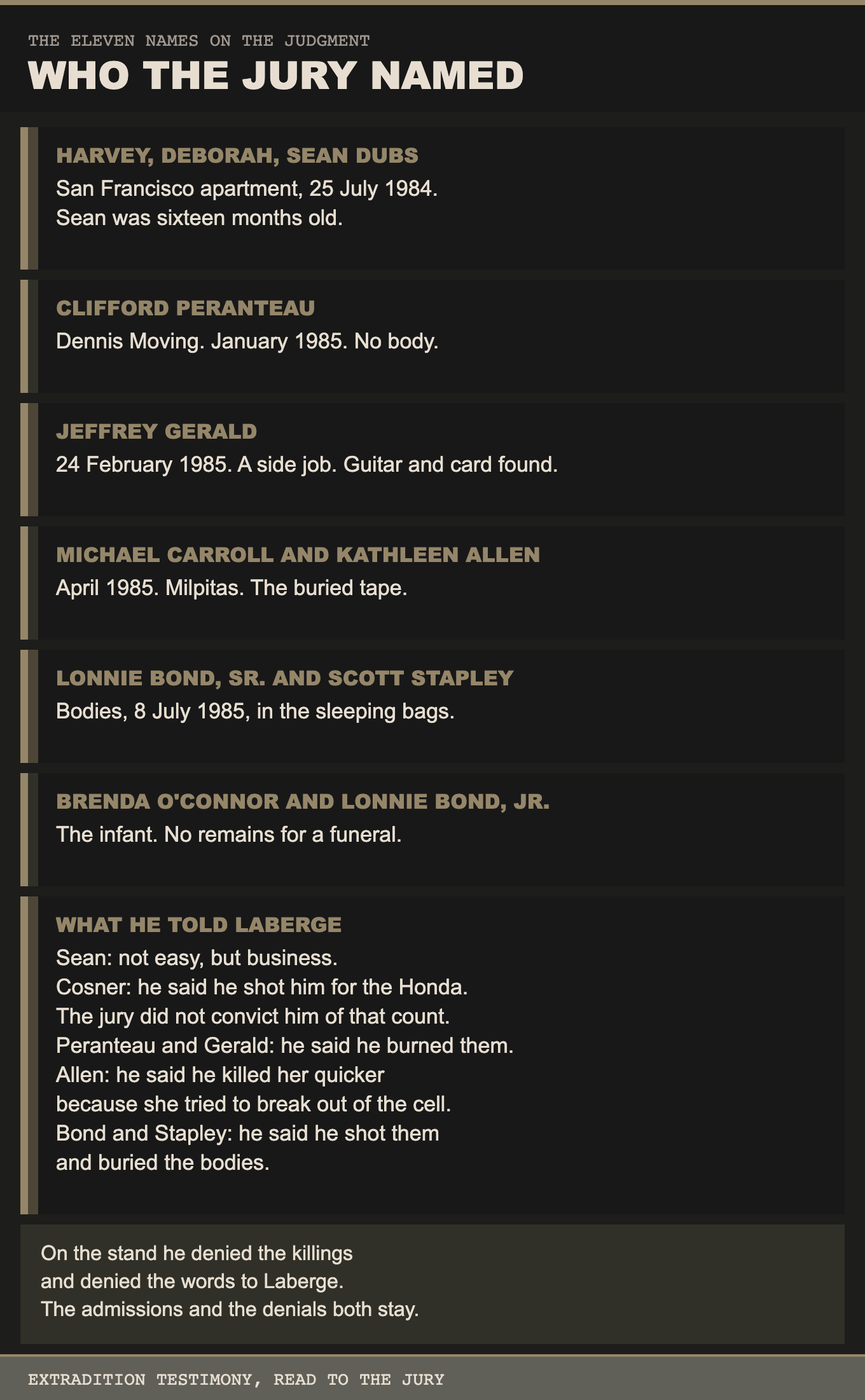
Harvey Dubs, Deborah Dubs, and Sean Dubs. In July 1984 they lived in a San Francisco apartment. Sean was sixteen months old. Harvey worked at Petrov Graphic Types World and was trying to start a videotaping business from home. On 25 July he left work about 5 p.m., early, and told a coworker, Lauren Bradbury, that he had advertised video equipment and was meeting someone who had answered. About 5:45 p.m. Deborah was on the phone with Karen Tuck and said she was expecting someone about the equipment. Someone rang or knocked. Deborah hung up to answer the door. Tuck called the next day. No one answered. Dorice Murphy, across the street, saw an Asian man at about 5:45 p.m. struggling down the front steps with a suitcase. A second man got out of the driver’s side, opened the trunk, and they drove away. Harvey did not come to work the next day and had not called. A man who said his name was James Bright called Petrov and said Harvey had a family emergency in Washington State. Bradbury thought that was wrong. Harvey was from New York and had no other relatives. Deborah was from the Bay Area. Bradbury asked for a number. The caller got irritated and hung up. Deborah’s father filed a missing-persons report that evening, 26 July.
On 27 July, about 11:30 a.m., Barbara Speaker, in the apartment below, heard footsteps. She saw Ng closing the Dubses’ front door. He left the keys in the lock and went down the stairs with a flight bag and a duffle bag, both full and heavy. She followed and said excuse me. He kept walking. At the end of the street a car came around fast and he got in. She thought it was the Dubses’ car. On the stand he confirmed the driver was Lake. About half an hour later George Tuck found Deborah’s key ring in the door. In the bedroom the shelves where Harvey kept cassette tapes and VCRs were empty, dust on the shelf and none in the spots where the machines had been. That night Speaker saw a man through the living-room window and later saw him come down the stairs carrying something large. She thought it was the same man from the morning. The disappearance was in the newspapers and on television. There was no lead until Brunn found the family’s VCR in Wilseyville the next summer. A few days later Murphy and Speaker each picked Ng from a photographic lineup. Ng told Laberge that killing Sean was not easy, but it was just business, a part of the operation, and that they took video equipment from the apartment. On the stand he denied the Dubs killings, denied he was the man Murphy saw on the 25th, and said he was the man Speaker saw on the 27th only because Lake asked him to help with a job. He denied the words to Laberge. He said he did not know how the circled map got into his apartment. He said a VCR without a serial number, found in his apartment, belonged to Lake.
Clifford Peranteau. He worked with Ng at Dennis Moving Company in San Francisco, on the same crew. Hector Salcedo was close to him. One night in December 1984 or January 1985 Ng arrived uninvited, showed a bag of marijuana, and said a friend had a plantation. If they helped work it they could take some home. One Friday night in January 1985 Salcedo and Peranteau drank to the 49ers reaching the Super Bowl. Around midnight or 1 a.m. Saturday, Salcedo dropped him at home. Peranteau did not come to work. Salcedo called, then went to the house. No one answered. About a week later the motorcycle was gone. It had still been there when Salcedo checked earlier. An ex-girlfriend said mostly everything inside was gone. Three or four weeks before, nothing had been missing. Dennis Goza, the owner, got a letter that said Cliff was sorry to leave on short notice, that a new job, a place to live, and a honey had come together, and to send the last three days’ check and the W-2 to a post office box in Mokelumne Hill, about twenty miles from Wilseyville. The body of the letter was typed. The signature and the address were handwritten. The signature did not look genuine. Analysis said the letter was typed on a typewriter found at Wilseyville. An investigator testified that Lake had forged it. In April 1985, about three months after the disappearance, Lake sold the motorcycle in Wilseyville and said Peranteau was a friend in San Francisco who had asked him to sell it. In July, in the Calgary dugout, officers found a striped towel from Peranteau’s home. In Ng’s apartment, a pen and pencil set that belonged to Peranteau. At Wilseyville, more of his things. Ng told Laberge he had made a mistake keeping the pen set after killing him, that he could say Lake gave him the pens, and that he shot Peranteau while Peranteau pleaded for his life. He said the authorities would not find Peranteau or Gerald because he burned the bodies after he and Lake killed them. On the stand he denied ever visiting the apartment, denied knowing the address, and denied the words to Laberge. No body identified as Peranteau is described in the opinion.
Jeffrey Gerald. He worked on a crew with Ng at the same company and lived in San Francisco with Terry Kailer. Over six weeks Kailer answered twelve calls from a man who said he was Charlie or Charlie Ng. On the morning of 24 February 1985 she took two more. Later that day Gerald said it had been Ng, and that he was meeting him at a bus station for a side job, a move. He said he would be home by dinner with Chinese food. From the station he called his girlfriend, Sandra Krumbein, in New Jersey, and said he was helping a friend move for a hundred dollars. They made plans for her to come to San Francisco. Neither she nor Kailer heard from him again. Three days later his bedroom door was ajar. Clothes, bedding, a guitar and amplifier, and pictures were gone. Kailer filed a missing-persons report. Investigators later found the guitar at Wilseyville and his Social Security card buried on the property. The day after he disappeared, a Wilseyville neighbor of Lake’s saw Lake with a bloody sheet wrapped around his body, and a local doctor treated Lake for a gunshot wound in the hand. That is defense evidence of where Lake was. Ng told Laberge he killed Gerald so he could move up in seniority at the moving company, and that the body was burned. On the stand he denied meeting Gerald at a bus station, denied the calls, and said he was scheduled to work an eight-hour shift the day after the disappearance and that he also worked the day the apartment was burglarized. No body identified as Gerald is described in the opinion.
Michael Carroll and Kathleen Allen. Carroll lived with his foster brother, John Gouveia, in Milpitas in 1984. Before Carroll disappeared, Gouveia answered a call from someone who said he was Chuck. Gouveia asked if it was Charles Ng. The caller laughed and said yeah, just tell Mike I called. Allen was Carroll’s girlfriend and worked at a Safeway in Milpitas. On 14 April 1985 she took a call at work and then told a coworker that Mike had been shot and might be dead, and that someone was going to pick her up and take her to Lake Tahoe. That evening she told her friend James Baio that Carroll had been gone two days, had called to say he was in trouble and going to the Tahoe area, and was sending someone for her. Telephone records show that at 1:01 p.m. that afternoon someone at the Wilseyville property called the Safeway. Allen left work between 7 and 7:30 p.m. and got into a gold Honda Prelude, later identified as Cosner’s car. A white man was inside. Baio called her at a Milpitas hotel. She said she could not talk because somebody else was in the room. She sounded in a hurry. She said the person was kind of a weird guy and wanted to take pictures of her. Baio asked her to call from the destination. He never heard from her again. The next day, 15 April, she called her manager and asked for four weeks off. She said her boyfriend had a job, or a good lead, near Lake Tahoe and she wanted to go with him. Phone records show someone at Wilseyville called the Safeway that morning.
Lake got Carroll’s car. On 14 April he called George Blank in San Jose and asked for help with a car stranded in Milpitas. He said it belonged to friends and that he would send a man named Charles to the bus depot with the keys. On 16 April Debra Blank met Charles, later identified as Ng, and took the keys and a letter of directions. Blank found a Mercury Capri in the Safeway lot. It was Carroll’s. On 26 April Lake came to inspect it and take things, and asked Blank to fix it and try to sell it. On 8 or 9 May a letter arrived with a pink slip, a release of liability, and an insurance policy, all in Carroll’s name, plus a deposit slip in Allen’s name and an envelope from the Safeway Federal Credit Union. After the sale, the letter said, Blank should take his share for the repairs and deposit the rest with the enclosed slip. Investigators found a two-gallon plastic barrel buried at Wilseyville with things belonging to Carroll and Allen, and books in the house with Carroll’s name printed inside. Canceled checks of Allen’s from April and May 1985 include one dated 2 May, more than two weeks after she disappeared, made out to Randy Jacobson. A handwriting expert said Lake wrote the face of the check and probably signed Allen’s name. Jacobson’s body was found at the Wilseyville property. He is not one of the eleven counts. The opinion does not say how he was killed.
The tape titled M Ladies, Kathi, Brenda was buried on the property. The first scene is Allen shackled in a chair. Lake and Ng tell her that if she cooperates, thirty days later they will drug her, blindfold her, and release her somewhere. If she does not, they will shoot her and bury her in the same place they buried Carroll. They want Carroll’s bank accounts and the names of people they need to write, so that Mike can be moved over the horizon and people will think he moved and was never heard from again. Lake tells her she must agree to cook, clean, and fuck for them. He says that is the choice, and it is not much of a choice unless she has a death wish. If she cooperates they will be as nice as they can within the limits of keeping her prisoner. If she does not, they will tie her to the bed, rape her, shoot her, and bury her. After she agrees, Lake unshackles her and the men force her to strip. Ng says he wants to shower with her and that it will not be the last time. When she looks nervous, Lake says they do not want to make an example of her. She undresses and walks off camera with Ng. In the next scene a nearly naked Allen massages a naked Ng. In the last scene she is face down, shackled to a bed, wearing only shorts. Lake takes pictures and tells her she tried to beat down the door. He says he has cyanide pills and will take them if he is caught. He threatens to hit her and whip her if she tries to escape again. He says he does not usually confess his sadistic tendencies to strangers, but he can talk to her because she is going to go away and he will never have to deal with her again, unfortunately for her. He makes her put on lingerie, takes more photographs, and tells her to dress because they are going outside. Ng told Laberge he killed her quicker because she tried to break out of her cell, and that he put his gun inside her vagina and made her call Safeway for time off. On the stand he said the tape was Lake’s idea, that Allen was the first woman he helped Lake imprison, that he knew she was not there willingly, and that he believed Lake was trying to turn her into a willing sex slave. He said they did not agree to kill her and did not plan to. He said he did not have sexual intercourse or oral sex with her. When he left for San Francisco, he said, she was still alive. He said he was not paying attention when Lake spoke of burying her where Carroll was buried, and that he did not help kill or bury Carroll. He denied the statements to Laberge.
Lonnie Bond, Sr., Brenda O’Connor, Lonnie Bond, Jr., and Scott Stapley. In January 1985 Bond rented the Carter house next door to the Wilseyville property. The houses shared a driveway. He lived there with his fiancee, Brenda O’Connor, and their infant son. Lake called the property manager and complained that someone was firing guns from the house and that Bond was not locking the gate. Stapley lived in San Diego with Tori Doolin. In February 1985 they visited. Doolin met Lake when he came over to talk to Bond and Stapley. She last saw Stapley on the evening of 19 April 1985 in San Diego. He had pulled Bond and O’Connor’s things from a storage locker into his truck and was going to drive O’Connor and the baby back to the Carter house. On 23 April Ng crashed Stapley’s truck in Kern County. The next day Ng and Lake were at Doolin’s apartment. Ng waited in the car. Lake told her he had found Stapley, Bond, O’Connor, and the baby dead in the Carter house, that he had burned the bodies in a kind of funeral, buried them, and cleaned the house. He wanted Stapley’s belongings so it would look as if Stapley had moved. Doolin gave him the bicycle, clothing, and other things. Outside, Lake showed her the damage to the truck. She never saw Stapley again. O’Connor’s mother never saw or heard from O’Connor or the baby again. In May Lake told the property manager he thought the tenants had left town, and that Bond had left his car because he owed Lake money.
O’Connor is on the same tape, in the same chair, hands bound. She asks what they did to her family. They tell her they did not kill Bond or Lonnie. When she asks if they are going to let her family go, they say probably not. Lake says they hate her, and that the neighborhood hated the family after they moved into the Carter house. He says they were going to give Lonnie to a family in Fresno that did not have kids. She pleads for the baby, over and over. Lake tells her she must work, clean, and fuck for them, or they will tie her to the bed, rape her, and shoot her. She agrees. Ng cuts off her T-shirt and bra with a knife and tells her she is totally theirs. He says she can cry like the rest of them and it will do no good, because they are pretty cold-hearted. They ask if she is ready for a shower. Ng says he always does that, and that it is luckier. Lake says Ng has his heart set on the shower and he does not want to turn him down. She strips and says she is dizzy, hot, and does not feel well. They tell her to suffer, then get her water. She says she does not need a shower. Ng says it is a house rule that she be clean before he and Lake fuck her. The scene ends with her and Ng going to the shower. Lake tells him to be careful with her. When Lake was arrested he had Stapley’s gun and Stapley’s credit cards and bank card. On 8 July 1985, back in Calaveras County, officers patrolling about a quarter mile from the property saw tufts of cloth that looked like the insulation of a sleeping bag. Animals had dug the fill up with some bone. Excavation found the bodies of Bond and Stapley, in separate sleeping bags, one on top of the other. Bond had been shot once in the head. His wrists were handcuffed. A plastic bag was over his head. A leather strap with a ball gag was around his neck. Stapley had been shot three times: in the front of the mouth, above the right eyebrow, and in the right collarbone. A plastic bag covered his head and shoulders. His hands and ankles were bound with duct tape. He had the same strap and gag. Ng told Laberge he shot Stapley and Bond and buried the bodies. On the stand he said the first time he saw O’Connor was when the filming started, that he knew Lake hated her, that he helped with the threats so she would see two people and comply, and that he did not intend to hurt her or kill her. He said he was not present when Bond and Stapley were killed. Later, he said, Lake showed him the two bodies under the porch. Ng bound Bond, put a gag in his mouth, and put him in a sleeping bag. Lake did the same to Stapley. Lake wanted it to look as if rival drug dealers had killed them. Brenda O’Connor’s mother, Sharon, said the absence of remains was very hard because they could not have a funeral. She called Lonnie the sweetest little guy. The opinion does not describe a body identified as Brenda O’Connor or as the infant.
Paul Cosner is not a conviction. He lived in San Francisco with Marilyn Namba. On 2 November 1984 he called his sister and planned to meet her the next morning. That evening Namba called him from work and they planned to watch a movie when she got home. He sounded rushed. He said he was going to deliver a car he was selling. It was a gold Honda Prelude, the car Lake and Ng were in at the lumber store seven months later. He did not come home. He did not meet his sister. She filed a missing-persons report the next day. A few days before he disappeared, a neighbor saw him talking with Lake in the building’s garage. Ng told Laberge he did not want to kill that punk, but Lake wanted his Honda, a cheap Honda, and he described the sounds Cosner made after Ng shot him. On the stand he denied any agreement to kill Cosner. He said Lake told him the Honda was a hot car from drug dealers. He denied the words to Laberge, including a line Laberge had, that Cosner was a hard operation because he would not cooperate. The jury did not reach a verdict. He remains the twelfth missing person in the opening of the opinion, and not one of the eleven.
Lake, in this judgment
The man who died before anyone could try him
Lake is the accomplice named throughout the opinion, and he is not a party to the appeal. In 1984 his sister, Fern Ebeling, passed mail between him and Ng. That Thanksgiving Ng ate at Lake’s mother’s house, the only person there who was not family. In December Ng introduced Lake to a coworker who needed work on a house. Ng said he met Lake at twenty-two or twenty-three, looked up to him, and was grateful that Lake took him as a friend when he was not a citizen, could not drive, did not have a job, and had a criminal record. He knew Lake was a survivalist, building shelters and stockpiling for the end of the world. When Ng was court-martialed, Lake sent photographs of the bunker going up. Ng said he did not know Lake was building a place to keep sex slaves. Sometimes Lake stayed in the San Francisco apartment and kept bedding, a change of clothes, tools, ammunition, and marijuana there.
The defense put on Lake as the dominant man, and in places as the only one. Neighbors in Philo, Mendocino County, where Ng lived with Lake and Claralyn for part of 1982, said Lake reprimanded him, spoke to him in a degrading way, and that Ng seemed timid and eager for approval. Lake carried cyanide and told people he would take it if he were captured. He talked about a bunker for a nuclear war and about keeping women there. He often used the name Charles Gunnar. The defense offered evidence of his involvement in uncharged killings, including his brother Donald and his best friend Charles Gunnar. That is what the defense presented. This judgment does not decide those killings. Lake told a Wilseyville neighbor the Bond family were pests, and that it was all right to kill someone who was bugging you. On the day of the lumber-store arrest Ng thought someone had seen him take the vise. He was afraid police would find Cosner’s car, the tape, and the buried bodies, and afraid he would be deported to Hong Kong. He and Claralyn drove back past the lot. He crouched in the back seat and saw Lake standing with the police. That night he bought a one-way ticket to Chicago and made his way into Canada.
How the case reached a jury
Thirty-seven motions to fire his lawyers, then a verdict
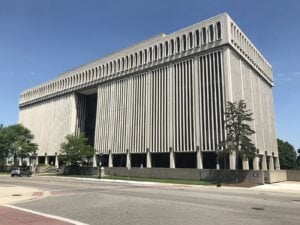
A warrant issued from the Calaveras County Justice Court on 8 June 1985, while he was in custody in Canada. On 15 July 1985 the court appointed the Calaveras County Public Defender. On 10 December 1985 it appointed Garrick Lew. On 14 January 1987 it appointed Michael Burt as second counsel. Ng was extradited in 1991. On 20 November 1992 the district attorney filed, and the case moved from the justice court to the Calaveras County Superior Court. Judge Donald McCartin, a retired Orange County judge, took the bench on the venue questions on 21 January 1994. The case was tried in Orange County, No. 94ZF0195, before Judge John J. Ryan. Ng fought the transfer. The 2022 affirmance leaves the Orange County trial in place.
He filed thirty-seven Marsden motions, asking to substitute counsel. On 20 April 1998, after a competency hearing, the court found him mentally competent and denied a request to represent himself, ruling that he did not really want to do it and that the point was delay. On 15 May 1998 the court granted a later Faretta motion and appointed the Orange County Public Defender as advisory and standby counsel. On the eve of trial he asked for six more months and for another competency hearing. He said he had not slept, was tired, and could not concentrate. The court found nothing wrong with his mental ability, found the competency motion was tied to the continuance, and found he was spending time and money to delay. It denied the competency motion and revoked his self-representation. The Supreme Court held that revocation was within the trial court’s discretion: he was using self-representation to disrupt and delay the trial. Jury selection began 14 September 1998. Trial began in September 1998. The verdicts were 24 February 1999. The penalty phase began 8 March 1999. The death verdict was 30 April 1999. On appeal he was represented by Eric S. Multhaup. The People were represented by Attorneys General Kamala D. Harris and Rob Bonta, through deputies Ward A. Campbell and Kenneth N. Sokoler.
An earlier Court of Appeal decision, reported as Ng, 52 Cal. App. 4th, disqualified Judge Fitzgerald. The appellate court did not find actual bias. It found a person aware of the facts might reasonably doubt his impartiality, including Fitzgerald’s remark that he wanted to try the case and that his ego told him he was in a better posture than anybody around. The Supreme Court said that disqualification does not show Fitzgerald was biased, and that the venue rulings he made were correct. Challenges to Judge Ryan’s evidentiary rulings, offered as proof of bias, failed. So did the attacks on the death-penalty statute that the court said it had already rejected, including the arguments drawn from Apprendi, Ring, and Hurst. The judgment, convictions and death sentence, stands.
The penalty evidence included a military conviction on 15 July 1982 for conspiracy to commit larceny of government property worth more than one hundred dollars, the larceny itself, and unlawful entry with intent to commit that larceny. After arrest on those charges he escaped confinement on 14 November 1981 and was captured on 29 April 1982. Lake and Claralyn were in the apartment officers searched after that April arrest. Family witnesses described a childhood in Hong Kong, a father who beat him with a stick for poor grades, and a move to the United States in 1979 to attend college. He testified that he moved when he was eighteen. Those two accounts of the move are both in the opinion. He said he regretted the tape, that he was young and adventurous, and that he did not exercise independent judgment.
Limits
What this opinion does not close
It does not convict him of killing Paul Cosner. The jury did not reach a verdict. It does not make Randy Jacobson one of the eleven, though his body was at Wilseyville and a check in Kathleen Allen’s name, which an expert said Lake wrote, was payable to him. It does not try Leonard Lake. He was dead. The defense evidence about Donald Lake and Charles Gunnar is not a finding of this court. The anthropologists’ count, at least four adults, one child, and one infant, is not a list of names. Sean Dubs and Lonnie Bond, Jr., are convictions. The opinion does not match a fragment, or the buried liver, to either child. Bond and Stapley are the two bodies it describes in the sleeping bags. The opinion prints Wilseyville as a town in Calaveras County, approximately three hours west of San Francisco. The bill, the warrant, and the bones are what the opinion uses.
Timeline
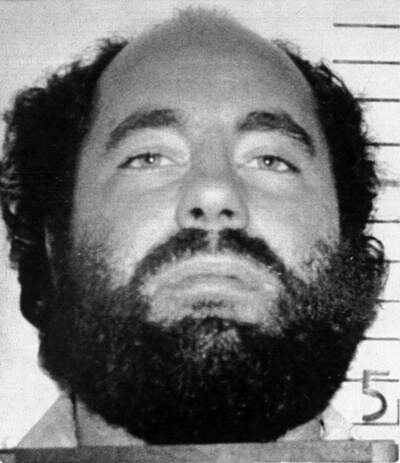
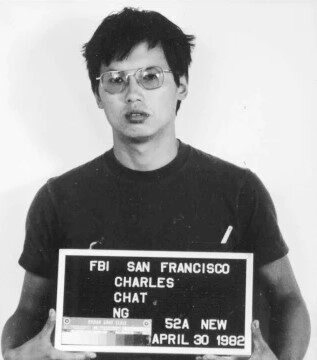
- 14 November 1981 After arrest on military larceny charges, he escapes confinement. He is captured 29 April 1982. The FBI booking photograph is dated 30 April 1982. A military court convicts him on 15 July 1982.
- 25 July 1984 Harvey, Deborah, and Sean Dubs disappear from their San Francisco apartment. Sean is sixteen months old. A VCR from the apartment is later found at Wilseyville.
- 2 November 1984 Paul Cosner leaves to deliver a gold Honda he is selling. The jury later fails to reach a verdict on his murder.
- January and 24 February 1985 Clifford Peranteau does not come to work. Jeffrey Gerald leaves for a side job at a bus station and does not come home.
- 14 to 19 April 1985 Kathleen Allen leaves a Milpitas Safeway in Cosner’s Honda. The Bond household and Scott Stapley disappear from Wilseyville. On 23 April Ng crashes Stapley’s truck in Kern County.
- 2 June 1985 The vise at South City Lumber. Lake is arrested with Stapley’s silenced pistol and Bond’s Honda. He swallows cyanide and dies within days.
- 8 July 1985 Bond and Stapley are excavated a quarter mile from the property, in sleeping bags, one on top of the other. On 6 July Ng has been arrested for shoplifting in Calgary.
- 1991 to 1998 Extradition. Venue to Orange County. Found competent 20 April 1998. Self-representation granted 15 May 1998 and revoked before jury selection, which begins 14 September 1998.
- 24 February and 30 April 1999 Guilty on eleven counts. The special circumstance is true. The jury returns death. The court sentences him to death in 1999.
- 28 July 2022 People v. Ng, S080276. The judgment is affirmed in its entirety.
Questions
Questions this opinion can answer
Was Charles Ng convicted?
Yes. On 24 February 1999 an Orange County jury convicted him of eleven counts of first-degree murder and found the multiple-murder special circumstance true. On 30 April 1999 the jury returned a death verdict. The trial court sentenced him to death in 1999. On 28 July 2022 the California Supreme Court affirmed that judgment in its entirety. People v. Ng, S080276. Judge John J. Ryan. No. 94ZF0195.
Who are the eleven?
Sean Dubs, Deborah Dubs, Harvey Dubs, Clifford Peranteau, Jeffrey Gerald, Michael Carroll, Kathleen Allen, Lonnie Bond, Sr., Lonnie Bond, Jr., Robin Scott Stapley, and Brenda O’Connor. Sean was sixteen months old. Lonnie Bond, Jr., was an infant.
What about Paul Cosner?
He disappeared on 2 November 1984 after leaving to deliver the gold Honda later found at the lumber store. The jury did not reach a verdict on the murder charge against Ng for Cosner. He is not one of the eleven.
Was Leonard Lake convicted with him?
No. On 2 June 1985, after the arrest at South City Lumber, Lake ingested cyanide and died in the hospital a few days later. He is the accomplice in the opinion. He is not a defendant in the appeal.
What was found at Wilseyville?
Over five weeks, four agencies found thousands of bone and tooth fragments, many hundreds of them burned, a child’s liver, and a bunker whose smallest room opened only from the outside. Two anthropologists said the fragments were at least four adults, one child, and one infant. On 8 July 1985 Bond and Stapley were found a quarter mile away, in sleeping bags. The opinion does not put the fragments’ names on the page.
What did he tell Maurice Laberge?
Laberge’s extradition testimony was read at trial because Laberge had died. Ng told him killing Sean was business, that he shot Cosner because Lake wanted the Honda, that he shot Peranteau while Peranteau pleaded and then burned Peranteau and Gerald, that he killed Gerald for seniority, that he killed Allen quicker because she tried to break out and put a gun inside her vagina to make her call Safeway, and that he shot Bond and Stapley and buried them. On the stand he denied those statements. The jury convicted him of the eleven and did not reach a verdict on Cosner.
Sources
The paper this account uses
Every count, every date, the bunker, the fragments, the tape, the words to Laberge, and the denials on the stand are People v. Ng, S080276, filed 28 July 2022. Where the opinion’s opening says the property is west of San Francisco, and the county is Calaveras, both are kept. Where twelve missing people, eleven convictions, and a hung count do not match, all three are kept.
Opinion
People v. Ng, S080276
Supreme Court of California, 28 July 2022. Justice Groban. Orange County No. 94ZF0195, Judge John J. Ryan. The judgment affirmed.