 Evidence #01
 Evidence #02
 Evidence #03
 Evidence #04
Overview
A doctor, fifteen verdicts, and two hundred more deaths
Hyde, Greater Manchester, and earlier Todmorden. March 1975 to June 1998.
Harold Frederick Shipman, who spelled the middle name Fredrick, was a general practitioner. A jury at Preston Crown Court convicted him on 31 January 2000 of murdering 15 patients and of forging Kathleen Grundy’s will. The inquiry’s first report found that he killed 215 patients in general practice. Its final report, on 27 January 2005, named 218 and put the toll near 250. He died at Wakefield prison on 13 January 2004.
Later summaries, using the medical and legal record through 2023, call him the only British doctor convicted of murdering his patients. The file below does not rest on that title. It rests on the 15 jury verdicts, the inquiry’s named findings, and the other clinicians who were prosecuted in other countries and, in Britain, in other roles. Those comparisons are set out with the motive.
The jury’s 15 verdicts are criminal convictions. The figures of 215, 218, and about 250 are the inquiry’s findings. They are not further murder convictions. The Director of Public Prosecutions had already said there would be no further criminal proceedings.
File brief
The shortest true account
Shipman trained at Leeds, worked at Pontefract General Infirmary, and entered general practice at Todmorden in 1974. His partners dismissed him in 1975 after he admitted taking pethidine for himself. In February 1976 he pleaded guilty to specimen drugs charges, was fined, and was allowed to keep practising. The General Medical Council held no disciplinary inquiry. The Home Office made no order stopping him from handling controlled drugs. He later worked at the Donneybrook practice in Hyde and then alone at 21 Market Street. Patients regarded him as the best doctor in Hyde. In March 1998 a neighbouring doctor told the coroner she feared he was killing patients. A short police inquiry closed on 17 April 1998. He killed three more patients after that, including Kathleen Grundy. Her daughter, a solicitor, did not believe a new will that left the estate to Shipman. The body was exhumed. Morphine was in the tissues. The will had been forged. The trial opened on 5 October 1999. He was sentenced to 15 terms of life imprisonment. Mr Justice Forbes said his recommendation would be that Shipman spend the rest of his days in prison.
Takeaways
What is established
- The criminal court convicted him of 15 murders and one forgery. The first inquiry report found 215 killings in general practice. The final report named 218 and put the toll near 250, including hospital deaths.
- The usual method was a lethal dose of an opiate, most often diamorphine. The chairman found no reliable evidence that he killed by any means other than a drug.
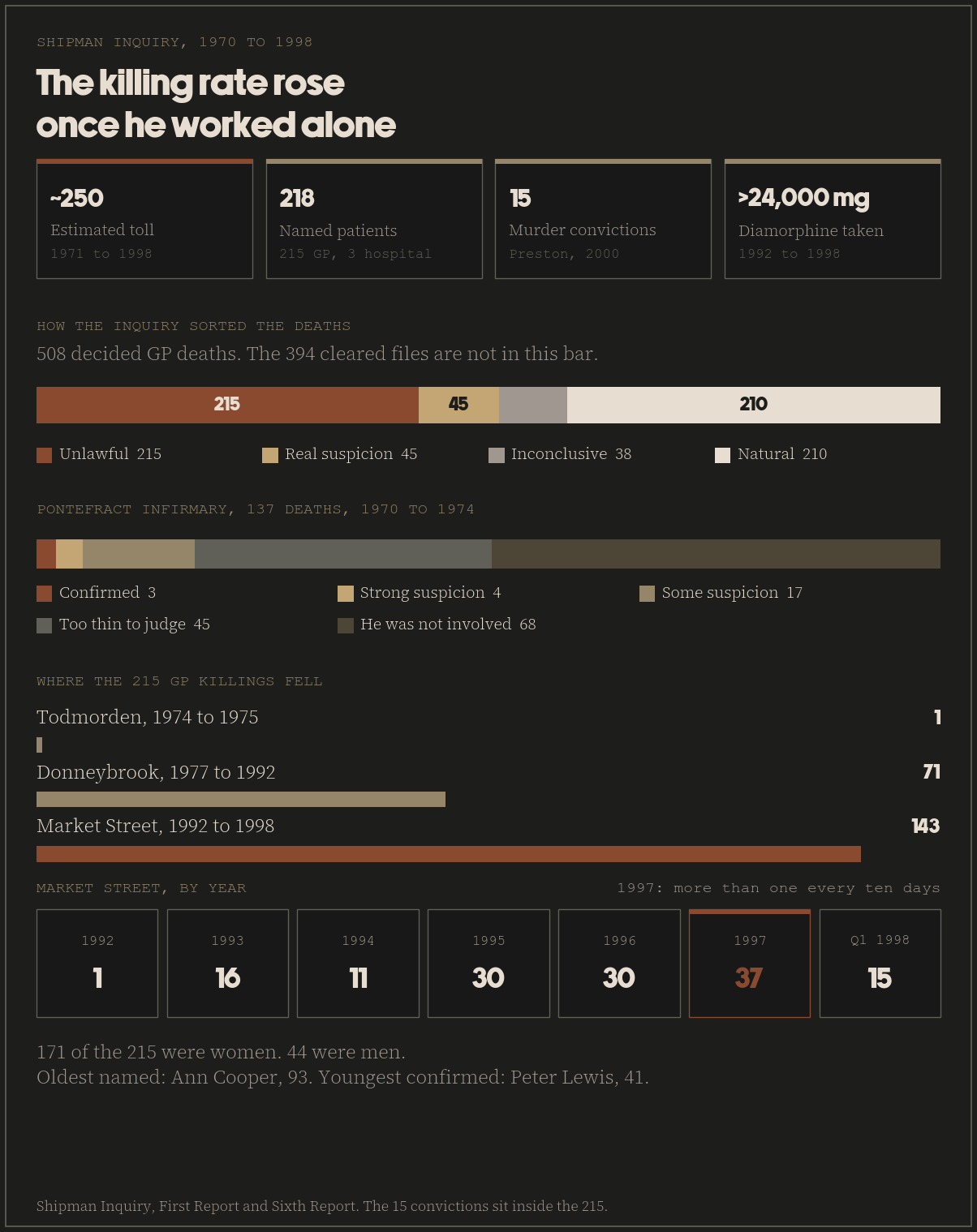
- Of the 215, one death was in Todmorden, 71 were during the Donneybrook years, and 143 were during six years at Market Street. 171 of the patients were women and 44 were men.
- All but three of those deaths were registered on medical certificates he completed. Most were followed by cremation, which required two further doctors. The safeguards did not stop him.
- A confidential police investigation in March and April 1998 ended with a finding of no substance. Winifred Mellor, Joan Melia, and Kathleen Grundy were killed after it closed.
- The inquiry examined 888 cases, wrote decisions in 494, found 210 deaths natural, left 45 as real but unproved suspicion, and could form no view in 38.
- Professor Richard Baker estimated the excess of deaths most likely at 236, later placing the range near 220 to 240 once the inquiry’s suspicions were included.
Snapshot
The case in figures
Criminal verdicts
15 murders and one forgery, 31 January 2000
Inquiry findings of killing
215 patients, March 1975 to June 1998
Women and men
171 women and 44 men
Where
1 in Todmorden, 71 at Donneybrook, 143 at Market Street
Natural deaths in the same review
210
Unproved suspicion
45, plus 38 with no view possible
Cases examined
888, with written decisions in 494
Baker’s most likely excess
236, later set near 220 to 240
Status
Convicted, then examined
Criminal
Convicted of 15 murders and forgery. Fifteen life terms and four years concurrent.
Inquiry
First report: 215 killings in general practice. Final report: 218 named, toll near 250. No further charges, by a decision of the Director of Public Prosecutions on 18 February 2000.
Profession
Name erased from the medical register on 11 February 2000.
Drugs case
Guilty plea at Halifax on 13 February 1976. Fined. No ban on later practice.
Charges
What he was tried for
The indictment at the trial which opened on 5 October 1999 contained 15 counts of murder and one count of forging Kathleen Grundy’s will. He pleaded not guilty. The murder counts covered nine patients whose bodies were exhumed and six who had been cremated.
- Murder of Kathleen Grundy, Ivy Lomas, Marie Quinn, Irene Turner, Jean Lilley, Bianka Pomfret, Winifred Mellor, Muriel Grimshaw, and Joan Melia.
- Murder of Kathleen Wagstaff, Lizzie Adams, Norah Nuttall, Maria West, Pamela Hillier, and Maureen Ward.
- Forgery of the will dated 9 June 1998.
- Separate from the trial: the 1976 guilty pleas to obtaining pethidine by deception, possession, and forging a prescription.
Verdict
Fifteen life terms
The trial opened at Preston Crown Court on 5 October 1999 and lasted 58 days, before Mr Justice Forbes. The sentence was 15 terms of life imprisonment, and a concurrent term of four years for the forgery of Kathleen Grundy’s will. In his sentencing remarks, which the inquiry quotes on the title page of Volume One, he told Shipman: None of your victims realised that yours was not a healing touch. None of them knew that in truth you had brought her death, death which was disguised as the caring attention of a good doctor. His recommendation to the Home Secretary was that Shipman should spend the rest of his days in prison.
The inquiry’s 215 is a finding about the extent of the killings. It did not add counts to the indictment.
Boundary
What these two reports can decide
These two volumes do not contain the 494 individual written decisions. A reader who wants the evidence on one named patient, other than the conviction cases and the few the summary discusses, has to go to Volumes Two to Six. This account does not invent those case narratives.
Volume One and the police report do not record his birth date or his death. Later inquiry papers and the inquest do. He was born on 14 January 1946. On 13 January 2004, at HMP Wakefield, an officer found him hanging. A jury at Leeds Crown Court returned a verdict of suicide on 22 April 2005. That verdict is not a finding about the patients.
The inquiry findings of killing are not jury verdicts. Where she says she is sure, and where she says he probably killed, both count in the 215. Families and a criminal injuries authority might treat those words differently. The chairman herself separates them.
One Todmorden coroner’s file concerned a newborn child. She excluded deliberate killing and put the suggestion of inadequate care outside Phase One. That is the whole of what Volume One says about that death, and it is not expanded here.
Victim
Kathleen Grundy
Died 24 June 1998, aged 81, at 79 Joel Lane, Gee Cross. She had been mayoress of Hyde and was fit that morning, when he called to take a blood sample. Friends found her fully clothed on the sofa. He certified old age, talked the family out of a post mortem, and she was buried at Hyde on 1 July 1998. The forged will, dated 9 June 1998, left an estate of 386,402 pounds to him and ticked cremation, which would have destroyed the body he later needed gone. A fingerprint of his left little finger was on the will and on the typewriter. Morphine was in the thigh and the liver. He told the court he thought she had been abusing opiates. Hair analysis and the prescription record said she had not. The jury convicted.
No verified portrait is used. No photograph of a body is used.
Victim
Ivy Lomas
Died on 29 May 1997, in her early sixties, inside the Market Street surgery. He saw three more patients before he told the staff. He later joked to police that she had been a nuisance. The cover story was a failed resuscitation. Her body was exhumed on 12 October 1998 and morphine was found. Charged in November 1998. The jury convicted.
No verified portrait is used. No photograph of a body is used.
Victim
Marie Quinn
Died on 24 November 1997, aged 67. He said she had telephoned the surgery because she felt unwell. Billing records showed no such call. He admitted he was present at the death. Her body was exhumed on 13 October 1998. Morphine was found. Charged in November 1998. The jury convicted.
No verified portrait is used. No photograph of a body is used.
Victim
Irene Turner
Died on 11 July 1996, aged 67. He told a neighbour to wait a few minutes before packing a bag for hospital. The neighbour then found her dead, fully clothed, on the bed. The pretext had been preparation for hospital. Her body was exhumed on 10 November 1998. Morphine was in the tissue. He was alone with her. Charged in December 1998. The jury convicted.
No verified portrait is used. No photograph of a body is used.
Victim
Jean Lilley
Died on 25 April 1997. Contemporary reports give her age as 58 or 59. She was the only married woman among the 15. He had called about a cold. A neighbour was uneasy about how long he stayed. The ambulance crew later said she had been dead for some time. Her body was exhumed on 12 November 1998. Morphine was found. Charged in December 1998. The jury convicted.
No verified portrait is used. No photograph of a body is used.
Victim
Bianka Pomfret
Died on 10 December 1997, aged 49, the youngest of the 15. He certified a heart condition after alleged chest pain. After the death he invented that history on the surgery computer. She was found not long after he left, sitting as if asleep. Her body was exhumed on 23 September 1998. Morphine was found, and she had not been prescribed it. The jury convicted.
No verified portrait is used. No photograph of a body is used.
Victim
Winifred Mellor
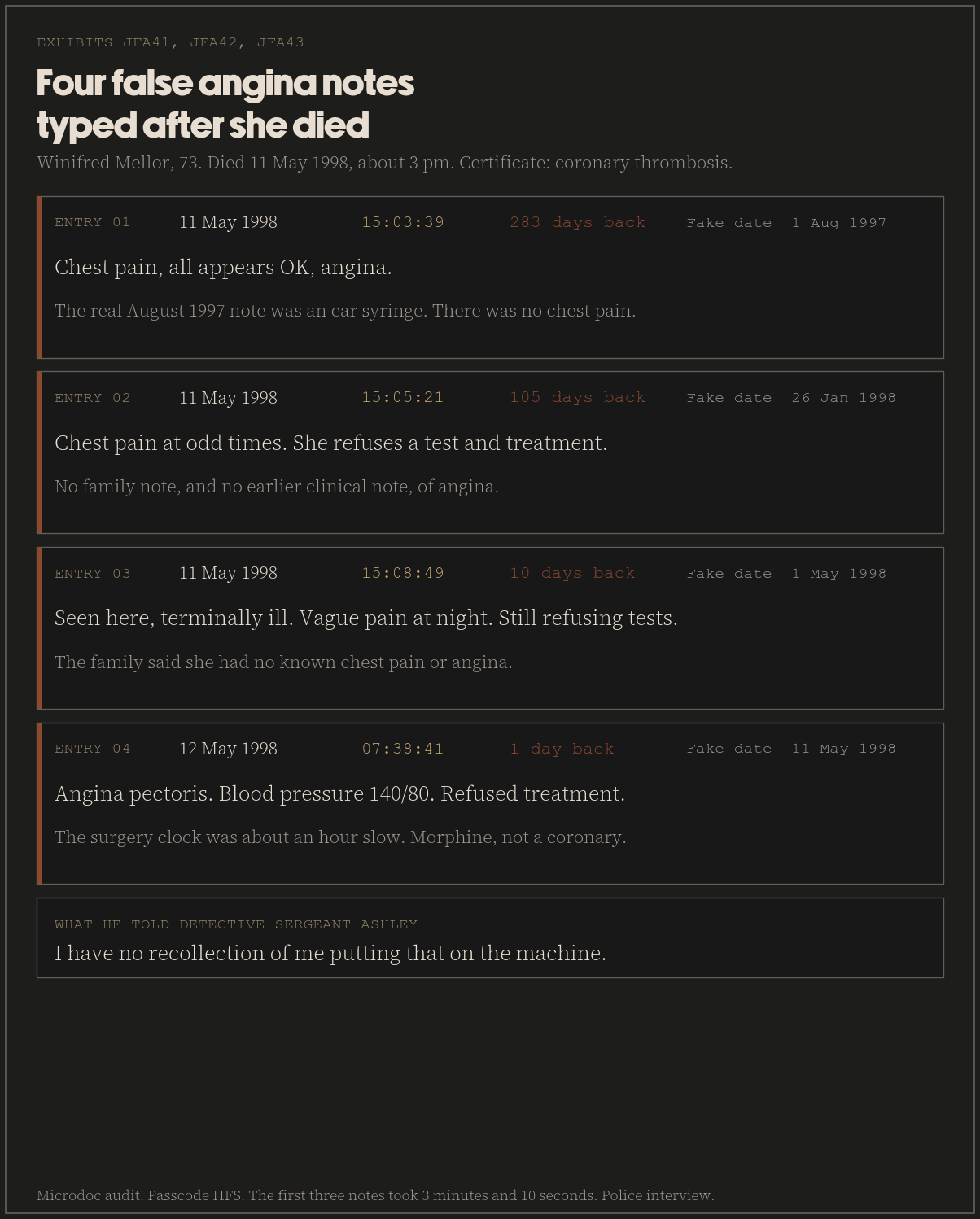
Died on 11 May 1998, aged 73, after the April police inquiry had closed. He certified coronary thrombosis. The post mortem found no coronary thrombosis, and morphine was in the tissue. She was found in a chair with the left sleeve rolled up. Minutes after leaving the house, around 3 pm, he logged into the surgery computer as HFS and typed a nine month history of angina, backdated to 1 August 1997, in 3 minutes and 10 seconds. He was seen outside the house shortly before she was found, and he later denied the visit. Her body was exhumed on 22 September 1998. The jury convicted.
No verified portrait is used. No photograph of a body is used.
Victim
Muriel Grimshaw
Died on 14 July 1997, aged 76. He wrote that he had treated her for rheumatoid arthritis the day before. There was no surgery note and no appointment to support that. He talked the family out of a post mortem and altered the certificate. She was found at home the day after his visit. Nobody had seen her in between. Her body was exhumed on 8 December 1998. Morphine was found. Charged in February 1999. The jury convicted.
No verified portrait is used. No photograph of a body is used.
Victim
Joan Melia
Died on 12 June 1998, aged 73, the second patient killed after the April inquiry closed. He certified pneumonia and emphysema. He had seen her earlier for a chest infection, and he told people at the house that he was calling an ambulance. Ambulance records showed he had not. Morphine was found after exhumation on 21 September 1998. The prosecution could not prove he was at the house at the moment she died. The jury inferred that he had killed her.
No verified portrait is used. No photograph of a body is used.
Victim
Kathleen Wagstaff, Lizzie Adams, Norah Nuttall, Maria West
All four were cremated, so there was no tissue. He admitted he was present at each death. Charged in February 1999. The jury convicted on the match with the exhumation cases.
Marie West, 81, died on 6 March 1995. He told her son it had been a massive stroke, then a heart attack. A friend waited in the next room. He opened her eye and said there was no life there. He did not try to resuscitate her. Kathleen Wagstaff, also called Laura, was 81 and died on 9 December 1997. He injected her at home and then confused her with another patient, Anne Royal, when he rang the daughter in law at work. Lizzie Adams, 77, a retired sewing machinist, died on 28 February 1997. He certified pneumonia and pretended to call an ambulance. Dispatch records showed he had not. Norah Nuttall, reported as 64 or 65, died on 26 January 1998. She had been to the surgery for cough medicine. Her son found her slumped in a chair. Phone records disproved his claim that he had been paged.
No verified portrait is used. No photograph of a body is used.
Victim
Pamela Hillier
Died on 9 February 1998. Reports give her age as 67, 68, or 69. Cremated. He told the family her blood pressure was not high enough to worry about, and also that high blood pressure had killed her. She was found about half an hour after his visit. The jury convicted.
No verified portrait is used. No photograph of a body is used.
Victim
Maureen Ward
Died on 18 February 1998, aged 57, a former college lecturer. She had a history of cancer and had been well earlier that day. He certified carcinomatosis from a brain tumour. On the cremation form he said the warden had been present at the death. The warden had not. Cremated. He said he arrived to find her already dead. The jury did not believe him and convicted.
No verified portrait is used. No photograph of a body is used.
Victim
Eva Lyons
The first patient the chairman found that he killed, in March 1975, at Todmorden. Her individual decision is in a later volume.
She was 70 and she had cancer. The same review found cause for suspicion in six further Todmorden deaths. When the General Medical Council and the Home Office let him keep practising in April 1976, neither body knew that Lyons was already dead at his hands.
No verified portrait is used. No photograph of a body is used.
Victim
Alice Gorton
Died on 10 August 1979. A groan was heard after he thought she was dead, and she survived unconscious for about a day. The chairman uses her death to show that a dose can fail to kill at once and still be fatal.
No verified portrait is used. No photograph of a body is used.
Victim
The other patients in the 215
Named and decided in Volumes Two to Six, which are not in this set. The summary gives the counts, the sex split, the ages of Ann Cooper, Peter Lewis, and David Harrison, and the rule that each positive finding was either sure or probable.
No verified portrait is used. No photograph of a body is used.
Subject
Harold Fredrick Shipman
He was born on 14 January 1946 on the Bestwood council estate in Nottingham, the second child of Harold Frederick Shipman, a lorry driver, and Vera Shipman, born Brittan, a Methodist homemaker. His father lived from 1914 to 1985. Vera lived from 1919 to 1963. An older sister, Pauline, and a younger brother, Clive, grew up with him. He passed the 11 plus and went to High Pavement Grammar School, where he was remembered as a loner. When he was 17 and sitting A levels, his mother developed lung cancer. He helped nurse her and watched the family doctor give her morphine at home until she died on 21 June 1963. Journalists have often treated that death as the origin of the later killings. Neither the trial nor the inquiry found evidence that established a cause.
He entered the Leeds medical school in September 1965 at the age of 19. While lodging in Wetherby he began seeing Primrose May Oxtoby. She became pregnant. They married on 5 November 1966 and later had four children. He left Leeds in 1970 with the degree MB ChB. The first report uses his own spelling of the middle name, Fredrick. A year as a pre registration house officer at Pontefract General Infirmary was followed by full registration with the General Medical Council in August 1971. He stayed at the same hospital as a senior house officer, took a diploma in child health in 1972, and a diploma in obstetrics and gynaecology in 1974.
Early in 1974 he answered an advertisement and joined the Abraham Ormerod Medical Centre in Todmorden, on the Lancashire and Yorkshire border. After a short period as an assistant he became a junior partner. The partners found him competent, enthusiastic, and hard working. Patients liked him. He took on the reorganisation of the patient notes and, more importantly for what followed, the disposal of out of date controlled drugs and the ordering of new stock.
The partners put him in charge of the Dangerous Drugs Act cupboard. That is how the pethidine he later took for himself was ordered.
By February 1975 the Home Office Drugs Inspectorate and the West Yorkshire Police drugs squad knew he was obtaining unusually large amounts of pethidine. Pharmacists described him as very efficient and confident. A police report of that period said there seemed to be no drug abuse and that a watch would be kept. On 17 July 1975 a drugs inspector and a detective sergeant questioned him about gaps in the controlled drug records. He said he had tried pethidine once, as a student, at a party. In June the quantities going through Boots in Todmorden had already forced an interview. He explained the amounts and denied abuse. The practice had no register of pethidine supplied to patients. Some ampoules obtained for the practice could not be accounted for, and without a register that could not be proved. In August, Inspector Donald McIntosh visited the partners and told them to keep a register. He asked for a further police report in six months. Events overtook that request.
During 1975 he was having blackouts. His wife, Primrose Shipman, called Dr John Dacre after a fall in the bathroom. Other partners saw seizures in the car park and in the waiting room. She described a blackout in the passenger seat of the car. Dr Philip Humberstone at Halifax Royal Infirmary saw him on 18 August 1975 and a diagnosis of epilepsy of unidentified origin was made. He stopped driving. She drove him on visits. With hindsight the first report says those episodes were the pethidine, not epilepsy.
Context
How he was allowed to continue
In late September 1975 the partners found that he had been obtaining pethidine for his own use. He admitted it. He tried to persuade them to help him keep obtaining it illegally, and he offered his resignation. He then withdrew the resignation. They took advice and dismissed him. He was admitted to Halifax Royal Infirmary, referred to the psychiatrist Dr Hugo Milne, and then admitted voluntarily to The Retreat in York under Dr R. W. Bryson. Both psychiatrists later told the Home Office he should be registered as a person addicted to a drug. He was withdrawn from pethidine, treated for a moderately severe depression, and discharged on 30 December 1975 with advice to stay under psychiatric care for several years.
On 28 November 1975, still at The Retreat, he was interviewed by McIntosh and Detective Sergeant George McKeating. He said his use had reached 600 to 700 milligrams a day, injected into his arms and legs until the veins collapsed. McKeating saw the collapsed veins. That daily amount was six to seven times a usual single dose of 75 to 100 milligrams for a patient who had not taken the drug before. He said he had started about 18 months earlier, around May 1974, because he was depressed and did not get on with his partners. The partners do not accept that there was friction, and they say they did not know he was to be prosecuted until they read it in the newspaper. In a written statement he said he had no future intention of returning to general practice or to any job where he could obtain pethidine.
On 13 February 1976, at Halifax Magistrates’ Court, he pleaded guilty to eight specimen charges: three of obtaining ten ampoules of 100 milligram pethidine by deception, three of unlawful possession, and two of forging a prescription. He asked for 74 further offences to be taken into consideration. The list of those offences has not survived. Press reports of the time said 67 of the 74 were obtaining pethidine by deception. He was fined 75 pounds on each charge, 600 pounds in all, and ordered to pay 58.78 pounds compensation to the Family Practitioners Committee.
By the date of that plea he was already in a new job. On 2 February 1976 he started as a clinical medical officer for Durham Area Health Authority at Newton Aycliffe Health Centre. He had told them about the drugs and the pending case. They spoke to the psychiatrists and took him on condition that psychiatric follow up continued. He had no access to controlled drugs in that post. The blackouts stopped. His wife believed he was driving again by about March 1976.
The convictions went to the General Medical Council. On 28 April 1976 the Penal Cases Committee decided there should be no inquiry by the Disciplinary Committee. The letter to him said the committee took a grave view of drug abuse and of dishonesty, and that a further similar conviction would be likely to put both the old matters and the new one before the Disciplinary Committee. The Home Secretary had power under section 12 of the Misuse of Drugs Act 1971 to ban him from possessing, prescribing, or administering specified controlled drugs. Officials decided not to make that direction. They were influenced by the police view that there was no evidence patients had suffered, and by the Council’s decision. He was free to practise without limit or supervision.
In October 1977 he joined the seven doctor Donneybrook practice in Hyde. He stayed until January 1992, then practised single handed from the same building, and in August 1992 moved to 21 Market Street, with a list of about 3,000 to 3,100 patients. He remained there until the arrest in September 1998. In Hyde he was extremely popular, especially with elderly patients, and was spoken of as the best doctor in Hyde. The local Community Health Council praised him. In 1983 he appeared in a Granada Television World in Action film about community mental health care. Staff who worked with him also described a temper, arrogance, and a dislike of being questioned. The other doctors in the building did not stop the killings. The inquiry later attributed at least 71 unlawful killings to the Donneybrook years, with suspicion attaching to about 30 more, and 143 to the six years at Market Street. Those 143 are 66.5 percent of the 215 killings in general practice. The departure from Donneybrook in January 1992 was acrimonious. He practised alone in the same building until the Market Street surgery opened in August.
Place
Todmorden, then Hyde
Todmorden is the Pennine town where the Abraham Ormerod practice stood and where Eva Lyons died. Pontefract is the hospital of his early training. York is where The Retreat stands, and Halifax is the magistrates’ court of the drugs pleas. Newton Aycliffe is the health centre job of early 1976. Hyde is the town of Donneybrook and of 21 Market Street, opposite the Brooke Practice. Kathleen Grundy was buried at Hyde Chapel. The exhumations, the surgery search, and the remand were in Greater Manchester, with the first remand at Tameside Magistrates’ Court. The trial was at Preston Crown Court, before Mr Justice Forbes. Kathleen Grundy was buried at Hyde. The first report’s summary says Hyde Chapel. A later account of the same burial says Hyde Cemetery.
The rooms that matter are ordinary. A surgery, including the room where Ivy Lomas died. Front rooms and bedrooms where patients were found in chairs or on beds. Hyde Chapel. A crematorium, because most of the 215 were cremated. A typewriter in the surgery. None of this is a hidden site. The concealment was the certificate.
Timeline
- 14 January 1946 Born in Nottingham. His mother, Vera, dies of lung cancer on 21 June 1963, while he is 17.
- September 1965 Enters Leeds medical school at 19. He qualifies MB ChB in 1970.
- 5 November 1966 Marries Primrose May Oxtoby. They go on to have four children.
- August 1971 Fully registered with the General Medical Council after a house job at Pontefract. Diplomas in child health (1972) and obstetrics and gynaecology (1974) follow.
- April to May 1972 The final report names three killings at Pontefract: Thomas Cullumbine on 12 April, John Brewster on 28 April, and James Rhodes on 22 May.
- Early 1974 Joins the Abraham Ormerod practice at Todmorden and becomes a junior partner.
- February to September 1975 Large pethidine orders are noticed. He is interviewed and denies abuse. In late September the partners discover he is taking the drug himself and dismiss him.
- 30 December 1975 Discharged from The Retreat at York after withdrawal from pethidine and treatment for depression.
- 13 February 1976 Pleads guilty at Halifax Magistrates’ Court to eight specimen drugs charges, with 74 further offences taken into consideration. Fined 600 pounds.
- 28 April 1976 The General Medical Council’s Penal Cases Committee decides not to hold a disciplinary inquiry. The Home Office makes no order barring him from controlled drugs.
- October 1977 Joins the Donneybrook practice in Hyde. The inquiry later attributes 71 killings to the Donneybrook years.
- August 1992 Moves to single handed practice at 21 Market Street, Hyde. The inquiry later attributes 143 killings to the six years there.
- 18 February 1994 Renate Overton collapses after he injects morphine during an asthma attack. She dies in April 1995. The death is certified as natural.
- 24 March 1998 Dr Linda Reynolds reports her concerns to Coroner John Pollard. On 2 April funeral director Alan Massey asks Shipman about the rumours. Detective Inspector Smith closes the inquiry on 17 April 1998.
- 24 June 1998 Kathleen Grundy dies. He certifies old age. A will dated 9 June 1998 leaves her estate to him.
- 1 August 1998 Her body is exhumed. A typewriter and her medical notes are seized from the surgery.
- 7 September 1998 Arrested. Charged with her murder and with offences arising from the will. Remanded in custody the next day.
- 5 October 1999 Trial opens before Mr Justice Forbes. He pleads not guilty to 15 murders and the forgery.
- 31 January 2000 Convicted on all counts. Fifteen life terms, and four years concurrent for the forgery. The judge says he should spend the rest of his days in prison.
- 11 February 2000 Erased from the medical register.
- 18 February 2000 The Director of Public Prosecutions says there will be no further criminal proceedings.
- July 2002 and July 2003 The inquiry publishes Death Disguised, finding 215 killings in general practice, and then the report on the failed March 1998 police investigation.
- 13 January 2004 Found hanging in his cell at HMP Wakefield. An inquest jury later returns a verdict of suicide.
- 27 January 2005 The final report names three killings at Pontefract and puts the toll near 250.
- 9 September 2024 Statutory medical examiner review of non coronial deaths begins in England and Wales. The cremation forms that failed in Hyde are abolished.
Last killings
After the file was closed
The March 1998 investigation ended on 17 April 1998. The second report names the three patients killed after that date: Winifred Mellor, Joan Melia, and Kathleen Grundy. Grundy died on 24 June 1998. He was arrested on 7 September 1998. The chairman’s view is that an autopsy in April, of Ada Warburton or Martha Marley, would have put him on notice and that he would not have killed again.
Findings
215 deaths, counted from the summary
The first patient the chairman found that he killed was Eva Lyons, in March 1975, while he was still at Todmorden. The last was Kathleen Grundy, in June 1998, at Hyde. Between those dates the killings were not evenly spread. At Market Street he killed one patient in 1992, 16 in 1993, and 11 in 1994. In each of 1995 and 1996 he killed 30. In 1997 he killed 37. In the first three months of 1998 he killed 15. There was then an interval of about seven weeks, after which he killed three more before his arrest in September 1998.
The patients were mostly elderly and often living alone, which is why most were women. He also killed men when the chance was there. The oldest victim the chairman names in the summary is Ann Cooper, who was 93. Peter Lewis was 41 and already in the advanced stage of a terminal illness. The chairman found that Shipman hastened that death. David Harrison was 47, and he was the youngest patient whose death was unexpected.
He was able to do this inside a group practice as well as when he worked alone. The chairman is explicit that the years at Donneybrook, with other doctors in the building, did not stop the killings. The rate then rose after he moved to Market Street and had no partners. The 143 Market Street deaths are about two thirds of the 215. He sometimes killed two patients on the same day, or two or three on successive days, and he killed on Christmas Eve, New Year’s Eve, and New Year’s Day, including twice on New Year’s Day 1985 and again on 2 January. Long pauses followed the times he came close to being caught.
After the arrest, the police did not stop at one exhumation. They went back to 19 deaths they had already heard of in March 1998 and began interviewing families. Later in August they added nine more. By the beginning of 2001 Greater Manchester Police had investigated 192 deaths. West Yorkshire Police had looked at deaths in Todmorden as well. About 60 deaths flagged by Baker’s review had not been in the police pile, and those were taken up after the review was published in January 2001. The criminal charges remained 15. The rest of the work was inquests and the inquiry, because the Director of Public Prosecutions had closed the door on further trials.
The deaths that reached a criminal verdict were chosen because the evidence was strong. Nine bodies were exhumed and morphine was found. Six had been cremated, so there was no tissue left. The jury still convicted on those six because the circumstances matched. The inquiry then used that pattern, together with the clinical notes and the witnesses in each later case, to decide the other deaths one by one.
The inquiry did not stop at the indictment. Volumes Two to Six of the first report, which are not in this set of papers, contain her written decisions in 494 cases, 493 deaths and one incident involving a living person. The summary in Volume One is the account of the totals.
She found that he killed 215 patients. She found that 210 of the deaths she investigated were natural and were not caused by anything he did. In 45 deaths a real suspicion remained, but the evidence was not clear enough for a positive finding. In 38 further deaths there was so little evidence, or evidence of such poor quality, that she could form no view. Those are mostly early deaths, where papers and witnesses have gone. In all, 888 cases were examined. In 394 of them the legal team found compelling evidence that he was not responsible, and the files were closed without a written decision. In all but the most straightforward of those, she looked at the file and confirmed the closure.
Where she felt sure, she said so. Where the evidence was clearly weighted toward guilt but she could not say she was sure, she said he probably killed the patient. She did not make a positive finding when the evidence was finely balanced. There was no set standard of proof and no formal onus. Her decisions carried no further punishment and did not by themselves award compensation. The criminal court had already sentenced him for 15 murders.
Professor Richard Baker’s review, published in January 2001, estimated the excess of deaths among the patients across the career as lying between 198 and 277, and said an excess of 236 was most likely to reflect the number about which there should be concern. After seeing her findings, Baker said they supported an excess in the region of 220 to 240. That range counts the 215 she attributed to him and also some of the deaths she left as real suspicion. She treats the match between the two methods as support for both.
A separate check of coroners’ files in Todmorden looked at 81 deaths referred to the coroner during his time there. The police had already investigated nine in detail. One of those nine was the death of a newborn child. The chairman says there is no question of deliberate killing in that case. A suggestion of inadequate care was made, and the death sat outside the Phase One terms of reference. Of the other eight, she was satisfied that six were natural, one lacked the evidence for a decision, and one was suspicious without a positive conclusion. She did not review every South Manchester coroner’s file from the Hyde years. That search was estimated at about 52,500 files over 21 years. She ordered a more limited search for completeness, and Volume One records the decision to do it rather than a finished tally of that search.
Scene
Home, surgery, and a sofa
The conviction cases cluster in ordinary domestic rooms and in one surgery. Ivy Lomas died in the surgery, and he admitted he was there. Eight of the exhumed patients were alone with him at home or were found minutes or hours after he left. Grundy was on the sofa. Eight others were found sitting, as if asleep. Three were on their beds. There is no second location, no vehicle, and no disposal site in the sense of a hidden body. The body stayed where the patient had been sitting or lying, and the next step was a certificate.
The usual visit was in the afternoon, often when nobody had called him, on the pretext of a check or a blood sample. The patients were found in day clothes, upright in an armchair or lying on a sofa, as if asleep. A natural death at home more often comes after a long illness, in bed, with the family there. He sometimes killed two people on one day, or two or three on days in a row, and he killed on Christmas Eve, New Year’s Eve, and New Year’s Day. Professor Baker’s January 2001 audit compared his cremation forms with six other Hyde doctors, then added four Todmorden doctors when the comparison widened to every death certificate.
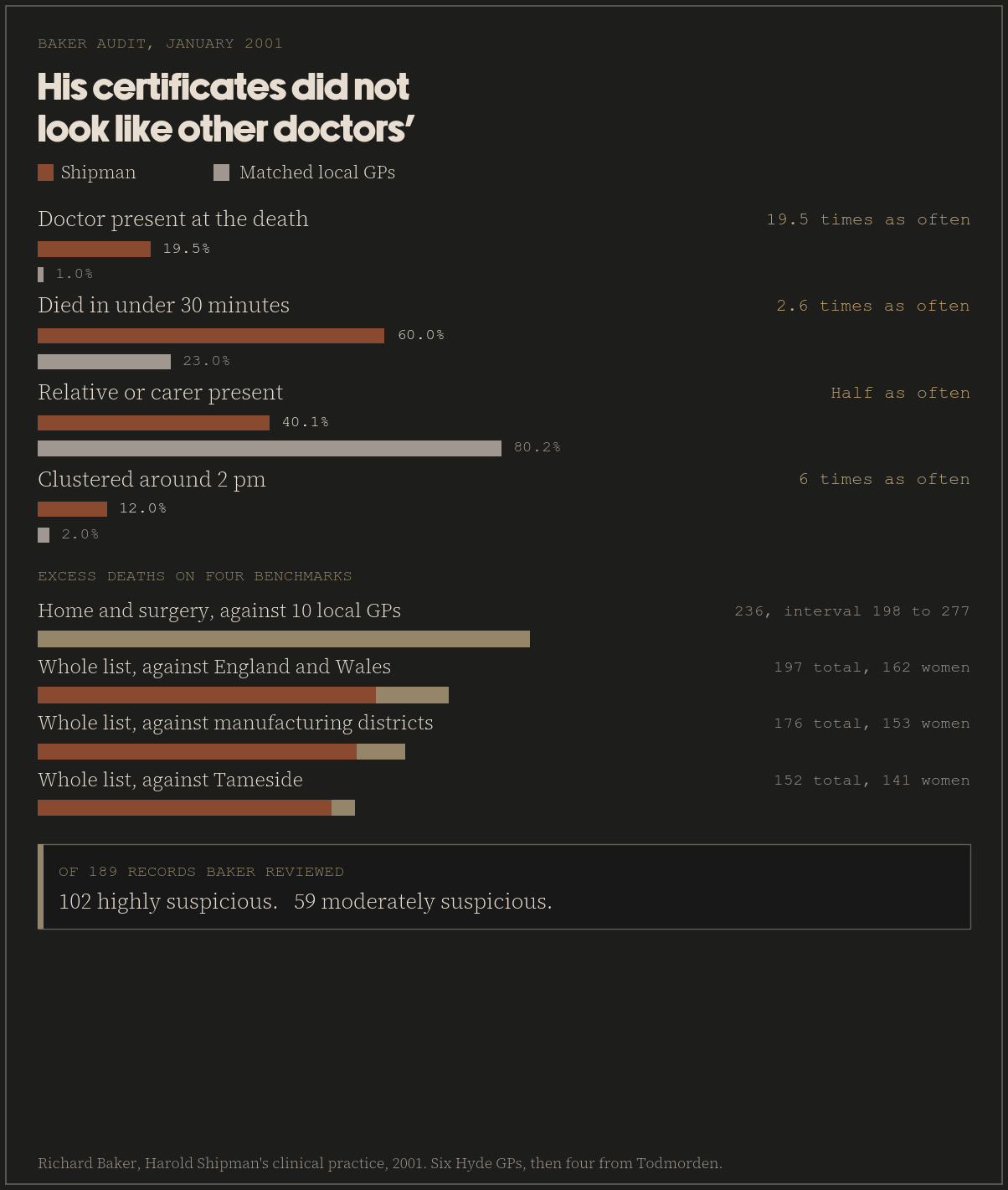
Baker measured those certificates against the matched doctors. Shipman was present at the death in 19.5 percent of cases, against 1 percent. Sixty percent of his patients were dead within 30 minutes, against 23 percent. A relative or carer was there for 40.1 percent of his deaths and for 80.2 percent of theirs. Twelve percent of his deaths clustered around 2 pm, against 2 percent. Of 189 records he read, he classed 102 as highly suspicious and 59 as moderately suspicious. The excess of home and surgery deaths was 236, with the likely range from 198 to 277. Set against England and Wales the excess was 197 deaths, 162 of them women. Against the manufacturing districts it was 176, 153 of them women. Against Tameside it was 152, 141 of them women.
Pathology
Morphine where a body remained
Chapter 7 of the first report is the pharmacology the inquiry used. Diamorphine is about twice as potent as morphine when it is given straight into a vein. A therapeutic dose for severe pain in an adult who is not already taking strong opioids is small. Professor McQuay’s best estimate of a dose likely to kill a fit adult who had not taken the drug before was 60 milligrams of morphine, or 30 milligrams of diamorphine, given over one minute into a vein. He expected 30 milligrams of diamorphine, given intravenously over five minutes or less, to put such a person to sleep and then stop their breathing. Dr Grenville was more conservative. He expected 20 milligrams of diamorphine, or 40 milligrams of morphine, to be fatal, and he would halve those amounts for an elderly, small, ill, or frail patient.
Those figures are the experts’ estimates of a fatal dose. They are not a formula, and the report says the true figure varies with age, size, health, and how fast the drug is given. A smaller dose could produce a long coma and brain damage without stopping breathing at once. Alice Gorton, who died on 10 August 1979, is the example the chairman uses. Shipman called the daughter in, believing the patient was already dead. The daughter heard a loud groan. Mrs Gorton lived, unconscious, for about another 24 hours. She was elderly and also a large woman. The chairman found that the dose was enough to cause death from brain damage or respiratory failure, and not enough, perhaps because of her size, to kill her on the spot.
In the nine exhumations, morphine was in the remains and the medical evidence called the death morphine poisoning. Grundy’s first post mortem found no anatomical cause. Toxicology did. Julie Evans said the level matched levels known to have killed by morphine overdose. Where the patient had been cremated, there was no equivalent test, and the jury, and later the chairman, worked from circumstances.
Method
An injection, then a certificate
The jury at the criminal trial found that he gave each of the 15 victims a large injection of opiate that was not for treatment, and that as a doctor he knew what that dose would do. The chairman treated that as the model. If she concluded that he had given an opiate injection which caused the death of a patient whose death was not otherwise imminent, she inferred that he intended to kill. She also left open a small number of deaths in which a large dose of a sedative, rather than an opiate, may have been used. She found no reliable evidence of any other method.
He obtained the drugs after 1976 without a controlled drugs register. He had said he would not carry controlled drugs again, so he was not required to keep one. Between 1992 and 1998 he obtained more than 24,000 milligrams of diamorphine. The Fourth Report, published in July 2004, describes three routes. He wrote inflated prescriptions in the names of dying patients and collected the drugs himself. In 1996 one such prescription, in a single dying patient’s name, was for 12,000 milligrams. The chairman notes that this quantity alone would have been enough to kill about 360 people. The full stock, more than 24,000 milligrams, was enough on that same arithmetic for at least 720 people, and for about 800 if each death took 30 milligrams. Between 22 February and 27 August 1993 he wrote 13 or 14 prescriptions for 30 milligram ampoules, too large a dose for a sudden pain and too small for the pain of a long last illness, in the names of patients who did not need the drug, and in at least six of those cases the named patient was already dead. He also took unused drugs from bereaved families on the pretence of destroying them, and he took drugs from living patients. In July 1998 he took five ampoules from a cancer patient, altered the drug card, and told a district nurse he was repaying a colleague.
Pharmacist Ghislaine Brant, at Battersby’s Pharmacy next door to the Market Street surgery, dispensed many of the abnormal prescriptions. The chairman found that he had flattered her until her caution slipped, and that she was largely the victim of a practised liar. In March 2005 the Statutory Committee of the Royal Pharmaceutical Society, chaired by Lord Fraser of Carmyllie, cleared her of seven disciplinary charges. Local police inspection was thin. A controlled drugs officer, Detective Constable Kelly, had been in post only a few months, and only part time, when the key prescriptions were going through.
Money was not the pattern, except in the Grundy will. Petty theft was. After the arrest, police took about 100 pieces of jewellery, valued at about 10,000 pounds, from a box in the bedroom at Roe Cross Green. Primrose Shipman produced receipts for 66, mostly cheap costume pieces, and those were returned. Appeals to families identified one piece, a platinum and diamond ring, which went back to that family. She said the remaining 33 were not hers. They were treated as proceeds of crime, passed to the Assets Recovery Agency, and auctioned in August 2005. The sale raised 1,700 pounds for Tameside Victim Support.
After death
Certificate, then cremation or burial
All but three of the 215 deaths were entered in the register on the strength of a medical certificate of cause of death that he wrote. Most were then cremated. Before a cremation, a second doctor must confirm the cause, and a third doctor at the crematorium must check the papers. The certificate rule was largely the one written in 1926. A doctor who had seen the patient in the previous 14 days could sign the medical certificate of cause of death without looking at the body, and the registrar read the form as it stood. Cremation had three papers. He signed Form B. A second doctor, qualified at least five years, signed Form C. A medical referee at the crematorium signed Form F. The chairman’s conclusion is that these steps, which exist to stop the concealment of an unlawful killing, gave no real safeguard. He avoided the coroner in all but a very few of the killings by saying he could certify the cause himself and by persuading relatives that a post mortem was unnecessary.
Sudden death at home, in a person who had not been terminally ill, is the sort of death that should go to the coroner. The Third Report, in July 2003, says that in nearly 50 years the second cremation form, Form C, had not uncovered a single homicide in England and Wales. Six Hyde doctors from the Brooke and Clarendon House practices countersigned 214 of his Form Cs over 18 years: Peter Bennett, Susan Booth, Jeremy Dirckze, Stephen Farrar, Alastair MacGillivray, and Rajesh Patel. Of those 214, 124 were patients the inquiry found he had killed. A question to the warden in Maureen Ward’s death, or to Freda Hibbs about her sister Joyce Woodhead, would have shown that his claim they had been present was false. Medical referees at Dukinfield Crematorium passed his papers for 24 years. The General Medical Council later charged all six doctors with serious professional misconduct. Bennett and Patel were cleared in December 2004, and the other four in July 2005. The panel said they could not have been expected to anticipate a colleague killing patients on this scale.
One patient survived the injection long enough for a hospital record to exist. On 18 February 1994, Renate Overton, 47, called him during an asthma attack. He injected morphine. She stopped breathing, suffered severe brain damage, and lived in a persistent vegetative state at Tameside General Hospital for 14 months, dying in April 1995. The notes recorded his morphine. Pathologist Dr David Bee certified natural causes without asking the clinicians why morphine had been given, and Coroner Revington decided an inquest was unnecessary. The chairman called that autopsy deeply flawed and the last clear chance to stop him years earlier. Bee admitted the mistakes to the General Medical Council in September 2004 and was cleared of serious professional misconduct.
People in Hyde had private doubts that never became a report. Two home helps and a victim’s niece kept their worries to themselves. Taxi driver John Shaw, who drove elderly women around the town, kept a list of 21 passengers who had seemed well and then died after seeing Shipman. He took the list to the police in August 1998, once the Grundy inquiry was already open. No official question reached the authorities until nearly twenty years after Shipman arrived in the town.
Evidence
What proved the fifteen
- Morphine in nine exhumed bodies, with medical evidence that morphine poisoning was the cause of death.
- His presence, admitted or witnessed, at or just before 14 of the 15 deaths. Joan Melia is the case without that proof.
- A forged will and a typewriter seized from the surgery. Michael Hall said the will was probably typed on that machine.
- Certificates of cause of death in his writing for all but three of the 215.
- Cremation Forms B, including the 16 in three months that Dr Reynolds counted.
- The 1976 drugs convictions, which Greater Manchester Police learned about from the Home Office on 10 August 1998. They had not known of them during the March inquiry.
- Baker’s excess death calculation, which landed close to the inquiry total.
Witness
Angela Woodruff
Kathleen Grundy’s daughter and her solicitor since 1986. She knew the real will, spoke to the supposed witnesses of the new one, and reported the forgery on 24 July 1998. The criminal case starts with her.
Witness
Dr Linda Reynolds
A principal at the Brooke Practice. On 24 March 1998 she told the coroner about the cremation forms and the pattern of deaths. The chairman says Reynolds had already crossed the credibility gap that stopped the police and Dr Banks.
Witness
John Pollard
South Manchester coroner. He received Reynolds’s report, asked the police to investigate, and later held the inquests that returned unlawful killing where the criminal court did not sit again.
Witness
Detective Inspector David Smith
Ran the March 1998 inquiry and closed it on 17 April. The second report finds that he was the wrong officer for the job, that he closed it early, and that he was not the person primarily to blame.
Witness
Chief Superintendent David Sykes
Supervised Smith and kept that supervision instead of handing the concern to a senior detective. The chairman calls that decision fundamentally wrong and the primary reason the investigation failed.
Witness
Dr Alan Banks
Reviewed records for the health authority and did not see the missed referrals to the coroner. The chairman says his share of the failure was real and smaller than that of Sykes and Smith.
Witness
Bernard Postles
Became senior investigating officer on 3 August 1998, after the Grundy exhumation, and ran the investigation that produced the 15 charges.
Witness
Julie Evans and Michael Hall
The forensic scientist and the document examiner. On 28 August 1998 she reported morphine at a fatal level. On 26 August he reported that the will was forged and had probably been typed on the seized machine.
Witness
Primrose Shipman
His wife. She called a partner after the bathroom fall, described a blackout in the car, and drove him on visits in Todmorden. The report does not make her a party to the later killings.
Witness
Professor Richard Baker
His January 2001 review put the likely excess of deaths at 236, inside a range of 198 to 277. After the inquiry he put the excess near 220 to 240.
Investigation
The inquiry that closed, and the one that did not
There were two police investigations, and they did not do the same job. The first was confidential, short, and closed while he was still killing patients. The second began because of a will, produced morphine from an exhumed body, and ended in 15 murder convictions.
On 24 March 1998 Dr Linda Reynolds, a principal at the Brooke Practice across from his surgery, told John Pollard, the South Manchester coroner, that she and her partners were worried about how many of Shipman’s patients were dying and about the way they died. The coroner asked Greater Manchester Police to look. Detective Inspector David Smith conducted the inquiry under Chief Superintendent David Sykes. Smith decided there was no substance in the concerns. The investigation ended on 17 April 1998.
Reynolds had two grounds. In the previous three months Shipman, working alone, had signed 16 cremation Forms B. The Brooke Practice, with about 9,500 patients, had had 14 deaths in the same period. His list was about one third the size of theirs. The 16 forms did not include deaths in hospital, burials, deaths certified by the coroner, or cases where a doctor from outside the Brooke Practice signed the second form. The inquiry calculated that the cremations the Brooke doctors could see were likely to be no more than about 21 percent of his deaths in that period. The gap was therefore larger than the raw comparison of 16 against 14. The Brooke figure of 14 deaths was later corrected to 15.
The second ground was the shape of the deaths. The patients were elderly women, found dead at home, apparently alone, fully dressed, and not apparently ill. Shipman often found them. Deborah Bambroffe, born Massey, a partner at Frank Massey and Son, had noticed that pattern and spoken to Dr Susan Booth, who took it to Reynolds. Bambroffe did not want her name given. Reynolds told the coroner that, and did not name her. Interviewed the same day by Smith, Reynolds said she feared killing by negligence or by drugs, and she named two bodies that had not yet been cremated: Lily Higgins, who died on 17 March and was cremated on 25 March, and Ada Warburton, who died on 20 March and was cremated on 30 March. The coroner put two possible explanations to the police. Either Shipman was a careful doctor who kept elderly patients at home, or he was killing them.
The three weeks that followed missed the checks that would have mattered. Nobody stopped the two cremations. Smith did not run a Police National Computer check, so the 1976 drugs convictions stayed invisible. At Dukinfield he did not read the cremation register or the bundles of Form B, and he missed 11 further Shipman deaths from the previous six months. He kept about three pages of notes and a spreadsheet, wrote no final report, and told Pollard the cremation to burial split was 70 percent to 30 percent. It was closer to 85 percent to 15 percent. On 17 April 1998 he closed the file by telling Pollard that all was well. He later lied to the inquiry about when he had learned of Ada Warburton’s death. On 2 April, funeral director Alan Massey, Bambroffe’s father, had already gone to the surgery to ask about the rumours. Shipman was calm. Massey left reassured, and Shipman now knew he was being talked about. He stopped for about seven weeks. Then he killed Mellor, Melia, and Grundy.
The second report, published in July 2003, is the chairman’s judgment of that investigation. She found that the conduct of Sykes, Smith, and Dr Alan Banks, the health authority medical adviser who reviewed records, fell below the standard the public was entitled to expect. She put the primary fault on Sykes. He gave the job to Smith and kept the supervision himself. She called that decision fundamentally wrong. Smith, she found, was out of his depth, had no plan, and closed the inquiry before it was complete. He should have asked a senior detective for help. He also failed to tell the coroner that the bodies of Ada Warburton and Lily Higgins were still available for autopsy. Banks did not see, in the notes he was given, the repeated failure to report deaths to the coroner, because he could not accept that Shipman might be killing patients or even caring for them badly. The chairman calls this difficulty the credibility gap. She treats it as mitigation. She does not treat it as an excuse. Reynolds had already crossed it.
Her conclusion on what a competent investigation would have done is specific. A senior detective would have tested the death rates within a day or two. An autopsy of Ada Warburton or Martha Marley would still have been possible. If either death was his, a drug would have been the means, toxicology would have been ordered, and morphine would have been found. He would have known he was suspected. She did not think he would have killed again after that. Instead the file closed, and Mellor, Melia, and Grundy died afterwards.
The investigation that convicted him started with the will, not with the death rate. Kathleen Grundy died on 24 June 1998. He certified old age. She was 81 and had been in good health. The death was sudden. She was buried at Hyde Chapel. Her daughter, Angela Woodruff, a solicitor, had drawn her mother’s will in 1986 and was the sole beneficiary of a substantial estate. A new will, dated 9 June 1998, was sent with a covering letter to solicitors in Hyde who did not know Mrs Grundy. A further letter, signed J. Smith or S. Smith, told them she had died. The new will left the entire estate to Shipman.
The will reached Hamilton Ward, solicitors in Hyde who did not act for Mrs Grundy, on the morning she died, with a typed covering letter signed K Grundy. On 30 June a second typed letter arrived, signed S or F Smith, with no return address, saying the writer was the friend who had typed it. Woodruff’s firm held the genuine 1986 will, in which she was the beneficiary. She recognised the new document at once: amateur typing, an oversized signature. She spoke to the two patients whose names appeared as witnesses, Claire Hutchinson and Paul Spencer. They had been called from the waiting room on 9 June, while Mrs Grundy was in to have her ears syringed, and asked to sign a paper on his desk. They had not seen her sign a will. On 24 July 1998 Woodruff reported the matter to police in Warwickshire, where she lived. It was passed to Greater Manchester. Detective Superintendent Bernard Postles later compared the will to something off a John Bull printing set. Officers realised the beneficiary was the same doctor who had been investigated a few months earlier. The body was exhumed on 1 August 1998. The same day, warrants were executed at the surgery and at his home. A typewriter and the medical records were seized.
The post mortem did not find a cause of death. On 14 August the North West Forensic Science Laboratory reported an opiate, possibly morphine. On 26 August the document examiner Michael Hall said the signatures on the will had been forged and that the will had probably been typed on the machine from the surgery. On 28 August the forensic scientist Julie Evans said the morphine levels were consistent with levels known to have caused death by morphine overdose. On 7 September 1998 he was arrested on suspicion of murdering Grundy, of trying to obtain property by deception, and of forgery. He was charged and, the next day, remanded by Tameside Magistrates’ Court. The first report says he had been in custody ever since.
Through the autumn and winter the police exhumed further bodies and charged further murders: Joan Melia, Winifred Mellor, and Bianka Pomfret in October; Marie Quinn and Ivy Lomas in November; Jean Lilley and Irene Turner in December. On 22 February 1999 he was charged with the murder of Muriel Grimshaw, whose body had been exhumed, and with the murders of Norah Nuttall, Kathleen Wagstaff, Maureen Ward, Pamela Hillier, Maria West, and Lizzie Adams, all of whom had been cremated. The trial of those 15 murders, and of the Grundy forgery, opened on 5 October 1999. He pleaded not guilty. On 31 January 2000 the jury convicted him on every count.
Others
Not co-defendants
No other person was convicted of these murders. The second report examines Sykes, Smith, and Banks as public servants whose work fell short, not as parties to the killings. Primrose Shipman is a witness to the Todmorden blackouts and to the driving. The reports used here do not charge her. Claire Hutchinson and Paul Spencer signed the Grundy will as witnesses after he called them in from the waiting room. They were witnesses for the prosecution, not defendants.
Admissions
What he admitted, and what he denied
He admitted the pethidine use in 1975, including a daily amount of 600 to 700 milligrams, and he pleaded guilty to the specimen charges in 1976. At the murder trial he pleaded not guilty. He admitted being present at some of the deaths, including Lomas, Quinn, Wagstaff, Adams, Nuttall, and West. Presence is not a confession of murder. He denied the Mellor visit. He said he found Maureen Ward dead. He suggested Grundy might have been addicted to drugs. The jury rejected the defences that those accounts were meant to support.
Motive
A will in one case, no stated motive in the rest
Volume One does not offer a psychiatric motive for the killings. It records the 1975 depression and the pethidine dependence, and it records that those blackouts were later understood as the drug. It does not say the later killings were a continuation of that addiction. By the Hyde years he was obtaining diamorphine in quantities far beyond any personal habit the 1976 case described, and he was giving it to patients who were not in pain that called for it.
The one killing that had an obvious material gain is Kathleen Grundy. The forged will made him the sole beneficiary of her estate. The chairman does not generalise from that will to the other 214. Most of the deaths had no such document. What they had was his presence, a sudden death, a certificate in his handwriting, and, where a body remained, morphine.
He refused a psychiatric examination, made no confession, and left the motive unstated. Richard Henriques, leading for the Crown, told the jury he killed because he enjoyed the power of deciding who lived. Coroner John Pollard thought he liked to watch a death. The chairman recorded no sexual sadism and no financial pattern beyond Grundy, and she noted that he once asked a home help whether finding a client dead gave her a buzz. A simple story in which he was replaying his mother’s death does not fit the first three named hospital victims, who were men. The clumsy will, after so many undetected deaths, has been read as arrogance after he survived the March inquiry, as a plan to take the money and leave, or as a wish to be stopped. None of those readings was proved. Criminologists Keith Soothill and David Wilson later argued that the scale also depended on how rarely the sudden death of an elderly woman living alone was treated as a question. Recording 173 of the inquiry’s homicides in the 2002 to 2003 police homicide index produced a spike in the national murder figures that the deaths themselves, spread over decades, had never made. He was not the only clinician prosecuted for serial killing. Reviews of healthcare serial murder find that most convicted defendants are nurses, and that doctors, because they prescribe and certify, can reach a higher toll before anyone outside the room asks a question. John Bodkin Adams, an Eastbourne GP, was acquitted of murder in 1957 after a case built on opiates and patient wills. Michael Swango, an American doctor, was convicted in 2000. Nurses Charles Cullen, Niels Högel, Elizabeth Wettlaufer, and Lucy Letby were convicted in later decades. The Thirlwall Inquiry, reporting on the Letby case, treated the twenty year delay in the medical examiner system as part of the same unfinished reform. The comparison does not make those cases one method. It shows that a certificate signed by the person who gave the drug is a recurring gap, and that Hyde was the largest British example of it.
Herbert Kinnell argued in the British Medical Journal in 2000 that Shipman was not a once in a lifetime exception, and later reviews by Beatrice Crofts Yorker and by Elizabeth Yardley and David Wilson treated healthcare serial murder, sometimes called clinicide, as a recurring event. In Yorker’s set of prosecuted cases, about 86 percent were nurses, 12 percent were doctors, and 2 percent were other clinical staff. Doctors reach higher tolls because they prescribe and they certify. John Bodkin Adams, an Eastbourne GP, was acquitted of murder in 1957. He had been named in 132 patients’ wills. Historian Pamela Cullen has argued that the acquittal delayed reform of death certification until Shipman. Marcel Petiot, a Paris doctor, was convicted of 26 murders of people who came to him trying to leave occupied France. The gain was their money, not a surgery list. Michael Swango moved from hospital to hospital, and from the United States to Zimbabwe, and was sentenced to life in 2000, with about 60 deaths suspected. Charles Cullen, a nurse in New Jersey and Pennsylvania, was convicted of between 26 and 29 murders and suspected of many more, using digoxin and insulin, and he kept ahead of the record by changing jobs. Niels Högel, a German nurse, was convicted of 85 murders in which he created emergencies so that he could join the resuscitation. Elizabeth Wettlaufer, a Canadian nurse, was convicted of 8 murders by insulin. Lucy Letby, a neonatal nurse at Chester, was convicted of 7 murders and 6 attempted murders. Consultants had raised the mortality. Managers set the warnings aside. The Thirlwall Inquiry tied that failure to the twenty years it took to finish the medical examiner reform that began with Shipman. Brian Hurwitz has described British general practice as the place where a criminal killing could hide inside ordinary medical deviance, because a trusted doctor killing a patient was, for a long time, culturally unthinkable. Biographers Brian Whittle and Jean Ritchie added a third reading of the Grundy will to hubris and to a wish to be caught: a plan to retire at 55 and leave the country.
Findings
Three ideas the reports make precise
The credibility gap
Many people could not believe a trusted doctor was killing patients. The chairman gives that difficulty weight, and she refuses to let it excuse the missed steps. Dr Reynolds had already said the thing out loud.
The certificate shield
A death certified by the patient’s own doctor, then confirmed for cremation by two more doctors, looked like a checked death. The chairman’s finding is that the paper was the method of concealment, not a protection against it.
Sure, or only probable
She did not pretend every one of the 215 was proved to a criminal standard. Some findings are sure. Some are probable, and still clearly weighted, not finely balanced. The number 215 is the count of positive findings. It is not a claim that a jury said guilty 215 times.
Check
What can be checked against the reports
- The 15 names on the indictment, and which nine were exhumed.
- The date the March 1998 inquiry closed, and the three names of patients who died after it.
- The split 1, 71, and 143 across Todmorden, Donneybrook, and Market Street.
- The sex split, 171 and 44, and the ages given for Cooper, Lewis, and Harrison.
- Baker’s 236 against the inquiry’s 215 plus the suspected remainder.
- Whether a quoted killing is a jury verdict, an inquest verdict, or the chairman’s finding.
Comparison
Two standards, side by side
Jury, 15 deaths
Guilty of murder. Intent inferred from a large non therapeutic injection given by a doctor.
Chairman, positive findings
Sure, or probable. Both sit inside the 215. Finely balanced cases were left undecided.
Coroner, named inquests
Unlawful killing, except open verdicts for Joan Dean and Marjorie Waller.
Baker
A statistical excess, most likely 236, later aligned near 220 to 240.
Conflict
Points that stay in dispute inside the reports
He said, in 1975, that he had started pethidine because he did not get on with his Todmorden partners. They do not agree there was friction. The inquiry records both accounts and does not need to decide the workplace mood in order to accept the drugs convictions.
He said Kathleen Grundy might have been a drug addict. The jury rejected that explanation for the morphine in her body.
He denied visiting Winifred Mellor on the day she died, after being seen outside the house. He said he found Maureen Ward already dead. The jury convicted in both cases.
Detective Inspector Smith’s later accounts of the 1998 investigation differed from one another. The chairman finds that he told lies in an August 1998 report, to Detective Superintendent Ellis, and in some statements to the inquiry, including a continued lie about how he learned of Ada Warburton’s death. She also finds that in oral evidence he corrected some earlier accounts, and she gives him credit for that.
On the standard of proof, a positive finding is not the same thing as a criminal conviction, and a finding of ‘probably’ is not the same thing as a finding that she was sure. The public number 215 folds those positive findings together. The first report does not split how many of the 215 were sure and how many were probable.
A family account given to the inquiry said that, at the death of Peter Lewis, someone walked back into the room and saw Shipman holding a pillow. The inquiry’s finding on method stays with a drug. It does not find that he killed by smothering.
Courts
Magistrates, a criminal trial, inquests, and an inquiry
On 18 February 2000 the Director of Public Prosecutions announced that there would be no further criminal proceedings. The reasons given were the impossibility of a fair trial after the publicity of the January convictions, and the fact that a whole life recommendation was already in place, so a further conviction would add no punishment.
The General Medical Council had told the police in August 1998 that it could do nothing until he was convicted. The West Pennine Health Authority went to the NHS Tribunal. A hearing could not be held before 29 September. The decision to suspend him was not sent to the authority until 15 October, and the authority could take the practice only after the time for an appeal expired on 29 October 1998. After the trial, the Preliminary Proceedings Committee suspended him, and on 11 February 2000 the Professional Conduct Committee erased his name from the medical register.
Inquests filled the gap the criminal court would not. Sarah Ashworth, Alice Kitchen, and Elizabeth Mellor had been exhumed but were not on the indictment. Inquests in August and September 2000 all returned unlawful killing. In early 2001 the coroner was directed to open inquests into 23 further deaths the police had identified, plus Charles Killan. Between January and April 2001 those inquests returned unlawful killing except for Joan Dean and Marjorie Waller, where the verdicts were open. The names on that list are Dorothy Andrew, Irene Berry, Edith Brady, Edith Brock, Elsie Cheetham, Erla Copeland, Lilian Cullen, Valerie Cuthbert, Elsie Dean, Joan Dean, Doris Earls, Elsie Hannible, Irene Heathcote, Hilda Hibbert, Charles Killan, Bertha Moss, Nellie Mullen, Gladys Saunders, Mabel Shawcross, Marjorie Waller, Mary Walls, Ada Warburton, Amy Whitehead, and Joyce Woodhead.
On 18 May 2001 the coroner opened inquests into a further 232 deaths and immediately adjourned them, on the Lord Chancellor’s direction, until the inquiry published its findings. The inquiry itself was established on 31 January 2001, after resolutions of both Houses, by an instrument of the Secretary of State for Health under the Tribunals of Inquiry (Evidence) Act 1921. Dame Janet Smith was the chairman. The first term of reference was to consider the extent of his unlawful activities. Volume One, Death Disguised, is dated July 2002. The second report, on the March 1998 police investigation, was presented to Parliament in July 2003 as Command Paper 5853.
Public account
Old age, and a caring doctor
The cause he wrote for Kathleen Grundy was old age. The alternative explanation the coroner offered the police in March 1998 was that he was a caring doctor who kept elderly patients at home and visited them often. Both accounts made a sudden death look like medicine. The inquiry’s phrase for the killings, taken from the sentencing remarks, is death disguised as the caring attention of a good doctor.
Limits of the story
What the reports do not say
The reports do not support the idea that the killings were mercy for the dying. In the 15 conviction cases nobody was terminally ill, and the deaths were not expected. Peter Lewis is the named case of a younger man already in the last stage of a terminal illness, and there the finding is that death was hastened, not that a planned medical end of life was agreed. The chairman says she does not intend to discuss euthanasia or assisted suicide as a general subject.
The reports also do not support the idea that the cremation forms and the second doctor’s signature were a real check. She says that, with those procedures in place, he killed 215 people without detection, and that in reality the procedures provided no safeguard at all.
They do not support a story in which the March 1998 inquiry was a near miss that the police simply lacked the science to finish. Her finding is that the investigation was given to the wrong officer, supervised by the wrong officer, closed too early, and that an autopsy was still available and was not sought.
Limits
What was not in these two volumes
These two volumes do not contain the 494 individual written decisions. A reader who wants the evidence on one named patient, other than the conviction cases and the few the summary discusses, has to go to Volumes Two to Six. This account does not invent those case narratives.
Volume One and the police report do not record his birth date or his death. Later inquiry papers and the inquest do. He was born on 14 January 1946. On 13 January 2004, at HMP Wakefield, an officer found him hanging. A jury at Leeds Crown Court returned a verdict of suicide on 22 April 2005. That verdict is not a finding about the patients.
The inquiry findings of killing are not jury verdicts. Where she says she is sure, and where she says he probably killed, both count in the 215. Families and a criminal injuries authority might treat those words differently. The chairman herself separates them.
One Todmorden coroner’s file concerned a newborn child. She excluded deliberate killing and put the suggestion of inadequate care outside Phase One. That is the whole of what Volume One says about that death, and it is not expanded here.
Open
Left open
How many of the 215 were findings of ‘sure’ and how many were findings o
How many of the 215 were findings of ‘sure’ and how many were findings of ‘probably’. The summary gives the total and the method. It does not give that split in the pages used here.
The individual evidence for each patient outside the conviction cases, t
The individual evidence for each patient outside the conviction cases, the Gorton example, Lyons, and the names in the inquest list. Those decisions are in Volumes Two to Six.
Whether the limited search of South Manchester coroners’ files changed a
Whether the limited search of South Manchester coroners’ files changed any total. Volume One records the decision to search, not a finished extra count.
His life after July 2003. These reports do not contain it.
His life after July 2003. These reports do not contain it.
Hospital
Three deaths at Pontefract
The first report did not find killings during the hospital years. After a former nurse raised the question, the final report looked at 137 deaths at Pontefract General Infirmary. Dame Janet Smith concluded that he probably began killing in 1972, within a year of qualifying. She named three men: Thomas Cullumbine, 54, on 12 April 1972; John Brewster, 84, on 28 April 1972; and James Rhodes, 71, on 22 May 1972. She thought the drug in Cullumbine’s case was probably morphine. She did not name a drug for the other two.
She also counted four deaths with a strong suspicion and 17 with some suspicion, and she thought the hospital toll might have reached 15. The final report raised a suspicion about Susie Garfitt, a four year old who died at Pontefract on 11 October 1972. It says her mother did not ask that the death be hastened. Suspicion is not a finding that he killed the child.
Of the 137 Pontefract deaths in that audit, 133 were certified by him and 4 were deaths at which he was present. Beside the suspicions already counted, 45 files lacked enough evidence and 68 were deaths in which he was not involved. The final report thought as many as five of the hospital deaths may have fallen inside three days in April 1972. Susie Garfitt had been diagnosed with cerebral palsy at six months. Her mother knew the child was dying and told him to be kind. The hospital deaths already showed the later habits: notes that did not match the ward, deaths kept from the coroner, drugs tried while he was taking pethidine himself, and a clock that favoured the evening, between 6 pm and midnight, when fewer staff were on the ward.
Final count
218 named, and about 250
The 215 is the first report’s count of killings in general practice: one at Todmorden, 71 at Donneybrook, 143 at Market Street. The final report adds the three named hospital deaths and says 218 patients were identified by name. It puts the toll near 250 between 1971 and 1998. That estimate includes deaths she did not name. It is still not a criminal conviction.
Between 1992 and 1998 he obtained more than 24,000 milligrams of diamorphine without a controlled drugs register. The first report had already recorded one prescription, in 1996, for 12,000 milligrams in a dying patient’s name.
Forensics
What the trial added to the morphine
Between August and December 1998 Greater Manchester Police exhumed 12 bodies. Nine went on the indictment: Grundy, Melia, Mellor, Pomfret, Lomas, Quinn, Turner, Lilley, and Grimshaw. Three other exhumed patients were left off the charges. Home Office pathologist Dr John Rutherford found age and chronic disease, and no sudden natural event that explained the collapse. Winifred Mellor’s certificate said coronary thrombosis. The body did not show it. Julie Evans found morphine in thigh muscle and liver because burial, from five weeks in Grundy’s case to 28 months in Irene Turner’s, and embalming in several cases, left no usable blood. Diamorphine breaks down in the body to morphine. Professor Henry McQuay told the court that a dose given into a vein produces sleep, then slowed breathing, then respiratory arrest. Hair from the exhumed patients showed no chronic morphine use. Dr Steven Karch explained that morphine laid down in hair would have recorded months of use if there had been any. None of the 15 had been prescribed morphine or diamorphine. That combination answered the claim that a patient had been taking the drug for a long time.
The defence, led by Nicola Davies QC, pressed the limits of that science. Morphine in a buried body can move, and conjugated morphine can break back down into free morphine, so a number in muscle is not a number in living blood. Evans agreed the muscle assay was new in this setting and could not, by itself, separate one dose from several. Davies called toxicology the prosecution’s foundation stone and argued that natural death or an adverse reaction remained possible. The jury had the rest of the pattern as well as the numbers.
Derrick Pounder set out the limits of that science in 2003. Morphine lasts in a buried body better than many drugs, which is the point Glasgow toxicologist Robert Anderson used against the claim that the tests were untried and useless, but a reliable quantity is harder after about four years in the ground. In life the body turns morphine into two joined forms, morphine-3-glucuronide and morphine-6-glucuronide. After burial those can split back into free morphine, so the ratio of free drug to total drug changes. The drug also leaks from liver, lung, heart muscle, and gut into the tissue around them as the cells break. Pounder called that leak a toxicological nightmare. Diamorphine, once injected, becomes morphine almost at once, passing through 6-acetylmorphine. McQuay told the jury that a dose into a vein brings sleep, then slowed breathing, then breathing that stops. The estimate for Kathleen Grundy was that she died within about three hours of the injection. The hair tests followed a method Tagliaro and colleagues had described in The Lancet in 1998. Steven Karch’s evidence was that morphine laid down in hair would have shown months of use. A negative hair test does not measure one dose. It does exclude a long habit. None of the 15 had a prescription for morphine or diamorphine.
The surgery computer, Microdoc, kept a hidden log of each change. Detective Sergeant John Ashley compared the screen the doctor saw, Exhibit JFA41, with the hidden logs, Exhibits JFA42 and JFA43. In seven of the 15 trial cases Shipman added a backdated illness after the death, including a false query about opiate abuse on Grundy’s file and chest pain on Pomfret’s. For Winifred Mellor, the log shows he signed in under the passcode HFS minutes after leaving her house and typed a nine month history of angina, backdated 283 days to 1 August 1997, in 3 minutes and 10 seconds. Phone records showed that calls he described, from Marie Quinn and Norah Nuttall, had not been made, and that the 999 calls he pretended to make for Lizzie Adams and Joan Melia had not been made either.
He bought a stationer’s will form from a newsagent by the surgery and typed the will and both covering letters in capitals on a portable Brother typewriter kept at the practice. Worn keys skipped characters. Those defects matched the machine that was seized. Document examiner Michael Allen called the K Grundy signature a poor, crude simulation: shaky strokes, retouching, the wrong scale. Fingerprint officer Andrew Watson matched a print of Shipman’s left little finger on the will and on the typewriter.
Trial
Fifty eight days at Preston
The trial at Preston Crown Court opened on 5 October 1999 before Mr Justice Forbes and ran 58 days. Richard Henriques QC led for the Crown, with Peter Wright QC and Miss Blackwell. Nicola Davies QC defended, instructed by Ann Ball of Hempsons. Ball’s team included Katherine Sheldrick, a trainee with a doctorate in biochemistry. Before the jury was sworn, Davies asked the judge to stop the trial because of the press, to split the 15 counts into three trials, and to exclude the evidence, called Volume Eight, that he had diverted morphine from 28 other patients. The press had already speculated about as many as 150 murder charges. Forbes refused all three, so the jury heard the pattern as one case. Across the witness evidence Henriques asked 8,310 questions and Davies 7,337. Shipman chose to give evidence. He affirmed, rather than taking an oath, and spent about 12 days in the box, roughly five and a half giving his own account and six and a half under cross examination. The witnesses had taken about 40 days. There were 89 prosecution witnesses. He called the altered notes the habits of a busy doctor with 3,100 patients.
The cross examination closed the gaps he tried to leave. Four ampoules found at his home were what remained of a pack a dead patient’s relative had handed back. He said he had no sensible answer for why he had destroyed six and kept four. He admitted a remark to nurse Marion Gilchrist, after the Grundy exhumation, that his mistake had been failing to have her cremated, because ashes cannot be dug up. Henriques called the suggestion that the former mayoress abused opiates quite wicked. Shipman answered that it was not his role to find out where the diamorphine had come from. In closing he said the poisoner fears the pathologist, the ambulance, and the hospital. After six days the jury returned unanimous guilty verdicts on all 16 counts on 31 January 2000. Forbes passed 15 life sentences and four years concurrent for the forgery, and told him that none of the women had known his was not a healing touch, that none had known he had brought death disguised as the care of a good doctor, and that in his case life must mean life. The General Medical Council erased him on 11 February 2000. Home Secretary David Blunkett confirmed a whole life tariff in July 2002. An appeal begun in late February 2000 did not overturn the convictions.
On 18 February 2000 the Director of Public Prosecutions, David Calvert-Smith QC, said there would be no further murder charges, though he accepted there was evidence for at least 23 more deaths. He cited publicity that would prevent a fair trial, the fact that further life sentences would not change the term, and the need to let the inquiry start. Relatives, among them Suzanne Bennison, granddaughter of Edith Brock, and John Hibbert, son of Hilda Hibbert, said he had escaped a court for their families. Between August 2000 and April 2001 Coroner John Pollard held inquests into 27 deaths, with 25 verdicts of unlawful killing and two open verdicts, then on 18 May 2001 opened and immediately adjourned 232 more so the inquiry could proceed. In November 2013 retired detective Pete Jackson disclosed that police had kept about 60 organ and tissue samples from the 1998 post mortems and had incinerated them in February 2011 without telling the families. An Independent Police Complaints Commission inquiry, Poppy 1, later found that Greater Manchester Police had acted within the law and that no officer had a misconduct case to answer. The families were not comforted by that finding.
After the trial
Wakefield, 13 January 2004
He was taken to HMP Frankland on 7 February 2000 and moved to HMP Wakefield on 18 June 2003. At Frankland he befriended Peter Moore, another man convicted of serial murder. A former cellmate, Tony Fleming, said Primrose, who had maintained his innocence, wrote asking him to tell her everything. A prison doctor called him very emotional in the weeks before he died. Police advised the family against a burial because of the risk of vandalism. His widow and their four children were at the cremation. He would not attend offending behaviour programmes. In December 2003 the prison cut him to basic privileges, which stopped him affording calls to his wife, and restored them on 8 January 2004. At 6:10 on the morning of 13 January 2004, the day before his 58th birthday, an officer found him hanging from bed sheets, partly behind a curtain. The Prison Service recorded the find at 6:20. Staff tried to revive him for about half an hour and did not call an ambulance. A doctor, sent for at 6:43 from across Leeds, pronounced him dead at 8:10. The prison ombudsman, Stephen Shaw, in August 2005, said the death could not have been predicted or prevented, and he rejected the claim that staff had taunted him. Three extra strips of material under the pillow, one knotted at both ends, one knotted at one end, and one plain, showed he had prepared. Shaw also found that staff had not been told of his long term risk, that the night rules for a Category A cell were poorly understood, and that the prison held the wrong next of kin, so Primrose Shipman heard of the death from a relative who had heard it on the radio.
His NHS pension had been forfeited on 17 July 2002. Dying before 60 left his widow, under the scheme rules, a tax free lump sum above 100,000 pounds and a widow’s pension of about 10,000 pounds a year. He had spoken to a probation officer about suicide and his wife’s pension. Shaw said he could find nothing in the pension that explained the date he chose. The cremation was private, at Hutcliffe Wood in Sheffield, on 19 March 2005. On 22 April 2005, after a ten day inquest, a jury at Leeds Crown Court returned a verdict of suicide.
After
What the inquiry changed
The inquiry sat at Manchester Town Hall from June 2001, cost about 21 million pounds, took roughly 2,500 statements, and published six reports with 190 recommendations. The first, Death Disguised, in July 2002, is the count of 215. The second, in July 2003, is the failed police investigation. The third, the same month, is death certification. The fourth, in July 2004, is controlled drugs. The fifth, in December 2004, accuses the General Medical Council of putting fairness to doctors ahead of safety for patients and calls for a civil standard of proof, separate adjudication, and regular review of a doctor’s right to practise. The sixth, on 27 January 2005, is Pontefract. It also rejects a claim, from an inmate at HMP Preston, Mr Harkin, that Shipman had confessed to 508 victims. The inquiry had first been proposed as a private review. The families obtained public hearings. The six reports came out on 19 July 2002, 14 July 2003 for both the police report and the certification report, 15 July 2004 for controlled drugs as Cm 6249, 9 December 2004 for the fifth report, Safeguarding Patients, Cm 6394, about 1,300 pages, and 27 January 2005 for Pontefract. The fifth report accused the General Medical Council of looking after its own.
Sir David Spiegelhalter later tested whether a running comparison of deaths would have caught him. He was watching about 27,000 GPs in about 9,000 English practices, so he set the false alarm and the missed alarm each at one in a million, and he tested ordinary mortality against a doubling of the risk. For counts of deaths, each period adds 0.69 times the gap between the deaths observed and the deaths expected. The number 0.69 is the natural logarithm of 2, the doubling he was testing for. On deaths he certified at home or in the surgery, for women over 64, measured against matched local doctors, that line was crossed in 1985, after 41 excess deaths, thirteen years before the arrest. The excess of women over 64 in that stream reached 67 by the end of 1996 and 119 by 1998. All excess deaths of women at home or in the surgery reached 174. His deaths from all causes, measured against England and Wales, stayed close to the national average from 1988 through 1994, and the test stored that as credit. Even after the credit was wiped in 1992, the all cause line was not crossed until 1997. A live trial by Paul Aylin and colleagues, published in The Lancet in 2003, ran cumulative charts, tuned to a shift of four standard deviations, on 1,009 GPs in five health authorities and flagged 12. One was Shipman. Eleven were not, which is a false discovery rate among the alarms of about 92 percent. Mohammed and colleagues then looked at two West Midlands doctors and six others. Every innocent alarm was a nursing home. For one doctor, 63 to 69 percent of deaths in 1995 to 1997 were in nursing homes. For the other, the share ran from 40 to 78 percent. The extra deaths tracked the nursing home deaths, and when the first doctor gave up one home in 1999 his deaths fell from 29 to 14. A Northern Ireland pilot in 2002 to 2004 flagged 15.8 percent of practices, and every alarm was case mix the chart had not measured. A 2008 study in the British Journal of General Practice found false alarm rates of 15 to 28 percent, and a real chance of detection only for a pace like his, ten or more deaths at home a year for three years, which means thirty deaths before the chart is likely to speak. About 40 percent of practices changed their lead doctor within three years, and from 2004 patients were registered with a practice rather than with one doctor, which diluted the signal further. Charts can confirm a killer after dozens of deaths. They also accuse innocent doctors. They were never a substitute for someone else reading the certificate.
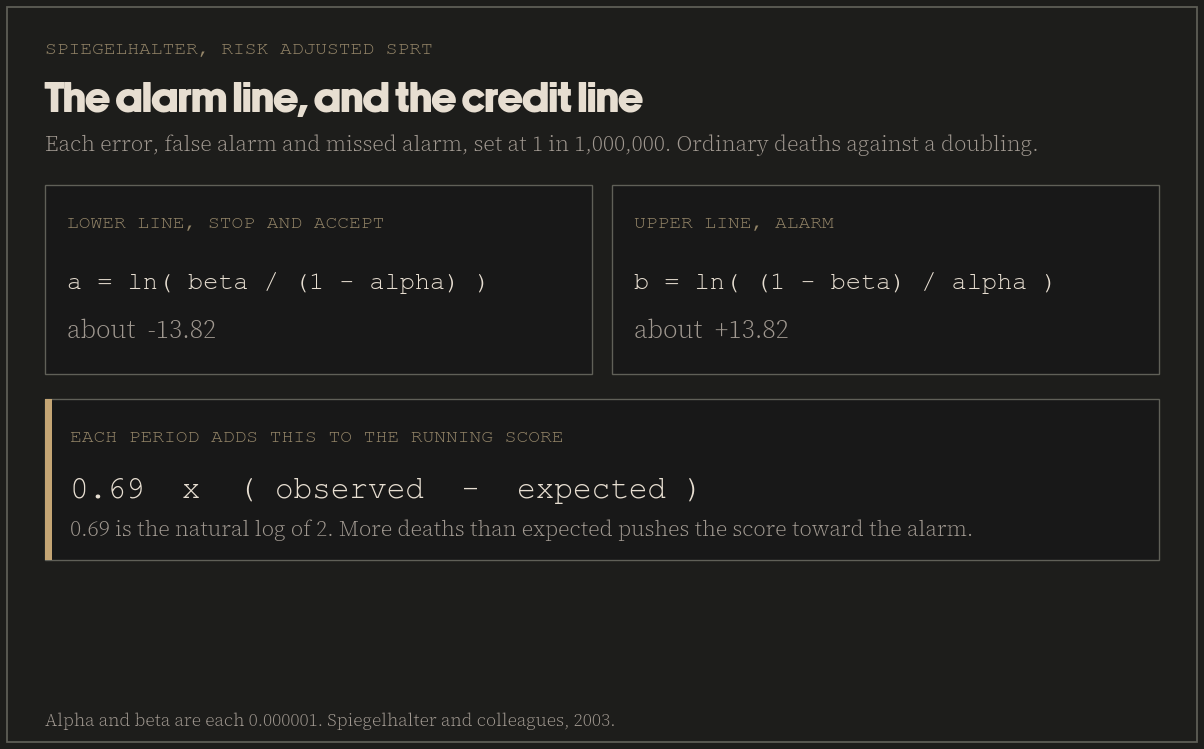
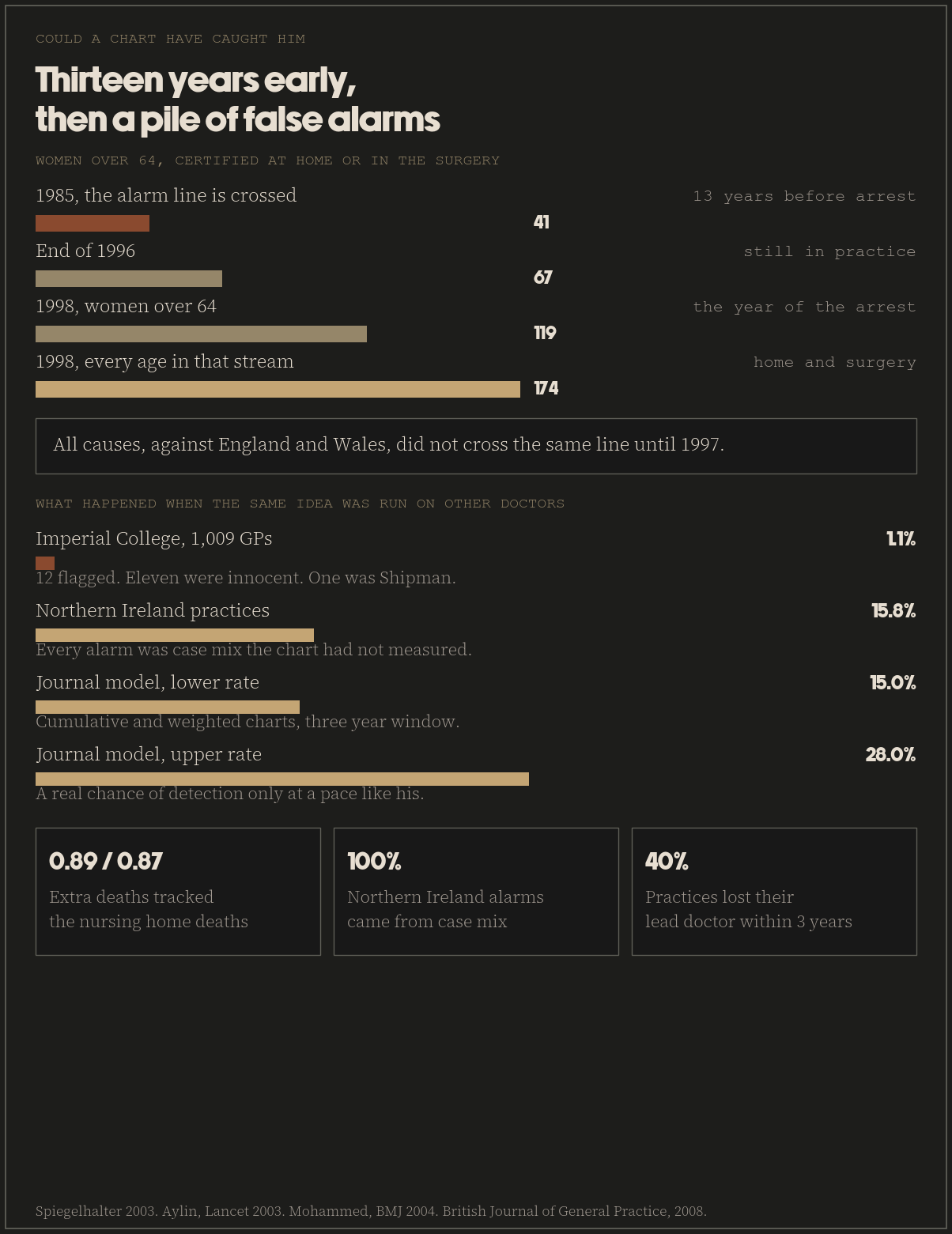
From 9 September 2024, every death in England and Wales that does not go to a coroner is reviewed by a medical examiner, who looks at the notes and speaks to the family. The old cremation forms that failed in Hyde were abolished. Controlled drugs are tracked through accountable officers and local intelligence networks. Fitness to practise hearings use the civil standard. A doctor revalidates every five years. The Office for National Statistics, in its September 2026 review of the first full year, counted 570,988 deaths registered in England and Wales in 2025. Doctors certified 81.7 percent of them under medical examiner scrutiny. Medical examiners certified 6,141 deaths themselves, 1.1 percent, after a coroner had cleared them. Coroners certified 17.2 percent. Deaths registered as unknown or uncertified fell from 13,676 in 2023 to 4 in 2025. Deaths coded as senility, the modern version of the old age he wrote on Kathleen Grundy’s certificate, fell from 13.7 percent of ill defined deaths in 2023 to 5.9 percent in 2025, which was 2,902 deaths. The median time to register a doctor certified death rose from 6 days to 8. The Ministry of Justice recorded the lowest number of deaths reported to coroners since the series began in 1995, and the highest share of those reports going to an inquest, 24 percent. The check is slower by a few days. It is the check Hyde did not have.
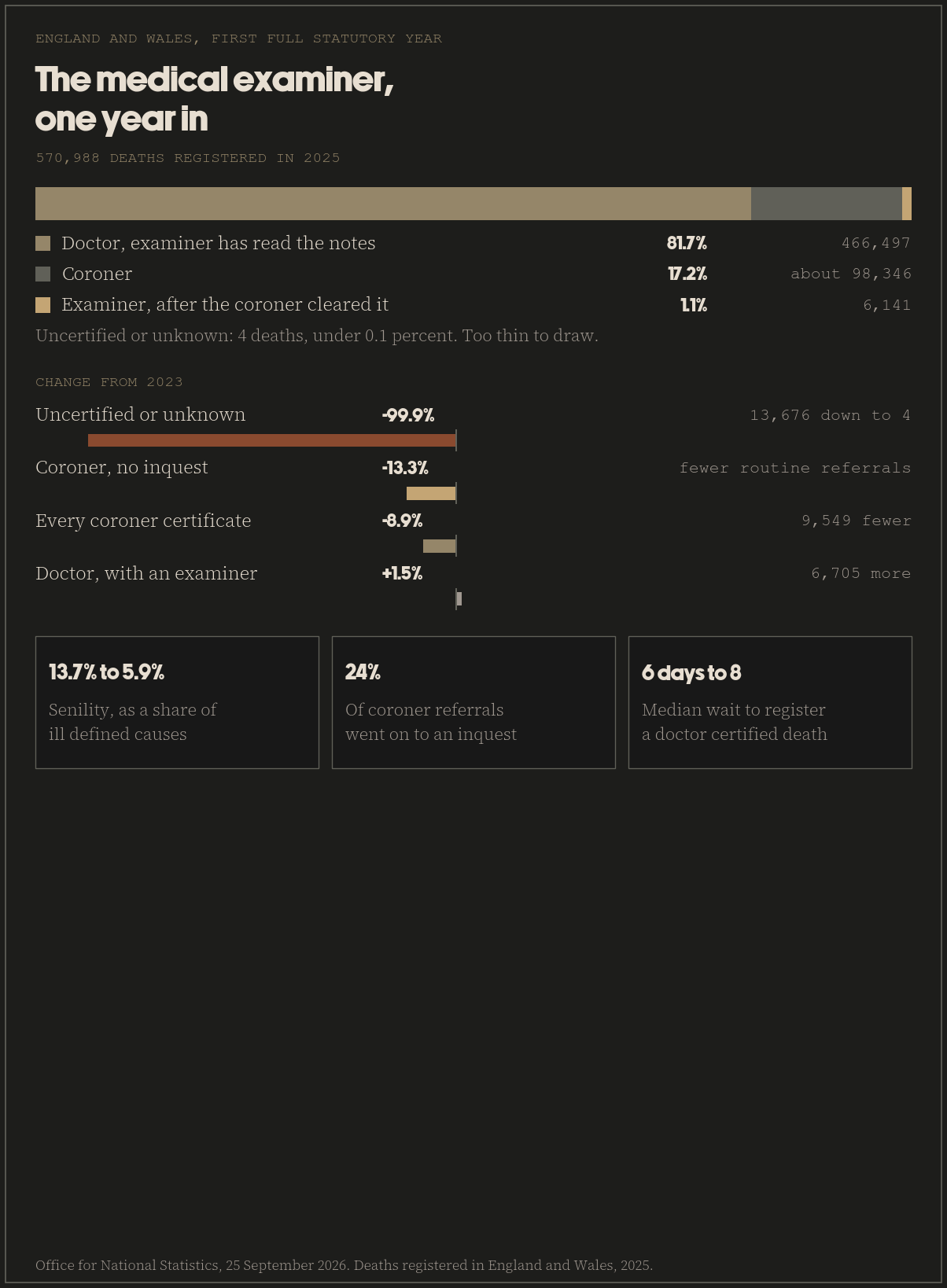
The road to that check was twenty two years. Dame Janet recommended independent scrutiny of every death in July 2003. Pilots ran in Sheffield from 2008 and in Gloucester. The Coroners and Justice Act 2009 legislated for it without the money. The cost was pushed onto local authorities, then a non statutory hospital rollout began in 2019 under the first National Medical Examiner, Dr Alan Fletcher, who had reviewed more than 22,000 deaths between 2008 and 2025. A general election and the COVID pandemic stalled the rest. The statutory system started on 9 September 2024. The Thirlwall Inquiry, in its 2026 report on Lucy Letby, called the delay a failure of political will. It put the cost of 129 medical examiner offices at about 50 million pounds a year, plus 7 million pounds of central administration, which is under 0.04 percent of NHS England’s 179 billion pound budget for 2024 to 2025. Ring fenced funding for the offices ended in September 2025, and the money now sits inside ordinary integrated care board budgets while NHS England itself is being abolished.
The government’s own programme had started earlier. Sir Liam Donaldson’s review, Good Doctors, Safer Patients, came in July 2006. In February 2007 the government published Learning from Tragedy, Keeping Patients Safe, Cm 7014, and Safeguarding Patients, Cm 7015. Four changes followed the four failures. Controlled drugs: the Health Act 2006 and the 2006 regulations, replaced in 2013 and amended in 2020, require accountable officers, local intelligence networks, inspection, tracked private prescriptions, 28 day validity on the relevant schedules, and destruction in front of an authorised witness. Medical regulation: from 2008 fitness to practise uses the balance of probabilities. The Medical Practitioners Tribunal Service, from June 2012, hears the cases separately from the people who investigate them. Revalidation every five years, tied to an annual appraisal, began in December 2012, and single handed practice has been squeezed. Coroners: the Coroners and Justice Act 2009, with rules in 2013, created a Chief Coroner. The first was Judge Peter Thornton, from 2012. Families have a statutory place as interested persons, and the old discretionary letters became prevention of future deaths reports, which must be answered in writing within 56 days. Death certification: the Health and Care Act 2022 and the 2024 regulations put a medical examiner on every death that does not go to a coroner. The old cremation Forms 4 and 5 are gone. The new certificate records the examiner, ethnicity, pregnancy, hazardous implants, and an extra line in the cause of death.
The Office for National Statistics release is dated 25 September 2026, not the later date some summaries give, and it includes provisional 2026 registrations through 28 August 2026. Of the 570,988 deaths in 2025, 466,497, which is 81.7 percent, were certified by the attending doctor under medical examiner scrutiny. Coroners certified about 98,346, which is 17.2 percent. Certifications by a coroner without an inquest fell 13.3 percent against 2023. Before the statutory start, non statutory scrutiny had already sent 5 to 6 percent of deaths for a clinical governance review and had surfaced 1,922 patient safety incidents in England in 2024 alone. The slower registration was not flat. The median for a doctor certified death peaked at 10 days in England and 14 days in Wales in January 2025, then eased to 7 days in England and 9 days in Wales by late August 2026. Two gaps remain. Examiners in England cannot open shared social care records themselves. A 2026 survey of 86 doctors, in the Journal of Patient Safety, found that 83 percent of those to whom the question applied still did not have consistent access to the post mortem report during a coroner’s case. Of the 888 general practice files, 887 were deaths and one was a living patient. The 494 written decisions covered 493 deaths and that one living patient. The legal team closed 394 files where the evidence cleared him.
Outcome
Fifteen verdicts, and a larger finding
He was convicted of 15 murders and one forgery, sentenced to life 15 times, and erased from the medical register. The first report then found 215 killings in general practice. The final report named 218 and put the toll near 250. A police investigation in the spring of 1998 had the chance to stop the last three and did not take it. He died in Wakefield prison on 13 January 2004. The safeguard that failed was a death certificate signed by the doctor who had given the injection.
Sources
Sources
Death Disguised
The Shipman Inquiry, First Report, Volume One, July 2002, chairman Dame Janet Smith DBE. Crown copyright. The narrative of the career, the trial, the drugs, the standard of decision, and the totals.
The Police Investigation of March 1998
The Shipman Inquiry, Second Report, July 2003, Cm 5853. The Reynolds report, the closed investigation, and the findings on Sykes, Smith, and Banks.
Final report and the death
The sixth report, 27 January 2005, for the Pontefract deaths and the toll near 250. The fourth report, July 2004, for the diamorphine stockpile. The inquest verdict of suicide, 22 April 2005, and the Prisons and Probation Ombudsman report, for the death at Wakefield. Office for National Statistics, Death certification reform, England and Wales: 2025, released 25 September 2026, for the first full year of medical examiner scrutiny. The individual decisions in Volumes Two to Six are still not narrated here.
Glossary
Glossary
Diamorphine
Diamorphine. An opioid the inquiry treats as about twice as potent as morphine when given into a vein. It was the drug he used most often.
Form B and Form C
Form B and Form C. Cremation papers. The doctor who certified the death completes Form B. A second doctor confirms it on Form C. A third doctor at the crematorium checks the set.
Credibility gap
Credibility gap. The chairman’s name for the difficulty of believing that a trusted general practitioner was killing patients.
Higher civil standard
Higher civil standard. Her description of how serious allegations are proved in court when they are not criminal charges. She did not bind herself to that standard, and she says so.
Specimen charge
Specimen charge. A charge tried as an example, with further offences taken into consideration. That is the shape of the 1976 drugs case: eight charges, 74 others.
Questions
Questions
Was Harold Shipman convicted of murder?
Yes. On 31 January 2000 a jury convicted him of 15 murders and of forging Kathleen Grundy’s will. He was sentenced to 15 terms of life imprisonment and a concurrent four years for the forgery. Mr Justice Forbes said he should spend the rest of his days in prison.
How many patients did the inquiry find that he killed?
The first report found 215 killings in general practice, from Eva Lyons in March 1975 to Kathleen Grundy in June 1998. The final report, in January 2005, named 218 and put the toll near 250, adding hospital deaths at Pontefract. None of those later figures is a set of criminal convictions.
How did he kill them?
The usual method was a lethal dose of an opiate, most often diamorphine. The inquiry found no reliable evidence that he killed by any means other than a drug. A few deaths may have involved a large dose of a sedative.
Why were there only 15 murder counts?
Those 15 were selected because the evidence was strong. Nine bodies still existed and contained morphine. Six had been cremated, and the jury used the matching circumstances. The Director of Public Prosecutions later refused further charges because a fair trial was no longer possible and a whole life recommendation was already in place.
Did anyone raise the alarm before Kathleen Grundy died?
Yes. On 24 March 1998 Dr Linda Reynolds told the South Manchester coroner that too many of his patients were dying in the same way. Detective Inspector David Smith closed that inquiry on 17 April 1998. Winifred Mellor, Joan Melia, and Kathleen Grundy were killed after it closed.
What did the second report say about that police inquiry?
The chairman found that Chief Superintendent David Sykes, Detective Inspector David Smith, and Dr Alan Banks fell below the standard expected of them. She thought a competent investigation would still have been able to obtain an autopsy, would have found morphine, and would have stopped the later killings.
Were the other deaths all murders in the legal sense?
The criminal court decided 15. The coroner later returned unlawful killing in further named inquests, and open verdicts for Joan Dean and Marjorie Waller. The inquiry’s remaining findings are her own decisions. Two hundred and ten deaths were found to be natural. Forty five stayed suspicious. Thirty eight could not be decided.
What happened to him after the convictions?
He was held at Frankland and then at Wakefield. On 13 January 2004 he was found hanging in his cell. An inquest jury at Leeds returned a verdict of suicide on 22 April 2005. The convictions were not overturned.