 Evidence #01
 Evidence #02
 Evidence #03
 Evidence #04
Overview
Fifteen homicide counts, and a complaint that is not a verdict
Milwaukee County Circuit Court, Criminal Division. Case F-912542. The State of Wisconsin against Jeffrey L. Dahmer.
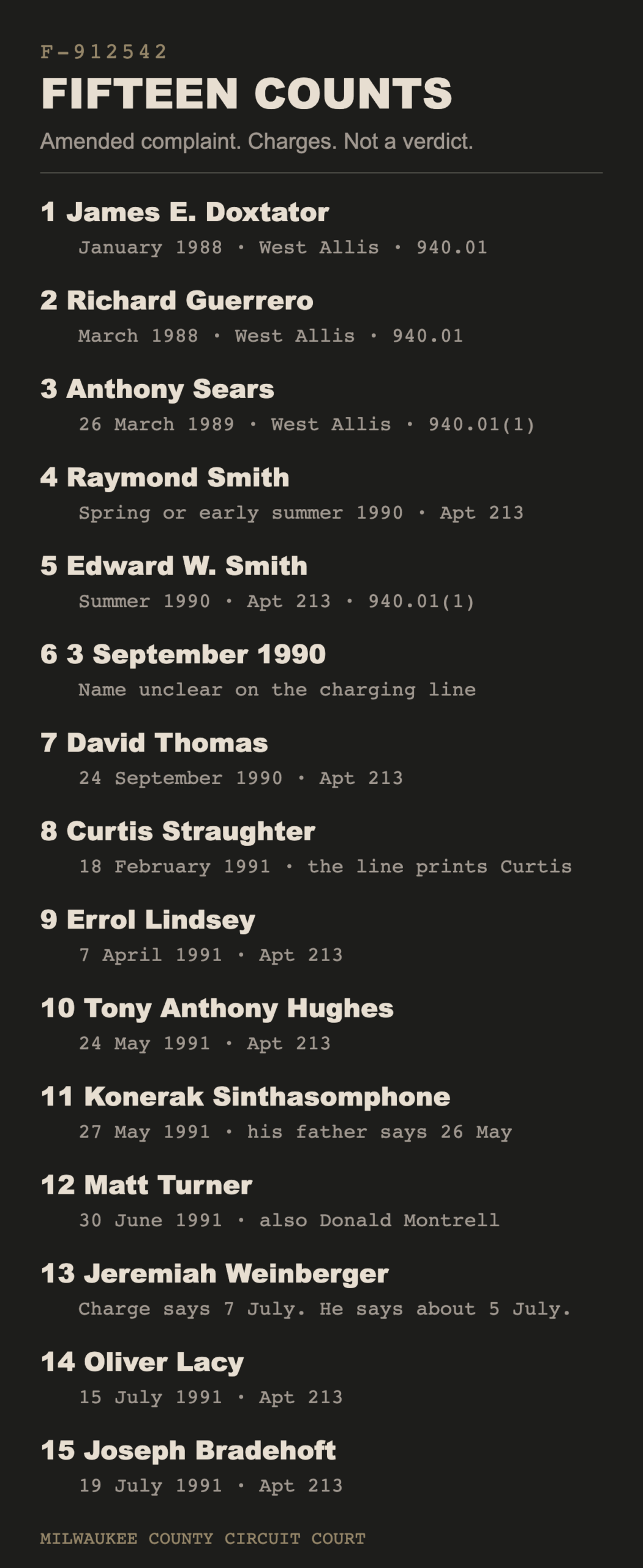
The amended criminal complaint charges him with fifteen homicides. The first two counts are first degree murder under Wisconsin Statutes section 940.01. The next thirteen are first degree intentional homicide under section 940.01(1). Captain Donald Domagalski of the Milwaukee Police Department is the complaining witness. The caption prints Dahmer’s date of birth as 21 May 1960 and his address as 924 North 25th Street, Milwaukee. Upon conviction, the complaint says, each of those counts carries a mandatory life sentence. This paper is the charge. It is not the judgment.
File brief
What the complaint actually contains
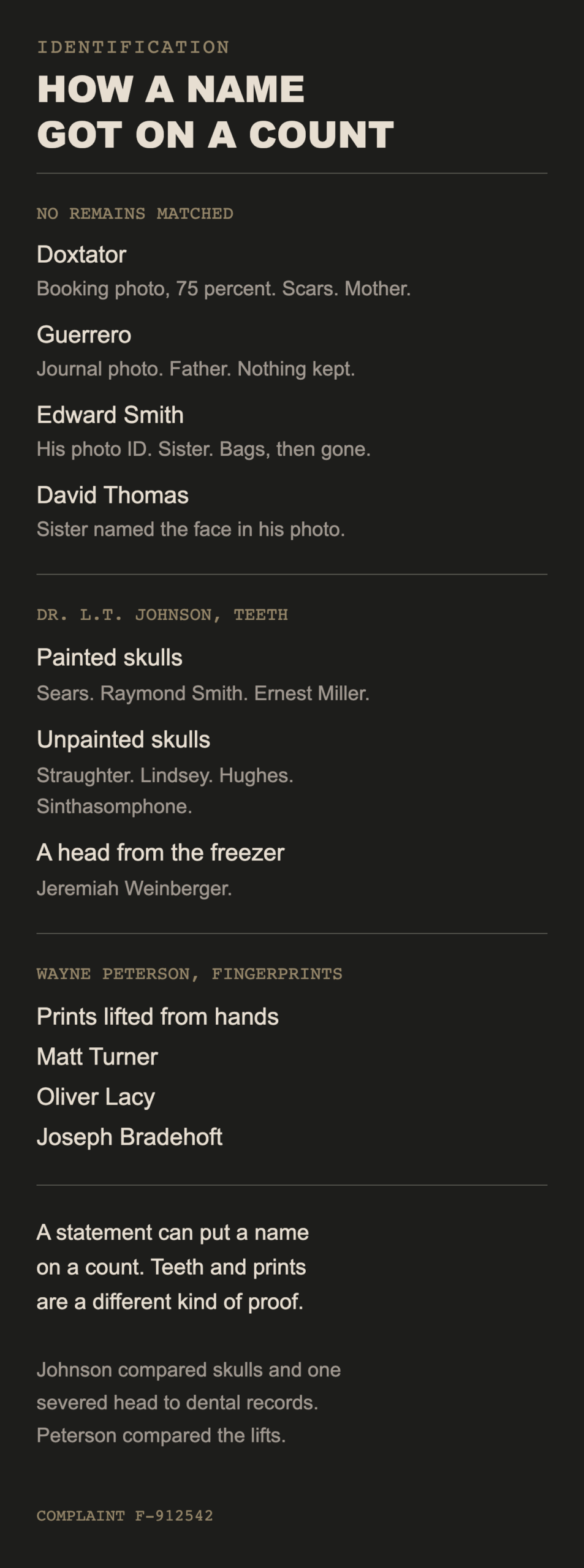
Most of the probable cause is his own statement, given against his penal interest, then set beside a relative who reported someone missing, and, where a body part still existed, beside a dentist or a fingerprint examiner. Dr. Jeffrey Jentzen, the Milwaukee County medical examiner, describes what was in Apartment 213 in the early morning of 23 July 1991. Dr. L.T. Johnson, a forensic odontologist, matches skulls and one severed head to dental records. Wayne Peterson, a Bureau of Identification technician, matches fingerprints lifted from hands.
Three of the charged deaths are placed at his grandmother’s house, 2357 South 57th Street in West Allis: James E. Doxtator, Richard Guerrero, and Anthony Sears. The other twelve are placed at Apartment 213, 924 North 25th Street. A rental application the captain says he saw carries an initial lease date of 13 May 1990.
The complaint does not charge any death before January 1988. It does not contain a trial transcript, a jury verdict, or a sentence on these fifteen counts. A separate judgment of conviction, Milwaukee case F-882515, is attached only to support a repeater allegation. That earlier case is not one of these homicides.
What holds up
What this complaint can carry
- Fifteen homicide counts, F-912542, sworn by Captain Donald Domagalski. Two are charged as first degree murder. Thirteen are charged as first degree intentional homicide. Both cite section 940.01. The paper says life imprisonment follows a conviction. It does not impose the sentence.
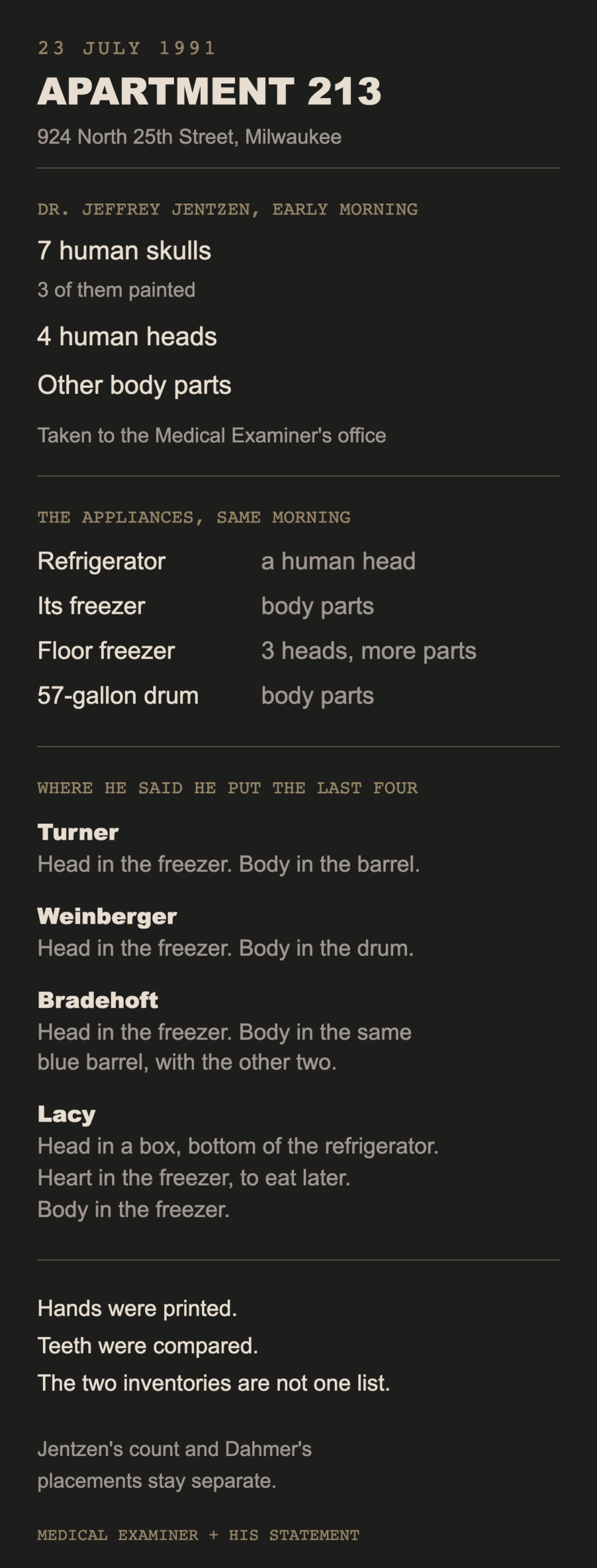
- On 23 July 1991 Jentzen was in Apartment 213. He describes seven human skulls, three of them painted, four human heads, and other body parts. In a second statement he describes a human head in the refrigerator, parts in that freezer, three heads in a floor freezer, and parts in a 57-gallon drum. Those two descriptions are not merged into one inventory here.
- Johnson’s dental comparisons name Anthony Sears, Raymond Smith, and Ernest Miller on painted skulls; Curtis Straughter, Errol Lindsey, Tony Hughes, and Konerak Sinthasomphone on unpainted skulls; and Jeremiah Weinberger on a head from the freezer. Peterson’s fingerprint comparisons name Matt Turner, Oliver Lacy, and Joseph Bradehoft from hands.
- James Doxtator, Richard Guerrero, Edward W. Smith, and David Thomas are identified from his statement and from family, not from a skull or a print. He said he kept nothing of Doxtator, Guerrero, or Edward Smith. He said Thomas was not his type, so he kept none of the parts.
- Where a charging date and a family date disagree, both stay. Konerak’s count says on or about 27 May 1991. His father says the boy left home on 26 May. Weinberger’s count says on or about 7 July. Dahmer says he met him on or about 5 July and that the man stayed two days. Edward Smith’s count says the summer of 1990, about July. His sister’s last contact is 23 June 1990.
Snapshot
The complaint in figures
Case
F-912542, amended criminal complaint
Court
Milwaukee County Circuit Court, Criminal Division
Defendant
Jeffrey L. Dahmer, born 21 May 1960, 924 North 25th Street
Complainant
Captain Donald Domagalski, Milwaukee Police
Counts
15 homicides. Charged. Not a verdict in this paper.
Scene
Apartment 213, examined 23 July 1991
Repeater
F-882515, convicted 30 January 1989. Not these murders.
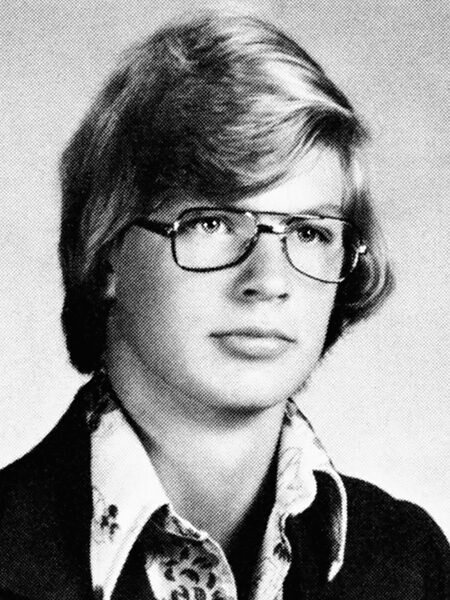
West Allis
Three deaths at his grandmother’s house
Counts 1, 2, and 3 are laid at 2357 South 57th Street, West Allis, the house he told police was his grandmother’s. The method he describes is the same shape each time. He met a man or a boy near a bar, offered money, took him to the house, put a sleeping potion in a drink, killed him after he passed out, and took the body apart. What he kept is the difference.
James E. Doxtator was born 1 March 1973. In January 1988 he was 14. Dahmer said he met a young male he thought was Hispanic, waiting for a bus in front of the 219 Club on 2nd Street, and offered him money to come to the house for a drink. They went by bus. After the boy passed out from the drink, Dahmer said, he killed him by strangling him. He dismembered the body, smashed the bones with a sledgehammer, and disposed of them. He said he kept no part of this person. He remembered two scars, close to each nipple, about the circumference of a cigarette, and that the boy said he lived with his mother near 10th and National.
His mother, Debra Vega, told the captain she lived at 1010 East Pierce in January 1988, about a block from 10th and National. She reported James missing on 18 January 1988 and never saw him or heard from him again. She said her son had two small scars near his nipples that looked like cigarette burns, and that he was Native American. Dahmer was shown a booking photograph of James E. Doxtator taken 23 September 1987. He said he was 75 percent sure it was the person at the bus stop, and that he remembered him looking somewhat older and heavier. There is no skull and no fingerprint in this count. The identification is his statement, the scars, the address, and his mother.
Richard Guerrero was born 12 December 1965. Dahmer said that in about March 1988 he met a Hispanic man at the Phoenix Bar on 2nd Street, near the 219 Club, and asked him to the grandmother’s house to look at videos, take photos, or have sex. He said they had oral sex, he drugged the man, and while the man was drugged he killed him. He dismembered the body and disposed of it completely. He kept no parts. He said he later saw the man’s picture in the personal section of a local newspaper, with a report that he was missing. Shown a photograph from the 1 January 1989 Milwaukee Journal, he identified Richard Guerrero as the person he killed. Pablo Guerrero, the father, said he had not seen his son since mid-March 1988, that he reported him missing, and that advertisements with the son’s picture ran in local newspapers.
Anthony Sears was born 28 January 1965. Count 3 dates the homicide on or about 26 March 1989, still at the West Allis house. Dahmer said he met Sears, and identified him in a photograph, at a club called La Cage. A friend of Sears drove the two of them toward the grandmother’s house. They had sex. Dahmer put sleeping pills in a drink, strangled him, and dismembered the body. This time he kept the head. He said he boiled it to remove the skin, kept the skull, and painted it.
Jeffrey Connor said he was with Anthony Sears on the evening of 25 March 1989 at a bar at 6th and National. They closed the bar. Sears had met a white man named Jeff, who said he was from Chicago and was visiting his grandmother at 56th and Lincoln. Connor drove them to that intersection. They got out and walked south. The captain says, from his own knowledge of Milwaukee County addresses, that 56th and Lincoln is north of and close to 2357 South 57th Street.
The skull was still there two years later. Jentzen said that in the early morning of 23 July 1991, with Milwaukee police and other members of the medical examiner’s office, he was in Apartment 213 when seven human skulls were recovered, three of them painted, along with four human heads and numerous other body parts. All of it went to the Medical Examiner’s office. Johnson compared the painted skulls with Anthony Sears’s dental records and determined that one painted skull was his.
Apartment 213
What the medical examiner said was in the room
The complaint uses Jentzen twice, and the two passages do different work. The first is a recovery count: seven skulls, three painted, four heads, and other parts, taken from the apartment to the morgue. The second is a map of the appliances. A refrigerator held a human head. The freezer section of that refrigerator held human body parts. A floor-standing freezer held three human heads and other parts. A 57-gallon drum held human body parts. At the Medical Examiner’s office the parts were examined. Fingerprints were lifted from hands found at the scene. Johnson did the dental examination. The lifts went to the Milwaukee Police Bureau of Identification.
Dahmer’s statement places four of the last bodies inside those appliances, and his placements are not the same sentence as Jentzen’s inventory. He said Matt Turner’s head went into the freezer and the body into the 57-gallon barrel. He said Jeremiah Weinberger’s head went into the freezer and the body into the drum. He said Joseph Bradehoft’s head went into the freezer and the body into the same blue 57-gallon barrel, with the body of the Black man and the body of the Puerto Rican man, which is how he described Turner and Weinberger. He said Oliver Lacy’s head went into a box in the bottom of the refrigerator, the heart into the freezer to eat later, and the body into the freezer. A reader can see that a head in a refrigerator and three heads in a floor freezer can sit beside those sentences. The complaint does not draw the arrows. This account does not draw them either.
Painted skulls
Raymond Smith and Ernest Miller
Sears’s painted skull is the first of three Johnson matched. The other two are Raymond Lamont Smith and Ernest Miller. Dahmer said he painted a skull after the skin was removed. Johnson’s work is the comparison of those painted skulls to known dental records. The paint is his account of what he did to a head. The identification is the dentist’s.
Raymond Smith, also called Ricky Beeks, was born 10 August 1957. Count 4 places the homicide at Apartment 213 during the spring or early summer of 1990. Dahmer said it was about two months after he moved in. The lease date the captain saw is 13 May 1990. He said he met a Black man at the 219 Club, offered him money to be photographed, have a drink, and watch videos, and took him to the apartment. He put a drug in a drink. The man fell asleep. Dahmer strangled him, removed his clothing, and had oral sex with him. He dismembered the body, kept the skull, and later painted it. He identified photographs of Raymond Lamont Smith as that man. Johnson compared the painted skulls recovered on 23 July 1991 with Smith’s dental records and determined that one of them was his.
Ernest Miller is the count that breaks the pattern of strangling. His aunt, Vivian Miller, said he came from Chicago to Milwaukee for the Labor Day weekend, left her home in the early morning of 3 September 1990, and was never seen or heard from again. Count 6 is dated on or about 3 September 1990. In this scan the charging line for that count does not clearly print a name. The probable-cause section that uses 3 September is Miller’s.
Dahmer said that during the summer of 1990 he met a Black man in front of a bookstore in the 800 block of North 27th Street, offered him money, and took him to Apartment 213. He identified a photograph of Ernest Miller as that man. He said they had sex, he drugged Miller, and he killed him by cutting his throat. He took photographs. He dismembered the body and disposed of the flesh except the biceps, which he kept in the freezer. He kept the skull, painted it after the skin was removed, and kept the skeleton, which he bleached. Johnson compared the painted skulls with Miller’s dental records and determined that one was his. A date of birth, 5 May 1967, is printed at the close of that section of the scan. The heading above Thomas carries Thomas’s own date of birth, so the 5 May date sits with Miller, and the type is crowded enough that a reader should see it as part of a bad scan.
Nothing kept
Edward Smith and David Thomas
Two of the Apartment 213 counts have no dental match and no fingerprint match, because he said he threw the bodies away.
Edward W. Smith was born 2 August 1962. Count 5 says the summer of 1990, and Dahmer said approximately July. His sister, Carolyn Smith, said she had no contact with him after 23 June 1990. She said he was called “the Sheik” because he often wore a turban-like wrap on his head. Dahmer remembered a headband “like an Arab.” He said he met Smith at the Phoenix Bar, offered him money for sex and to pose for pictures, and took a cab to the apartment. They had oral sex. He put sleeping pills in a drink and strangled him. He took four or five photographs, dismembered the body, and disposed of it completely in garbage bags. Later he got rid of the photographs too. He identified a photograph as Edward W. Smith. There is no skull of Edward Smith in the July inventory, on his own account, because nothing was kept.
David C. Thomas was born 21 December 1967. Count 7 dates the homicide on or about 24 September 1990. Dahmer said that in the autumn of 1990 he met a Black man near 2nd and Wisconsin, offered him money, and took him to the apartment. They drank and talked. He said he had no sex with this man because the man was not his type. He put a sleeping potion in a drink and killed him anyway, because he thought the man would wake up angry. He dismembered the body and kept none of it, for the same reason: not his type. He did photograph him while he was taking the body apart.
Chandra Beanland, who said she was Thomas’s girlfriend, reported him missing to Milwaukee police on 24 September 1990. Detective Brian O’Keefe spoke with Leslie Thomas, who identified herself as David’s sister. O’Keefe showed her the facial portion of the photograph Dahmer said he took during the dismemberment. The complaint says that facial portion showed no injuries when it was shown to her, and that she identified the person as her brother. The family supplied a photograph of David Thomas sleeping. O’Keefe said the face in that family photograph appeared to him to be the same person as in Dahmer’s photograph. That is an investigator’s comparison of two faces. It is not a dental identification, and the complaint does not pretend it is.
Unpainted skulls
Straughter, Lindsey, and Hughes
Four unpainted skulls are named by Johnson. Three of them are in this section. The fourth is Konerak Sinthasomphone, whose count turns on something the others do not: police officers walked him back to the apartment and left.
Curtis Straughter was born 16 April 1973. On 18 February 1991 he was 17. His grandmother, Katherine Straughter, said she last saw him that day. The charging line dated on or about 18 February 1991 is damaged in the scan, and the name it still shows is Curtis. Dahmer said he saw Straughter waiting for a bus by Marquette University, offered him money, and took him to Apartment 213. He gave him a drugged drink, strangled him with a strap, dismembered the body, took photographs, and kept the skull. Johnson compared the unpainted skulls with Straughter’s dental records and determined that one of them was his.
Errol Lindsey was born 3 March 1972. He was 19 on 7 April 1991, the date his sister Yahuna Barkley said she last saw him, when he went to the store. Count 9 uses that date. Dahmer said he met Lindsey in the spring of 1991 at 27th and Kilbourn, offered him money, and took him to the apartment. He gave him a drugged drink. After Lindsey fell asleep, Dahmer strangled him and then had oral sex with him. He dismembered the body and saved the skull. Johnson matched an unpainted skull to Lindsey’s dental records.
Tony Anthony Hughes is count 10, on or about 24 May 1991. The complaint says he was deaf and mute. Dahmer said he met him in front of the 219 Bar on 2nd Street, communicated by writing, and thought Hughes could read lips. He offered Hughes $50 to come to the apartment to take photographs and view videos. He gave him a drink with a sleeping potion, killed him, dismembered the body, and kept the skull. The probable-cause paragraph does not describe a sex act. Johnson matched an unpainted skull to Hughes’s dental records. Shirley Hughes, his mother, said he came to Milwaukee from Madison in the late afternoon or evening of 24 May 1991, that she had not seen him since, and that her son was deaf and mute. A date of birth is not cleanly printed on his charging heading in this scan, so none is stated here.
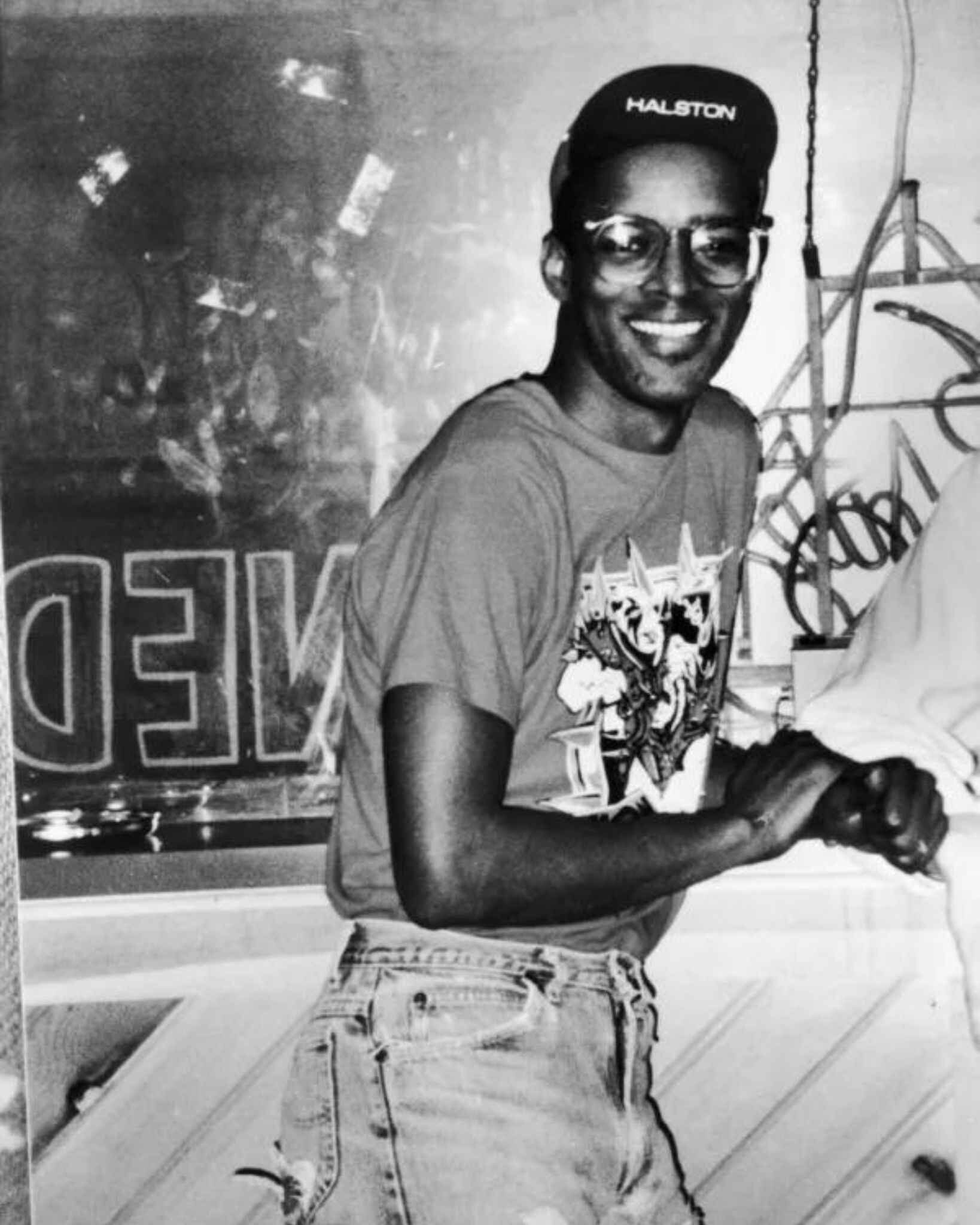
25th Street
Konerak Sinthasomphone, and the officers who brought him back
Konerak Sinthasomphone was born 2 December 1976. His father, Sounthone Sinthasomphone, said the boy was 14, that he left home on the afternoon of 26 May 1991, and that he did not return. Count 11 charges the homicide on or about 27 May 1991. The two dates stay side by side.
Dahmer said that in late May 1991 he met a young male the complaint describes as Oriental, whom he identified from a photograph as Konerak, in front of the Grand Avenue Mall, and that they went to Apartment 213. Konerak posed for two photographs while he was alive. Dahmer gave him a drink with a sleeping potion in it. They watched videos. Konerak passed out. Dahmer said he then went to a bar for beer because he had run out. Walking back from a bar on 27th Street just north of Kilbourn, he saw Konerak staggering down the street. He went up to him. Police stopped them.
He told the officers he was a friend of the boy, that the boy had gotten drunk, and that the boy had done this before. The complaint says the police escorted them back to the apartment. He told the officers he would take care of Konerak because he was his friend. They went inside. After the police left, he killed Konerak by strangling him. He took more photographs, dismembered the body, and kept the skull. Johnson compared the unpainted skulls from 924 North 25th Street with Konerak’s dental records and determined that one of those skulls was his.
That is the sequence the complaint prints. The officers are not named in it. What they were told, and that they left, is his statement as the captain sets it down. The skull match is Johnson’s. The boy’s age is his father’s, and it is also the arithmetic of a birth date of 2 December 1976 against a death in late May 1991.
The last nineteen days
Turner, Weinberger, Lacy, and Bradehoft
The last four counts fall between 30 June and 19 July 1991. Three of the bodies, on his account, went into the barrel and the freezer. The fourth, Lacy, went into the refrigerator and the freezer, and the heart was kept for a reason he stated.
Matt Turner, also known as Donald Montrell, was born 3 July 1970. Dahmer said that on 30 June 1991, after the Gay Pride Parade in Chicago, he met a Black man at the Chicago bus station and offered him money to pose nude and to view videos at the apartment in Milwaukee. They rode a Greyhound bus north and took a City Vet cab to Apartment 213. He gave the man a drugged drink. The man passed out. Dahmer used a strap to strangle him, dismembered him, kept the head in the freezer, and put the body in a 57-gallon barrel. Shown a Chicago Police photograph of Matt Turner, also known as Donald Montrell, he said he thought this was the person he had killed in that incident. Peterson later matched fingerprints lifted from body parts in the apartment to Turner’s known prints. The thought, and the print, are both in the complaint. The print is the one that does not depend on what Dahmer thought the photograph showed.
Jeremiah Weinberger is count 13, charged on or about 7 July 1991. Dahmer said that on or about 5 July he met a Puerto Rican man at Carol’s Gay Bar on Wells Street in Chicago, offered him money to come to Milwaukee to pose and view videos, and rode a Greyhound and then a cab to the apartment. The man stayed two days. On the first day they had oral sex. On the second day the man said he wanted to leave. Dahmer did not want him to leave. He put a sleeping potion in a drink and strangled him with his hands. He took photographs, dismembered the body, took more photographs, kept the head in the freezer, and put the body in the 57-gallon drum. He identified a Chicago Police photograph of Jeremiah Weinberger as the man. Johnson, at the Medical Examiner’s office, compared one of the human heads recovered from the freezer with Weinberger’s dental records and determined that the severed head he examined was Weinberger’s. The charge date and the meeting date are not the same. A two-day stay is his explanation of the gap. The complaint does not compute which of the two days was the killing.
Oliver Lacy was born 23 June 1967. Count 14 says on or about 15 July 1991. Dahmer said he met a Black man on 27th Street between State and Kilbourn. The man said he was going to his cousin’s house. Dahmer invited him to pose for photographs. He agreed. At the apartment they took their clothes off and did body rubs. Dahmer put a sleeping potion in a drink. When the man fell asleep, Dahmer strangled him and then had anal sex with him after death. He dismembered the body. He put the head in a box in the bottom of the refrigerator. He kept the heart in the freezer to eat later. He kept the body in the freezer. He kept an identification card that named Oliver Lacy and gave the date of birth 23 June 1967. Peterson matched a fingerprint from the apartment to Lacy’s known prints.
Joseph Bradehoft was born 24 January 1966. Count 15 says on or about 19 July 1991, four days before Jentzen entered the apartment. Dahmer said he got off a bus on Wisconsin Avenue near Marquette University and approached a white man who was waiting for a bus with a six-pack under his arm. He offered money to pose and view videos. They went to the apartment, had oral sex, and he put a sleeping potion in a drink. He strangled the man with a strap while he slept, dismembered him, put the head in the freezer, and put the body in the same blue 57-gallon barrel where he had put the other two. He kept an identification card that named Joseph Bradehoft and gave the date of birth 24 January 1966. Peterson matched a fingerprint from the recovered parts to Bradehoft.
The complaint groups Turner, Lacy, and Bradehoft for the fingerprint paragraph, and groups the appliances for Jentzen’s second statement. Weinberger is identified by the head, not by a print, in the section Johnson signs with his comparison. Four men. Three kinds of proof. The barrel, the refrigerator, and the freezers are where he said the parts were. Jentzen is who said what the appliances contained when police were in the room.
The earlier conviction
A repeater allegation, not a fifteenth murder
After the fifteen counts, the complaint adds habitual criminality under Wisconsin Statutes section 939.62. The captain says he viewed a certified copy of a judgment of conviction in Milwaukee County case F-882515, and that a copy is attached. That judgment, as the complaint describes it, shows that on 30 January 1989 Dahmer was convicted of second degree sexual assault and enticing a child for immoral purposes, sections 940.225(2)(e) and 944.12, that those convictions remained of record and unreversed, and that they fell within five years of the offenses in this complaint. Because of that, he is a repeater, and the complaint says he is subject to not more than ten additional years on each count, on top of the mandatory life sentence for each homicide.
The attached judgment form is a faint scan. Checkboxes for a stayed sentence and for probation are printed on that kind of form, and this copy is not clear enough to quote a term of years or a custody order from the handwriting. What can be quoted is the captain’s paragraph: the convictions, the date, the case number, and the statutes. The acts in F-882515 are not described in the homicide probable cause, and they are not described here. That case is the legal basis for extra years. It is not one of the fifteen dead.
Limits
What a charging document does not decide
A complaint is probable cause sworn by an officer. It is enough to charge. It is not a finding that every sentence in it has been proved to a jury, and it is not a sentence. The words “upon conviction” in the penalty paragraph are the statute as the captain recites it. They are not a judge’s order in this paper.
His statement is the spine of twelve of the narratives. Where a relative, a dentist, or a fingerprint examiner confirms a piece of it, that piece is marked. Where the only support is the statement itself, the count still names a person, and the reader can see the difference. Doxtator at 75 percent, with scars and a mother, is not the same as Weinberger’s head matched to a chart. Both are in the same complaint. They are not the same evidence.
Count 6’s missing name and count 8’s damaged line are properties of this scan. They are not cleaned up into a tidy list of fifteen perfectly printed names. Miller is tied to 3 September by his aunt and by the probable-cause heading that uses that morning. Straughter is tied to 18 February by his grandmother and by a charging line that still shows the name Curtis. A cleaner copy could settle the type. This one does not.
Timeline
- 21 May 1960 The complaint caption prints Jeffrey L. Dahmer’s date of birth.
- 18 January 1988 Debra Vega reports her son James E. Doxtator missing. He was 14. Dahmer says he strangled him at the West Allis house after a drugged drink, smashed the bones with a sledgehammer, and kept nothing.
- Mid-March 1988 Pablo Guerrero last sees his son Richard. Dahmer identifies a Milwaukee Journal photograph and says he killed him at the same house and kept nothing.
- 30 January 1989 Milwaukee case F-882515. Conviction for second degree sexual assault and enticing a child for immoral purposes. The complaint uses it as a repeater allegation. It does not describe the acts.
- 25 and 26 March 1989 Jeffrey Connor drives Anthony Sears and a man named Jeff toward 56th and Lincoln. Count 3 dates Sears’s death on or about 26 March. Dahmer says he boiled the head, kept the skull, and painted it.
- 13 May 1990 Initial lease date on the rental application for Apartment 213, 924 North 25th Street, as the captain describes it.
- Spring or early summer 1990 Raymond Smith, also called Ricky Beeks. Strangled, skull kept and painted. Johnson later matches a painted skull to his teeth. Dahmer says this was about two months after he moved in.
- 23 June 1990 Carolyn Smith’s last contact with her brother Edward. The count says the summer of 1990, about July. Dahmer says the body and the photographs were both destroyed.
- 3 September 1990 Vivian Miller’s last sight of her nephew Ernest. Dahmer says he cut Miller’s throat, kept the biceps, painted the skull, and bleached the skeleton.
- 24 September 1990 Chandra Beanland reports David Thomas missing. Dahmer says he killed him without having sex with him, because Thomas was not his type and would wake up angry, and that he kept no part of the body.
- 18 February 1991 Katherine Straughter last sees her grandson Curtis, then 17. Dahmer says he strangled him with a strap and kept the skull.
- 7 April 1991 Yahuna Barkley last sees her brother Errol Lindsey. Dahmer says he strangled him after a drugged drink and saved the skull.
- 24 May 1991 Shirley Hughes says her son Tony, who was deaf and mute, came up from Madison. Dahmer says he offered $50, drugged him, killed him, and kept the skull.
- 26 and 27 May 1991 Sounthone Sinthasomphone says his son Konerak, 14, left home on 26 May. The count says on or about 27 May. Dahmer says police walked them back to the apartment, and that after the officers left he strangled the boy and kept the skull.
- 30 June 1991 After the Chicago parade, Matt Turner rides a Greyhound to Milwaukee. Dahmer says he strangled him with a strap, put the head in the freezer, and put the body in the barrel.
- About 5 July, charged 7 July 1991 Jeremiah Weinberger stays two days. Dahmer says he strangled him when he wanted to leave. Johnson matches a head from the freezer to his dental records.
- 15 July 1991 Oliver Lacy. Strangled. Dahmer says he had anal sex with the body, kept the heart to eat later, and put the head in a box in the refrigerator.
- 19 July 1991 Joseph Bradehoft, waiting for a bus with a six-pack. Strangled with a strap. Head in the freezer. Body in the same blue barrel.
- 23 July 1991 Jentzen is in Apartment 213. Seven skulls, three painted. Four heads. A head in the refrigerator. Three heads in the floor freezer. Parts in a 57-gallon drum. Hands are printed. Teeth are compared.
Questions
Questions this complaint can answer
Was Jeffrey Dahmer convicted of these fifteen homicides in this document?
No. F-912542 is an amended criminal complaint. It charges fifteen homicides and recites the life sentence that follows a conviction. It does not contain a plea, a verdict, or a sentence on those counts.
How many people does the complaint name, and where?
Fifteen. James Doxtator, Richard Guerrero, and Anthony Sears at 2357 South 57th Street in West Allis. Raymond Smith, Edward Smith, Ernest Miller, David Thomas, Curtis Straughter, Errol Lindsey, Tony Hughes, Konerak Sinthasomphone, Matt Turner, Jeremiah Weinberger, Oliver Lacy, and Joseph Bradehoft at Apartment 213, 924 North 25th Street. Count 6’s charging line does not clearly print Miller’s name. The probable-cause section for Miller uses 3 September 1990, which is that count’s date.
What did the medical examiner say was in the apartment?
On 23 July 1991 Dr. Jeffrey Jentzen described seven human skulls, three of them painted, four human heads, and other body parts. He also described a human head in the refrigerator, body parts in that freezer, three human heads and other parts in a floor freezer, and body parts in a 57-gallon drum. Fingerprints were lifted from hands. The parts were taken to the Milwaukee County Medical Examiner’s office.
Which identifications are teeth, which are prints, and which are his word?
Dr. L.T. Johnson matched painted skulls to Anthony Sears, Raymond Smith, and Ernest Miller, unpainted skulls to Curtis Straughter, Errol Lindsey, Tony Hughes, and Konerak Sinthasomphone, and a head from the freezer to Jeremiah Weinberger. Wayne Peterson matched fingerprints to Matt Turner, Oliver Lacy, and Joseph Bradehoft. James Doxtator, Richard Guerrero, Edward Smith, and David Thomas are identified from Dahmer’s statement and from family. He said he kept no remains of those four. Doxtator’s photo identification is stated as 75 percent, with the nipple scars and his mother’s report beside it.
What is the 1989 conviction?
Milwaukee case F-882515. On 30 January 1989 he was convicted of second degree sexual assault and enticing a child for immoral purposes. The complaint uses that judgment, which the captain says he viewed, to charge him as a repeater under section 939.62, adding up to ten years on each homicide count on top of life. The acts in the 1989 case are not described in the homicide narratives.
Why do some dates disagree?
The charging line, the family member’s last sighting, and Dahmer’s own dating are not always the same sentence. Konerak’s father says 26 May 1991. The count says on or about 27 May. Weinberger’s count says on or about 7 July. Dahmer says he met him on or about 5 July and that he stayed two days. Edward Smith’s sister last heard from him on 23 June 1990. Dahmer places the killing in about July, and the count says the summer of 1990. Raymond Smith is “spring or early summer,” and Dahmer says about two months after a lease dated 13 May 1990. None of those pairs is corrected into a single day.
Sources
The paper this account uses
Every fact above is taken from the amended criminal complaint in Milwaukee County case F-912542, State of Wisconsin v. Jeffrey L. Dahmer, complaining witness Captain Donald Domagalski. Where the scan is damaged, the damage is described. Where two dates disagree, both are kept. The attached judgment in F-882515 is used only for the repeater paragraph the captain swears to. A verdict and a sentence on the fifteen homicides are not in this complaint.
Amended criminal complaint
State of Wisconsin v. Jeffrey L. Dahmer, F-912542
Milwaukee County Circuit Court, Criminal Division. Fifteen homicide counts, the Apartment 213 examination of 23 July 1991, the dental and fingerprint comparisons, and the repeater allegation from case F-882515. Public scan at DocumentCloud.
documentcloud.org/documents/21333021-jeffrey-dahmer-criminal-complaint