 Evidence #01
 Evidence #02
 Evidence #03
 Evidence #04
Overview
A scream in the Greek section, and three life sentences with no parole.
Fawkner Memorial Park · 1 November 1997
Mersina Halvagis was stabbed to death at Fawkner cemetery on the afternoon of 1 November 1997, a short distance from her grandmother’s grave. Peter Norris Dupas was convicted of that murder at a retrial, after an earlier conviction was quashed, and on 21 December 2012 the Court of Appeal dismissed his appeal. He is also serving life imprisonment without parole for the murder of Nicole Amanda Patterson at Northcote on 19 April 1999, and life imprisonment with no minimum term for the murder of Margaret Josephine Maher at Somerton on 4 October 1997. Those two convictions were left standing. The first Halvagis conviction was not.
Fawkner
Flowers, two bottles of Sprite, and a gate locked after she was already dead
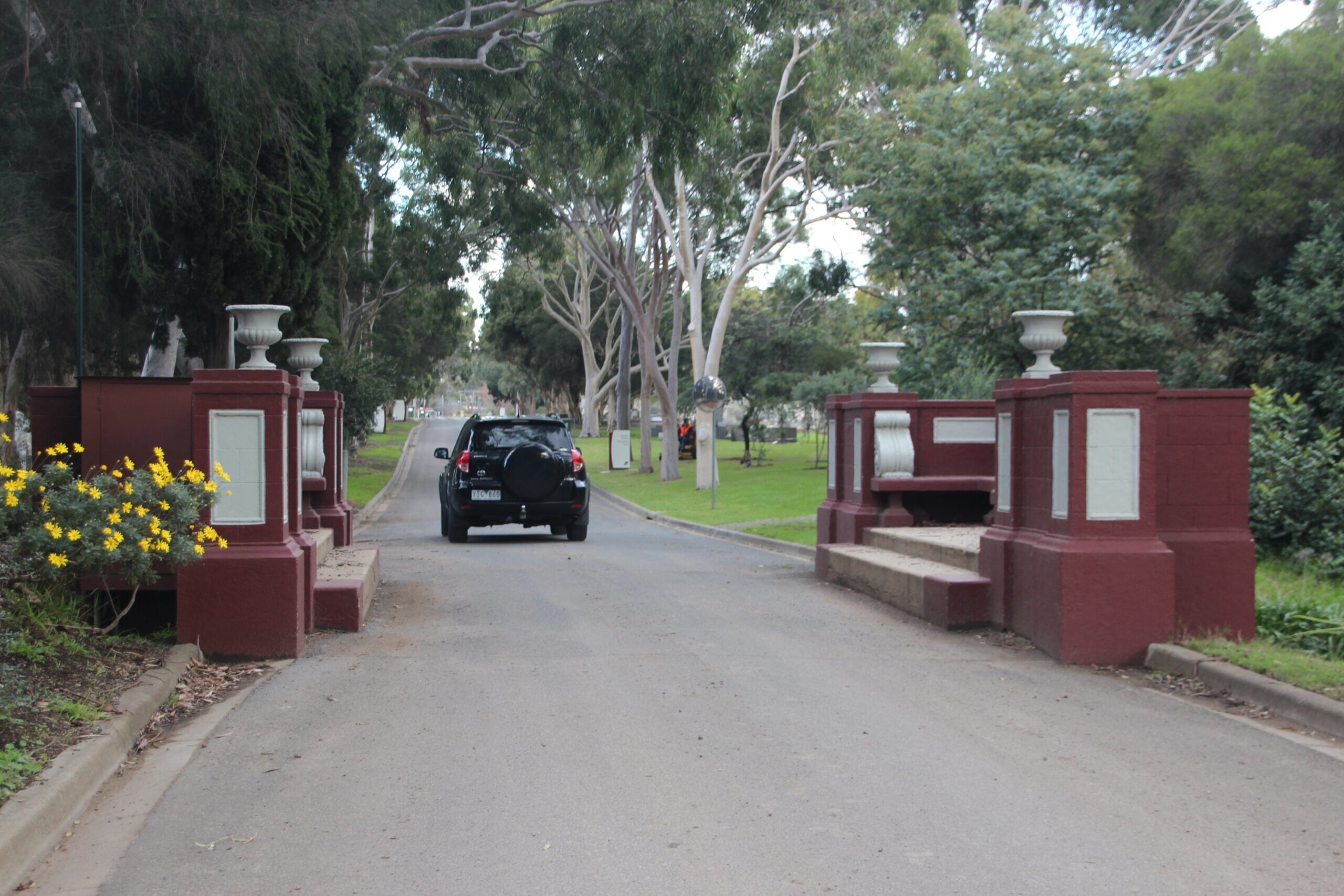
Mersina Halvagis died of multiple stab wounds. There were no witnesses to the killing. She was last seen in the tea rooms of Fawkner cemetery at about 3.47 pm on 1 November 1997. Elva Hayden, the catering manager, sold flowers and two bottles of soft drink at that time to a woman who matched her description. Steven Hume, a funeral supervisor, was in the tea shop and largely repeated that evidence. Her body was found in the early hours of the next morning, a short distance from her grandmother’s grave in the Greek Orthodox section.
Hume started locking the cemetery gates at 5.00 pm and finished at 5.45 pm. He saw no one then except an elderly man. He left at about 6.00 pm, having locked the main gate. The vehicle gates at the entrance were closed. The pedestrian gate was still open. By then, on the prosecution case, she had already been killed.
Aida Joaquim was at a funeral. Between about 4.00 pm and 4.30 pm she heard a woman scream loudly. The sound seemed far away, from the direction of the main gate. It lasted a few seconds. A second scream followed a few seconds later. As she was about to leave she saw a dark blue Ford Falcon station wagon drive past at speed. She did not see the driver. The passenger had a fringe and long blonde hair.
Arthur Joaquim heard two short screams by a female, less than a minute apart, very far from the roadway known as Box Forest Road. He first put the screaming at 4.00 pm to 4.30 pm, and later at about 4.30 pm to 4.45 pm. He too saw a blue Ford station wagon afterwards, with a blonde woman as the passenger. He did not really notice the driver. Neither of them identified the people in that car as Dupas, or the woman who screamed as Halvagis. The times they gave are not the same.
Lisa Tinker was 10. She was at the cemetery that afternoon with her mother, standing on a grave and cleaning the tombstone, when she heard a high pitched scream in the distance that slowly faded. She looked toward the sound and saw nothing. She thought it might have been mid afternoon and was not sure. She could not say whether the scream was a man’s or a woman’s. Her mother, Maria Tinker, did not hear it. At about a quarter to four, or ten to four, Lisa asked her whether she had heard that girl scream.
The prosecution case, as the Court of Appeal later summarised it, was that Dupas had been at the cemetery in the morning, spoken for some time to an attendant, Laima Burman, gone home to Pascoe Vale, made telephone calls, changed his clothes, and come back. Three people were said to have seen him in the afternoon: Katica Melnik sometime between 3.00 pm and 3.50 pm, Horst Weller sometime between 3.00 pm and 4.30 pm, and Angela Baran sometime between 3.45 pm and 4.20 pm. The prosecution contended he killed Halvagis between 4.00 pm and 4.30 pm. He had no alibi for that time. His partner lived with him and was overseas.
Calls were made from his home telephone at 12.45, at 12.52, and at 5.14 pm. The Court of Appeal recorded those times from the phone records. They do not, by themselves, put him in the cemetery, and they do not put him at home at 4.00 pm. The defence was that the identification witnesses were mistaken or unreliable, or that Baran was describing someone else, that the prison informer was not telling the truth, and that lies about the cemetery were not admissions.
Four descriptions
A pale jacket with a tear, a navy collar, peroxide hair, and a name that was not his
Laima Burman was working as a volunteer in the Latvian section from about 8.00 am until about 2.00 pm. An hour to an hour and a half after she started, she saw a man kneeling at a grave three or four sites away. Then he was standing in front of her. He asked if she was working there. He said he had just found his adoptive mother’s grave, that he had never seen her, and that it was all going to end there. He indicated the grave he had been kneeling at and asked her to look. They stood about an arm’s length apart. She gave him a rake to tidy the grave. He did nothing with it and left it.
He said he had found the grave through a family tree and through the cemetery office. She offered to help and asked for his name and telephone number. She went to her car for her diary. He gave the name John Roberts and a number she later realised was incomplete. They sat close together while she wrote. He seemed teary and emotional, and he smelt of alcohol. She asked if he was Latvian. He said he was Australian, that he lived somewhere nearby, and that he was sharing accommodation. She offered help through the church to find living relatives. The first conversation was about five minutes. They then sat for about ten. Twice he asked what was behind a nearby hedge. She told him it had nothing to do with that part of the cemetery.
She went back to her work, then wanted to speak to him again. She asked whether the person in the grave was his mother or his adoptive mother. He said no, definitely the adoptive mother. The next time she looked up, he was gone. Very early the next morning she learned of the murder, jumped out of bed, and said it was him, because something had not been right. She rang the police at once. A week later she was interviewed at the police caravan in the cemetery.
She described a man about 5 feet 7 inches tall, medium build, fair hair, prescription glasses, late thirties. The jacket was light, perhaps a very pale grey or bone or cream, about halfway done up, with pockets lower down. She was not sure whether it zipped or buttoned, because there was a fold. There was a tear near the right pocket. Most of the time his hands were in his pockets. The trousers were black, she thought tracksuit pants, gathered at the bottom. The shoes were white, or runners. At trial she was shown a jacket of Dupas tendered by the prosecution. She was equivocal. The jacket in court was darker than she remembered.
A little over six months after the murder she gave a description from which police prepared a computerised drawing. Sergeant Hardiman’s evidence about that drawing was largely consistent with hers. The drawing had dark eyes. She said the man’s eyes were not brown. They were a light colour, blue or grey, or at least not dark. On 6 May 1999 she was shown a folder of 12 photographs. She picked photograph 7, which was Dupas, and said he looked most likely to be the person, but younger in the photo, and smiling, which threw her. She said the hair was very similar, the same colouring and style, perhaps a bit longer at the back, and that the light made it look lighter. On the day, she said, his hair was neat but looked very unwashed. Her statement after the board was more cautious. She was unable to say one hundred per cent that the man was in the folder. Photographs 6, 7 and 12 each had similar features. Photograph 7 had hair very similar, and glasses of a similar style that were not tinted. In cross examination she agreed that, when she saw the board, she could not identify Dupas as the man she had spoken to.
On 16 August 2000, in a newsagency, she saw the front page of the Herald Sun and told her husband that was the man from the cemetery. She said it was definitely him. At trial she said she was shocked, that she had been waiting for years and knew she would see his face one day. The article, in large print, said that a killer convicted the day before was also the prime suspect in Melbourne’s graveyard murder mystery, and it carried a picture of Halvagis. She agreed she had already studied his photograph as one of the three she had picked on the board. At the coronial inquest she could not say whether the front page she was shown was the same paper she had seen that day, because she had seen so many photographs and so many papers since. She confirmed that a photograph in an article presented at trial was the one from which she had made the identification. She could not recall how the pictures were presented to her at the inquest.
Horst Weller walked in from Box Forest Road and, sometime between 3.00 pm and 4.30 pm, saw a man under a bushy tree. The man was startled. Weller looked at him for the best part of three seconds, from about three and a half to four metres away. He described silver rimmed round glasses, a jacket with a knitted collar, the zip halfway down, jacket and collar navy or dark blue, dark trousers, dark shoes. About 5 feet 7 inches. A bit plumpish. Gingery hair with silver strands on the left side, a college haircut brushed forward. He thought the man was about 45 to 55. That is not Burman’s late thirties, and it is not her pale jacket or her white shoes. The Court of Appeal set both descriptions out and did not collapse them into one man seen the same way.
Some time later Weller saw a television news service about the murder of Margaret Maher, with a picture of Dupas in connection with that murder. He said that when he saw the face he realised it was the man under the tree. He did not speak to police until January 2004. Until then, he said, he had not wanted to become involved. In March 2005 he was shown the photo board and picked number 7 straight away. It was put to him that the television report said Dupas was a suspect for the murder of Halvagis. His answer was that once he had seen the man under the tree, and then seen the photograph on television, he said that was the same man. He accepted that he had seen many images of Dupas in the media, that he usually read the Herald Sun every day, and that he would have seen many headlines about him.
Katica Melnik went with friends to the Greek Orthodox section after 3.00 pm, maybe 3.30 pm or later. She saw a man walking who looked confused. Quite heavy glasses. Very flat, short, blonde hair, fallen on his forehead and on his right side. A brown, greyish top, like overalls. It looked as if he was wearing a jacket, although she was unsure. At one stage he crossed a road in the cemetery toward a white monument in the Greek section. When she arrived there was a red car and a blue car in the car park. When she left, the blue car was gone. She arrived home at 4.15 pm. Home was 20 to 25 minutes from the cemetery. She later saw a television broadcast featuring Dupas and, after thinking for two or three hours, said she recognised the man from the cemetery. She could not say when she saw the broadcast, except that it was a long time earlier. She made a statement on 29 April 2005, seven and a half years later, and said the delay was because of fear. She accepted that in those years she had seen many reports about the murder. She was not asked to look at the photo board.
Angela Baran drove toward the Greek section in the middle of the afternoon and parked on the gravel. After 10 or 15 minutes at relatives’ graves she felt someone looking at her. She turned and saw a man with glasses, facing her and staring. She turned away. When she turned back, no one was there. She first saw him probably three or four graves away. The first thing she noticed was the hair: very peroxide, unnaturally blonde, short, with gel or something like it, short and spiky. The skin was pink pigmented, like scarring, not clear. Square glasses. Medium build, not very tall, about 5 feet 4 inches or 5 feet 7 inches, clean shaven. A jacket she thought might have been blue. He put his arms in the jacket. She had not heard anyone walking on the gravel. She felt uncomfortable, got up, walked to her car, looked around, and could not see him. She saw a red squarish car and did not know if anyone was in it. She left at about 4.20 pm. When she saw the news of the death she realised she had been there. She was later unable to identify Dupas as that man. She did not pick him from a photo board. The Court of Appeal treated her evidence as neutral. It did not compel a doubt, and it did not identify him. The defence said she was describing another person. The opening summary had counted her among the people who observed him. Those are different uses of the same witness, and the appeal kept the difference.
A cell and a garden
No forensics at Fawkner, a silent pantomime, and a witness who wanted a ride for a ride
Andrew Fraser had practised criminal law for about 28 years. He was convicted of serious drug offences, including being knowingly concerned in the importation of a commercial quantity of cocaine. In January 2002 he was in Port Phillip Prison and became friendly with Dupas in a protection unit, Sirius East. His evidence was the confession case. The defence said he was not telling the truth. The jury, knowing the attacks on his credit, convicted. The Court of Appeal held that the jury did not have to reject him.
He said that he and Dupas were walking alone in a small exercise yard nicknamed the chook pen when a young man of apparent Greek extraction stopped at the fence and asked if he was Peter Dupas. Dupas confirmed that he was. Fraser said the young man let go a stream of abuse, in substance that he was a cousin of Mersina Halvagis, that Dupas had killed her, that he was a dog, and that if he got a chance he would knock him. After the young man walked off, Fraser said Dupas asked how that cunt knew he did it. Fraser said it was a statement, not a question. Police could not identify the young prisoner. The Halvagis family told the informant there was no relative of theirs in Port Phillip Prison at the relevant time. There was no evidence of further inquiries. The Court of Appeal said that gap might have caused a jury to doubt Fraser. It did not require them to reject him. They could take the view that the inquiries were not enough to disbelieve the account.
About a week later, in the prison vegetable garden, Fraser said Dupas was shaking and having trouble rolling a cigarette. Asked what was wrong, he said words to the effect that the young bloke was going for medication that day and that he was going to get him. Fraser said Dupas placed a gardening fork behind a bush. Nothing came of it.
Dupas was then taken for a police interview about the murder of Margaret Maher. When he came back, in his cell, he asked Fraser about the interview process. Fraser said he was highly agitated, that he was going to end up wearing Maher, and that police were going to look at him again about Halvagis. He mentioned DNA material found in a woollen glove at the Maher scene, and said he thought he had been loaded, meaning the police had planted it. During that conversation, Fraser said, he blurted out that he did not leave any at Fawkner, and did not leave any forensics. He also said, in substance, that no one saw him at Fawkner and that no one could have seen him. That is Fraser’s account of what was said. It is not, by itself, a laboratory finding that Dupas’s DNA was in a glove. The Court of Appeal recorded it as part of the informer’s evidence.
After Dupas was charged with Maher’s murder he asked Fraser to read the brief. Fraser told him the DNA at the Maher scene was a problem. Dupas said no one could have seen him do it, there was no one around, nobody saw him. Fraser said he was anxious and came close to confusing the two investigations, and again said there were no forensics at Fawkner and no witnesses. When Fraser said he had a problem about Maher, he became very agitated, rocked backwards and forwards, and clasped his hands. He got up from the bed, pointed at the panic button, which Fraser took to mean someone might listen, and gestured to keep quiet. He then performed a pantomime in which he re enacted the killing of Halvagis. Fraser demonstrated that pantomime in the body of the court at trial. The description of the pantomime did not appear until Fraser’s third statement, although he said it was something that once seen could never be forgotten. The jury heard that delay. The Court of Appeal said it did not compel a doubt about the demonstration he gave in evidence.
In late 2004 Fraser visited him in the cell again. He was agitated and repeated that no one could have seen him and that he left nothing at Fawkner. On another occasion in the garden Fraser found a homemade knife about 8 to 12 inches long, showed it to him, and Dupas took it. While the knife was in his hands, Fraser said, he started to go a bit strange and shake, and said Mersina, Mersina. Fraser took the knife back and said they would throw it out.
In about the middle of 2005 Detective Senior Constable Paul Scarlett of the Homicide Squad spoke to Fraser, then at Fulham Prison. Asked if he had any idea why Scarlett was ringing, Fraser said something like, what took you so long. Scarlett said he was calling about the death of Halvagis. Fraser was interviewed about four times. He was released two months early because he agreed to give evidence against Dupas on his release. He conceded in cross examination that he had told police he would only help them if they helped him, a ride there for a ride back: you scratch my back, I’ll scratch yours. A precondition of his statement, on the defence argument, was early release. He had made numerous earlier attempts to secure early release, including by identifying corrupt police and giving other assistance, before he implicated Dupas. Subject to his petition of mercy being granted, he would not give evidence. If he did not give evidence he was at risk of being returned to prison under the terms of that petition. His solicitor applied for a one million dollar reward the day after the verdict at the first trial. He denied knowing of the reward before he assisted police, despite receiving The Age every day. His explanation was that, as a criminal lawyer, he did not read cops and robbers in the newspapers. The Court of Appeal called that a minor point. It also said the eleven credit attacks would have justified scepticism and would have entitled the jury to disbelieve him. With the exception of the unidentified Greek prisoner, they went to motive and consistency, not directly to the content of the admissions. Nothing in them required the jury to disbelieve him. No exception was taken to the trial judge’s charge on his evidence, and no further direction was sought. The Pollitt direction, the warning required for a prison informer, was held to be adequate. Corroboration was not required.
What he denied, and what was on the body
An unmarked grave 128 metres away, shoes that excluded him, and a jacket that was the wrong colour
Dupas’s grandfather is buried in an unmarked grave at Fawkner, about 128 metres from the site of Halvagis’s grandmother’s grave. He had told some friends of that. The evidence was not disputed. In a police interview he said he had not been to Fawkner cemetery and did not know anyone buried there. A friend said that in April or May he asked Dupas about the murder and was told the same thing: he had not been to the cemetery and he did not have relatives buried there. The prosecution said those were lies, and lies told after he had told other people the truth about his grandfather. The defence said the lies were not admissions. The Court of Appeal left both uses with the jury. Speaking a denial is not the same thing as silence, and a lie is not, by itself, a confession. The jury could use the lies with the other evidence. They were not told to treat them as proof on their own.
On 22 April 1999, when police searched his house, they found a green jacket with a tear, and four other blue jackets. Burman had described a tear near the right pocket and a light jacket. Shown the tendered jacket at trial, she was equivocal because it was darker than she remembered. The search and the jacket do not become an identification. They are what was found, set against what she said.
On 7 November 1997, six days after the murder, an optometrist, Ms La Rocca, prescribed bifocal glasses with photosensitive glass. A spectacle maker, Mr Sgourakis, made them to that prescription. The frames were plain shiny gold with a double bridge. Weller had described silver rimmed round glasses on the man under the tree. Burman had described prescription glasses, and said the glasses in photograph 7 were similar in style but were not tinted. The prescription is a fact about Dupas a week later. It is not a finding that the man in the cemetery was wearing those frames that afternoon.
Domenica D’Alberto cut his hair every six weeks in about 1997 to 1998 or 1999. He had a bowl cut. She changed it over time to more of a blended cut. Every second cut she streaked the hair with blonde tips. The hair was fine and limp. She recalled him asking in October 1997 whether anything could be done to change the look at the front, perhaps pulling the fringe back, and she showed him a different way using a gel. At a haircut on 15 December 1997 she made a note that she was told not to make the hair look so blonde. She recalled that at the end of 1997 he was wearing transition lenses. Baran had described peroxide, unnaturally blonde, short spiky hair and gel. Melnik had described flat short blonde hair fallen on the forehead. Weller had described gingery hair with silver strands and a college cut brushed forward. Burman had described fair hair, neat and unwashed. The hairdresser’s evidence explains why blonde hair was available as a description. It does not choose between those four accounts.
Near the body, police found signs of a scuffle and cigarette butts. A bottle of Sprite was in the car Halvagis had been driving. Her shoes were at the back of another plot, without blood stains. Police suggested they had been thrown or placed there. Maxwell Jones, a forensic biologist, said the DNA on the cigarette butts was not Dupas’s. What was thought to be a fingerprint was on the outer heel of her left shoe and was tested for DNA. The profile was from more than one person. Halvagis could not be excluded as one of them. There was an indication of an unknown male. A second sample from the whole exterior of the right shoe was also mixed. Halvagis was a contributor, with an unknown male. Dupas was excluded from the shoe DNA, as were all the members of her family. Jones told the jury that DNA can be deposited on objects in a myriad of ways. The Court of Appeal said this evidence did not implicate him and did not exculpate him. A jury could take the view that an unidentified person’s DNA on a shoe she had been wearing was of no assistance in deciding whether he killed her.
Dr David Ranson, of the Victorian Institute of Forensic Medicine, gave evidence of the stab wounds. The time of death could have been later afternoon or evening. It was difficult to be sure. The injuries were consistent with stab wounds and with scraping. He could not say what position she was in when she was first attacked, how far she was from her final resting place when the attack began, how long the attack lasted, or the order of the injuries. The cause of death, as the appeal stated it at the outset, was multiple stab wounds. No finer map of those wounds is in the appeal. The fiancé and his father found the body. The appeal does not give their names. Family members gave evidence. The appeal does not set out what they said.
Northcote
A Monday appointment at nine, twenty seven stab wounds, and a diary left on the couch
On 22 August 2000, in the Supreme Court at Melbourne, Vincent J sentenced Peter Norris Dupas for the murder of Nicole Amanda Patterson at Northcote on 19 April 1999. A jury had found him guilty. He was 47. He had been born on 6 July 1953, the youngest of three children, in what the reports described as a fairly normal family. Counsel on the plea, Mr Brustman, suggested the family may not have been as unproblematic as the reports made it appear. He did not contend that anything in that environment explained the personality problems that showed themselves early. Dupas left high school at 17 after Form 5 and later obtained his HSC in custody. Vincent J found him reasonably intelligent, and found no suggestion that he had been the victim of neglect or abuse.
Patterson was 28. She practised as a psychotherapist and youth counsellor. She worked at the Ardoch Centre, which tries to assist homeless or disadvantaged young people, and she assisted in activities of the Australian Drug Foundation. She wanted a private practice and placed an advertisement in a local newspaper in the Northcote area where she lived. The advertisement said she counselled people about relationship and sexuality problems, and that disclosures would be kept strictly confidential. Vincent J suspected, but he did not find, that those references excited Dupas’s interest. When and how Dupas learned that the person who placed the advertisement was a young woman was unknown. The prosecutor suggested in cross examination that he had seen a photograph of her in a local newspaper. He denied it. The judge did not decide that question.
What the judge did find was that she had been selected some time before her death. In cross examination Dupas made what Vincent J called a startling admission: he first tried to contact her from a public telephone a day or so before 3 March 1999, about six weeks before she was killed. He claimed he could not recall where that telephone was, and he was evasive about why he did not ring from home. The judge thought it highly likely he was already seriously contemplating an attack. He had her mobile number and could probably have spoken to her if that was all he wanted. Instead he made a number of calls to her home between 3 March and 12 April, when the appointment was made. Vincent J saw force in the prosecutor’s contention that he was stalking her, trying to learn her movements and whether anyone else was in the house where she lived and worked.
On the morning of Monday 19 April 1999, not long after his partner, Miss Cruz, left for work from the house in Pascoe Vale where they lived, he set out for Patterson’s home. She was expecting a client named Malcolm who was suffering from depression. Those words were on a note in her handwriting, later found by police. One of the few things Dupas said in the witness box that Vincent J accepted was that, in the calls that led to the appointment, he said he was having problems in his relationship with his partner arising from a low level of self esteem. He said she was nice to him and responded to his concerns. The judge had no doubt she felt no sense of danger, preparing for a client at nine o’clock on a Monday morning in her own home.
What happened in the minutes after he arrived, and how long he was in the house before the attack, the judge said was unlikely ever to be known. He found that Dupas struck her again and again with a knife capable of deep wounds. The weapon has never been found. Defensive injuries to her hands were, in the judge’s words, silent evidence of unsuccessful attempts to defend herself against a sustained and determined assault. Altogether she received 27 stab wounds. Her breasts were completely cut from her body, probably, but not necessarily, after death. Vincent J called that a depraved act of contempt. He said the breasts were never located, and that it appeared likely they were taken as a kind of trophy. He also found that Dupas checked the house, collected her handbag and driver’s licence, presumably as trophies as well, and went home to ordinary activities as if nothing had occurred.
A later court heard a more particular account from the pathologist, and it does not match the 2000 sentence in every detail. At the trial for the murder of Margaret Maher, the evidence of Dr Ranson, as Nettle JA set it out in 2005, was that Patterson’s body was found at 21 Harper Street, Northcote, on 19 April 1999, naked from the waist down. The skirt had been removed and was in an adjacent room. The cause of death was multiple stab injuries to the chest. Twenty seven stab wounds were on the chest and back. They included damage to the lungs and the heart, with fatal loss of blood. Both breasts had been cut off and were missing. Ranson found that part of the left breast had been removed after death, and that breast tissue was present in her mouth. Photographs of the excised breast and of the residual tissue in the trunk showed dog eared tags, which gave the edges a sawtooth appearance, characteristic of skin cut by a sawing motion with a sharp object such as a knife. Vincent J in 2000 had said the breasts were never located and were probably, but not necessarily, removed after death, and likely taken as a trophy. Ranson’s evidence, given later and recorded by the Court of Appeal, puts tissue in the mouth and puts part of the left breast’s removal after death, and still describes the breasts as missing. Both accounts are what those courts set down. They are not the same account.
The clothing was examined by a forensic scientist, Ms Taupin. There were a large number of stab type cuts to the cardigan and to the back of the T shirt worn beneath it. The T shirt had been cut down the centre front from the neckline to above the hemline, scissor cuts with a slight extension of tearing toward the hem. A singlet under the T shirt was severed the same way, from the neckline to above the hem, again scissor cuts running into a tear. A cut in the right shoulder strap of the brassiere detached the strap from the front of the garment. The skirt was severed from the waistband almost to the edge of the hemline, scissor cuts extending to a tear toward the lower part of the skirt. The knife that stabbed her was never found. The scissors that cut the clothes were a different description of a different implement. The court did not say they were the same object.
Vincent J found two mistakes. Dupas had given the false name Malcolm and a false telephone number. The number was in fact that of a student he had engaged to do labouring work. He had partially searched the premises and missed the diary, under other items on a couch in the living room. The diary had the appointment and the incriminating number. Once police connected him to that number he came under suspicion, was arrested, and his house was searched. The judge said important evidence that led to the conviction was found in that search. He did not, in the remarks, list the items. The later Halvagis appeal records that the search on 22 April 1999 found a green jacket with a tear and four blue jackets. Cummins J, sentencing for Halvagis in 2007, said Dupas was arrested for the Patterson murder three days after 19 April 1999. Three days after the 19th is the 22nd. The jacket found that day is not, on these judgments, identified as the evidence that convicted him of Patterson’s murder.
Vincent J found, beyond reasonable doubt, that Dupas regarded Patterson as prey to be entrapped and killed, and that her life and youth mattered to him only for the satisfaction and power of taking them. He was not mentally ill as that term is understood. He did not act on impulse, or in high emotion, or while affected by alcohol or drugs. The crime was remorseless, deliberate, and carried out after manipulation, in full understanding of what he was doing. Culpability was extremely high. There was no remorse. Rehabilitation was so close to hopeless that it could be discounted. The risk would not diminish except perhaps with the physical infirmity of age. The sentence was imprisonment for the rest of his natural life, without the opportunity for release on parole. Four hundred and eighty nine days of pre sentence detention were reckoned as already served. In August 2001 the Court of Appeal dismissed his application for leave to appeal against that conviction and that sentence. The 2005 judgment records the dismissal and the month. It does not, in the passage that states it, give the day.
Somerton
A breast cut off after death, three possible causes, and a jury that chose the neck
Margaret Josephine Maher was last seen alive when she left the Safeway supermarket at Broadmeadows Town Shopping Centre in the early hours of 4 October 1997 and walked toward Pascoe Vale Road. Warren CJ put that departure at 12.20 am. A passage from the trial judge’s ruling, set out in the appeal, put it at 12.15 am, and described her as a prostitute heading for the Hume Highway, where she normally worked. Both times are in the Court of Appeal’s reasons. They are twelve minutes apart on the page, and the court did not pick one. A witness driving west on Somerton Road between 1.00 am and 2.30 am saw a woman with no trousers or skirt emerge from the bushes on the right. The witness could not definitively identify her as Maher. The Court of Appeal did not treat that sighting as proof of who the woman was.
The body was found the same day, at about 1.45 pm, by the side of Cliffords Road at Somerton. She was lying on her side. The lower garments had been pulled down and the upper garments pulled up, so that the torso was exposed. The left breast had been cut off after death and placed in her mouth. Kaye J, sentencing on 16 August 2004, said the circumstances showed she had been murdered at a different place and that the mutilated body had then been dumped and left where it was found. There were no eyewitnesses to the death. The Crown case was circumstantial. Kaye J said it was not possible to draw conclusions about the precise circumstances in which she met her end. The jury accepted that death resulted from compression of the neck, and that Dupas compressed the neck intending either to kill her or to cause really serious injury. There was no suggestion of any legal justification. After the killing he mutilated the body in the manner already described to the jury. Kaye J called the leaving of the body, in a desolate place, a display of loathing and of contempt for her dignity.
The pathologist, Dr Matthew Lynch, would not rank a cause. Nettle JA recorded his evidence this way. There were three possibilities he could not elevate beyond possibilities: drug toxicity, the heart condition, or compression of the neck. On examination he found lacerations to the right breast, a small laceration above the right eye, a small area of skin loss near the right eye, a small incised injury to the left wrist, and a superficial incised injury to the left middle finger. On the right lateral neck there was a lineal area of petechial haemorrhage. On dissection, a small amount of haemorrhage was found in the muscles adjacent to the thyroid cartilage. Warren CJ’s summary of the same post mortem is not identical. She listed a stab wound to the left wrist, compressions to the neck, an injury to the right eyebrow from the impact of a blunt object, and lacerations to the right arm, and the breast severed after death and put in the mouth. Nettle’s list has lacerations to the right breast, not the right arm, and a small incised injury to the wrist rather than a stab wound. The two judges were summarising one body. The lists should be read as each of them wrote them, not folded into a single inventory the court did not publish.
The jury were told they could not convict unless satisfied that an act of a person was a substantial cause of death. The Crown said the compression of the neck was that cause. It did not have to be the only cause, or the principal cause. The prosecutor’s argument, as the judge repeated it, was that Lynch had been answering a different question, the sole cause or the cause, and that the jury could draw inferences from facts Lynch was not deciding: the dumping of the body, her general state of health, the sightings on the night of 3 October, the condition of the body, the injuries, and the mutilation. The argument was that even though she was a drug addict she did not die until someone put pressure on her neck and inflicted the other injuries, and that the person who did that was the person who dumped her. Defence counsel told the jury there was no homicide. Lynch, he said, attended the scene, saw the injuries, saw the breast removed and placed in the mouth, and still could not raise drug toxicity, coronary artery disease, or neck compression above a possible cause. If the pathologist could not, the jury could not be satisfied beyond reasonable doubt that there was a homicide at all.
The jury convicted. They accepted compression of the neck, not one of the other two possibilities, as the cause they were sure of, in the sense of a substantial cause. On 26 August 2005 the Court of Appeal, Warren CJ, Nettle JA and Harper AJA, refused leave to appeal. Nettle JA held that the causation directions were adequate. The judge did not have to use the phrases significantly contributed or operating cause. He had told the jury, more than once, that the question was whether neck pressure was a substantial cause even if it was not the sole or principal cause, and that Lynch’s inability to rank the three possibilities did not answer that question for them. Harper AJA agreed with both judgments. The conviction for Maher’s murder stands on that refusal of leave.
Ms Taupin examined the clothing. A cut completely severed the centre front of the windcheater, from the neckband through the hemline. The T shirt underneath was completely severed by scissor cuts from the neckband through the hemline. The most feasible scenario, she concluded, was that the windcheater and the T shirt were cut together, in one action, by one implement: a pair of sharp, smooth bladed scissors with medium to long blades. That is a different implement from the knife described in the Patterson stabbing, and a different pattern from Patterson’s clothes, where the scissor cut down the front stopped above the hem and then tore, and where the skirt was cut and Maher’s leggings, on the defence argument recorded by the judge, were not. Defence counsel told the jury the cases were markedly dissimilar: one breast removed and left in the mouth, two breasts missing and never found, stab wounds in one death and not the other, scissor cuts through the hem in one and not the other. The trial judge told the jury to scrutinise those dissimilarities. He did not tell them which differences mattered. That was for them.
The Patterson evidence was not admitted so the jury could reason that because Dupas murdered Patterson he murdered Maher. Kaye J rejected that use. The differences in how the two women were killed were, on his ruling, too great. He admitted the evidence for one purpose: that Dupas had excised Patterson’s breasts after death, and that this rare act made it striking and highly probative that the same person excised Maher’s left breast, and that the person who mutilated her was the person who killed her. Jenny Mouzos, of the Australian Institute of Criminology, managed the National Homicide Monitoring Programme. Of homicides in Australia between 1 July 1989 and 30 July 1998, the only two cases she found involving removal of a breast or breasts were Patterson and Maher. Both were in the northern suburbs of Melbourne, within 18 months of each other. Ranson gave evidence of the rarity as well. The judge told the jury that unique, as he was using the word, did not mean the only incidence in the world. It meant so rare that the removal was a signature of one person. The jury had to be satisfied it would be an affront to common sense to say two different people removed the breast or breasts and cut the clothing. He warned them that the Patterson death and the excision of her breasts must not be used to conclude that Dupas was the type of person who would commit the offence on trial, or that he was of bad character, or that he had a general disposition to commit it.
The Court of Appeal upheld that limit. Warren CJ said the manner of the mutilation could not be separated from the fact of it, and that the judge had in any event weighed the dissimilarities. Nettle JA said the evidence that Dupas had hacked off Patterson’s breasts shortly after her murder made it very probable that he had hacked off Maher’s breast shortly after she died, and that the prejudice of the jury also learning he had murdered Patterson was met by the directions. The similar fact ruling did not reopen the Patterson conviction. It used it. The Maher verdict is a verdict that he killed her by compressing her neck, and that he mutilated the body afterwards. It is not a verdict that drug toxicity and the heart condition were excluded as medical facts by the pathologist. Lynch left them as possibilities. The jury, on the whole of the evidence, found the neck compression a substantial cause.
Kaye J sentenced him to imprisonment for life and fixed no minimum term. Dupas was already serving Vincent J’s life sentence without parole for Patterson. Kaye J said the new sentence would have no practical effect on his disposition, and that sentencing him was still not an academic exercise. The purposes he named were denunciation, just punishment, vindication of the person who was killed and of those left with the grief, and general deterrence. The hearing of the plea was on 12 August 2004. The sentence is dated 16 August 2004. Nettle JA described 16 August 2004 as the day he was convicted. The sentence speaks of a jury that had found him guilty and of a plea heard four days earlier. The date of the verdict, if it was a different day from the sentence, is not stated in the passages that fix the orders.
Before the murders
A knife at 14, a rape at Mitcham, a beach at Blairgowrie, and two short periods on parole
Vincent J said Dupas had admitted 16 prior convictions from six court appearances between 27 March 1972 and 11 November 1994. The presentment he appended dates the last of those appearances as 21 November 1994, at the County Court at Bendigo. The judge’s sentence and the presentment do not use the same day. All of the offences, he said, were sexually related or motivated. A number involved physical violence and a knife. On three appearances he was imprisoned for rape, aggravated rape, or assault with intent to rape. On the second and third of those he offended within a very short time of release. The only periods in which he was at large without offending were, as the judge understood them, two stretches of about 12 months under strict parole after release in 1992 and in 1996. When that control expired he went back to the same kind of offending. Vincent J suspected those quiet periods showed control, not change, and that the impulses were released when he thought it was safe. He could not find the sentencing remarks of Judge Lazarus from 1980, though searches were made. He appended the presentment and the remarks of three of the four County Court judges.
On 27 March 1972, at the Magistrates’ Court at Oakleigh, he was convicted of being found on premises without lawful excuse and fined $50, in default 14 days. The judge who sentenced him in September 1974 said that offence had apparently some sexual background, and that it was the one prior alleged on that occasion. On 2 April 1974, at the Magistrates’ Court at Dromana, he was convicted of loitering with intent to commit a felony and of behaving in an offensive manner in a public place. The fine on the first charge was $100, in default 20 days. The second charge was found proved and adjourned for a period not exceeding one month.
On 1 July 1974, at the County Court at Melbourne, the presentment records convictions for rape, housebreaking and stealing, and housebreaking and stealing. The sentence on the rape count was 9 years. Each of the other two counts drew 6 months, concurrent with each other and with the rape sentence. The total was 9 years, with a minimum of 5 years before parole. The remarks reproduced in the 2000 sentence are dated Monday 30 September 1974, and they describe the rape count, one count of housebreaking and stealing, and one count of housebreaking with intent to commit a felony. The presentment’s second and third labels and the remarks’ labels are not word for word the same. The remarks say he raped a young married woman, previously unknown to him, in her own home and on her own bed at Mitcham. He got in with a false story that his car had broken down. He threatened her with a knife, tied her with cord, struck her when she resisted, and threatened to harm her baby. He had left home that morning with the knife and the cord. A fortnight later he entered the homes of two women in a different suburb with the same pretence. In one he stole money. In the other the woman said her husband would be home shortly, and the jury found he entered with intent to commit a felony and went no further. He tried to set up a partial alibi after the rape. The judge found the offences premeditated and found him fully responsible, though psychologically disturbed.
Those 1974 remarks also record what counsel disclosed, and they do not match Vincent J’s later summary on the year. Counsel disclosed an incident in 1969 in which Dupas attacked and wounded a woman living next door, with a knife. It was not a prior conviction. A gap in the legislation meant it could not be alleged as one, and the judge did not use it to lengthen the sentence. He did use it on the question of danger. As a consequence of the incident in 1968, the same remarks say, Dupas was admitted to Larundel Hospital in October of that year, examined, discharged the next day, and then attended as an outpatient. A consultant psychiatrist, Julie Jones, reported soon afterwards that he lost normal control when pent up sexual need and aggression overwhelmed him. Vincent J, in 2000, described an incident in 1968, when Dupas would have been 14, in which he attacked and wounded a female neighbour with a knife, a Children’s Court appearance, and probation for 18 months. The hospital month is October 1968 in the earlier remarks. The attack is 1969 in those remarks and 1968 in Vincent J’s sentence. Both are in the one set of sentencing remarks he published. Dr Bartholomew, after a thorough investigation, found it difficult to make a definite diagnosis because Dupas made no admissions. He was reasonably certain of a serious psycho sexual problem, of denial as a coping device, and of potential danger. His 1974 report, quoted by Vincent J, said the same thing in the language of that year: a serious psycho sexual problem, denial, potentially dangerous.
On 2 June 1980, at the County Court at Melbourne, the presentment records rape, three counts of assault with intent to rape, malicious wounding, assault with intent to rob, and indecent assault. The arithmetic of concurrency produced a total effective sentence of six and a half years, with a minimum of 5 years. Judge Lazarus dealt with that appearance. His remarks were not found in 2000. What the later remarks of Judge Leckie record is that Dr Myers gave evidence on that occasion, that Lazarus imposed what looked on its face like a light sentence in the hope of rehabilitation, and that the hope failed. Leckie was told the Blairgowrie offences were committed within a month of release on parole from that sentence.
On 3 June 1985, at the County Court at Melbourne, he pleaded guilty to aggravated rape and to indecent assault with aggravating circumstances. The presentment records 12 years on the first count and 6 years on the second, concurrent, with a minimum of 10 years. Judge Leckie’s remarks are dated Friday 28 June 1985. The facts he stated are these. Dupas drove to a beach near Blairgowrie, got out with a knife, and intended to use it, if the opportunity came, to frighten a female so he could have intercourse with her. Margaret Bathman was on the beach. He followed her, came up behind her, forced his arm across her throat, forced her to the ground, threatened her with the knife, took off her bathing costume, and raped her. Leckie said Dr Myers put the probability of reoffending, without specific treatment, as strong, and the recidivism rate in cases of that type at 80 to 90 per cent or higher. Counsel’s phrase, which Myers accepted, was that Dupas carried a loaded time bomb in his pocket. Leckie accepted that he felt remorse and tried to overcome the urge. He was not prepared to run the risk of another girl being attacked in the same way. He could not prescribe parole conditions, including medication with Depo Provera if no other drug was then thought effective, and he was given no guarantee the treatment would be given or that it would work. The knife made the offence one committed with an offensive weapon, and the prior convictions supplied further grounds of aggravation under the Crimes Act.
On 21 November 1994, at the County Court at Bendigo, he was convicted of false imprisonment and sentenced to 3 years and 9 months, with a minimum of 2 years and 9 months. Vincent J did not set out the facts of that count. He did say that all of the prior offences were sexually related or motivated, and that it was not long after the strict parole that followed the 1992 and 1996 releases came to an end that the same behaviour returned. Maher was killed on 4 October 1997. Halvagis was killed on 1 November 1997. Patterson was killed on 19 April 1999. The three murders sit after those releases, not inside the parole periods the judge described as the only quiet ones.
Three trials, and the one that was quashed
Domican, a stay the High Court refused, and a verdict the Court of Appeal left standing
He was arrested in April 1999 in relation to other matters. The other matter was Patterson. The Halvagis investigation did not charge him in 1997. Burman had rung police the morning after the murder. She had given a description, sat for a computer drawing, and in May 1999 failed to make a certain identification from a photo board. The newspaper identification came on 16 August 2000, the day after, or in the language of the headline the day after, a conviction. Weller did not go to police until January 2004, and did not see the board until March 2005. Melnik’s statement is 29 April 2005. Fraser was not interviewed until the middle of 2005. The case that went to a jury was built years after the afternoon in the cemetery.
On 9 August 2007 a jury before Cummins J convicted him of the murder of Mersina Halvagis. He was thereafter sentenced to life imprisonment with no minimum term. The defence had asked the judge to exclude the identification evidence of Burman, Weller and Melnik under the Christie discretion, on the ground that it had no real probative value and that the circumstances of each identification made it dangerous. Weinberg JA, with Nettle and Ashley JJA agreeing on that ground, held in the appeal reported at (2009) 28 VR 380 that the evidence was admissible and that the judge did not err in refusing to exclude it. The conviction was quashed on a different ground. The directions required by Domican v The Queen were not given. A general warning about identification is not enough. The judge must, with the authority of the office, isolate the weaknesses in the particular evidence: the delay, the media, the photo board that was not a certain identification, the differences between the descriptions. Reference to what counsel said is not a substitute. A new trial was ordered. The 2007 conviction does not stand.
Before the retrial he asked for a permanent stay. The ground was pre trial publicity. He had two murder convictions, Patterson in August 2000 and Maher in August 2004. Leave to appeal each of those had been refused. The charge that he had killed Halvagis, and his name as a suspect, had been published for years: on internet sites, in about 120 newspaper articles, in four books, and on television, sometimes with his image. Counsel pointed to three intense periods, late 2000, late 2004, and early 2005, and to what a Google search would still retrieve. The submission to Cummins J was that the ubiquity of his reputation as a serial killer meant no fair trial could be had. Cummins J refused the stay. The Court of Appeal rejected the challenge to that refusal, and still quashed the conviction for the Domican failure and ordered a retrial. Dupas then appealed to the High Court, not to restore a fight about the directions, but to stop the retrial. He wanted the order for a new trial vacated and a permanent stay, or a stay until further order, put in its place.
On 15 April 2010 the High Court, French CJ, Gummow, Hayne, Heydon, Crennan, Kiefel and Bell JJ, dismissed that appeal. The reasons were published on 16 June 2010. The Court held there was no error of principle in the way Cummins J applied Glennon. A jury, properly directed, could be relied on to try the case on the evidence, and the publicity did not create an unacceptable risk that the trial would be unfair. A stay, permanent or until further order, was not warranted. The respondent’s summons was also dismissed. Counsel were C. B. Boyce with L. C. Carter for Dupas, instructed by Victorian Legal Aid, and J. D. McArdle QC with B. L. Sonnet for the Crown. The High Court did not decide whether he killed Halvagis. It decided that he could be tried.
The retrial was before Hollingworth J. The Evidence Act 2008 was in force, so the application to exclude the identifications was made under section 137, not under the common law discretion alone. She refused to exclude them. She said the authorities treated reliability as a question of weight, not of admissibility, and that a trial judge assessing probative value was not to take into account her own view of reliability or of the witness’s credibility. The jury found him guilty. He was sentenced to life imprisonment without parole. On 26 November 2010 the Supreme Court recorded that sentence for the murder of Halvagis on 1 November 1997, and recorded that he was already serving the two earlier life sentences. The ruling on the identifications, heard on 15 and 16 September 2010 and ruled on 21 October 2010, is R v Dupas [2011] VSC 200. The appeal was brought against the conviction at that retrial.
The only defence witness at the retrial was Dr Richard Kemp, a forensic psychologist working on face recognition, memory and eyewitnesses. He gave general evidence that memory is not static, that post event information from television, newspapers and other reports can overwrite a memory or fill gaps, that the effect is stronger when the later source seems reliable or high status, that people who have been affected routinely cannot tell the original memory from the altered one, and that there is no reliable test, in general, for whether a memory has been changed. Age, delay, exposure, and the circumstances of the original sighting all bear on susceptibility. What he was not allowed to do was to say that Burman, Weller or Melnik had in fact been contaminated, or even that they probably had been. On the voir dire he said the research did not let him opine that any particular witness had definitely or even probably succumbed. He was asked, witness by witness, whether their identifications exemplified displacement, post event information, unconscious transference, or greater susceptibility because of delay. He said he could not express an opinion that any identification was unreliable, or on the degree of likelihood that it was. The defence did not suggest he could. Hollingworth J confined him to the general evidence. The Court of Appeal agreed with that limit. It held that the path into evidence should have been section 108C, which deals with credibility, and that leave under that section was not sought after the defence abandoned it and argued section 79 instead. Applying section 79, the judge had in substance considered what section 108C required, and the conclusion was one the appeal court shared. The general evidence went to the jury. It supported the warning. It did not decide the witnesses.
The appeal was heard on 26 March 2012. Judgment was given on 21 December 2012. Warren CJ, Maxwell P, Nettle, Redlich and Bongiorno JJA sat, the bench having been enlarged because success on the first ground required the court to depart from R v Shamouil, a 2006 decision of the New South Wales Court of Criminal Appeal that had been followed often. Maxwell P and Nettle JA decided on the transcript and the written submissions. Counsel were J. Desmond with R. Edney for Dupas, instructed by Doogue and O’Brien, and T. Gyorffy SC for the Crown, instructed by C. Hyland, Solicitor for Public Prosecutions. Leave to appeal was granted. The appeal was dismissed.
The court held that Shamouil was wrong. At common law, a judge excluding evidence because its prejudicial effect outweighed its true evidential value did have to assess the weight a jury could rationally give it, including reliability. Section 137 was meant to keep that test, and to make exclusion mandatory when the test is met. The judge assumes the jury may accept the evidence as truthful. The judge does not assume the jury will accept it as reliable. That ruling did not win Dupas the appeal. The court went on to hold that the identification evidence had been properly admitted, that the Pollitt direction on Fraser was adequate, that the limit on Dr Kemp disclosed no error that helped him, and that the verdict was open. Hollingworth J had told the jury the difference between identification and similarity evidence, warned them of the potential unreliability, and directed them that they had to be satisfied beyond reasonable doubt that he had been identified as the person present at the cemetery at the relevant time. The Court of Appeal thought that last direction was probably more favourable to him than it needed to be. The weaknesses were for the jury, who had seen the witnesses. DNA that excluded him from the shoes did not require an acquittal. Baran’s different man did not require one. Fraser’s motives did not require one. The lies, the grandfather’s grave, the clothing, the lack of an alibi, and the identifications were all before them. No reasonable jury, the court held, was compelled to doubt. The life sentence without parole for the murder of Mersina Halvagis is the sentence that stands. The 2007 conviction is not.
Nothing opened after 21 December 2012 is relied on here for a later order. The three sentences, as the courts imposed them and as the appeals left them, are life without parole for Patterson, life with no minimum term for Maher, and life without parole for Halvagis. Whether a later court has made an order is not stated, because no later order has been opened. What these judgments do state is that each sentence was imposed so that release on parole was not fixed as a right, and that the Maher sentence was not expected to change the fact of the Patterson sentence. Kaye J said as much in 2004. Hollingworth J’s sentence in 2010 recorded that both earlier sentences were already being served.
Timeline
From a children’s court probation to a life sentence the Court of Appeal would not touch
- 6 July 1953. Peter Norris Dupas is born. He is the youngest of three.
- October 1968. He is admitted to Larundel Hospital after a knife attack on a woman next door, and discharged the next day. Vincent J later dates the attack to 1968, when Dupas was 14, and records a Children’s Court probation of 18 months. The 1974 remarks date the incident counsel disclosed as 1969, and say it was not a prior conviction.
- 27 March 1972. Oakleigh Magistrates’ Court. Found on premises without lawful excuse. Fined $50, in default 14 days.
- 2 April 1974. Dromana Magistrates’ Court. Loitering with intent to commit a felony, and offensive behaviour.
- 1 July 1974. County Court, Melbourne. Rape and associated breaking offences. Nine years, minimum five. The remarks in the later sentence are dated 30 September 1974 and describe the rape of a married woman at Mitcham.
- 2 June 1980. County Court, Melbourne. Rape, assaults with intent to rape, malicious wounding, assault with intent to rob, and indecent assault. Six and a half years, minimum five. Judge Lazarus’s remarks were not located in 2000.
- 3 June 1985, with remarks dated 28 June 1985. County Court, Melbourne. Aggravated rape of Margaret Bathman at Blairgowrie, and aggravated indecent assault. Twelve years, minimum ten. Judge Leckie is told the offences were within a month of release on parole.
- 21 November 1994. County Court, Bendigo. False imprisonment. Three years and nine months, minimum two years and nine months. Vincent J’s narrative end date for the prior convictions is 11 November 1994.
- 4 October 1997. Margaret Josephine Maher leaves Safeway at Broadmeadows at 12.15 am or 12.20 am. Her body is found at about 1.45 pm beside Cliffords Road, Somerton. The left breast has been cut off after death and placed in her mouth. Dr Lynch cannot rank drug toxicity, heart disease, and neck compression above possibilities. The jury later finds the neck compression a substantial cause of death.
- 1 November 1997. Mersina Halvagis is last seen in the Fawkner tea rooms at about 3.47 pm. Screams are heard in the mid to late afternoon. She is stabbed to death near her grandmother’s grave. Dupas’s grandfather lies in an unmarked grave about 128 metres away. On 7 November he is prescribed bifocal photosensitive glasses.
- 6 May 1999. Burman sees a photo board and cannot say with certainty. Photograph 7 is Dupas. She also sees similarities in photographs 6 and 12.
- 19 April 1999. Nicole Amanda Patterson, 28, is stabbed at 21 Harper Street, Northcote. Twenty seven wounds. Both breasts are cut off and are missing. Dr Ranson later finds part of the left breast removed after death, and breast tissue in the mouth. Vincent J in 2000 says the breasts were never located and were probably, not necessarily, removed after death.
- 22 April 1999. Dupas is arrested for the Patterson murder. The search of his house finds a green jacket with a tear and four blue jackets.
- 22 August 2000. Vincent J sentences him to life imprisonment for Patterson’s murder, with no opportunity for parole. Four hundred and eighty nine days are reckoned as served.
- 16 August 2000. Burman sees the Herald Sun and says the photograph is definitely the man from the cemetery. The headline links a killer convicted the day before to the graveyard murder.
- August 2001. The Court of Appeal dismisses leave to appeal the Patterson conviction and sentence.
- January 2002. In Sirius East at Port Phillip Prison, Andrew Fraser says Dupas admits the Halvagis killing, says he left no forensics at Fawkner, and performs a silent pantomime of the murder.
- 12 and 16 August 2004. Plea and sentence before Kaye J for the murder of Margaret Maher. Life imprisonment. No minimum term. He is already serving the Patterson sentence.
- January 2004 and March 2005. Weller goes to police, then picks photograph 7. On 29 April 2005 Melnik makes a statement. In mid 2005 Fraser is interviewed and is later released two months early.
- 26 August 2005. Warren CJ, Nettle JA and Harper AJA refuse leave to appeal the Maher conviction.
- 9 August 2007. A jury before Cummins J convicts him of Halvagis’s murder. He is sentenced to life with no minimum term. That conviction is later quashed.
- In the appeal reported at (2009) 28 VR 380, the Court of Appeal holds the identifications were admissible and quashes the conviction of 9 August 2007 because the Domican directions were inadequate. A new trial is ordered.
- 15 April 2010. The High Court dismisses the appeal that sought a permanent stay of the retrial. Reasons are published on 16 June 2010.
- 15 and 16 September 2010, ruling 21 October 2010. Hollingworth J refuses to exclude the identification evidence. The ruling is published as [2011] VSC 200.
- 26 November 2010. He is sentenced to life imprisonment without parole for the murder of Mersina Halvagis, on the retrial conviction.
- 26 March 2012, judgment 21 December 2012. Warren CJ, Maxwell P, Nettle, Redlich and Bongiorno JJA grant leave to appeal and dismiss the appeal. The life sentence for Halvagis stands.
Questions
Questions
Was Peter Dupas convicted of murdering Mersina Halvagis?
Yes. A jury convicted him on 9 August 2007 and that conviction was quashed because the directions on identification were inadequate. At the retrial a jury again convicted him, and he was sentenced to life imprisonment without parole. On 21 December 2012 the Court of Appeal granted leave and dismissed the appeal. That conviction stands. He is also serving life without parole for the murder of Nicole Patterson, and life with no minimum term for the murder of Margaret Maher.
Did the courts find that he left his DNA on her shoes?
No. DNA from Mersina Halvagis’s shoes excluded him. An unknown male was indicated in the mixtures, and she could not be excluded. The DNA on cigarette butts near the body was not his. The Court of Appeal said none of that implicated him and none of it exculpated him. The jury could treat it as no assistance either way.
What killed Margaret Maher?
Dr Lynch could not elevate drug toxicity, her heart condition, or compression of the neck above possibilities. The jury, told that a person’s act had to be a substantial cause and need not be the only cause, found that compression of the neck was that cause, and that Dupas was the man who did it. The Court of Appeal refused leave to appeal that conviction on 26 August 2005.
Sources
Sources opened for this account
R v Dupas [2000] VSC 356, Vincent J, 22 August 2000, the sentence for the murder of Nicole Amanda Patterson, including the appended presentment and the County Court remarks of 30 September 1974 and 28 June 1985. R v Dupas [2004] VSC 281, Kaye J, 16 August 2004, the sentence for the murder of Margaret Josephine Maher, as quoted in the appeal that followed. R v Dupas (No 2) [2005] VSCA 212, Warren CJ, Nettle JA and Harper AJA, 26 August 2005, leave to appeal the Maher conviction refused. Dupas v The Queen [2010] HCA 20, French CJ, Gummow, Hayne, Heydon, Crennan, Kiefel and Bell JJ, order 15 April 2010, reasons 16 June 2010, the stay appeal dismissed. R v Dupas [2011] VSC 200, Hollingworth J, ruling 21 October 2010. Dupas v The Queen [2012] VSCA 328, Warren CJ, Maxwell P, Nettle, Redlich and Bongiorno JJA, 21 December 2012, reported (2012) 40 VR 182, leave granted and the appeal against the retrial conviction dismissed. The first Halvagis appeal is the decision reported as R v Dupas (No 3) (2009) 28 VR 380, which quashed the conviction of 9 August 2007 for inadequate Domican directions and ordered a new trial. The sentence of 26 November 2010 for that retrial is R v Dupas [2010] VSC 540.