 Evidence #01
 Evidence #02
 Evidence #03
 Evidence #04
Overview
A jury found Gerard Baden-Clay guilty of murdering Allison. An appeal court called it manslaughter. The High Court restored the murder verdict.
Brookfield, Queensland · 19 April 2012
Allison Baden-Clay was last spoken to by anyone other than her husband at about 8:30 p.m. on 19 April 2012. On 30 April her body was found under the Kholo Creek bridge, 13 kilometres from the house in Brookfield where she lived with Gerard Robert Baden-Clay and their three daughters. A jury convicted him of murder on 15 July 2014. On 8 December 2015 the Queensland Court of Appeal substituted manslaughter. On 31 August 2016 the High Court of Australia set that substitution aside and restored the verdict of guilty of murder.
The morning
He said he went to bed at 10, woke after 6, and cut himself shaving
The Baden-Clays lived at Brookfield with three daughters, aged five, eight, and ten. Allison was last spoken to by anyone other than her husband at about 8:30 p.m. on 19 April 2012. His account, given to his parents and then to police, was that he went to bed at about 10, leaving her watching television. He was a heavy sleeper. He did not know whether she had actually slept in their double bed or had stayed on the couch. He woke just after 6 a.m. on 20 April. She was not in the house. He said she often walked early. That morning he had to get the children ready for school and take them there. The evidence recited in the High Court is that he was under the pump and rushing, and that he cut himself shaving.
He phoned her and sent texts. There was no answer. He called his parents and said he did not know where she was. He drove around the suburb looking for her. At 7:15 a.m. he called 000 and reported her missing. Police were at the house at 8 a.m. Asked whether he and his wife were estranged, he denied it. Asked whether there was an indication the marriage was going to break up, he said he hoped not. He said he had had an affair that ended last year. His father, who had come to the house, saw cuts on his cheek and was told they were shaving cuts. A constable noticed scratches on the right side of his face, asked, and got the same answer: he had cut himself shaving in a hurry. The constable looked in Allison’s handbag. Her mobile phone was not in it. Calls went to message bank. The phone was never found.
His own phone had a clock the house did not. It was placed on a charger beside the side of the bed he slept on at 1:48 a.m. on 20 April, and taken off at 6:18 a.m. He said he was asleep at 1:48. Later that day he told police she walked at about 5 a.m. a couple of times a week. A grey walking outfit, a singlet and three quarter length pants, was missing. She had suffered depression and had been prescribed Zoloft. She had meant to leave at 7 a.m. to go to a conference. The evening before, he said, they had spent fifteen minutes on the problems in the marriage, as a counsellor had recommended, and then talked about the next day. There were, he told police that morning, some difficult things they had talked about. Their money, he said, was on the bones of their arse.
The three girls did not wake in the night. There was no sign of a struggle in the house. Later examination found no blood and no sign that anyone had cleaned blood away. His four wheel drive and her car, a Holden Captiva bought at the end of February 2012, were both at the house. The Captiva was in the carport. There was some evidence of screams from the direction of the house. An independent witness gave evidence that they were likely to have come from her own teenage daughter. The Crown did not, in the end, rely on those screams as having anything to do with Allison’s disappearance.
Kholo Creek
Ten days later she was on her side under a bridge, fourteen metres down, below the high tide mark
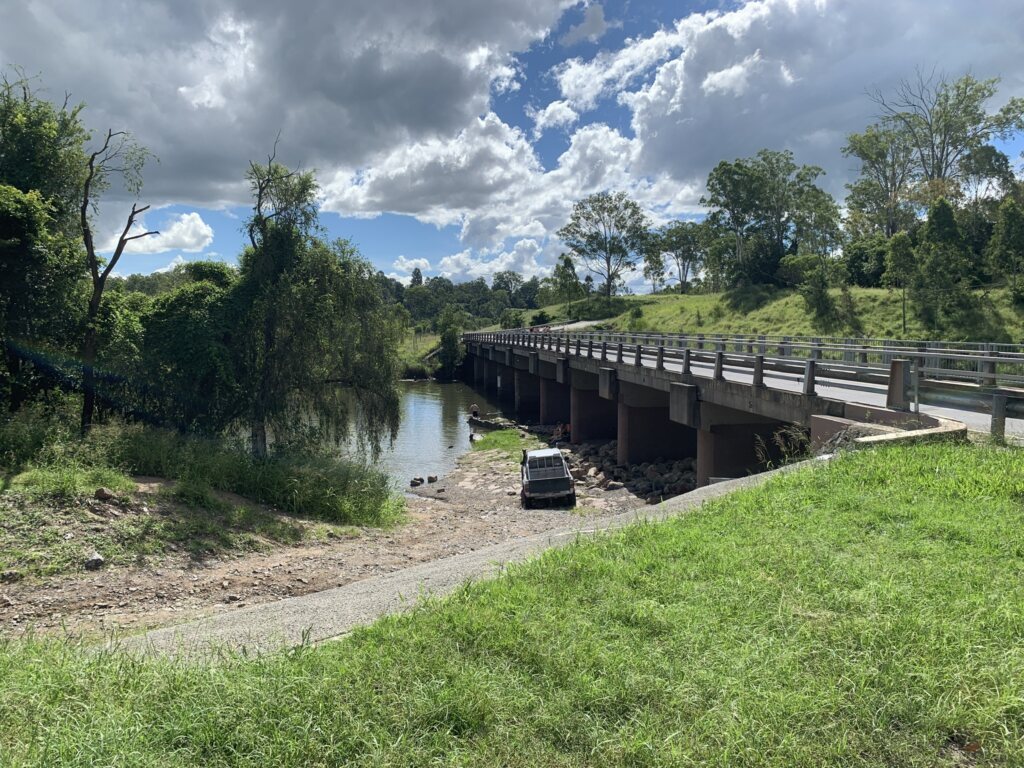
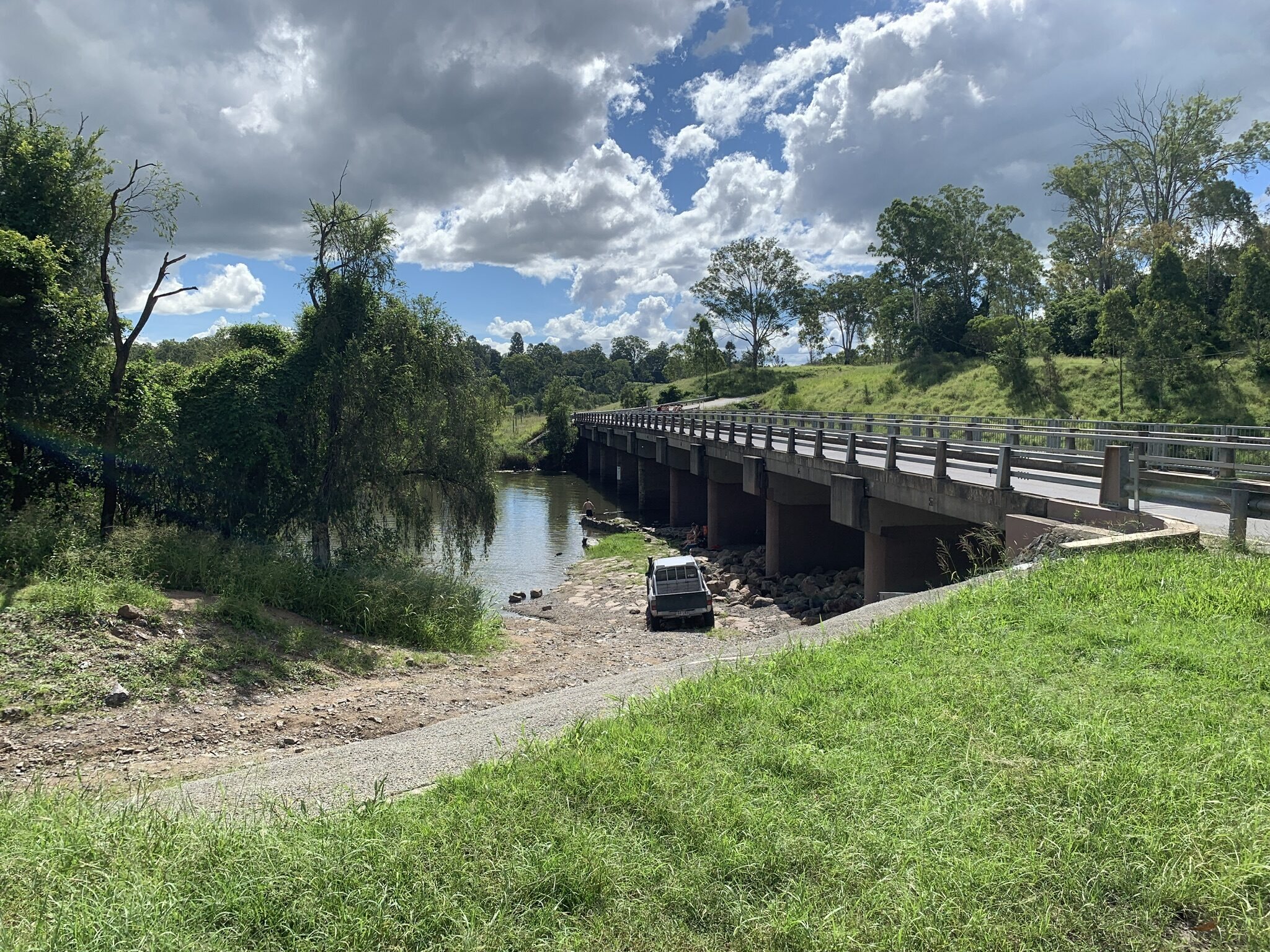
On 30 April 2012 Allison Baden-Clay’s body was found lying on its side on an embankment under the Kholo Creek road bridge at Mount Crosby. The bridge is 13 kilometres by road from the house. The body was below the high tide mark. It could not be seen from the bridge, which stood about 14 metres above. She was clothed in a blue or purple singlet, dark three quarter length pants, socks, and shoes. A jumper lay around her neck, mostly inside out. None of the clothing was damaged. The High Court’s account of the same finding adds that the singlet had a bra built into it, and that the shoes were sneakers. The eldest daughter thought that, while her mother was watching television, she had been in a sloppy jacket and pyjama pants. The missing walking clothes her husband described to police were a grey singlet and three quarter length pants. What she was last remembered wearing, what he said was missing, and what was on the body are not the same list.
Leaves of several kinds were on and about the body. A botanist identified four species he could find in the Baden-Clay garden and not in the immediate vicinity of the place under the bridge: crepe myrtle, cat’s claw creeper, fishbone fern, and lilly pilly. The High Court records leaves from trees of six species that grew at the house, four of which did not grow at the creek. The Court of Appeal names those four and describes how they sat. Some leaves of the cat’s claw, the fern, and the crepe myrtle were tangled in her hair. The crepe myrtle leaves were fallen leaves. The fern was a mix of live and fallen. One cat’s claw leaf looked as if it had been pulled from a living plant. Cat’s claw grew about the carport. Leaf litter from the crepe myrtle and the fern was in the carport and on the patio near the back door. The Court of Appeal thought a jury would have had little hesitation in placing an altercation at the house, most likely outside on the patio, because of those leaves.
Dr Nathan Milne did the post mortem. Decomposition fitted death at some time in the previous eleven days, the stretch since she was last seen alive. The changes in the body fitted its having been put, soon after death, in the position in which it was found. Putrefaction and mummification were far enough along to hide injuries. CT and physical examination showed no fractures. The internal organs showed no abnormality. The carotid arteries were normal. The hyoid bone, in particular, was not fractured and not damaged. There was a probable area of bruising on the lining inside the chest wall. If it was bruising, it was blunt force of a mild degree, because no rib was broken. It could have been something striking the body, or the body striking a surface. Milne could not rule out a change that happened after death. A small chip in one tooth could not be dated, and an odontologist saw no trauma to the hard tissues of the jaw or the teeth. There was no definite injury suggesting a weapon, and no skull fracture.
Milne did not think she died of natural causes. There was no sign of natural disease. He could not say what did kill her. The liver held high levels of sertraline, the drug in Zoloft, and of its metabolite. A blood alcohol reading was .095. He thought alcohol or sertraline toxicity unlikely as the cause, and he could not exclude it. Toxicologists said an overdose of sertraline would be unlikely to kill, and that the alcohol reading might be fermentation from bacteria after death. Professor Olaf Drummer, a forensic pharmacologist and toxicologist, concluded that drugs did not contribute to the death. None of the doctors or psychologists who had treated her held a concern that she was suicidal. If she had fallen from the bridge onto the bank, Milne would have expected fractures. If she fell into the water, there might be no detectable injury. Nothing indicated drowning, but the lungs were too decomposed for him to exclude it, and he could not exclude death from a fall off the bridge. There were no signs suggestive of drowning in the sense the High Court recorded from his evidence.
The Crown case, in the Court of Appeal’s summary, was that he killed her at the Brookfield house, that smothering was a possible mechanism, and that he drove the body to Kholo Creek in her Captiva and left it under the bridge. On the appeal he did not argue that a jury could not find he had killed her. Byrne SJA, sentencing him on the day of the verdict, said the prosecution’s suggestion that he smothered her looked likely, and that whatever the mechanism, the violent attack caused her death. He said the body was taken to Kholo Creek and disposed of in an undignified way: dumped over a ledge, left lying in mud, exposed to the elements, to insects, and to wildlife. The Court of Appeal later said smothering was a reasonable possibility, and also that another possibility, a blow in a struggle and a fall against a hard surface without an intent to cause serious harm, had not been excluded. The High Court held that second possibility was not open on the evidence at all.
The Captiva
A transfer stain over the back wheel arch, found only when the folded seats were put up
The Captiva had three rows of seats. The third could fold down and lengthen the boot. When police first looked, that back row was folded down, with baskets of toys on it. When the seats were raised, a bloodstain sat over the back wheel arch cowling on the driver’s side, with a flow rivulet that gravity had made. It was a transfer stain: blood moved from a person or an object onto the surface. DNA from a swab matched Allison’s profile. Nobody could say how old the stain was, or how much blood had made it. The two older children described the usual seats. Adults in front. Children in the middle row. Neither remembered an injury to their mother that would explain blood in the back. Baden-Clay said he knew of no such injury.
The defence later argued that the jury had to be sure, beyond reasonable doubt, that he left the body at Kholo Creek before they could use that fact to find he killed her, and that they had to be sure the blood was left in the Captiva on the night she disappeared, not on some earlier day in the less than two months they had owned the car. Byrne rejected the first of those as a direction. He told the jury that disposal at the creek tended to prove he had killed her, not that he had murdered her. No one asked him, at trial, for the same direction about the age of the stain. The Court of Appeal agreed with him. Neither finding was an indispensable link. A jury could find he killed her from other facts: she was with him that night, she died about the time she disappeared, the leaves in her hair pointed to the house, the marriage was under strain, the fingernail marks showed a physical altercation, and he lied about those marks in a way that suggested guilt. How the body reached the creek did not have to be settled before that conclusion, though finding that he took it there in the Captiva would reinforce it. It was obvious, the court said, that the stain only mattered if it was left on 19 or 20 April, and it was open to find that it was. There was no other explanation. She did not sit in the back row. No one could recall an injury.
What the jury was told
593 Brookfield Road, a rented house, and a body on the eastern bank with her hands inside the sleeves
Byrne summed up on 9 July 2014. The published summing up is R v Baden-Clay [2014] QSC 154. The charge he read was that on or about 19 April 2012, at Brisbane, Gerard Robert Baden-Clay murdered Allison June Baden-Clay. He said he was not guilty. The jury had viewed the house and the area near the bridge. Byrne told them the use of that view was limited. The house, he said the evidence disclosed, was a rented house at 593 Brookfield Road, Brookfield, where she lived with him and their three children. The shortest road to the Kholo Creek bridge is about 13 kilometres. Depending on traffic, the drive takes about thirteen to twenty minutes.
The body was lying in soft, waterlogged mud on the eastern bank, underneath the bridge, on the right side, facing the bank. The hands and arms were up in front of the head. She was wearing three quarter length or tracksuit pants, socks, white sneakers, a singlet, a bra, underwear, and a jumper. The jumper was wrapped around her neck, with her hands inside the sleeves, and most of it was inside out. Two rings were on the wedding ring finger. The High Court’s shorter list, three quarter length pants, socks, sneakers, and a singlet with a bra built into it, is the same finding described with less of the clothing. The summing up separates the singlet, the bra, and the underwear, and puts her hands in the sleeves. There was no sign of sexual assault. There was no injury to the hands. The fingernails were detached. Four of them were found inside the jumper. There was no bone fracture, including the hyoid, and no haemorrhage around the hyoid. The probable injury on the lining of the left front of the chest wall was associated with ribs four, five, and six. It was probably a bruise. Decomposition meant a change after death could not be excluded. A fairly small fracture of the lower left eye tooth had taken a portion of the tooth. It could not be aged. There was no trauma to the teeth or the hard tissues of the jaw, and no other abnormality. Nothing suggested the body had brushed sticks, rocks, or other objects in moving water. Milne’s assessment of what he saw where she was found was that it was not a natural death. Impact with a rock, with force, could have caused the chest injury. If she had fallen the 14 metres from the bridge to where she lay, he would have expected fractures. There were none. A fall into a depth of water might leave nothing detectable, and a fall from a height could not be excluded. The jumper could have been moved before or after death. Tidal movement, if the body had been in the water, could have put it where it was found.
Martin Giles, a hydraulic engineer, used flood and flow levels, rainfall, catchment data, and his own look at the bridge. He concluded the water would not have been enough to move a body from somewhere else to that spot under the bridge. The tide, against the ground where she lay, was of the order of 100 millimetres at most. He said it was impossible to imagine that the depth of flow he calculated could have carried a body in. Dr James Wallman, a forensic entomologist since the early 1990s, was given insects collected on the afternoon of 30 April. What he saw could fit her having been dead for eleven days. He could not say whether the body had been under water, or for how long. Dr Jacob John, a retired professor who kept a diatom collection made over forty years, was given creek water, a piece of her bone with the marrow intact, and liver. Diatoms are microscopic algae, mostly silica, so they do not rot. In a typical drowning, he said, a person swallows a great deal of water. It rushes into the lungs, ruptures the tissue, and can be carried to the liver, the kidney, and the bone marrow, and stay there. He found no diatoms in the liver or the marrow. That is not what he would have expected if she had drowned. Milne, for his part, said the absence of diatoms does not exclude drowning, given the decomposition, and that he could not exclude the body having been in the water. The prosecutor, Mr Fuller, later asked the jury to be persuaded she did not drown, and to treat Giles’s volumes as too small to have lifted the body out of the creek to where she was found. The defence asked them to remember that Milne could not exclude drowning. Both submissions are in the summing up. The findings of Giles and John are evidence. The exclusion Milne refused to make is also evidence.
Amanda Reeves, a forensic scientist, tested the nails. From the right hand, one incomplete DNA profile was unsuitable for a meaningful comparison, and the other samples failed. From the left hand, five fingernails were swabbed. One swab showed very low indications of a possible second contributor, below the laboratory’s reporting threshold, so there might have been no second person at all. Scrapings from his own fingernails produced his profile, with the same kind of indication below the threshold. The swab from the Captiva matched her profile. Reeves said DNA breaks down with time, storage, and weather, and that decomposition produces chemicals that interfere with seeing a profile. A foreign profile that cannot be reported is not an identification of him on her nails, and it is not a finding that nobody else was there.
Dr Gordon Guymer, director of the Queensland Herbarium, a botanist since 1980, identified six species on the plant material. Four had been tangled in the hair: crepe myrtle, cat’s claw creeper, fishbone fern, and eucalypt. The other two, on or near the body but not in the hair, were lilly pilly and Chinese elm. The crepe myrtle in the hair was fallen leaf. One cat’s claw leaf had been pulled from a living plant after the claw caught on something. He could not say whether the other three cat’s claw leaves were still on the vine or already loose. Some of the fishbone fern was fallen and some may have been fresh. The eucalypt was fallen. On 13 July 2012 he surveyed the bridge. Chinese elm was there, and eucalypts in the distance. Those were the only two of the six at that place. At 593 Brookfield Road the same day’s survey found crepe myrtle, cat’s claw, fishbone fern, and lilly pilly. At the back of the house were the fern, the crepe myrtle, the creeper, a Chinese elm, and a eucalyptus not far from the boundary. He then walked the roads, Brookfield Road for 800 metres from the house, then Rafting Ground Road, Moggill Road, and Mt Crosby Road to the bridge, 13.6 kilometres. Crepe myrtle grew at one address on Rafting Ground Road and at five addresses on Moggill Road. He saw one patch of cat’s claw on Moggill Road, at Pinjarra Hills, in bush along a fence. Fishbone fern was at 36 Boscombe Road, along Rafting Ground Road, and in clumps between those places. In the 800 metres of Brookfield Road he saw no cat’s claw and no lilly pilly. The leaves are not a private signature of one garden. Four of the six were at the house. Two of the six were also at the creek. Crepe myrtle and fishbone fern grew at other addresses on the way.
On the sertraline, the summing up goes past Drummer’s conclusion that the drugs did not contribute. He had worked on the effects of drugs and poisons for more than twenty five years. The therapeutic range he described ran from a starting dose of 50 milligrams to 200 milligrams a day. Asked if sertraline is toxic, he said not particularly. No records he had considered showed an overdose of sertraline by itself causing death. A reading of .095 alcohol can be produced by fermentation when a body lies out for days. Dr Robertson accepted there had not been a recent ingestion of a large amount. Because of decomposition it was, he said, absolutely possible that there was no sertraline in the stomach at death. She had used the drug since 2003 and would have a tolerance. It is a drug of low toxicity, not often reported in deaths by itself. The levels in the blood were not consistent with the majority of sertraline related deaths. The levels in the liver were not what he would expect after an acute overdose. The lack of a significant amount in the stomach made an acute dose, and death soon after swallowing it, unlikely. He also said people on antidepressant medication have a higher risk of suicide, and that suicidal thoughts are a possible effect of this class of drug, more an issue in the first four or five weeks after starting. She was years past that window. Ms Ritchie, the counsellor, was left with the impression, when depression was mentioned, that it was well managed and not an issue, though she asked no specific questions and has no medical or psychological qualification. He told police the depression was in the past and pretty well managed by her medication.
His evidence of the evening, as Byrne reminded the jury of it, is more particular than the ten o’clock bedtime. At 3:45 p.m. he had a parent and teacher interview with Sarah’s teacher. His parents collected the children and he joined them for dinner at his parents’ place. When he got home with the girls, Allison was already there. He gave her his phone. He saw it again that evening when she handed it back so he could read texts. The girls went to bed about 7:00 or 7:30. He and Allison sat on the couch. They talked about the day, the cross country, the interview, and a sleepover planned for the next evening. She asked what had happened on McHugh’s birthdays. He said he could not remember. She asked whether he regretted the whole thing or just being caught. He said he had appreciated her strength and her forgiveness, and that he was very remorseful. The mood, he said, was perfectly normal, certainly civilised. She was in her pyjamas. He did not see her in anything else that night. He went to bed around 10, in a T shirt and old boxer shorts. He said he did not put the phone on the charger at 1:48 a.m. He could not say whether she came to the bed. He woke a bit after 6. He was a very heavy sleeper. She was not there. He went to the toilet and checked email. He was rushing. He started to shave with his normal razor, quite old and blunt. He heard Sarah make a noise. That, he said, was when he cut himself. He showed the jury a stroke down the face and then a flick up. On a second pass he released the razor early so he would not cut the same place. He cut himself again, showered, and put balm on the cuts. A daughter came through. He asked her to help with a bandaid. It would not stick. He began to worry, and he texted and called. She almost always took her phone when she walked. He could not recall a time she did not. He spoke to his parents, who came to the house. While his father looked after the girls he drove the streets in the Captiva, about twenty minutes, perhaps half an hour. He called 000 and went home to the police. He let them search. He said he had nothing to hide. A lawyer advised him not to give a formal statement.
The children, in the evidence the summing up recites, did not fill the night with noise. In a second interview in June, Sarah recalled no car noises. Ella had heard no loud talking between her parents, ever. Hannah’s evidence was that her mother was in pyjamas on the night of the 19th, which matches what he said, and the body was found in different clothes and in walking shoes. Mr Byrne, for the defence, asked the jury which prosecution theory they were being offered. That he killed her that night and then dressed her in the clothes she was found in. Or that he killed her after she had got into walking clothes, perhaps the next morning. He said neither could justify a murder conviction. Why did the children hear nothing. Why was there no blood in the house if a body was carried or dragged through foliage and put in the Captiva. On the prosecution case, he argued, she had apparently bled only in the car, and that stain was not frankly red, could not be aged, and had been mistaken for a drink stain. If leaves stuck to the body and were still there ten days later, why were there no leaves in the Captiva. How did the car leave and come back, perhaps as long as forty minutes, without the three girls noticing. At the creek, on that argument, he would have had to stop near the bridge, get the body through grass and mud, climb back up, drive home, and park in the carport, with no mud left in the car. Constable Huth had gone down the side of the bridge on 30 April. Mr Fuller, for the Crown, said there was a bit of a track, that another officer, Vernados, had not fallen walking down, and that the place fitted a body rolled or pushed off the ledge above. She had no identification, no money, and no phone. The chest bruise and the chipped tooth, he said, fitted a struggle. The jury convicted of murder. The Court of Appeal later held they could not be sure of the intent. The High Court held they could.
The cheek
Three orange abrasions that looked like fingernails, and smaller red scratches he said were the razor
Photographs of his face were taken at 1 p.m. on 20 April and at 1:22 p.m. on 21 April. On the right cheek is a set of abrasions the Court of Appeal describes as orange. The one on the left side of the cheek, as you look at the photograph, is about 27 millimetres long, slightly curved at the bottom, about two millimetres wide. On the right side two abrasions run vertically, one under the other, separated by a millimetre or so. The higher of those is perhaps 3.5 millimetres at its widest. Below them, and to the left of the first abrasion, is a set of small scratches with small red spots of dried blood, perhaps five or six millimetres long. Dr Griffiths, who examined him at 7:15 p.m. on 22 April, saw two abrasions about a centimetre apart. The one on the left was about 25 millimetres long and about 2.5 millimetres wide. The one on the right had a slight curve and was about four millimetres wide. He did not recall the small red scratches. A footnote in the appeal says that wider mark is the pair of vertical abrasions separated by a millimetre, seen as one wound by the time he looked.
On 21 April, on legal advice, he saw two general practitioners and told both that a blunt razor, used in a hurry, had made the marks. Dr Beaven saw three superficial abrasions that looked fairly recent. She asked why he had not noticed he was bleeding, and in how many motions. He said one, then that it must have been a couple, and that he had not noticed the blood because he was rushing. Dr Kumar saw two marks, one four centimetres long and half a centimetre wide, the other two centimetres long and half a centimetre wide. She thought they seemed wide for a razor, and that a rush shave could still have done it. She also noted a superficial scratch on the left side of his neck and marks on the chest near the right shoulder. He said a caterpillar had landed on his neck at a school cross country that morning, the 19th, and that he had scratched the itch. He showed her how. She was satisfied he had made those marks himself. People who had been at the race confirmed he complained of a bite and of itching. Dr Griffiths thought the neck marks were from human fingers, the armpit might be a backpack strap, and the chest abrasion could be fabric forced against the skin. He thought the cheek wounds were abrasions, not cuts, irregular and broad, and that they resembled fingernail scratches.
Three experts worked from the photographs. Dr Stark, a forensic physician, said the orange abrasions were made within a day or so of the 20 April photograph, from contact with a rough surface, typical of fingernails, though she would not say so as a certainty. They were not typical of even a blunt razor, which ought to leave a finer abrasion, and she could not completely exclude a razor. A person who nicks himself does not ordinarily keep going and make abrasions of that width. The redder scratches looked different enough to suggest maybe two sets, at different times. Yellowing of the orange marks was some sign of healing, so the red scratches were slightly later. The red scratches were more consistent with a razor. In re examination she said a fingernail could possibly have made them too. Dr Hoskins thought the orange marks characteristic of fingernails: ragged, about the expected size, roughly parallel. A razor was extremely implausible. The smaller marks were more scratches than abrasions and could be a blade. Fresher dried blood on one scratch, against drier browner scab on the abrasions, suggested the abrasions came first. He put the abrasions at probably six to twenty four hours before the 20 April photograph, and the scratches at less than six hours, because of the darker blood. In cross examination he could not say with certainty that they were separate, or that the abrasions were earlier. Ageing injuries, he accepted, is not a precise science. Professor Wells saw blunt trauma from a roughened surface that had taken skin off. Fingernails, or an animal’s claw, came to mind. He could not reconcile those marks with the razor. The smaller wounds could be a blade or the same implement. He would not say whether they were made at the same time. Shaving cuts, he said, sit around the protuberances of the skin and are finer, more incised. Parallel abrasions would mean the blade had been held at the same angle again and again.
On the torso the experts were looser, and the Crown did not use those marks as her blows. Hoskins said two neck marks could be a scratch through clothing, the chest scratches were very superficial and unsurprising if he made them himself, and the right armpit bruising could be a backpack strap pulled up, clothing pulled up and back, or a fingernail through cloth. Wells saw bruising on the left shoulder that could be fingernails dragged through a shirt, chest bruising from a fingernail or blunt force through fabric, and an armpit mark consistent with clothing pulled hard against the skin. The prosecutor’s address treated the facial scratching as the only injury she inflicted. The Court of Appeal said that was not surprising. His explanation of the neck and chest, a bite and then scratching, was supported by the people at the cross country and was acknowledged as possible by the doctors. Having disavowed the torso at trial, the Crown could not point to it on the appeal. The High Court records the same limit in one sentence. Injuries to the torso were examined and were not relied on by the prosecution.
His evidence was that every mark on the face was the razor. He had cut himself repeatedly while shaving and made two fairly long slices. It was put to him that the marks at the bottom, the red scratches, were shaving cuts and the others were not. He said all of them were. The defence case was that the small red scratches were careless razor use, not fingernails. The Court of Appeal said the jury could start from the premise that the orange abrasions were fingernail scratches. That was the preferred view of the three experts who saw the photographs, and of Griffiths, who saw the man. The experts were more equivocal about the red scratches, and that did not matter, because the defence never said the red scratches were anything but a razor. If the jury found two mechanisms, the only timing question was whether the red scratches came later. Stark and Hoskins both thought the look of the marks suggested that. Neither was absolute. The jury could still use their evidence, the photographs, and the colour of the blood, and find on the balance of probabilities that the injuries were separate, made by different means, the red ones later. That finding being open, Byrne was entitled to direct them that if Baden-Clay had tried to disguise the abrasions by putting shaving cuts near them, so as to have an innocent explanation, that conduct could support an inference of guilt of murder or of manslaughter, with the usual warnings, and with the particular warning that they had to consider carefully whether it showed an intent to kill or only an unlawful killing without that intent. A separate Edwards direction, about using the shaving story as a lie if they found it false, was not challenged.
The affair
He told Toni McHugh he would be out of the marriage by 1 July. She did not believe him. Allison thought the affair was over.
He ran a real estate agency. He owed friends about $180,000 borrowed for the business. They were not pressing him. In December 2011 he told Dr Flegg that to keep control of the business he needed to raise $400,000. In early March 2012 he left a message. A friend of Flegg’s called back. He sounded distressed and asked whether Flegg could lend about $300,000. On 11 March Flegg told him there would be no loan. The Crown did not say the killing was planned. It said the pressures might explain violence that was out of character. There was a life insurance policy on Allison. The Crown disavowed any suggestion he killed her to collect it. The High Court said it was unnecessary to say more about that.
The sexual relationship with Toni McHugh began in August 2008, when she started work at the agency. It continued until a friend told Allison in September 2011. McHugh said he regularly spoke of leaving his wife and worried about Allison’s mental health and, through that, the daughters. When Allison found out, he told McHugh it had to end. McHugh did not go back to the job. She tried to contact him and stopped when he did not answer. His evidence was that once Allison knew, he agreed to show commitment by not going out at night without her approval, and by giving her the password to his phone so she could read the texts, the emails, and the call history. In December 2011 he started it again. He asked McHugh to meet. He told her he loved her and wanted to end the marriage. After that there were very short calls and email through an account in another name. They met once more, on a date he could not recall, before the beginning of April 2012. He said he would be out of the marriage by 1 July, and that they should not meet until then. Contact by email and telephone continued. On 3 April he wrote that he had given her a commitment he intended to keep, and that he would be separated by 1 July. She did not believe it. He had promised before and not acted. On 11 April he wrote again that he loved her. In evidence he admitted the love and the 1 July promise, and said he had never loved her. He said it to placate her. He admitted telling her he did not love his wife, and insisted that he did.
On 27 March Allison saw a counsellor, Ms Ritchie. On 16 April he went with her. They talked about the difficulties. He agreed that every second day he would give fifteen minutes to listening to what she felt about the affair. He did not say the affair was still going. Ritchie thought Allison looked hopeful when she left. The High Court’s recital of what he told police is slightly different. He said they had seen a counsellor the previous Monday, who suggested fifteen minutes be set aside each night for Allison to vent and grill him about the affair, which she thought had ended, and that they had had a fifteen minute session the night before she disappeared. Every second day, in the counsellor’s session, and each night, in his account to police, are not the same arrangement. Both are in the judgments.
On 19 April McHugh rang him. She was going to a property management conference the next day. He said his wife and another employee would be there. McHugh was angry. He should tell his wife. It was not fair to either woman that they be in the same room. She wanted his intentions. He said he was thinking of selling the business after he left his wife. He did not agree to see McHugh. In her evidence she said she needed to know what was going to happen. He confirmed the 1 July promise in writing less than three weeks before the disappearance. She thought he was pulling a number out of thin air. She did not believe it at all. The two judgments do not describe the conference call in the same words. The Court of Appeal says he disclosed that his wife and another employee would attend. The High Court says he told her two of his staff were going, and that she inferred one of them would be his wife. On the afternoon of the 19th she became upset. She thought, after the call, that he was taking more of a stand and that something would be different. On 20 April she rang at lunchtime to ask where his wife was. He sounded distressed, said Allison was missing, and that they needed to not communicate and lay low. On 21 April he told her police would want to speak to her and she should tell the truth. While she was with police he rang again and told her to answer yes or no. He asked whether she had told them they were together again. She said yes. The call ended. They met once more. He told her she would have to fall in love with someone else, and that things were not going to be looking good for him. To police, on the morning of the 20th, the affair was a thing that had ended.
What he asked the jury to believe
Four ways she might have died alone. None of them was that he killed her by accident.
He gave evidence. The night of 19 April 2012 he was at home with Allison and the three girls. He went to bed at about 10 p.m. She was watching television in the living room. He woke just after 6 a.m. She was not there. She often walked early. That morning he had to get the children ready and take them to school. He was, in his words, under the pump a little bit, and rushing. He cut himself shaving. He denied that he and Allison were estranged. He hoped the marriage would not break up. The affair, he told police, had ended the year before. In the witness box he admitted the words he had used to Toni McHugh, and he took the meaning out of them. He had told McHugh he loved her. He said he never had, and that he said it to placate her. He had told her he did not love his wife. He insisted that he did. He had told her, during the affair, that he had no relationship with his wife, and that one day he wanted to come to her unconditionally. Between December 2011 and April 2012 they talked about living arrangements. McHugh said he would entertain the talk and never really got practical about anything.
He denied a fight on the evening of 19 April and on the morning of 20 April. He denied killing Allison. He denied leaving the children alone in the house to drive to the bridge. He denied disposing of the body. On his account he was not there when she died, so he could not have been the person who killed her without meaning to. That is the evidence the High Court treated as fatal to the manslaughter hypothesis the Court of Appeal later wrote. A man who swears he had nothing to do with the death is not a man whose evidence raises an accidental blow in a struggle.
Byrne, knowing the Crown case was circumstantial, asked defence counsel to state the reasonable hypotheses consistent with innocence that counsel wanted put in the summing up. Counsel handed up a document with four. Drowning. A fall from a height, causing death, or causing her to drown. Alcohol, or sertraline, or both, in a toxic dose. Serotonin syndrome, leading her to drown or to fall from a height. None of the four is manslaughter. None of them has him in the death at all. In the closing address counsel told the jury there were two possibilities. He murdered her. Or, as he had said in evidence, he expected her to walk back in the door, or to be found, having slipped or hurt herself. Counsel agreed with Byrne that this was a considered tactical position. In the exchange about a fall onto bricks or cement, counsel accepted there was no such suggestion, because there were no fractures of the head. When Byrne asked for a hypothesis consistent with killing her without an intent to kill, counsel’s answer was that, on the prosecution case, death was occasioned unintentionally. That is not the same as asking the jury to find an accidental killing. Manslaughter went to the jury because the Crown had to prove intent. It was not the case the defence ran. The High Court said the directions put fairly the case the accused made, and that no complaint was made in that court that the directions were inadequate. The summing up grounds that had been argued in Queensland, about the razor cuts and about whether the blood and the creek had to be proved beyond reasonable doubt as indispensable links, were rejected by the Court of Appeal and were not in issue in the High Court.
The Crown at trial did not say the killing was planned. Premeditated, in the way the High Court glossed the word, means planned, and that was not the Crown case. The case was that on the night of 19 April he was confronted by what his conduct had built: the long tension with his wife, the tension with McHugh, the late afternoon call, the chance that the affair would be exposed at the conference the next day, and a wife who might not forgive him a second time. In an altercation he killed her, intending to kill her or to cause grievous bodily harm. Both sides, the Crown told the High Court, ran the trial as murder or nothing. No factual story of manslaughter, as distinct from murder, was put by the defence. There was no evidence of a blow, or of a fall in which her head hit a hard surface, during an altercation. His evidence excluded it. A hypothesis with no evidence under it cannot be a reasonable hypothesis that leaves a doubt about intent.
The Court of Appeal had said the financial stress and the affair supplied a context of strain that might end in a confrontation, and did not supply a motive that pointed to murder rather than manslaughter. It said there was no evidence of motive in the sense of a reason to kill. The High Court called that an error. What the jury had, and what that court said the appeal court had not weighed, was more particular. He had promised McHugh he would leave the marriage by 1 July. He could not afford to divorce his wife. The next day the two women might meet, and McHugh might reveal the lies about an affair he had told his wife was over. There was also concealment and lying after the death, which the Court of Appeal did not use when it decided the post offence conduct was neutral. The false denial to police that the affair was ongoing. The instruction to McHugh to lie low and not communicate. The call, while she was with police, asking whether she had told them they were together again, and telling her to answer only yes or no. A jury could treat that anxiety as a sign that, in his mind, the affair and the killing belonged together, and that her death was not an unintended tragedy.
The High Court did not say post offence conduct always proves murder. It said there is no hard rule that concealment and lies are always neutral between murder and manslaughter. The result turns on the evidence and on the issue actually in dispute. It was open to this jury to regard the lengths he went to, hiding the body and hiding his part in the death, as beyond what human experience would expect from a man who knew only that he had killed without meaning to. Even if that conduct were treated as neutral on intent, neutrality alone would not make the Court of Appeal’s hypothesis a hypothesis on the evidence. Looking at the lies by themselves, or the creek by itself, and ignoring the rest, is the piecemeal approach the High Court rejected. The whole of the evidence is weighed together.
One piece of that whole is the absence of a weapon. The jury could take into account that nothing suggested a weapon caused the death, and could judge his intention with that in mind. Killing a person without a weapon is difficult unless the act is driven by a real determination to cause death or grievous bodily harm. That is the High Court’s formulation. It sits beside what the body could and could not show. Milne found a probable bruise on the internal lining of the left front of the chest wall. It was unclear whether the mark was made before death or after. If it was a bruise, it was mild force, because the ribs under it were not broken. There was a chipped tooth and no sign of trauma to the teeth or the hard tissues of the jaw. There were no fractures of the head, which is what a fall onto a hard surface of the kind the Court of Appeal used as its example would be expected to leave, and there were no other fractures. The cause of death remains unknown because of decomposition. The High Court said there were no positive proved facts from which the appeal court’s inference, a blow and a fall without intent to cause serious harm, could be drawn. The orange abrasions were a different fact. Three experts said one set of marks on the right cheek was most likely fingernails, and that a razor was implausible for that set. The second set looked different, fresher, consistent with a razor, particularly if the blade was moved from side to side as it was drawn from front to back, or back to front, across the face. Those two sets are what Byrne was allowed to leave to the jury as a possible disguise. They are not, by themselves, a diagram of how she died.
Suicide and toxicity were the hypotheses the jury was entitled to reject, and both courts treated that rejection as sound. A journey of 13 kilometres to throw herself off the bridge could be rejected as fanciful. Toxicity failed on the expert evidence: Drummer’s conclusion that drugs did not contribute, and the toxicologists’ evidence that a sertraline overdose would be unlikely to kill and that the alcohol reading of .095 might be bacterial fermentation after death. The treating doctors and psychologists had no concern that she was suicidal, though she had suffered depression and had been prescribed medication. The defence document had added serotonin syndrome as a route to drowning or to a fall. The High Court records that it was on the list counsel asked to have put. It does not record a finding that serotonin syndrome was present. What the jury rejected, on the evidence the High Court says they were entitled to reject, was that she died by her own act or by the drugs and the alcohol.
Common ground on the High Court appeal, and the assumption the Court of Appeal proceeded on, was that he killed her. The argument was only about intent. Section 668E(1) of the Criminal Code of Queensland is the provision under which a verdict can be set aside as unreasonable. The High Court said setting aside a jury’s verdict on that ground is a serious step. The jury saw and heard the witnesses, including him. An appeal court that has not seen them is not to narrow, in a hard and fast way, the bounds within which a jury may decide. The question is whether on the whole of the evidence it was open to the jury to be sure. Here, once the accidental blow is put aside as speculation, no other hypothesis of manslaughter and not murder was ever identified at the trial, in the Court of Appeal, or in the High Court. It was open to the jury to conclude that he killed her and that he did so with intent at least to cause grievous bodily harm. It tested credulity too far, the High Court said a jury could find, to suggest that his evident desire to be rid of his wife was fulfilled by her unintended death, as a piece of fortune. That is the comparison the court drew with Plomp, a man whose wish to be free of his wife was not allowed to be explained away as her fortuitous drowning. The comparison is the court’s. It is not a finding that the two deaths happened in the same way.
Two courts
The Court of Appeal said a blow and a fall had not been excluded. The High Court said his own evidence excluded it.
The trial was before Byrne SJA and a jury in the Supreme Court at Brisbane. On 15 July 2014 the jury found him guilty of murdering Allison Baden-Clay on or about 19 April 2012. He appealed. The hearing was 7 August 2015. Holmes CJ, Fraser JA and Gotterson JA gave one judgment on 8 December 2015. M J Copley QC appeared for him. M R Byrne QC and D C Boyle appeared for the Crown. The appeal was allowed. The murder verdict was set aside. A verdict of manslaughter was substituted. Sentence submissions were to be filed by 15 January and 22 January 2016. That resentencing never happened. The High Court intervened.
He did not argue, in that court, that a jury could not find he had unlawfully killed her. He argued they could not be sure of the intent murder requires, an intent to kill or to cause grievous bodily harm. There were no injuries on the body of a kind that showed that intent. No blood and no cleanup in the house. No evidence of violence in the marriage before. The financial pressure in April was no worse than earlier in the year, and the creditors were not pressing. Nothing showed how the fingernail marks were made. She might have scratched him in an angry attack. If he lied about the razor, the lie might have been panic after an unintended death. The hypothesis the court accepted as still open was this. She attacked him and scratched his face. Trying to make her stop, he killed her without meaning to. Afterwards, in panic, he took the body to Kholo Creek hoping it would wash away, and he lied about the marks. Smothering was a reasonable possibility. So was a blow, and death from a fall against a hard surface, without an intent to cause serious harm. While that other possibility stayed open, the jury could not properly have been sure of the intent. The court called the lies and the disposal intractably neutral between murder and manslaughter. There was no motive in the ordinary sense, no statement that he meant to harm her, no blood or disorder at the house, no convincing evidence of noise, and no injury the post mortem could identify as something he had a reason to hide. Decomposition might explain the lack of injury. Guessing that it did was, the court said, impermissible conjecture.
The Crown’s answer was that the pressure could lead to violence out of character, that McHugh was likely to confront Allison the next day, that the marks showed a violent confrontation, and that the lies, the attempt to disguise the scratches, and the disposal of the body could show an intent to kill or to cause grievous bodily harm. The Court of Appeal said strain in a marriage can explain a confrontation and does not point to murder rather than manslaughter. Equivocal post offence conduct can be left to a jury. It cannot, by itself, hold up a finding of intent that nothing else supports. The jury could reject every word he said. Except for the explanation of the scratches, that rejection did not advance the Crown case.
The High Court gave judgment on 31 August 2016, in The Queen v Baden-Clay [2016] HCA 35. French CJ, Kiefel, Bell, Keane and Gordon JJ sat. W Sofronoff QC, D C Boyle and S J Hedge appeared for the Crown. M J Byrne QC and M J Copley QC appeared for Baden-Clay, instructed by Peter Shields Lawyers. The orders are short. The appeal was allowed. Orders 1 and 2 of the Court of Appeal, the orders that allowed his appeal and substituted manslaughter, were set aside. In their place, the appeal to that court was dismissed. The jury’s verdict of guilty of murder stands.
The High Court’s reason is that the hypothesis the Court of Appeal treated as still open was not a hypothesis on the evidence. It was speculation, raised for the first time on appeal. Baden-Clay gave evidence. He denied any fight on the evening of 19 April or the morning of 20 April. He denied killing her. He denied leaving the children alone to go to the bridge. He denied disposing of the body. That evidence is inconsistent with a version in which he killed her unintentionally in a struggle. A jury that rejects his denials does not have to invent a struggle he refused to describe. When Byrne asked defence counsel for a reasonable hypothesis consistent with no intent to kill, counsel said that, on the prosecution case, death was occasioned unintentionally. Byrne said there were no fractures of the head. Counsel agreed. Byrne said there was no suggestion she fell and hit her head on bricks or cement. Counsel said no. Counsel also said it was not the defence contention that the post offence conduct did not tend to prove an intentional killing. Manslaughter was left to the jury only because the Crown had to prove intent. It was not the defence case. The High Court said a jury may take into account that an accused person has given evidence and that the jury has seen him, and may reject every word as a lie. Once his account is rejected, there was no evidence of a struggle in which death was accidental. The lies about the scratches, and the disposal of the body, could be used as showing a consciousness of guilt of murder, not only of a panicked unlawful killing. The post offence conduct was a deliberate and calculated series of acts, not only a reaction in panic. Suicide, by a 13 kilometre journey to throw herself from the bridge, and death by alcohol or drug toxicity, were open to the jury to reject. The first was fanciful. The second failed on the expert evidence.
The two judgments can be read against each other without smoothing them. The Court of Appeal thought a blow and a fall remained a reasonable possibility, and that the lies and the creek could not choose between that possibility and murder. The High Court thought that possibility was never on the evidence, because the man who would have had to be the unintentional killer swore there was no fight, no killing, and no disposal, and his counsel declined the very hypothesis the appeal court later built. The result that stands is the High Court’s. He is guilty of murder.
The sentence
Life, the only penalty the law provided, with 762 days already served
Byrne sentenced him on 15 July 2014, the day the jury returned the verdict. The remarks are R v Baden-Clay [2014] QSC 155. He began with the night. On the night of 19 April 2012, he told him, you murdered your wife, Allison. The killing was not premeditated. It was violent. That night he was under considerable stress. The financial circumstances were, as he had confessed to police, dire. His domestic circumstances were no better. To police on the morning of 20 April the money had been described as pretty tight, and as on the bones of their arse. Dire is the word Byrne used when he passed sentence.
He had resumed the affair with Toni McHugh. He kept telling her he loved her. He led her to understand that he intended to leave Allison and to be with her. That afternoon, Byrne found, he told McHugh that Allison would be at the conference McHugh was to attend in Brisbane the next day. The High Court’s recital of the same call is narrower. He told her two of his staff were going, and she inferred that one would be his wife. Byrne, who had presided at the trial, stated the disclosure as a fact. Allison knew nothing about the resumption. He had deceived her into believing the affair ended in September 2011. If the two women met the next day, Byrne said, the consequences could have been dramatic, and he realised it. His unsuspecting wife was doing her best to maintain the marriage.
A relationship counsellor had devised a plan. It allowed Allison to express her feelings about the affair in a brief session every second day. He had agreed, reluctantly. The first session happened the night before Allison died, and it turned into an interrogation. She remained tormented by the affair. She pressed him for details. On the night she died, Byrne said, she again questioned him about the affair. All the pressures proved too much. The prosecution suggested he smothered her, and that looked likely. Whatever the mechanism, the violent attack caused her death. Her fingernails scratched his face, the act, Byrne said, of a desperate woman struggling for life. Those marks were only consistent with his guilt.
The conduct after the murder, he said, bespoke a profound absence of remorse. He took the body to Kholo Creek and disposed of her in an undignified way, dumping her over a ledge to leave her lying in mud, exposed to the elements, to insects, and to wildlife. Then he put in place, and persisted in, a deception. He used a razor to cut himself near where she had scratched him, trying to disguise the injuries she had inflicted defending herself. He drove around the streets of Brookfield pretending to look for her. He insinuated that mental illness may have led to a drug overdose or to suicide. Besmirching her memory in that way was thoroughly reprehensible. He had no criminal history. He was definitely not of good character. He was given to lies and other deception, so much so that whatever he might say on any application for parole, fifteen years or more hence, would need to be assessed with considerable scepticism. Byrne did not announce a longer period than that. He said the community, acting through the court, denounced the lethal violence. The impacts on Allison’s family had been grave. Their victim impact statements poignantly expressed their pain. He had taken a devoted, loving mother from her three girls and blighted their lives.
Under section 159A of the Penalties and Sentences Act 1992 he declared the 762 days spent in pre sentence custody, from 14 June 2012 until 15 July 2014, to be imprisonment already served under the sentence. The law, he said, provides but one penalty for the crime. He imposed it. Imprisonment for life.
The Court of Appeal’s substitution of manslaughter on 8 December 2015 would have required a different sentence. On 8 January 2016, in R v Baden-Clay [2016] QCA 1, Holmes CJ ordered that submissions on sentence be filed and served if and after the High Court dismissed the Crown’s appeal against the manslaughter substitution. The Crown’s application for special leave was granted on 12 May 2016 by Bell and Gageler JJ. The appeal was heard on 26 July 2016 and the decision was reserved. On 31 August 2016 the murder verdict was restored and the conviction appeal was dismissed. The life sentence imposed on that verdict was never replaced.
A note published with the sentence records two earlier rulings without setting out their text. On 19 December 2013 Douglas J held that the family counsellor was compellable. Section 10E of the Family Law Act 1975, a Commonwealth provision about counselling communications, does not govern admissibility in criminal proceedings. If a public interest privilege existed, the balance favoured compelling her. That is why Ms Ritchie could be called. On 28 February 2014 Applegarth J granted in part an application to exclude some of the forensic pathologist’s evidence about the cause of death, and refused an application to exclude the expert evidence about the scratch marks on his face. The note does not say which sentences of the pathologist were kept out. What Milne was allowed to say, and what the appeal courts later recited, is the evidence set out above. No cause of death. No natural disease. No skull fracture. A probable mild bruise, or a change after death. Drugs that did not, in Drummer’s opinion, contribute.
Timeline
From the agency in 2008 to the High Court in 2016
- August 2008. The sexual relationship with Toni McHugh begins when she starts at his real estate agency.
- September 2011. A friend tells Allison. He tells McHugh the affair has to end. McHugh leaves the job. He gives Allison the password to his phone.
- December 2011. He contacts McHugh and starts the relationship again. He tells Dr Flegg he needs to raise $400,000 to keep the business.
- End of February 2012. The Holden Captiva is bought. The bloodstain is later found in it.
- 11 March 2012. Dr Flegg refuses a loan of about $300,000.
- 27 March 2012. Allison sees the counsellor, Ms Ritchie.
- 3 April and 11 April 2012. He writes to McHugh of the 1 July separation and of love. She does not believe the date.
- 16 April 2012. He attends counselling with Allison and agrees to listen, every second day, for fifteen minutes. He does not say the affair continues.
- 19 April 2012, morning. At a school cross country he complains of a bite and itching. That afternoon McHugh learns Allison will be at the next day’s conference and becomes angry.
- About 8:30 p.m., 19 April. Allison is last spoken to by anyone other than her husband. He says he went to bed at about 10, leaving her watching television.
- 1:48 a.m., 20 April. His phone goes on the charger beside his side of the bed. He says he was asleep. It comes off at 6:18 a.m.
- Just after 6 a.m. He says he woke, she was gone, and he cut himself shaving. At 7:15 a.m. he calls 000. Police are at the house at 8 a.m.
- 20 and 21 April. Photographs of the cheek. He tells Dr Beaven and Dr Kumar the marks are a blunt razor. He tells McHugh to lay low, then to answer police yes or no.
- 22 April, 7:15 p.m. Dr Griffiths examines him and thinks the cheek abrasions look like fingernails.
- 30 April. The body is found under the Kholo Creek bridge, on its side, below the high tide mark.
- 14 June 2012. Pre sentence custody begins. Byrne later declares 762 days, to 15 July 2014, as time served.
- 19 December 2013. Douglas J holds the family counsellor compellable. Section 10E of the Family Law Act 1975 does not govern admissibility in a criminal trial.
- 28 February 2014. Applegarth J refuses to exclude the expert evidence about the scratch marks, and grants in part an application to exclude some of the pathologist’s evidence on cause of death.
- 9 July 2014. Byrne sums up to the jury.
- 15 July 2014. The jury finds him guilty of murder. Byrne sentences him to life the same day and declares 762 days already served.
- 8 December 2015. The Court of Appeal substitutes manslaughter.
- 8 January 2016. Holmes CJ directs that sentence submissions wait on the High Court.
- 12 May 2016. Bell and Gageler JJ grant the Crown special leave.
- 26 July 2016. The High Court hears the appeal and reserves its decision.
- 31 August 2016. The murder verdict is restored. The appeal to the Court of Appeal is dismissed.
Questions
Questions
Was Gerard Baden-Clay convicted of murdering Allison Baden-Clay?
Yes. A jury in the Supreme Court at Brisbane found him guilty of murder on 15 July 2014. On 8 December 2015 the Queensland Court of Appeal set that verdict aside and substituted manslaughter, because it held that an unintentional killing had not been excluded. On 31 August 2016 the High Court of Australia allowed the Crown’s appeal, set aside that substitution, and ordered that his appeal be dismissed. The murder verdict stands.
How did Allison Baden-Clay die?
The cause of death was never established. Decomposition hid injuries. There was no skull fracture, the hyoid was intact, and there was no definite weapon injury. Dr Milne excluded natural disease and thought alcohol and sertraline toxicity unlikely. Professor Drummer concluded that drugs did not contribute. The Crown suggested smothering. Byrne said that looked likely, and that whatever the mechanism, a violent attack caused her death. The Court of Appeal treated a blow and a fall as another possibility. The High Court held that possibility was not open.
What was the sentence?
On 15 July 2014 Byrne SJA sentenced him to life imprisonment on the murder verdict and declared 762 days in custody, from 14 June 2012 to 15 July 2014, as time already served. He spoke of any parole application fifteen years or more later as something to be treated with scepticism. The Court of Appeal’s manslaughter substitution would have required a new sentence. The High Court restored the murder verdict before that happened.
Sources
Sources opened for this account
- The Queen v Baden-Clay [2016] HCA 35, 31 August 2016, French CJ, Kiefel, Bell, Keane and Gordon JJ. https://www4.austlii.edu.au/au/cases/cth/HCA/2016/35.html
- R v Baden-Clay [2015] QCA 265, 8 December 2015, Holmes CJ, Fraser and Gotterson JJA. https://www4.austlii.edu.au/au/cases/qld/QCA/2015/265.html
- R v Baden-Clay [2014] QSC 154, summing up of Byrne SJA, 9 July 2014. https://www.queenslandjudgments.com.au/caselaw/qsc/2014/154
- R v Baden-Clay [2014] QSC 155, sentencing remarks of Byrne SJA, 15 July 2014. https://www.queenslandjudgments.com.au/caselaw/qsc/2014/155